• Skip to main content
  • Skip to primary sidebar
  • Skip to footer

Chimpanzee Sanctuary Northwest

Hope. Love. Home. Sanctuary

  • Our Family
    • The Chimpanzees
    • The Cattle
  • Blog
  • About Us
    • Visiting the Sanctuary
    • Philosophy
      • FAQs
      • Mission, Vision & Goals
      • Privacy Policy
    • The Humans
      • Staff
      • Board of Directors
      • Founder
    • Annual Reports
    • The Future of CSNW
    • CSNW In The News
  • You can help
    • Donate
      • Become a Chimpanzee Pal
      • Sponsor A Day
      • Transfer Stock
      • Be A Produce Patron
      • Be a Bovine Buddy
      • Give from your IRA
      • Personalized Stones
      • Bring Them Home Campaign
    • Leave A Legacy
    • Employment Opportunities
    • Volunteer
    • See Our Wish List
    • Events
  • Resources
    • About Chimpanzees
    • Enrichment Database
    • Advocacy
      • Advocacy Action Center
      • Apes in Entertainment
        • Trainers
        • Role of the AHA
        • Greeting Cards
      • Chimpanzees as Pets
      • Roadside Zoos
      • Chimpanzees in Biomedical Research
      • Conservation
        • African Apes
        • Orangutans
  • Shop
    • Merchandise Store
  • Contact
  • DONATE NOW

primate protection

Jamie’s story

June 10, 2013 by Debbie

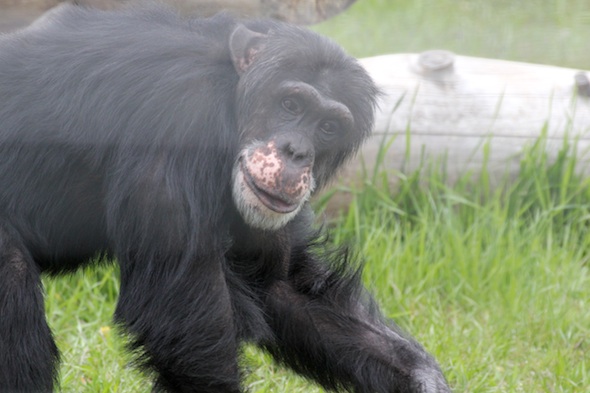
Jamie is probably the smartest primate you’ll ever meet. Her exact birthdate is unknown, but she was likely born in 1977. We celebrate her birthday on Halloween every year – it fits her mischievous personality. Jamie’s early years were spent around humans. She lived with a trainer and was probably used in some form of entertainment. She was clearly exposed to a lot more human-like things than most lab chimpanzees are.

Jamie’s records are really scarce. What we can decipher is that Buckshire likely purchased Jamie in the mid 80s, after she was with a trainer for about nine years. After that, she may have been leased to the Laboratory for Experimental Medicine and Surgery in Primates (LEMSIP) in New York, where she was given the tattoo “#CH522.” She was likely used in hepatitis B vaccine trials, and possibly as a breeder, though we have no records of any offspring.

Jamie’s tattoo on her chest reads “522.” On her first day at CSNW, you could still make it out on her pale skin:
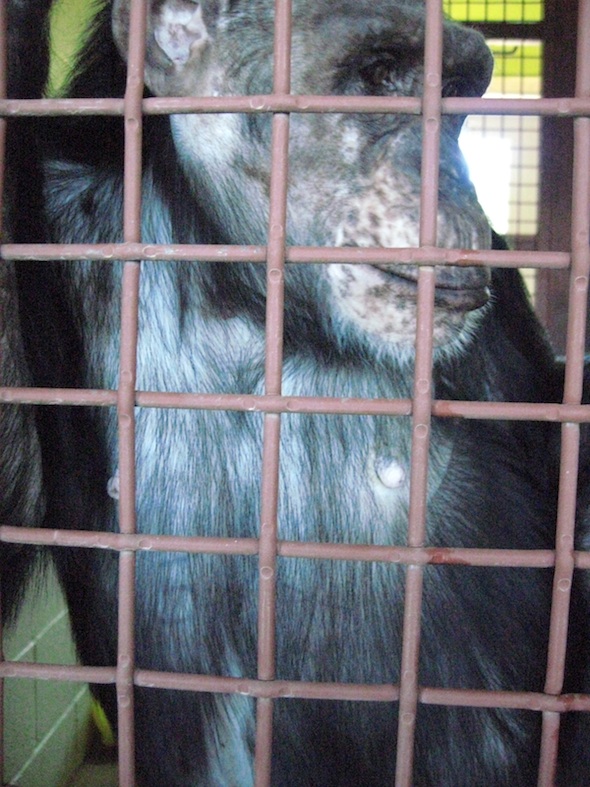
web jamie tattoo early Picture 020

All of the technician notes from Jamie’s physicals including something along the lines of “pulls hair from stomach.” In captivity, and especially in dismal conditions, chimpanzees will develop stereotypic behaviors such as over-grooming by pulling their hair. Diana noted Jamie’s bare belly on their first visit to Buckshire. In the lab, Jamie had very little choices and zero control over her life. She resorted to pulling her hair out due to pure boredom.
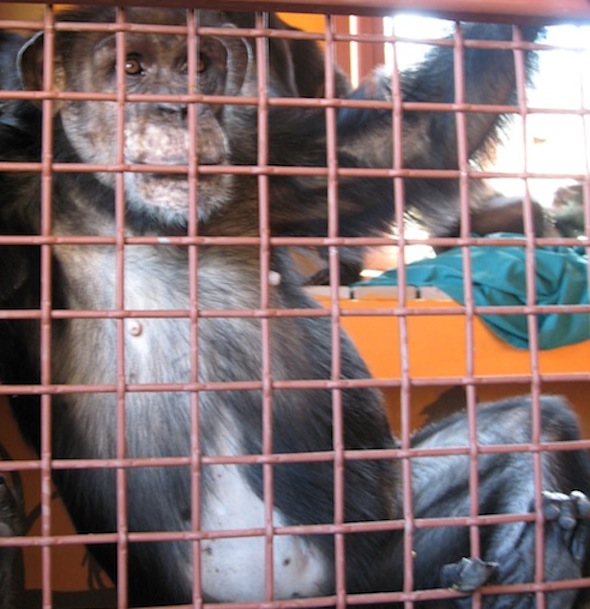
web jamie bare belly early

Unfortunately, Jamie still exhibits this behavior. For the first year she was at the sanctuary, we saw no sign of her hair plucking. Now it varies from no sign at all to a small, bare patch. Though her environment has improved exponentially, the habits that chimpanzees pick up in situations of deprivation often continue even when their environment improves. And no captive situation can provide the rich social, emotional, and mental stimulation that chimpanzees evolved to experience. It is unfair that Jamie has to live in captivity, and we think she knows that.

It’s impossible to imagine Jamie in a small biomedical cage with nothing to keep her mind stimulated, and we’re so happy that we can now provide ways for her to stay active. Whether it’s drawing, putting together tools, taking things apart, working on a tricky project, getting a new boot, or expressing her innate chimpanzee-ness on Young’s Hill, these are all things that she did not have during her decades when she was viewed as a mere tool for biomedical progress.

Jamie enjoying a piece of fruit from her breakfast forage:
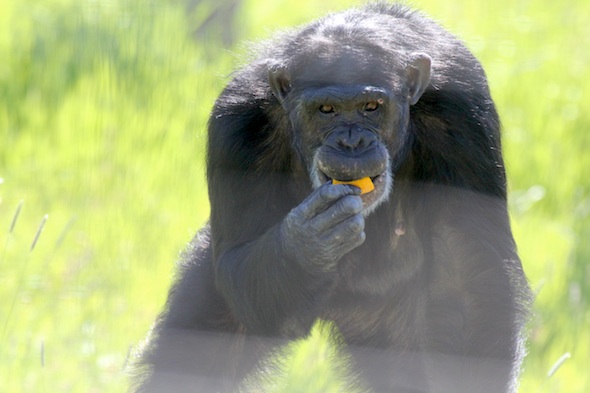
web Jamie stand eat food orange peel look at camera YH (ek) IMG_8958

Jamie and Jody investigating something on the hill:
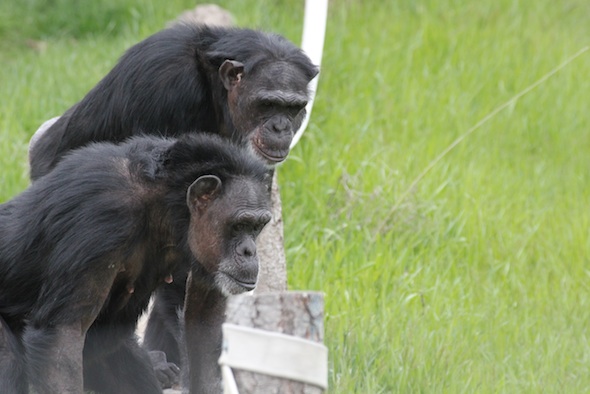
web Jamie Jody search for critter log bridge YH IMG_6791

Jamie, quite content, taking a nap with a boot:
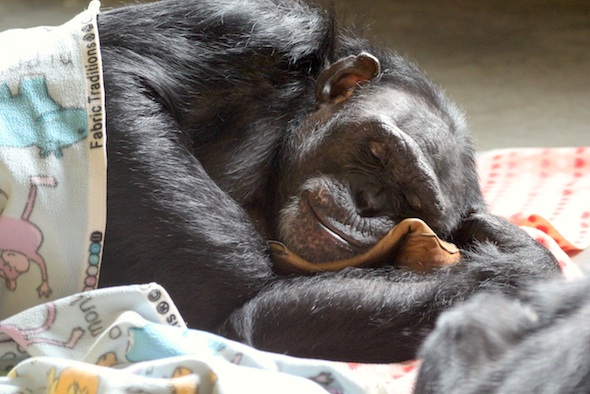
Jamie with her boot

Celebrate the “boss lady” and her amazing new freedom she has in sanctuary. Give Five today and share with your friends!
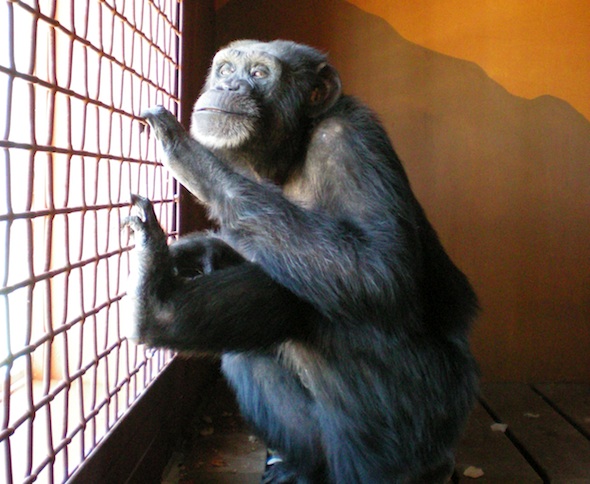
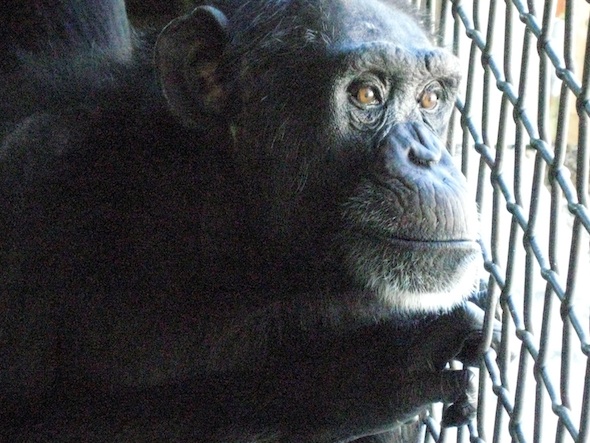
Filed Under: Apes in Entertainment, Chimp histories, Chimpanzees in Biomedical Research, Jamie, Sanctuary Tagged With: advocacy, Animal Welfare, biomedical research, Buckshire, chimpanzee rescue, chimps in entertainment, Cle Elum 7, csnw, Jamie, LEMSIP, pets, primate protection, Sanctuary

Foxie’s story

June 9, 2013 by Debbie

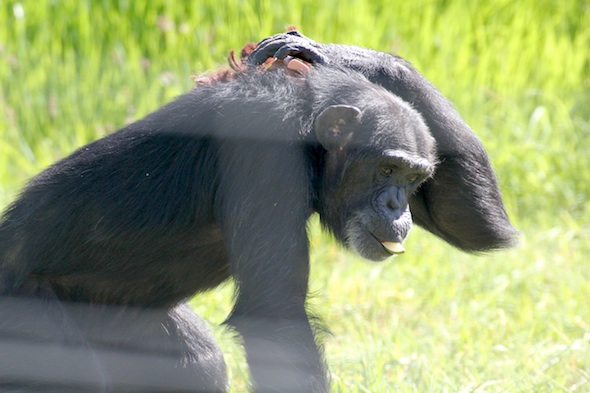
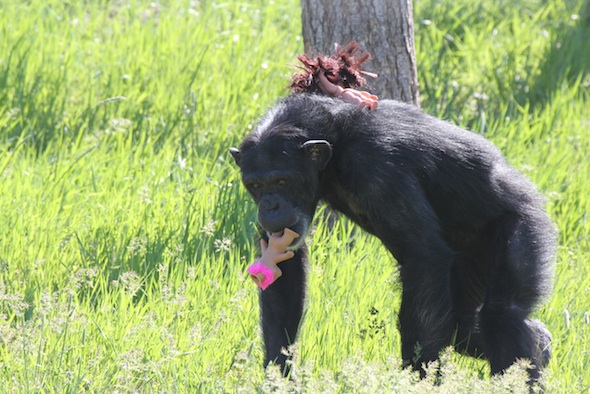
Foxie might be the silliest being I’ve ever met. She truly can brighten anyone’s day with her bouncy head nods and loud laughter—even Jamie—the most serious being I’ve ever met, is entranced with her charm and playfulness. Foxie steals peoples’ hearts with her love of trolls and Dora dolls, especially when she rubs their belly on her own. She’s sweet, kind, and truly resilient. Read what Diana said about Foxie when they first met at Buckshire.

Foxie was born on August 8, 1976 at Southwest Foundation for Biomedical Research in Texas (which became Texas Biomedical Research Institute and still houses chimpanzees for research). Buckshire purchased Foxie in 1983 and then leased her to Michale E. Keeling Center, another biomedical lab also in Texas. She was there for two years before being shipped back to Buckshire in October 1985. We don’t have any records of her early years, just that she was used in hepatitis A vaccine trials. In November 1985, she was shipped down south again to White Sands Research Center in New Mexico. Foxie was known as “#CA0130” at Buckshire and WSRC. At SFBR her tattoo was “#4-051.”

In two years, Foxie moved from one lab to another, back to Buckshire, and then to yet another lab. At WSRC she was used as a breeder. On December 21, 1987, she gave birth to Angie (who now, thankfully, lives at Save the Chimps in Florida) who was taken from her right away. Foxie also gave birth to Kelsey in 1989 and a set of twins, David and Steve. All were taken away from her within days of their births. She left Coulston on August 13, 1996 and remained at Buckshire for the next 12 years.

Foxie is known at CSNW for her love of troll dolls (and also Dora the Explorer dolls). Though it can seem endearing how she loves and hugs her dolls, it’s also a sad reminder that Foxie was never able to keep a baby of her own. She would get knocked down, and wake up with her babies stolen from her. After being traumatized in the lab, Foxie not surprisingly has likely suffered some psychological distress. She doesn’t really nest with blankets like the other chimpanzees do, and she doesn’t care about a lot of other enrichment unless they are her dolls that she adores.

Foxie is extremely forgiving. For all that humans have done to her—shipped her around, injected her with vaccine tests, and stolen her babies—she’s surprisingly very energetic and interactive with the humans. She can make anyone smile with her playful spins and pirouettes. She probably would have made an excellent mother if she’d been given the chance, but at least in sanctuary she is able to take her dolls with her outside, forage for fruit which she loves, and do somersaults and acrobatics that she never had the space to do in the labs she was caged in.

web foxie look out window early FR 4 100_0324

When Foxie first came to CSNW she was curious about the outdoors, which she’d never really experienced before.

web foxie look out barn doors curious early Picture 031

Now, Foxie confidently takes her precious dolls with her on adventures around Young’s Hill.

web Foxie walk put dora on back fruit in mouth forage YH (ek) IMG_9106

web Foxie walk YH troll in mouth dora on back IMG_7656

Give Five today to keep Foxie’s belly full of delicious fruit smoothies! (her favorite).

Filed Under: Chimp histories, Chimpanzees in Biomedical Research, Foxie, Sanctuary Tagged With: advocacy, angie, Animal Welfare, biomedical research, Buckshire, chimpanzee rescue, Cle Elum 7, coulston foundation, csnw, Foxie, primate protection, Sanctuary, save the chimps, white sands research center

Burrito’s story

June 8, 2013 by Debbie

Burrito is super goofy. He is often sweet and playful with caregivers – he likes to play chase and tug-of-war (though he does also have other sides to his personality). Seeing him play with his friend Foxie is one of the greatest sites to behold. He’s even goofy when he’s found a toy he decides to play with on his own.

Before the chimpanzees came to the sanctuary, Keith, J.B., Sarah, and Diana all met them while they were still in the basement at Buckshire. Read Diana’s first impressions of Burrito from January, 2008.

It’s easy to forget about Burrito’s past when he’s being happy and goofy, and we hope that he doesn’t think about it much either.

Burrito was born at White Sands Research Center on January 6, 1983. His father Mack was the father to many chimpanzees born within the laboratory.  At birth, Burrito was immediately taken from his mother, Karen, and placed in the “nursery” at White Sands. He was named “WSRC #67 – Raj” and was used in hepatitis B vaccine safety trials beginning in December 1984, when he not even two years old.

Burrito never had a chance to truly be a chimpanzee before coming to the sanctuary.

On August 1, 1986 Raj was shipped to the Buckshire Corporation in Pennsylvania. He lived as a “house chimp” until February 1987 when his named was changed to Burrito, and he was then leased to an “animal act” with Jungle Larry until February 1988. Then he returned to Buckshire.

We don’t have any records for Burrito beyond that point, so it’s possible that he stayed at Buckshire for the next 20 years. Burrito’s early days were absolutely deprived of the nurturing care and attention chimpanzees need from their mothers to learn the skills to make it in the world. It’s not surprising at all that Burrito never really learned how to be a chimpanzee. At CSNW, the first time he swung across the posts in the outdoor area was so moving. Burrito can now, finally, be a chimpanzee. Watch this video of Burrito brachiating.

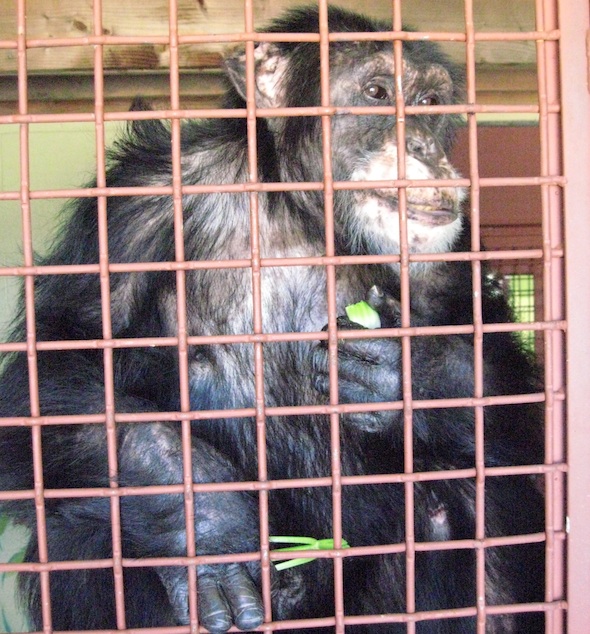
Burrito, just a few days after arriving at CSNW:

web burrito eat celery FR caging early Picture 009

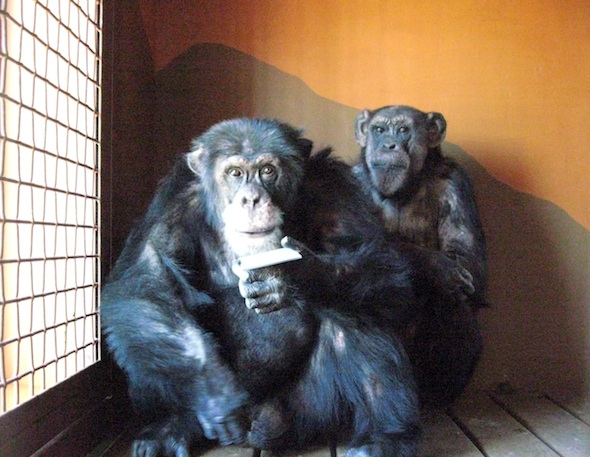
Burrito and Jody in June 2008:

web burrito with mirror jody in back FR 4

Burrito has not always displayed the greatest confidence, especially with new things, but with every day that goes by, Burrito confidence grows and his bravery increases. After all Burrito has gone through, our hearts fill with so much pride when we see him displaying his “chimpanzee-ness” like he should have always been free to do.

Burrito on Young’s Hill:

web Burrito walk face camera Young's Hill YH IMG_6664

Burrito with Jody, nearly five years in sanctuary:

web cropped cabin burrito jody

Celebrate Burrito’s five years in sanctuary: Give Five today!

Filed Under: Apes in Entertainment, Burrito, Chimp histories, Chimpanzees in Biomedical Research, Jody, Sanctuary Tagged With: advocacy, Animal Welfare, biomedical research, Buckshire, Burrito, chimpanzee rescue, chimps in entertainment, Cle Elum 7, coulston foundation, csnw, primate protection, Sanctuary, white sands research center

Annie’s story

June 7, 2013 by Debbie

Leading up to the five year anniversary next week, we wanted to share the stories of each chimpanzee before they came to CSNW. Annie, Burrito, Foxie, Jamie, Jody, Missy, and Negra all were housed in a windowless basement at the Buckshire Corporation in Pennsylvania before they were rescued in June 2008. Buckshire leased their chimps primarily to two laboratories: White Sands Research Center (which later became the infamous Coulston Foundation) in New Mexico, and the Laboratory for Experimental Medicine and Surgery in Primates (otherwise known as LEMSIP) in New York.

Through their decades in research, the chimpanzees were routinely anesthetized, or “knocked down,” for physical exams and to be injected with vaccines or provide blood samples for research. After giving birth to infants, they were anesthetized and their babies were removed from them and taken to a nursery where they would become the next generation of research chimpanzees.

Today, the chimpanzees no longer have to live in fear of being injected with vaccines or undergo invasive exams, they no longer have to sleep in 5 x 5 x 7 foot cages with slatted bars for a floor, and they no longer have to be alone. Now they have the feeling of sun on their backs when on Young’s Hill, they have the choice of what to play with or who to interact with, they get really healthy and delicious fresh fruit and veggies, and they can relax. CSNW has given them what they deserve, a peaceful and comfortable retirement.

Today, we’ll share Annie’s story:

We don’t know a lot about Annie’s infancy. She was reportedly captured from the wild to be used in research and it’s estimated that she was born in 1974. Buckshire purchase Annie from a private breeder and leased her out to White Sands Research Center where she was used in hepatitis vaccine research and also used as a breeder. Records indicate that she arrived at White Sands in late 1981. Ten days after her arrival to White Sands, she was knocked down to have her blood drawn and get a new tattoo—“WSRC #33.” A couple months later she was transferred to her first breeding cage.

Annie would have been a youngster, a merely seven years old when she was forced to breed. She was transferred back and forth for nearly two years and bred with at least seven different males—David, Max, Panchito, Rufus, Mack, Chuck, and Cheetah. In June 1983, she gave birth to her first infant, Tobias, who was immediately removed and taken to the nursery.

6/22/83 – Delivered infant male #78 Tobias, appears healthy – removed to nursery.

In the wild, chimpanzee mothers will nurse their babies for the first four or five years. Just like humans, their bond is incredibly strong. But in the lab, babies were immediately taken away from their mothers and never allowed to make that bond. Annie was never able to truly be a mother, and was instead transferred countless times between even more male breeding partners.

Over the next decade, Annie gave birth to five more babies—Abby, Brooke, Virgil, Mariah, and Damian. In the technicians’ reports she was said to be a good mother, observed nursing and cleaning her infants. In most cases, Annie’s infants were stolen from her within days of giving birth. In each case, she was knocked down and the babies were removed and taken to the nursery.

7/24/84 – Delivered healthy infant female #101 Abby. Removed and taken to nursery – infant appears in good health – mother cleaned very well.

9/12/87 – Delivered healthy infant female… mother taking good care of infant, clean and nursing. Infant #CA0168 (Brooke).

Annie got to care for Brooke for almost a whole week: 9/18/87 – Infant female removed and taken to nursery. Stayed on mother since 9/12 – excellent mother… both infant and mother appear in excellent health.

6/23/89 – Infant taken from mother at this time… to the nursery. Infant named Virgil #201.

9/24/91 – Took infant to nursery. Infant was a girl #224 (Mariah).

5/6/94 – Gave birth at approx. 2:20pm. Mother taking good care of baby. Infant is looking good at this time. (Damian #244)

5/7/94 – Animal anesthetized to remove baby… Baby was not holding onto mother or nursing.

After spending over a decade at WSRC (which became the Coulston Foundation), she finally was shipped back to Buckshire in late 1996. For the next 12 years, she stayed at Buckshire, never getting to be a mother to her babies, never getting to make true friends and never getting to really be a chimpanzee. Read what Diana said when she first met Annie (and Missy).

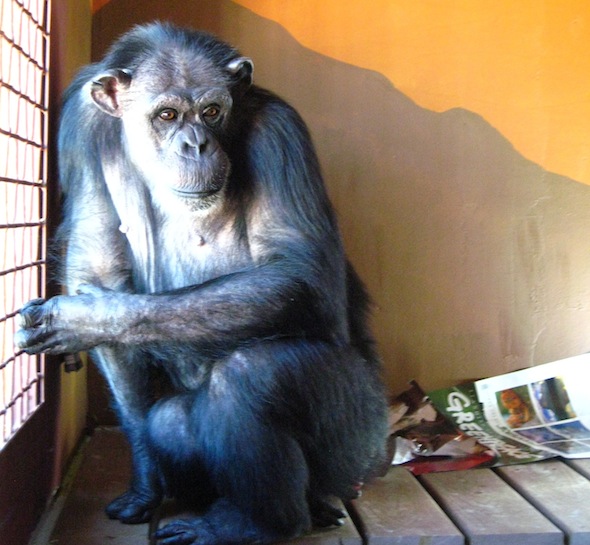
Annie, on her second day in sanctuary:

web Annie sit on FR4 bench second day before

In June 2008, she was rescued by Chimpanzee Sanctuary Northwest and retired to live with the Cle Elum Seven, where she has had access to sun over her head and grass under her feet for probably the first time since she was captured from Africa.

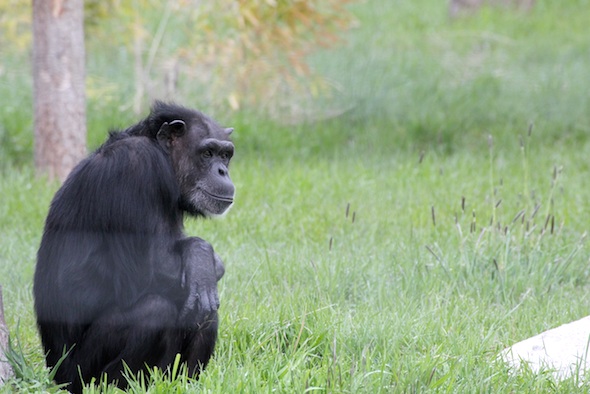
Annie now, on Young’s Hill:

web Annie sit arms crossed next to treat rock YH IMG_6264

web Annie sit next to treat rock arms crossed YH IMG_6267

To honor Annie’s five years in sanctuary, Give Five today to help give her one meal of delicious fresh fruits and veggies. Share with your friends, too!

Filed Under: Annie, Chimp histories, Chimpanzees in Biomedical Research, Sanctuary Tagged With: advocacy, Animal Welfare, Annie, biomedical research, Buckshire, chimpanzee rescue, Cle Elum 7, coulston foundation, csnw, primate protection, Sanctuary, white sands research center

Along the Bushmeat Highway: Part 3

May 26, 2013 by Debbie

This is the third installment of a series of posts from Dr. Cleve Hicks. Cleve did his PhD research in the DRC studying chimps in the Bili Forest. Read Part 1 of this story and Part 2 first! (To add some context to the story, look at the map of the “Bushmeat Highway” here).

—

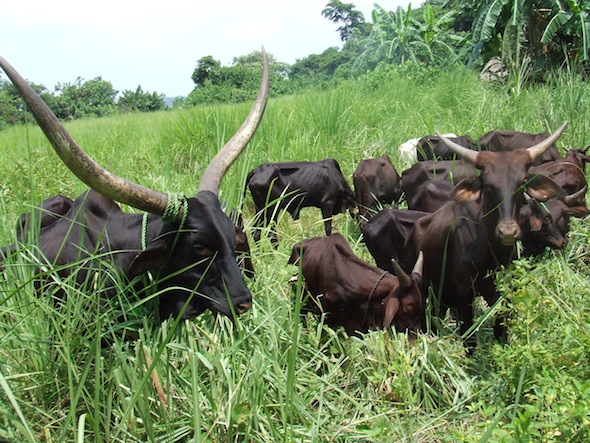
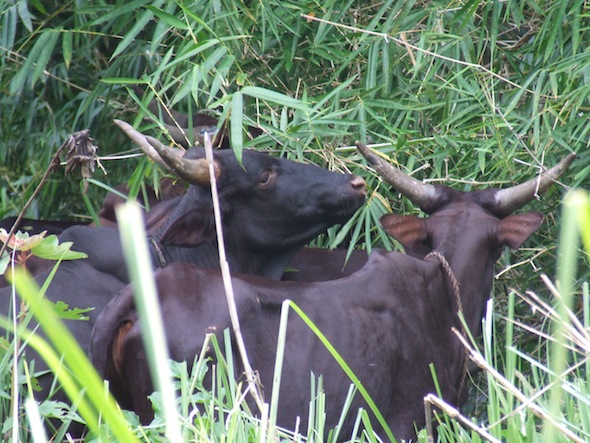
Our stay in Titule was prolonged an extra day due to an illness suffered by one of our Ecoguards. Fortunately we were able to sleep at the house of my old friend Chief Mangay of Lebo. Upon departing from Titule, we veered north towards Bili, crossing the mighty Uele River on pirogues. Villagers on the south bank of the Uele proudly showed us a large eagle they had captured from its nest. On the north bank of the river, we left behind the continuous cover of forest to the south and entered into savannah / forest mosaic territory. This road was, as it had been in 2006, much less heavily trafficked than the roads to the south of the Uele. Not only did we see no monkey or duiker carcasses or monkey orphans, but just to the north of the Uele we got of first glimpse of free-living monkeys in the trees above the road: a black and white colobus and a bit further along a tree-full of chittering red-tailed guenons. Lukuru researchers Ephrem Mpaka and Gilbert Paluku had noticed the same pattern (no monkey or duiker meat) on their trip from Buta to Bili two days earlier. This was encouraging, but there were also signs that times and circumstances were changing. In the north bank riverside town of Lisala, as we stopped to snack on binyes (simple concoctions of flour, sugar, and palm oil), we were confronted with a bustling herd of long-horned cattle, about 15 in number, munching on bamboo and riverside herbs. They were being herded by local Congolese, whom we were told had recently bought them from Mbororo herders to the north. We watched the bovines munch their way through the roadside forest and the lush vegetation lining the Uele River. Are these cattle destined to replace the abundant hippopotamuses that forage under the cover of night along the river’s edge?

MbororCattleUele

A large herd of cattle purchased by local Congolese from Mbororo herders, on the north bank of the Uele River, Lisala.

CattleEatBambo

Cattle feasting on bamboo at the forest edge.

Further to the north, in the shadow of a collapsed bridge across the Api River, we were told by a local man that Mbororo herders were massed just 30 km away from us, with tens of thousands of cattle ready to sweep across the savannahs. In their wake, he claimed, sometimes travelled child soldiers of the dreaded Lord’s Resistance Army (although according to him, the two groups were not friends). Later, as we travelled north, we would hear from a number of Azande that the Mbororo would frequently raid their fields for crops, leading to pitched battles. Such observations reinforced my impression of an inherent contradiction in the policy of the authorities of Northern DRC. Government officials were both sending military to confront Mbororo herders but at the same time buying cattle from them. Where this will lead is impossible to say.

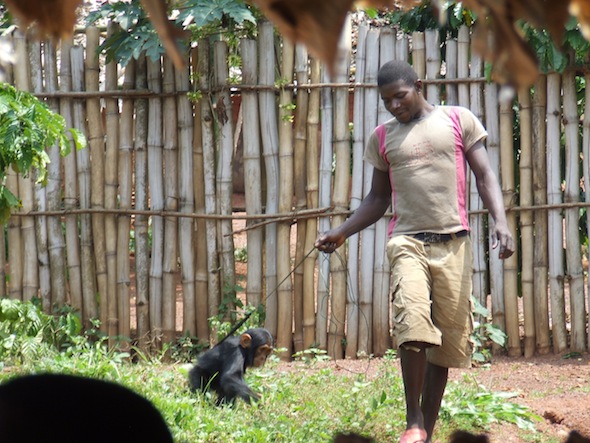
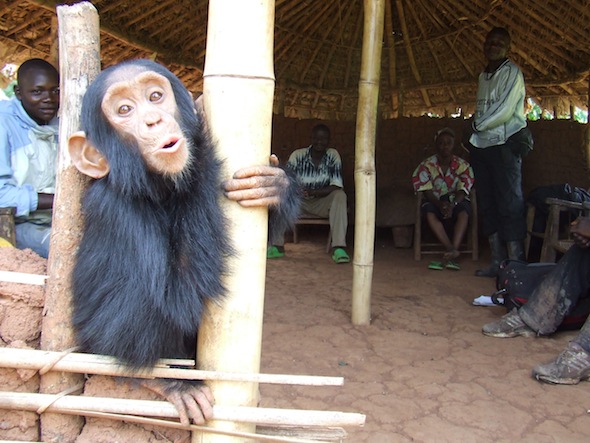
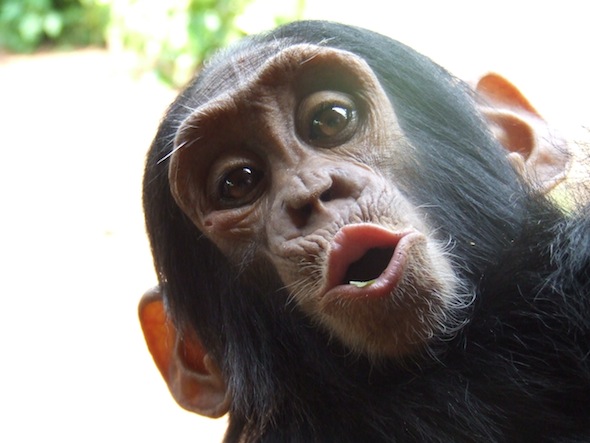
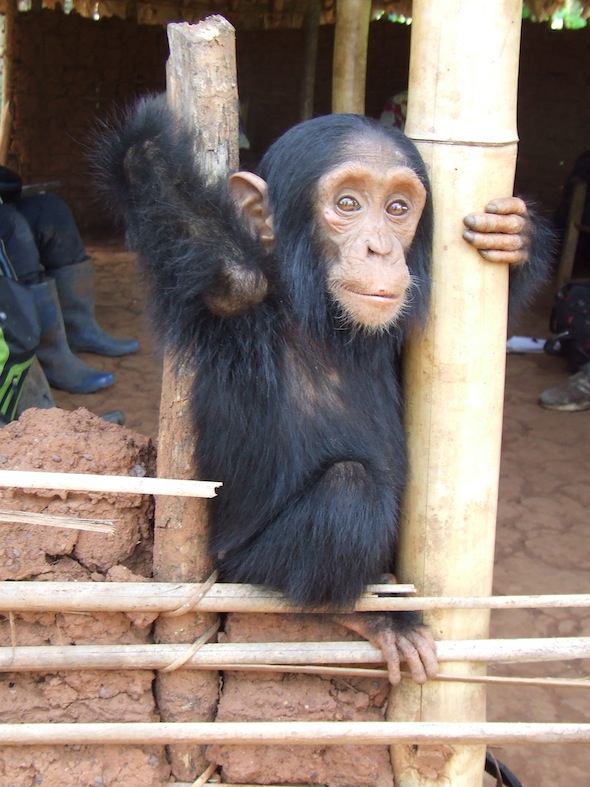
Sadly, although commerce in monkeys and duikers seemed to be much less common in this region, as was the case at Bili 5 years ago, we did hear the distressing news that the traditional chief of Lisala was keeping an orphan chimpanzee at his house about 1 km north of the Uele River. In the past, we had received a number of reports of orphan chimpanzees having been captured from this narrow belt along the north bank of the Uele River. Henri and I paid the chief a visit. Henri carefully explained the ICCN mission and asked the chief if we could see the orphan. He sent someone up to his house, and in a few minutes we heard a shrill, near-human scream. Shortly after, we watched as a tiny infant chimpanzee was dragged down to the paillote on a leash. I readied my camera and began taking photos as the orphan was placed onto a bamboo pole beneath the chief’s paillote.

On my previous mission south of the Uele River I had looked into the desperate eyes of over 35 orphan chimpanzees, but one never really gets used to the shock of it—the unimaginable sense of loss and helplessness registered in those haunted, searching brown eyes. Although in the past we had been able to save a number of the orphans we had encountered on our travels, today there was nothing I could do for Lisala, only photograph him as he raised his eyes skyward and emitted a plaintive pant-hoot to which he will never hear a response.

Henri got the story of Lisala’s capture from the chief: about two months ago, in the forest about a two hours’ walk east from the town, a group of local bow-hunters came across a party of chimpanzees. According to the chief, the apes fled in terror, abandoning the baby for the hunters to capture. This is often the story given, but I find it extremely unlikely that a mother chimpanzee would desert her baby. Far more likely, she was shot for bushmeat, which the chief would not want to admit to the ICCN. Indeed, Lisala had a vivid red bruise on his right brow ridge, possibly acquired when he tumbled out of the trees clutching onto his dying mother.

LisalaOrphan1

LisalaOrphan2

LisalaOrphan3

Lisala the orphan chimpanzee, kept by a traditional chief just north of the Uele River.

The hunters presented the baby as a gift to the chief. Now the chief wanted cigarettes and / or money from us for the privilege of seeing his baby chimpanzee. We politely deferred, of course, and went into our standard speech about the danger of keeping chimpanzees as a pets, and the damage that such a practice inflicts on populations of free-living apes. As we left his parcel, the chief called out after us in Lingala as a parting shot: ‘Ezali mabe te – ey ko batela mboka ya mokondji!’ (It isn’t a bad thing – he will guard the chief’s village!’).

As we sped northwards on our motorbikes, I was left with a heavy heart. There are only a limited number of times that this tragic situation can repeat itself before the African forests will be emptied of our closest evolutionary cousins. We have little time left to come up with a solution.

LisalaOrphan4

What can we do to keep this tragedy from repeating itself over and over again?

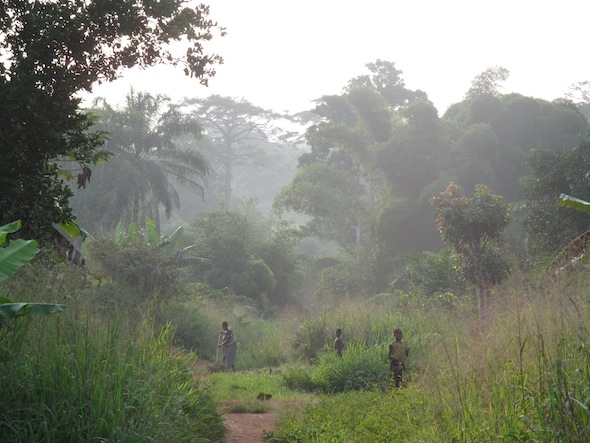
A few hours and a couple of motorbike breakdowns later, near sunset, we crossed into the hinterlands of Bili, 12 km south of the town center. We stopped to stretch our sore backs and munch on some soft pink peanuts offered us by a friendly villager. A tiny and rather brazen kitten approached us and made fast friends with Karsten. We wondered what awaited us in the frontier town just over the horizon. The last time I set foot in Bili was over five years ago. Although at that time bushmeat was certainly consumed locally, there was little evidence that, with the exception of ivory, it had become linked to the commercial trade networks proliferating rapidly to the south. But will the situation remain the same in 2012? We shall see…

BiliWoman

The outskirts of Bili at sunset.

Along the Bushmeat Highway: Part 1
Along the Bushmeat Highway: Part 2

Also by Dr. Cleve Hicks, The FARDC ‘Petting Zoo’ at Bili

This mission was made possible by the generous support of the Max Planck institute for Evolutionary Anthropology, The Lukuru Wildlife Research Foundation, The US Fish and Wildlife Service, l’ Institut Congolais pour la Conservation de la Nature, The Lucie Burgers Foundation, and The African Wildife Foundation.

Filed Under: Advocacy, Free-living chimps Tagged With: advocacy, animal protection, animal rescue, animal rights, Animal Welfare, bushmeat, bushmeat orphans, chimpanzee, Chimpanzee Sanctuary Northwest, dr. cleve hicks, eyes on apes, free-living chimps, primate protection

Upcoming guest bloggers

May 18, 2013 by Debbie

I’m pretty excited to announce that we’re going to be featuring some guest bloggers who work with apes in the wild! Our mission at the sanctuary is to provide quality lifetime care for the Cle Elum Seven, but also to advocate for apes everywhere. If you’re signed up for our Take Action list, you’ve probably received some action alerts from Eyes on Apes before. These are usually for issues that our nonhuman ape cousins face close to home, like the entertainment, pet, and biomedical industries.

Free-living apes are facing a whole different set of issues. In Africa their habitat is slowly being torn down, and the logging roads create access for hunters to easily hunt chimpanzees, gorillas, bonobos, and a whole slew of other exotic animals and sell their meat on the black market (it’s called the bushmeat trade). In Southeast Asia, orangutans are losing much of their habitat to palm oil plantations and other agricultural development.

From afar, there’s only so much detail we can provide—but those who are right there witnessing these issues can paint a very different picture. Our goal is to have them tell their stories, and help us to help our closest living relatives who are literally facing extinction.

We already have folks lined up for this exciting project: Dr. Cleve Hicks (former graduate student at the Chimpanzee and Human Communication Institute just down the road) who is now working with apes in the Bili Forest in central Africa; Dr. Debra Durham who is currently in east Africa and has expertise in both captive and free-living issues (you might remember this article about PTSD in ex-biomedical lab chimps, including Negra); and Dr. Zarin Machanda who met JB and Diana at the Fauna Foundation years ago, and has worked with chimpanzees in east Africa. Stay tuned for these stories with great information coming very soon!

Here’s a photo of Negra, who now gets to have sunshine, friends, and choices after being stolen from Africa and used in biomedical research for decades. Let’s raise awareness about others like Negra still in labs, and for her relatives in Africa that need our help. Share this video and subscribe to the blog if you haven’t already, so you’ll be sure to get notified of the upcoming guest blogger posts!

web Negra green grass Young's Hill YH IMG_8027

—

Guest blog posts:

Resilience and The Landmine Snare by Maureen McCarthy

Along the Bushmeat Highway: Part One, Two, and Three and The FARDC ‘Petting Zoo’ at Bili by Dr. Cleve Hicks

Video interview Part One and Part Two with Dr. Debra Durham (presented as a Take Action Tuesday posts)

Jacky and Nama by Dr. Sheri Speede

Meet the Chimpanzees of Kanyawara and Research at Kanyawara by Dr. Zarin Machanda

Margot and Is successful reintroduction possible? by Dr. Gwendy Reyes-Illg

Why are orangutans endangered in the wild? by Rich Zimmerman

Filed Under: Advocacy, Free-living chimps, Negra, Sanctuary Tagged With: advocacy, africa, african rainforest logging, animal protection, animal rescue, animal rights, Animal Welfare, bushmeat trade, chimpanzee, chimpanzee rescue, chimpanzee retirement, chimpanzee sanctuary, Chimpanzee Sanctuary Northwest, Cle Elum 7, Cle Elum Seven, cleve hicks, csnw, debra durham, eyes on apes, free-living chimps, free-living orangutans, indonesia, malaysia, Negra, orangutan, palm oil, primate protection, primate rescue, Sanctuary, wild chimpanzees, wild orangutans, zarin machanda

Always on the go

May 14, 2013 by Debbie

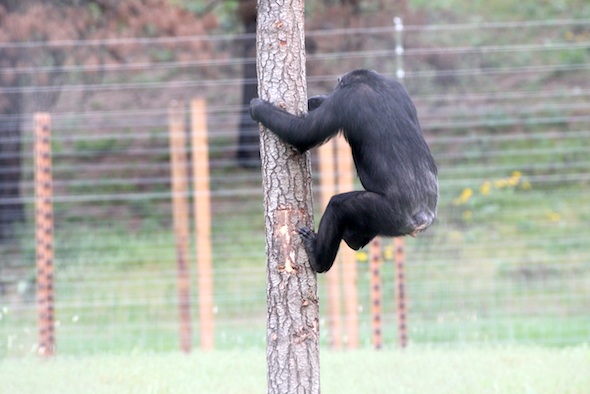
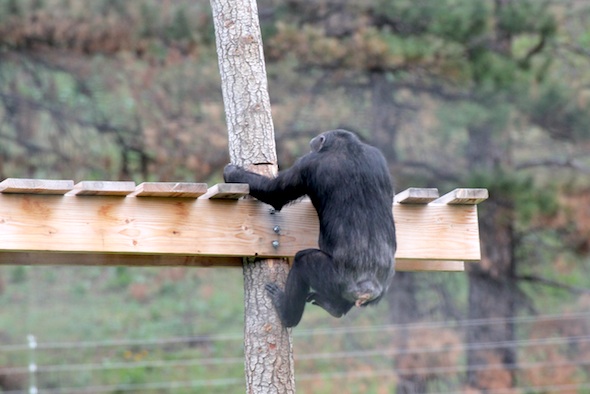
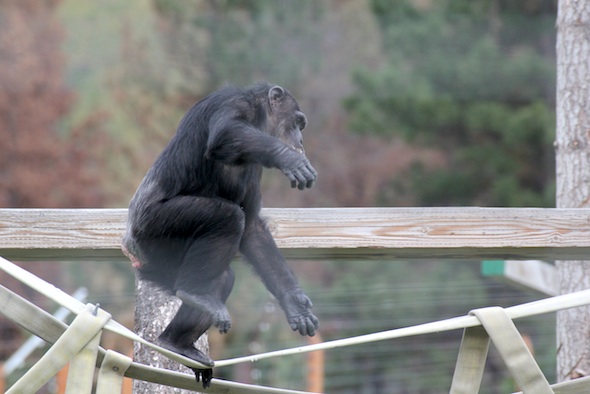
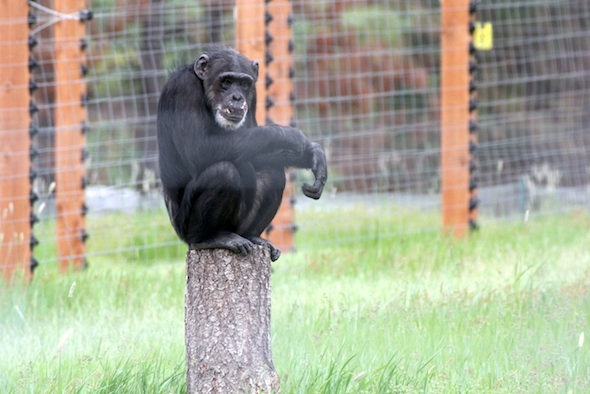
We all know that Missy is a bundle of energy. She’s got one speed when she’s on Young’s Hill: FAST. She brings a smile to our faces every time she darts back and forth and up and down the hill, because she’s able to exert her energy in a space larger than she ever would have even imagined of in the lab. It’s so hard to try and think of how she was able to contain that energy in the confined space she had for decades. Now, she’s able to run as fast as she can, climb every structure and post, do her acrobatics on the fire hoses, and if she wants, to sit still. Missy is a very great example of how the chimps now have choices.

web Missy climb post Young's Hill YH IMG_8082

web Missy climb post structure Young's Hill YH IMG_8070

web Missy tightrope fire hose shaky bridge Young's Hill YH IMG_7968

web Missy sit on stump Young's Hill YH IMG_8093

web Missy close up greenhouse GH IMG_7897

Filed Under: Missy, Sanctuary, Young's Hill Tagged With: animal protection, animal rescue, animal rights, Animal Welfare, chimp enrichment, chimp sanctuary, chimpanzee, chimpanzee rescue, chimpanzee retirement, chimpanzee sanctuary, Chimpanzee Sanctuary Northwest, Cle Elum 7, Cle Elum Seven, csnw, Missy, Play, primate protection, primate rescue, rescue, Sanctuary, young's hill

  • « Go to Previous Page
  • Page 1
  • Interim pages omitted …
  • Page 18
  • Page 19
  • Page 20
  • Page 21
  • Page 22
  • Interim pages omitted …
  • Page 43
  • Go to Next Page »

Primary Sidebar

Subscribe To the Blog and Get Notified of New Posts First!

Archives

Calendar of Blog Posts

June 2026
S M T W T F S
 123456
78910111213
14151617181920
21222324252627
282930  
« May    

Categories

SUBSCRIBE TO OUR NEWSLETTER

Footer

PO Box 952
Cle Elum, WA 98922
[email protected]
509-699-0728
501c3 registered charity
EIN: 68-0552915

Official DDAF Grantee

Menu

  • The Chimpanzees
  • Blog
  • About Us
  • You can help
  • Resources
  • Contact
  • Donate

Proud Member of

Connect With Us

Search

Copyright © 2026 Chimpanzee Sanctuary Northwest. All Rights Reserved. Site by Vegan Web Design