• Skip to main content
  • Skip to primary sidebar
  • Skip to footer

Chimpanzee Sanctuary Northwest

Hope. Love. Home. Sanctuary

  • Our Family
    • The Chimpanzees
    • The Cattle
  • Blog
  • About Us
    • Visiting the Sanctuary
    • Philosophy
      • FAQs
      • Mission, Vision & Goals
      • Privacy Policy
    • The Humans
      • Staff
      • Board of Directors
      • Founder
    • Annual Reports
    • The Future of CSNW
    • CSNW In The News
  • You can help
    • Donate
      • Become a Chimpanzee Pal
      • Sponsor A Day
      • Transfer Stock
      • Be A Produce Patron
      • Be a Bovine Buddy
      • Give from your IRA
      • Personalized Stones
      • Bring Them Home Campaign
    • Leave A Legacy
    • Employment Opportunities
    • Volunteer
    • See Our Wish List
    • Events
  • Resources
    • About Chimpanzees
    • Enrichment Database
    • Advocacy
      • Advocacy Action Center
      • Apes in Entertainment
        • Trainers
        • Role of the AHA
        • Greeting Cards
      • Chimpanzees as Pets
      • Roadside Zoos
      • Chimpanzees in Biomedical Research
      • Conservation
        • African Apes
        • Orangutans
  • Shop
    • Merchandise Store
  • Contact
  • DONATE NOW

free-living chimps

Sky Walking

August 10, 2025 by Diana

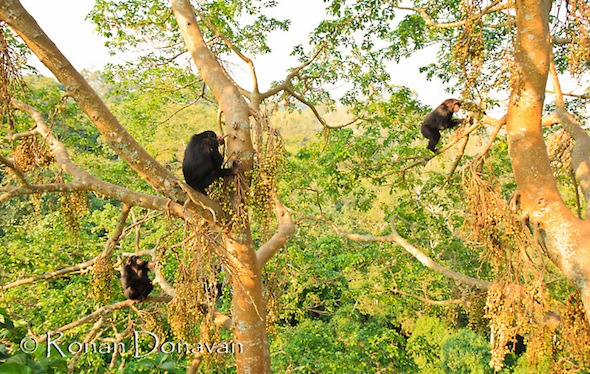
The original publication mentioned in the video from Frontiers in Ecology and Evolution is called: Foraging strategy and tree structure as drivers of arboreality and suspensory behaviour in savannah-dwelling chimpanzees. Click here for the link to the publication.

Click here for one popular science translation of the study: Walking on Two Legs May Have Evolved in Trees, Not on the Ground.

There’s more to the study than the quick video above. It includes discussion of the type of habitat in Tanzania where the study chimpanzees live. Unlike the dense forest ecosystems where many chimpanzees live, the habitat of the site in Tanzania is called savanna-mosaic, which always strikes me as poetic or romantic or something. It’s thought to be similar to the type of ecosystem where early humans adapted to thrive.

I was talking about the study with J.B., and that conversation caused me to think about studying chimpanzees in order to learn more about humans or human origins.

I’ve definitely said it before, but it doesn’t hurt to reflect again on how and why chimpanzees have been bought/sold/traded by humans in the pet, entertainment, and biomedical industries. They are frequently thought of and used as stand-ins for humans, yet they are different and separate enough that humans tend to feel less moral obligation towards them.

Their likeness to us has been, all to often, to their detriment. I don’t think that’s the case in this particular study. I do find theories about early humans interesting. But I think it is the case in an update to another story that has been in the news.

A couple of weeks ago, I wrote a blog post sharing a sad update to the Tonia Haddix / Chimp Crazy saga. If you missed that update, you can read the full post here. Just two days ago, Haddix was finally sentenced to almost four years in prison for lying under oath that a chimpanzee named Tonka had died, when in fact she was secretly keeping him in her basement. She has not yet been charged for the second chimpanzee she was trying to hide just months ago.

Her lawyer made a statement that Haddix had a difficult upbringing and history with humans, so had turned instead to animals for comfort. I think it was clear in the documentary Chimp Crazy that she felt chimpanzees in particular filled a need she had, even referring to Tonka as being more of a human than a chimpanzee. If she saw evidence of that it was because the humans around him were attempting to assimilate him into their world, rather than seeing him for who he is.

Haddix is an extreme example of this warped vision, but it’s easy to slip into this view because chimpanzees are so similar to humans and so culturally and socially adaptive. Celebrating and understanding their differences is perhaps more important to helping them than seeing their similarities.

I hope we can do both.
Filed Under: Education, Jamie, Latest Videos, Missy, Rayne Tagged With: bipedalism, evolution, foraging strategy, free-living chimps, wild chimpanzees

Ebola and Great Ape Conservation

December 16, 2014 by Debbie

There are many questions about how this year’s Ebola outbreak started, how it spread so quickly, and how to prevent it from spreading further—but what does Ebola have to do with non-human great ape conservation?

It is known that Ebola Hemorrhagic Fever is transmitted by coming into direct contact with bodily fluids of someone infected and showing symptoms of the virus, a cadaver of someone who died from the virus, or the fluids or meat of an infected animal.

Bushmeat is the meat of any non-domesticated animal that is consumed by humans. In Africa, bushmeat is not only consumed locally, but it is exported worldwide. Many bushmeat species are endangered, in which cases the hunting of those species is illegal. Still, these animals are hunted, and their meat is sold on the black market and exported to other countries, including the United States. No one really knows just how many pounds of illegal bushmeat are smuggled into the U.S., because it is believed only a fraction of the imports are confiscated—but estimates range from hundreds of thousands to millions of pounds per year.

While habitat loss is the largest long-term threat to African ape populations, hunting for bushmeat has risen in the last couple of decades as the most significant immediate threat—and could cause species extinction if the practice continues to grow. However, with the emergence of the deadly Ebola virus, more people have begun to tune into the problem. Though research shows that fruit bats serve as hosts to the Ebola virus and are believed to be the direct source of the current outbreak, consumption of infected ape meat has been linked to previous outbreaks since the late 1990s. Primates and other animals can become infected by eating half-eaten fruit that have come in contact with fruit bat saliva, and the virus is passed to humans who eat infected animal bushmeat.

The Ebola virus can also be detrimental to wild ape populations. In 2002, over 5,000 gorillas died from an outbreak. In fact, the threat of imminent Ebola outbreaks (and other pathogens) on already dwindling populations has prompted researchers to propose developing a vaccination for the apes. Before vaccines could be administered to wild apes, however, some researchers feel they would need to be tested on captive apes. As we know, there is a push to end the use of chimpanzees in research altogether, so the topic sparked a debate earlier this year (read more on that here).

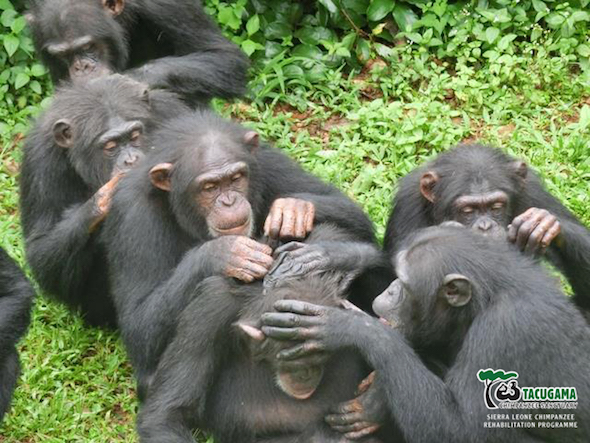
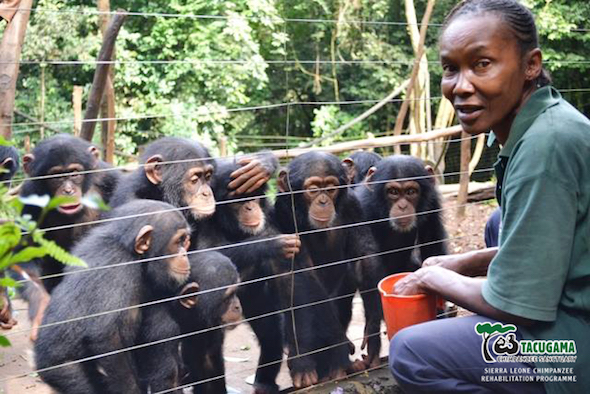
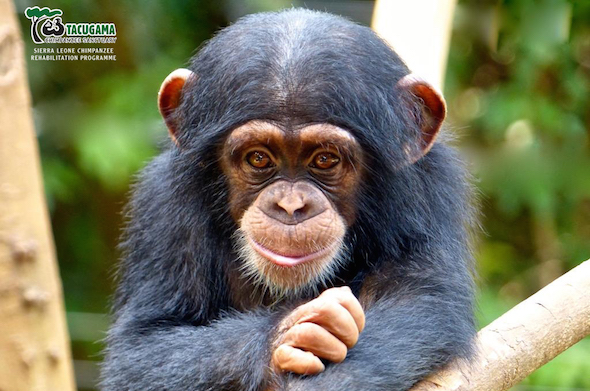
The Ebola scare has also left African sanctuaries in a predicament, such as Tacugama Chimpanzee Sanctuary in Sierra Leone—one of the affected countries.

web-tacugama-baby

web-tacugama-chimps-groom

web-tacugama-rehabilitator

The travel limitations and general panic about the disease have kept people away from the country, and the lack of outreach opportunity has hit the sanctuary and others like them hard. Additionally, with travel restrictions in the affected countries, it is harder for volunteers to help with the day-to-day work. The sanctuaries have had to hire more local staff, causing their funds to be stretched thin. Recently, the Chimpanzee Conservation Center in Guinea has been impacted by this trouble as well. Thankfully, no apes in sanctuaries have contracted Ebola, and all the caregivers have been taking extra hygiene precautions to make sure everyone stays healthy.

Though the direct threat to great apes from Ebola is reason for concern, it’s possible that the attention on Ebola could have a positive impact on ape conservation and help prevent future outbreaks in human populations. Unlike other pandemics and deadly pathogens, which are able to sustain in human populations long-term, Ebola is a unique virus in that it comes and goes sporadically in humans in the form of destructive outbreaks. So far these outbreaks seem to have originated from human contact with infected wildlife. With effective education in local communities, and efforts to take legal action against logging, prevention of hunting and eating bushmeat can save countless lives—of both human and nonhuman apes.

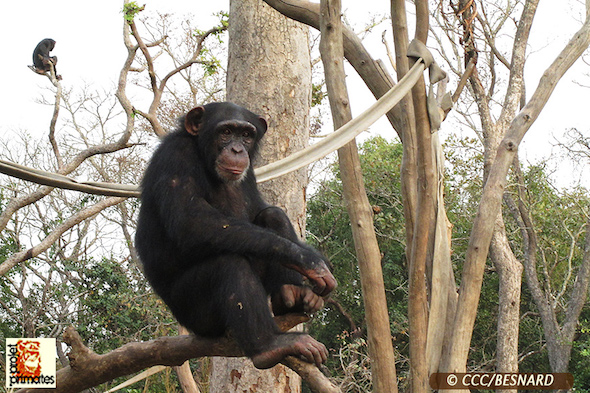
web-ccc-ama

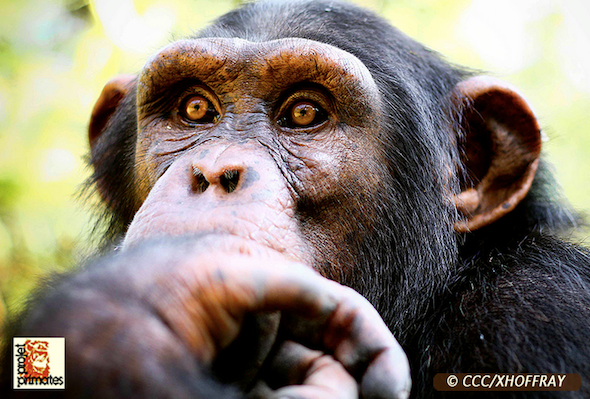
web-ccc-hakim

web-ccc-teenage-group

Filed Under: Advocacy, Free-living chimps Tagged With: advocacy, african sanctuaries, animal protection, animal rescue, animal rights, Animal Welfare, chimp, chimpanzee, chimpanzee conservation center, chimpanzee rescue, chimpanzee retirement, chimpanzee sanctuary, Chimpanzee Sanctuary Northwest, conservation, csnw, ebola, ebola virus, eyes on apes, free-living chimps, free-living gorillas, great ape conservation, guinea, primate protection, primate rescue, projet primates, Sanctuary, sierra leone, tacugama chimpanzee sanctuary, wild apes

Research at Kanyawara

October 22, 2013 by Debbie

Dr. Zarin Machanda is one of our guest bloggers who is doing a series on the chimpanzees of Kanyawara in the Kibale National Park. Read her introduction post here, to use as a little background for this post about the research they do in the wild. The Kibale chimpanzees were also mentioned in our latest guest blogger post from Maureen McCarthy, a heartbreaking story about a chimpanzee caught in a snare trap. In Kibale, they have snare removal projects and work to help save chimpanzees. Find out more about them here.

—

And now, for the second installment of Zarin’s series:

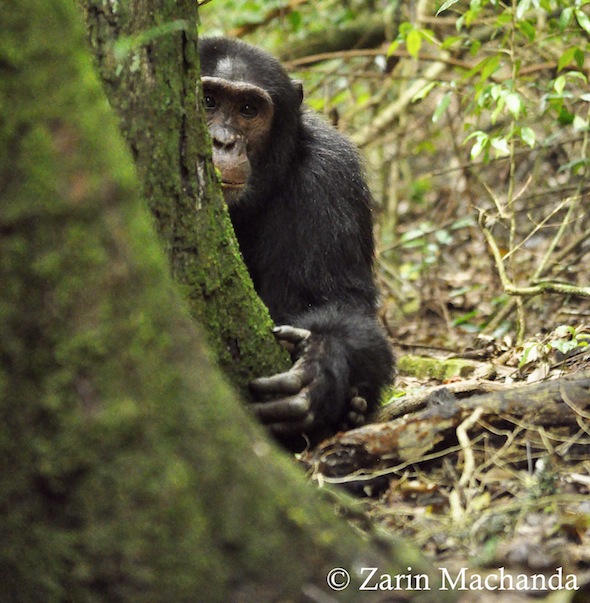
Hi everyone – I’m back to tell you a little bit more about the chimpanzees of Kanyawara. Today, I thought I would write about some of the different research projects that we have going on. But first, a quick update from the field – it seems that Eslom is prevailing against Lanjo in the quest for alpha male status. I know I shouldn’t be disappointed because alpha male transitions are rare (this will be the 4th in 26 years of observation at Kanyawara), so any new observations are bound to be interesting. But why did it have to be Eslom?! I mean, he’s scared of having his picture taken!

Eslom

The only photo I have ever managed to take of Eslom. As soon as I pulled out my camera, he went and hid behind a tree. I managed to get one shot of him peeking out before he got spooked. Alpha male material? I’ll let you decide.

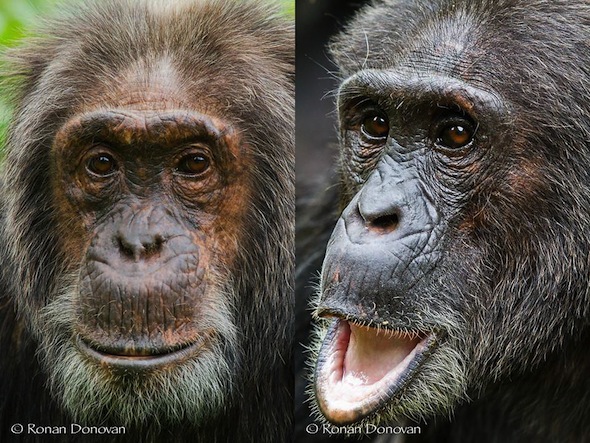
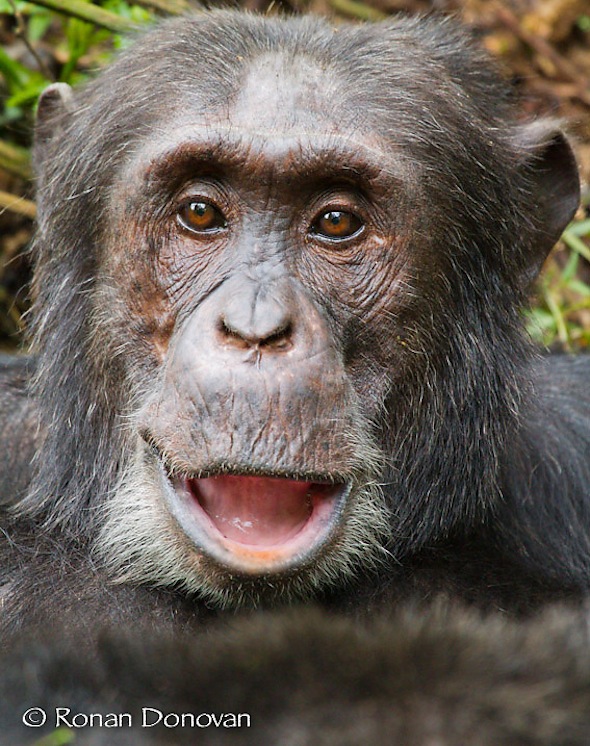
I still have faith that Lanjo is just biding his time and waiting for Eslom to get tired of running around causing havoc. And who knows – there could always be a surprise candidate waiting in the wings: Big Brown, a former alpha wanting to relive his glory days or maybe even dark horse, Makoku. Don’t let that floppy lip fool you, this 30-year old was high-ranking before Kakama died.

big brown and makoku

Two more potential, although unlikely, candidates for alpha male. Big brown (left) was alpha in the mid-1990s but since he’s over 40, I’m not sure he has the fight left in him. Makoku (right) has an older brother Johnny in the community who might prove to be an ally if he decides to go for alpha status – but so far, he doesn’t seem that interested. Photo courtesy of Ronan Donavan.

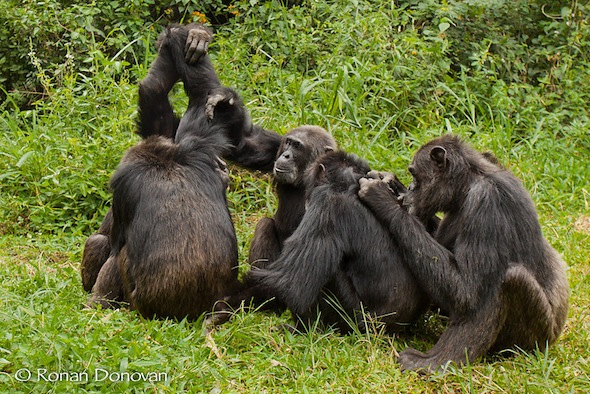
As a research group, we are particularly interested in male dominance and male relationships, so this change in the hierarchy will yield incredibly valuable data for us. Among chimpanzees in the wild, adult males are socially dominant to all the other individuals and they are also much more gregarious – adult males like to be in parties together whereas adult females tend to spend more time alone with just their dependent offspring. Adult males also exhibit more cooperative behaviors like boundary patrols and hunting and we think that tend to have strong relationships with one another to facilitate this cooperation. One of my research interests revolves around understanding how and why individuals form strong long-term social relationships with one another. But to do that, we have to figure out how to identify relationships. Of course, it would be easy to just go with a gut feeling – sometimes you just have a sense watching individuals that they are great friends or that they don’t like each other. But as scientists, we need an objective measure that others can replicate. So how do we measure friendship?

chimps grooming

A pile of male chimpanzees grooming each other. Adult males form very strong bonds with one another and we often use grooming behavior as an indicator of a bond. The chimpanzees at Kanyawara also engage in a behavior called hand-clasp grooming where they raise their hands and clasp them above their heads while grooming each other. Not every chimpanzee community exhibits this kind of behavior and we think that this might be a cultural variant of grooming. Photo courtesy of Ronan Donavan.

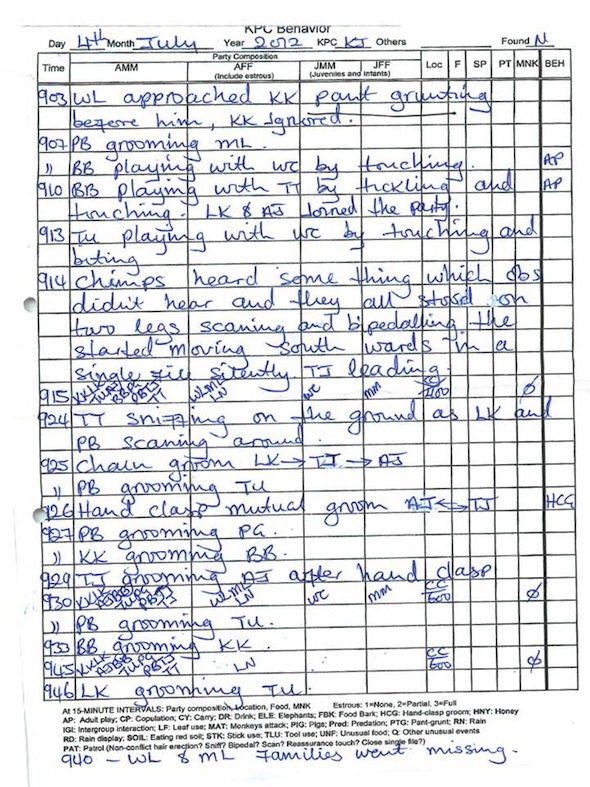
Well first, we have to collect systematic data on the behaviors and activities of the chimpanzees. At Kanyawara, we employ 6 full-time Ugandan field assistants who enter the forest almost every day to collect our long-term field data. We still prefer the old-fashioned method of pen and paper data collection – just like Darwin used to do! One type of data involves identifying all the individuals present in a party every 15 minutes and then writing down the time and description of any interesting behaviors (e.g. grooming, copulations, etc.) that occur. At the same time, another field assistant collects data on one specific individual in the party and records their activity every minute, and who they are sitting near every 15 minutes. From this data, we can figure out which individuals spend time with each other in parties, sit next to each other and groom each other most often. Combining these measures, we can identify individuals with strong bonds. I like to think of it this way – you wouldn’t spend a lot of time with someone you don’t like (let alone let them groom your private parts) and we don’t think that chimps do either.

data

An example of some of the data that we collect. Our field assistant, James, was following a large group of chimps that morning. Around 9:00am there was a lot of social activity including some adult males like Big Brown (BB) and Tofu (TU) playing with some young individuals. Then at 9:14am, the chimps heard something and appeared to be cautious but interested. As they moved south towards the sound – possibly the neighboring community of chimps – the males started grooming each other a lot while some of the females and their families left the party.

Dr. Richard Wrangham started our research site in 1987, so we have over 25 years of this kind of data which means that we can look at relationships over very long periods of time. Our research has shown that not only are males strongly bonded to one another, but almost every male has at least one really close associate – kind of like a BFF, except we call them PSPs (preferred social partners) and these relationships on average last for years. For example, we know that Makoku and his older brother Johnny are PSPs and they have been since at least 1995. As maternal brothers, they share a lot of genes in common and it makes sense that they have a strong bond because from an evolutionary point of view, you should support individuals who share your genes. If they succeed, it’s like a part of you has succeeded as well. By the way, Johnny and Makoku (as well as their mother Lope and sister Rosa) have floppy bottom lips, so there are definitely some shared genes there! It’s a little surprising to me that Makoku isn’t actively trying to be alpha male right now – not only was he the second highest ranking male before Kakama died, but he also has Johnny to get his back if anyone fights him. And Johnny is our biggest male chimpanzee, just the kind of wingman you’d want in a fight. Of course, Makoku could be trying to emulate his older brother’s style since Johnny never cared that much for being high ranking either. This seemed to work for Johnny – although the general pattern is for the alpha male (or at least high-ranking males) to sire the majority of babies in a community, mid-ranking Johnny is one of our most reproductively successful males and has fathered numerous offspring including Lanjo and Eslom. Does anyone else get the feeling that this is a little bit like watching a soap opera? The Days of our Lives: Kanyawara edition!

Johnny

Johnny is Makoku’s older brother and has a floppy bottom lip just like the rest of the members of his family. Johnny has always been medium ranking, but surprisingly, he is also a real ladies man and has fathered a number of offspring. Photo courtesy of Ronan Donavan.

Besides studying long-term relationships, another area of research that Kanyawara has pioneered is the study of behavioral endocrinology. Basically, this involves trying to understand the interaction between the behaviors that we observe and the physiological processes happening inside the body that involve hormones. For example, one interesting question to examine right now is how testosterone levels of our adult males may be fluctuating given the instability in the dominance hierarchy. With all the aggression that Eslom is displaying, I bet his testosterone levels are through the roof!

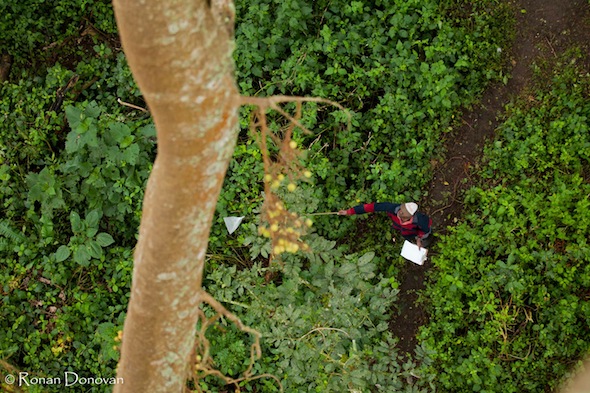
As I mentioned in my previous post, we don’t physically interact with our chimpanzees unless their lives are in danger, so we can’t collect blood samples to measure their hormone levels. Instead, we rely on the urine and feces that they leave behind and it is remarkable how much you can tell about the inner workings of the body from a single urine sample. In our lab at the University of New Mexico, Martin Muller, Melissa Emery Thompson and their students use and develop techniques which can determine the levels of testosterone, estrogen, progesterone, cortisol (a measure of metabolic stress), and C-peptide (a measure of insulin). This means, of course, that we have to collect urine and fecal samples. This fun task most often falls on our field assistants, who have devised a very clever way to get the urine and not get too messy in the process. Basically, you have to find a long branch with a v-shaped end to it. Luckily, we work in a forest so these aren’t too hard to find. Then you take a clean plastic bag and tie it over the v-shaped end and voilà, you have made yourself a urine catcher! When a chimp is in a tree and starts peeing, you take your urine catcher and put the plastic bag end in the stream of urine. Once we have enough (only about 3ml), we can pipette the liquid off the plastic bag and into labeled tubes for storage.

urine collection

A chimps-eye view of John, one of our field assistants, collecting urine using the handy plastic bag on a stick technique. The longer the stick, the less chance of getting splashed. Photo courtesy of Ronan Donavan.

Some of the hormone data that we have collected have changed the way that we think about the chimpanzees and their behavior. For example, the data from Kanyawara has shown that males who are higher ranking tend to have higher levels of testosterone. These guys are also generally more aggressive indicating that the testosterone may be mediating their aggressive behavior. These high ranking males also have higher levels of cortisol which means that they are experiencing increased metabolic costs – in other words, even though there is a benefit to being high ranking, there is also a significant energetic cost to it as well. This dataset has also given us a lot of information about females as well. Remember Outamba, the super mom chimp that I mentioned in my previous post? Well we know she is high ranking and we also have data to suggest that she, and the other high ranking females, have higher levels of estrogen and progesterone. This might be why she is able to have babies more frequently than the other females.

So that’s a little bit about some of the research we do on adult individuals. Next post I’ll tell you what it’s like to be a baby chimpanzee and some of the research that we do on our infants. Chimpanzees are so interesting and complex that I don’t think we’ll ever run out of research questions. Let’s just hope that we can also protect the chimps in the wild so that we can keep learning from these amazing individuals.

Filed Under: Advocacy, Free-living chimps Tagged With: advocacy, animal protection, animal rescue, animal rights, Animal Welfare, chimpanzee, chimpanzee rescue, chimpanzee retirement, chimpanzee sanctuary, Chimpanzee Sanctuary Northwest, free-living chimps, kanyawara, kibale national park, ronan donavan, Sanctuary, wild chimps, zarin machanda

The Landmine Snare

September 30, 2013 by Debbie

Maureen McCarthy, PhD candidate at the University of Southern California, was our very first guest blogger. She is doing field research in Uganda, and while there she has been featured as a regular on Scientific American’s blog. The entry that follows is particularly moving. WARNING: some disturbing images are included in this entry.

—

This is our last week of data collection. It was supposed to be a laid-back week to collect a few more samples and enjoy a few final days tracking chimpanzees, a fieldwork victory lap of sorts. It didn’t turn out as I’d hoped, though. Instead, things went very, very wrong.

On Tuesday, we ventured back to a forest reserve south of the Budongo Forest. It’s one we’ve visited numerous times before…a much larger forest than most we visit, one which helps functionally connect the fragmented forests of this corridor region to the much larger Budongo Forest to the north. On the surface, chimpanzees here have a good habitat compared to our friends to the south in most forest fragments I’ve been studying. A closer look, however, reveals an abundance of illegal logging and snare hunting sites within the forest. Though snare hunting is illegal, it is a leading cause of injury and death among chimpanzees in Uganda. Up to one third of chimpanzees in forests of Western Uganda have sustained snare injuries (Reynolds, 2005; Wrangham and Goldberg, 1997; Wrangham and Mugume, 2000).

We received news that chimpanzees had been heard far inside the forest early that morning. Jack and I, along with a field assistant and a guide from the National Forestry Authority, began traveling through the forest en route to the area where they were heard. Around mid-morning, we too began hearing pant hoot vocalizations from the chimpanzees, as well as occasional whimpers and screams, which are not unusual, especially among larger parties. We projected waypoints for their location and followed trails in that direction until we knew we were close. It sounded like a large party was present, with a second party approximately 200 meters away.

We decided to leave the nearby party so as not to disturb them, instead backtracking along their trail in the hopes of finding nests from the previous night. After successfully locating numerous nests and dung samples, we followed their trail back to where they’d been calling in the hopes of finding that they’d gone, leaving some dung samples behind. Instead, we saw a number of chimpanzees, which, along with their earlier vocalizations, suggested a large party was still present. We watched as a subadult male climbed a tree. He produced a dung sample, and we noted its location so we could find it there after they had moved. When it seemed that the chimpanzees may be preparing to leave, we decided to slowly and carefully move closer to the tree where we saw the male, in an attempt to collect the dung. As we approached, we found that a young chimpanzee was watching us from deep within the dense vegetation. The youngster was about three years old. He watched us fearfully and whimpered from a limb about one meter off the ground, then became more fearful and began to scream. We wondered why he didn’t simply leave his leafy perch. Was he injured or trapped? One of our field assistants, who led in the front of our party, assured us confidently that he could see both hands and feet, and that all limbs were free. Despite these assurances, I was left with an uneasy feeling. However, a large party of chimpanzees was still nearby. An adult started to climb down from his position in a tree. I decided that it would be too risky to move closer through the dense vegetation. Given the thickness of the undergrowth, we would have to approach very closely to see the young chimp well enough to assess the situation thoroughly. If he then became very upset, others in the party could come to his defense and we could risk being seriously attacked. I would have to rely on my field assistant’s assessment that the youngster was fine despite what seemed to be unusual behavior. At least, we noted hopefully, there was no distressed mother visible. We left the possibility of sample collection behind and went home for the day.


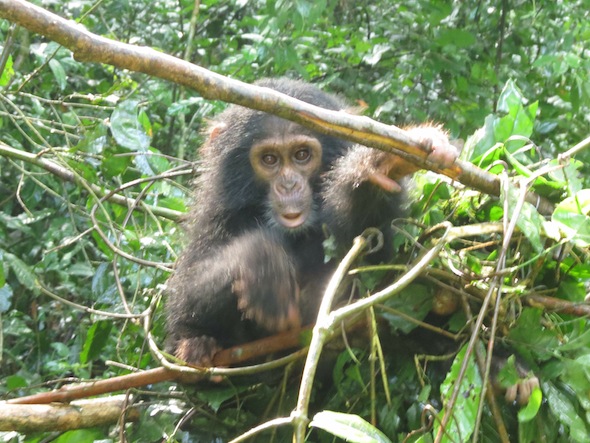
The next morning, we came back in the hopes that the chimpanzees had all left and the dung samples remained. As we approached, we heard and saw no sign of chimpanzee presence. However, we soon heard the unmistakable whimpers of the same young chimpanzee. Jack and I looked at each other with sinking, awful dread. The infant chimpanzee was indeed trapped there. I approached, passing through the vegetation to get a close look at the chimpanzee. He had a wire snare around his left foot. He still seemed strong and relatively healthy despite being trapped. We suspected that he had been ensnared there sometime after the party arrived on Tuesday morning. We left the area immediately to get phone reception and called our colleagues at the Budongo Conservation Field Station for assistance. We hoped their veterinary staff could provide the necessary help to free the chimp from his snare.

maureen landmine snare Photo 1

The ensnared chimpanzee. Note the trapped left foot, with the snare wire visible on the branch above. Photo © Maureen McCarthy.

Phone signals were poor and transportation was challenging between Budongo and our location. We spent hours waiting but eventually received word that help was on the way. Finally, two veterinarians from Budongo met us in a nearby village. I was relieved that help had finally arrived and that this chimpanzee could be given a chance to be free again and to go on with his young life. We trekked through the forest until we finally arrived again at the location of our little friend. As we pushed through the dense vegetation, I couldn’t see the chimp at his usual post. For a brief moment, my heart leapt as I thought he may have escaped his snare. A moment later, however, I was devastated by reality—he was not visible because he had died and was now hanging below the branch where we found him earlier.

My mind was reeling. How could he have died so soon? Sure, it took hours for help to arrive, but he looked so strong earlier. Dozens of “what ifs” flooded my thoughts. What if we had ignored the risks and pushed in further yesterday to assess the situation fully and see that he was truly ensnared? What if we had stayed by his side today? What if we had just tried to release him on our own before help arrived? If we did release him, could we have helped him find the other chimpanzees in his community? I was heartbroken and guilt-ridden with thoughts that I should have done more.

Thankfully, the veterinary staff from Budongo could not have been more calming and professional. Their assessment was that the chimpanzee was likely an orphan since there was no sign of his mother in the vicinity. We should expect a chimpanzee mother to remain nearby if her infant is trapped in a snare. They also assessed the cause of the infant’s death. The infant was found hanging upside down by the trapped leg. It seems that he had fallen from the leafy cushion of branches on which he was seated and was unable to right himself. Perhaps he was simply too tired after all the trauma he’d experienced since the previous day. As he hung upside down, the oxygen-poor blood accumulated in his head as the heart was unable to pump it back up to his chest and replenish his brain with oxygen-rich blood. The wound, along with our account of where the chimpanzees traveled, corroborated the notion that the injury had occurred the previous day. Perhaps most tragically, he had only just died. If we had been able to intervene only an hour sooner, the outcome could have been very different. This particular detail is staggeringly difficult for me…

maureen landmine snare Photo 2

The snare injury, post-mortem. Photo © Maureen McCarthy.

The vets also assessed the reason for his injury. It was caused by what is known as a landmine snare, a particularly complex snare devised to catch a large animal such as a bushbuck. The complex construction made it clear that it would have been difficult if not impossible for the chimpanzee to free himself, at least not without losing his foot in the process. This snare was likely set by an illegal logger in one of the nearby camps within the forest, perhaps one of the men who went crashing through the forest to avoid being seen by us just earlier that morning.

The veterinarians freed the chimpanzee’s body from the snare and carefully collected it for post-mortem analysis and a respectful burial. He was so small, so vulnerable, and so beautiful. Life had only just left him, and I was simultaneously so sorry for him and so grateful that he no longer had to suffer the fear and pain he had been feeling.

What can we make of this tragedy? I feel distraught and helpless over the loss of this young innocent life. I can find comfort in a couple of thoughts, though. First, I am grateful that none of our team members was injured in what potentially could have been a very dangerous situation. If I had insisted that we push in to get a closer look when other chimps surrounded us, I could instead be writing an account of one of our team members being attacked by a chimpanzee. Second, I am grateful that, if he had to die, at least the loss of consciousness he experienced was relatively painless compared to a week or more of suffering slow starvation, a fate endured by some chimpanzees similarly caught in snares.

max

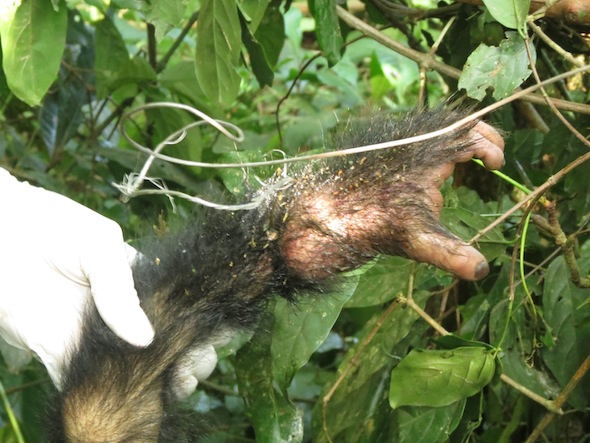
Max, a snare injury survivor in Kibale National Park, Uganda. Photo courtesy of Ronan Donovan.

I can take one more comfort. That is, I can hope we learn something from this awful situation and create some sort of positive outcome. I hope the plight of this innocent chimpanzee can help shed light on the gravity of snare hunting as a threat to our closest living relatives. There are committed individuals in Uganda trying to ensure that this won’t happen to another chimpanzee. For example, please consider supporting a snare removal program such as the Jane Goodall Institute Snare Removal Program or the Kibale Snare Removal Program. Here’s hoping snare hunting becomes a thing of the past.

This post was originally published at Scientific American.

Works cited:

Reynolds, V. (2005). Chimpanzees of the Budongo Forest. New York: Oxford University Press.
Wrangham, R.W., Goldberg, T. (1997). An overview of chimpanzee conservation and management strategies. In Conserving the chimpanzees of Uganda: a population and habitat viability assessment for Pan troglodytes schweinfurthii (ed. E. Edroma, N. Rosen and P.S. Miller). IUCN/SSC, Apple Valley, MN.

Wrangham, R.W., Mugume, S. (2000). Snare removal program in Kibale National Park: a preliminary report. Pan Africa News 7: 18-20.

Filed Under: Advocacy, Free-living chimps Tagged With: advocacy, animal protection, animal rescue, animal rights, Animal Welfare, budongo, bushmeat orphan, chimpanzee, chimpanzee rescue, chimpanzee retirement, chimpanzee sanctuary, Chimpanzee Sanctuary Northwest, free-living chimps, kibale national park, maureen mccarthy, primate rescue, rescue, scientific american blog, snare trap, uganda

Meet the Chimpanzees of Kanyawara

August 15, 2013 by Debbie

Most of our advocacy work focuses on issues close to home, like the entertainment industry, apes as pets, and biomedical research. As caregivers for the Cle Elum Seven, our expertise at CSNW lies in the plight of captive chimpanzees. We see the Cle Elum Seven as ambassadors for other chimpanzees that still are used in research or entertainment and deserve better.

We also see them as ambassadors for wild chimpanzees. They never got to experience the love from their mother, learning how to forage and use tools, and living in a large group of other wild chimpanzees. Though sadly, chimpanzees in the wild have problems of their own. Some are being hunted for their meat to be sold on the black market, some are losing their homes to human encroachment, and some are fighting for their lives after being caught—but not killed, by a snare trap.

Our guest blogger project aims at raising more awareness about these issues from the perspective of those that work in that environment, analogous to the CSNW staff’s expertise with chimpanzees in captivity. Dr. Zarin Machanda works in the Kibale National Park in Uganda, and we are thrilled to have her stories of her experience working with chimpanzees in the wild, just as we tell stories about the Cle Elum Seven. Here’s her introduction to the chimpanzees of Kanyawara.

—

Hi everyone! My name is Zarin Machanda and I’m going to do a few guest blog posts over here this summer. I know JB and Diana from when I volunteered at the Fauna Foundation. I have a very distinct memory of JB with a torn up t-shirt after an encounter with a grumpy ostrich! I’m still not sure what happened, but I think the ostrich won.

I left Montreal for Harvard where I have been studying wild chimpanzees in Uganda for the last 10 years. I’ll describe my research in another post but my main interest is understanding how and why social relationships develop. Today, I want to tell you about our field site and introduce you to some of our amazing chimpanzees. Many of the photos here were taken by Ronan Donavan, a friend and photographer who worked in Uganda for many months.

map

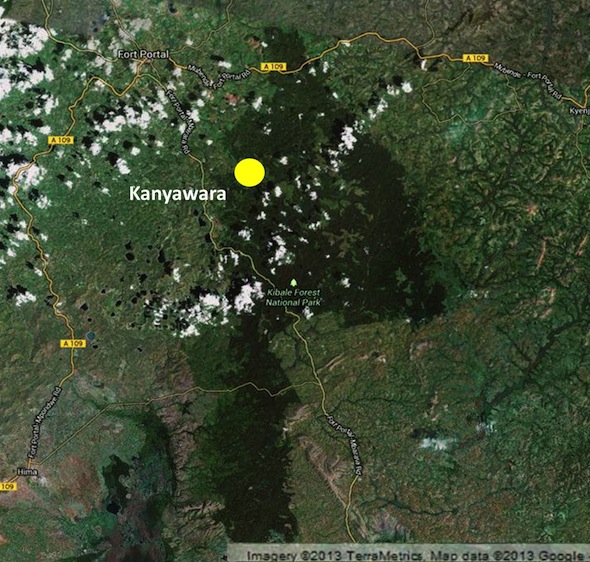
Satellite image of Kibale National Park with the Kanyawara chimpanzee community range in the northwest sector. Image courtesy of Google Maps.

I work for the Kibale Chimpanzee Project, a long-term research project studying the Kanyawara community of chimpanzees. They live in Kibale National Park in Uganda, a beautiful equatorial rainforest that is home to over 250 species of trees, over 325 species of birds and over 60 species of mammals, including 13 species of primates. This is one of the densest and most diverse populations of primates anywhere in the world and includes approximately 1500 wild chimpanzees (Pan troglodytes schweinfurthii).

kanyawara

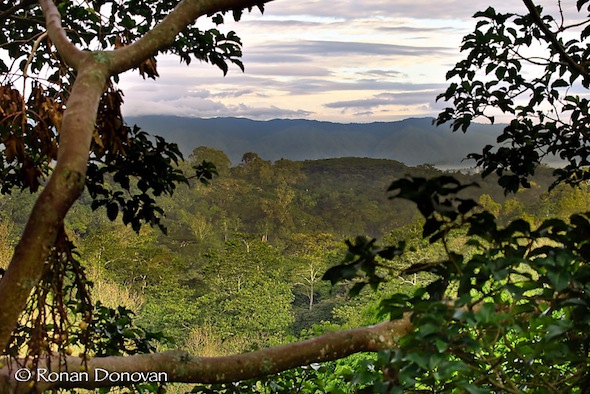
The canopy of Kibale National Park with the Rwenzori Mountains in the background. Photo courtesy of Ronan Donavan.

Every day, our field assistants and researchers enter the forest to follow the chimps and collect data on their behavior. We don’t have any physical contact with them—we just observe them, take notes about what they do, and collect samples of their urine and feces for later analysis. How do you collect urine from a chimp? Well you’ll have to come back later to find out!

All of our chimpanzees are given names and we can recognize them just as easily as we can tell each other apart. Every chimp research site has a different philosophy for naming chimps—some pick philosophers, others like jazz musicians but we like to name our individuals after important world figures and world events. For example, in the year 2000, we named a chimp Tuke (pronounced Two-kay)—get it?

canopy

The Kanyawara chimpanzees feeding on figs. Photo courtesy of Ronan Donavan.

I wish I could tell you about all 53 of our chimps because each one is special in their own way, but I’ve chosen just a few for you to meet: Lanjo, Outamba, Max, Tsunami, and Tembo.

Lanjo was born in 1995. He is quite large for his age and he’s recognizable because his hair is light brown compared to the more typical black hair of the other chimps. He is not only handsome, but he is also loved by all the researchers and field assistants. Our alpha male, Kakama, recently passed away and we have been taking bets on who is going to take over. My money is on Lanjo although some other folks favor Eslom. Interestingly, these two couldn’t be more different—while Eslom is likely to display, chase everyone and generally cause chaos wherever he goes, Lanjo is as cool as a cucumber and just watches it all happen. That’s the kind of alpha that I would want and I have a feeling most of chimps would prefer cool over crazy! It’s going to be an interesting couple of months in our community since we know that changes in the hierarchy really shake up relationships among the males. Individuals jockey for position and need to figure out which of their friends will be most useful to them as they vie for dominance. Fingers and toes crossed for Lanjo, although Kakama will be greatly missed.

lanjo

Lanjo showing off his muscles for the camera. Photo courtesy of Ronan Donavan.

Outamba is a high ranking female and is recognizable because of her narrow mouth and prominent brow. We think she is about 34 although it’s hard to know her exact age because females transfer into new communities during adolescence and we make educated guesses about their age. Outamba is Kanyawara’s baby-making machine! She has had 5 infants in 15 years—that’s one baby every 3 years compared to the average female who generally has one baby every 5-6 years. It’s even more impressive that all of Outamba’s babies have survived, so she’s not just making babies quickly but she’s doing a great job of taking care of them too. We think she is such a successful mother because as a high-ranking female, she has access to the areas of the highest quality food. For mammals, more food means more babies and higher infant survival rates—so Outamba must be eating well.

outamba

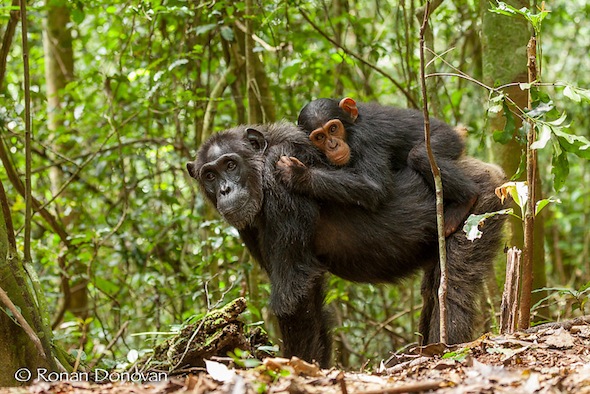
Outamba carrying her youngest daughter Gola on her back. Photo courtesy of Ronan Donavan.

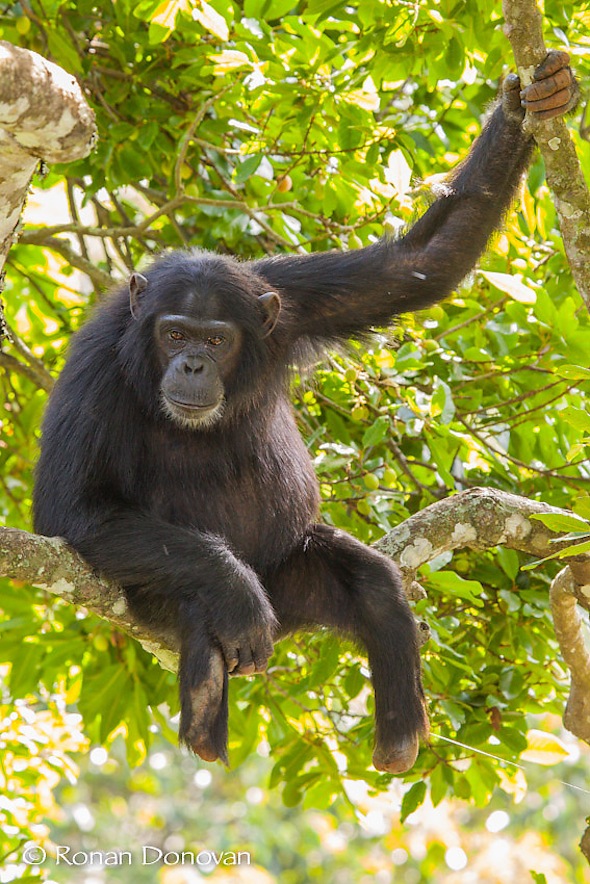
Max is one of our shy individuals and we don’t see him very often because he prefers to stay near his mother in a remote part of the Kanyawara range. This is unusual for an adolescent male because as he grows up he should spend more time with the adult trying to integrate into the male dominance hierarchy. Max’s odd behavior most likely stems from the fact that he lost both of his feet to wire snares set by poachers when he was younger. I’ll write more about these snares and our conservation efforts in another post, but they affect our young chimps more often than adults because these guys barrel through the forest without looking where they are going. Another reminder that baby chimpanzees and baby humans are very similar. Despite these injuries, Max is a trooper! He can still climb trees like a champ and has survived for a number of years without his feet.

max

Max sitting in a tree. He lost both his feet to wire snares. Photo courtesy of Ronan Donavan.

Tsunami was born in January of 2005. Her mother is Tongo and she is Lanjo’s younger sister. Right now, her face is still pink with a few dark freckles but this will change as she gets older and her face darkens. Like our other young chimps, Tsunami likes playing with objects such as rocks and sticks and she will even carry these things around for days. She is often seen playing with and trying to carry her siblings. In 2011, tragedy struck when Tsunami’s baby sister, Teddy, died after accidentally falling out of a tree. Tongo couldn’t carry the body and had to leave it on the ground but Tsunami stayed with Teddy and even tried carrying her—it was heartbreaking. I think Tsunami is going to make a great mom when she grows up—she certainly has a good role model in Tongo and she is one amazing big sister.

tsunami

Tsunami, one of our juvenile females. Photo courtesy of Ronan Donavan.

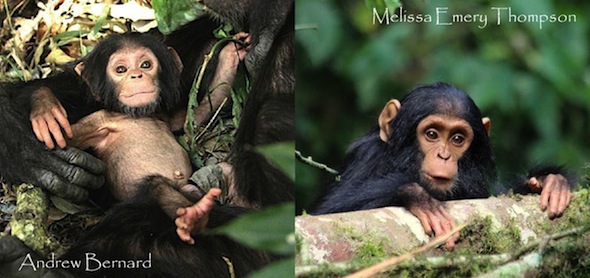
At 1.5 years, Tembo is one of our youngest chimpanzees. We gave him the Swahili word for elephant as a name, because he was born the same day that elephants came to camp and knocked over a tree. Tembo is a special guy because he is not only the son of Tenkere but also the grandson of Outamba. Since female chimpanzees are supposed to transfer to new communities at adolescence, it’s unusual to have maternal grandmothers in a group. We’re not sure why Tenkere decided to stay but it is likely that it’s because she also has access to high quality food like her mom, which she may not have as a new immigrant to another community. Not leaving may end up being a poor choice because Tenkere is genetically related to many of the males in the group. We’ll have to keep an eye on Tembo and get DNA samples from him to do a paternity test. But, so far he seems healthy and playful and he has quite a family looking out for him. I’m hoping he lives up to his name—big and strong and able to knock over trees.

tembo

(Left) Newborn Tembo lying with his mother Tenkere. Even as a newborn he had sideburns just like his mother. (Right) Tembo at 1.5 years of age. Photos courtesy of Andrew Bernard and Melissa Emery Thompson, respectively.

Well that’s all for now. Next time, I’ll describe a little bit more about my research and some of the other projects that we are working on. In the meantime, please check out our website for more news from the field.

Filed Under: Advocacy, Free-living chimps Tagged With: advocacy, animal protection, animal rescue, animal rights, Animal Welfare, chimpanzee, chimpanzee rescue, chimpanzee retirement, chimpanzee sanctuary, Chimpanzee Sanctuary Northwest, free-living chimps, kanyawara, kibale chimpanzee project, kibale national park, wild chimpanzees, wild chimps, zarin machanda

The FARDC ‘Petting Zoo’ at Bili

June 18, 2013 by Debbie

Dr. Cleve Hicks, one of our guest bloggers, was featured last month with a series of posts called “Along the Bushmeat Highway” (Read Part 1, Part 2, and Part 3). The story was from July of last year, and Cleve has given us some more recent follow-up information about the Bili forest area in the DRC. WARNING: some disturbing images included in this entry (the most graphic one is included as a link in its caption).

—

UPDATE – THE FARDC ‘PETTING ZOO’ AT BILI, OCTOBER 2012

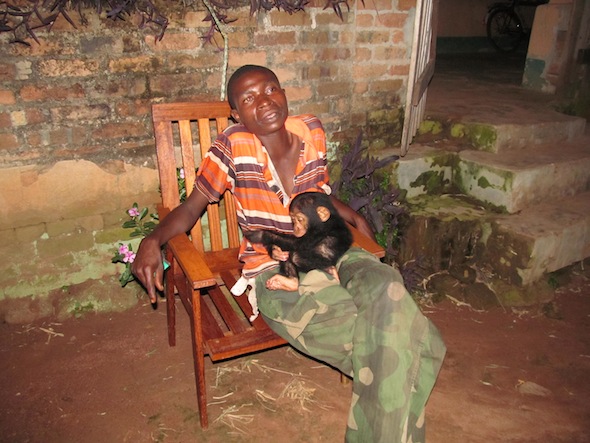
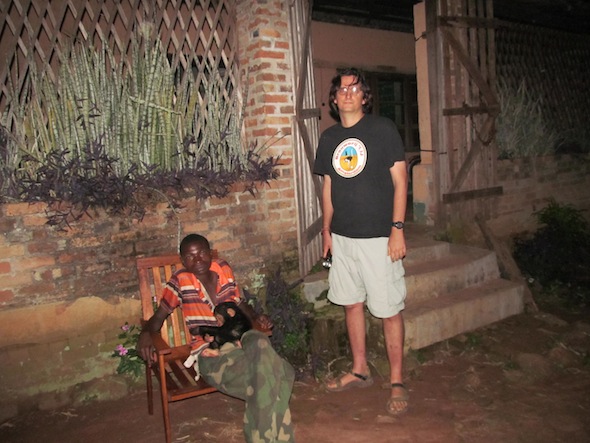
The skinny young man dressed in a mix of rags and military gear loomed out of the night like an apparition. He careened across our yard and nearly collapsed on top of Ephrem. Our evening banter was abruptly cut off as we rose from our chairs to confront the lurching, inebriated intruder. He was the youngest member in the squad of six Congolese soldiers stationed in a barracks up the hill from us in Bili. The soldier was so drunk that he could barely sit upright in the seat which we had offered him. At least on this occasion he had left his weapon back at the barracks. ‘I am a member of the Congolese military!’ he proclaimed in a slurred voice. ‘I am Congolese, and this is my pet!’ I looked in his lap and my heart sunk as I made out the dark shape clinging there: a baby chimpanzee, perhaps two years old, her eyes dull and glassy, pink tongue lolling out of her mouth. She periodically nodded off into a dazed slumber, and it looked as if the rumours that the troops were keeping her intoxicated with booze and dope were true.

1 drunk soldier with baby chimp

A drunken young soldier with a baby chimpanzee at our project house. (Photo © Ephrem Mpaka of the Lukuru Wildlife Research Foundation).

2 cleve with soldier and baby chimp

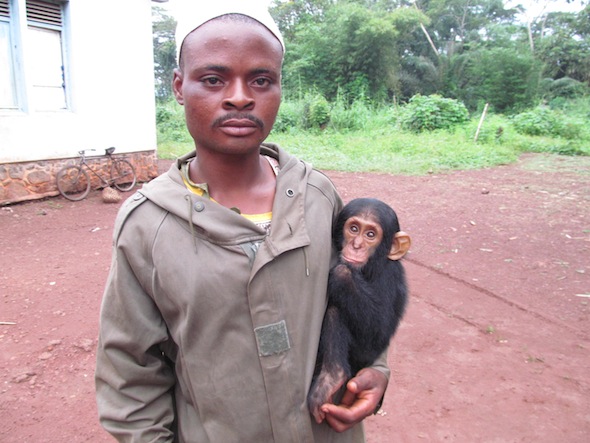
This was the same orphan that our team had photographed the day before, gazing out from the arms of her owner with a look of befuddled hopelessness. I had sent Ephrem with a pair of Ecoguards over to the barracks of the FARDC (Forces Armées de la République Démocratique du Congo) to photograph the ‘petting zoo’ which we had been told the new squad leader was keeping there. In addition to this little female chimpanzee, named Congo, the military and their families were keeping three monkey orphans: a baboon tied to a short leash, an agile mangabey, and a red tailed guenon. The latter two primates scampered around the yard looking for food. After some initial tension between our guards and the military, things calmed down and the soldiers allowed Ephrem to photograph the primates. The soldiers explained that they had acquired the orphan chimpanzee from a shop in the town of Roa about 50 km southwest of Bili, as a ‘mascot’ for the troops. Ephrem explained to the men that it was both dangerous and immoral to keep primates in such a condition, and in the case of the chimpanzee, illegal. Later that evening we considered sending the guards to confiscate Congo, but in the end, decided against it. These military were heavily-armed, often drunk, and had already made threats against our project. Also, we had no place to send the poor orphan.

3 orphan chimp Congo

The orphan chimpanzee Congo kept by a soldier at the military barracks in Bili.

We were unsure why this young soldier had come to our house with the baby chimpanzee. Did he want to sell her to us? Intimidate us? Or was he just out-of-his-mind drunk? Maybe all three at once. After failing completely to penetrate his whiskey-soaked stupor with reason, we sent him stumbling on his way back to the barracks.

Two of the three chimpanzee orphans we had encountered on this trip, one in Bili and the other two en route, had been held by FARDC soldiers and officers (the third was held by a traditional chief at Lisala). The one we saw in the regional capital of Buta had been kept by the highest military authority in that town. Although the people of Bili certainly consumed monkeys and other wildlife, we had never seen any chimpanzee meat or orphans in the hands of the locals. The indigenous Azande still seemed to hunt only for local trade and consumption, but it was clearly in the vested interested of a number of outsiders to link up Bili to the huge and rapidly expanding commercial bushmeat network a hundred miles to the south. This was particularly the case for ivory. What a terrible example these military men and federal officials were setting – and not only in regards to conservation.

Later in the month these military men, in cahoots with the corrupt territorial administrator, began to shake down local merchants for money and merchandise, citing a law forbidding non-soldiers from wearing military-style clothing and mercilessly harassing anyone who happened to be wearing khaki shorts or cargo pants. They would then use this money to buy copious amounts of alcohol, which they would drink in public – fuelling more roadside shakedowns. They even did this to one of our motorbike drivers at our project base, forcing me to record the incident on film and threaten to report the culprits to the authorities. Only the threat of exposure caused them to back down. It was and is my hope that the local people, frequently victims of such aggression and thievery from the soldiers and administrators, would realize that we could serve as an ally against such forces of anarchy – and there were indications that this was happening.

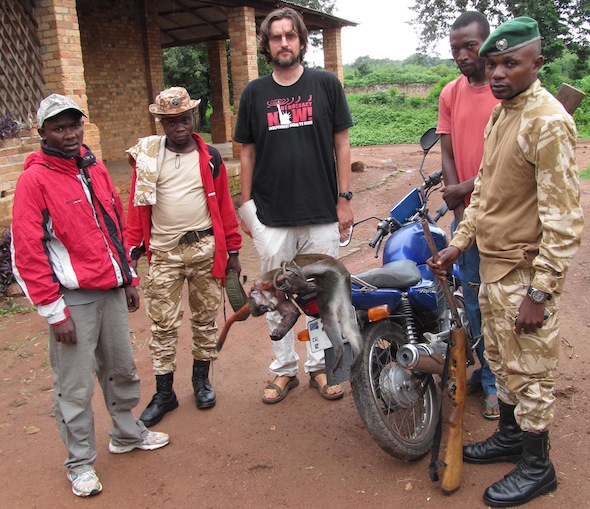
In addition, we found evidence that powerful outsiders were ignoring the closed hunting season, a period of several months in which it is forbidden by national law to hunt. The purpose of this closed season is to allow key prey species to recover. On the road between our forest camp and Bili, in the middle of this closed season, our guards came upon a man shooting a red tailed guenon out of a tree. They confiscated his gun and the monkey carcass and brought them to us. It turned out the gun belonged to a highly-placed government official in Bili. That man paid us a visit on the same night demanding that we return his gun. We refused to comply. Later, in a public hearing, he tried to explain to us why it should be permissible for powerful men like him to hunt any time they wanted to. We encountered similar incomprehension of or disrespect for basic Congolese law from a number of regional officials throughout the course of our stay in Bili.

4 confiscated monkey & shotgun

Our Ecoguards, Feruzi OPJ and Feruzi Yenga, confiscated this monkey and shotgun during the closed hunting season. The owner was a powerful governmental official.

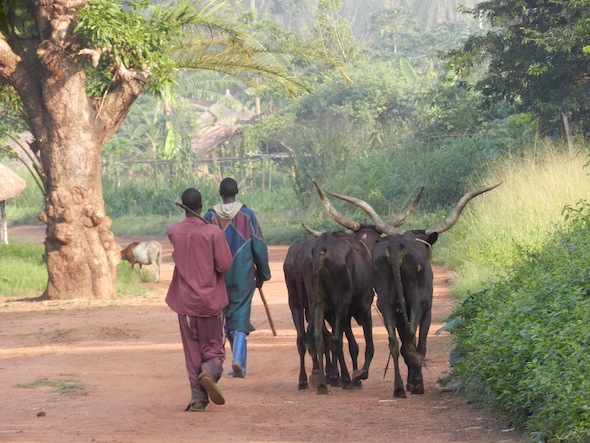
In late October, on our way out of Bili to Buta, we drove past a herd of 45 Mbororo cattle being imported into the lushly forested region. We had seen only a few very skinny cattle at Bili, but here, further south in the heart of the forest, domesticated animals were arriving in increasing numbers – out with the local fauna, in with the cattle, pigs, goats, and chickens. Arriving at Buta, we stopped at the headquarters of the highest-ranking regional military official, a man whom our team had confirmed owned a baby chimpanzee. Despite this, he was widely known to be professional and respectful in his dealings with civilians. He listened courteously to our complaints about his troops in Bili and said he would work to get them transferred, and that he would also send out a message to his soldiers not to buy baby chimpanzees. At least he listened to us and appeared to take our complaints seriously. I am under no illusions that this will change anything much, for the orphan Congo or the people of Bili, but I am convinced from what we have seen that the Congolese military are a crucial link in the illicit trade of protected wildlife species, from chimpanzees to elephants. The commander told us that he and his team had been recently trained at their base by military advisors from the United States, and he proudly showed us a certificate on the wall to prove it. Might this arrangement between foreign governments and the FARDC present us with an opportunity to spread to the Congolese troops the urgent message that they should be protecting, not cruelly exploiting, DR Congo’s priceless and world-famous endangered species?

5 bili cattle

Domesticated livestock are rapidly replacing the local fauna (above, Bili, below, Road to Buta)
6 cattle road to buta

7 male chimp gangu forest

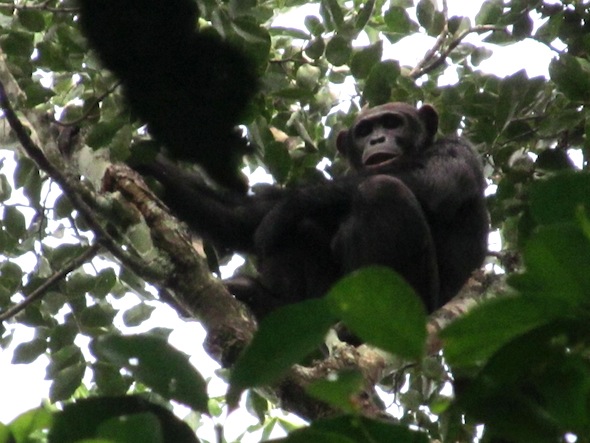
A majestic adult male chimpanzee in the Gangu Forest (photo © Ephrem Mpaka of Lukuru Wildlife Research Foundation). How can we keep him and his kind from ending up in the bushmeat markets? It may soon be too late for Gangu’s elephants (adult and juvenile mandibles found at a hunting camp).

Along the Bushmeat Highway: Part 1
Along the Bushmeat Highway: Part 2
Along the Bushmeat Highway: Part 3

This mission was made possible by the generous support of the Max Planck institute for Evolutionary Anthropology, The Lukuru Wildlife Research Foundation, The US Fish and Wildlife Service, l’ Institut Congolais pour la Conservation de la Nature, The Lucie Burgers Foundation, and The African Wildife Foundation.


Filed Under: Advocacy, Free-living chimps Tagged With: advocacy, animal protection, animal rescue, animal rights, Animal Welfare, bili, bushmeat, chimpanzee, chimpanzee sanctuary, Chimpanzee Sanctuary Northwest, dr. cleve hicks, FARDC, free-living chimps, lukuru wildlife research foundation, primate protection, primate rescue, wild chimps

Along the Bushmeat Highway: Part 3

May 26, 2013 by Debbie

This is the third installment of a series of posts from Dr. Cleve Hicks. Cleve did his PhD research in the DRC studying chimps in the Bili Forest. Read Part 1 of this story and Part 2 first! (To add some context to the story, look at the map of the “Bushmeat Highway” here).

—

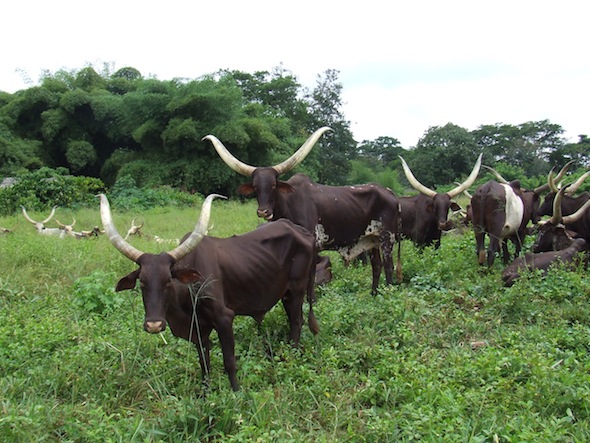
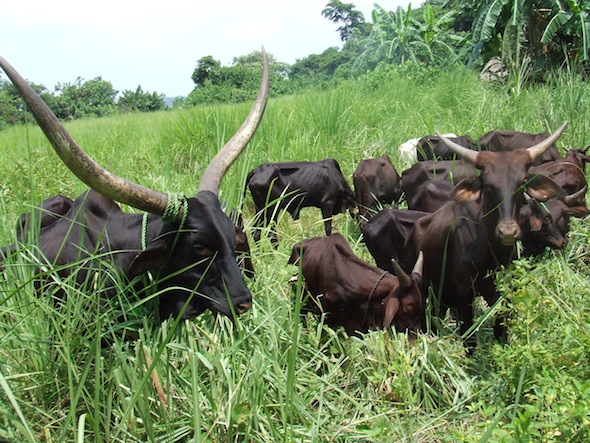
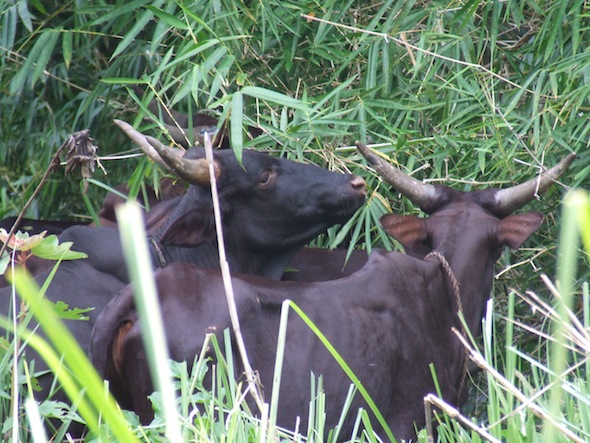
Our stay in Titule was prolonged an extra day due to an illness suffered by one of our Ecoguards. Fortunately we were able to sleep at the house of my old friend Chief Mangay of Lebo. Upon departing from Titule, we veered north towards Bili, crossing the mighty Uele River on pirogues. Villagers on the south bank of the Uele proudly showed us a large eagle they had captured from its nest. On the north bank of the river, we left behind the continuous cover of forest to the south and entered into savannah / forest mosaic territory. This road was, as it had been in 2006, much less heavily trafficked than the roads to the south of the Uele. Not only did we see no monkey or duiker carcasses or monkey orphans, but just to the north of the Uele we got of first glimpse of free-living monkeys in the trees above the road: a black and white colobus and a bit further along a tree-full of chittering red-tailed guenons. Lukuru researchers Ephrem Mpaka and Gilbert Paluku had noticed the same pattern (no monkey or duiker meat) on their trip from Buta to Bili two days earlier. This was encouraging, but there were also signs that times and circumstances were changing. In the north bank riverside town of Lisala, as we stopped to snack on binyes (simple concoctions of flour, sugar, and palm oil), we were confronted with a bustling herd of long-horned cattle, about 15 in number, munching on bamboo and riverside herbs. They were being herded by local Congolese, whom we were told had recently bought them from Mbororo herders to the north. We watched the bovines munch their way through the roadside forest and the lush vegetation lining the Uele River. Are these cattle destined to replace the abundant hippopotamuses that forage under the cover of night along the river’s edge?

MbororCattleUele

A large herd of cattle purchased by local Congolese from Mbororo herders, on the north bank of the Uele River, Lisala.

CattleEatBambo

Cattle feasting on bamboo at the forest edge.

Further to the north, in the shadow of a collapsed bridge across the Api River, we were told by a local man that Mbororo herders were massed just 30 km away from us, with tens of thousands of cattle ready to sweep across the savannahs. In their wake, he claimed, sometimes travelled child soldiers of the dreaded Lord’s Resistance Army (although according to him, the two groups were not friends). Later, as we travelled north, we would hear from a number of Azande that the Mbororo would frequently raid their fields for crops, leading to pitched battles. Such observations reinforced my impression of an inherent contradiction in the policy of the authorities of Northern DRC. Government officials were both sending military to confront Mbororo herders but at the same time buying cattle from them. Where this will lead is impossible to say.

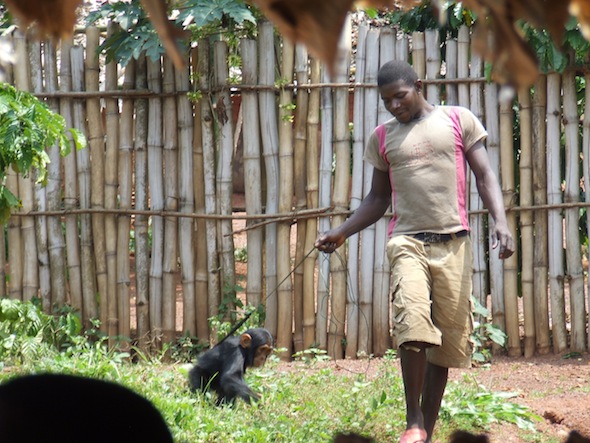
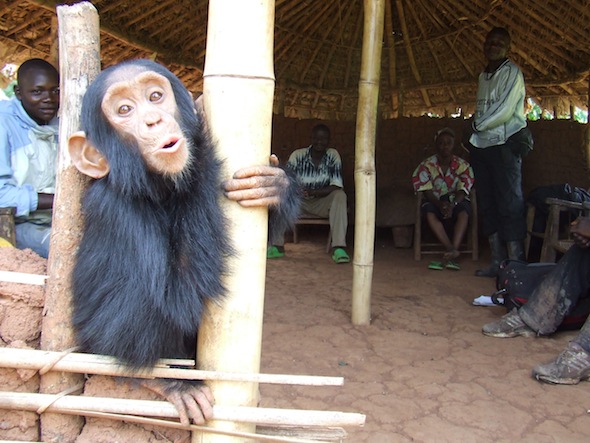
Sadly, although commerce in monkeys and duikers seemed to be much less common in this region, as was the case at Bili 5 years ago, we did hear the distressing news that the traditional chief of Lisala was keeping an orphan chimpanzee at his house about 1 km north of the Uele River. In the past, we had received a number of reports of orphan chimpanzees having been captured from this narrow belt along the north bank of the Uele River. Henri and I paid the chief a visit. Henri carefully explained the ICCN mission and asked the chief if we could see the orphan. He sent someone up to his house, and in a few minutes we heard a shrill, near-human scream. Shortly after, we watched as a tiny infant chimpanzee was dragged down to the paillote on a leash. I readied my camera and began taking photos as the orphan was placed onto a bamboo pole beneath the chief’s paillote.

On my previous mission south of the Uele River I had looked into the desperate eyes of over 35 orphan chimpanzees, but one never really gets used to the shock of it—the unimaginable sense of loss and helplessness registered in those haunted, searching brown eyes. Although in the past we had been able to save a number of the orphans we had encountered on our travels, today there was nothing I could do for Lisala, only photograph him as he raised his eyes skyward and emitted a plaintive pant-hoot to which he will never hear a response.

Henri got the story of Lisala’s capture from the chief: about two months ago, in the forest about a two hours’ walk east from the town, a group of local bow-hunters came across a party of chimpanzees. According to the chief, the apes fled in terror, abandoning the baby for the hunters to capture. This is often the story given, but I find it extremely unlikely that a mother chimpanzee would desert her baby. Far more likely, she was shot for bushmeat, which the chief would not want to admit to the ICCN. Indeed, Lisala had a vivid red bruise on his right brow ridge, possibly acquired when he tumbled out of the trees clutching onto his dying mother.

LisalaOrphan1

LisalaOrphan2

LisalaOrphan3

Lisala the orphan chimpanzee, kept by a traditional chief just north of the Uele River.

The hunters presented the baby as a gift to the chief. Now the chief wanted cigarettes and / or money from us for the privilege of seeing his baby chimpanzee. We politely deferred, of course, and went into our standard speech about the danger of keeping chimpanzees as a pets, and the damage that such a practice inflicts on populations of free-living apes. As we left his parcel, the chief called out after us in Lingala as a parting shot: ‘Ezali mabe te – ey ko batela mboka ya mokondji!’ (It isn’t a bad thing – he will guard the chief’s village!’).

As we sped northwards on our motorbikes, I was left with a heavy heart. There are only a limited number of times that this tragic situation can repeat itself before the African forests will be emptied of our closest evolutionary cousins. We have little time left to come up with a solution.

LisalaOrphan4

What can we do to keep this tragedy from repeating itself over and over again?

A few hours and a couple of motorbike breakdowns later, near sunset, we crossed into the hinterlands of Bili, 12 km south of the town center. We stopped to stretch our sore backs and munch on some soft pink peanuts offered us by a friendly villager. A tiny and rather brazen kitten approached us and made fast friends with Karsten. We wondered what awaited us in the frontier town just over the horizon. The last time I set foot in Bili was over five years ago. Although at that time bushmeat was certainly consumed locally, there was little evidence that, with the exception of ivory, it had become linked to the commercial trade networks proliferating rapidly to the south. But will the situation remain the same in 2012? We shall see…

BiliWoman

The outskirts of Bili at sunset.

Along the Bushmeat Highway: Part 1
Along the Bushmeat Highway: Part 2

Also by Dr. Cleve Hicks, The FARDC ‘Petting Zoo’ at Bili

This mission was made possible by the generous support of the Max Planck institute for Evolutionary Anthropology, The Lukuru Wildlife Research Foundation, The US Fish and Wildlife Service, l’ Institut Congolais pour la Conservation de la Nature, The Lucie Burgers Foundation, and The African Wildife Foundation.

Filed Under: Advocacy, Free-living chimps Tagged With: advocacy, animal protection, animal rescue, animal rights, Animal Welfare, bushmeat, bushmeat orphans, chimpanzee, Chimpanzee Sanctuary Northwest, dr. cleve hicks, eyes on apes, free-living chimps, primate protection

  • Page 1
  • Page 2
  • Go to Next Page »

Primary Sidebar

Subscribe To the Blog and Get Notified of New Posts First!

Archives

Calendar of Blog Posts

June 2026
S M T W T F S
 123456
78910111213
14151617181920
21222324252627
282930  
« May    

Categories

SUBSCRIBE TO OUR NEWSLETTER

Footer

PO Box 952
Cle Elum, WA 98922
[email protected]
509-699-0728
501c3 registered charity
EIN: 68-0552915

Official DDAF Grantee

Menu

  • The Chimpanzees
  • Blog
  • About Us
  • You can help
  • Resources
  • Contact
  • Donate

Proud Member of

Connect With Us

Search

Copyright © 2026 Chimpanzee Sanctuary Northwest. All Rights Reserved. Site by Vegan Web Design