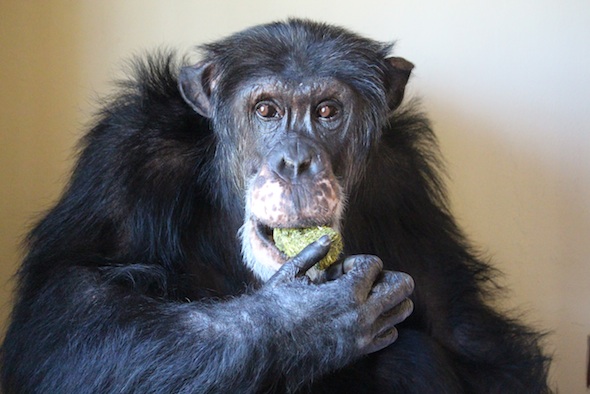
Annie and Missy are a couple of old ladies. They don’t seem to know this, however, so let’s not tell them and we’ll just hope they never find out.
Rituals
It’s 6pm. We’ve given the chimps their dinner, spot cleaned the playroom, passed out fresh blankets for nesting, and finished our long closing checklist to make the sure the chimps are safe, comfortable, and secure overnight. Each of the chimps is either finishing their after dinner food puzzle or settling into their nests for the evening. It’s time to call it a day. But we can’t leave until the boss gives us the OK and that can get complicated when your boss is a 37-year-old chimpanzee with a cowboy boot obsession.
Sure, it’s possible to just close the door and leave, but we’d be walking away from one very frustrated and potentially angry chimpanzee. Because when she goes to bed, she needs to take certain boots with her, and it’s our job to figure out which ones she is after.
Tonight, it took three staff members to model all her current favorites. We danced, did the moonwalk, and pirouetted for her. One particular pair grabbed her interest, and as I held them up near the caging, she began to groom them.
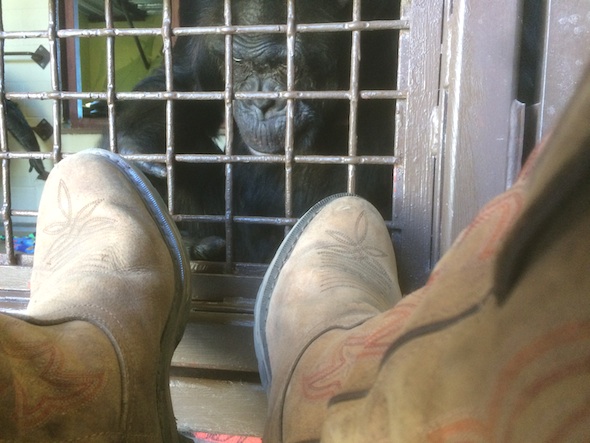
The grooming turned into tickling as I did my best attempt at chimp laughter (chimp laughter is akin to hyperventilating and can have similar consequences if humans do it too long or too enthusiastically).
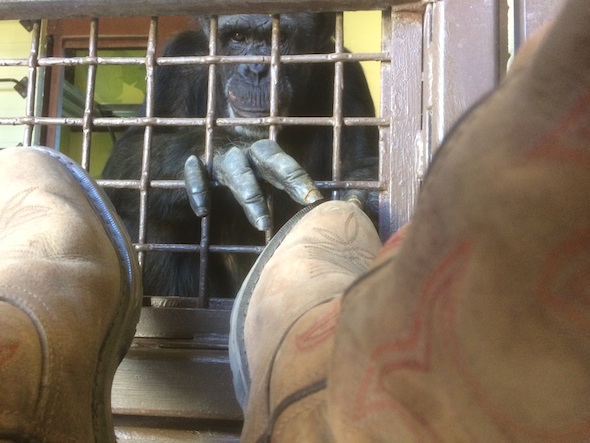
You can tell when Jamie is finally satisfied. She lets our a low moan of approval and echos the nest grunts from her family as they bed down throughout the playroom. She begins to build her own nest by surrounding herself with blankets and weaving them into the caging.
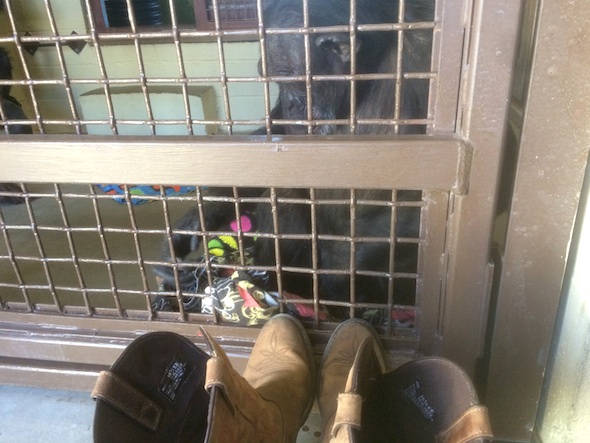
Then, and only then, are we allowed to leave. But not with the boots – those stay with the boss.
Reconciliation
Every once and a while, there’s a little more tension in the group than usual. Fights break out more often, and when they do, they result in more injuries. But chimps have a mechanism for dealing with this tension.
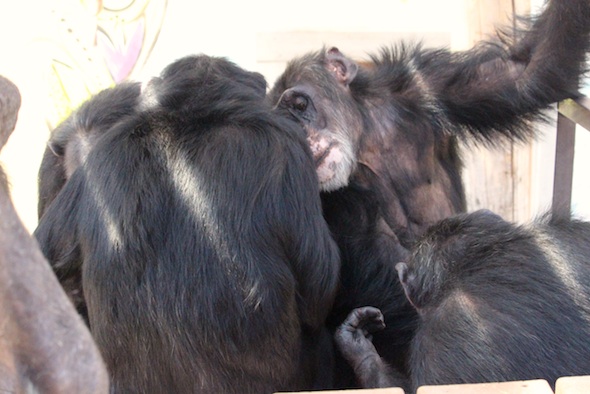
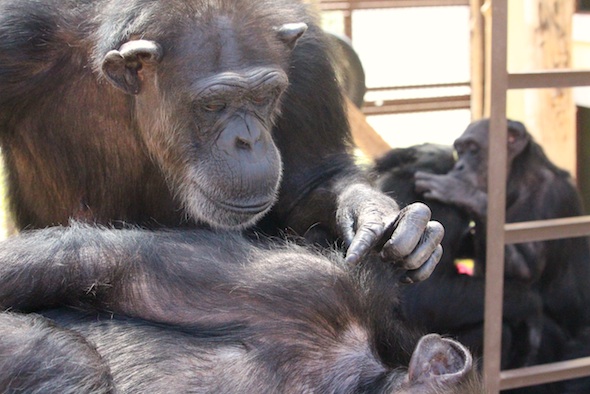
After a big conflict last weekend, they’ve been working hard to reestablish their relationships through grooming.
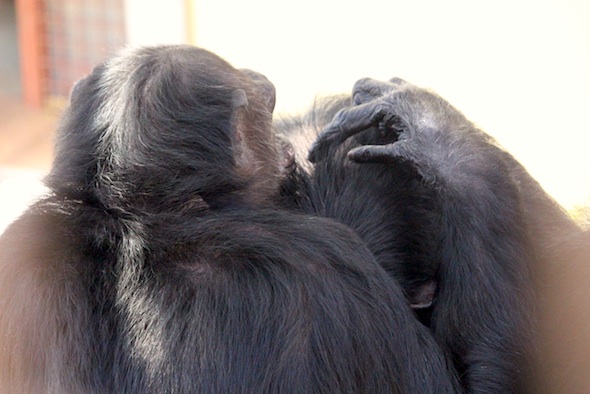
Chances are, some of the wounds they are grooming on each other are wounds they themselves inflicted.
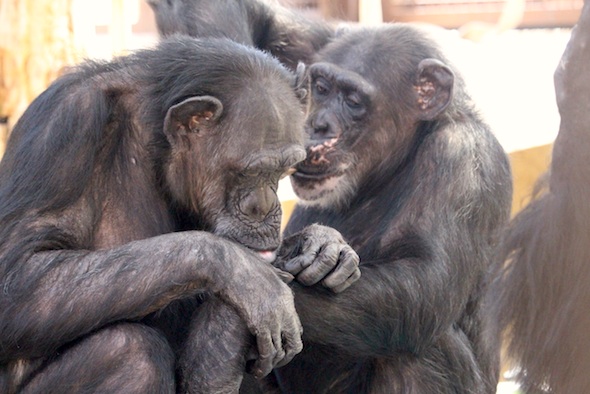
But that’s life for a chimp. You fight, and you make up. Then, maybe, you fight again.
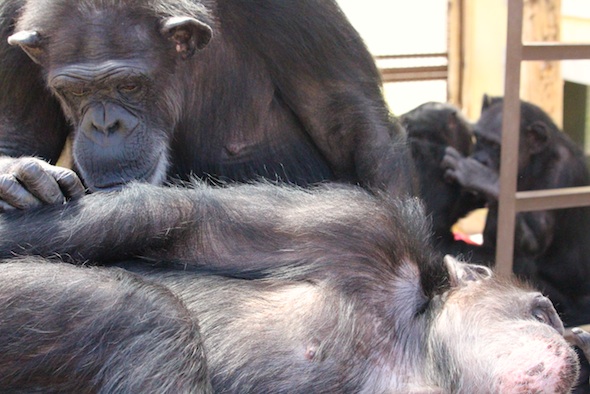
But you always make up.
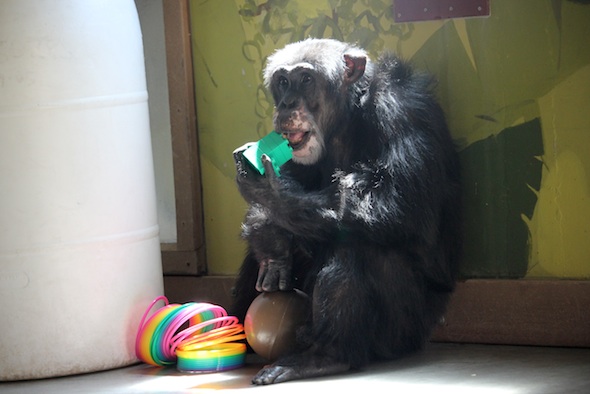
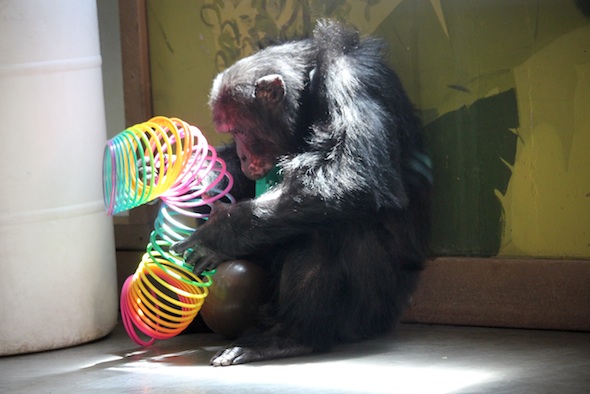
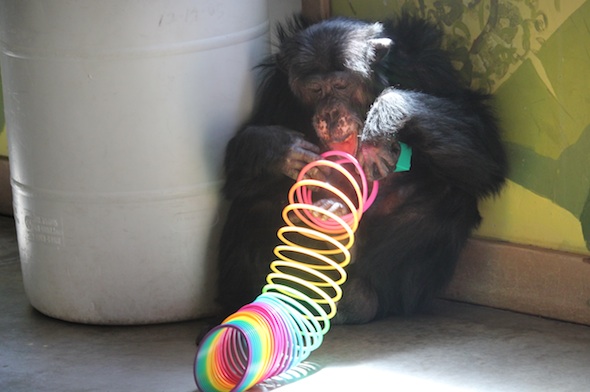
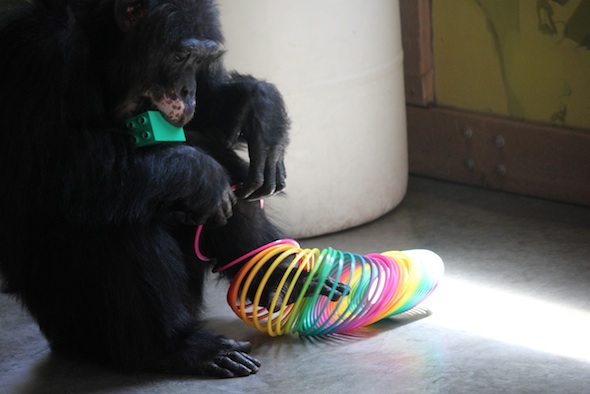
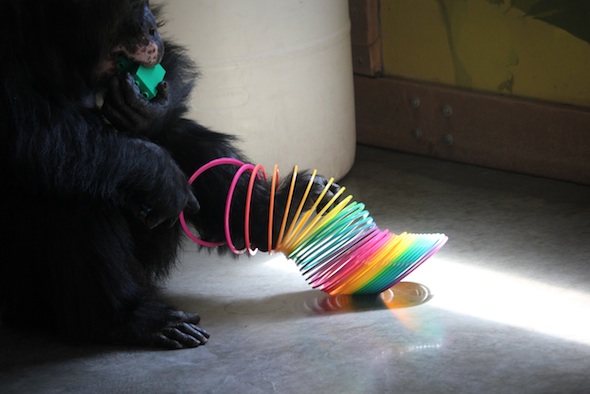
Burrito and his slinky
Night owl
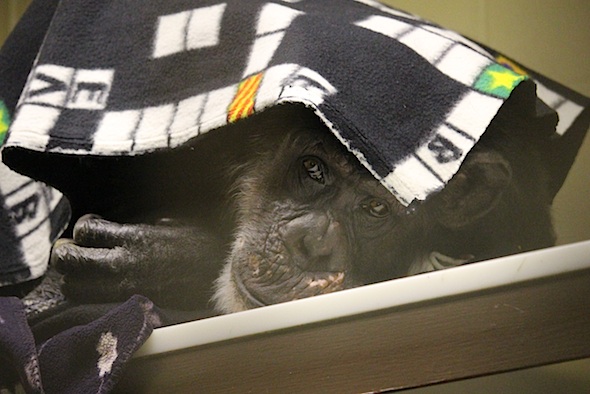
Chimpanzees spend a lot of time in their nests. In the wild, they tend to bed down at dusk and remain there for about 12 hours until the sun rises again. On average, they sleep for 9 to 10 hours, waking now and again throughout the night and even calling to group members in other trees but rarely leaving their nests.
Here at the sanctuary, most of the chimps follow a similar 12-hour nesting pattern, even though the length of each day here in Central Washington changes drastically with the seasons. On a typical day, the chimps eat dinner at 4:30 and get their evening food puzzles at 5:00. When they are done eating, they begin to make their nests indoors, and almost everyone is in bed by the time we’re wrapping up our workday at 5:30. This is true even in the summer when it stays light outside until 10:00!
Once the chimps are inside for the night, we close off Young’s Hill for security reasons. But if any of the chimps choose to stay outside, two staff members stay at the chimp house until the chimps choose to come back in.
Jamie, as you may have heard, is not like the other chimps. She needs very little sleep, and she has no interest in lying awake in her nest for hours counting sheep. So, being the clever chimp that she is, she figured out that all she has to do is stay outside after dinner or even sit in the doorway to Young’s Hill and, just like that, she has two companions for the rest of the evening.
When she keeps her caregivers here late, she usually does three of four purposeful walks around Young’s Hill, much like her daytime patrols. But eventually, even she grows tired of the walks and it becomes obvious that she’s just killing time to keep her human friends around a bit longer.
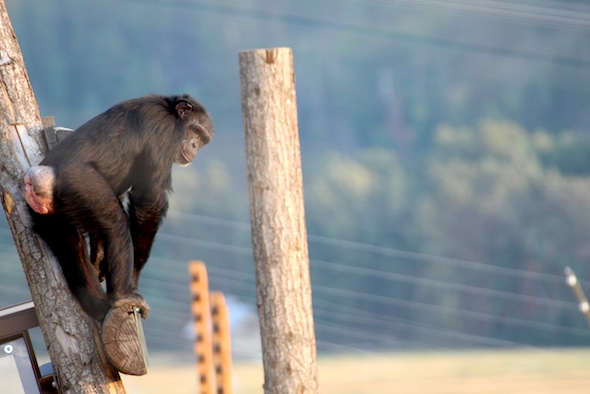
On our last walk last night at 8pm, she made a point of climbing every structure on the hill.
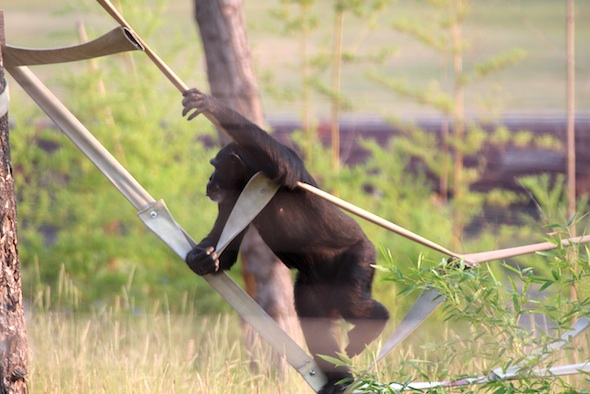
She crossed every fire hose bridge.
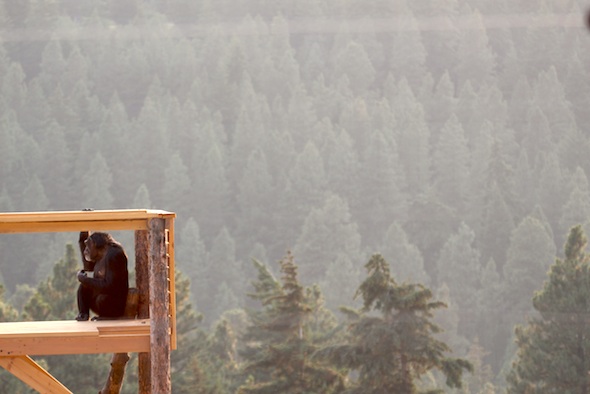
Finally, she sat quietly at the highest point on the hill and took in the view.
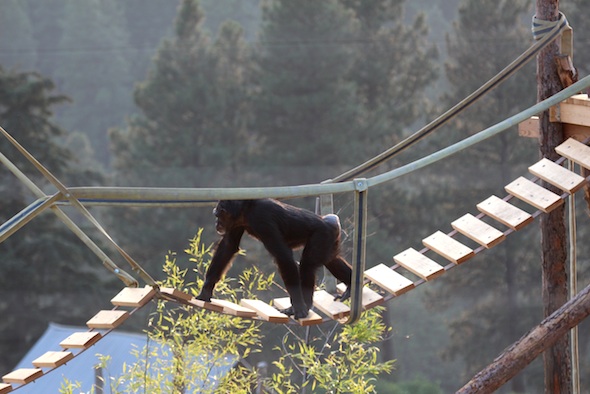
When she decided that she’d had enough, she climbed down and returned to the chimp house.
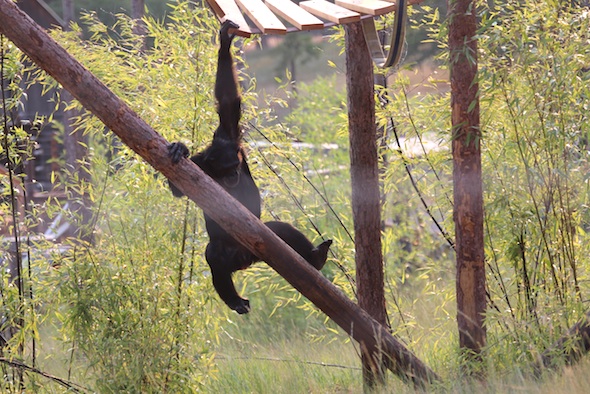
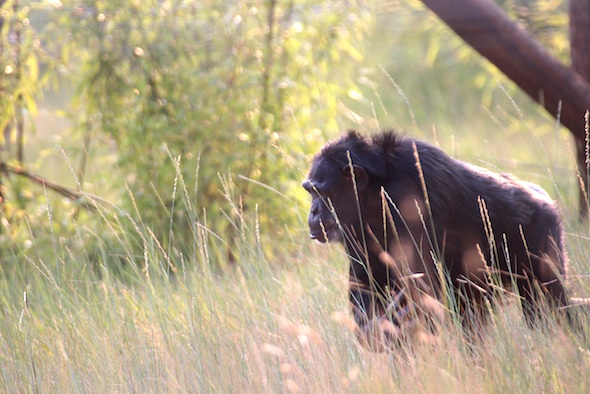
Even Jamie needs to sleep eventually. Which is good, because her caregivers do too.

Negra braves the heat
It’s difficult to catch Missy in an action shot because she moves so fast.
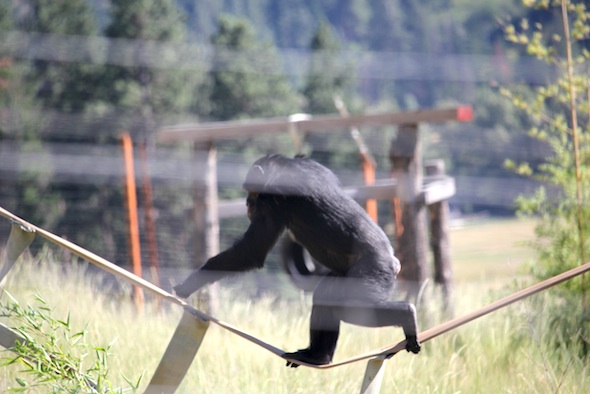
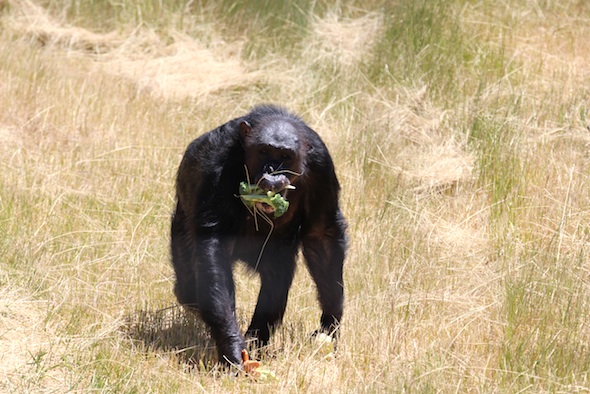
It’s even harder to catch Negra in an action shot because…well, she’s just not very active. But even temperatures in the high 90’s couldn’t stop Negra from parkouring her way through Young’s Hill, troll in hand, to grab some broccoli and cauliflower during today’s lunch forage.
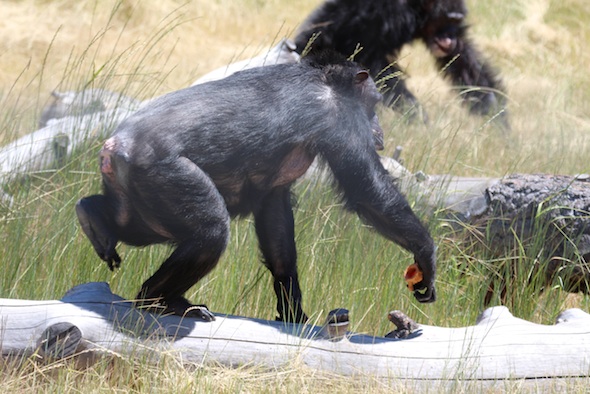
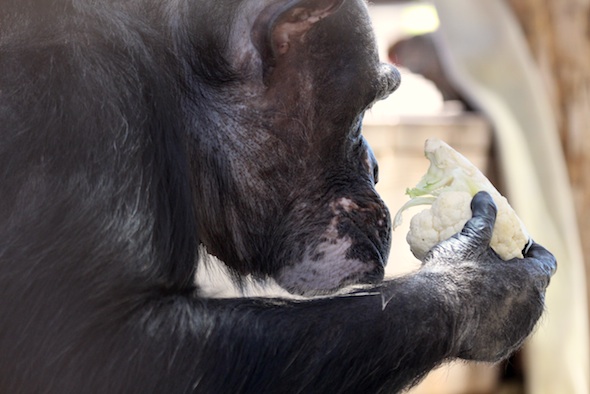
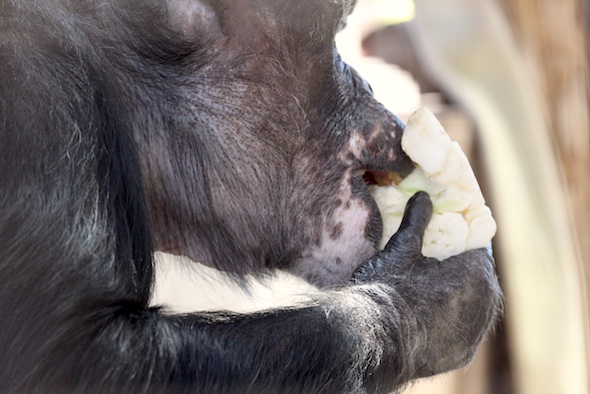
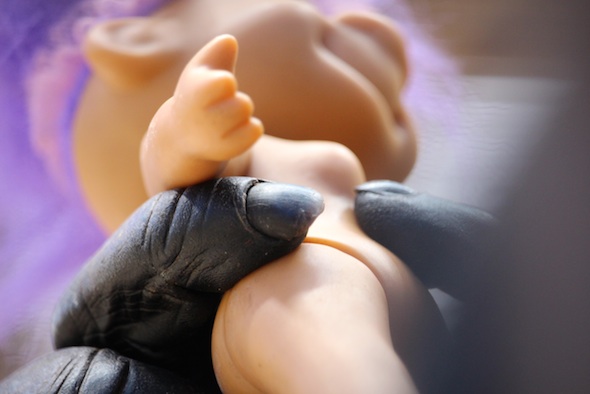
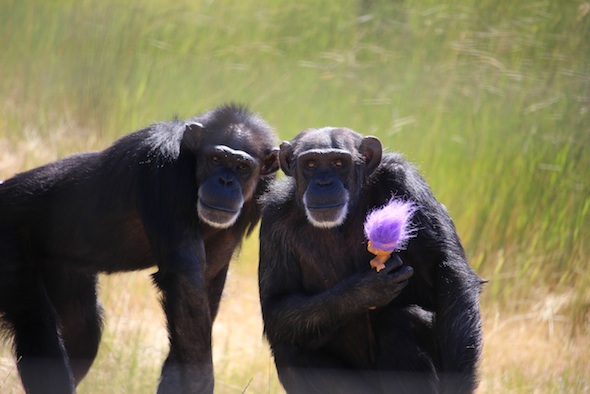
Foxie has been holding on to a new troll with its purple hair still intact. She treasures these while they last (Jamie and Jody usually rip the hair out).
Speaking of hair, a lot of people have trouble telling Annie and Foxie apart, so here’s a good side-by-side shot to help you out. Annie looks like someone just rubbed a balloon on her head. Not unlike a troll doll, come to think of it.
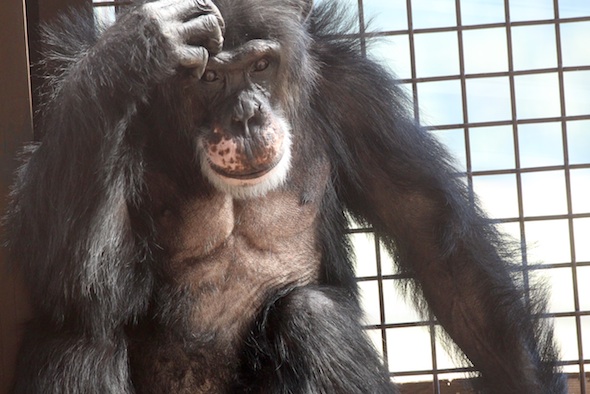
And Burrito has been showing off a bit more of his physique, thanks to his recent exam. Don’t let anyone tell you that you can’t build muscle on a diet of fruits and vegetables. Your results may vary, however, unless you also stick to Burrito’s daily workout routine that includes leaping, swinging, and banging on everything in sight as you terrify everyone around you in a formidable dominance display and then running for your life as six angry girls chase after you.
Burrito’s exam
Recently, Burrito fractured a canine tooth. We don’t know how it happened exactly – in fact, we only became aware of the injury when we noticed it pointing straight out of his mouth, perpendicular to his other teeth. As with other significant injuries, we began by administering oral antibiotics and pain relievers and arranged for our local veterinarian, Dr. Zamzow, to come take a look. Dr. Zamzow then consulted with Dr. Mensching, also a veterinarian and a member of our board of directors, and Dr. Bezner from Save the Chimps, to come up with a plan to deal with Mr. B’s broken tooth.
If you don’t know this already, I should point out that chimpanzees are remarkably tough. Believe it or not, Burrito never missed a meal, and didn’t even seem to favor that side of his mouth when chewing. It’s really hard to appreciate how stoic chimps can be until you witness it yourself.
Despite his own lack of concern about the injury, a broken tooth can present serious risks for more severe pain and infection down the road, particularly the canines which are large and deeply rooted, so we decided that it would have to be repaired or extracted by a veterinary dentist. But as you may know, Burrito is already being treated for symptoms of heart disease, and that makes decisions about medical interventions a bit more complicated due to the risks of anesthesia. But when an intervention is required, for whatever reason, it presents an opportunity to learn more about his overall health, so we gathered an amazing group of people to help with Burrito’s treatment. And it was all made possible because you helped us build an onsite veterinary clinic.
Before we can make any decisions about how the treat the tooth, we need x-rays. Yesterday, two vet techs from Valley Veterinary Hospital in Ellensburg came to the sanctuary with digital radiography equipment to get pictures of his teeth and jaw. These x-rays will be shared with a board certified veterinary dentist, who has agreed to come to our clinic to treat Burrito, whatever that treatment may be. And because of our concerns about Burrito’s heart, we were grateful to have the assistance of a huge team of veterinary cardiologists, anesthesiologists, residents, and vet students from the Washington State University Veterinary Teaching Hospital, all led by Cardiologist Dr. Lynn Nelson.
After receiving anesthetic injections inside the chimp house, Burrito was wheeled to the mobile clinic where he was intubated and placed onto gas anesthesia for the procedures. The anesthesiologists were able to ensure his safety by monitoring his airway gases and reading his vitals using ECG, blood pressure, temperature, and pulse ox equipment. Dr. Zamzow drew blood for CBC and chem profiles and obtained an urine sample.
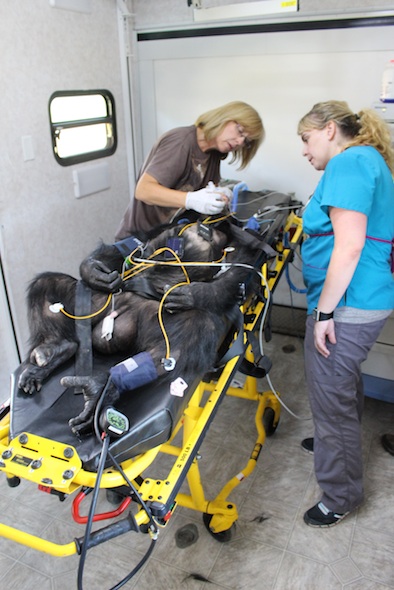
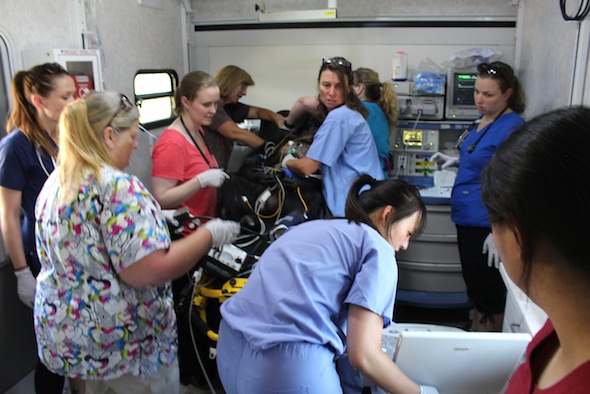
With such a huge group of people, teams worked in shifts as much as possible.
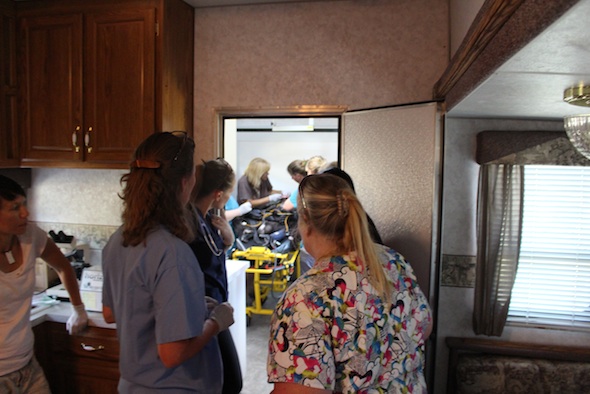
But the clinic turned out to fit more people than we had expected. Technicians obtained dental x-rays while the cardiology team began the echocardiogram.
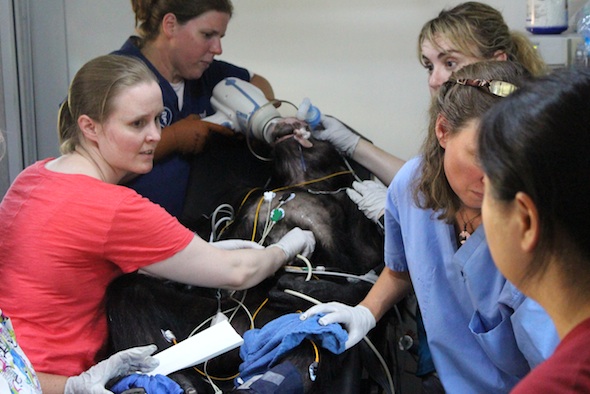
This imaging of Burrito’s heart will help us evaluate his initial diagnosis and may potentially provide avenues for better treatment. It will also help us determine how well he might handle the anesthesia required for a longer dental procedure. We will share the information we obtain with the Great Ape Heart Project to help improve the lives of other captive chimpanzees.
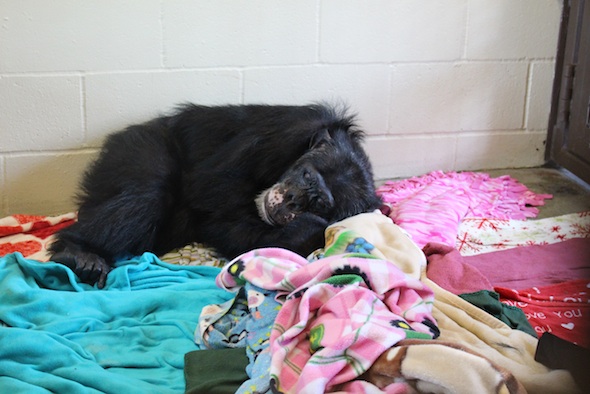
When the tests were complete, Burrito was placed back inside into one of the front rooms to recover from the anesthesia. The girls had to wait outside in the greenhouse until he was ready to deal with all of their excitement.
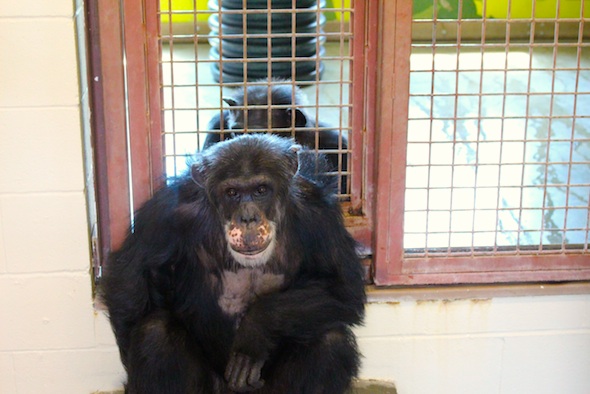
After a few hours of rest, he was ready for visitors on the other side of the caging. Jody and Foxie were particularly concerned about their buddy, but eventually all of the girls came to groom him through the bars. For his safety, he was not allowed to return to the group until he was 100% recovered from the anesthesia.
Both the general and injectable anesthesia can upset the stomach and make you feel all worn out, so Burrito took an additional day to lounge around by himself, waited on at all times by his staff of caregivers.
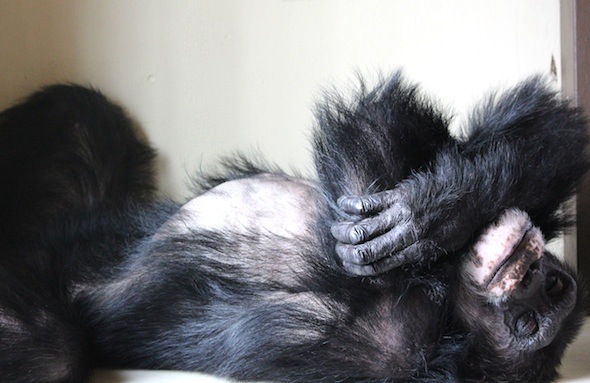
With the help of some anti-nausea medicine, he was feeling good enough this evening to join the gang for a dinner forage on the hill.
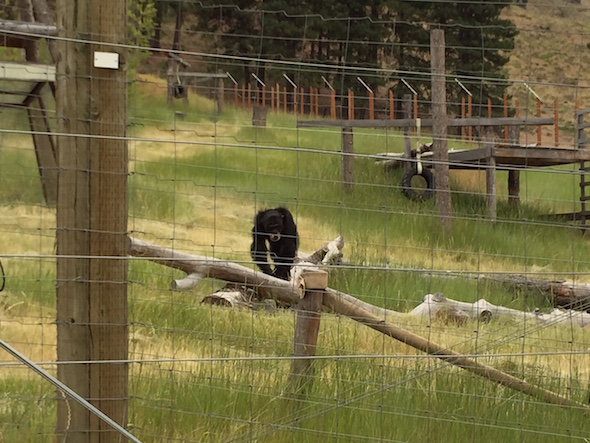
In the coming weeks we will learn more about Burrito’s health from these tests, and the veterinary dentist will be able to decide the best coarse of action based on his x-rays and what the other tests tell us about his ability to tolerate prolonged anesthesia.
Exams like this aren’t easy on a chimp, and they’re pretty tough on the people who care about them too. We owe a huge debt of gratitude to Dr. Zamzow, Dr. Mensching, Dr. Bezner, Valley Veterinary Hospital, and the WSU Veterinary Teaching Hospital for providing the best care a chimp could ask for. And to everyone who helped us build and equip our onsite clinic: You made it possible for him to receive this level of care. And I know you would agree that this guy deserves nothing less.