• Skip to main content
  • Skip to primary sidebar
  • Skip to footer

Chimpanzee Sanctuary Northwest

Hope. Love. Home. Sanctuary

  • Our Family
    • The Chimpanzees
    • The Cattle
  • Blog
  • About Us
    • Visiting the Sanctuary
    • Philosophy
      • FAQs
      • Mission, Vision & Goals
      • Privacy Policy
    • The Humans
      • Staff
      • Board of Directors
      • Founder
    • Annual Reports
    • The Future of CSNW
    • CSNW In The News
  • You can help
    • Donate
      • Become a Chimpanzee Pal
      • Sponsor A Day
      • Transfer Stock
      • Be A Produce Patron
      • Be a Bovine Buddy
      • Give from your IRA
      • Personalized Stones
      • Bring Them Home Campaign
    • Leave A Legacy
    • Employment Opportunities
    • Volunteer
    • See Our Wish List
    • Events
  • Resources
    • About Chimpanzees
    • Enrichment Database
    • Advocacy
      • Advocacy Action Center
      • Apes in Entertainment
        • Trainers
        • Role of the AHA
        • Greeting Cards
      • Chimpanzees as Pets
      • Roadside Zoos
      • Chimpanzees in Biomedical Research
      • Conservation
        • African Apes
        • Orangutans
  • Shop
    • Merchandise Store
  • Contact
  • DONATE NOW

conflict

Q&A: Why Cy is Missing a Finger and Other Notes on Chimpanzee Aggression

December 29, 2025 by J.B.

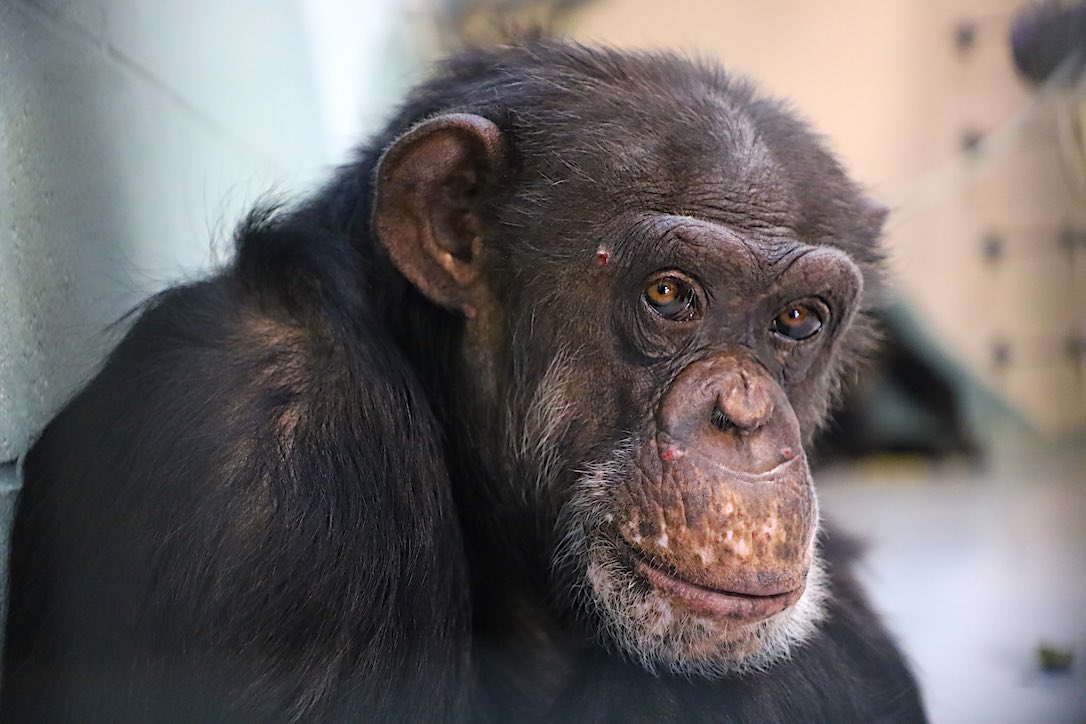
Recently, we invited you to submit your questions. Joshua wanted to know: Why does Cy have only three fingers and a thumb on his left hand?

The short answer?
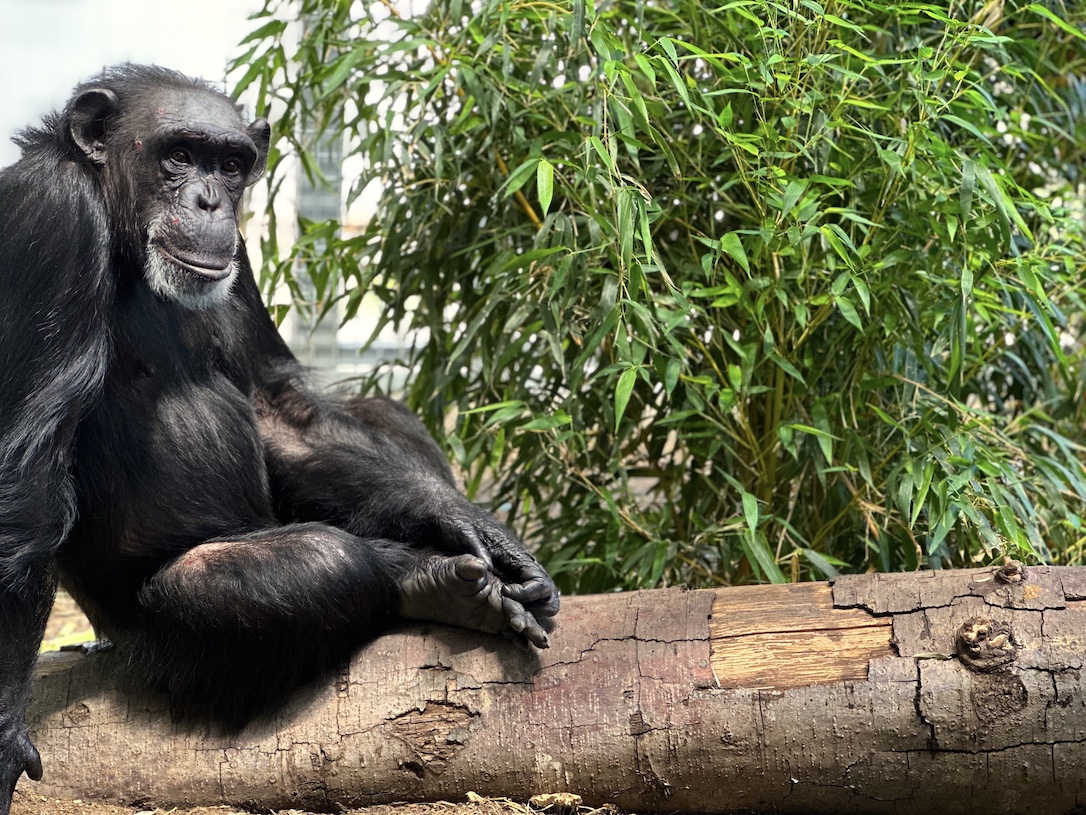
“No regrets.” – Rayne

As far as we’ve been told, Rayne bit off or severely injured the third digit of Cy’s left hand at some point during their time at their previous home in California. As to why she did it (if the accusations are indeed true), we need to step back a bit.

Chimpanzees can be incredibly aggressive. And I don’t mean traumatized research chimpanzees can be aggressive or chimpanzees kept in captivity can be aggressive. I mean that natural selection has endowed all chimpanzees, to varying degrees, with a capacity for aggression and a tendency to utilize it to achieve certain ends. In other words, it’s a normal part of being a social chimpanzee—a tiny fraction of their overall behavior, to be sure, but an important one.

When discussing aggression in chimps, we typically differentiate between intergroup and intragroup aggression. Intergroup aggression, or the violence directed at chimpanzees in other communities, has the distinction of being far more lethal. These attacks, often the result of stealthy raids into neighboring communities, are understood to be part of an evolutionary strategy to guard or gain access to territory (and thus resources such as food or potential mates). Intragroup aggression, on the other hand, tends to be a way that chimpanzees—particularly late adolescent and adult males—determine rank or status within the community. Lethal aggression does occur within communities (often in the form of infanticide or the overthrow of the alpha male) but at about half the rate of that between groups.

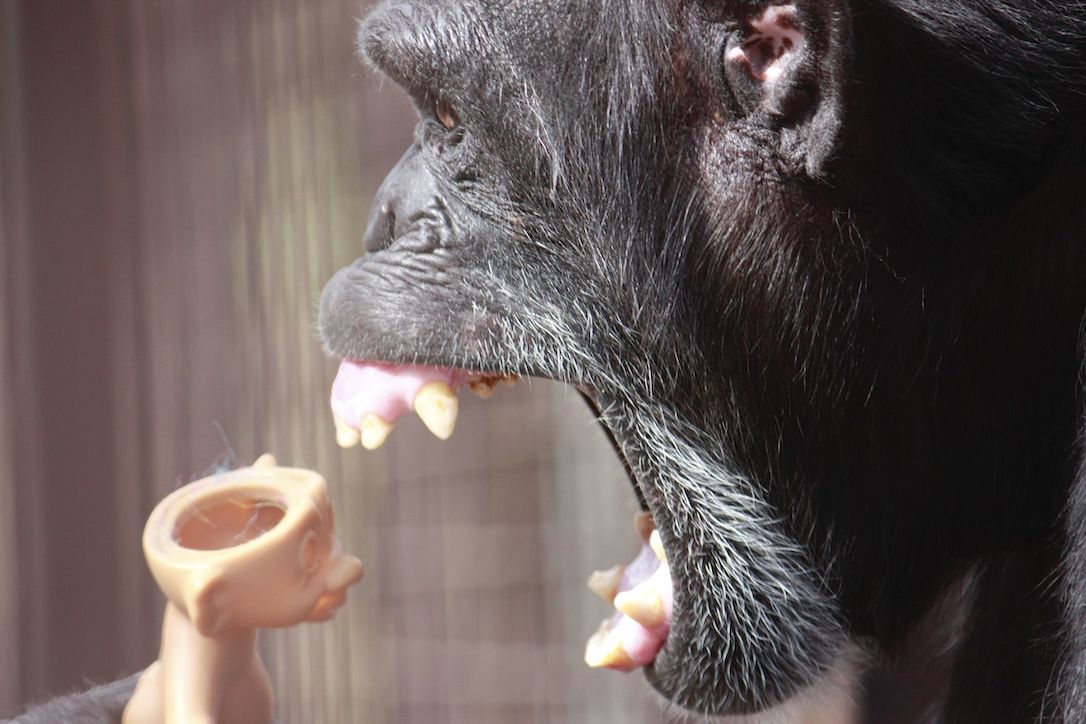
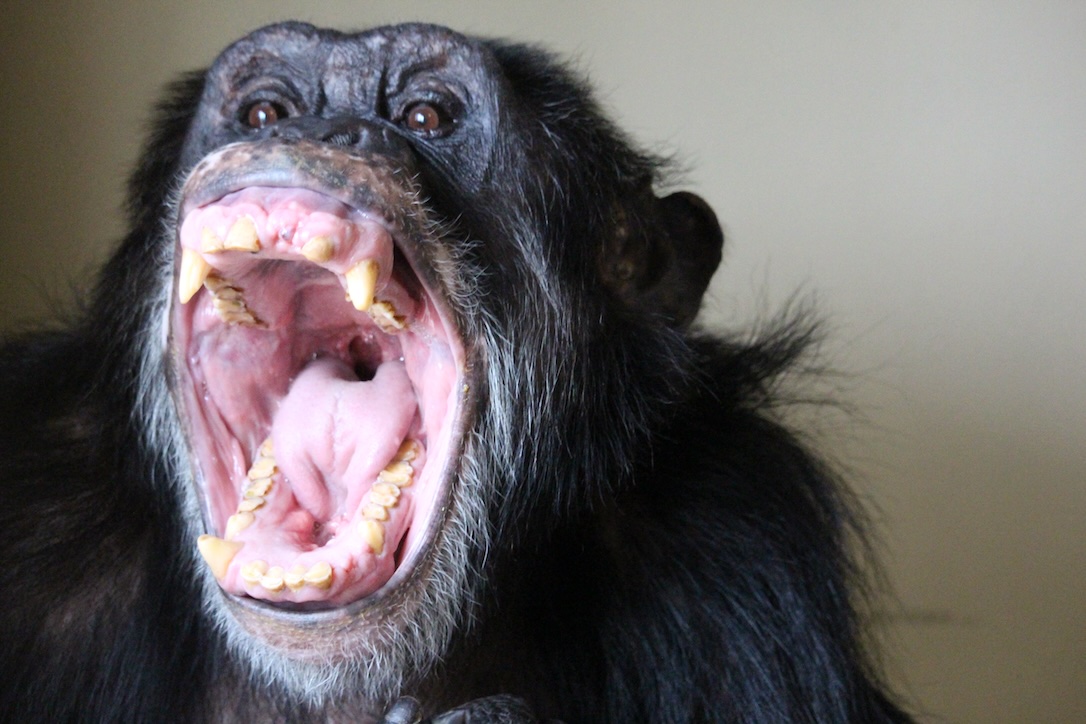
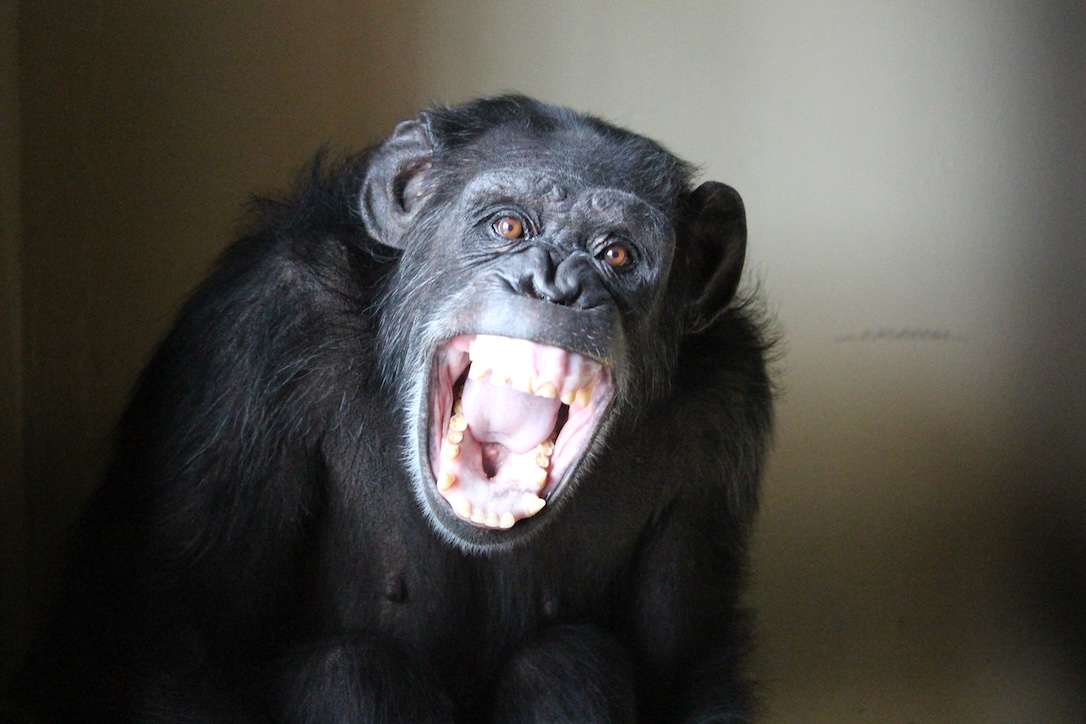
It’s almost impossible to describe to someone who doesn’t work with chimps just how violent chimpanzee fights can be. Their strength, speed, and agility are literally superhuman. Their screams and cries are deafening. And they can be seemingly ruthless, quite often ganging up on more vulnerable chimps. While their muscular arms and legs are used to grapple and pin, their ultimate weapons of choice are their large teeth and powerful jaws, which open wide enough to accommodate most any body part of an intended victim—though they usually select ears, fingers, toes, and, in cases of more extreme violence, genitalia.
Life for captive chimpanzees is very different from that of their wild counterparts. They don’t have the same kind of territories to defend, nor do they have the potential to acquire new resources by raiding and killing. But natural selection doesn’t typically endow us with knowledge of why we behave the way we do; instead we’re simply primed to behave in ways that tended to benefit our ancestors (humans are no exception to this). And captive chimpanzees are often presented with situations that stoke those very same intergroup prejudices—most notably, during social introductions. When we are integrating groups—or even riskier, adding a single chimpanzee to an established group—we have to overcome that same hostility toward outsiders that drives wild chimpanzees to attack and kill their neighbors. And this is where we may see the most severe forms of aggression. At CSNW, it once lead to a conflict in which one participant, Honey B, had to have her toe amputated, and another, Burrito, had to be castrated due to the severity of the wound to his scrotum. Neither injury was lethal, though in Burrito’s case it was largely because of timely veterinary intervention. In a way you could say that we’re fortunate, because chimpanzees have died in similar circumstances at many accredited zoos and sanctuaries. These are the stories that don’t always make it to social media, but instead are shared by keepers and caregivers over drinks at a conference hotel bar, finding comfort in others that understand what it is like to work in this crazy field.
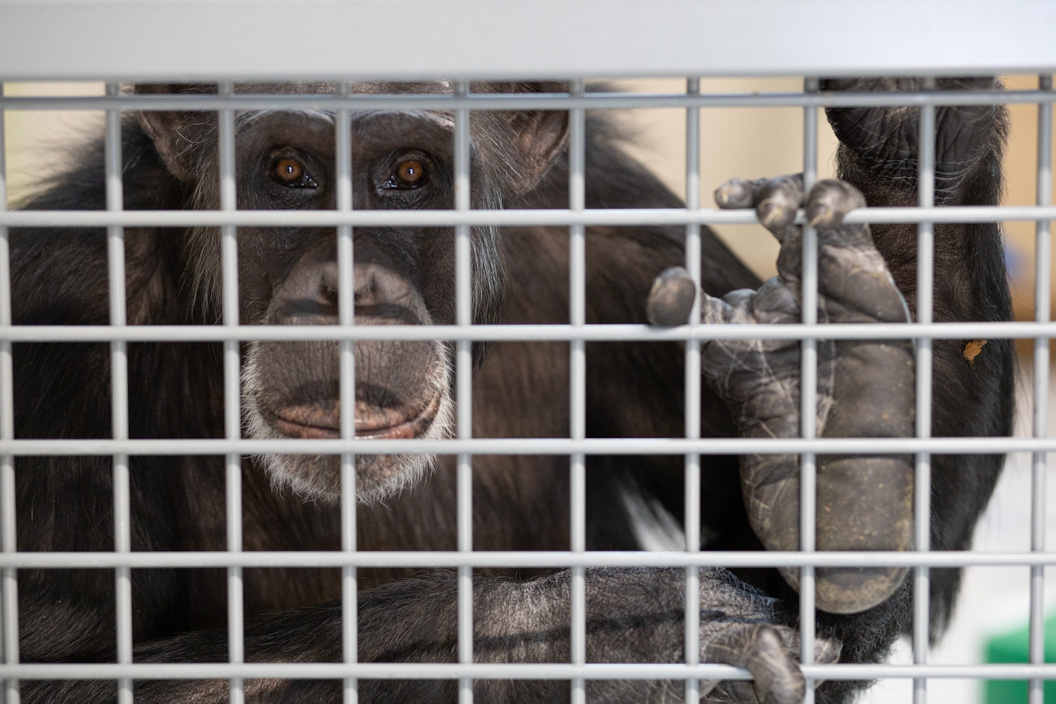
Honey B

More often, we are witnessing the almost commonplace kind of aggression that serves to establish rank, form coalitions, and settle scores. Chimps, like humans, are status-seekers. Status may come with tangible benefits, but status itself is an intrinsic benefit, one that is apparently worth fighting for. Because this form of aggression serves to clarify relative dominance, we tend to see somewhat less of it in stable groups and more in groups that are newly formed, lacking a strong leader, or undergoing a leadership transition. It also appears to be more common in groups with unusual compositions (in terms of age, sex, etc.) or ones with chimps that lack social experience. Regardless, wherever there are two or more chimpanzees, there will be at least the occasional fight. One study at an accredited zoo found that their chimpanzees were wounded in fights ten times per year on average. Thankfully, along with their superhuman fighting abilities, chimps possess a superhuman ability to heal and an equally superhuman tolerance for pain.

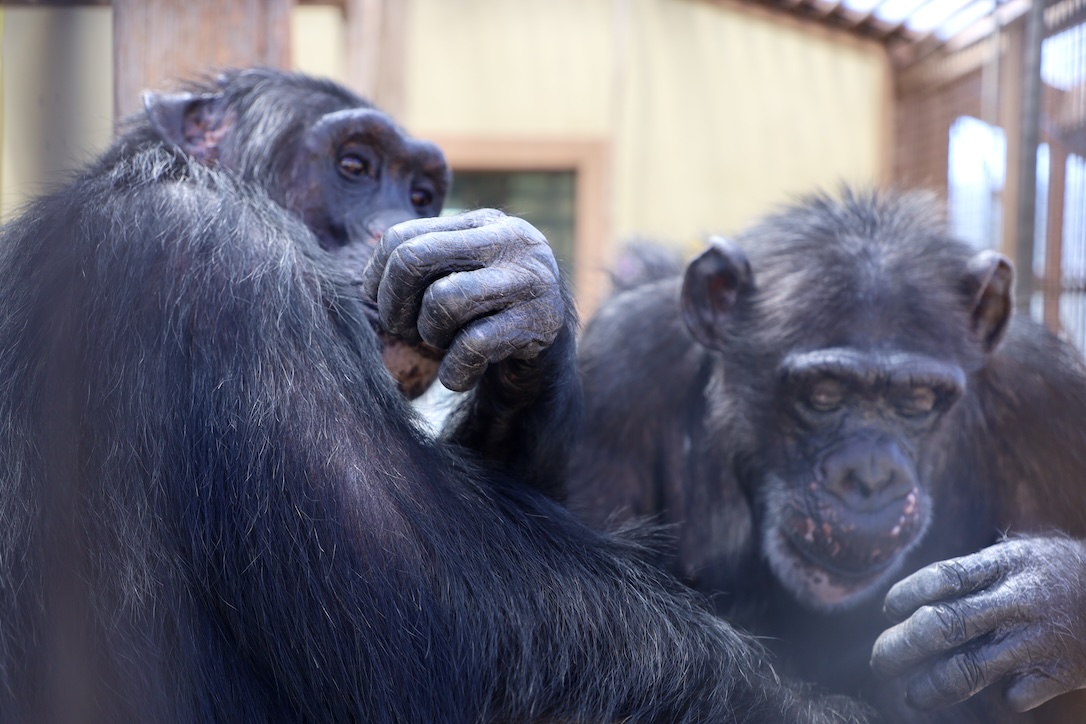
Jamie’s group has been together for over 18 years now. You’d think that they would have achieved some level of stability after all this time. But they epitomize the problem with a lack of leadership and atypical rearing. When they arrived from the lab, we did a quick inventory of missing ears and digits: Negra was missing half an ear, Annie’s ear was torn almost in two, Burrito was missing a fingertip, Missy was missing most of a pinky, and Jody was missing toes (though at least one was said to have been severed by a guillotine cage door). Those are just the ones I can think of off the top of my head. We do the same inventory of every group that we rescue, and relatively few adult chimpanzees arrive at sanctuary with all ears and digits fully intact—unless they, like George, lived largely alone.
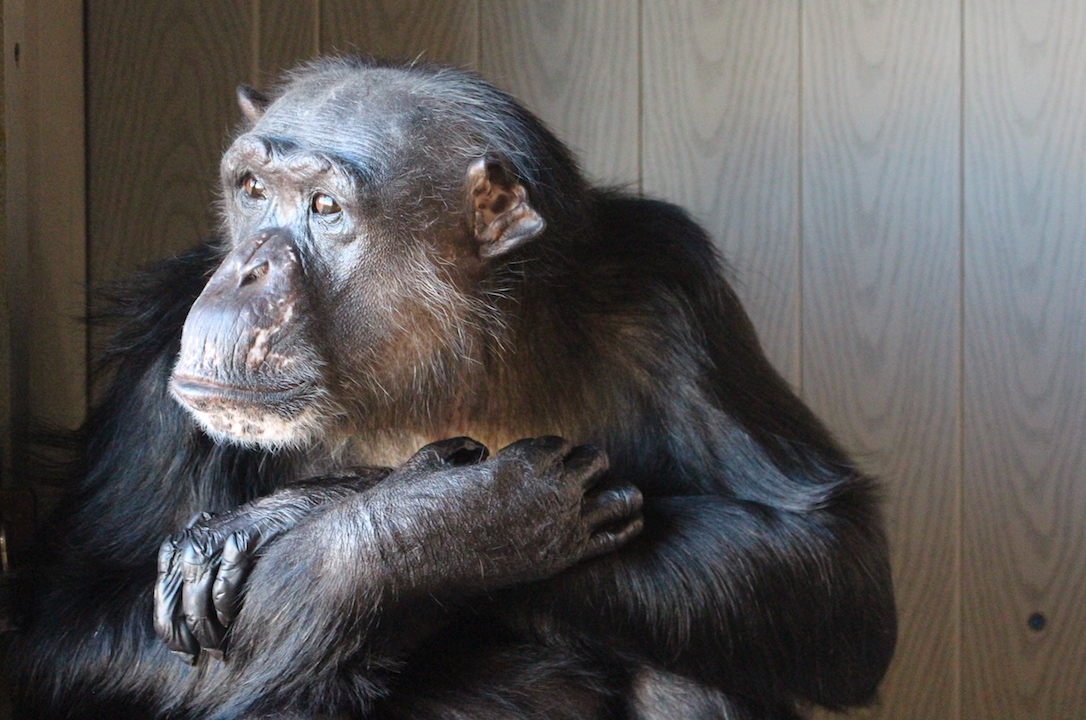
Negra
Missy (R)

We’ve done our fair share of repairs and amputations here at the sanctuary, beyond those of Burrito and Honey B. One morning, the chimp house was perfectly still until a shriek erupted from Front Room 4. We looked over to see Burrito fleeing and Foxie sitting there in shock, a chunk of her ear laying on the bench beside her.
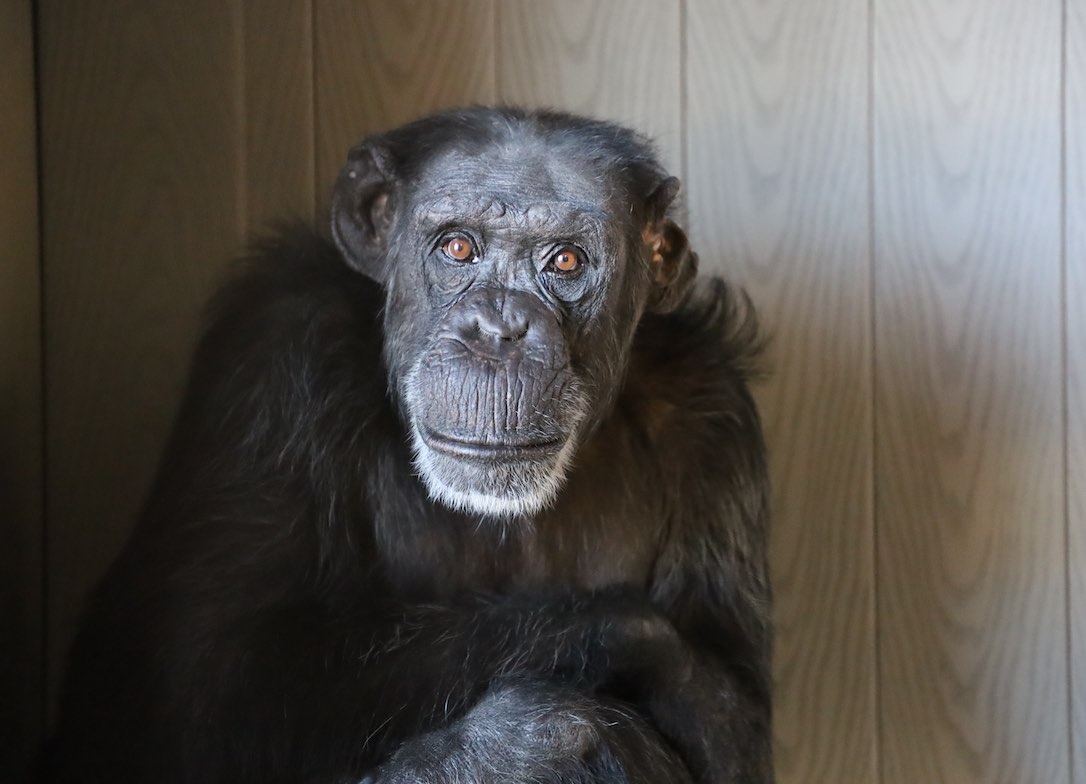
There’s a trap that I try to steer people clear of (and one that I have to try to avoid myself), which is to assume that every action that a chimpanzee takes is part of a grand Machiavellian drama; that each squabble is a deft maneuver towards some strategic aim. Did Burrito bite Foxie’s ear off because he wanted to outrank her? Was he trying to form an alliance with Jamie, who has positioned herself as Foxie’s chief antagonist? Possibly. That kind of thing certainly happens. But again, we have to bear in mind that the algorithm of natural selection has in many cases done most of the calculations for us in advance, and has left us with some rather dumb emotions to carry out all the work. Status might ultimately bring more food and more mating opportunities, but we start fights because we’re pissed. We overcompensate because we’re insecure. We anger others because we are socially inept. We gang up on the weak because we crave power. We ostracize those who are different because we want to belong. In other words, we can describe chimpanzee behavior in terms of ultimate causes, but as socially savvy as chimps are—and they are very savvy—the proximate cause for any given fight or injury is likely that they are bundles of emotions, both noble and ignoble, with the strength of several humans and teeth like railroad spikes.

As for Cy’s finger, I certainly don’t know what happened, but knowing him now, I’d be willing to place a bet: Rayne was going after someone she was mad at and Cy was injured trying to stop the fight. That’s the other thing about chimp fights, at least in captivity—they rarely end as they began and the chimp with the most injuries was probably not involved at the start.
Filed Under: Chimpanzee Behavior, Cy Tagged With: aggression, amputation, chimpanzee, conflict, fights, northwest, rescue, Sanctuary, wounding

Person of the Year

December 15, 2025 by J.B.

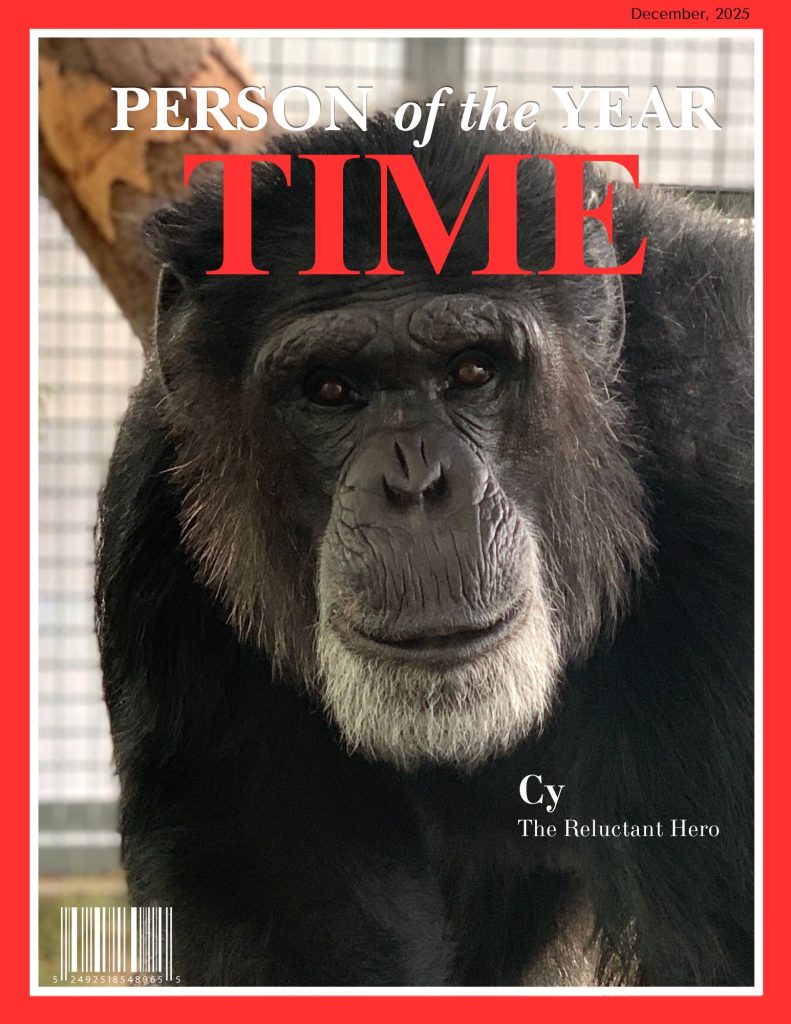
I’ve wanted to write about my admiration for Cy for some time but I can never find the words.

I guess I’ll start here: Yesterday, we added Terry to the intro group, along with Rayne and George. Terry and George had a few brief scuffles during their earlier meetings, which is one of the reasons why we chose to add Terry now—so that they can work out their differences before Terry has even more of his old group mates to back him up. The first few hours were quiet, with Terry making some awkward invitations to George to play and George politely declining out of an abundance of caution. But just before dinner, Jamie’s group began to fight, and the noise led Terry to display, raking a plastic bowl on the ground and banging on the walls. At first, George quietly observed and stayed out of Terry’s way. But a male chimp can only stay silent for so long, and he eventually joined in with his own double-kick to the window glass. Terry didn’t appreciate that.

In established groups, male chimps display side-by-side all the time, but it’s clear that many members of Cy’s group are out to teach George a lesson early on: You have not earned the right to display yet. As soon as George’s feet hit the floor, Terry screamed and ran after him. Rayne followed close behind. George was, for the first time, learning how it feels to be outnumbered.

As George was chased from the playroom to the greenhouse and back, Cy ran by his side, throwing his own body into the breach every time George was cornered. He picked Rayne up and threw her to the side. He dove to grab Terry’s feet as he nearly slipped away in pursuit of George. He was a superhero, again.

Terry and Rayne got the message and left George alone. Or maybe they said all they needed to say. But when it was over, George was virtually unscathed, and Cy had sustained a deep canine gash to the wrist. Throughout the night, Cy stayed by George’s side.

Why would Cy do this? To be sure, there are often selfish explanations for seemingly altruistic acts. I scratch your back so that you may one day scratch mine, right? But the way Cy acts reflects something deeper, something that I can only describe as a sense of moral duty. For whatever reason, Cy is duty-bound to sacrifice himself for the benefit of those more vulnerable than him. And this is not only an admirable trait, but a crucial component of any attempt to integrate a lone, socially naive chimp like George.

Today was much calmer, though George continued to show some understandable unease with the volatility of his new group mates (as seen in today’s video). But he had Cy to lean on. And Terry, in his own awkward way, showed that he didn’t hold a grudge. By the end of the day, they would all be grooming in the greenhouse, held together by a reluctant hero.

I’ve loved and felt a strong bond with a lot of nonhuman animals before. But I look up to Cy. And I wish there were more people, both human and non-, like him in the world.


Filed Under: Chimpanzee Behavior, Cy, George, Introductions, Latest Videos, Sanctuary, Terry Tagged With: alpha, chimpanzee, conflict, Cy, duty, morality, northwest, rescue, Sanctuary

Role Models

November 17, 2025 by J.B.

One of the reasons why we chose to introduce George to Cy’s group, at least to start, is that he needs some good role models. Having lived alone or with only one other chimpanzee for most of his life, he never had the opportunity to fully develop his social skills. And that can have serious consequences. Failure to follow the rules of a social group can get a chimp into trouble pretty quickly, especially when entering the group alone. We love Jamie and Willy B as people, but as leaders of their respective groups, they each leave a lot to be desired. They might be tough, but they are also insecure, capricious, and generally self-interested. I have a hard time imagining either of them sticking their neck out to defend a naive newcomer like George.

Cy and Rayne, on the other hand, are exemplars of true leadership. In addition to being tough, they are also kind, fair, tolerant, and forgiving. One way to think about the process that George is going through right now is that this is his chance to make mistakes. I hate to see him get in scuffles or to be in distress, but I can’t help thinking to myself: Screw up now George, it’s only going to get more difficult from here! We want him to offend Rayne when Rayne gets to decide how to respond, and not Rayne trailed by four other screaming chimps. We want him to learn about the privilege of dominance, and the price paid for disrespect, when Cy is the one doing the teaching.

George has proven himself to be up for the challenge of learning to be a chimp—as long as he keeps paying attention to his teachers.

Filed Under: Chimpanzee Behavior, Cy, George, Introductions, Latest Videos, Rayne Tagged With: chimpanzee, conflict, Cy, george, introduction, northwest, Rayne, reconciliation, rescue, Sanctuary

It’s Nothing Personal

October 13, 2025 by J.B.

Missy takes her job seriously. Like a hockey enforcer, her role is to aggressively protect her MVP, Jamie, and ensure everyone plays by the rules. But she’s also quick to reconcile after a conflict. After all, it’s nothing personal—she’s just doing her job.

Chimpanzees are actually quite well known for reconciling to maintain peace and repair relationships after conflicts. While chimpanzee fights can be loud, scary, and dangerous for those involved, opponents will often seek each other out almost immediately after a conflict to embrace, groom, and kiss. This may seem counterintuitive at first, but it demonstrates the value of social relationships in the chimp world.

Filed Under: Burrito, Chimpanzee Behavior, Foxie, Jamie, Latest Videos Tagged With: chimpanzee, conflict, fight, northwest, reconciliation, Sanctuary

Chimpanzee Dynamics – It’s Complicated

April 5, 2025 by Ellen Brady-McGaughey

As I was putting together videos for today’s blog, some playful moments between Foxie, Jamie, Burrito and Negra, I realized they presented a nice moment to highlight the complicated intricacies of chimpanzee politics and friendships. We have observed a lot of complicated and sometimes downright confusing moments as we have undergone the reintroduction process with the group of 9, constantly looking to understand their relationships and dynamics to determine next steps, but “it’s complicated” can be applied even in long-standing groups of chimpanzees like Jamie’s group.

Chimpanzees can be brutal. They fight and injure each other, and being low ranking within the group hierarchy can be a tough role to fill. Lower ranking individuals endure more stealing of things like food from higher ranking individuals, usually don’t get first access to the most exciting items (like more novel or high-value foods or enrichment), and can become the recipient of redirected aggression during conflicts within their group even when they weren’t initially involved because they are an “easy” target. Maintaining status as a high-ranking individual isn’t easy either, and depending on the individual and their strategy for maintaining status in their group, they may put themself in harm’s way more frequently in attempts to maintain or improve their rank. An example of this in action could be Willy B displaying and hitting Lucky as part of a dominance display, which then results in many chimps chasing and hitting at Willy B.

Chimpanzees are also capable of remarkable forgiveness and reconciliation, and form meaningful relationships that shape not only their own lives but greatly impact the lives of those around them as well. While the moments of fighting, aggression, and tension can feel very big for us as the humans caring for them, the chimpanzees are often quick to overlook another’s transgressions, and spend time grooming and playing to ease tension and build relationships. Being high-ranking is often not as simple as who is the biggest, strongest, or fastest. Relationships with the other chimpanzees can highly influence where an individual falls in the hierarchy, as friendships can translate to having support during conflicts (or a lack of support), and can limit or expand an individual’s aspirations for higher rank.

I say all that to say, witnessing moments of play between high-ranking and often imposing Jamie and low-ranking Foxie is all the sweeter when you recognize the complexities of their relationship. While Jamie can be intimidating and domineering, they can still find common ground and enjoy moments of play. Burrito and Negra too have a complicated relationship – they have a standing play time each day as they wait for us to finish cleaning their playroom, but Negra is also often a target for Burrito when he feels the need to display. While there are moments of tension, they enjoy many more moments of play and companionship. Being a chimp is just plain complicated!

Filed Under: Burrito, Chimpanzee Behavior, Display, Foxie, Friendship, Jamie, Negra, Play Tagged With: Burrito, conflict, Foxie, friendship, hierarchy, Jamie, Negra, politics, rank

Drama and Dora on the Bray

October 27, 2024 by Diana

I mentioned this incident in a comment on my blog post from last week. There was some interest from blog readers to see the footage of this fight in which Dora is interested enough to go onto the Bray, but apparently only wanted to watch, not participate, as she made a break for it when the intensity increased.

Dora can be a force when she does get involved in conflicts, so it’s just as well that she chose to stay out of it this time.

While fights are not uncommon, even in groups like Cy’s that fight more than the average, the amount of time they spend in conflict is minuscule compared the amount of time they spend in friendship.

Most of their days are filled with comfort and joy… which is why we are holding the third annual Comfort and Joy Quid Pro Throw online auction from October 31 – Nov 20. We will be adding items throughout, so check in daily.

*New this year* – if you register for the Comfort and Joy online auction, you’ll be a guest (virtually) at Lucky’s birthday on November 6th! So, don’t delay, register today.


Filed Under: Chimpanzee Behavior, Dispaying, Display, Dora, Education, Fights, Latest Videos Tagged With: Bray, comfort & joy online auction, conflict, dora, fight, video

Superhero

December 4, 2023 by J.B.

Two things to note before you watch the video below:

  • The video shows the chimps fighting. If that’s not your cup of tea, we understand.
  • If you choose to watch, you must do so with the sound on so you can hear the narration that attempts to explain some of what you will see. The chimps will be loud at first but we’ll turn down the volume on the screaming and pant-hooting early on in the video.

Showing the chimps in your care fighting may not be what they teach in nonprofit PR/fundraising school, but I’m always hopeful that people can learn to understand and appreciate chimps as they are while continuing to support them and the sanctuaries that care for them. Sanctuary life is filled with fun, happy moments. To a lesser extent, it also contains unsettling, even terrifying moments. They are still chimps, after all.

As I mention in the video, we are often of two minds in this job. First and foremost, we are caregivers, fretting over each bump and scrape the chimps receive and agonizing over every decision we make with regard to their care. This is the mind we inhabit in the midst of a conflict. But we are also primatologists and enthusiastic observers of chimp behavior. We are the people that, like many of you, were glued to Jane Goodall documentaries as kids and who find the complexities of chimpanzee social dynamics endlessly fascinating. And as I watched the footage of this conflict, I felt my 20-year-old self, just entering the field, marveling at each and every interaction. Perhaps you will feel the same.

If by chance you are new to Chimpanzee Sanctuary Northwest, this group is the result of the integration of two smaller groups: A group of six, led by Cy, and a group of three, led (mostly) by Willy B. Almost immediately after their integration in 2022, Willy B accepted Cy’s dominance and established himself as the #2. But Willy B does not have Cy’s social skills, and from time to time that can get him into trouble with a few others in the group.

Similar to what is seen in the literature, the rate of conflict in this larger group hasn’t gone down all that much since the initial integration; it ebbs and flows and at times it may even be higher. But the conflicts are shorter and result in fewer injuries (I don’t believe in jinxes, I don’t believe in jinxes, I don’t believe…). This conflict was unlike most in that it lasted a long time; as I say in the video, this is likely because of Gordo’s unique inability to calm down. Prior to the integration of these two groups, Gordo would occasionally get this upset with Cy. Cy, having nearly unlimited patience, would just let himself be chased by Gordo until Gordo eventually wore himself out. But that was a low-ranking male venting at the alpha, who clearly felt no threat to his own safety or status. Here, the relationships between the lower-ranking males is less well-defined. And thus the stakes are higher.

There’s an important caveat that I should mention here: I describe some of what I think I’m seeing, but any time I read a matter-of-fact description about relationships and behaviors as complex as those in chimpanzees, my BS detector starts to go off. Half the time we just don’t know or we drastically oversimplify things. So let me admit that up front. And this, I should add, is with the benefit of instant replay and slow motion—now maybe you can see why we say we don’t always know what happened in real time when the chimps get in fights.

Oh, and another one: Cy gets top billing in this blog post and he certainly has the most influence over the outcome, but boy that Honey B has some guts. And there are so many other interesting interactions that I didn’t touch on, many of which are also influential. Alpha males always get the headlines while the females quietly do much of the work. But this alpha sure did put on a show.

This video also doesn’t include what happened after the fight, which in some ways is the most interesting and important aspect of chimpanzee relationship formation and maintenance.

I could probably go on all day about this so I’ll stop here. Feel free to ask questions!

Filed Under: Cy, Fights, Friendship, Gordo, Honey B, Latest Videos, Rayne, Sanctuary, Terry, The Bray, Willy B Tagged With: aggression, alliance, chimpanzee, conflict, fight, friendship, hierarchy, northwest, rescue, Sanctuary

  • Page 1
  • Page 2
  • Page 3
  • Go to Next Page »

Primary Sidebar

Subscribe To the Blog and Get Notified of New Posts First!

Archives

Calendar of Blog Posts

June 2026
S M T W T F S
 123456
78910111213
14151617181920
21222324252627
282930  
« May    

Categories

SUBSCRIBE TO OUR NEWSLETTER

Footer

PO Box 952
Cle Elum, WA 98922
[email protected]
509-699-0728
501c3 registered charity
EIN: 68-0552915

Official DDAF Grantee

Menu

  • The Chimpanzees
  • Blog
  • About Us
  • You can help
  • Resources
  • Contact
  • Donate

Proud Member of

Connect With Us

Search

Copyright © 2026 Chimpanzee Sanctuary Northwest. All Rights Reserved. Site by Vegan Web Design