Change can be hard for George, but it’s a little easier now that he has a family. Watch as he relies on his new friends for comfort while navigating a positive but unexpected change in the routine.
With a Little Help From My Friends
Chimpanzee Sanctuary Northwest
Hope. Love. Home. Sanctuary
If you think too much about the interplay between mathematics and behavior, you start to feel like Neo from The Matrix.* Reality as you know it begins to dissolve and, slowly, something else comes into focus:

Equations. Code. The Matrix. A complex web of ledgers and calculations that influences nearly everything we do.
Some calculations are built into an animal’s DNA and are carried out without conscious awareness. Take kin selection, for example, which explains why we and other animals might act against our own self-interest to help our relatives. We take this drive for granted—of course you help your family!—but at first blush it seems to run counter to the cold, unforgiving calculus of natural selection, in which our own genes have evolved to “selfishly” replicate themselves. That is, until you remember that there’s more than one way for our genes to survive and reproduce. After all, we share roughly half of our DNA with our siblings, a quarter with our nieces and nephews, an eighth with our cousins, and so on. When animals help relatives at cost to themselves, they may still be promoting their own genes’ reproductive success—provided they help the right relatives in the right proportion. Biologist J.B.S. Haldane had his tongue firmly planted in his cheek when he said, “I’d lay down my life for two brothers or eight cousins,” but this same idea, formulated as a biological rule, can be used to predict behavior as disparate as which orphans will be adopted by which red squirrels and how humans will behave in economic games. It’s behavior, explained—in part—by math.
Not all heritable predispositions can be reduced to equations so neatly, but if you squint you can still see the tally marks on the ledger. As I mentioned in a previous post, chimps tend to exhibit different rates of lethal violence depending on whether the victims are members of their community or strangers from a neighboring community. The benefits to killing a neighbor are clear: less competition equals more food and mating opportunities. And the costs are limited to the potential injuries a chimp might sustain during the attack. But what about aggression within the community? If dominance is beneficial, why not kill your way to the top? Well, for one thing, you’d be awfully lonely when you got there. Chimps live in communities because they benefit from group living. Community members help find food and raise offspring, they signal when predators are near, and they assist in territorial defense. To reference another movie: APES TOGETHER, STRONG.** The costs and benefits of aggression relative to the benefits of cooperation in these different circumstances have been calculated over millions of years of evolution and have resulted in feelings, emotions, and tendencies that favor ingroups while treating outgroup members as things to be kidnapped or eliminated.
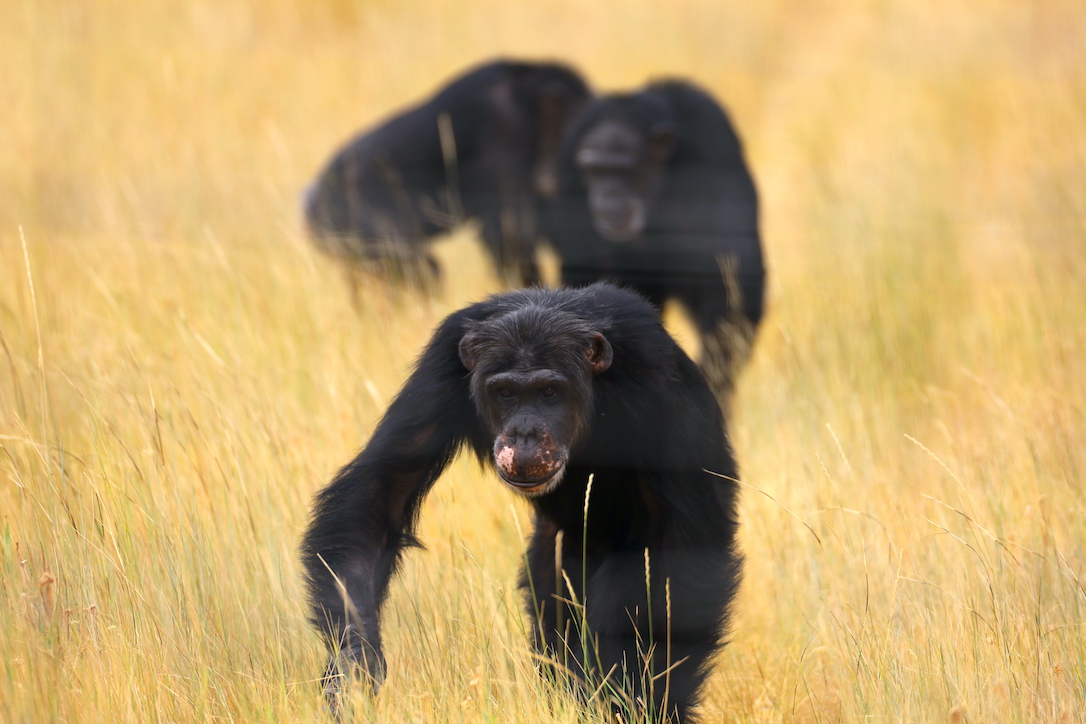
In these cases chimps are acting largely unconsciously on the math of natural selection, but there are times when they are most definitely doing the calculating themselves. Territorial patrols are a good example of this. As Craig Stanford writes in The New Chimpanzee:
A patrol begins when a group of males breaks off from some other activity and makes a beeline toward parts unknown. The males travel with increasing caution as they approach the territorial border…The males appear to be on edge, freezing at distant sounds to listen intently before continuing. They begin to show intense interest in objects that might be evidence of the enemy, stopping to examine and sniff stick tools, leaf wadges, nests, and feces. But the patrol may penetrate further, making a deep incursion in to enemy territory. The tension is palpable as the males continue for hundreds of meters before turning back. On most of the patrols I accompanied at Gombe in the 1990s, such a deep incursion ended with the males freezing when they heard distant calls from the enemy community, then wheeling around and racing back into the home range, whereupon they hooted and displayed as though venting the emotional tension of their mission.
He writes:
Chimpanzee intercommunity conflicts are really raids. A party from one community attacks one or a few individuals from an adjacent community, usually in the overlap zone of their territorial boundaries. Such attacks may be carried out strategically when the attackers detect an imbalance of power. Ten chimpanzees rarely engage in a battle with ten or more enemies…So male chimpanzees monitor their territorial boundaries, picking and choosing their battles based on their perception of when a critical mass in their ranks can successfully challenge neighbors. [emphasis mine]
Like humans, chimpanzees may be endowed with behavioral predispositions but they don’t act on instinct alone. They are always crunching the numbers—and in the case of patrols, performing calculations based off of evidence, like detectives investigating a crime scene. Nine fresh nests and a chorus of pant-hoots in the distance—we’d better turn back. They may want to attack, but will not do so unless they’ve determined that the odds are in their favor.
This type of calculating behavior is not limited to aggression. Chimpanzees are known to reconcile after conflicts with fellow community members. As we’ve already discussed, community members are valuable. But some are more valuable than others, right? Some are potential allies in an effort to move up in the hierarchy. Some may be regular hunting or grooming partners. Some may even be kin—especially in the case of males, who tend to remain in their natal communities. These relationships are, in a way, investments, in which trust has been built and years of reciprocal favors have been exchanged. These are the relationships worth saving—in primatology lingo, they are valuable relationships. And it’s the Valuable Relationship Hypothesis that is used to explain why chimps tend to reconcile more readily or more frequently with certain individuals. It can even be used to predict their likelihood of reconciliation. Just consult the ledger—how often do they groom, and in which direction is the grooming typically directed? How many times has one supported the other in a fight? How often do they mate?
OK, so to paraphrase a blog commenter from many years ago: BORING DISSERTATION, J.B. Who cares about any of this? Well, George, for one. You can bet that he has been furiously crunching numbers ever since he got here. And we’re fortunate that he seems relatively good at math. You can actually see him update his equations and alter his behavior in real time as he gains new experiences—unlike our arithmetically challenged friend, Willy B.
But we caregivers have our calculators out, too. When starting introductions, our first job is to tackle that unfortunate biological predisposition that says that strangers are enemies. We can’t change their DNA, but we can work to make strangers seem a little less strange. This is why we begin with one-on-one meetings, especially with a lone chimpanzee like George. As mentioned above, chimps are less likely to exhibit lethal violence when they lack support. Put George with a large group too soon and he may fall victim to outgroup violence. Put him with one chimp at a time and, while they may fight, they’re more likely to hold back as a matter of self-preservation. And over repeated meetings, strangers slowly become familiar—not quite members of the group, but not quite enemies, either. The calculus changes, and the behavior follows suit.
When it’s time to move beyond the one-on-one meetings and build up the group, the order—and the math—matters. Based on the outcomes of the dyadic meetings, we get a vague sense of the relationships between each dyad—which ones exhibit trust and which ones show tension, for example. As you add members to the introduction group, you might be tempted to save the tense relationships for last. That could be a mistake, because chimps will assess when they have overwhelming advantage—or critical mass, as Stanford calls it. If Terry and George have some things left to work out, let’s let them work them out with just Cy and Rayne overseeing the process, and hopefully by the time Lucky, Gordo, and Dora are added, Terry and George will have clarified their relationship. Add Terry at the end, and his threat barks could rally the rest of the group to overwhelm Cy’s defenses and gang up on George.
When conflicts do occur, and they inevitably will, it’s important to steal a glance at the chimps’ homework. How are they calculating the value of their new relationships? There’s no use reconciling with an enemy. Enemies are competition, pure and simple, and you’re better off without them. But if a relationship has value—if there’s a good chance of cooperation in the future—you’ll be quicker to repair it when it is strained. Whether chimps reconcile after a conflict, and how soon, can be an important indicator of how integrated a new chimpanzee is into a group. We’ve witnessed only a few conflicts since Terry was added to the intro group. The first was intense but somewhat limited due to a relative balance of power—while Rayne rallied to Terry’s side, Cy was able to fend them off. Terry and George largely avoided each other immediately following the incident. OK, that’s not good. But subsequent conflicts have been less intense as more interactions have been added to the positive side of the ledger, and the reconciliation has been swift, as you can see below. Does this mean that we no longer have to worry about George’s safety? Certainly not. But we can have some hope that future conflicts will more closely resemble ingroup conflicts, in which violence is typically less intense and more ritualized and the chimps actively work to repair and maintain relationships.
There’s a risk that this could all be interpreted as me stating that there is a right way to conduct introductions, or that we know more than we do about how to run them. Our efforts to integrate Willy B should dispel that notion. And even if there were a right way, the outcome is still largely out of our control, regardless of our actions. You’ll rarely feel more powerless than when you are conducting a chimpanzee intro. Nevertheless, it can still be worth occasionally peeling back the curtain and glimpsing the matrix that influences so much chimpanzee behavior.
*A movie that I don’t think I’ve ever seen in full—and yet I will overconfidently cite here as though I have because of its prevalence in American popular culture—in which a programmer named Neo is able to see the code behind a simulation that everyone had until then accepted as reality.
**I did see this one. It was about a group of apes that escaped and took over the world, and we watched it a few days before we let the chimps out into an electric fence enclosure that was the first of its kind in the U.S. and was definitely going to work on paper and hopefully in real life and I hoped that Jamie and company would allow us to live and reside in their kingdom once they took over.
It takes a lot to keep these Pacific Northwest chimps from enjoying the outdoors.
P.S. For all you avid blog followers: Notice anything different?
George has the beginnings of a nice little family, now. We added Lucky last Wednesday and it was remarkably uneventful (unlike Terry’s first day). George is getting more confident but still playing it cautiously around the other chimps and taking his cues from Cy, which is all we can ask for at this point. With some milder temps and sunny skies, the gang got to spend some quality time on the Bray. Terry and George took several walks to the top of the hill together (with Terry beating his chest for the girls on the other side) and everyone got their fill of snow and ice.
Recently, we invited you to submit your questions. Joshua wanted to know: Why does Cy have only three fingers and a thumb on his left hand?
The short answer?
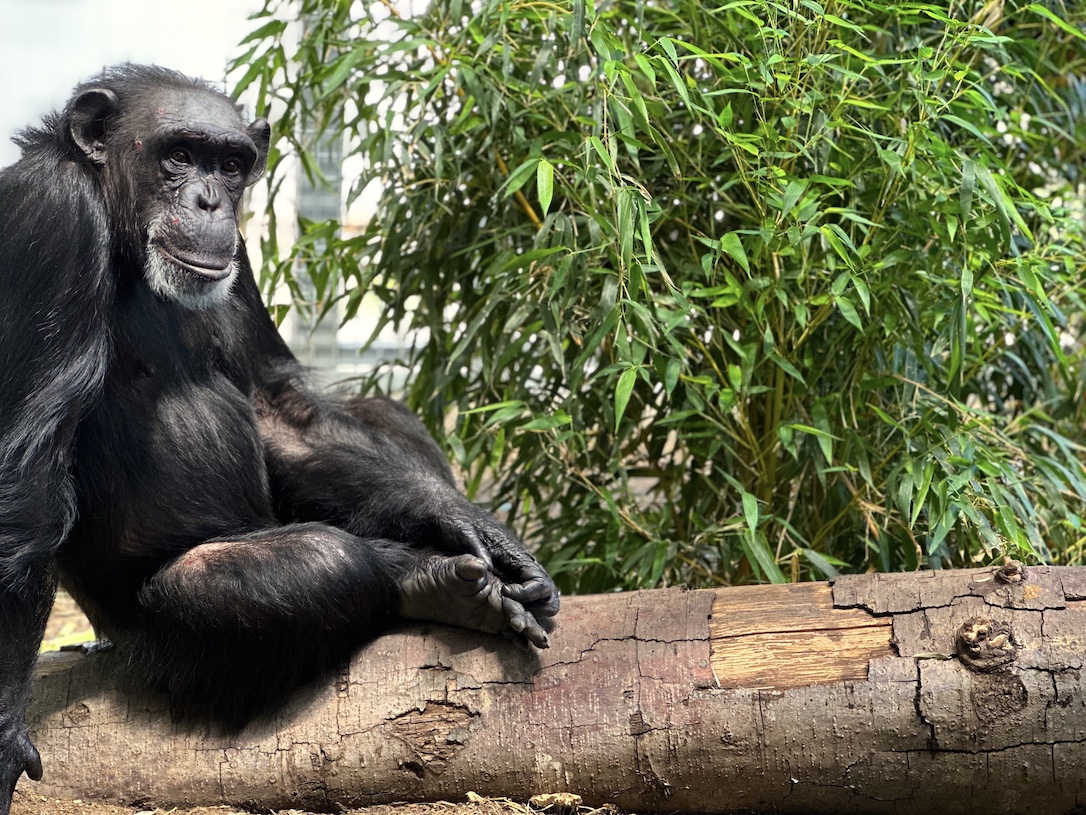
As far as we’ve been told, Rayne bit off or severely injured the third digit of Cy’s left hand at some point during their time at their previous home in California. As to why she did it (if the accusations are indeed true), we need to step back a bit.
Chimpanzees can be incredibly aggressive. And I don’t mean traumatized research chimpanzees can be aggressive or chimpanzees kept in captivity can be aggressive. I mean that natural selection has endowed all chimpanzees, to varying degrees, with a capacity for aggression and a tendency to utilize it to achieve certain ends. In other words, it’s a normal part of being a social chimpanzee—a tiny fraction of their overall behavior, to be sure, but an important one.
When discussing aggression in chimps, we typically differentiate between intergroup and intragroup aggression. Intergroup aggression, or the violence directed at chimpanzees in other communities, has the distinction of being far more lethal. These attacks, often the result of stealthy raids into neighboring communities, are understood to be part of an evolutionary strategy to guard or gain access to territory (and thus resources such as food or potential mates). Intragroup aggression, on the other hand, tends to be a way that chimpanzees—particularly late adolescent and adult males—determine rank or status within the community. Lethal aggression does occur within communities (often in the form of infanticide or the overthrow of the alpha male) but at about half the rate of that between groups.
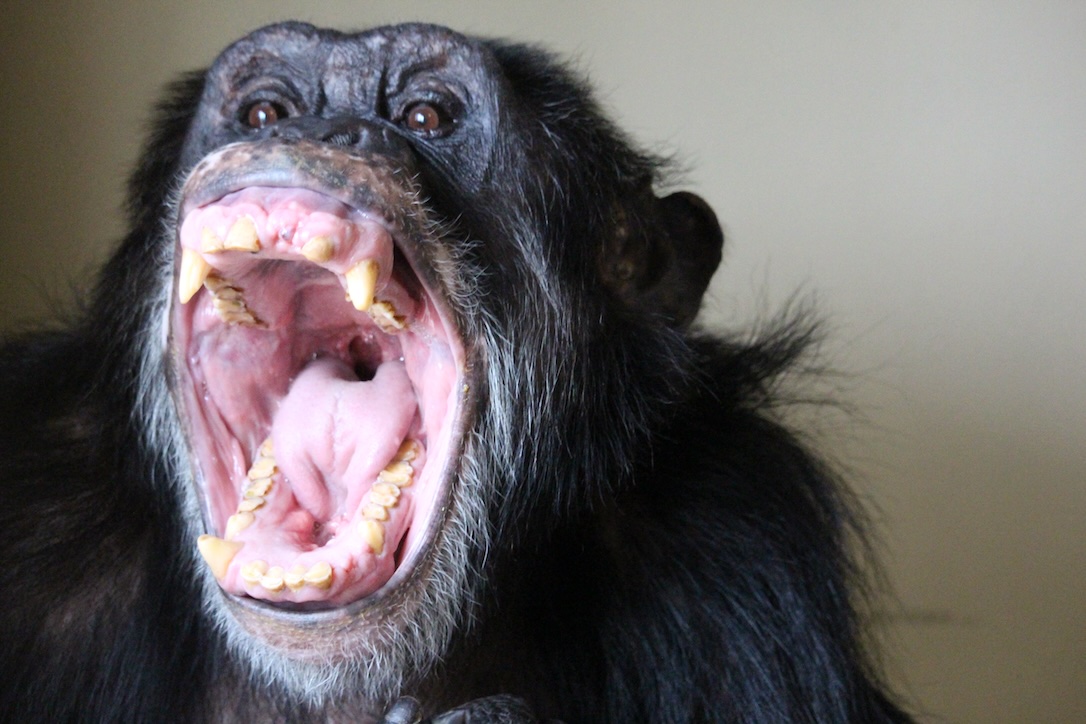
It’s almost impossible to describe to someone who doesn’t work with chimps just how violent chimpanzee fights can be. Their strength, speed, and agility are literally superhuman. Their screams and cries are deafening. And they can be seemingly ruthless, quite often ganging up on more vulnerable chimps. While their muscular arms and legs are used to grapple and pin, their ultimate weapons of choice are their large teeth and powerful jaws, which open wide enough to accommodate most any body part of an intended victim—though they usually select ears, fingers, toes, and, in cases of more extreme violence, genitalia.
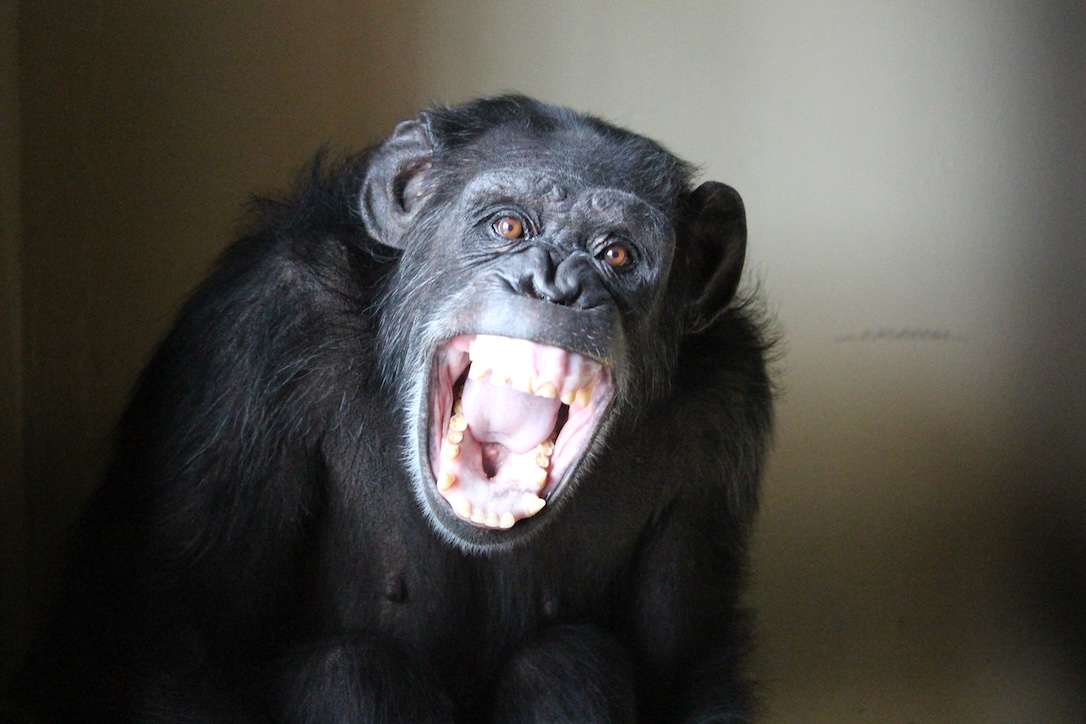
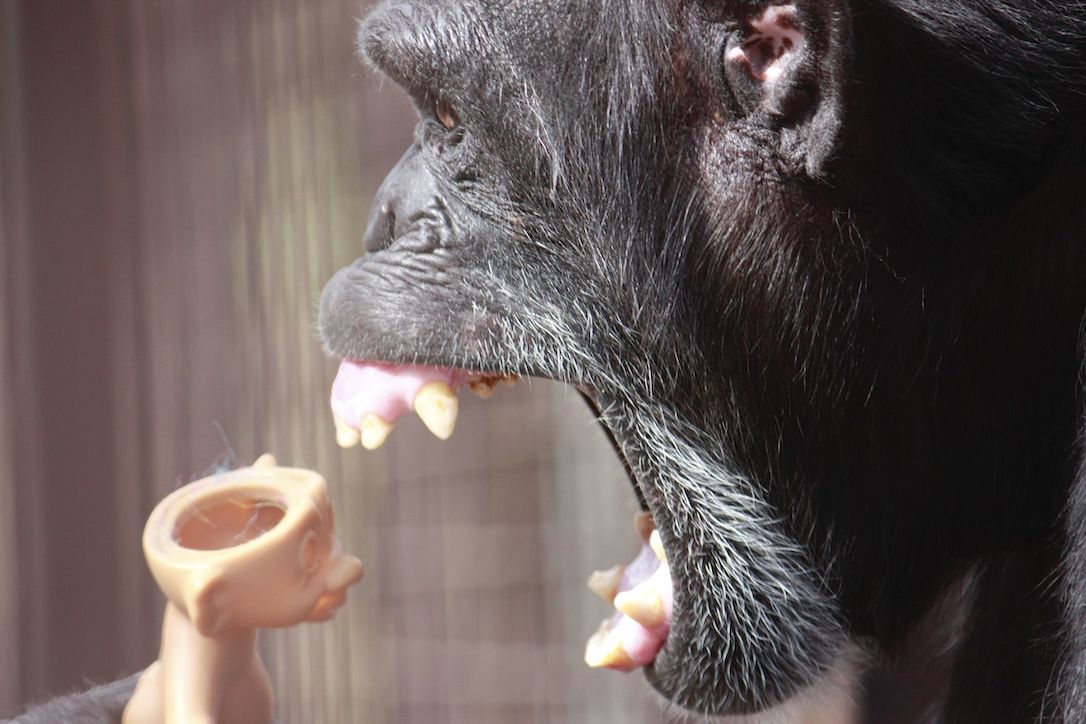
Life for captive chimpanzees is very different from that of their wild counterparts. They don’t have the same kind of territories to defend, nor do they have the potential to acquire new resources by raiding and killing. But natural selection doesn’t typically endow us with knowledge of why we behave the way we do; instead we’re simply primed to behave in ways that tended to benefit our ancestors (humans are no exception to this). And captive chimpanzees are often presented with situations that stoke those very same intergroup prejudices—most notably, during social introductions. When we are integrating groups—or even riskier, adding a single chimpanzee to an established group—we have to overcome that same hostility toward outsiders that drives wild chimpanzees to attack and kill their neighbors. And this is where we may see the most severe forms of aggression. At CSNW, it once lead to a conflict in which one participant, Honey B, had to have her toe amputated, and another, Burrito, had to be castrated due to the severity of the wound to his scrotum. Neither injury was lethal, though in Burrito’s case it was largely because of timely veterinary intervention. In a way you could say that we’re fortunate, because chimpanzees have died in similar circumstances at many accredited zoos and sanctuaries. These are the stories that don’t always make it to social media, but instead are shared by keepers and caregivers over drinks at a conference hotel bar, finding comfort in others that understand what it is like to work in this crazy field.
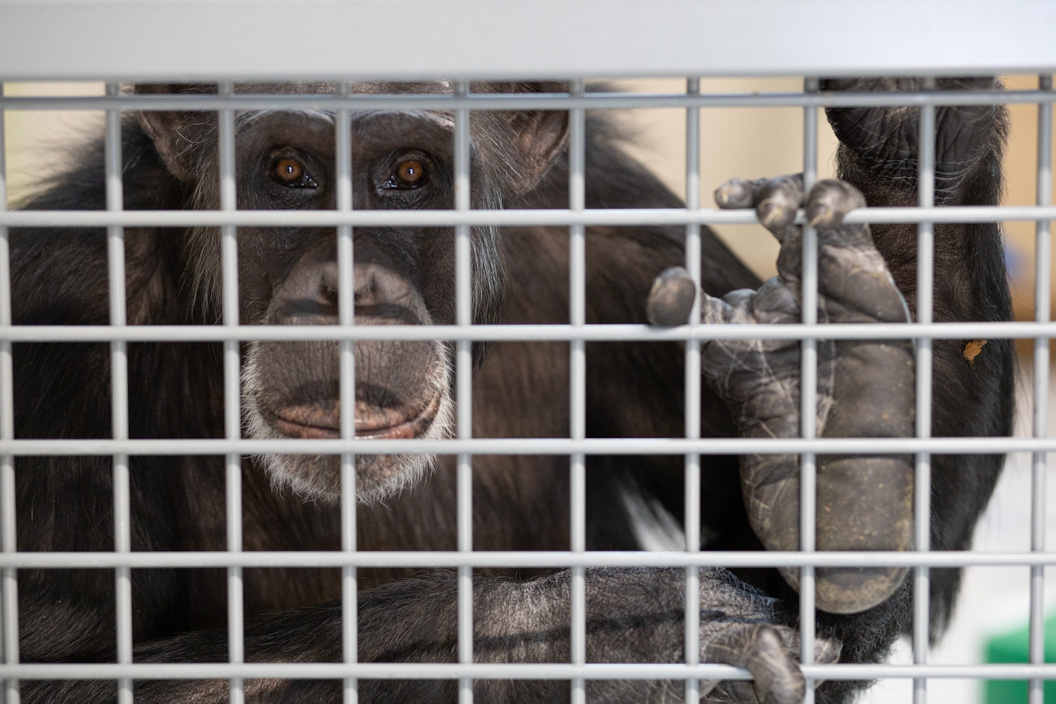
More often, we are witnessing the almost commonplace kind of aggression that serves to establish rank, form coalitions, and settle scores. Chimps, like humans, are status-seekers. Status may come with tangible benefits, but status itself is an intrinsic benefit, one that is apparently worth fighting for. Because this form of aggression serves to clarify relative dominance, we tend to see somewhat less of it in stable groups and more in groups that are newly formed, lacking a strong leader, or undergoing a leadership transition. It also appears to be more common in groups with unusual compositions (in terms of age, sex, etc.) or ones with chimps that lack social experience. Regardless, wherever there are two or more chimpanzees, there will be at least the occasional fight. One study at an accredited zoo found that their chimpanzees were wounded in fights ten times per year on average. Thankfully, along with their superhuman fighting abilities, chimps possess a superhuman ability to heal and an equally superhuman tolerance for pain.
Jamie’s group has been together for over 18 years now. You’d think that they would have achieved some level of stability after all this time. But they epitomize the problem with a lack of leadership and atypical rearing. When they arrived from the lab, we did a quick inventory of missing ears and digits: Negra was missing half an ear, Annie’s ear was torn almost in two, Burrito was missing a fingertip, Missy was missing most of a pinky, and Jody was missing toes (though at least one was said to have been severed by a guillotine cage door). Those are just the ones I can think of off the top of my head. We do the same inventory of every group that we rescue, and relatively few adult chimpanzees arrive at sanctuary with all ears and digits fully intact—unless they, like George, lived largely alone.
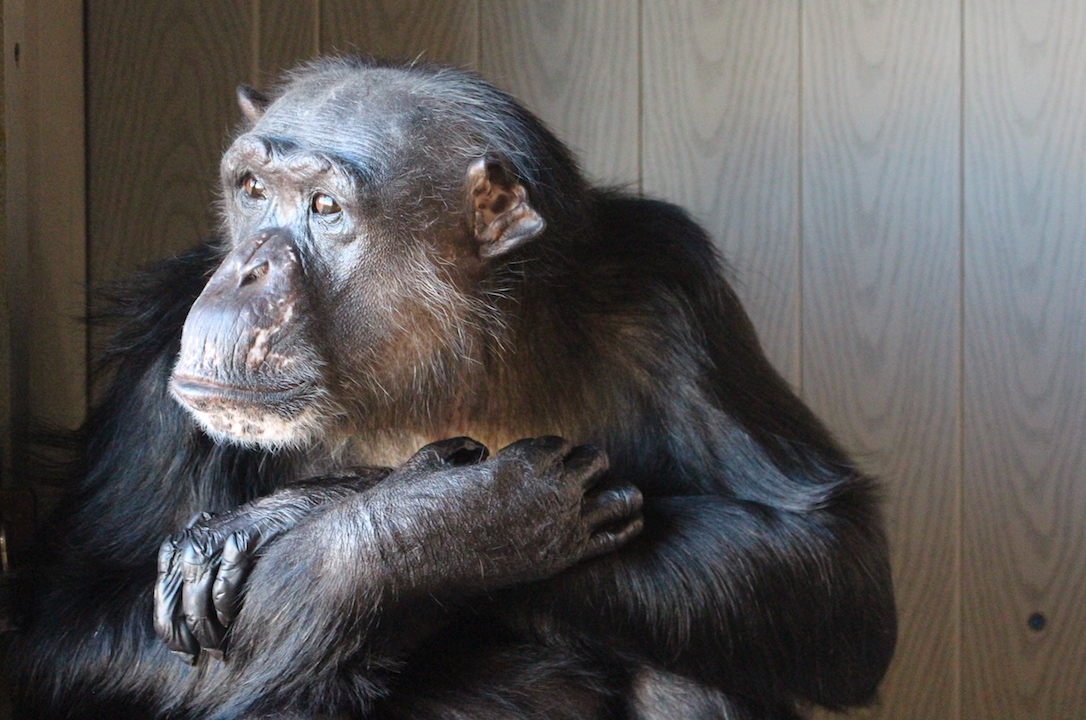
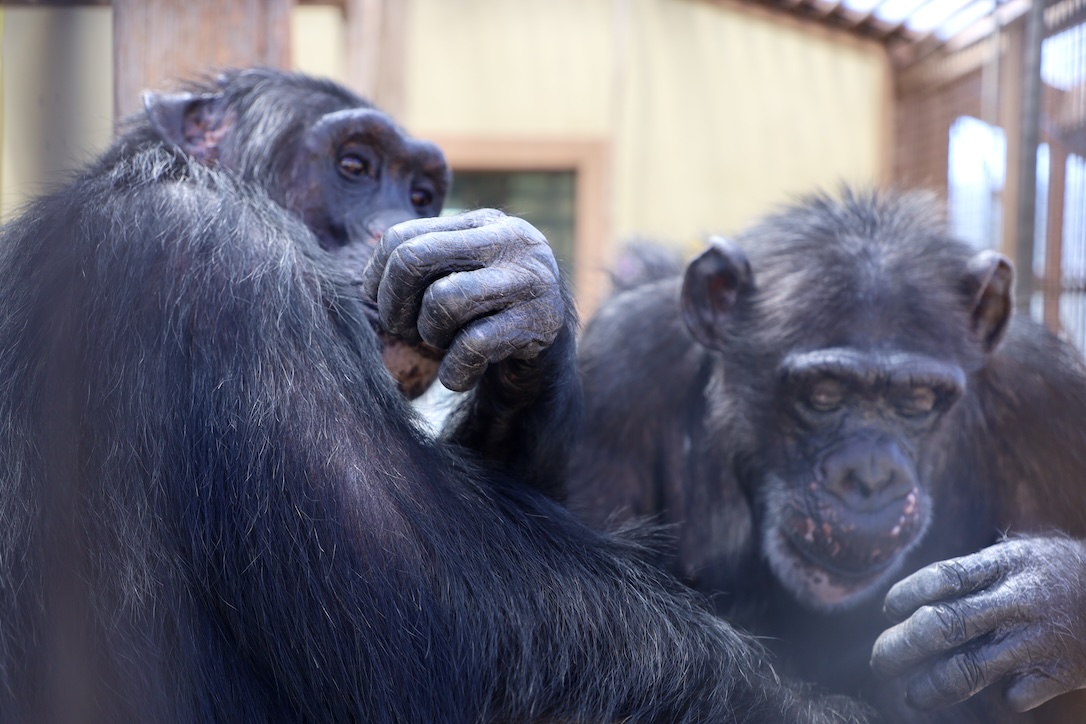
We’ve done our fair share of repairs and amputations here at the sanctuary, beyond those of Burrito and Honey B. One morning, the chimp house was perfectly still until a shriek erupted from Front Room 4. We looked over to see Burrito fleeing and Foxie sitting there in shock, a chunk of her ear laying on the bench beside her.
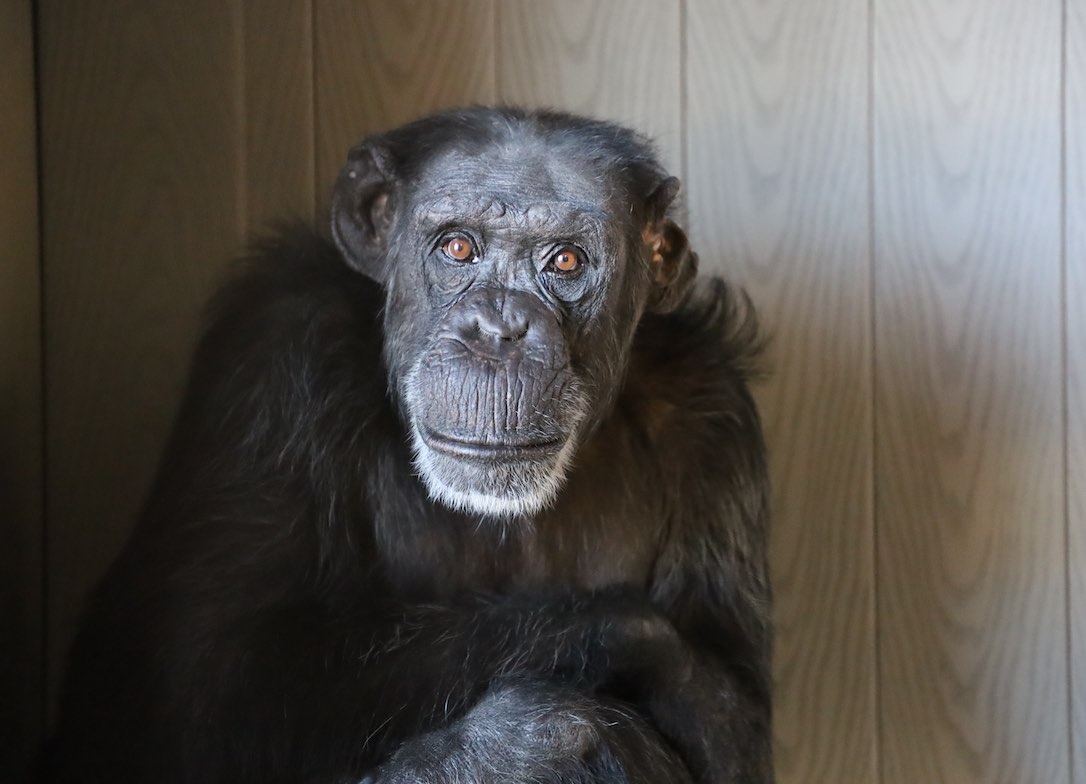
There’s a trap that I try to steer people clear of (and one that I have to try to avoid myself), which is to assume that every action that a chimpanzee takes is part of a grand Machiavellian drama; that each squabble is a deft maneuver towards some strategic aim. Did Burrito bite Foxie’s ear off because he wanted to outrank her? Was he trying to form an alliance with Jamie, who has positioned herself as Foxie’s chief antagonist? Possibly. That kind of thing certainly happens. But again, we have to bear in mind that the algorithm of natural selection has in many cases done most of the calculations for us in advance, and has left us with some rather dumb emotions to carry out all the work. Status might ultimately bring more food and more mating opportunities, but we start fights because we’re pissed. We overcompensate because we’re insecure. We anger others because we are socially inept. We gang up on the weak because we crave power. We ostracize those who are different because we want to belong. In other words, we can describe chimpanzee behavior in terms of ultimate causes, but as socially savvy as chimps are—and they are very savvy—the proximate cause for any given fight or injury is likely that they are bundles of emotions, both noble and ignoble, with the strength of several humans and teeth like railroad spikes.
As for Cy’s finger, I certainly don’t know what happened, but knowing him now, I’d be willing to place a bet: Rayne was going after someone she was mad at and Cy was injured trying to stop the fight. That’s the other thing about chimp fights, at least in captivity—they rarely end as they began and the chimp with the most injuries was probably not involved at the start.
My phone was filling up with videos of Cy looking out for our boy, George, so I had to share them with you.
Regarding the little skirmish with Terry, this will be an interesting dynamic to keep an eye on. George is outnumbered, and will only be more so over the next few months, so it’s critical that he has Cy backing him up. But bailing him out? That can lead to the development of what we in the primatology business refer to as spoiled brat syndrome. I made that up, of course, but some of my colleagues will recall a certain chimpanzee that could get away with anything because his mom was in charge. And then there’s Willy B. I wouldn’t call Willy B a spoiled brat (he is in a category by himself) but Cy and Honey B did seem to enable his more problematic behavior by defending him without question. I’m actually not worried about George getting away with too much, but I will be curious to see if Cy eventually begins to let out the leash a little bit so that George faces more consequences in situations like these.
For now, I will continue to enjoy watching Cy wait for George at the door to tell him not to go outside without his coat 🙂
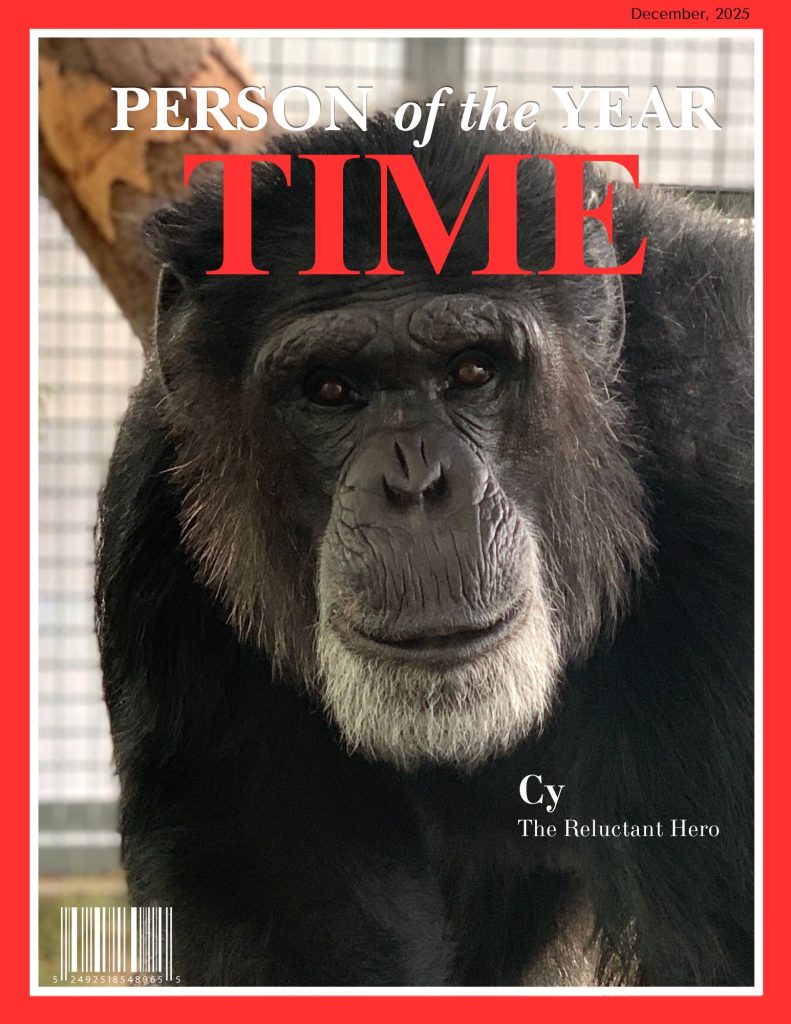
I’ve wanted to write about my admiration for Cy for some time but I can never find the words.
I guess I’ll start here: Yesterday, we added Terry to the intro group, along with Rayne and George. Terry and George had a few brief scuffles during their earlier meetings, which is one of the reasons why we chose to add Terry now—so that they can work out their differences before Terry has even more of his old group mates to back him up. The first few hours were quiet, with Terry making some awkward invitations to George to play and George politely declining out of an abundance of caution. But just before dinner, Jamie’s group began to fight, and the noise led Terry to display, raking a plastic bowl on the ground and banging on the walls. At first, George quietly observed and stayed out of Terry’s way. But a male chimp can only stay silent for so long, and he eventually joined in with his own double-kick to the window glass. Terry didn’t appreciate that.
In established groups, male chimps display side-by-side all the time, but it’s clear that many members of Cy’s group are out to teach George a lesson early on: You have not earned the right to display yet. As soon as George’s feet hit the floor, Terry screamed and ran after him. Rayne followed close behind. George was, for the first time, learning how it feels to be outnumbered.
As George was chased from the playroom to the greenhouse and back, Cy ran by his side, throwing his own body into the breach every time George was cornered. He picked Rayne up and threw her to the side. He dove to grab Terry’s feet as he nearly slipped away in pursuit of George. He was a superhero, again.
Terry and Rayne got the message and left George alone. Or maybe they said all they needed to say. But when it was over, George was virtually unscathed, and Cy had sustained a deep canine gash to the wrist. Throughout the night, Cy stayed by George’s side.
Why would Cy do this? To be sure, there are often selfish explanations for seemingly altruistic acts. I scratch your back so that you may one day scratch mine, right? But the way Cy acts reflects something deeper, something that I can only describe as a sense of moral duty. For whatever reason, Cy is duty-bound to sacrifice himself for the benefit of those more vulnerable than him. And this is not only an admirable trait, but a crucial component of any attempt to integrate a lone, socially naive chimp like George.
Today was much calmer, though George continued to show some understandable unease with the volatility of his new group mates (as seen in today’s video). But he had Cy to lean on. And Terry, in his own awkward way, showed that he didn’t hold a grudge. By the end of the day, they would all be grooming in the greenhouse, held together by a reluctant hero.
I’ve loved and felt a strong bond with a lot of nonhuman animals before. But I look up to Cy. And I wish there were more people, both human and non-, like him in the world.