• Skip to main content
  • Skip to primary sidebar
  • Skip to footer

Chimpanzee Sanctuary Northwest

Hope. Love. Home. Sanctuary

  • Our Family
    • The Chimpanzees
    • The Cattle
  • Blog
  • About Us
    • Visiting the Sanctuary
    • Philosophy
      • FAQs
      • Mission, Vision & Goals
      • Privacy Policy
    • The Humans
      • Staff
      • Board of Directors
      • Founder
    • Annual Reports
    • The Future of CSNW
    • CSNW In The News
  • You can help
    • Donate
      • Become a Chimpanzee Pal
      • Sponsor A Day
      • Transfer Stock
      • Be A Produce Patron
      • Be a Bovine Buddy
      • Give from your IRA
      • Personalized Stones
      • Bring Them Home Campaign
    • Leave A Legacy
    • Employment Opportunities
    • Volunteer
    • See Our Wish List
    • Events
  • Resources
    • About Chimpanzees
    • Enrichment Database
    • Advocacy
      • Advocacy Action Center
      • Apes in Entertainment
        • Trainers
        • Role of the AHA
        • Greeting Cards
      • Chimpanzees as Pets
      • Roadside Zoos
      • Chimpanzees in Biomedical Research
      • Conservation
        • African Apes
        • Orangutans
  • Shop
    • Merchandise Store
  • Contact
  • DONATE NOW

group formation

The Calculus of Friendship and Aggression

January 19, 2026 by J.B.

If you think too much about the interplay between mathematics and behavior, you start to feel like Neo from The Matrix.* Reality as you know it begins to dissolve and, slowly, something else comes into focus:

Equations. Code. The Matrix. A complex web of ledgers and calculations that influences nearly everything we do.

Some calculations are built into an animal’s DNA and are carried out without conscious awareness. Take kin selection, for example, which explains why we and other animals might act against our own self-interest to help our relatives. We take this drive for granted—of course you help your family!—but at first blush it seems to run counter to the cold, unforgiving calculus of natural selection, in which our own genes have evolved to “selfishly” replicate themselves. That is, until you remember that there’s more than one way for our genes to survive and reproduce. After all, we share roughly half of our DNA with our siblings, a quarter with our nieces and nephews, an eighth with our cousins, and so on. When animals help relatives at cost to themselves, they may still be promoting their own genes’ reproductive success—provided they help the right relatives in the right proportion. Biologist J.B.S. Haldane had his tongue firmly planted in his cheek when he said, “I’d lay down my life for two brothers or eight cousins,” but this same idea, formulated as a biological rule, can be used to predict behavior as disparate as which orphans will be adopted by which red squirrels and how humans will behave in economic games. It’s behavior, explained—in part—by math.

Not all heritable predispositions can be reduced to equations so neatly, but if you squint you can still see the tally marks on the ledger. As I mentioned in a previous post, chimps tend to exhibit different rates of lethal violence depending on whether the victims are members of their community or strangers from a neighboring community. The benefits to killing a neighbor are clear: less competition equals more food and mating opportunities. And the costs are limited to the potential injuries a chimp might sustain during the attack. But what about aggression within the community? If dominance is beneficial, why not kill your way to the top? Well, for one thing, you’d be awfully lonely when you got there. Chimps live in communities because they benefit from group living. Community members help find food and raise offspring, they signal when predators are near, and they assist in territorial defense. To reference another movie: APES TOGETHER, STRONG.** The costs and benefits of aggression relative to the benefits of cooperation in these different circumstances have been calculated over millions of years of evolution and have resulted in feelings, emotions, and tendencies that favor ingroups while treating outgroup members as things to be kidnapped or eliminated.

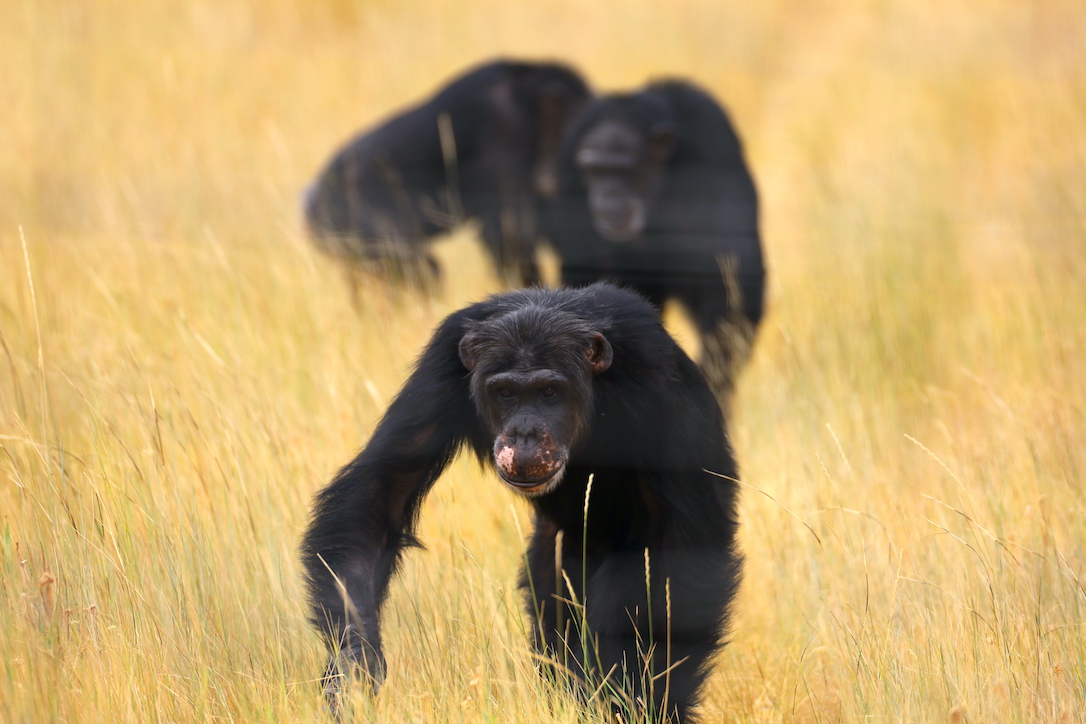
In these cases chimps are acting largely unconsciously on the math of natural selection, but there are times when they are most definitely doing the calculating themselves. Territorial patrols are a good example of this. As Craig Stanford writes in The New Chimpanzee:

A patrol begins when a group of males breaks off from some other activity and makes a beeline toward parts unknown. The males travel with increasing caution as they approach the territorial border…The males appear to be on edge, freezing at distant sounds to listen intently before continuing. They begin to show intense interest in objects that might be evidence of the enemy, stopping to examine and sniff stick tools, leaf wadges, nests, and feces. But the patrol may penetrate further, making a deep incursion in to enemy territory. The tension is palpable as the males continue for hundreds of meters before turning back. On most of the patrols I accompanied at Gombe in the 1990s, such a deep incursion ended with the males freezing when they heard distant calls from the enemy community, then wheeling around and racing back into the home range, whereupon they hooted and displayed as though venting the emotional tension of their mission.
He writes:

Chimpanzee intercommunity conflicts are really raids. A party from one community attacks one or a few individuals from an adjacent community, usually in the overlap zone of their territorial boundaries. Such attacks may be carried out strategically when the attackers detect an imbalance of power. Ten chimpanzees rarely engage in a battle with ten or more enemies…So male chimpanzees monitor their territorial boundaries, picking and choosing their battles based on their perception of when a critical mass in their ranks can successfully challenge neighbors. [emphasis mine]

Like humans, chimpanzees may be endowed with behavioral predispositions but they don’t act on instinct alone. They are always crunching the numbers—and in the case of patrols, performing calculations based off of evidence, like detectives investigating a crime scene. Nine fresh nests and a chorus of pant-hoots in the distance—we’d better turn back. They may want to attack, but will not do so unless they’ve determined that the odds are in their favor.

This type of calculating behavior is not limited to aggression. Chimpanzees are known to reconcile after conflicts with fellow community members. As we’ve already discussed, community members are valuable. But some are more valuable than others, right? Some are potential allies in an effort to move up in the hierarchy. Some may be regular hunting or grooming partners. Some may even be kin—especially in the case of males, who tend to remain in their natal communities. These relationships are, in a way, investments, in which trust has been built and years of reciprocal favors have been exchanged. These are the relationships worth saving—in primatology lingo, they are valuable relationships. And it’s the Valuable Relationship Hypothesis that is used to explain why chimps tend to reconcile more readily or more frequently with certain individuals. It can even be used to predict their likelihood of reconciliation. Just consult the ledger—how often do they groom, and in which direction is the grooming typically directed? How many times has one supported the other in a fight? How often do they mate?

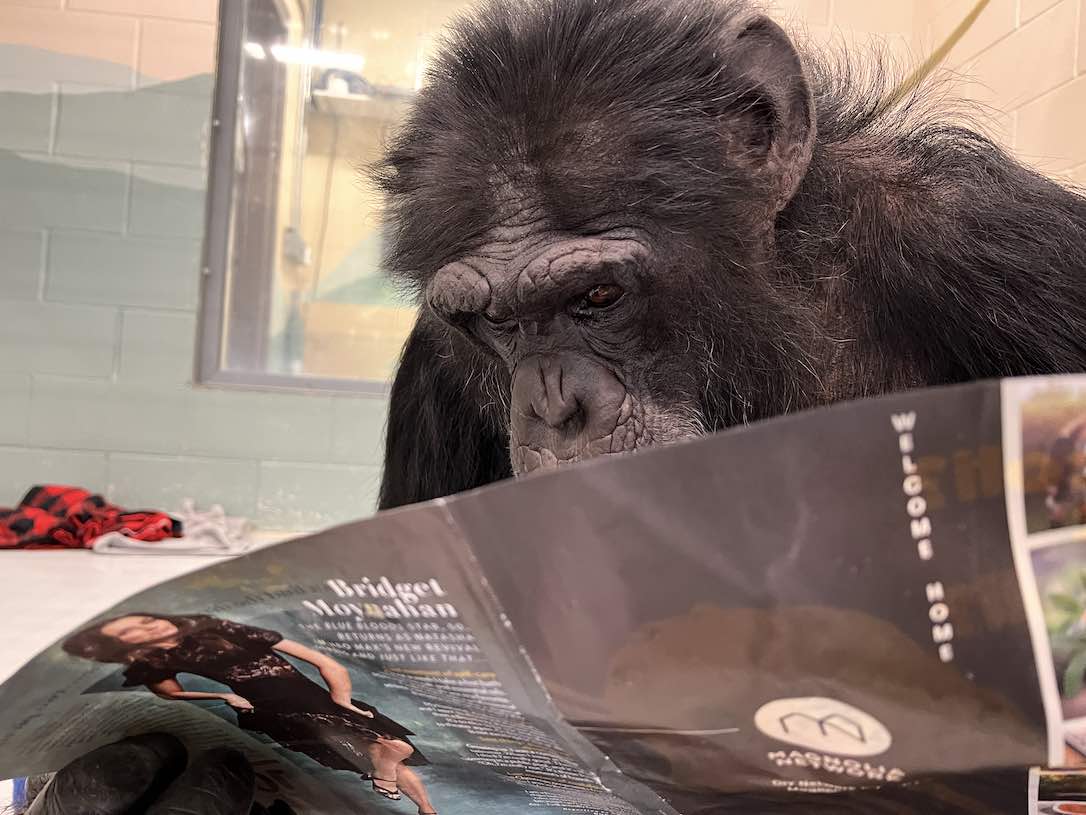
OK, so to paraphrase a blog commenter from many years ago: BORING DISSERTATION, J.B. Who cares about any of this? Well, George, for one. You can bet that he has been furiously crunching numbers ever since he got here. And we’re fortunate that he seems relatively good at math. You can actually see him update his equations and alter his behavior in real time as he gains new experiences—unlike our arithmetically challenged friend, Willy B.

But we caregivers have our calculators out, too. When starting introductions, our first job is to tackle that unfortunate biological predisposition that says that strangers are enemies. We can’t change their DNA, but we can work to make strangers seem a little less strange. This is why we begin with one-on-one meetings, especially with a lone chimpanzee like George. As mentioned above, chimps are less likely to exhibit lethal violence when they lack support. Put George with a large group too soon and he may fall victim to outgroup violence. Put him with one chimp at a time and, while they may fight, they’re more likely to hold back as a matter of self-preservation. And over repeated meetings, strangers slowly become familiar—not quite members of the group, but not quite enemies, either. The calculus changes, and the behavior follows suit.

When it’s time to move beyond the one-on-one meetings and build up the group, the order—and the math—matters. Based on the outcomes of the dyadic meetings, we get a vague sense of the relationships between each dyad—which ones exhibit trust and which ones show tension, for example. As you add members to the introduction group, you might be tempted to save the tense relationships for last. That could be a mistake, because chimps will assess when they have overwhelming advantage—or critical mass, as Stanford calls it. If Terry and George have some things left to work out, let’s let them work them out with just Cy and Rayne overseeing the process, and hopefully by the time Lucky, Gordo, and Dora are added, Terry and George will have clarified their relationship. Add Terry at the end, and his threat barks could rally the rest of the group to overwhelm Cy’s defenses and gang up on George.

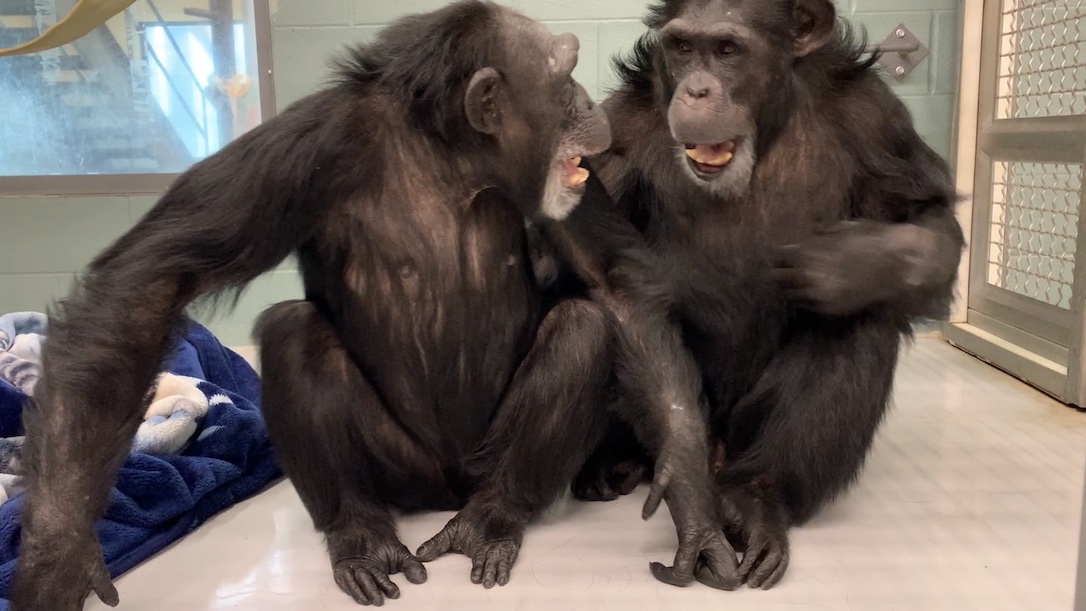
When conflicts do occur, and they inevitably will, it’s important to steal a glance at the chimps’ homework. How are they calculating the value of their new relationships? There’s no use reconciling with an enemy. Enemies are competition, pure and simple, and you’re better off without them. But if a relationship has value—if there’s a good chance of cooperation in the future—you’ll be quicker to repair it when it is strained. Whether chimps reconcile after a conflict, and how soon, can be an important indicator of how integrated a new chimpanzee is into a group. We’ve witnessed only a few conflicts since Terry was added to the intro group. The first was intense but somewhat limited due to a relative balance of power—while Rayne rallied to Terry’s side, Cy was able to fend them off. Terry and George largely avoided each other immediately following the incident. OK, that’s not good. But subsequent conflicts have been less intense as more interactions have been added to the positive side of the ledger, and the reconciliation has been swift, as you can see below. Does this mean that we no longer have to worry about George’s safety? Certainly not. But we can have some hope that future conflicts will more closely resemble ingroup conflicts, in which violence is typically less intense and more ritualized and the chimps actively work to repair and maintain relationships.

There’s a risk that this could all be interpreted as me stating that there is a right way to conduct introductions, or that we know more than we do about how to run them. Our efforts to integrate Willy B should dispel that notion. And even if there were a right way, the outcome is still largely out of our control, regardless of our actions. You’ll rarely feel more powerless than when you are conducting a chimpanzee intro. Nevertheless, it can still be worth occasionally peeling back the curtain and glimpsing the matrix that influences so much chimpanzee behavior.


*A movie that I don’t think I’ve ever seen in full—and yet I will overconfidently cite here as though I have because of its prevalence in American popular culture—in which a programmer named Neo is able to see the code behind a simulation that everyone had until then accepted as reality.

**I did see this one. It was about a group of apes that escaped and took over the world, and we watched it a few days before we let the chimps out into an electric fence enclosure that was the first of its kind in the U.S. and was definitely going to work on paper and hopefully in real life and I hoped that Jamie and company would allow us to live and reside in their kingdom once they took over.
Filed Under: Chimpanzee Behavior, Cy, George, Introductions, Introductions, Latest Videos, Sanctuary, Terry Tagged With: calculus, chimpanzee, group formation, introductions, northwest, politics, rescue, Sanctuary

Party of Five

January 5, 2026 by J.B.

George has the beginnings of a nice little family, now. We added Lucky last Wednesday and it was remarkably uneventful (unlike Terry’s first day). George is getting more confident but still playing it cautiously around the other chimps and taking his cues from Cy, which is all we can ask for at this point. With some milder temps and sunny skies, the gang got to spend some quality time on the Bray. Terry and George took several walks to the top of the hill together (with Terry beating his chest for the girls on the other side) and everyone got their fill of snow and ice.

Filed Under: George, Introductions, Introductions, Latest Videos, The Bray Tagged With: bandon, chimpanzee, george, group formation, introductions, Lucky, northwest, oregon, rescue, Sanctuary, west coast game park safari

Reintroductions

August 12, 2024 by J.B.

We’ve spent a lot of time on this blog discussing group formation, or introductions, so you probably know by now that they are at once the greatest and most terrifying activity you can take part in as a chimpanzee caregiver. While I wouldn’t put them in the same category, reintroductions can be a bit of a roller coaster, too. Reintros occur any time a group is reformed after a period apart. This is commonly due to medical isolation of one or more members but it can also occur if a group is moved to a new facility or if an institution practices fission-fusion management, wherein individuals are routinely moved between groups  (I dislike the use of the term fission-fusion in the captive context but I don’t get to make the rules). Most reintroductions are fairly easy, as the group members have already worked out their relationships. But if a group is separated immediately after a bad conflict for the purpose of treating injuries, they may need to be reintroduced more carefully—even from scratch—lest they immediately pick up where they left off. Whether or not the participants had a chance to reconcile in those cases can make a big difference.

Regardless of the reason for separation, some chimps do not reintro quietly. Males, in particular, seem to fear that everyone forgot who they were while they were gone. REMEMBER ME? THAT’S RIGHT, I AM STILL LARGE AND MAKE LOUD SOUNDS! DO NOT MISTAKE MY ABSENCE FOR WEAKNESS, FOR I HAVE REMAINED STRONG THIS WHOLE TIME AND HAVE COME TO RECLAIM MY POSITION! I pick on the males, of course, but only because their behavior is so familiar. In reality, chimps do sometimes have good reason to fear that the social order changed while they were away and they are right to test the waters when they return.

Willy B has been separated from his group a number of times over the last two years so we felt confident letting him meet the whole group at once, but given his, uh, peculiarities, you can’t help but get a few butterflies as you watch him reestablish himself.

It’s nice to see how the group tolerates him, and even comforts him when he needs it, despite his frequent awkward jerkiness. Willy B remains a special project for CSNW, one that occupies a lot of our collective brain power and dominates the discussion at most every staff meeting. What to do about Willy B? While we’re still searching for the right answer, I’m glad that his group mates are able to extend a little sympathy now and again to a guy that could really use some.

Filed Under: Chimpanzee Behavior, Display, Introductions, Introductions, Latest Videos, Willy B Tagged With: chimpanzee, display, dominance, group formation, introductions, northwest, reintroductions, rescue, Sanctuary

What’s Happening

May 20, 2022 by J.B.

I know we’ve been uncharacteristically quiet when it comes to the integration of the two Waystation groups. Superstitious or not, none of us want to jinx it! But now that we’ve made it through the first three weeks, I thought I’d take this opportunity to fill you in on just a few of the things that have been happening with this new group.

Who’s the Boss?

One of the biggest questions we all had prior to integrating the two groups was who would maintain the alpha role. Willy B and Cy are both large, powerful males who held comfortable positions as alphas in their previous groups. Their initial one-on-one introductions had us all holding our breath due to the obvious potential for aggression, but they generally got along quite well and the relationship was promising. Once the entire group was together, however, the dynamics became a lot more complicated and neither showed any signs of submitting to the other. Willy B would engage in his characteristically lengthy displays that are seemingly designed to drive everyone crazy – he would find a metal panel or cage door that rattled and he shake it incessantly until everyone else started displaying. While chimpanzee dominance behavior is often viewed through the lens of Machiavellian strategy, Willy B seemed more like someone just bursting with nervous energy and nowhere to direct it. Cy would respond by crashing into the room, bashing on the walls and windows, and stomping his feet on the floor. Throughout the day and all through the evening, they would trade thunderous displays in the playrooms and front rooms, leaving the other boys displaying in their wake and the girls running and screaming. None of us were getting any sleep. Each episode felt like it could be the match that would ignite a larger fire, and though the two would regularly interact in friendlier ways, neither would confront the other directly during times of tension. Until last Sunday.

On Sunday afternoon, Willy B was engaged in one of his protracted displays and the tension was building within the group. Eventually, some smaller conflicts erupted and Cy decided that he’d had enough. He faced off with Willy B in one of the front rooms. Cy was on a bench below Willy B in Front Room 5, and after gradually building up a display he leapt directly at Willy B. Grace and Katelyn were just feet away, garden hose in hand, anxiously hoping that everyone would come away unscathed. As Cy came flying toward the upper bench, Willy B revealed a huge fear grimace and swung around, presenting his back side to Cy. Cy landed on the bench and embraced Willy with both arms. After two weeks of negotiation, Cy had put his foot down and Willy had submitted.

Since then things have seemed a little more orderly within the group. Cy is a patient leader and he doesn’t intervene unless he feels it’s necessary, but if he thinks Willy B is stirring the pot a bit too much, or if Gordo is pushing his luck with Willy B, he has no problem stepping in and quieting everyone down. For his part, Willy B seems a bit relieved to have someone else in charge. Now he can focus all that energy on playing with his new pal, Rayne. And Cy seems relieved to get back to his magazines. We often liken him to a father that tells the kids to play outside so he can read the sports section in peace.

Bosom Buddies

We always knew that Mave would do great in a larger group but we’ve been pleasantly surprised by how well Willy B and Honey B are getting along with their new family. Willy B adores Rayne – I’ve never seen him as expressive as when he is playing with his new pal. And while Honey B tends to be more of a loner in general, she is part of a new clique that Diana has dubbed “the mall walkers”. Each playroom has a second floor catwalk that extends around all four sides of the room and overlooks the main floor below, similar to those fancy indoor malls where people of a certain age do their speed-walking. Each morning, beginning around 7am, Honey B, Dora, and Rayne walk laps around the second floor of each playroom together, often playing but otherwise just getting their steps in.

Eight is Enough

Each morning we serve breakfast in one or more of the greenhouses and playrooms and attempt to close off an area for cleaning. Eight of the chimps happily cooperate. Honey B does not. This isn’t any different than when she lived in her group of three, but early in the introduction process there was a concern that we’d have to reintroduce her each morning if she was separated during cleaning due to her reluctance to shift. Despite the fact that she would have been living happily with the group just hours prior, these reintroductions had the potential to cause tension and hinder the integration process. Thankfully, she has been able to come and go as she pleases without issue, and a couple hours of alone time seems to give her a great deal of comfort.

Family Ties

It can takes months, even years, for two groups to become fully integrated, meaning that they no longer fall back on old, familiar patterns of association. Right now we are seeing two distinct patterns. During the day, the chimps act as though they have always been one big group. Willy B is often at the center of early morning grooming parties on the greenhouse tree structures, Honey B plays and walks laps with Rayne and Dora, and Mave is everywhere at all times doing everything with everyone. But at night, it’s back to three and six. Mave, Honey B, and Willy B make their nests in the front rooms – specifically Front Room 6 – while the others sleep on the catwalks and nesting platforms in the two playrooms. They are all free to sleep where they choose, but for now it seems there’s comfort in sticking with the old gang when it’s time to let your guard down and catch some sleep.

One Day at a Time

When it comes to group formation, there is no point at which we will pat ourselves on the back and declare victory. But whatever happens, I think we can celebrate the introduction process and these first three weeks that they have lived as a full group. Honestly, there have been many days over the last few weeks when the Cle Elum Seven bickered more than the nine. And they’ve lived together for 16 years! Still, chimps will be chimps, and there will be plenty of fights ahead. More importantly, however, there will also be plenty of playing, grooming, reassuring, even mall-walking – all the things we’d dreamed about when we first met Honey B, Willy B, and Mave and imagined them in larger family.


Filed Under: Sanctuary Tagged With: chimpanzee, group formation, integration, introductions, northwest, rescue, Sanctuary

The Hug

November 8, 2019 by J.B.

Burrito and Willy B have now been together for nine days. This past Tuesday, we added Negra and Honey B – who get along unexpectedly well – creating a group of four. Upon entering the group, Negra did as Negra does, which is to say that she waltzed back into the playroom and made a nice comfy nest while pestering her caregivers to start dinner, as if nothing had changed. Honey B, on the other hand, came out of the gate with a message for Burrito: don’t mess with the little girl. On two occasions, as Burrito started to display, Honey B pounced on him, leaving him with a couple minor bites. Burrito seemed to be immediately overcome with the realization that the girls that had dominated him for so long were not an anomaly – they are all this way. Willy B stayed out of it entirely, as though he had received the same message from Honey B in the past and took it to heart.

With her point made, Honey B spent a considerable amount of time trying to get Burrito to groom and play. He has so far declined most of her offers, understandably. But they have maintained a peaceful relationship since.

So yesterday it was time to add Mave to the group. We had a strong feeling that Mave and Burrito would get along, based on their brief encounter in the group of ten and their interactions through the lexan as they have been housed in adjacent enclosures. And Mave seems to be a very stabilizing force wherever she goes, with her keen social awareness and penchant for giving out hugs when they are needed most. But given that Burrito was already working on a challenging relationship with Honey B, we thought it would suit him best to spend time with Mave one-on-one. As you can see, they hit it off right away and within a couple hours, both were introduced into the group with Willy B, Honey B, and Negra. This is how things will likely stay for a little while, so that Burrito can continue to build on his friendship with Willy B, work out his differences with Honey B, and find comfort in the warm fluffiness of Mave’s hugs. Negra will continue to play with her new friend Honey B and keep track of mealtimes for the staff. When the time is right, we will begin to engage Foxie with some of the newcomers so that she, like Burrito, can overcome her fears and forge new relationships.

Filed Under: Burrito, Friendship, Introductions, Introductions, Latest Videos, Mave Tagged With: Burrito, chimpanzee, group formation, hug, introductions, Mave, northwest, rescue, Sanctuary

Getting along

November 1, 2019 by J.B.

At this point some of you may be wondering what it is exactly that makes the process of captive chimpanzee group formation so difficult, so I thought we could take a step back and look at some of the challenges.

It starts with biology. Free-living chimpanzees live in large communities ranging from just over a dozen to nearly two hundred individuals. The dynamic structure of these communities, a system known as fission-fusion, allows for regular changes in group size and composition in response to factors such as the abundance of food or the presence of females in estrus. This form of social organization enables chimpanzee communities to adapt to variations in resource availability by temporarily splitting into smaller parties while retaining the protection and other benefits of living in a large group.

Missy, Jamie, Annie, and Jody on Young’s Hill

But while subgroups are free to split off from and later rejoin the community, only certain individuals are generally allowed to leave their community entirely to join another. To do this successfully, it helps to be young and female.

Chimpanzee communities as a whole are understandably protective of what is most important to their survival and reproductive success; namely, access to food and potential mates. Neighboring communities threaten to compete for these scarce resources, which is why chimpanzees often exhibit such fierce territoriality. Groups of males, and in rare cases both males and females, will coordinate patrols of their territorial boundaries and attack, often lethally, lone individuals or small groups from neighboring communities that have wandered too close.

The chimpanzees at CSNW exhibit behavior that is similar to the patrols of free-living chimpanzees

As Anthony mentioned previously, males remain in their natal groups for life and form lifelong bonds with one another. Consequently, there is no biological or cultural mechanism to facilitate the transfer of males from one community to another. Nor is there a straightforward path for adult females to transfer. But as adolescent females reach sexual maturity, they generally leave their natal communities and seek out new one. This instinctual emigration is assumed to be an evolved mechanism to prevent inbreeding within the community and the timing of their departure is anything but arbitrary. While fear of outsiders remains the general rule, males are typically welcoming of young immigrant females, especially ones who arrive with estrus swellings. Resident females are not always as welcoming to the newcomers who, bear in mind, will be eating from the same fruit trees and potentially competing for the attention of resident males, but the newcomers can rely on protection from the resident males as they assimilate into the new community.

Burrito shows an interest in Annie’s swelling

So there is a clear pattern, with limited exceptions, across nearly all chimpanzee communities in Africa: There is only one reliable ticket to move between communities, and it is determined by the immutable characteristics of age and sex and to a large extent reliant on the selfish desires of the males who hold power. When we form groups in captivity, we are almost always fighting against millions of years of natural history.

Of course, chimpanzees are not products of instinct alone, but beneath the layers of culture there remain a number of instinctual tendencies that stand out in the captive environment. An example: When captive chimpanzees go to bed at night, they typically make nests just like their wild cousins. These nests may be made out of straw, wood wool, or blankets instead of branches, but they generally share one trait in particular with those of their wild counterparts: they have high sides to hold them in. For wild chimpanzees, the nest serves as a cradle to keep them from plunging dozens of feet to the ground while they slumber. Perhaps it would only make sense for captive chimpanzees to do the same, except that they create the same doughnut-shaped nests even when sleeping in the middle of a concrete floor. In fact, sometimes they sleep directly on the concrete with all of the blankets arranged into a ring around them. It’s a bit of security-seeking encoded in the biology of a species far removed from the environment in which they evolved. Instincts can be attenuated by both learning and the environment but they remain a powerful driving force in our behavior.

Jody builds a nest on the playroom floor
Though the setting and materials are different, her nest resembles those of her wild cousins

To some extent, the nurture side of the nature-nurture influence probably does mitigate some of these xenophobic tendencies. Lab-reared chimpanzees are regularly moved between pairs or small groups throughout their lives, and they do not grow up in a culture that systematically reinforces their biological predispositions towards outsiders as their wild counterparts do. In a way, captive-born chimpanzees are trained to ignore their biology. Sadly, their upbringing presents its own set of problems.

Maintaining peace and order in a chimpanzee community requires strict adherence to certain social norms and conventions. If you watch the video of Burrito and Willy B meeting alone for the first time, you can see the delicate communication required to navigate such a perilous moment. To facilitate the encounter, Willy B covers his top teeth with his upper lip and shows only his lower ones. This signals an intent not to harm – specifically, not to bite – much in the same way that a dog’s bow signals an intent to play. At the same time, he engages in vigorous “breathy panting,” a vocalization that conveys friendliness and interest. He senses Burrito’s fear and as a result he gives Burrito a wide berth. Burrito, for his part, conveys to Willy B that despite his fear he would like to get closer by extending an arm toward him. One misstep by either party and the entire process could unravel into outright aggression, as it did during their group encounter two weeks prior.

And while they overcame the risks of this initial encounter, the challenge of actually living together has, unfortunately, only begun. Sustaining friendships and alliances is difficult and constant work, and studies show that chimpanzees separated from their mothers at an early age and raised by humans exhibit social deficiencies that make group living harder as adults. These chimpanzees fail to develop the knowledge and skills required to navigate the complex and often subtle rules of chimpanzee social life. As a result, they are more likely to have to live in small groups or in some cases, alone.

Burrito’s former life as a pet, circus performer, and research subject deprived him of some of the social skills needed to succeed in a group

Despite all of this, most chimpanzees in sanctuaries, zoos, and laboratories can and do live in groups. As they should, because the benefits of a large social network are immeasurable. But we need to keep in mind what we are asking of them: to plunge ahead, ill-equipped and unprepared, and with almost no control at all, into a process that goes against their very instincts. This is one of the many sad realities of captivity for chimpanzees.

So despite our setback with the group of ten, I am, at the moment, hopeful. Burrito and Willy B have been living together since Wednesday, grooming regularly and playing with one another on occasion. These two guys overcame their fears and are experiencing the initial whispers of a bond that should have been their birthright as male chimpanzees. Whether it will be sustained over time, and amidst the turbulent influence of other group members, remains to be seen. But it’s a promising start.

Filed Under: Burrito, Chimpanzee Behavior, Free-living chimps, Introductions, Introductions, Sanctuary, Willy B Tagged With: chimpanzee, group formation, introductions, northwest, rescue, Sanctuary

Getting to Know You

September 20, 2019 by J.B.

Honey B, Willy B, and Mave have officially completed their 30-day quarantine period, but we’re still waiting on results from a fecal exam before we move on to introductions. As we wait, we are carefully observing the interactions between the two groups for cues to help us develop our introduction strategy. Jamie and Burrito will likely present the greatest challenge because of their backgrounds as pets and performers – chimps raised in human environments are often at a disadvantage when it comes to navigating complex social situations. And Foxie, while socially adept, has been slightly more reactive than we expected (this is a nice way of saying that she screams a lot). Our instincts, along with tons of data from our friend and former intern Jake, told us that Jody, Missy, and Annie would be a strong subgroup to welcome the new folks to the neighborhood, and today’s interaction seemed to back that up.

We hope that these ten chimps will be compatible but we are realistic about what lies ahead. Even if a full group formation is unsuccessful, it will be an absolute joy to watch some of the Cle Elum Seven meet new friends after all these years. Just look at the excitement and anticipation in Jody’s eyes.

Filed Under: Introductions, Latest Videos Tagged With: chimpanzee, group formation, introductions, northwest, rescue, Sanctuary

  • Page 1
  • Page 2
  • Go to Next Page »

Primary Sidebar

Subscribe To the Blog and Get Notified of New Posts First!

Archives

Calendar of Blog Posts

June 2026
S M T W T F S
 123456
78910111213
14151617181920
21222324252627
282930  
« May    

Categories

SUBSCRIBE TO OUR NEWSLETTER

Footer

PO Box 952
Cle Elum, WA 98922
[email protected]
509-699-0728
501c3 registered charity
EIN: 68-0552915

Official DDAF Grantee

Menu

  • The Chimpanzees
  • Blog
  • About Us
  • You can help
  • Resources
  • Contact
  • Donate

Proud Member of

Connect With Us

Search

Copyright © 2026 Chimpanzee Sanctuary Northwest. All Rights Reserved. Site by Vegan Web Design