Everyone needs a good laugh… sometimes it takes friends to get a smile out of us, and other times we can make ourselves crack up.
rescue
More medical equipment
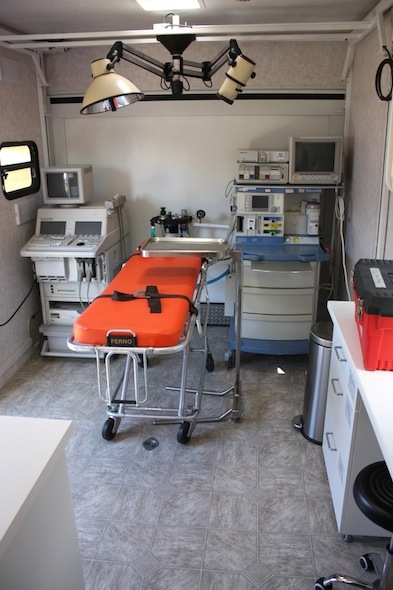
Exciting news – we received an ultrasound machine! The machine (pictured below, on the left) comes courtesy of Pacific Vascular in Bothell, WA and is capable of doing cardiac, abdominal, and, as you might have guessed, vascular imaging. A million thanks to Pacific Vascular, to supporter Karen Gates and her son Jack for making the connection and advocating for us, and to Bob for giving us a tutorial.
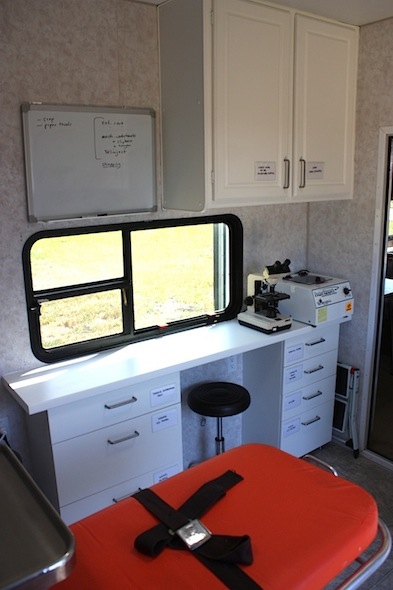
Providence Medical Center in Everett, WA has come through again, this time with a centrifuge (below, on the right). Thanks Dan!
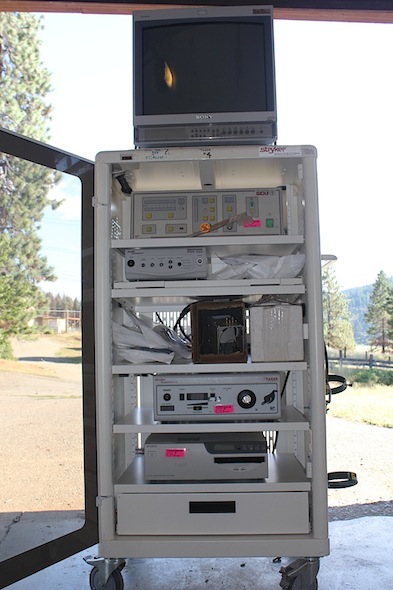
And Kittitas Valley Healthcare has donated both an endoscopy tower and a mayo stand. Thank you Judi and everyone at KVH!
We’re still looking for a steam autoclave, a laryngoscope, and a portable x-ray machine. And ideally, we’d love to have a second, more portable, ultrasound machine for doing imaging inside the chimp house when the chimps aren’t under anesthesia (especially for Burrito). So if you know of any companies that might be willing to donate these items, please let us know!
Take Action Tuesday: Help save chimpanzees in Cameroon!

A U.S. company called Herakles Farms is planning to begin a palm oil plantation in Cameroon near the border of Nigeria. Chimpanzees and gorillas live in these forests, and in fact the most endangered subspecies of each ape are living in that region. The Nigeria-Cameroon chimpanzee population (a.k.a. Elliot’s chimpanzee) is estimated to be approximately 3,500 individuals remaining. The Cross River gorilla population is estimated to be fewer than 300 individuals.
Endangered chimpanzees, forest elephants, and monkeys all live within the Herakles Farms concession. These already diminishing populations need our help!

This form letter has been put together to make it very easy for us to lend our voice in support of the apes, courtesy of Greenpeace. Although it is very convenient to just fill in your name and email and hit “send”—it really helps to make your letter unique. Tell the CEO of Herakles Farms why it is important to you that their plans for a palm oil plantation in Cameroon be canceled immediately.
We know from the plight of orangutans in Southeast Asia that palm oil directly negatively affects their population, sometimes driving orangutans and other forest dwellers to starvation when their homes are slashed and burned to the ground to make room for the plantations. In your day-to-day life, try to be a conscious consumer and avoid palm oil where you can. You can help be an advocate for apes every day by taking this extra effort to check the ingredient list of products you buy!
After sending your letter, take a few minutes to watch the second installment of a video interview with Dr. Debra Durham, where she talks a little bit about her conservation efforts with wild chimpanzees. Her current project is called Compassion in Action Mushroom Project (it’s a really innovative plan to help protect wild chimpanzees—be sure to check it out!)
Happy Birthday, Missy!
Missy turned 38 today, and to celebrate we made the day all about her. Volunteers Patti and Annie brought some of Missy’s favorite foods and toys, and we did forages in the greenhouse and on Young’s Hill for breakfast. We also harvested cattails from the pond. Tonight, we’ll put out Kongs after dinner, which are her favorite food puzzles.
The Cle Elum Seven really have aged backwards since coming to the sanctuary – it’s hard to believe that playful, active Missy is 38 years old. Let’s hope she never acts her age.
Tool Use and the Termite Mound
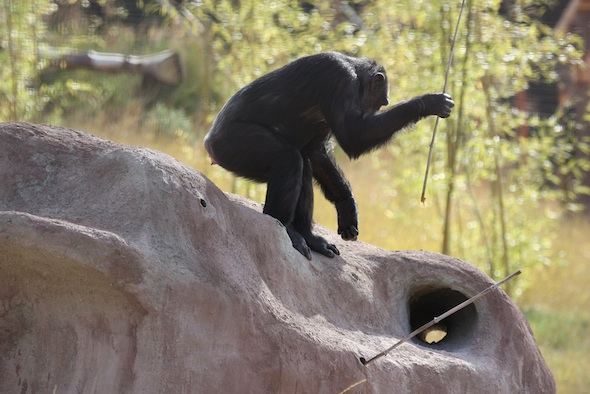
Jane Goodall’s research was ground-breaking in many ways, but one of her most important discoveries was that chimpanzees possess the ability to use tools. At the time, it was thought that tool use was a defining characteristic of the human species. But shortly after she began studying the chimpanzees of Gombe, Dr. Jane saw them using sticks to fish termites out of their nests. When she reported her findings to her mentor, Louis Leakey, he famously wrote, “Now we must redefine tool, redefine Man, or accept chimpanzees as humans.”
Over the last 50 years, primatologists have discovered that the use of tools to “fish” for termites and ants is even more complex than had originally been thought. Chimpanzees have been observed bringing “tool kits,” containing a variety of tools for different purposes, to the nests. For example, some tools are used specifically to perforate the nests of army ants. Breaking nests open by hand tends to result in an aggressive counter-attack by the ants, and may even cause them to relocate the nest. Using the perforating tool results in a less painful experience and allows for the harvesting of the ants to be sustainable. Other tools are used specifically for dipping into the nest, and their size and shape, as well as the technique for ingesting the insects once they are caught, are influenced by the behavior of the insects being harvested. And all of these techniques are influenced by culture, which is to say that they are learned and not determined by genetics and environment alone. They differ from community to community, as each community has its own set of knowledge and traditions.
When we built Young’s Hill, the Young’s provided the funds for us to build an artificial termite mound. The mound is actually hollow and consists of concrete laid over a rebar framework. Stainless steel tubes protrude through the concrete, and we can climb in and attach PVC tubes filled with food treats on the inside. The mound also protects critical irrigation components for the bamboo groves.
Most captive chimpanzees, having been raised outside of the cultures found in free-living communities, do not consider insects to be food. So we stick with what they enjoy – in this case, frozen banana mixed with peanut butter and almond milk.
If you’re impressed with Jamie’s tool-using abilities, vote for her in the Humane Society of the United States’ chimpanzee art contest.
Sunrise
The sanctuary is located in a canyon formed by the Yakima River, and there is a period each morning when the sun has risen but it has not yet begun to shine directly onto Young’s Hill. In the summer, when temperatures regularly reach into the 90’s or higher, this is the most comfortable time for the chimps to be outside.
This morning, the gang went outside at around 7:45 – all except for Negra, of course. She needs her beauty rest, and she loves when the rowdier chimps leave her alone in the building to sleep in.
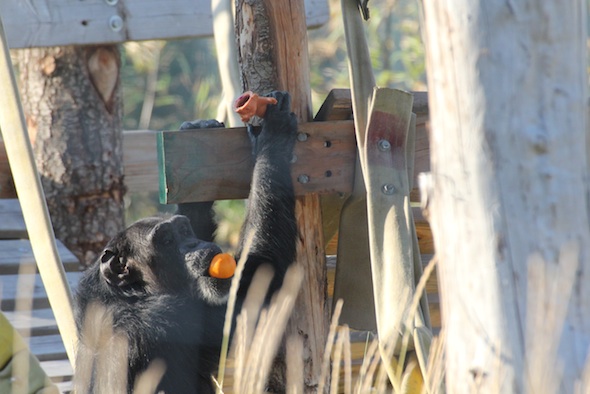
But everyone else took to the hill to play and explore. Foxie managed to keep her birthday party going an extra day, because she immediately found an orange that had gone undiscovered in yesterday’s forage.
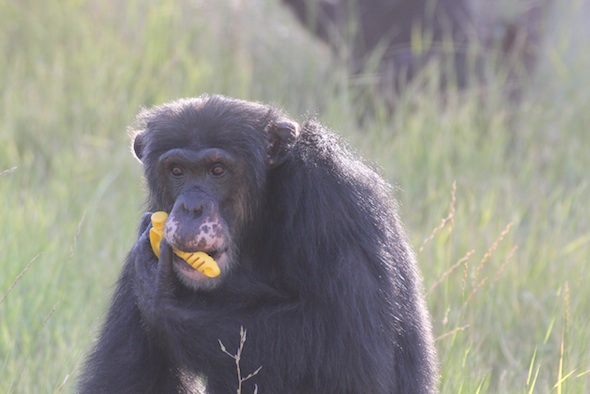
Burrito followed the girls up the hill, going further than he normally does, all the while holding on to his yellow toy hammer.
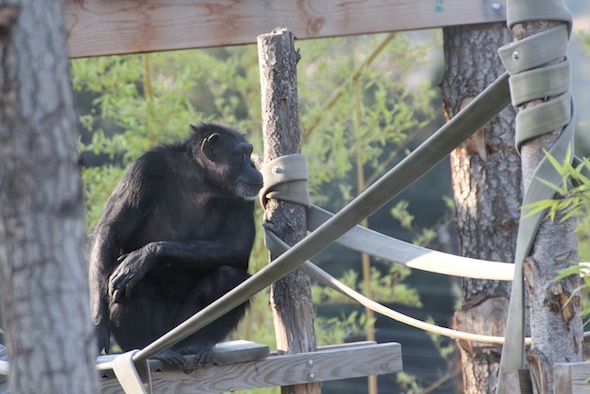
Annie sat upon a climbing structure, where she could keep an eye on her friend Missy as she ran around the hill.
Jamie hung out with the other chimps for a while, but eventually she turned to me and gestured to signal that it was time for me to grab a cowboy boot and join her for a walk around the perimeter.
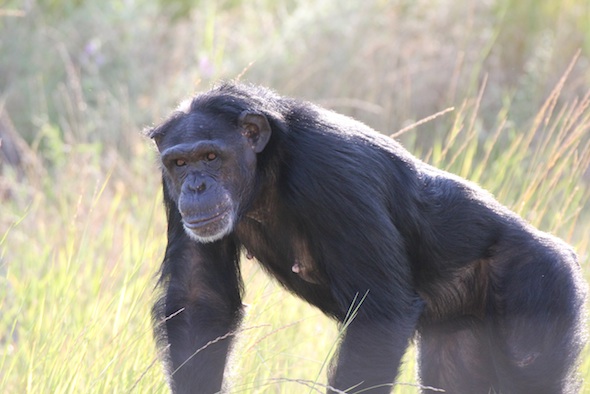
Missy gathered grass from around the bamboo, where it stays lush and green from irrigation.

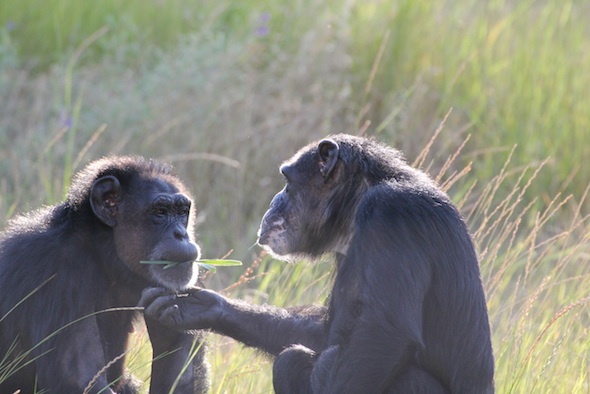
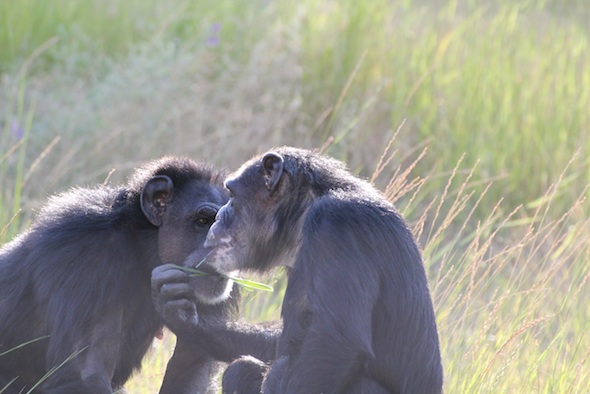
Jody also gathered grass, which is one of her favorite pastimes, but something was obviously upsetting her.

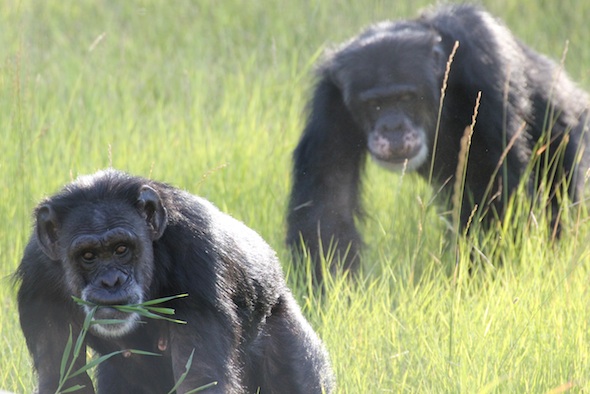
She approached Missy for reassurance and Missy offered it to her, with all the coolness and confidence of Don Corleone.

Window Play
Burrito and Debbie had a fun game of chase going this morning, with Debbie running on the outside of the chimp building where the garden is, and Burrito running inside from window to window. At one point in the game, Burrito generously shared a little bit of his water.
Jamie played a bit too, but she mostly wanted Debbie to pick her something from the garden.