• Skip to main content
  • Skip to primary sidebar
  • Skip to footer

Chimpanzee Sanctuary Northwest

Hope. Love. Home. Sanctuary

  • Our Family
    • The Chimpanzees
    • The Cattle
  • Blog
  • About Us
    • Visiting the Sanctuary
    • Philosophy
      • FAQs
      • Mission, Vision & Goals
      • Privacy Policy
    • The Humans
      • Staff
      • Board of Directors
      • Founder
    • Annual Reports
    • The Future of CSNW
    • CSNW In The News
  • You can help
    • Donate
      • Become a Chimpanzee Pal
      • Sponsor A Day
      • Transfer Stock
      • Be A Produce Patron
      • Be a Bovine Buddy
      • Give from your IRA
      • Personalized Stones
      • Bring Them Home Campaign
    • Leave A Legacy
    • Employment Opportunities
    • Volunteer
    • See Our Wish List
    • Events
  • Resources
    • About Chimpanzees
    • Enrichment Database
    • Advocacy
      • Advocacy Action Center
      • Apes in Entertainment
        • Trainers
        • Role of the AHA
        • Greeting Cards
      • Chimpanzees as Pets
      • Roadside Zoos
      • Chimpanzees in Biomedical Research
      • Conservation
        • African Apes
        • Orangutans
  • Shop
    • Merchandise Store
  • Contact
  • DONATE NOW

rescue

Digging

November 1, 2013 by J.B.

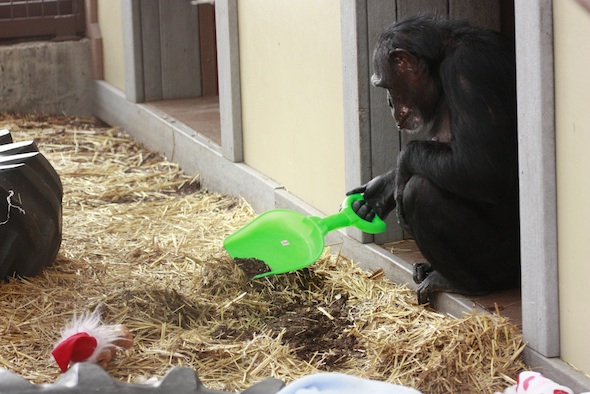
Jamie loves to dig.

web_Jamie Christmas dig with new shovel enrichment_MG_2547

We sometimes find evidence that the chimps have been digging into the nests of ground squirrels on Young’s Hill. They seem to want to figure out where those squirrels disappear to when they dive into those little holes in the ground, but they never dig down far enough to find them.
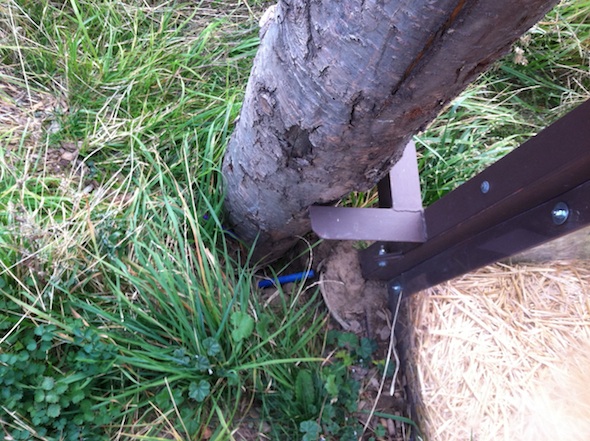
web_Tools_in_hole_cabin_YH_jb_IMG_2091

Some of the chimps use tools to dig into the hard clay soil. A plastic shovel or trowel works best, but in a pinch, anything pointy will do. A tool also keeps a chimp’s hand away from the sharp teeth of an angry squirrel – the same reason why Jamie uses hardcover books or pasta spoons to chop at garter snakes instead of her bare hands. I would bet that, by now, Jamie knows that garter snakes are not going to hurt her, but she still seems to act as if they are dangerous, or at least “icky.” I’m sure a lot of humans can relate.
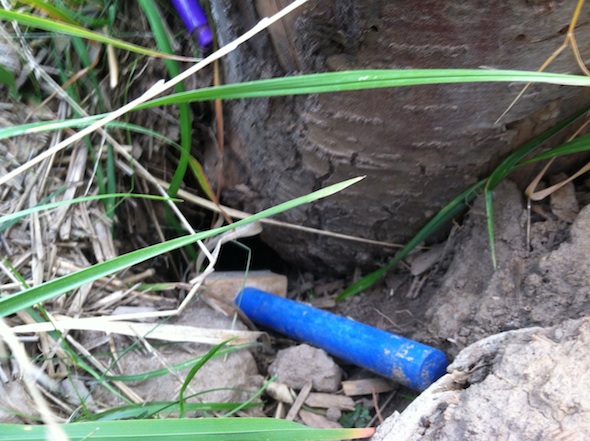
web_Tools_in_hole_close_up_cabin_YH_jb_IMG_2092

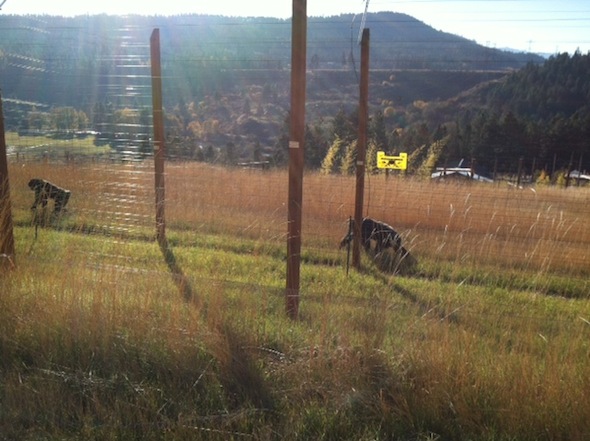
When Jamie is not going after squirrels, she likes to keep herself busy with projects. A few weeks ago, I found her digging in the entrance to Young’s Hill with a plastic trowel.
Filed Under: Chimpanzee Behavior, Jamie Tagged With: chimpanzee, dig, hunt, northwest, rescue, Sanctuary, snake, squirrel, tool use

the walking club

October 26, 2013 by Diana

Unless this is your first time visiting the blog (if so, welcome!!), you probably know about Jamie’s obsession with walking around the perimeter of Young’s Hill while one or more of her human caregivers walks around the outside of the perimeter while wearing a cowboy boot.

She has been doing this multiple times a day with all of her caregivers since the spring. While Jamie is quite demanding about taking these walks 4-7 times a days, it’s admittedly not a dreaded task for us humans. It’s hard to describe how great it feels to not only be making Jamie happy, which is pretty much a CSNW caregiver’s definition of a successful day, but it’s also just a very peaceful way to spend 15 or so minutes. It’s particularly great right now because the weather has been amazing this October, and the hill and the surrounding property is beautiful, even awe-inspiring at certain times of the day.

We actually dreamed of doing these perimeter walks before Young’s Hill was a reality. When it was in the design phase, we wondered if the chimps might patrol the perimeter of the hill, similar to the way chimpanzees in the wild go on patrol to check the boundaries of their territory. So when Jamie started doing this, it felt right.

While spending time with the chimpanzees one-on-one, like walking with Jamie while the other chimps do their own thing, is personally fulfilling, what’s 100 times more rewarding is observing the chimpanzees with each other and seeing their bonds strengthen and their friendships expand.

Which is why we’ve been thrilled that other chimpanzees have been joining Jamie on her walks lately. J.B. captured some clips on his phone and put together the video below.

Maybe, just maybe, one day the chimpanzees will go off on their own with each other to walk the perimeter of the hill, leaving us humans behind.


Burrito and Jamie on the hill

Filed Under: Boots, Burrito, Caregivers, Chimpanzee Behavior, Free-living chimps, Jamie, Missy, Sanctuary Tagged With: animal, biomedical research, Burrito, chimp, chimpanzee, csnw, Jamie, Missy, northwest, patrol, rescue, Sanctuary, shelter, walk, young's hill

Negra in the Sun

October 18, 2013 by J.B.

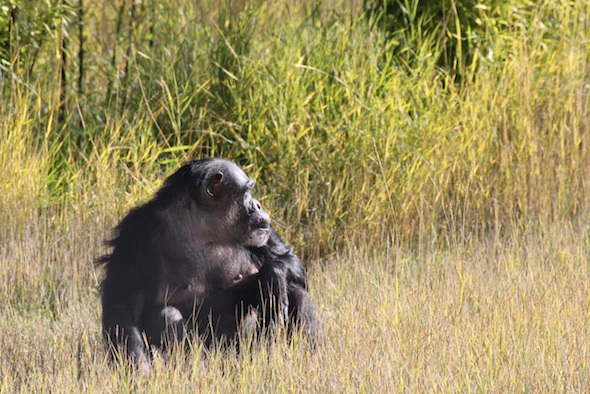
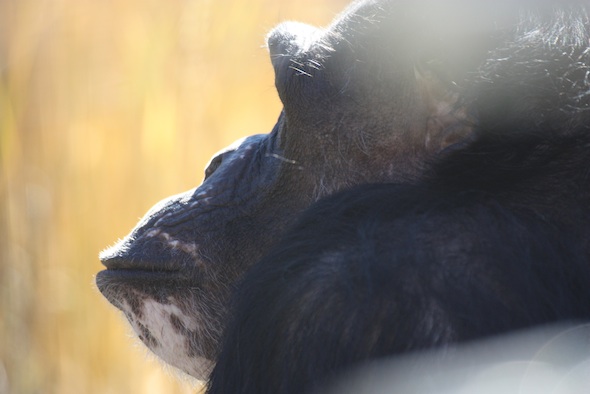
There’s nothing better than watching Negra sit outside and soak up the sun.

web_Negra_eat_pomegranate_YH_bamboo_jb_IMG_4810

web_Negra_grass_bamboo_look_at_sun_valley_YH_jb_IMG_4825

web_Negra_profile_sun_YH_jb_IMG_5271

Filed Under: Negra Tagged With: chimpanzee, Negra, northwest, rescue, Sanctuary, sun

“Fake Neggie”

October 5, 2013 by Debbie

All of the chimps have nick-names that have caught on over the years and almost all of the caregivers use with them. Annie is “Annie Bo-Bannie,” Burrito is just “Mr. B,” Foxie is “Foxie Fox!” Jody is “Jo-Jo,” Jamie is “James,” Missy is “Miss” and Negra is “Neggie.”

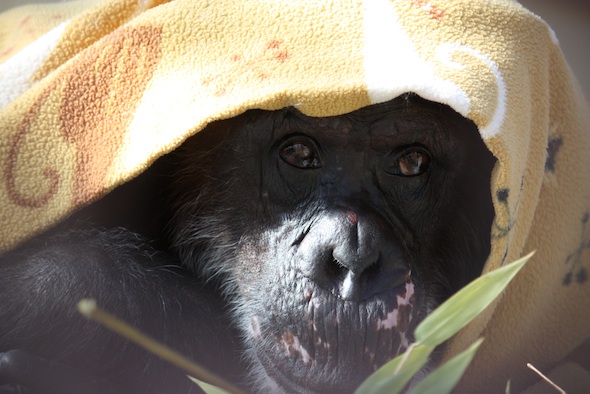
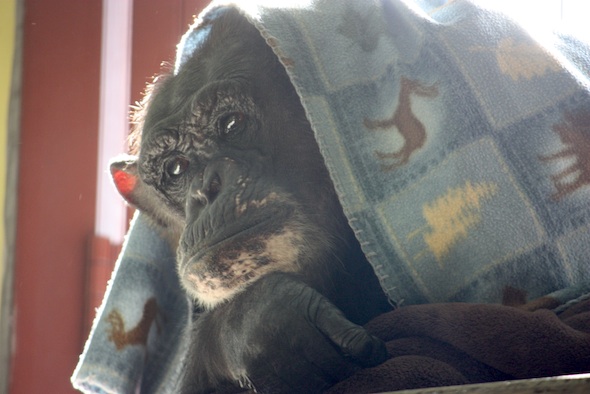
Missy has a tendency to sometimes lie in the “Neggie spot” which is in front of the catwalk window, where Negra likes to sit and gaze out onto the valley below. Sometimes Missy even covers herself in a blanket, in perfect Negra style. When we go to say hi to the chimps, sometimes Missy trips us up and we mistake her for Negra at first, because of her perfect impersonation. This is what we call “Fake Neggie.”

Today, Fake Neggie was in the greenhouse on the top platform, soaking in the sun…

web_missy_under_blanket_fake_neggie_GH_dm_IMG_5227

and Real Neggie was in her spot on the catwalk in the playroom.

web_negra_under_blanket_PR_dm_IMG_5234

Filed Under: Missy, Negra, Nesting, Sanctuary Tagged With: animal protection, animal rescue, animal rights, Animal Welfare, chimp, chimp enrichment, chimp sanctuary, chimpanzee, chimpanzee rescue, chimpanzee retirement, chimpanzee sanctuary, Chimpanzee Sanctuary Northwest, Cle Elum 7, Cle Elum Seven, csnw, Missy, Negra, Nesting, primate protection, primate rescue, rescue, Sanctuary

Smile!

October 4, 2013 by J.B.

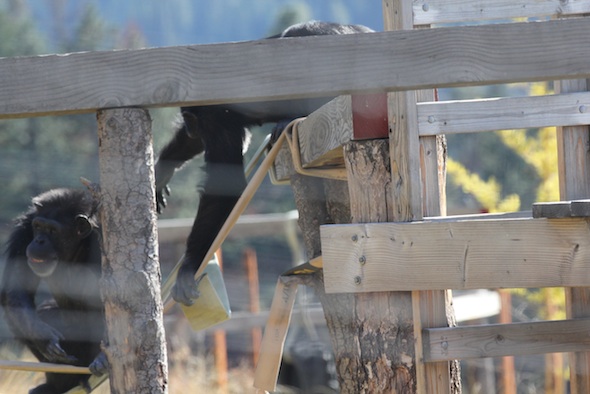
A couple weeks ago, Debbie posted about the difference between chimpanzee fear grimaces and chimpanzee smiles. This afternoon, Missy and Annie decided to demonstrate the many things that might elicit a smile, otherwise known as a play face.

For example, you might smile if your friend leaped out of the grass and tried to wrestle you to the ground.

web_Annie_playface_wrestle_Missy_YH_jb_IMG_4943

Or, you might smile if you were the one doing the leaping.

web_Missy_playface_wrestle_Annie_YH_jb_IMG_4945

You might smile if your friend was tickling your toes.

web_Annie_playface_wrestle_beam_Missy_YH_jb_IMG_4970

And you might smile if you tickled her right back.

web_Annie_slight_playface_grab_Missy_foot_YH_jb)IMG_4994

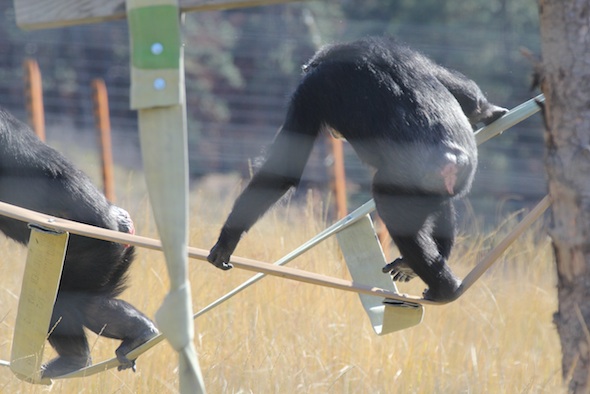
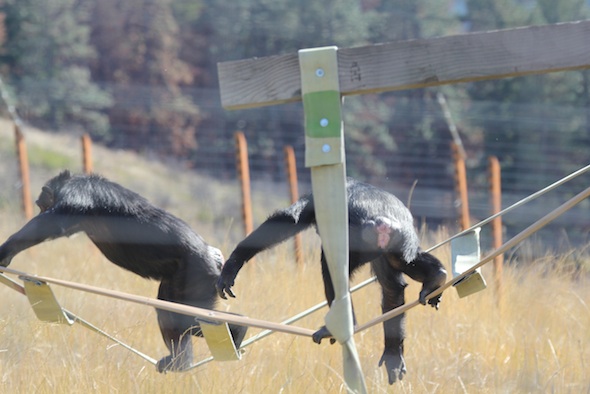
You might smile if your friend chased you across a fire hose bridge.

web_Annie_smile_Missy_chase_firehose_bridge_YH_jb_IMG_5004

You might also smile if you were the one doing the chasing. Especially if you went too fast…

web_Missy_chase_Annie_firehose_bridge_YH_jb_IMG_5011

…fell off…

web_Missy_chase_Annie_firehose_bridge_YH_jb_IMG_5012

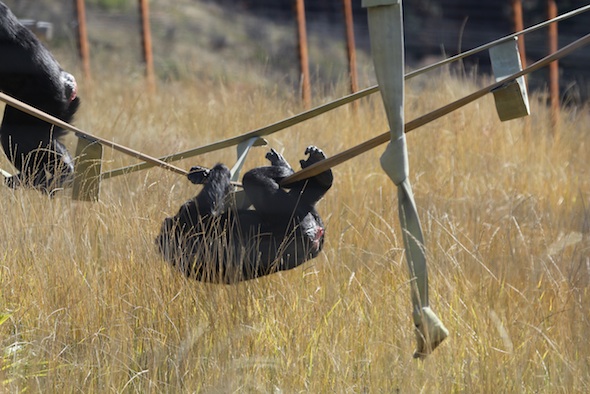
…hung upside down…

web_Missy_hang_upside_down_firehose_YH_jb_IMG_5016

…and kept right on chasing.

web_Missy_playface_hang_upside_down_firehose_bridge_YH_jb_IMG_5018

You might even walk away smiling after a move like that.

web_Missy_smile_YH_jb_IMG_5026

Filed Under: Annie, Chimpanzee Behavior, Missy, Play Tagged With: Annie, chimpanzee, Missy, northwest, Play, playface, rescue, Sanctuary, smile, wrestle

The Landmine Snare

September 30, 2013 by Debbie

Maureen McCarthy, PhD candidate at the University of Southern California, was our very first guest blogger. She is doing field research in Uganda, and while there she has been featured as a regular on Scientific American’s blog. The entry that follows is particularly moving. WARNING: some disturbing images are included in this entry.

—

This is our last week of data collection. It was supposed to be a laid-back week to collect a few more samples and enjoy a few final days tracking chimpanzees, a fieldwork victory lap of sorts. It didn’t turn out as I’d hoped, though. Instead, things went very, very wrong.

On Tuesday, we ventured back to a forest reserve south of the Budongo Forest. It’s one we’ve visited numerous times before…a much larger forest than most we visit, one which helps functionally connect the fragmented forests of this corridor region to the much larger Budongo Forest to the north. On the surface, chimpanzees here have a good habitat compared to our friends to the south in most forest fragments I’ve been studying. A closer look, however, reveals an abundance of illegal logging and snare hunting sites within the forest. Though snare hunting is illegal, it is a leading cause of injury and death among chimpanzees in Uganda. Up to one third of chimpanzees in forests of Western Uganda have sustained snare injuries (Reynolds, 2005; Wrangham and Goldberg, 1997; Wrangham and Mugume, 2000).

We received news that chimpanzees had been heard far inside the forest early that morning. Jack and I, along with a field assistant and a guide from the National Forestry Authority, began traveling through the forest en route to the area where they were heard. Around mid-morning, we too began hearing pant hoot vocalizations from the chimpanzees, as well as occasional whimpers and screams, which are not unusual, especially among larger parties. We projected waypoints for their location and followed trails in that direction until we knew we were close. It sounded like a large party was present, with a second party approximately 200 meters away.

We decided to leave the nearby party so as not to disturb them, instead backtracking along their trail in the hopes of finding nests from the previous night. After successfully locating numerous nests and dung samples, we followed their trail back to where they’d been calling in the hopes of finding that they’d gone, leaving some dung samples behind. Instead, we saw a number of chimpanzees, which, along with their earlier vocalizations, suggested a large party was still present. We watched as a subadult male climbed a tree. He produced a dung sample, and we noted its location so we could find it there after they had moved. When it seemed that the chimpanzees may be preparing to leave, we decided to slowly and carefully move closer to the tree where we saw the male, in an attempt to collect the dung. As we approached, we found that a young chimpanzee was watching us from deep within the dense vegetation. The youngster was about three years old. He watched us fearfully and whimpered from a limb about one meter off the ground, then became more fearful and began to scream. We wondered why he didn’t simply leave his leafy perch. Was he injured or trapped? One of our field assistants, who led in the front of our party, assured us confidently that he could see both hands and feet, and that all limbs were free. Despite these assurances, I was left with an uneasy feeling. However, a large party of chimpanzees was still nearby. An adult started to climb down from his position in a tree. I decided that it would be too risky to move closer through the dense vegetation. Given the thickness of the undergrowth, we would have to approach very closely to see the young chimp well enough to assess the situation thoroughly. If he then became very upset, others in the party could come to his defense and we could risk being seriously attacked. I would have to rely on my field assistant’s assessment that the youngster was fine despite what seemed to be unusual behavior. At least, we noted hopefully, there was no distressed mother visible. We left the possibility of sample collection behind and went home for the day.

The next morning, we came back in the hopes that the chimpanzees had all left and the dung samples remained. As we approached, we heard and saw no sign of chimpanzee presence. However, we soon heard the unmistakable whimpers of the same young chimpanzee. Jack and I looked at each other with sinking, awful dread. The infant chimpanzee was indeed trapped there. I approached, passing through the vegetation to get a close look at the chimpanzee. He had a wire snare around his left foot. He still seemed strong and relatively healthy despite being trapped. We suspected that he had been ensnared there sometime after the party arrived on Tuesday morning. We left the area immediately to get phone reception and called our colleagues at the Budongo Conservation Field Station for assistance. We hoped their veterinary staff could provide the necessary help to free the chimp from his snare.

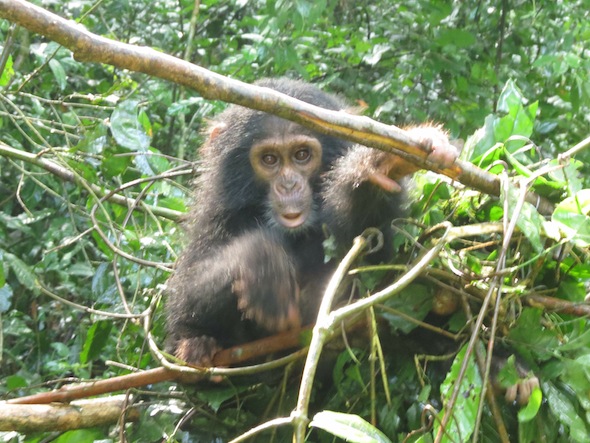
maureen landmine snare Photo 1

The ensnared chimpanzee. Note the trapped left foot, with the snare wire visible on the branch above. Photo © Maureen McCarthy.

Phone signals were poor and transportation was challenging between Budongo and our location. We spent hours waiting but eventually received word that help was on the way. Finally, two veterinarians from Budongo met us in a nearby village. I was relieved that help had finally arrived and that this chimpanzee could be given a chance to be free again and to go on with his young life. We trekked through the forest until we finally arrived again at the location of our little friend. As we pushed through the dense vegetation, I couldn’t see the chimp at his usual post. For a brief moment, my heart leapt as I thought he may have escaped his snare. A moment later, however, I was devastated by reality—he was not visible because he had died and was now hanging below the branch where we found him earlier.

My mind was reeling. How could he have died so soon? Sure, it took hours for help to arrive, but he looked so strong earlier. Dozens of “what ifs” flooded my thoughts. What if we had ignored the risks and pushed in further yesterday to assess the situation fully and see that he was truly ensnared? What if we had stayed by his side today? What if we had just tried to release him on our own before help arrived? If we did release him, could we have helped him find the other chimpanzees in his community? I was heartbroken and guilt-ridden with thoughts that I should have done more.

Thankfully, the veterinary staff from Budongo could not have been more calming and professional. Their assessment was that the chimpanzee was likely an orphan since there was no sign of his mother in the vicinity. We should expect a chimpanzee mother to remain nearby if her infant is trapped in a snare. They also assessed the cause of the infant’s death. The infant was found hanging upside down by the trapped leg. It seems that he had fallen from the leafy cushion of branches on which he was seated and was unable to right himself. Perhaps he was simply too tired after all the trauma he’d experienced since the previous day. As he hung upside down, the oxygen-poor blood accumulated in his head as the heart was unable to pump it back up to his chest and replenish his brain with oxygen-rich blood. The wound, along with our account of where the chimpanzees traveled, corroborated the notion that the injury had occurred the previous day. Perhaps most tragically, he had only just died. If we had been able to intervene only an hour sooner, the outcome could have been very different. This particular detail is staggeringly difficult for me…

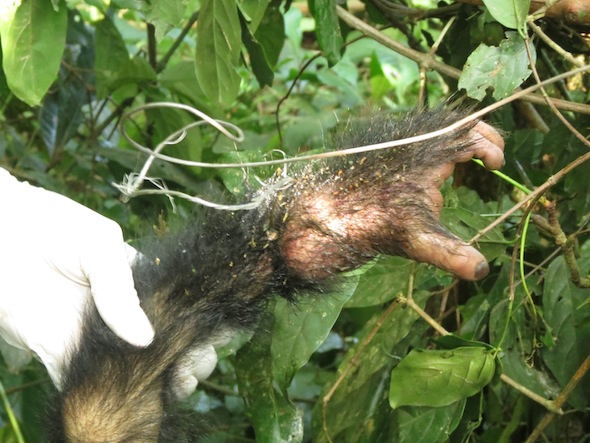
maureen landmine snare Photo 2

The snare injury, post-mortem. Photo © Maureen McCarthy.

The vets also assessed the reason for his injury. It was caused by what is known as a landmine snare, a particularly complex snare devised to catch a large animal such as a bushbuck. The complex construction made it clear that it would have been difficult if not impossible for the chimpanzee to free himself, at least not without losing his foot in the process. This snare was likely set by an illegal logger in one of the nearby camps within the forest, perhaps one of the men who went crashing through the forest to avoid being seen by us just earlier that morning.

The veterinarians freed the chimpanzee’s body from the snare and carefully collected it for post-mortem analysis and a respectful burial. He was so small, so vulnerable, and so beautiful. Life had only just left him, and I was simultaneously so sorry for him and so grateful that he no longer had to suffer the fear and pain he had been feeling.

What can we make of this tragedy? I feel distraught and helpless over the loss of this young innocent life. I can find comfort in a couple of thoughts, though. First, I am grateful that none of our team members was injured in what potentially could have been a very dangerous situation. If I had insisted that we push in to get a closer look when other chimps surrounded us, I could instead be writing an account of one of our team members being attacked by a chimpanzee. Second, I am grateful that, if he had to die, at least the loss of consciousness he experienced was relatively painless compared to a week or more of suffering slow starvation, a fate endured by some chimpanzees similarly caught in snares.

max

Max, a snare injury survivor in Kibale National Park, Uganda. Photo courtesy of Ronan Donovan.

I can take one more comfort. That is, I can hope we learn something from this awful situation and create some sort of positive outcome. I hope the plight of this innocent chimpanzee can help shed light on the gravity of snare hunting as a threat to our closest living relatives. There are committed individuals in Uganda trying to ensure that this won’t happen to another chimpanzee. For example, please consider supporting a snare removal program such as the Jane Goodall Institute Snare Removal Program or the Kibale Snare Removal Program. Here’s hoping snare hunting becomes a thing of the past.

This post was originally published at Scientific American.

Works cited:

Reynolds, V. (2005). Chimpanzees of the Budongo Forest. New York: Oxford University Press.
Wrangham, R.W., Goldberg, T. (1997). An overview of chimpanzee conservation and management strategies. In Conserving the chimpanzees of Uganda: a population and habitat viability assessment for Pan troglodytes schweinfurthii (ed. E. Edroma, N. Rosen and P.S. Miller). IUCN/SSC, Apple Valley, MN.

Wrangham, R.W., Mugume, S. (2000). Snare removal program in Kibale National Park: a preliminary report. Pan Africa News 7: 18-20.

Filed Under: Advocacy, Free-living chimps Tagged With: advocacy, animal protection, animal rescue, animal rights, Animal Welfare, budongo, bushmeat orphan, chimpanzee, chimpanzee rescue, chimpanzee retirement, chimpanzee sanctuary, Chimpanzee Sanctuary Northwest, free-living chimps, kibale national park, maureen mccarthy, primate rescue, rescue, scientific american blog, snare trap, uganda

A walk in the rain

September 27, 2013 by J.B.

I will never forget the first time the Cle Elum Seven chimps saw rain.

Central Washington is very dry in the summer, and a couple of months had gone by after their arrival without any significant precipitation. Every day was hot and sunny. Imagine this from their perspective. They had lived for decades in windowless rooms. Some hadn’t been outside since they were infants; others may have never seen the outdoors in their entire lives. As far as they knew, this is how the outside world was and always would be.

Then one day, the skies opened up and it poured.

The chimps were in the playroom at the time, and they ran to the doors and windows to see what was happening. Missy and Jamie started to alarm call, alerting the others to this frightening and confusing turn of events. Jamie was brave enough to go outside, but she immediately turned around and dried herself off head to toe with a towel. When it was over, they cautiously ventured out to inspect the aftermath.

It’s both heartbreaking and awe inspiring to watch a 35-year-old learn about basic things like rain. As the years went by, the chimps grew accustomed to the sight and sound of rain, but they still didn’t like to go outside in it. They’d spend rainy days indoors in their nests, and if they were unfortunate enough to get caught outside in the rain, they’d run as fast as they could to get back inside.

But this year, Jamie decided that a little rain wasn’t going to keep her from walking around Young’s Hill. And as I watch her walk, drenched from the rain but determined to carry on, I can’t help but admire her.

Filed Under: Jamie, Young's Hill Tagged With: chimpanzee, hill, Jamie, northwest, rain, rescue, Sanctuary, walk, wet, young's

  • « Go to Previous Page
  • Page 1
  • Interim pages omitted …
  • Page 104
  • Page 105
  • Page 106
  • Page 107
  • Page 108
  • Interim pages omitted …
  • Page 159
  • Go to Next Page »

Primary Sidebar

Subscribe To the Blog and Get Notified of New Posts First!

Archives

Calendar of Blog Posts

June 2026
S M T W T F S
 123456
78910111213
14151617181920
21222324252627
282930  
« May    

Categories

SUBSCRIBE TO OUR NEWSLETTER

Footer

PO Box 952
Cle Elum, WA 98922
[email protected]
509-699-0728
501c3 registered charity
EIN: 68-0552915

Official DDAF Grantee

Menu

  • The Chimpanzees
  • Blog
  • About Us
  • You can help
  • Resources
  • Contact
  • Donate

Proud Member of

Connect With Us

Search

Copyright © 2026 Chimpanzee Sanctuary Northwest. All Rights Reserved. Site by Vegan Web Design