• Skip to main content
  • Skip to primary sidebar
  • Skip to footer

Chimpanzee Sanctuary Northwest

Hope. Love. Home. Sanctuary

  • Our Family
    • The Chimpanzees
    • The Cattle
  • Blog
  • About Us
    • Visiting the Sanctuary
    • Philosophy
      • FAQs
      • Mission, Vision & Goals
      • Privacy Policy
    • The Humans
      • Staff
      • Board of Directors
      • Founder
    • Annual Reports
    • The Future of CSNW
    • CSNW In The News
  • You can help
    • Donate
      • Become a Chimpanzee Pal
      • Sponsor A Day
      • Transfer Stock
      • Be A Produce Patron
      • Be a Bovine Buddy
      • Give from your IRA
      • Personalized Stones
      • Bring Them Home Campaign
    • Leave A Legacy
    • Employment Opportunities
    • Volunteer
    • See Our Wish List
    • Events
  • Resources
    • About Chimpanzees
    • Enrichment Database
    • Advocacy
      • Advocacy Action Center
      • Apes in Entertainment
        • Trainers
        • Role of the AHA
        • Greeting Cards
      • Chimpanzees as Pets
      • Roadside Zoos
      • Chimpanzees in Biomedical Research
      • Conservation
        • African Apes
        • Orangutans
  • Shop
    • Merchandise Store
  • Contact
  • DONATE NOW

positive reinforcement

Building trust

October 27, 2017 by J.B.

Providing medical care to chimpanzees is always a challenge, but it can be particularly difficult when they have been subject to decades of invasive medical research procedures against their will.
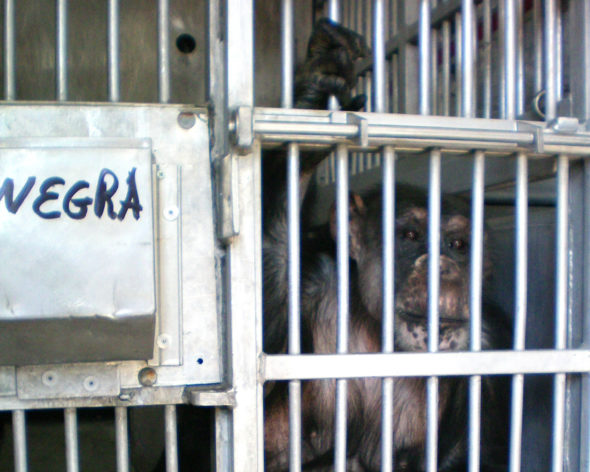
Years ago, we participated in a study that considered whether chimpanzees might exhibit abnormal behaviors that cluster into syndromes similar to posttraumatic stress disorder and depression in humans (you can read it here). Negra was featured in the paper as a case vignette:

A chimpanzee named Negra was a 36-year-old female at the time of the study. Taken from the wild in Africa as an infant, she has remained in captivity since that time. She was used in invasive research, including hepatitis experiments, and for breeding. Each of her infants was removed from her at an early age. During the period in which she was used in research, she was kept in isolation for several years. Approximately 1 year prior to the study, she was transferred to Chimpanzee Sanctuary Northwest in Washington state, where she currently lives with six other chimpanzees.

Negra met alternative criteria for depression and PTSD. According to reports, she had persistent depressed hunched posture, and she was socially withdrawn. Negra slept excessively during the daytime, and she lacked interest in play, food, other individuals, and grooming. She also demonstrated poor attention to tasks. She was described as slow and sluggish, and at times, she appeared anxious. In response to an unexpected touch, she would “threat bark,” scream, or run away. Compared with other chimpanzees, she demonstrated less variability in her facial expressions. Caretakers reported that her face was expressionless, “like a ghost,” for at least a month after she arrived at the sanctuary. She seldom, if ever, exhibited a play face. She was tested for a thyroid disorder and assessed for other medical causes of her clinical presentation, but all laboratory tests were within normal limits. Based on later reports provided by her caretakers, some of her symptoms have improved since she has been living in the sanctuary. She has become more interested in other chimpanzees, including grooming, and the variability in her facial expressions has increased.

Negra’s anxious response to being touched was not just a sad reminder of her earlier trauma; it was a serious impediment to her care at the sanctuary. Chimpanzees routinely receive wounds from fights, they develop dental problems, they get heart disease and diabetes and many other illnesses, and these things often require medical intervention.

There’s always a way to force medical care on an uncooperative chimpanzee, and sadly that is what’s required from time to time. But that can be stressful and even dangerous. They deserve a chance to participate willingly. Giving them that choice, however, requires a lot of time and energy on the part of their caregivers.

For years, CSNW caregivers (first Debbie and now Anna) have been working with Negra to habituate her to basic medical evaluations and treatments as part of our positive reinforcement training program. These efforts have paid off many times over, most recently when Negra received a wound to her back during a fight. Negra let Anna spray the injury with antiseptic solution and she allowed Dr. Erin to follow that up with laser therapy. In cases where antibiotics may be needed, Negra will even let her caregivers swab the wound to culture the infection and determine the best course of treatment.
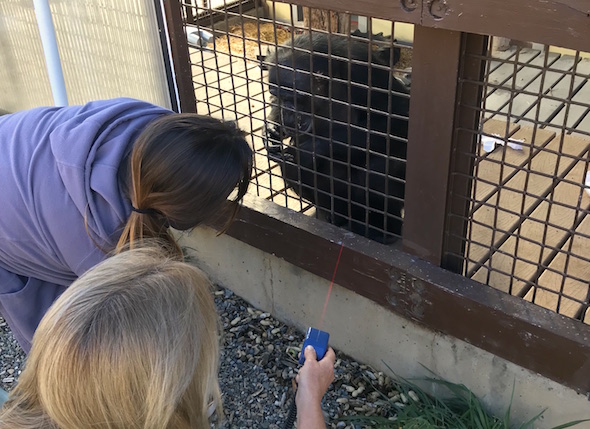
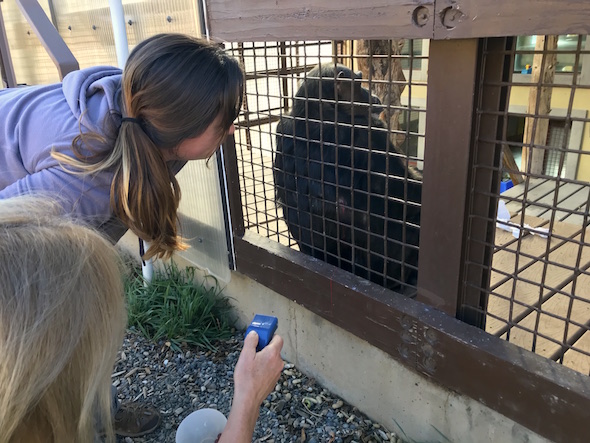
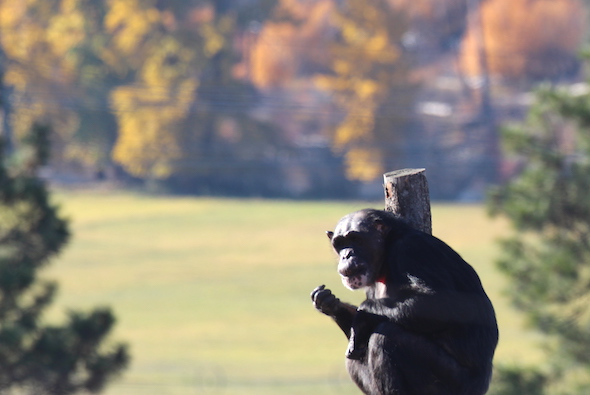
For some chimpanzees, this kind of cooperation is no big deal. But chimpanzees are individuals – they have unique life experiences and they cope with those experiences in different ways. Negra has never given her trust lightly. It had to be earned through years of persistent efforts on the part of her caregivers.

It has certainly been worth it.
Filed Under: Caregivers, Negra, Veterinary Care Tagged With: care, chimpanzee, injury, laser, northwest, positive reinforcement, prt, rescue, Sanctuary, therapy, training, trust, vet, veterinary, wound

Positive Reinforcement Progress

November 13, 2015 by J.B.

It’s been seven months since we started our Positive Reinforcement Training program. In that time, both the chimps and the staff have learned a lot.

We, the staff, have learned that training is a difficult skill to develop. As we try to teach new behaviors to the chimps, we are often just as confused and frustrated as they are, if not more so. It takes a lot of patience, creativity, and most importantly, experience, to become a good trainer.

The chimps have learned dozens of behaviors that will make their lives healthier and happier, and they’re starting to discover that cooperating with physical exams and other medical procedures doesn’t have to be scary – it can even be fun.

For his part, Burrito still thinks this whole thing is too good to be true – getting praised and rewarded with food, just for showing us his teeth? He would have done that for free…

But Burrito is not the only one making progress – stay tuned for updates on Annie, Foxie, Jamie, Jody, Missy, and Negra in the coming months.

Filed Under: Burrito, Intelligence, Thanks, Veterinary Care Tagged With: Burrito, chimpanzee, national anti-vivisection society, navs, northwest, operant conditioning, positive reinforcement, prt, rescue, reward, Sanctuary, training

Positive Reinforcement Training

May 1, 2015 by J.B.

We’re really excited to be embarking on a new program here at Chimpanzee Sanctuary Northwest. Thanks to a generous grant from the National Anti-Vivisection Society Sanctuary Fund, we recently began a Positive Reinforcement Training (PRT) program with the goal of teaching the chimps to participate in cooperative health monitoring.

Many of you reading this are probably familiar with PRT – it’s the “clicker training” that you see used everywhere from teaching dolphins to do flips to teaching your own dog to come when called. It uses positive rewards (usually food) and a “bridge” (a clicker, whistle, or even the word “good”) to reinforce particular behaviors. PRT is a tool, and like most tools, it can be used for good and for bad. So while it may unfortunately be used to teach animals to perform tricks for people’s amusement, it can also have a positive effect on the welfare of chimpanzees in captivity.

In their many decades in different laboratories across the country, the Cle Elum Seven chimps were darted with chemical anesthetics so that the labs could carry out experiments, treat wounds and illnesses, and perform routine physical exams. In some cases, the chimps were forced into small cages and surrounded by technicians with syringes, each one waiting until the chimp moved close enough to the caging to jab them. It’s hard to imagine how terrifying that must have been. And it happened over and over again – for some, well over a hundred times.

Thankfully, life in the laboratory is behind them now, but sanctuaries also have to collect information on the chimpanzees’ health if we want to provide the best care possible. What if there was a way to gain the same information without anesthetizing them at all? And if they did require anesthetization, what if they could learn to willingly participate in the procedure and avoid the pain and trauma of being darted? That’s where PRT comes in.

PRT has been used successfully in zoos, labs, and sanctuaries to teach chimps to cooperate with a host of health monitoring procedures: presenting different body parts for examination, sitting on a scale to be weighed, urinating into a cup, allowing their temperature to be taken, presenting an arm or leg for injection, and even allowing their blood to be drawn.

For us, the real prize is to get a look at Burrito’s heart function using an ultrasound machine. A few years ago, Burrito started showing symptoms of congestive heart failure, and since then we have successfully treated his symptoms with medication. But we’d like to get an echocardiogram to confirm the diagnosis and monitor the disease’s progression, and we’d like it even more if we could avoid anesthetizing him for it.

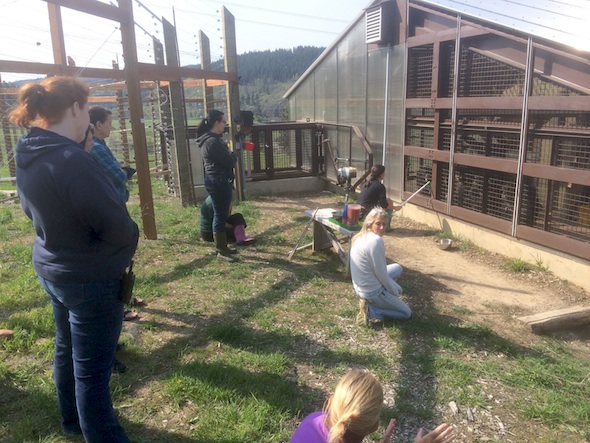
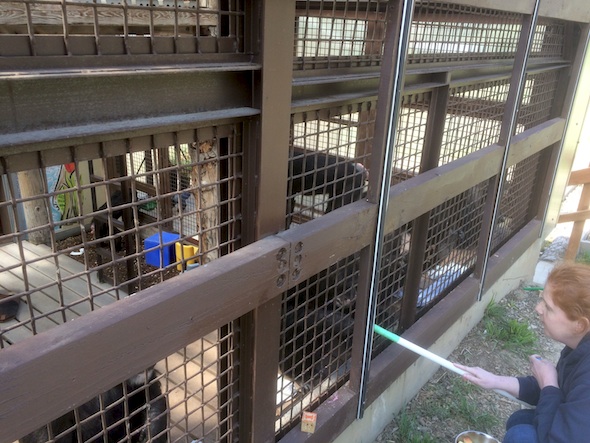
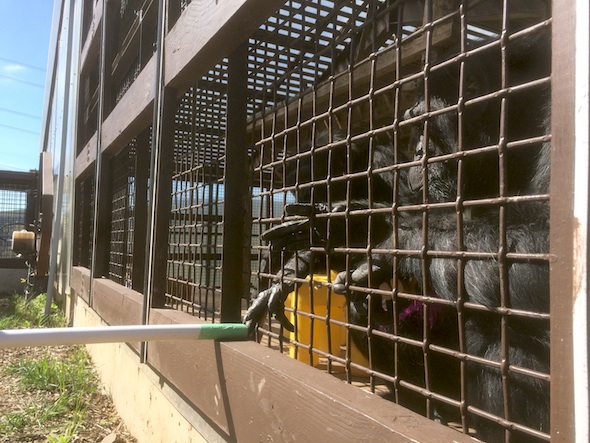
The grant from NAVS allowed us to bring in Gail Laule from Active Environments for the first of many visits to help create our PRT program and train our staff. Our work with the chimps began last Tuesday, and it’s amazing how much progress the chimps have made in just a little over a week. We began with simple things, like touching a target (just a pvc tube with some tape on the end), and quickly moved on from there.

web_PRT_staff_training_GH_jb_IMG_6814

web_Elizabeth_Burrito_PRT_target_GH_jb_IMG_6825

web_Foxie_touch_PRT_Target_GH_jb_IMG_6831

There are some challenges, of course. Jamie likes to be in control, and this new program has got her quite confused about who exactly is in charge here. So for now, the bulk of Jamie’s training consists of teaching her to allow us to work with the other chimps without interference. Negra, who suffered so much in her 35 years in the lab, was scared of the sound of the clicker, so she needed to be eased into training with more sensitivity. But while that first day was a bit of a challenge for Negra and her caregivers, imagine how she would feel if we had to dart her someday when she became ill. The beauty of PRT is that you can slowly and safely desensitize the chimps to frightening interventions so that when they are really needed, they can be performed with less stress and trauma.

But there is one chimp in particular that seems to enjoy training even more than the others, and who seems to have a particular aptitude for it. Any guesses?

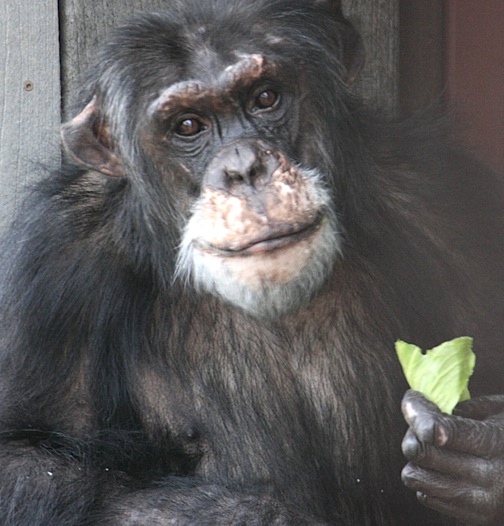
web Burrito outside OA greenhouse eat wrap dinner_MG_6122

That’s right, Burrito has finally found something that combines his two greatest passions: eating and playing with his caregivers. He is going to ace this program.

All of the chimps are learning to touch a target and to present different body parts for inspection – this is how we might examine and treat wounds, for example, and it also creates the foundation for more complex behaviors. To perform his ultrasound, Burrito will have to hold his chest to the caging for an extended period of time, so our training with him is also focusing heavily on that. Here’s a quick clip to show you how well our star student is doing:

We are so grateful to NAVS for providing the funding for this training, to Gail for getting us off on the right foot, and to all of our supporters who make each day in sanctuary possible for these seven chimps. We are looking forward to sharing our progress with you!

Filed Under: Burrito, Caregivers, Chimpanzee Behavior, Food, Sanctuary, Thanks Tagged With: active environments, Burrito, chimpanzee, health, medical, northwest, positive reinforcement, prt, rescue, Sanctuary, training, veterinary

  • « Go to Previous Page
  • Page 1
  • Page 2

Primary Sidebar

Subscribe To the Blog and Get Notified of New Posts First!

Archives

Calendar of Blog Posts

June 2026
S M T W T F S
 123456
78910111213
14151617181920
21222324252627
282930  
« May    

Categories

SUBSCRIBE TO OUR NEWSLETTER

Footer

PO Box 952
Cle Elum, WA 98922
[email protected]
509-699-0728
501c3 registered charity
EIN: 68-0552915

Official DDAF Grantee

Menu

  • The Chimpanzees
  • Blog
  • About Us
  • You can help
  • Resources
  • Contact
  • Donate

Proud Member of

Connect With Us

Search

Copyright © 2026 Chimpanzee Sanctuary Northwest. All Rights Reserved. Site by Vegan Web Design