• Skip to main content
  • Skip to primary sidebar
  • Skip to footer

Chimpanzee Sanctuary Northwest

Hope. Love. Home. Sanctuary

  • Our Family
    • The Chimpanzees
    • The Cattle
  • Blog
  • About Us
    • Visiting the Sanctuary
    • Philosophy
      • FAQs
      • Mission, Vision & Goals
      • Privacy Policy
    • The Humans
      • Staff
      • Board of Directors
      • Founder
    • Annual Reports
    • The Future of CSNW
    • CSNW In The News
  • You can help
    • Donate
      • Become a Chimpanzee Pal
      • Sponsor A Day
      • Transfer Stock
      • Be A Produce Patron
      • Be a Bovine Buddy
      • Give from your IRA
      • Personalized Stones
      • Bring Them Home Campaign
    • Leave A Legacy
    • Employment Opportunities
    • Volunteer
    • See Our Wish List
    • Events
  • Resources
    • About Chimpanzees
    • Enrichment Database
    • Advocacy
      • Advocacy Action Center
      • Apes in Entertainment
        • Trainers
        • Role of the AHA
        • Greeting Cards
      • Chimpanzees as Pets
      • Roadside Zoos
      • Chimpanzees in Biomedical Research
      • Conservation
        • African Apes
        • Orangutans
  • Shop
    • Merchandise Store
  • Contact
  • DONATE NOW

J.B.

Foraging

June 24, 2013 by J.B.

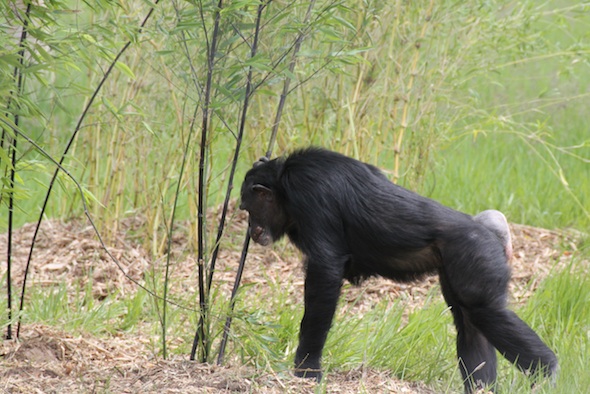
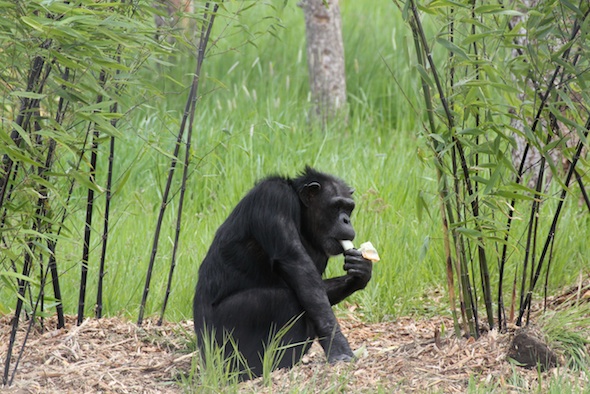
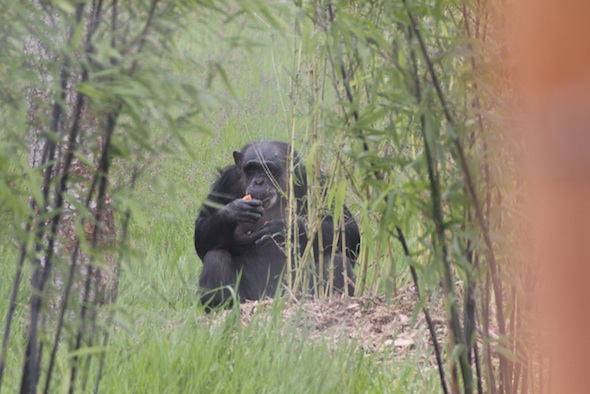
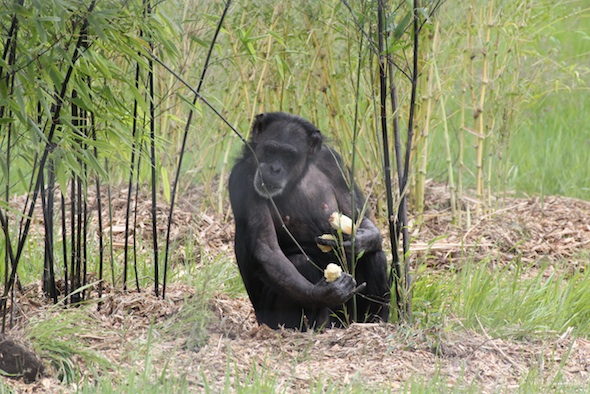
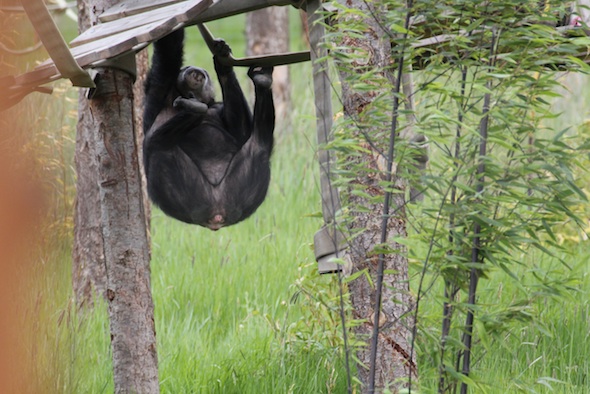
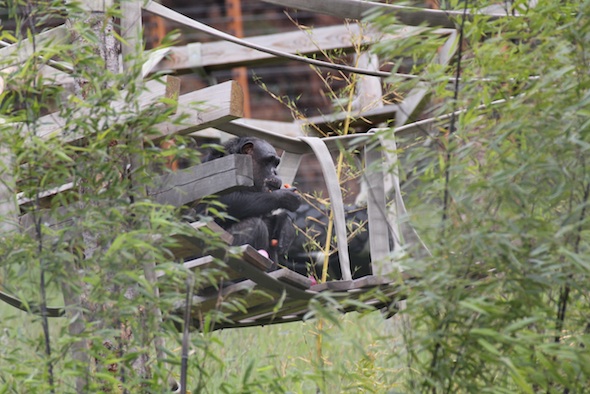
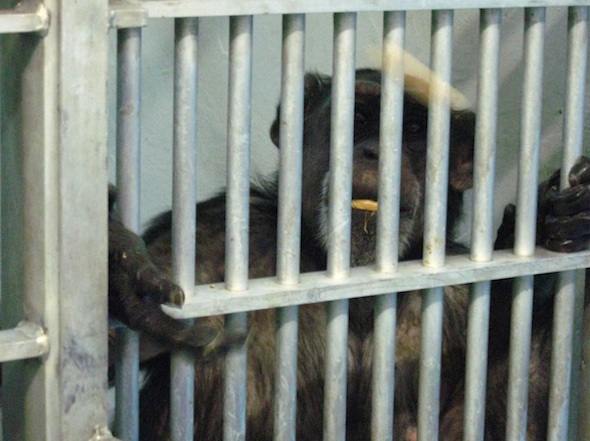
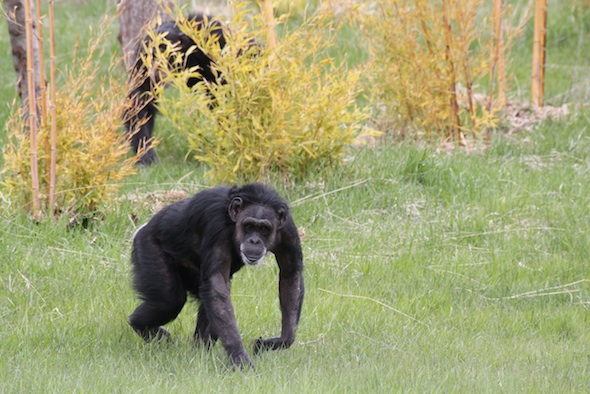
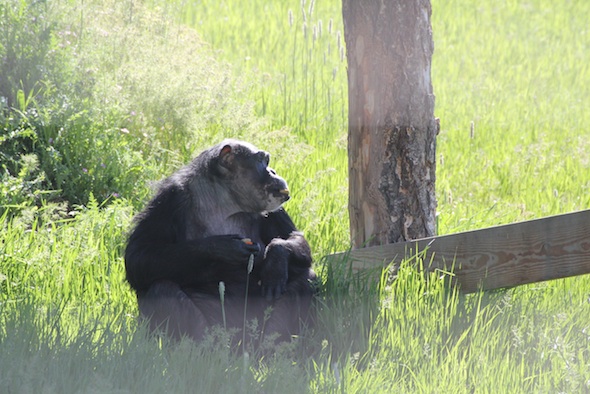
We provide food to the chimps in a variety of ways. Sometimes we serve them individually, either hand to mouth or hand to hand through the caging. This ensures that everyone is getting their fair share and gives us a great opportunity to monitor and evaluate the chimps’ health up close. Other times we put food in puzzles like the termite mound or raisin boards, giving the chimps a chance to use tools and their incredible problem-solving abilities. But my (and Burrito’s) favorite method is the forage. For a forage, we cut the food into small pieces and spread it throughout the enclosure while the chimps are locked out. Then we let them back in and they proceed to search for their meal. Foraging encourages activity and usually discourages stress and aggression because it’s difficult to steal or hoard food when it is spread out over such a large area, though Jamie sometimes tries her best.

The GoPro camera provides an interesting glimpse into a forage on the hill and it also allows us to hear all the groans and food squeaks that we would otherwise miss.
Filed Under: Burrito, Food, Young's Hill Tagged With: chimpanzee, Food, forage, gopro, northwest, rescue, Sanctuary, young's hill

Veterinary Clinic Update

June 1, 2013 by J.B.

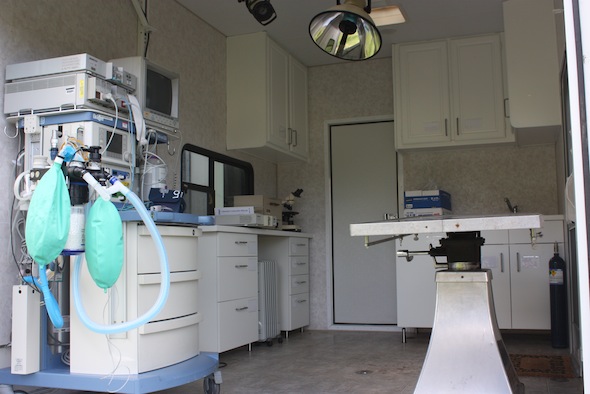
We’re getting closer to completing one of our most important projects to date: the creation of an onsite veterinary clinic. This project was made possible by generous contributions from Karen and Don Young, the National Anti-Vivisection Society, Project V.E.T.S., and the many Fund-a-Need donors at our 2011 and 2013 auctions. And now I’m happy to say that we have a few more people to add to this list.

Kathy Cochran, one of the best friends a chimp could have, connected us with Bud McIrvin and Dan Price of Providence Hospital in Everett, WA, and as a result we now have an incredible anesthesia machine to add to our clinic. Dan was even kind enough to drive out to Cle Elum this morning with his wife, Janet, to give me and Dr. Mensching a tutorial.

Clinic anesthesia machine

Filed Under: Construction, Sanctuary, Thanks Tagged With: anesthesia, chimpanzee, clinic, equipment, medical, northwest, rescue, Sanctuary, veterinary

New bamboo on the hill

May 19, 2013 by J.B.

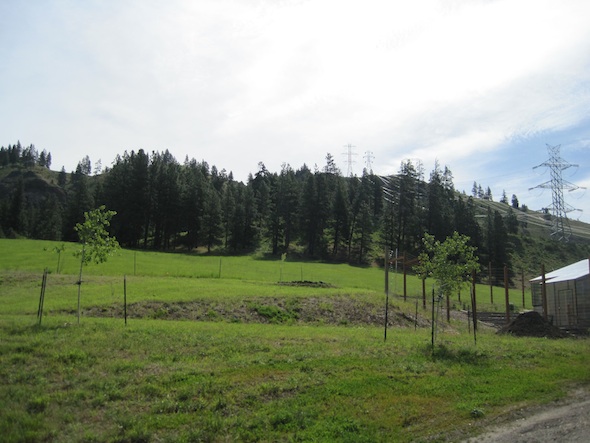
The site that we now call Young’s Hill was once just an empty horse pasture. Here it is in 2010, before we started construction:

YH before IMG_5898

A wide open pasture may be great for horses, but it’s awfully boring for chimps. And growing a forest from scratch takes a long time. Thankfully, we were introduced to Jackie Heinricher of Booshoot Gardens (now Provitro BioSciences) and she found a solution for us: bamboo!

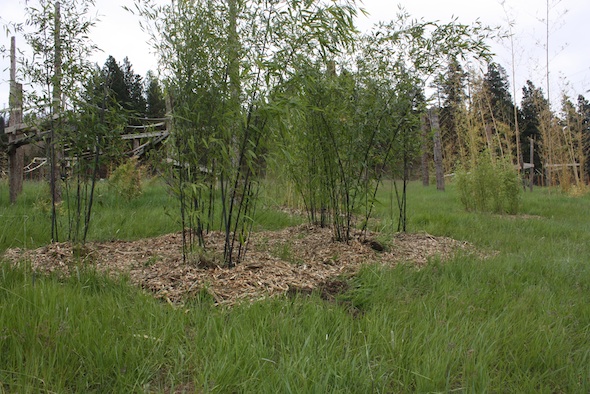
We initially planted two groves on Young’s Hill and just recently planted some in the chimps’ greenhouse. It’s a great source of shade in the summer, and it’s also great for climbing, nesting, and eating.

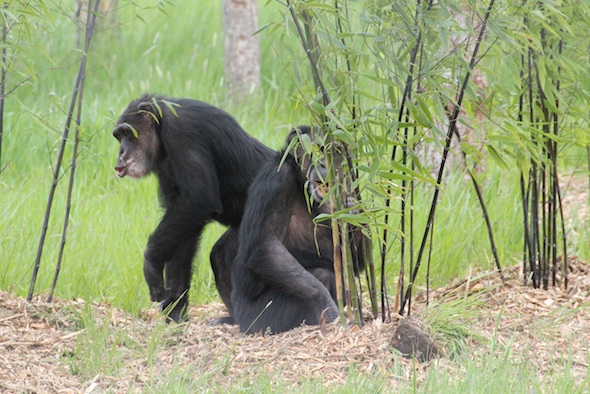
Yesterday, we planted three new species of bamboo on the hill, including Phyllostachys nigra, which has beautiful black culms. All were generously donated to us by Provitro.

web Black bamboo grove YH IMG_2030

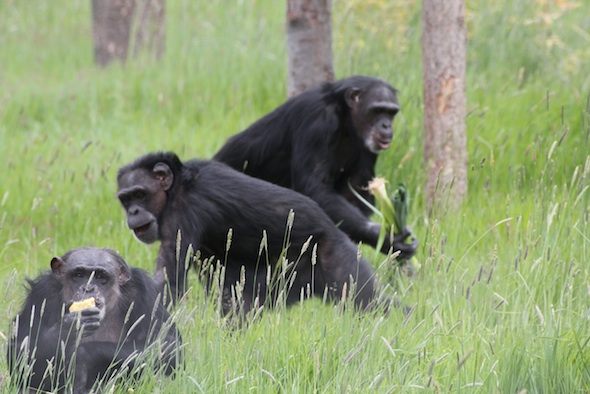
The chimps were really excited, though I admit it may have had a little to do with the corn, leeks, onions, and carrots that we spread around the hill.

web Missy pant hoot jody open mouth black bamboo YH IMG_8289

We’ve never heard the chimps so vocal on the hill before. As they foraged, everyone was pant-hooting with excitement.

web Negra eat corn jamie leeks jody open mouth YH IMG_8300

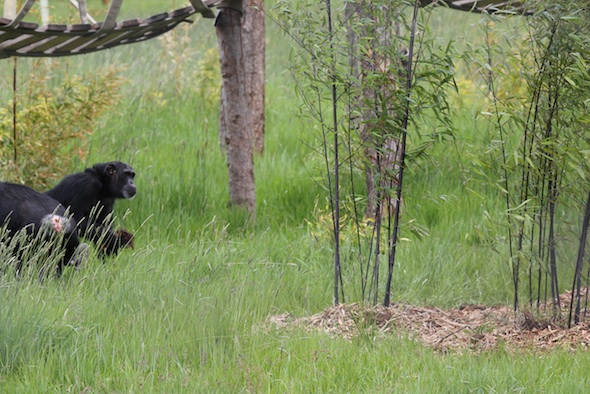
Foxie is always suspicious of new things, so at first she and Dora kept kept their distance from the new bamboo:

web Foxie suspicious of bamboo dora annie YH IMG_8312

And Jamie wasn’t quite sure what to make of it either:

web Jamie hold and inspect black bamboo YH IMG_8461

But soon everyone took a turn sitting under the new plants:

web Annie eat onion under black bamboo YH IMG_8452

web Jody sit with back to camera new bamboo YH IMG_8391

web Negra eat carrot new bamboo YH IMG_8384

web Jody bite black bamboo YH IMG_8405

Yesterday was a great day for all of us and Negra must have gotten caught up in the excitement because she did something we have never seen her do before: she climbed up onto the shaky bridge!

web Negra climb onto shakey bridge YH IMG_8359

Negra has lost over 10 pounds since coming to the sanctuary, and probably gained a lot of muscle, but she is still not in good enough shape to keep up with the activities of some of the other chimps. If she keeps this up, though, she may soon be giving Missy a run for her money!

web Negra eat carrot on shakey bridge black bamboo YH IMG_8367

We built a few of the structures on Young’s Hill specifically for Negra – they are close to the building and can be accessed without a lot of climbing. Maybe they’ll come in handy when she’s older because for now, Negra has decided that the whole hill is hers.

Filed Under: Annie, Construction, Enrichment, Food, Foxie, Jamie, Jody, Negra, Sanctuary, Thanks, Young's Hill Tagged With: Annie, bamboo, booshoot, chimpanzee, Foxie, Jamie, Jody, Negra, northwest, provitro biosciences, rescue, Sanctuary, young's hill

A Bittersweet Day

May 12, 2013 by J.B.

Today is Jody’s 38th birthday. Around here, we celebrate the chimps’ birthdays just as we would our own – a day filled with gifts and activities centered around the birthday guy or gal. Throughout the day, Jody will make giant nests of blankets and straw, pick dandelions from Young’s Hill, and enjoy flowers brought by volunteers and staff. We hope it will be all that Jody could ask for and more. But Jody’s birthday is always bittersweet. Because we don’t know her actual date of birth, we celebrate Jody’s birthday on Mother’s Day as a tribute to the mother that she was and, sadly, could have been if she had been given the chance.

We know very little about Jody’s early years. We are told that she was born in 1975, though these dates are often guesses, and spent some time performing in a circus. Like all chimpanzees in entertainment, she eventually became too strong and willful to control, and at that point she was purchased by the Buckshire Corporation in Pennsylvania.

In the 1970’s and 1980’s, demand was high for chimpanzees in the biomedical research community. Chimpanzees were being used to test experimental hepatitis vaccines and other pharmaceuticals, and with the emergence of HIV/AIDS the demand grew even higher. Buckshire purchased chimpanzees from breeders, importers, and circuses and then leased those chimpanzees out to laboratories for profit.

Buckshire leased their chimps primarily to two laboratories: White Sands Research Center, which later became the infamous Coulston Foundation, in New Mexico, and the Laboratory for Experimental Medicine and Surgery in Primates, otherwise known as LEMSIP, in New York. In 1981, Jody was shipped to White Sands to be used in hepatitis research and for breeding.

eb crop jody hand out buckshire cage IMG_0816

White Sands wasted no time with Jody. Within three days of her arrival, she was housed with a chimpanzee named Tom for breeding. She was routinely anesthetized, or “knocked down” in lab parlance, for physical exams and to be injected or provide blood samples for research. Her first knock down came on her 10th day at the lab. She was 6 years old. She was intubated, her blood was drawn, and she was given a new tattoo – “WSRC #37.”

Over the next year and a half, Jody was regularly transferred between cages. Sometimes she was with another female, sometimes by herself, but usually she was with a male for breeding purposes…Max, Mack, John, Magoo….all in an attempt to create the next generation of lab chimpanzees.

Finally, on August 6, 1982, lab technicians found that they had succeeded in impregnating Jody and she was transferred to the “P.G. Cage” by herself. The following January, Jody gave birth for the first time. The technician’s notes read:

1/4/83 – 4cc Ketaset IM. Delivered infant baby male – taken away to nursery…Baby – Male WSRC #66 OPY – appears healthy.

In the wild, chimpanzee mothers will nurse their babies for the first five years. Their bond is incredibly strong and during that time the entire world revolves around their child, just as it does for human mothers. But Jody never got to nurse her baby, or hold him, or carry him on her back, or teach him about the world. She was immediately knocked down and her baby was stolen. Six weeks after delivering and losing her first baby, Jody was put into a cage with a male named Rufus for breeding, and the cycle continued.

Jody would go on to have eight other babies and two miscarriages and endure at least 52 knockdowns at White Sands. The technician’s notes tell the same story over and over again, with chilling detachment. Jody delivers a baby, and then she is anesthetized with a chemical anesthetic called ketamine (a.k.a. Ketaset or Vetalar) so that the baby can be taken away. The “IM” in these notes stands for “intramuscular” – this is not like slipping something in her drink…she was being stabbed with syringes or shot with darts.

11/23/83 – 4cc Ketaset IM. Delivered healthy infant male #88…removed and taken to nursery

6/20/84 – Found approx. 2-month old fetus + placenta in cage this a.m.

4/26/85 – Delivered healthy looking baby at 10:30pm…3cc Ketaset IM. Not taking care of baby. Infant removed to nursery. Animal does not appear to be feeling well. Did not eat any fruit this date.

3/15/86 – Delivered healthy infant early a.m. this date. 3 1/2 cc Ketaset IM. Mother was leaving infant on the floor – infant removed + taken to nursery. Appears to be a healthy animal #142 Cliff, male.

5/20/87 – Delivered healthy male infant between 11:30 and 12:00 pm…5cc Ketaset IM. Infant male #162 Clay removed and taken to nursery, Mother leaving infant unattended.

4/26/88 –  PATHOLOGIST’S NOTE: Bloody mass found in cage – test indicates spontaneous abortion due to acute, hemorrhagic placentitis

1/4/89 – Arrived for night checks at 10:15pm…found infant alive in cage no more than one hour old – mother not taking good care of infant. 4 1/2 cc Ketaset IM. Removed infant male #0187 – appeared healthy.

9/30/90 – Delivered healthy infant female approx. 4 to 6 a.m. this date. Mother not taking good care of infant- leaving infant on floor unattended. 4 1/2 cc Vetalar IM, infant removed to nursery.

1/14/92 – Delivered healthy male at approx. 2:50pm this date. Mother not taking good care of baby. Leaving baby on floor unattended. 4.5 cc Vetalar IM Infant removed at 4:05pm, taken to nursery. Drew milk out for baby.

2/19/93 – Delivered infant early a.m. this date. 0515 hrs found infant on cage floor.Infant very cold. Removed infant immediately to nursery, mother not caring for infant. Infant male #236 Taylor.

Nine babies and two miscarriages in ten years.

The notes repeatedly state that Jody was not taking proper care of her infants, and this was very likely true. Chimpanzees who were stolen from their own mothers shortly after birth and then forced to endure life in a laboratory cage cannot be expected to care for their children properly. And if her date of birth is correct, she was still a child herself when she became pregnant. But the labs also had multiple incentives to take the babies from their mothers right away. First, a hand-reared chimpanzee is often easier to “work with” than a chimpanzee raised by a protective mother. But more importantly, Jody’s purpose at White Sands was to create more chimpanzees. Had she been allowed to raise and nurse her children as mothers in the wild would do, she would only give birth once every five years. By taking her babies away, they could keep her constantly pregnant.

Jody had the potential to be a great mother. She is tender, sensitive, and caring, but also fiercely protective of herself and her family. She deserved to be raised by her own mother and to learn what it is like to be loved unconditionally, and she deserved the chance to show her own children the same love.

One of the difficult things about sanctuaries is that you can’t make everything right again. For Jody, that time has passed. But what we can do, what we must do, is honor Jody and all the mothers whose children were stolen by never allowing this to happen again, and to help Jody heal by making each day more interesting, more exciting, and more hopeful than the last.

web Jody walk past bamboo Burrito in backghround YH IMG_6778


Filed Under: Chimpanzees in Biomedical Research, Jody, Sanctuary Tagged With: chimpanzee, Jody, lab, mother, mother's day, northwest, rescue, research, Sanctuary

Choices

May 10, 2013 by J.B.

You’ve probably noticed that all of us here at CSNW get excited when the chimps are out on Young’s Hill. Knowing that they lived for decades in small cages in a windowless basement, we celebrate every minute that they can feel the warmth of the sun on their backs, the dampness of the grass beneath their feet, or the cool breeze through their hair.

This year, it’s been all about Negra. Every chimpanzee does things in her own way, and in her own time, and Negra tends to approach things much more slowly and cautiously than the others. But this spring, she has found her confidence out on the hill. She is often the first one out the door in the morning, and sometimes the only one out in the afternoon. She loves eating her breakfast, or handfuls of spring grass, in the shade of the bamboo or one of the many climbing structures.

web Negra eat forage under platform YH IMG_7568

This morning, we were thrilled to see her try something she hasn’t done before. She crawled into the underground tunnel and stayed there for about 15 minutes while snacking on grass and dandelion leaves. Every once and a while she’d pop out to grab more grass and then retreat to her hiding spot.

web Negra peek out of Missys tunnel YH IMG_7627

web Negra in Missys tunnel YH IMG_7621

Sometimes, when you provide captive chimpanzees with choices, they’ll surprise you. For a while, we thought that Negra would choose to stay indoors in bed as the other chimps frolicked outside. But when she was ready, she chose to join them.

But as Negra spends more and more time on the hill, it’s worth noting that none of the Cle Elum Seven spend their entire day outside.

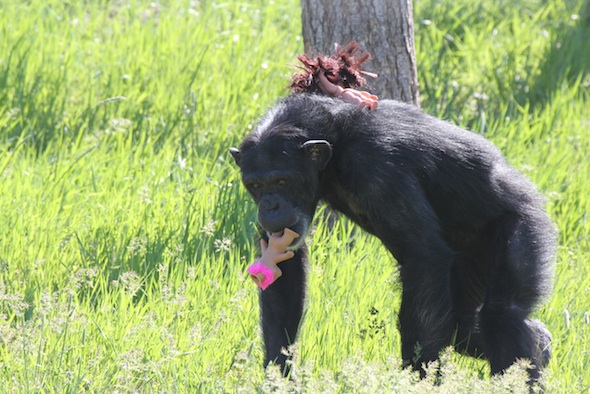
In the morning, it’s common to see all seven chimps on the hill, whether we put their breakfast out there or not. Today, Foxie took a Dora and a troll on her morning adventure.

web Foxie walk YH troll in mouth dora on back IMG_7656

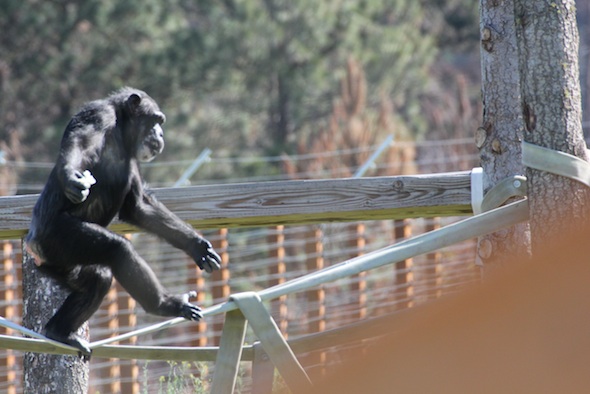
And Missy defied gravity, as she often does.

Missy tightrope YH IMG_7583

But when they’ve had enough playing and exploring, the chimps usually head back inside for a nap. They could choose to build a nest outside, but they seem to prefer napping indoors.

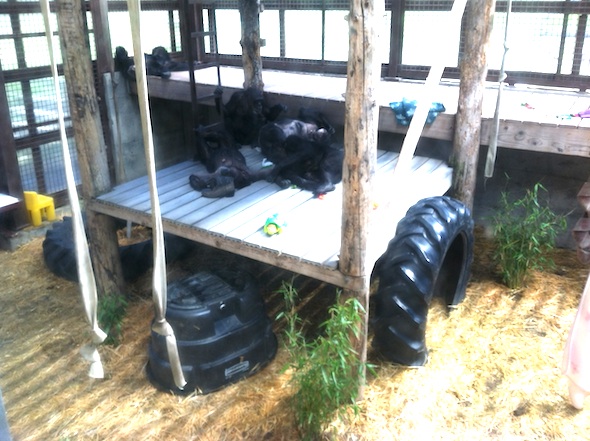
The greenhouse is everyone’s favorite spot year round. In the winter, they might wrap themselves up in a blanket on the second level of the platform, where it is warmest. But on a hot day like today, it’s common to see most of the group sprawled out on the lower platforms. They don’t like to be outside in the direct sun for too long, but they love the heat in the greenhouse. It’s like a sauna.

When the chimps want to relax and let their guard down, I think they feel more secure in an environment that is more familiar to them – one that has four walls and a roof.

web Jody Burrito Annie Negra Missy GH platform

And I think they also like to keep an eye on what the humans are doing. While we clean the playroom in the morning, Burrito often sits in the window of the greenhouse, watching us. Burrito was raised by humans, so it’s no surprise that he likes to be part of our world and keep up with what we’re doing. But more importantly, he wants to see what kind of food we are going to put out in the playroom once it’s cleaned. One track mind, that guy.

web Burrito in window PR to GH

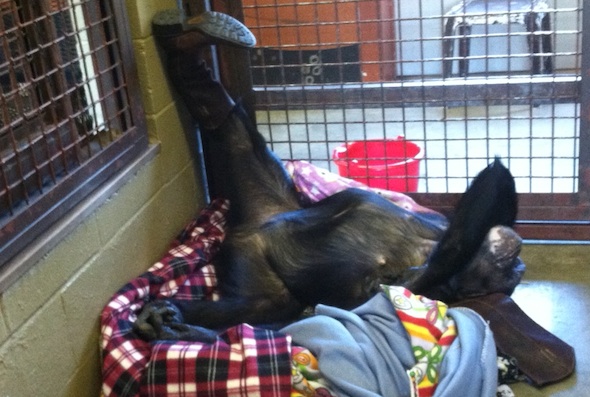
Sometimes the chimps just want to be alone, so you will occasionally find someone in the front rooms while we are cleaning the playroom. This morning, Diana put on some boots for Jamie, and after they walked around the hill she gave them to her. Jamie wore one of the boots to bed and rested her head on the other.

web Jamie nest with boot on foot up in the air room 3 FR

It can be hard to separate your own ideas of what’s best for the chimps from their ideas of what’s best for themselves. On days like today, when it’s 86 degrees and sunny and Jamie is sleeping on the floor inside, I feel like a parent whose kids are inside playing video games on a beautiful day. But that’s a silly way to think. The chimps are most certainly not our kids; in fact, most of them are older than me. And after all, what’s the point of sanctuary if not to give them choices?

Filed Under: Boots, Burrito, Chimpanzee Behavior, Foxie, Jamie, Negra, Sanctuary, Trolls, Young's Hill Tagged With: boots, captivity, chimpanzee, choices, dora, enclosures, Foxie, Jamie, Negra, northwest, rescue, Sanctuary, troll

Chow Dust

April 29, 2013 by J.B.

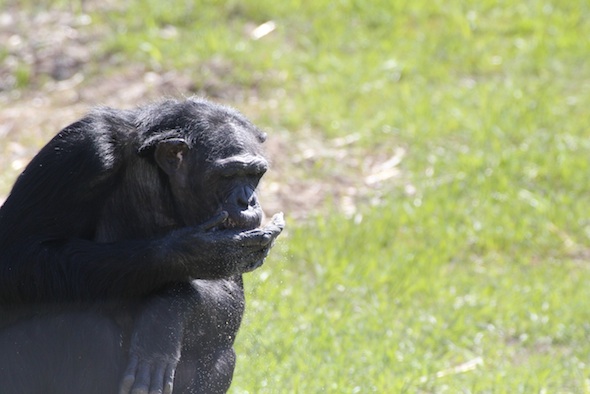
The bulk of the chimps’ diet consists of fresh fruits and vegetables, nuts, seeds, and browse (more fibrous plant material such as grape vines or cattails), but we still supplement their diet with a very small amount of commercially prepared primate chow. The end of the bag is usually filled with crumbs and chow dust, which the chimps view as a special treat.

Jamie got most of it during a forage the other day:

web Jamie eat chow dust YH IMG_6524

web Jamie chow dust lips YH IMG_6519

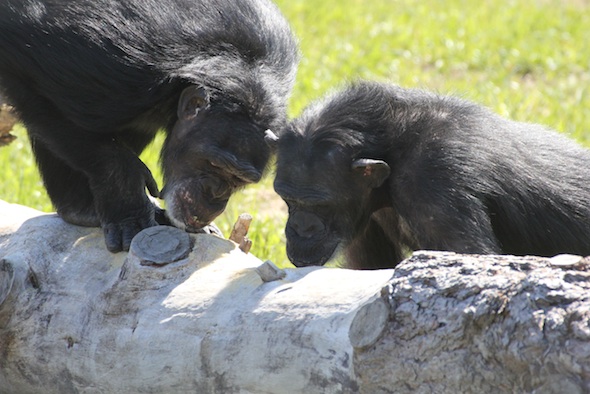
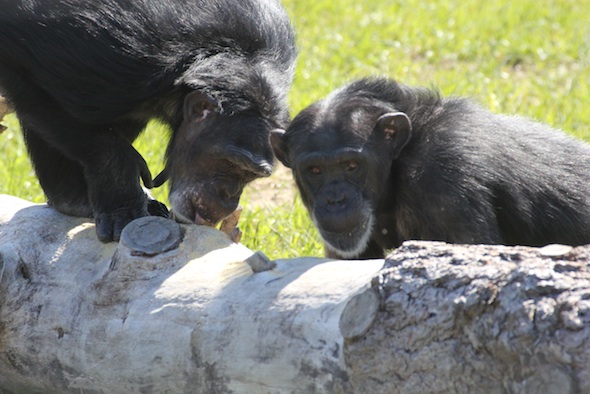
But Foxie came along to help her clean up what was left:

web Jamie Foxie eat chow dust YH IMG_6543

web Jamie Foxie eat chow dust YH IMG_6547

Filed Under: Food, Foxie, Jamie Tagged With: chimpanzee, chow, eat, Food, Foxie, Jamie, northwest, rescue, Sanctuary

Natural Enrichment

April 26, 2013 by J.B.

The other day, Jamie was quietly taking in the view from Young’s Hill.

web Jamie stand on log bridge look into distance YH IMG_6785

As Jody passed by, the two of them noticed something in the grass.

web Jamie Jody search for critter log bridge YH IMG_6791

Young’s Hill is home to many other critters besides chimpanzees. Bugs, birds, garter snakes, and squirrels all try lay claim to these two acres, but they often run into trouble with their seven noisy neighbors.

You wouldn’t normally expect chimpanzees to be scared of creepy crawlies. Wild chimpanzees hunt and eat a variety of animals, which can include birds, reptiles, insects, and small mammals (even other primates), depending on the community. But the Cle Elum Seven are not wild. Physically, they are the same as their wild cousins, and they share many of the same behavioral traits, but they lack the culture of a wild community. And given their histories, they haven’t had much personal experience with the great outdoors either. So what might be seen as food by a chimp in Gombe might be feared by a chimp in Cle Elum.

Jamie certainly likes to kill, which shouldn’t surprise those of you that have gotten to know her through this blog. However, she has a good instinct for self-preservation and she still hasn’t quite figured out which animals fight back, so she often approaches cautiously. In fact, we sometimes liken her to a pointer, because she will stop dead in her tracks with one arm and one leg up. But rather than directing someone else to the prey, I always feel like she’s thinking…If it gets me, at least I’ll still have two good limbs.

web Jamie JOdy search for critter log bridge grass YH IMG_6795

Thankfully, it usually ends up being a wild goose chase, as it did in this instance. The field mice quickly scurry back into their holes and the birds effortlessly fly away while the chimps are still trying to get up to speed.

web Jamie JOdy search for critter log bridge grass YH IMG_6796

This type of enrichment can’t be beat – especially when no animals are harmed in the process. Captive chimpanzees will always require some kind of artificial enrichment, but there’s nothing like the unpredictable and often exhilarating enrichment that exists in the natural world.


Filed Under: Chimpanzee Behavior, Jamie, Jody, Young's Hill Tagged With: chimpanzee, eat, Enrichment, hunt, northwest, prey, rescue, Sanctuary

  • « Go to Previous Page
  • Page 1
  • Interim pages omitted …
  • Page 86
  • Page 87
  • Page 88
  • Page 89
  • Page 90
  • Interim pages omitted …
  • Page 134
  • Go to Next Page »

Primary Sidebar

Subscribe To the Blog and Get Notified of New Posts First!

Archives

Calendar of Blog Posts

June 2026
S M T W T F S
 123456
78910111213
14151617181920
21222324252627
282930  
« May    

Categories

SUBSCRIBE TO OUR NEWSLETTER

Footer

PO Box 952
Cle Elum, WA 98922
[email protected]
509-699-0728
501c3 registered charity
EIN: 68-0552915

Official DDAF Grantee

Menu

  • The Chimpanzees
  • Blog
  • About Us
  • You can help
  • Resources
  • Contact
  • Donate

Proud Member of

Connect With Us

Search

Copyright © 2026 Chimpanzee Sanctuary Northwest. All Rights Reserved. Site by Vegan Web Design