• Skip to main content
  • Skip to primary sidebar
  • Skip to footer

Chimpanzee Sanctuary Northwest

Hope. Love. Home. Sanctuary

  • Our Family
    • The Chimpanzees
    • The Cattle
  • Blog
  • About Us
    • Visiting the Sanctuary
    • Philosophy
      • FAQs
      • Mission, Vision & Goals
      • Privacy Policy
    • The Humans
      • Staff
      • Board of Directors
      • Founder
    • Annual Reports
    • The Future of CSNW
    • CSNW In The News
  • You can help
    • Donate
      • Become a Chimpanzee Pal
      • Sponsor A Day
      • Transfer Stock
      • Be A Produce Patron
      • Be a Bovine Buddy
      • Give from your IRA
      • Personalized Stones
      • Bring Them Home Campaign
    • Leave A Legacy
    • Employment Opportunities
    • Volunteer
    • See Our Wish List
    • Events
  • Resources
    • About Chimpanzees
    • Enrichment Database
    • Advocacy
      • Advocacy Action Center
      • Apes in Entertainment
        • Trainers
        • Role of the AHA
        • Greeting Cards
      • Chimpanzees as Pets
      • Roadside Zoos
      • Chimpanzees in Biomedical Research
      • Conservation
        • African Apes
        • Orangutans
  • Shop
    • Merchandise Store
  • Contact
  • DONATE NOW

J.B.

More medical equipment

August 30, 2013 by J.B.

Exciting news – we received an ultrasound machine! The machine (pictured below, on the left) comes courtesy of Pacific Vascular in Bothell, WA and is capable of doing cardiac, abdominal, and, as you might have guessed, vascular imaging. A million thanks to Pacific Vascular, to supporter Karen Gates and her son Jack for making the connection and advocating for us, and to Bob for giving us a tutorial.
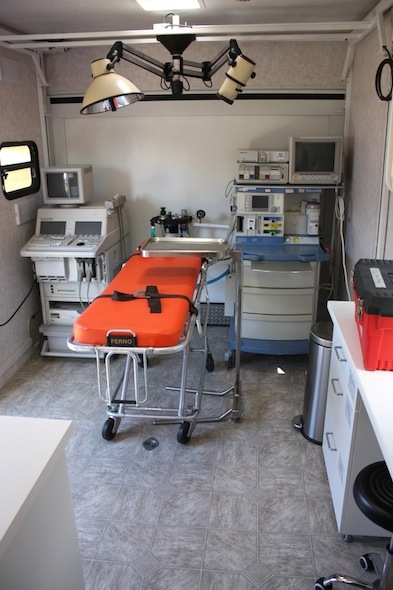
web_Clinic_anesthesia_ultrasound_stretcher_lamps_august_2013_IMG_3990

Providence Medical Center in Everett, WA has come through again, this time with a centrifuge (below, on the right). Thanks Dan!
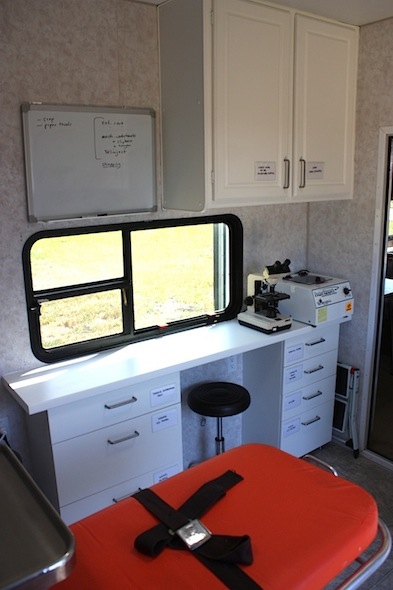
web_Clinic_microscope_centrifuge_August_2013_IMG_3993

And Kittitas Valley Healthcare has donated both an endoscopy tower and a mayo stand. Thank you Judi and everyone at KVH!
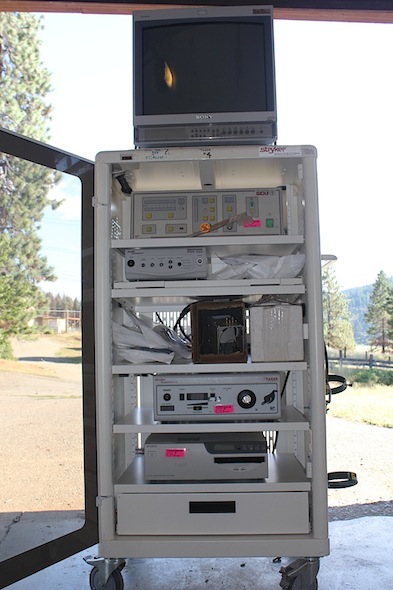
web_Clinic_endoscopy_tower_jb_IMG_4004

We’re still looking for a steam autoclave, a laryngoscope, and a portable x-ray machine. And ideally, we’d love to have a second, more portable, ultrasound machine for doing imaging inside the chimp house when the chimps aren’t under anesthesia (especially for Burrito). So if you know of any companies that might be willing to donate these items, please let us know!
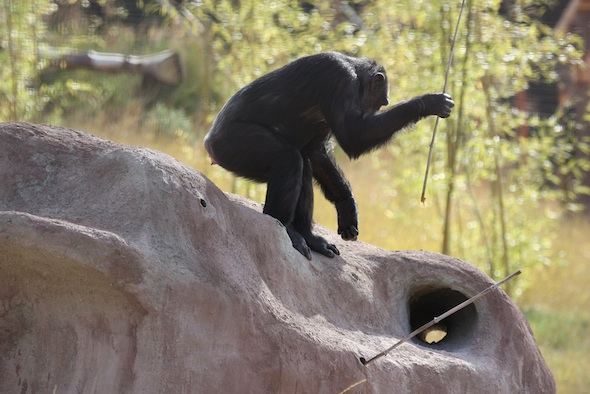
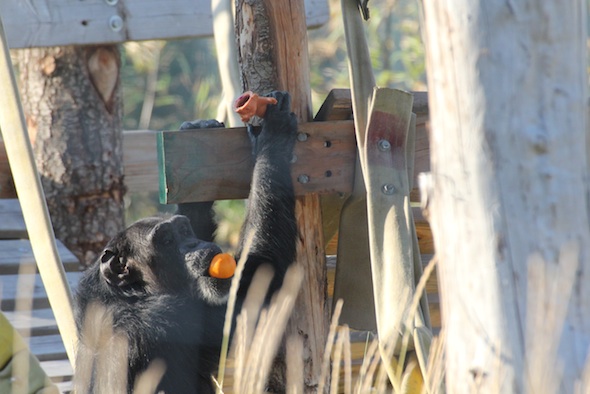
Filed Under: Sanctuary, Thanks Tagged With: centrifuge, chimpanzee, clinic, endoscopy, equipment, laryngoscope, mayo stand, medical, northwest, rescue, Sanctuary, ultrasound, veterinary

Happy Birthday, Missy!

August 23, 2013 by J.B.

Missy turned 38 today, and to celebrate we made the day all about her. Volunteers Patti and Annie brought some of Missy’s favorite foods and toys, and we did forages in the greenhouse and on Young’s Hill for breakfast. We also harvested cattails from the pond. Tonight, we’ll put out Kongs after dinner, which are her favorite food puzzles.

The Cle Elum Seven really have aged backwards since coming to the sanctuary – it’s hard to believe that playful, active Missy is 38 years old. Let’s hope she never acts her age.

Filed Under: Enrichment, Food, Missy, Party Tagged With: chimpanzee, Missy, northwest, party. birthday, rescue, Sanctuary

Tool Use and the Termite Mound

August 16, 2013 by J.B.

web Missy tool use treat rock peanut butter sticks youngs hill IMG_0052

Jane Goodall’s research was ground-breaking in many ways, but one of her most important discoveries was that chimpanzees possess the ability to use tools. At the time, it was thought that tool use was a defining characteristic of the human species. But shortly after she began studying the chimpanzees of Gombe, Dr. Jane saw them using sticks to fish termites out of their nests. When she reported her findings to her mentor, Louis Leakey, he famously wrote, “Now we must redefine tool, redefine Man, or accept chimpanzees as humans.”

Over the last 50 years, primatologists have discovered that the use of tools to “fish” for termites and ants is even more complex than had originally been thought. Chimpanzees have been observed bringing “tool kits,” containing a variety of tools for different purposes, to the nests. For example, some tools are used specifically to perforate the nests of army ants. Breaking nests open by hand tends to result in an aggressive counter-attack by the ants, and may even cause them to relocate the nest. Using the perforating tool results in a less painful experience and allows for the harvesting of the ants to be sustainable. Other tools are used specifically for dipping into the nest, and their size and shape, as well as the technique for ingesting the insects once they are caught, are influenced by the behavior of the insects being harvested. And all of these techniques are influenced by culture, which is to say that they are learned and not determined by genetics and environment alone. They differ from community to community, as each community has its own set of knowledge and traditions.

When we built Young’s Hill, the Young’s provided the funds for us to build an artificial termite mound. The mound is actually hollow and consists of concrete laid over a rebar framework. Stainless steel tubes protrude through the concrete, and we can climb in and attach PVC tubes filled with food treats on the inside. The mound also protects critical irrigation components for the bamboo groves.

Most captive chimpanzees, having been raised outside of the cultures found in free-living communities, do not consider insects to be food. So we stick with what they enjoy – in this case, frozen banana mixed with peanut butter and almond milk.

If you’re impressed with Jamie’s tool-using abilities, vote for her in the Humane Society of the United States’ chimpanzee art contest.

Filed Under: Chimpanzee Behavior, Enrichment, Jamie, Sanctuary, Young's Hill Tagged With: ant, chimpanzee, dipping, northwest, rescue, Sanctuary, termite mound, tool use

Sunrise

August 9, 2013 by J.B.

The sanctuary is located in a canyon formed by the Yakima River, and there is a period each morning when the sun has risen but it has not yet begun to shine directly onto Young’s Hill. In the summer, when temperatures regularly reach into the 90’s or higher, this is the most comfortable time for the chimps to be outside.

This morning, the gang went outside at around 7:45 – all except for Negra, of course. She needs her beauty rest, and she loves when the rowdier chimps leave her alone in the building to sleep in.

But everyone else took to the hill to play and explore. Foxie managed to keep her birthday party going an extra day, because she immediately found an orange that had gone undiscovered in yesterday’s forage.

web_Foxie_orange_troll_climb_YH_jb_IMG_1098

Burrito followed the girls up the hill, going further than he normally does, all the while holding on to his yellow toy hammer.

web_Burrito_yellow_toy_hammer_in_mouth_YH_jb_IMG_1123

Annie sat upon a climbing structure, where she could keep an eye on her friend Missy as she ran around the hill.

web_Annie_sit_on_perch_YH_jb_IMG_1080

Jamie hung out with the other chimps for a while, but eventually she turned to me and gestured to signal that it was time for me to grab a cowboy boot and join her for a walk around the perimeter.

web_Jamie_YH_jb_IMG_1174

Missy gathered grass from around the bamboo, where it stays lush and green from irrigation.

web_Missy_grass_in_mouth_log_YH_jb_IMG_1168

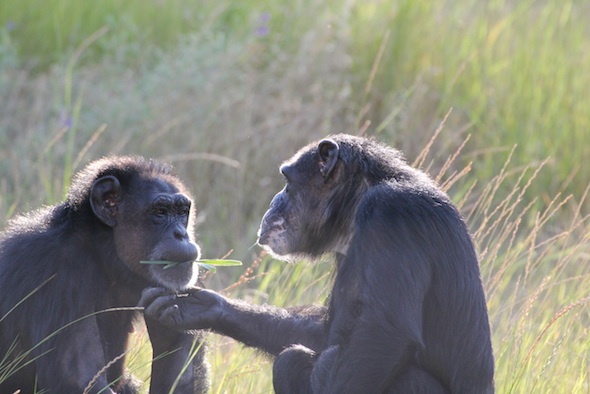
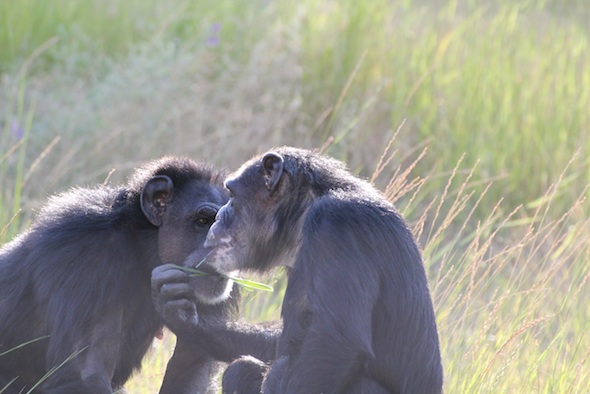
Jody also gathered grass, which is one of her favorite pastimes, but something was obviously upsetting her.

web_Jody_grass_in_mouth_Annie_Burrito_YH_IMG_1150

web_Jody_Burrito_grass_in_mouth_compressed_lips_YH_jb_IMG_1165

She approached Missy for reassurance and Missy offered it to her, with all the coolness and confidence of Don Corleone.

web_Jody_seek_reassurance_Missy_1_grass_YH_jb_IMG_1109

web_Jody_seek_reassurance_Missy_2_grass_YH_jb_IMG_1110

web_Jody_seek_reassurance_Missy_3_grass_YH_jb_IMG_1111


Filed Under: Annie, Burrito, Chimpanzee Behavior, Foxie, Jamie, Jody, Missy, Young's Hill Tagged With: chimpanzee, northwest, reassurance, rescue, Sanctuary

The Explorers Club

July 26, 2013 by J.B.

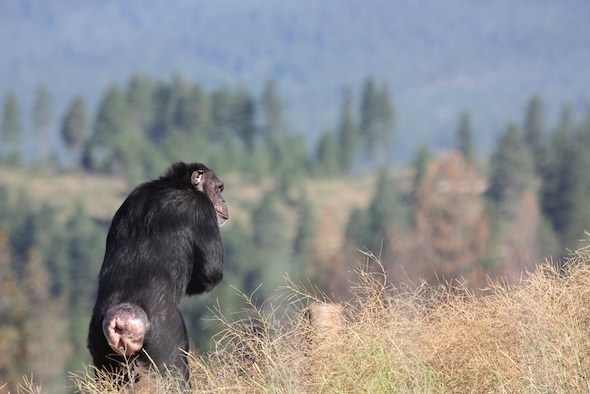
Everyday, Jamie goes on walks around the perimeter of Young’s Hill. Her day is not complete until she surveys the boundaries, checks to see what the neighbors horses are doing, and pokes a stick into a ground squirrel nest or two. From the top of the hill, she can view the entire canyon and even the mountains in the distance.

web_Jamie_bipedal_YH_mountains_in_background_jb_IMG_3073

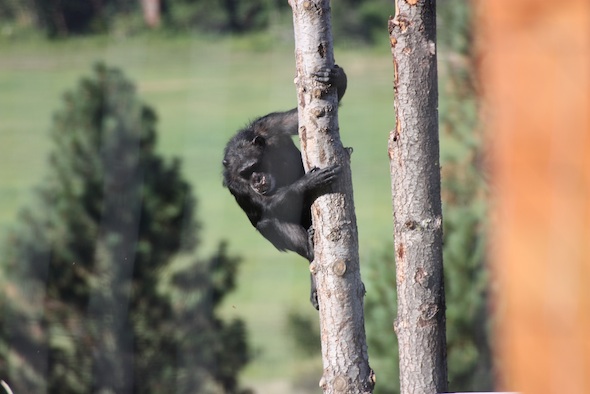
Missy often tags along with Jamie for her daily walks, but she tends to get distracted halfway through. Jamie is too slow, too methodical. Missy can only walk for so long before she needs to climb something and jump off it.

web_Missy_climb_log_post_YH_look_down_jb_IMG_3046

I consider Annie an involuntary member of the explorer’s club. She’s just along for the ride because she can’t let her best friend Missy out of her sight.

web_Annie_walk_fire_hose_bridge_YH_jb_IMG_3157

Jody loves to pick and eat wild plants. There’s a great patch of prickly lettuce and mustard at the top of the hill, and that’s all the motivation that Jody needs.

web_Jody_climb_mound_weed_in_mouth_YH_jb_IMG_3181

Young’s Hill is only two acres, but the top of the hill can seem like a world away from the safety and security of the building so not everyone is comfortable spending a lot of time up there. Foxie, Burrito, and Negra all tend to stay in the lower half of the enclosure. But we’ve already seen them push the boundaries of their comfort zones this year, so maybe one day we’ll find all seven of them looking down on us from the top of Young’s Hill.

web_Annie_stand_on_log_YH_jb_IMG_3206


Filed Under: Annie, Jamie, Jody, Missy, Sanctuary, Young's Hill Tagged With: Annie, chimpanzee, Jamie, Jody, Missy, northwest, rescue, Sanctuary

The many ways to kill a snake

July 19, 2013 by J.B.

Young’s Hill, the chimps’ two-acre outdoor enclosure, is home to quite a few snakes. The entire sanctuary is surrounded by a rattlesnake fence, which helps keep the truly dangerous snakes out, but many harmless garter snakes were already living here when we built the enclosure.

At first, the chimps were afraid to touch even the smallest garter snake. They would use tools to try to kill them, because they were afraid to use their bare hands. One time, Jamie used a hardcover children’s book to try to chop one to death. Another time, she used a pasta spoon. Over the years, they’ve discovered that garter snakes are relatively harmless, so they’ve become more comfortable going after them with their hands.

But this was the most unusual strategy that I have seen yet.

Filed Under: Chimpanzee Behavior, Jamie, Young's Hill Tagged With: chimpanzee, hunt, Jamie, kill, northwest, rescue, Sanctuary, snake

Life and Death

July 12, 2013 by J.B.

The evidence in favor of protecting chimpanzees is overwhelming. We share over 98% of our DNA with them. Studies have shown that they have the capacity to create and use tools, to learn human languages, and to memorize and recall certain kinds of information faster and more accurately than college students. Field research has demonstrated that different communities have different cultures, that individuals form complex social alliances, and that they have the ability to hunt cooperatively.

But when I recite these facts, I feel like I am only telling part of the story. Taken individually, these abilities are fascinating, but to me they aren’t morally persuasive. Do chimpanzees really have to learn our language for them to deserve freedom from suffering? Do I really think that their ability to use tools is the reason why we shouldn’t lock them up and perform tests on them?

When you add them up, however, you start to understand that chimpanzees possess a remarkable richness and depth of experience. Yes, they are intelligent. Yes, they experience emotions. But the whole is even greater than the sum of its parts.

Over the years, I’ve thought about the moments that affected me most, the ones that deepened my understanding of chimpanzees and strengthened my resolve to help them, and they revolve around the two most fundamental experiences that we share with chimpanzees: life and death.


The first time I witnessed the death of a chimpanzee, Diana and I were working at the Fauna Foundation in Quebec, Canada. A chimpanzee named Pablo became suddenly ill, and before anything could be done to help him, he was gone. The story was detailed in a fantastic article by Joe D’Agnese in Discover Magazine. After Richard, the co-founder and veterinarian at Fauna, declared him dead, his body was laid on a blanket in one of the smaller rooms so that the other chimpanzees could come in and see him. I was not prepared for what came next. Over the next hour or so, we witnessed what I can only describe as a wake. Pablo’s family, the chimps that he had known through the hell of the lab and their eventual release to a wonderful and loving sanctuary, proceeded to come into his room, one or two at a time, and pay their respects. The older chimps seemed to accept his death and gently groomed his body for a while before moving on. The younger chimps, less experienced with death’s finality, tried to revive him, and when that didn’t work, they lashed out in anger.

Pablo’s death affected everyone at Fauna, and we all struggled to maintain our composure. As I headed down the hall, with tears running down my cheeks, I looked up to see someone waiting for me. Annie, the matriarch of the chimpanzees at Fauna, held her fingers out through the caging and offered a breathy pant of reassurance. After a lifetime of being told that humans were superior in all ways, I was being consoled by a loving, maternal chimpanzee, one who was much older and far wiser than me.

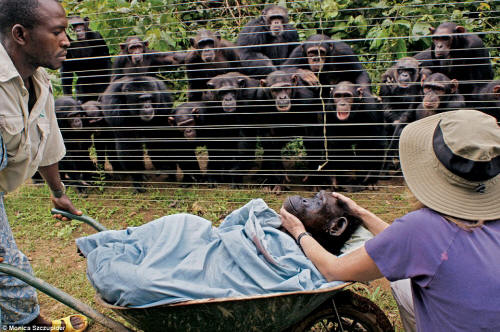
A few years ago, Monica Szczupider captured one of the most haunting photos that I have ever seen, one that speaks volumes about how chimpanzees deal with death. Following the death of Dorothy, a chimpanzee with strong ties to her family group at the Sanaga-Yong sanctuary in Cameroon, the staff wheeled her body to the fencing so that the other chimps could see her.

ChimpsGrieving_small

All cultures have their own way of dealing with death, but beneath the layers of ritual, our reactions are remarkably similar – the desire to spend one last moment with someone you love, and the need to hold those who are still with you even closer. In chimpanzees, we can see the root of this experience.


Many of the chimpanzees that we care for in sanctuaries lived for decades in laboratory cages. But they were alive only in the biological sense that their bodies continued to function. If your only knowledge of chimpanzees was of them living alone in small cages, you could be forgiven for thinking that there wasn’t much to their existence beyond eating, sleeping, and lashing out. What else could they do?

But at sanctuaries, we get to witness chimpanzees living for the first time. Not just being alive, but experiencing life, with all its ups and downs. I don’t think I will ever forgot the moment that we released the Cle Elum Seven onto Young’s Hill. They had been watching us build the enclosure for months, and by the end of the summer they were ready to walk out under the open sky for the first time. As soon as the door was opened, they rushed outside without hesitation. But before they ran off into the great outdoors, they stopped and hugged. They hugged out of fear. They hugged for joy. They hugged because they, like us, experience the world not just as individuals but as friends and as family members. Whatever it was that they were feeling, it was something that needed to be shared.

web2 Burrito Annie hug Negra foreground youngs hill release day first time yh DSC_0740

When we first met the chimps in the lab, we actually commented to each other that they didn’t seem as traumatized as we had expected, given their circumstances. But in hindsight, it was only because we didn’t know them yet. And maybe because they hadn’t had a chance to know themselves yet. The Missy that we met in that basement cell may have never had the opportunity to run before. But now, Missy is a running machine. She runs for no reason, in all directions, just to experience running. She lives to run.

fb web Missy run YH grass in mouth IMG_5751

I can’t say for sure that I know what it’s like to be a chimpanzee. In fact, I’m sure we can never really know. But just as we humans are more than what can be measured on IQ tests and SATs, there is far more to being a chimpanzee than we once thought.

Filed Under: Chimpanzee Behavior, Sanctuary, Young's Hill Tagged With: chimpanzee, ethics, northwest, rescue, rights, Sanctuary

  • « Go to Previous Page
  • Page 1
  • Interim pages omitted …
  • Page 85
  • Page 86
  • Page 87
  • Page 88
  • Page 89
  • Interim pages omitted …
  • Page 134
  • Go to Next Page »

Primary Sidebar

Subscribe To the Blog and Get Notified of New Posts First!

Archives

Calendar of Blog Posts

June 2026
S M T W T F S
 123456
78910111213
14151617181920
21222324252627
282930  
« May    

Categories

SUBSCRIBE TO OUR NEWSLETTER

Footer

PO Box 952
Cle Elum, WA 98922
[email protected]
509-699-0728
501c3 registered charity
EIN: 68-0552915

Official DDAF Grantee

Menu

  • The Chimpanzees
  • Blog
  • About Us
  • You can help
  • Resources
  • Contact
  • Donate

Proud Member of

Connect With Us

Search

Copyright © 2026 Chimpanzee Sanctuary Northwest. All Rights Reserved. Site by Vegan Web Design