• Skip to main content
  • Skip to primary sidebar
  • Skip to footer

Chimpanzee Sanctuary Northwest

Hope. Love. Home. Sanctuary

  • Our Family
    • The Chimpanzees
    • The Cattle
  • Blog
  • About Us
    • Visiting the Sanctuary
    • Philosophy
      • FAQs
      • Mission, Vision & Goals
      • Privacy Policy
    • The Humans
      • Staff
      • Board of Directors
      • Founder
    • Annual Reports
    • The Future of CSNW
    • CSNW In The News
  • You can help
    • Donate
      • Become a Chimpanzee Pal
      • Sponsor A Day
      • Transfer Stock
      • Be A Produce Patron
      • Be a Bovine Buddy
      • Give from your IRA
      • Personalized Stones
      • Bring Them Home Campaign
    • Leave A Legacy
    • Employment Opportunities
    • Volunteer
    • See Our Wish List
    • Events
  • Resources
    • About Chimpanzees
    • Enrichment Database
    • Advocacy
      • Advocacy Action Center
      • Apes in Entertainment
        • Trainers
        • Role of the AHA
        • Greeting Cards
      • Chimpanzees as Pets
      • Roadside Zoos
      • Chimpanzees in Biomedical Research
      • Conservation
        • African Apes
        • Orangutans
  • Shop
    • Merchandise Store
  • Contact
  • DONATE NOW

behavior

A Natural History of Jerks

August 28, 2023 by J.B.

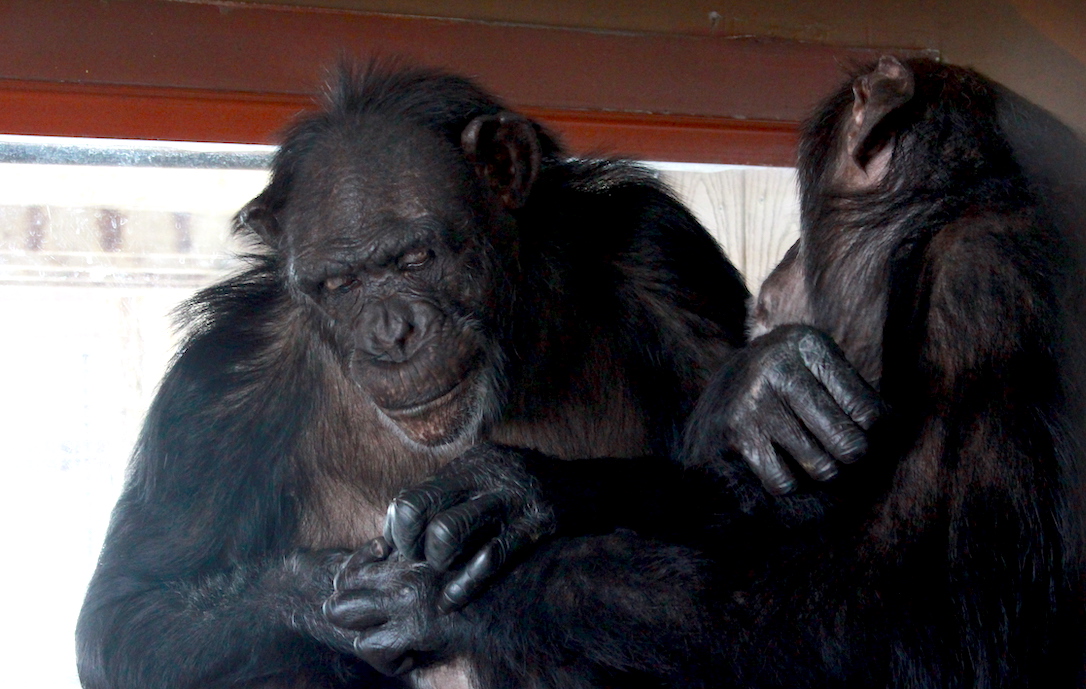
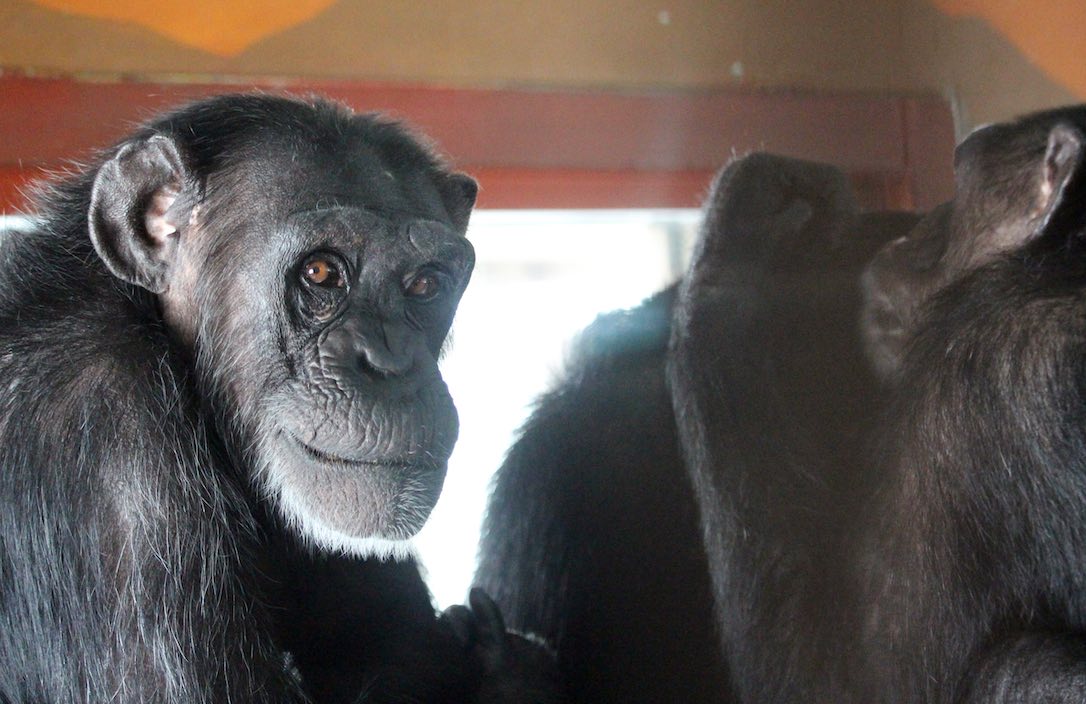
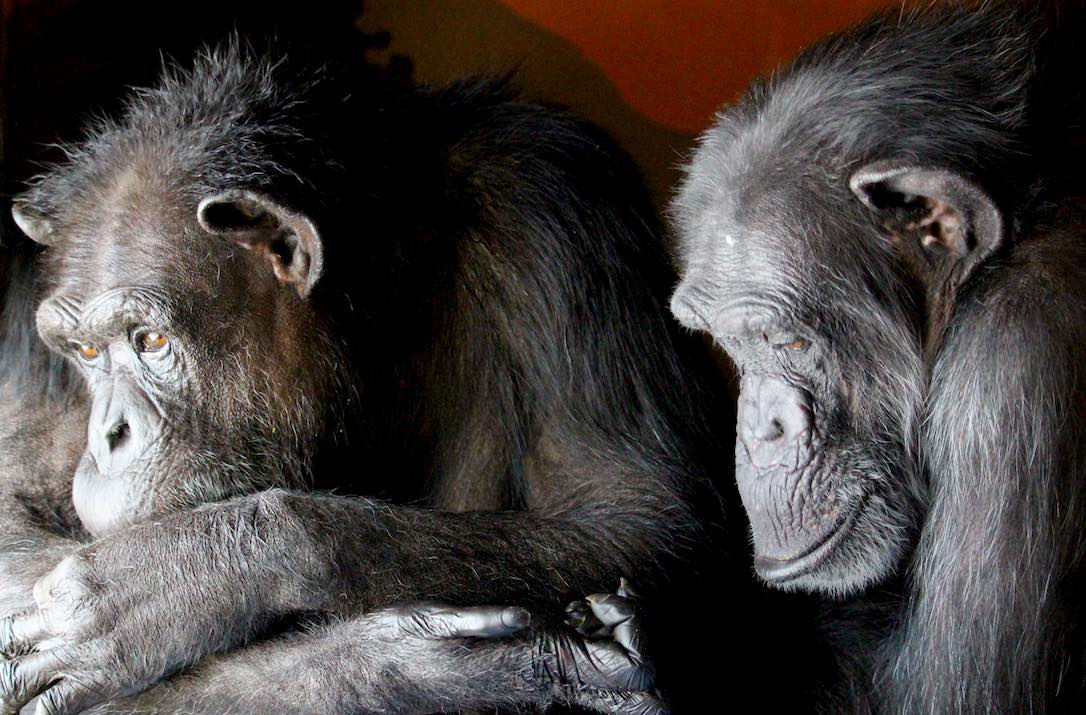
Male chimps can be jerks. True, females can also be jerks (see: Chimpanzee, Jamie), and not all males are jerks (at least not all of the time). There is an exception to every rule. Nonetheless, it is undeniable that chimpanzee jerkishness has a certain maleness to it, just as chimpanzee maleness contains a certain jerkishness.

But just as not all male chimps are alike, so too is it true that not all jerks are alike. While this is by no means an an exhaustive examination of the topic, here we will distinguish between two types of jerk: Those jerks who wreak havoc blindly, as if possessed, and those who inflict their jerkiness with forethought and intention.

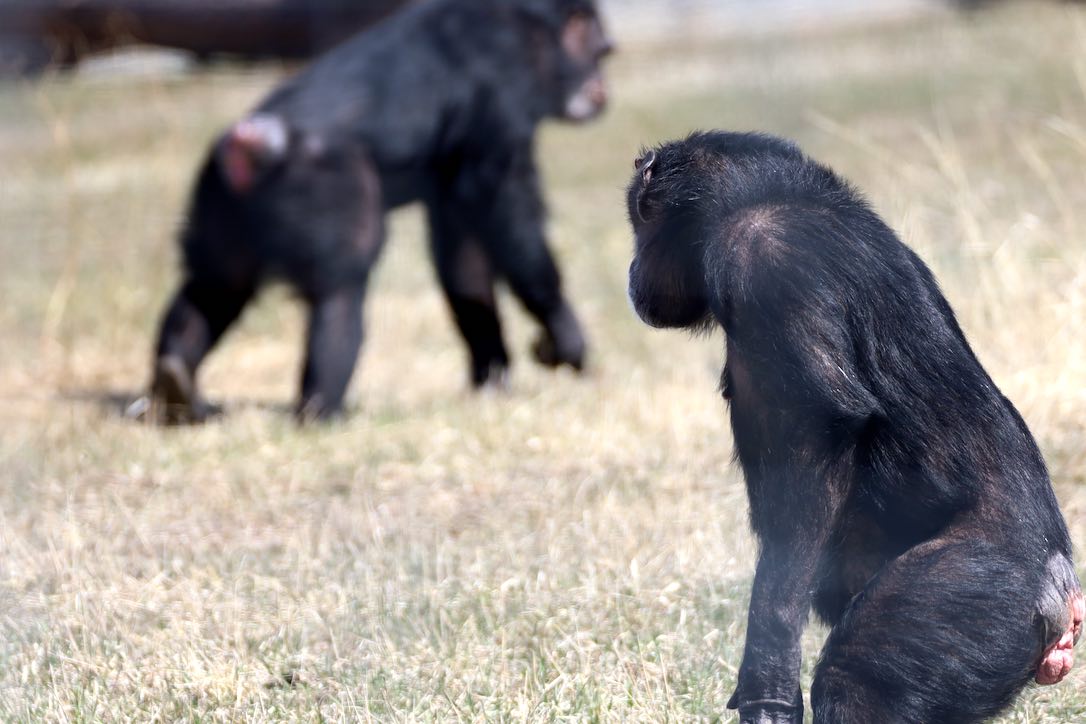
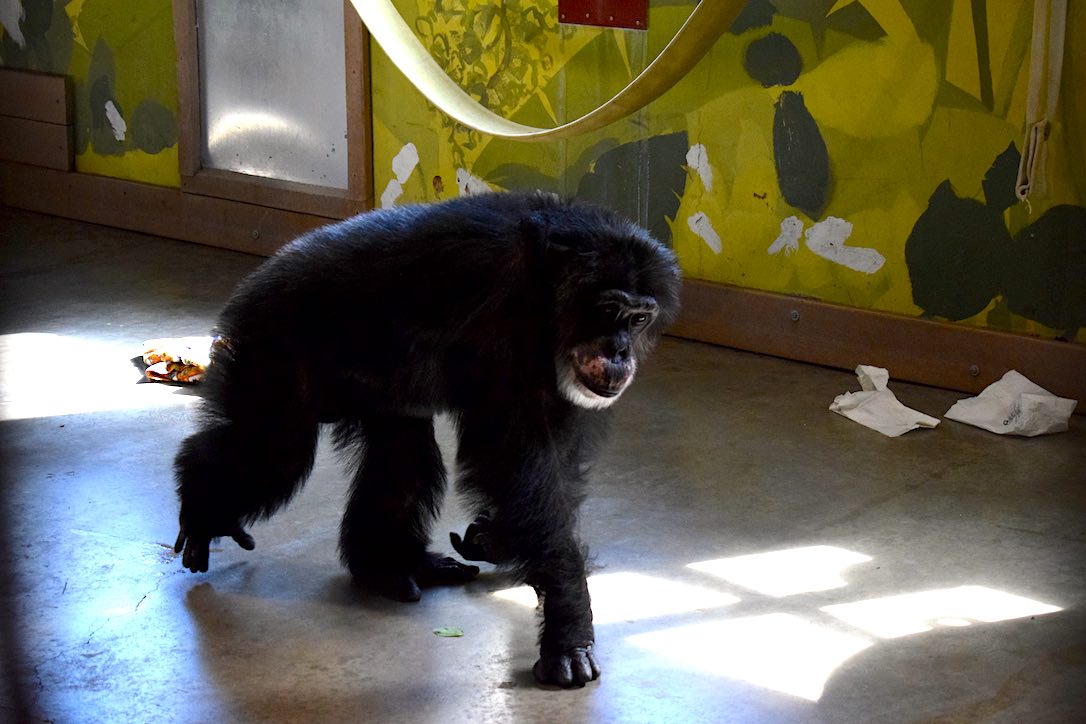
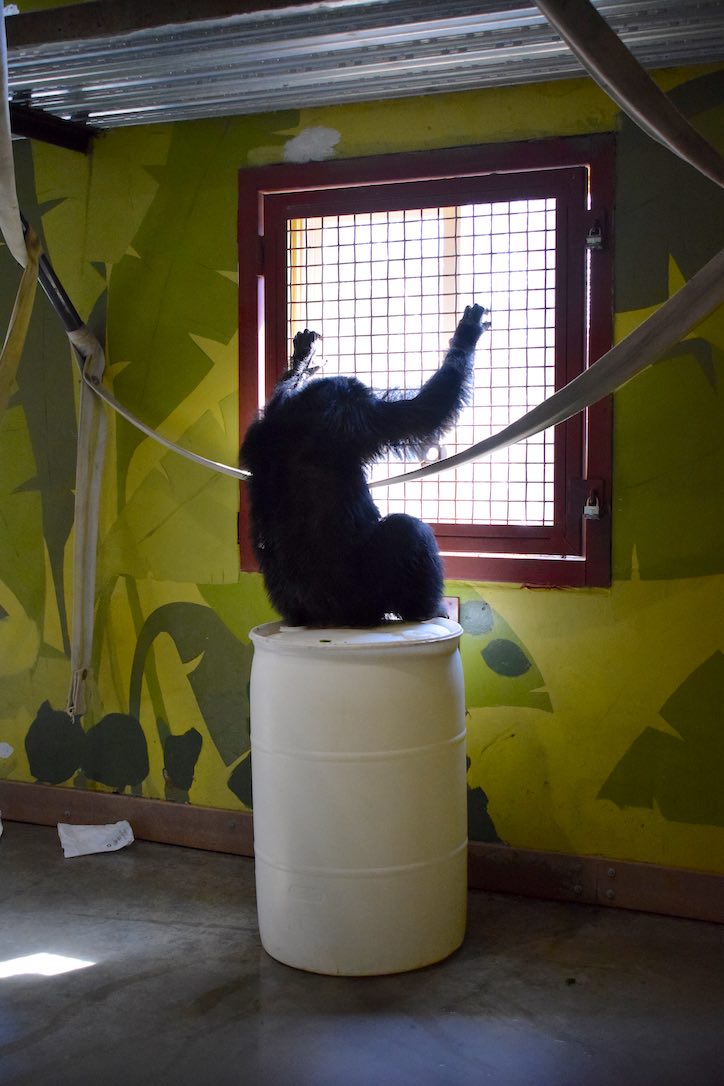
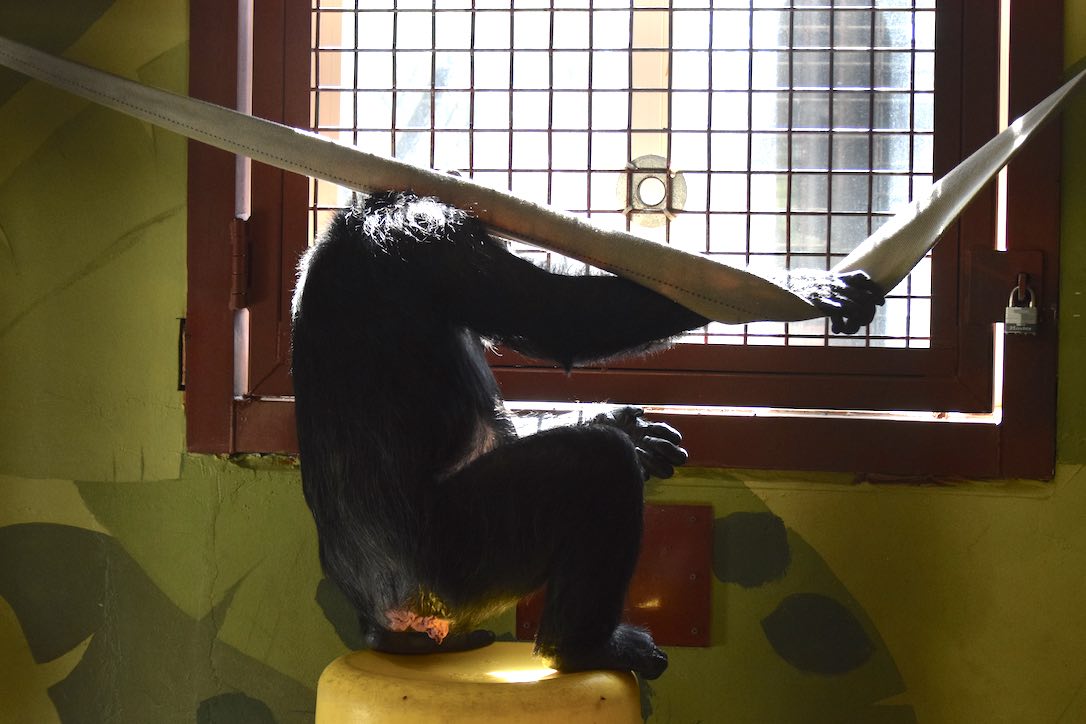
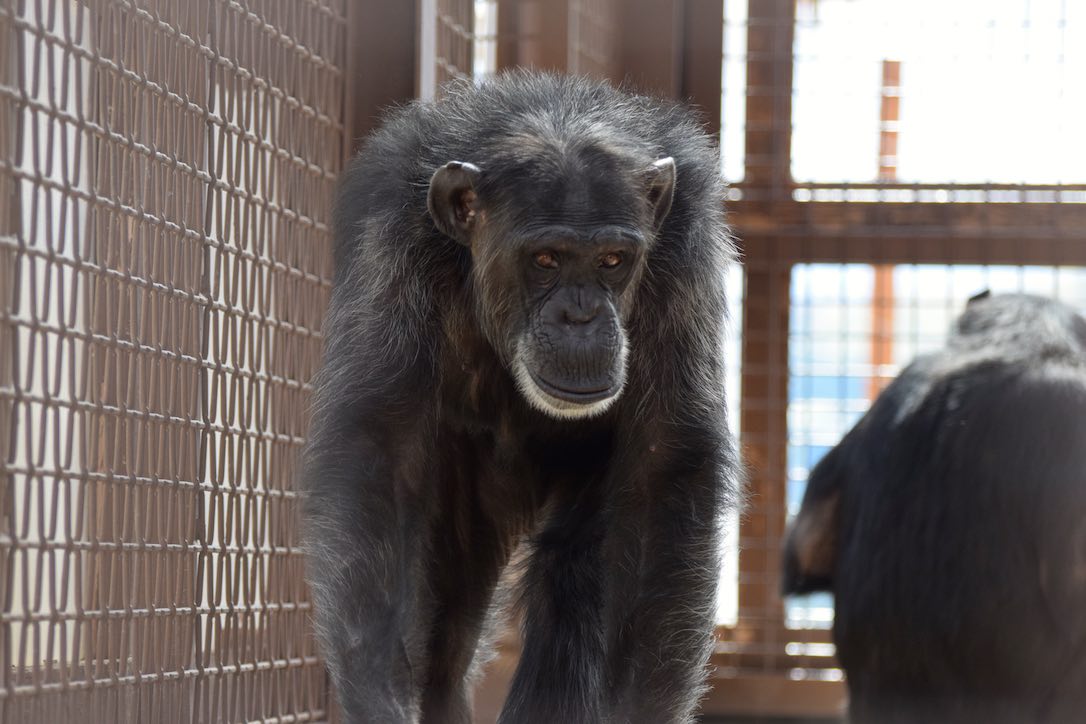
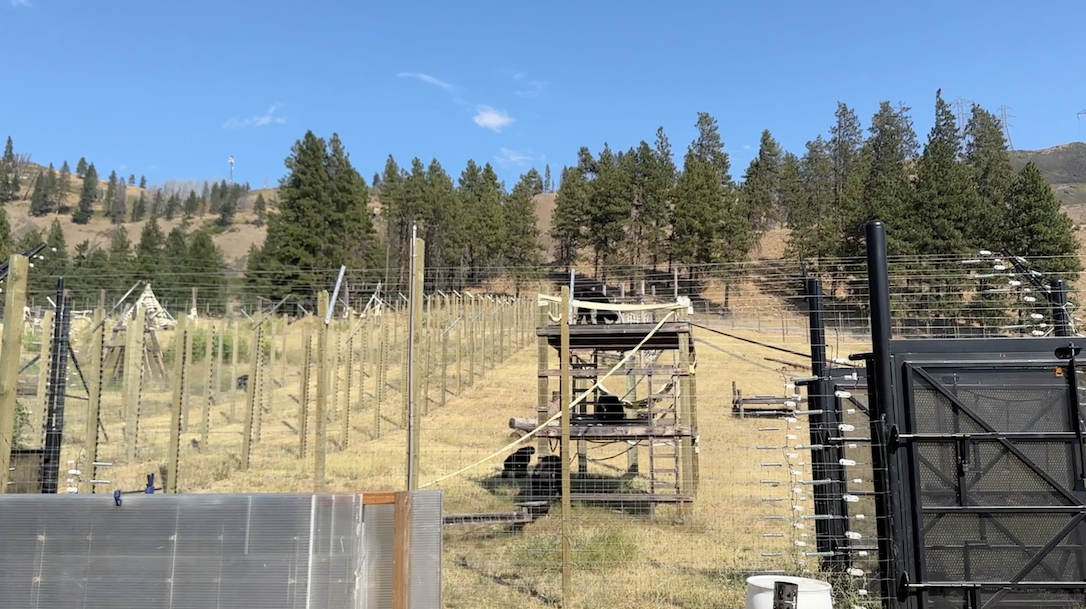
To illustrate the former, let’s turn to our dear friend Willy B. Today I watched him sit peacefully in the shade beneath a climbing structure on the Bray, his 2-acre habitat, surveying the yard for remnants of a the day’s forage. When the forage was finished, he quietly returned to the indoor enclosures. It being mid-afternoon, however, this peaceful Dr. Jekyll was suddenly and inexplicably transmogrified into a raging Mr. Hyde. Apropos of nothing and with no other chimps in sight, he began to bang on the food chute with the back of his wrist. The noise and vibration shattered the calm of the afternoon and soon the others were up from their naps. With hair on end, they circled each other in the confines of the front room area. Some began to pant hoot, which in turn raised the tension in the room even further. Minutes went by. The banging was incessant. Others began to stand bipedally and swagger. Bang, bang, bang. The noise swelled and soon came to fully occupy the space where thoughts would normally occur, making it impossible to do anything but join in the chaos. Bang, bang, bang…

BANG! A fight breaks out. The swirling mass of chimpanzees, now screaming, races from the front rooms through the chute and out to the Bray. Willy B climbs to the top of the tower and, with a fear grimace, watches as the other chimps threaten and hit one another. But he is not angry. Instead, he is scared and confused. Because he is once again Dr. Jekyll, wondering what on earth could have caused such tumult below.
Interestingly, this fight contained within it, and was indeed amplified by, the actions of our second type of jerk. Are you familiar with the admonition, common in both comedy and politics, to never punch down? For male chimpanzees, punching down is not only accepted in certain circumstances but is in fact a right of passage. As Craig Stanford states in The New Chimpanzee,

[Adolescent male chimpanzees] don’t submissively pant grunt to one another, and dominance among them is hard to discern. But once a young male reaches adulthood, he begins to climb to higher rank by taking on and intimidating each adult female. When he has risen in status above the most dominant female, the young male finds himself at the bottom of the male dominance network. Only time and repeated jousts with higher-ranking males will determine his ultimate highest status. (p.42-43)

According to some researchers, adolescent male chimpanzees routinely harass adult females as a low-cost way method of honing their competitive skills before testing them in the much riskier world of male competitive dominance. Gordo is well beyond adolescence, but his actions are often reminiscent of a chimpanzee stuck permanently in the liminal space between the female and male hierarchies. While size does not dictate rank, his more diminutive stature makes it unlikely that would challenge Cy, Terry, or Willy B directly. His social skills are of little help, either. He is able, however, to dominate Honey B. Usually.

As the dust on the Bray began to settle, the chimpanzees worked their way through the chute and back to the greenhouse. The screams had subsided and all that remained was Honey B’s diminishing whimper. This, thought Gordo, was the perfect time to assert himself. As she approached him, he hit her across the back and ran straight back to the Bray, knowing that she was afraid of the outdoors and wouldn’t have the courage to follow him.
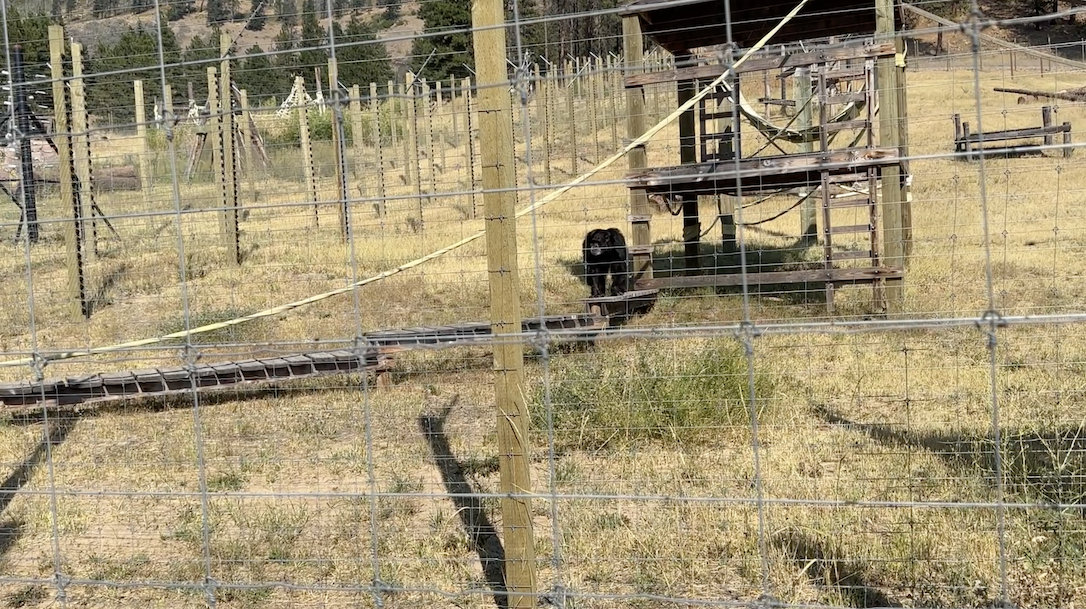
He reached the platform and turned to watch Honey B screaming at him helplessly from the end of the chute.
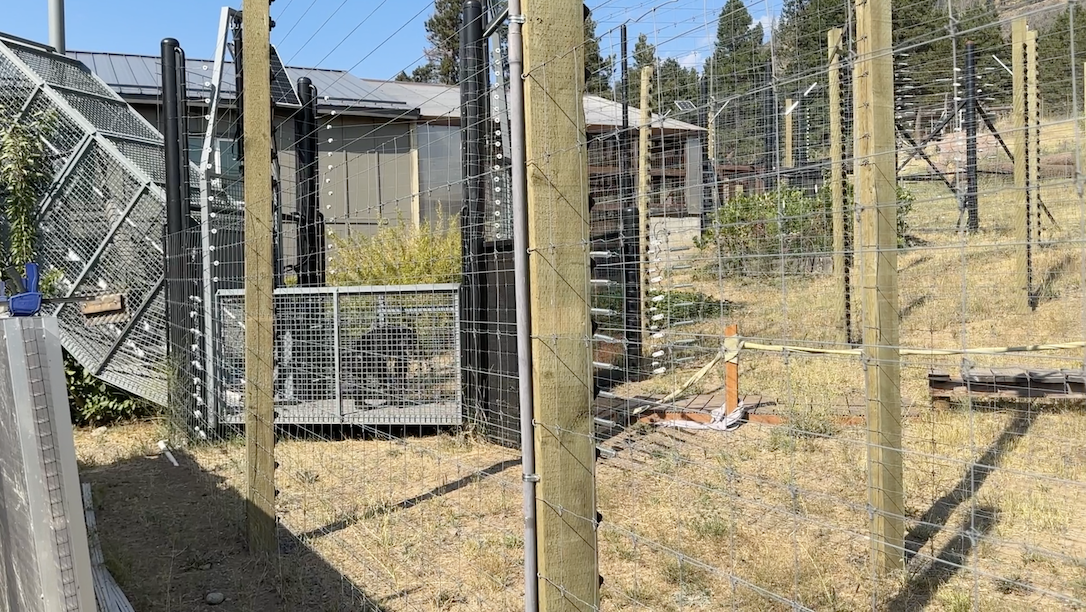
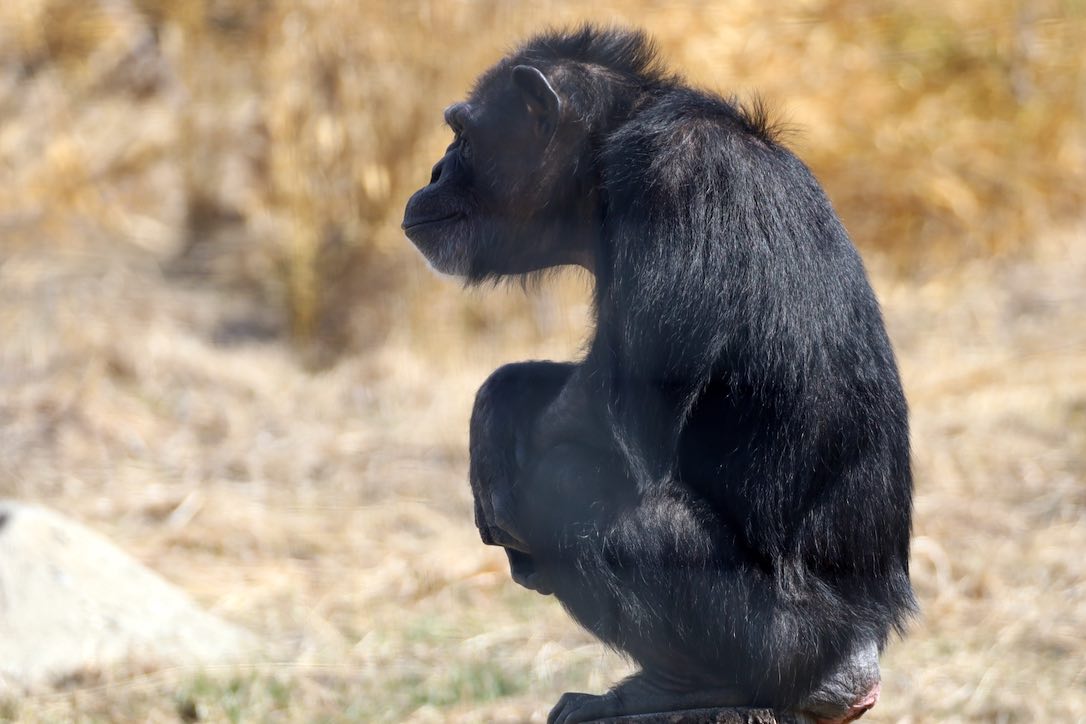
Is it any less indecent for Willy B to cause daily disruptions to the harmony of the group simply because they are born out of blind rage and not malice? I make no claims as to the relative moral status of these two varieties of jerkishness. Nor, again, do I intend to cast all males as irredeemably jerkish. But in my experience, they do seem on average to contain each type of jerkishness in greater proportion than their female counterparts.

And as to whether these same tendencies prevail in my own species, I claim ignorance.
Filed Under: Chimpanzee Behavior, Gordo, Willy B Tagged With: aggression, behavior, chimpanzee, jerk, northwest, rescue, Sanctuary

Mave’s Menace

March 21, 2023 by Chad de Bree

Something spooked Mave in the Oakwood Greenhouse yesterday. Can you guess what it was?

Here are some bonus photos from today! Today’s was absolutely gorgeous with the weather in the 50s! So Negra’s group had a nice lunch forage on Young’s Hill!

Annie!

Jody!

And Queen Negra!

And Nutmeg for good measure!

Filed Under: Mave Tagged With: alarm call, alarmed, behavior, frog, greenhouse, Mave, reassurance, spooked

“Are the chimps trained?”

September 5, 2022 by Anthony

When I tell people that I work at a chimpanzee sanctuary, they usually respond with one of the following frequently-asked questions: Do you get to touch the chimps? Do they go outside? Can people visit the sanctuary?

Today’s blog post responds to another common question with a complex answer: Are the chimps trained?

If this question refers to the awful practice of coercing captive primates to perform tasks for our entertainment, then the answer is a plain and emphatic “no.” (“We don’t do that here.”)

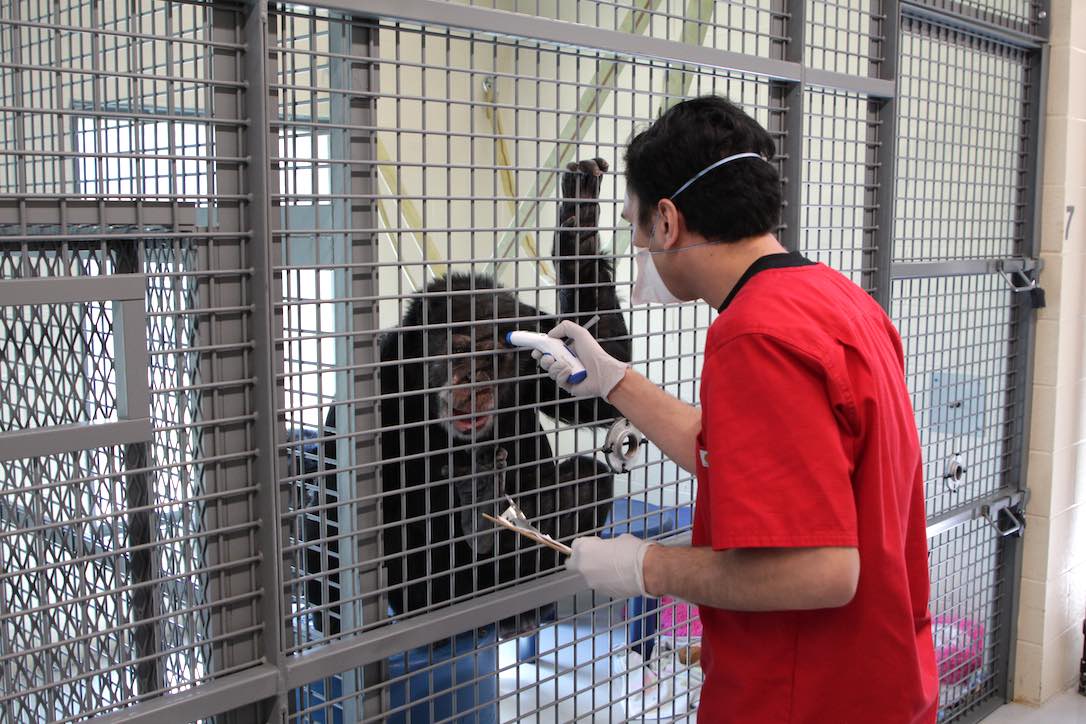
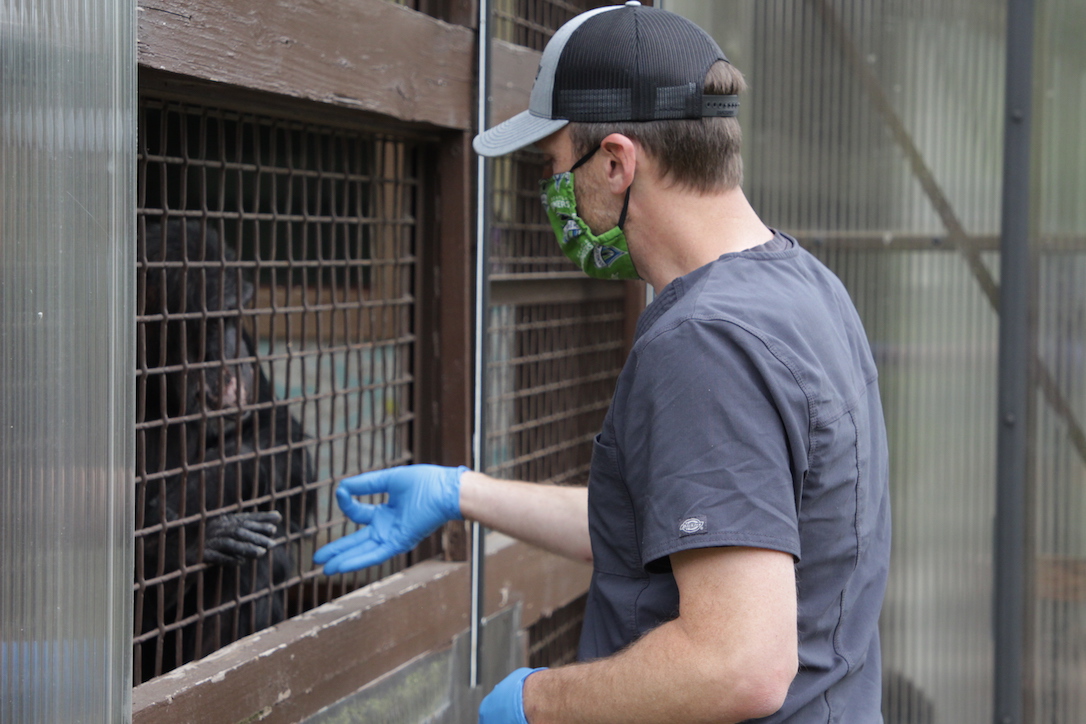
When defined more broadly though, behavioral training can be an important practice for improving and maintaining excellent animal welfare. For example, chimpanzees can be taught to voluntarily cooperate in their own veterinary care, greatly reducing the stress and risk associated with medical procedures. Training can also be a powerful tool for improving human-chimpanzee relationships, desensitizing chimps to unfamiliar environmental changes, and providing the chimps with additional cognitive, social and sensory enrichment.

CSNW, like many institutions that care for chimpanzees, has adapted a behavioral training program to improve the lives of the residents. Our past training initiatives have helped us administer medical care and monitor chimpanzee wellness over the years. We are now revamping this framework to utilize a larger staff, accommodate an additional group of chimps, and target loftier goals. Last year, we invited Margaret Whittaker of Creative Animal Behavior Solutions to review training methodology and help us optimize our plans for the future. One key takeaway has been that progress requires a shared understanding of the underlying theory and familiarity with common techniques. We caregivers should understand what training is, value training as an important component of care, and know how to train efficiently and responsibly.

Essentially, training is the process of behavior modification through learning. We often call training between humans “teaching” and training with non-humans “conditioning,” but they’re basically synonymous. Our preferred type of training, operant conditioning, allows the chimps to voluntarily participate and choose which behaviors to present. The chimpanzees are free to come and go at their own leisure, and we never punish them for choosing not to participate. Indeed, certain individuals often decline our invitation because they have better things to do, and that’s okay. In operant conditioning, they’re the operators.

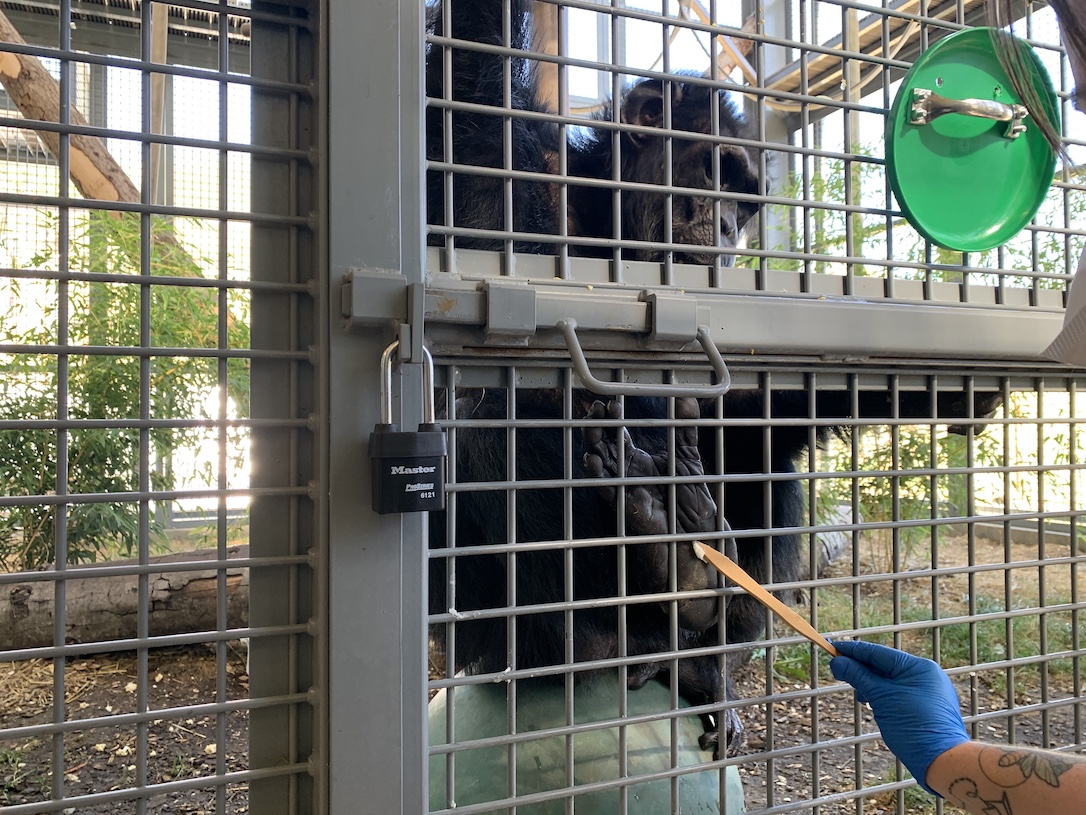
Although the semantics are complicated, the activity of operant conditioning is actually quite simple. First, the trainer uses both a verbal and gestural cue to communicate that a desired behavior will be rewarded in the subsequent window. (You can see an example of J.B. asking Burrito to present his right foot below.) Then, the trainer uses an audible “bridge” to mark the correct behavior and indicate that a treat is on the way. This edible reward is a form of motivation via positive reinforcement. In training jargon, “positive” refers to the addition of a stimulus and “reinforcement” refers to the increase in a desired behavior.

In short, we give rewards when the chimps choose to do desirable behaviors.

You may be wondering why we choose to modify chimpanzee behavior through training. After all, the chimps are wild creatures and we should respect their freedom to choose their own behavior. Even so, captivity is an unfortunate and complicated circumstance, unfairly chosen for them long ago, and purposeful training has the potential to make this environment more comfortable for them. Of course, we caregivers carry the responsibility to only focus our efforts on behaviors that benefit the chimps and use the least intrusive, minimally aversive methods for each.

Some examples of behaviors we train and rehearse are:

Eating cooperatively and/or at stations (allowing subordinate group members to receive food)

Presenting various body parts for injury treatment and monitoring

Receiving injections for vaccinations and sedation/immobilization

Shifting between enclosures to enable cleaning and to facilitate social integrations

Sitting on a bench scale to monitor weight and body condition

In the future, we will also prioritize desensitizing the chimps to uncomfortable but necessary medical procedures, including heart and lung auscultation, radiographs, EKGs and ultrasounds. These approaches usually require that we isolate, immobilize and anesthetize chimpanzees; winning their voluntarily participation is a safer and less stressful alternative for all involved!

I hope to share more content related to behavioral training (including visual demonstrations of our progress) in the near future!

Filed Under: Caregivers, Chimpanzee Behavior, Intelligence, Sanctuary, Training Tagged With: Animal Welfare, behavior, chimpanzee, chimps, Primates, Sanctuary, training

Man of Mystery

November 9, 2019 by Diana

Willy B remains somewhat of a mystery to me and to some of the chimpanzees too, I think.

Maybe he’s the big silent type. He definitely can be difficult to read and he rarely makes eye contact when I’m serving him food. That trait, combined with his size, has caused me to affectionately refer to him as a gorilla.

He seems to take time to feel settled and is rather aloof in new situations. With all of the many new experiences and combinations of new chimpanzees he’s been meeting, he’s been pretty aloof for the last few weeks, with very rare breaks to let his guard down for a bit to play with Burrito.

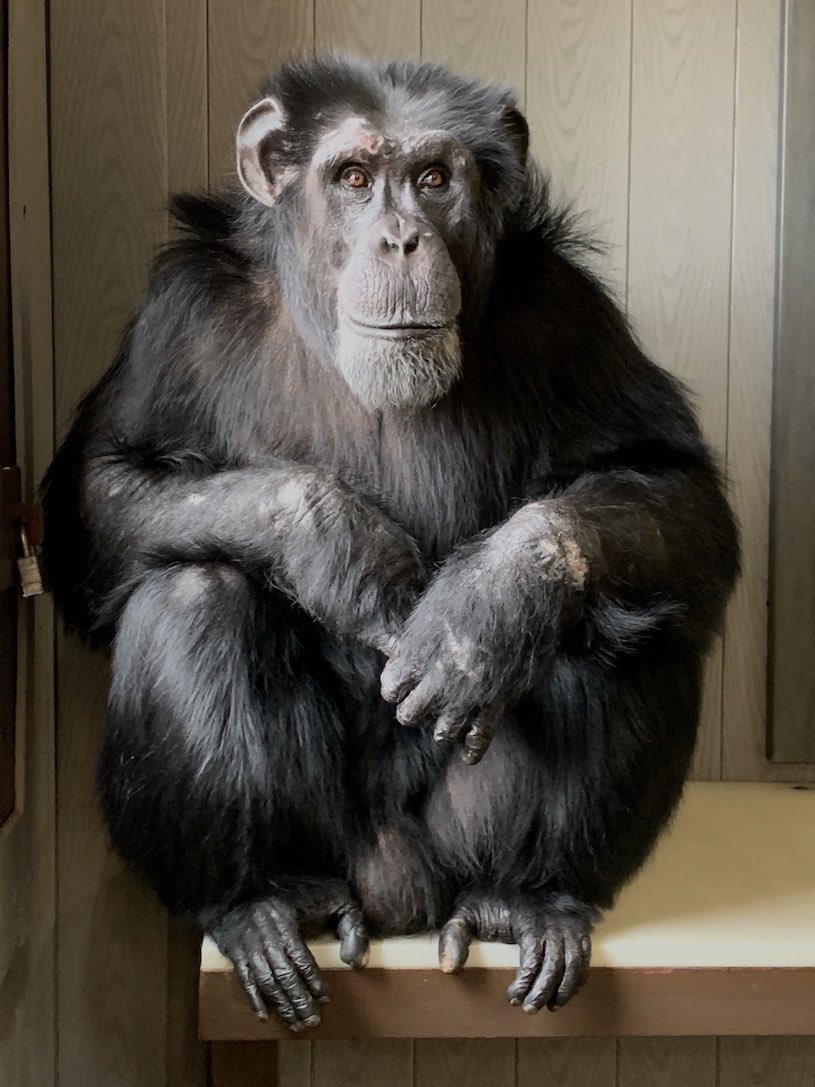
Most of the time, he’s been keeping to himself. Today, we gave him and the rest of the group access to the front rooms for the first time. He’s seen other chimps in those rooms, but hasn’t really had the chance to hang out in them. He seemed to enjoy the option to get away from the group and it gave us the chance to snap a couple of photos of him (above) in front room four, which we also call the “portrait studio” because of the nice lighting.

It was the first time in over a month that I’ve been able to get him to respond just a little to my invitation to play chase. It didn’t last long, but he did his characteristic double-tap across front room three a couple of times. Maybe he was just humoring me.

Despite his relatively mellow nature, as he gets more comfortable, we have observed him being the tiniest bit intimidating at meals. All it takes from this large guy is the slightest look or a motion of his arm, presumably indicating that he wants the food being served, and the female chimpanzees next to him react in fear. I don’t blame them! He’s a gorilla!

Interestingly, Burrito doesn’t seem intimidated by him at meals and will sit right next to him when they are being served, even taking food that Willy B has dropped. Is this because Willy B doesn’t want to dominate Burrito in the same way he easily does the females, or is he playing it cool for the moment until he gets more comfortable? We’ll just have to wait and see.

Burrito has actually surprised us quite a bit. We tend to think of him as someone who gets wound up and just can’t contain his energy, but he’s clearly modulating his displays and being careful not to charge anyone. Who knew Burrito had so much self control? The calming presence of Mave is likely helping him (these two have been grooming a LOT), but even before she was added to the group on Thursday, Burrito was impressing us with his heretofore-unknown ability to keep his composure. Even chimpanzees we’ve known for over a decade can surprise us.

Filed Under: Burrito, Chimpanzee Behavior, Sanctuary, Willy B Tagged With: behavior, chimpanzee, chimpanzee rescue, chimpanzee retirement, chimpanzee sanctuary, Chimpanzee Sanctuary Northwest, chimpanzees, Sanctuary

Great Expectations

September 12, 2019 by Anthony

We caregivers have been incredibly busy lately, but we make a point to read comments on our social media content and we attempt to respond appropriately whenever possible. Lately, most of our followers, donors and volunteers have been overwhelmingly focused on one topic in particular: social integrations. More specifically, everybody wants to know about our plan for introducing the three new individuals (Honey B., Willy B. and Mave) to our existing social group of seven resident chimpanzees. Diana described the situation eloquently in her recent post, which is a “must-read” for anyone trying to follow the action here at the sanctuary.

Willy B. and Mave listen to the other group of chimpanzees in the adjacent Playroom.

As stated previously by the other staff, the incoming trio are about to clear their four-week quarantine period and we are formulating a loose plan to begin the introduction process. All members of our care staff are experienced in chimpanzee care and management, but we have never conducted a merger of two social groups in this unique facility or with these individual chimpanzees. Therefore, it is impossible to write a detailed, step-by-step description of our introduction plan. We are committed to remaining flexible and open-minded from start to finish, and will make whatever changes are needed to ensure the safety and well-being of all chimpanzees throughout the process. As with the outdoor tunnel, The chimpanzees will let us know how they feel about each step and we will adjust our plan to reflect their choices. At this point in time, all we can say is that we have scoured the written literature on chimpanzee social integrations, consulted with experienced personnel from other facilities and organizations, and aggregated our own observations in order to make the best decisions for these individual chimps.

The existing scientific reports of first meetings between unfamiliar chimpanzees have somewhat helped us to set our expectations. Chimpanzee social behavior is by far the most thoroughly studied of all wild primates, and there are substantial bodies of work on their behavior in captivity as well. What we see around the sanctuary is often paralleled by what scientists have seen at other locations and in other populations of chimpanzees. To illustrate this point, let’s consider Burrito’s behavioral changes since the new three entered his world, both audibly and visibly.

Burrito Chimpanzee stomps around the Playroom.

In general, Burrito has been more alert and agitated than usual. He has conducted more forays onto Young’s Hill to monitor the section of fence closest to the new expansion, spends more time gazing towards the neighboring enclosures, and creates more noise by drumming and throwing objects around the Chimp House. He has been uncharacteristically late for some meals and even skipped a couple courses entirely. During these absences, we hear him getting rowdy by the Playroom windows, usually within sight of the three new arrivals who can watch the spectacle from the safety of their outdoor tunnel. Once his displays and hoots reach their inevitable crescendo, he leaps towards the window and stares intently, apparently waiting for a response. When he does show up tardy for meals, he has been swaggering up to the Greenhouse deck and then charging through the females, scattering them and causing a ruckus. This is an edgier version of Bubba than we have seen previously.

Burrito looks out of the Playroom window after completing a display.

This change in Burrito’s behavior is evidence of what some primatologists have called the neighbor effect. In their 1996 study of chimpanzees housed at a large research facility, Dr. Kate Baker and Dr. Filippo Aureli observed captive chimpanzees to determine whether noise from neighboring groups had an observable effect on each individual’s behavior. To summarize their findings, chimpanzees tended to perform more pant-hoots, displays and outright physical aggression when neighboring groups did the same. Aggression outside of social groups was related to aggression within groups. For captive chimpanzees, rowdiness and instability are apparently contagious. Right now, we are witnessing a similar pattern of behavior here at CSNW.

Willy B. watches Burrito from across the yard.

Other aspects of captive chimpanzee behavior have been studied at facilities around the globe. For example, recent studies have investigated how chimpanzee behavior varies in relation to temporary space restrictions, permanent relocations, different enclosure types, and atypical rearing histories. One study even asked whether chimps find music enriching (results: “meh”). Most of these papers were produced from data collected at no more than a few facilities, and many publications are mere case studies of single groups of chimpanzees. Each facility is unique and groups of chimpanzees can vary greatly depending on social structure, cultural variation, and context. Thus, even though there is a good deal of information out there, it requires a good deal of sifting and speculating to apply it to our chimpanzee residents here at the sanctuary.

Missy Chimpanzee monitors the neighboring chimps.

In a couple of situations, we have invited graduate students to conduct noninvasive applied welfare studies at the sanctuary. We are definitely not a research facility and do not profit from scientific investigations, but collecting systematic observations can generate information that can then be used to optimize our care of the chimpanzee residents. Central Washington University (CWU) is located in nearby Ellensburg and contains the nation’s only Graduate Program in Primate Behavior, so a handful of committed CWU students have helped us to answer key questions about the Cle Elum Seven. Most recently, a collaborative team led by Jake Funkhauser published his analysis of the sanctuary’s chimpanzee social network and dominance hierarchy. This report, although only based on a summer’s worth of observations, produced insight that has proved valuable as we prepare to add three new individuals into the mix.

Foxie Chimpanzee expressed her arousal and uncertainty during one of Burrito’s displays.

Additionally, we recently hosted Chimp Haven’s Director of Behavior and Research, Amy Fultz, who observed the chimps and inspected the facility. Amy has coordinated countless introductions between unfamiliar chimpanzees and numerous mergers of large social groups, thereby developing an immense body of knowledge and wisdom that she was generous enough to share with our team. Even as she gave us some useful tips and relayed some incredible stories, she also emphasized a few points that we already knew: that each chimpanzee is a unique individual, that each facility offers its own advantages and challenges, and that any introduction between two groups can take a surprising turn at any moment. It’s best to have a plan, of course, but the plan will inevitably change as we acquire new information about the chimps and their preferences.

Burrito Chimpanzee watches his neighbors through the caging of the Greenhouse.

Even with a wealth of available data and input from various sources, we know that this is unfamiliar territory for these ten chimpanzees and is a big step for our team as well. Ultimately, we will put these two groups together in our own way, the CSNW Way, which will be whichever way works best at that moment in time. For now, our staff is continuing to observe how the chimpanzees react to each small change in their environment and we will continue to share those moments with you whenever possible. We certainly appreciate all of your interest and support as we help the new three to acclimate to their new home, new lifestyle, and new neighbors, who will hopefully become their seven new friends. Shortly, we hope to have some updates for you all!

Filed Under: Burrito, Chimpanzee Behavior, Introductions, Sanctuary Tagged With: animal behavior, Animal Welfare, behavior, Burrito, captive chimpanzees, chimp, chimp sanctuary, chimpanzee, Chimpanzee Behavior, chimpanzee sanctuary, Chimpanzee Sanctuary Northwest, chimpanzees, Sanctuary, social integration, social networks

The Intensity of Being a Chimpanzee

March 9, 2019 by Diana

This afternoon, the chimp house was the epitome of peacefulness.

If you had walked in the door at 3:00, you would have had to strain to hear the soft lip-smacking and gentle raspberry sounds that accompanied their grooming.

If you had climbed the ladder to get a view of the chimpanzees in a fluid huddle in the loft, you might have marveled at what a close-knit and affectionate group they are.

This peaceful scene erased the ear-piercing screams and general mayhem that constitute chimpanzee quarreling that had occurred throughout the morning.

But that’s the nature of chimpanzees.

One minute they seem intensely angry at each other and the next they are engaged in the most intimate grooming session.


Filed Under: Annie, Burrito, Chimpanzee Behavior, Foxie, Grooming, Jamie, Sanctuary Tagged With: Animal Welfare, behavior, chimpanzee, chimpanzee sanctuary, Chimpanzee Sanctuary Northwest, Grooming, Primate behavior

Excitement (or not) of the day

August 19, 2017 by Diana

This morning, we humans noticed a large puddle above the greenhouse. Since we have not had significant rain in months, we knew that there must be an issue with the irrigation system. J.B. was called in to investigate, and Jody watched his every move very carefully (from a comfortable position):

Jody lay and look


The investigation involved entering Young’s Hill, which delayed the chimpanzees going onto the hill for a bit. Burrito and Foxie waited patiently together in a windowsill (look at those great chimpanzee feet):

Burrito and Foxie window sill


Negra, on the other hand, was happy to spend the extra time sleeping (I feel you, Negra):

Negra sleep


J.B. quickly fixed the issue (a blown hose), and the chimps were eager to get outside (well, except for Negra, who continued to sleep). Annie found a potato left over from yesterday’s forage (that’s pretty exciting):

Annie with potato


Jamie and Missy explored and made sure that J.B. didn’t leave anything out on the hill:

Jamie profile

Missy walk hill


Bonus photos – a lot of people ask if Jamie ever wears the boots that she loves so much. The answer is yes, occasionally. And today was one of those days:

Jamie wearing boot


Jamie stand platform

Save

Save

Save

Save

Filed Under: Annie, Boots, Burrito, Enrichment, Foxie, Jamie, Jody, Missy, Negra, Sanctuary, Young's Hill Tagged With: behavior, boots, chimp, chimpanzee, northwest, Sanctuary

  • « Go to Previous Page
  • Page 1
  • Page 2
  • Page 3
  • Page 4
  • Interim pages omitted …
  • Page 7
  • Go to Next Page »

Primary Sidebar

Subscribe To the Blog and Get Notified of New Posts First!

Archives

Calendar of Blog Posts

June 2026
S M T W T F S
 123456
78910111213
14151617181920
21222324252627
282930  
« May    

Categories

SUBSCRIBE TO OUR NEWSLETTER

Footer

PO Box 952
Cle Elum, WA 98922
[email protected]
509-699-0728
501c3 registered charity
EIN: 68-0552915

Official DDAF Grantee

Menu

  • The Chimpanzees
  • Blog
  • About Us
  • You can help
  • Resources
  • Contact
  • Donate

Proud Member of

Connect With Us

Search

Copyright © 2026 Chimpanzee Sanctuary Northwest. All Rights Reserved. Site by Vegan Web Design