• Skip to main content
  • Skip to primary sidebar
  • Skip to footer

Chimpanzee Sanctuary Northwest

Hope. Love. Home. Sanctuary

  • Our Family
    • The Chimpanzees
    • The Cattle
  • Blog
  • About Us
    • Visiting the Sanctuary
    • Philosophy
      • FAQs
      • Mission, Vision & Goals
      • Privacy Policy
    • The Humans
      • Staff
      • Board of Directors
      • Founder
    • Annual Reports
    • The Future of CSNW
    • CSNW In The News
  • You can help
    • Donate
      • Become a Chimpanzee Pal
      • Sponsor A Day
      • Transfer Stock
      • Be A Produce Patron
      • Be a Bovine Buddy
      • Give from your IRA
      • Personalized Stones
      • Bring Them Home Campaign
    • Leave A Legacy
    • Employment Opportunities
    • Volunteer
    • See Our Wish List
    • Events
  • Resources
    • About Chimpanzees
    • Enrichment Database
    • Advocacy
      • Advocacy Action Center
      • Apes in Entertainment
        • Trainers
        • Role of the AHA
        • Greeting Cards
      • Chimpanzees as Pets
      • Roadside Zoos
      • Chimpanzees in Biomedical Research
      • Conservation
        • African Apes
        • Orangutans
  • Shop
    • Merchandise Store
  • Contact
  • DONATE NOW

animal rescue

Take Action Tuesday: New children’s book exploits Anjana and tiger cubs

October 8, 2013 by Debbie

EOA take action tuesday

Exploitation comes in many forms, and, unfortunately, it isn’t always obvious at first glance. Many of you have seen the “cute” pictures of a baby chimpanzee holding white tiger cubs or the photos and videos of an orangutan with a hound dog. These images and stories have been circulating and re-released in many forms over the last six years. All of these animals reside at a facility called The Institute of Greatly Endangered and Rare Species (T.I.G.E.R.S.).

Although T.I.G.E.R.S preaches about species conservation and they claim to contribute toward helping endangered species, the source of their money-making is nowhere near ethical. The premise of their facility revolves around photo ops and up-close and hands-on interaction with these animals, using them in traveling shows, and leasing them out for a variety of media productions. Displaying wild animals in this way involves numerous animal welfare concerns and poses serious public safety risks.

Suryia, the same orangutan who is seen with the hound dog, appeared in a Robitussin ad in 2010. You may remember that this ad was altered as a result of our advocacy efforts and other public pressure – Suryia was replaced by a CGI chimpanzee in the ad.

T.I.G.E.R.S. director Bhagavan “Doc” Antle continues to use the “unlikely animal friendships” angle to exploit endangered species and give the wrong impression of the proper care of these animals. He has published children’s books about Suryia and the hound dog, and now has a new book about Anjana the chimpanzee and the tiger cubs. It is scheduled to release in November, just in time for the holidays.

The books present children with the misleading notion that T.I.G.E.R.S. is a sanctuary preserve, when in truth it is a glorified roadside zoo with a history of violations for improper housing and care for the animals. Antle is also famous for showcasing ligers (a lion-tiger cross) who notoriously have genetic abnormalities, neurological disorders, and short life expectancies due to their unnatural breeding.
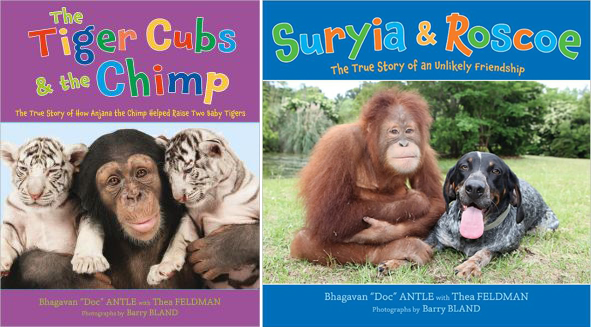
Doc Antle's children's books

Don’t support this exploitation. When you receive an email or see images of baby apes with other animals on Facebook, Twitter, Pinterest, etc, take the opportunity to investigate where the animals are living, and politely educate people on the true circumstances behind the photos. If the image is an orangutan with a dog or a chimpanzee with tiger cubs, now you know the real story.

Encourage your friends and family to avoid purchasing Antle’s children’s books. As an alternative, we suggest purchasing an educational children’s book about chimpanzee behavior like “A Chimpanzee Tale.” You can also give the books negative ratings on Amazon, which may deter others from purchasing them.

Sample response to emails and Facebook posts with “cute” pictures of baby apes:

Sadly, this picture is not cute and cuddly as it may appear. Portraying these exotic animals as cute and cuddly attractions seriously misinforms people about the true nature of these beings and perpetuates the pet and entertainment industries. Infant apes should be with their mothers — not tiger cubs, dogs, or humans. Unfortunately, the facilities where these pictures originate are breeding exotic animals, which leads to a lifetime of unwarranted imprisonment for those animals. No respectable sanctuary would intentionally breed, nor would they put their animals on display or exploit them for entertainment purposes.

Sample negative feedback for Amazon’s listing of Anjana and Suryia’s books:

This book paints a false picture of a hopeful, loving environment for Anjana and the other exotic animals at T.I.G.E.R.S. Unfortunately, the facility regularly exploits these animals for entertainment purposes, endangers the public by offering “hands-on” experiences, and breeds exotic animals, leading to a lifetime of unwarranted imprisonment. No reputable sanctuary would intentionally breed, nor would they put their animals on display or exploit them for entertainment purposes. Please do not buy this book for your children. It is highly misleading and purchasing it will only contribute to the continued exploitation of these highly intelligent beings.
Filed Under: Advocacy, Apes in Entertainment, Sanctuary Tagged With: advocacy, animal protection, animal rescue, animal rights, Animal Welfare, anjana, chimpanzee, chimpanzee rescue, chimpanzee sanctuary, Chimpanzee Sanctuary Northwest, Cle Elum 7, Cle Elum Seven, csnw, doc antle, ligers, primate protection, primate rescue, roadside zoo, roscoe dog, Sanctuary, suryia, t.i.g.e.r.s., the institute of greatly endangered and rare species, tiger cubs

“Fake Neggie”

October 5, 2013 by Debbie

All of the chimps have nick-names that have caught on over the years and almost all of the caregivers use with them. Annie is “Annie Bo-Bannie,” Burrito is just “Mr. B,” Foxie is “Foxie Fox!” Jody is “Jo-Jo,” Jamie is “James,” Missy is “Miss” and Negra is “Neggie.”

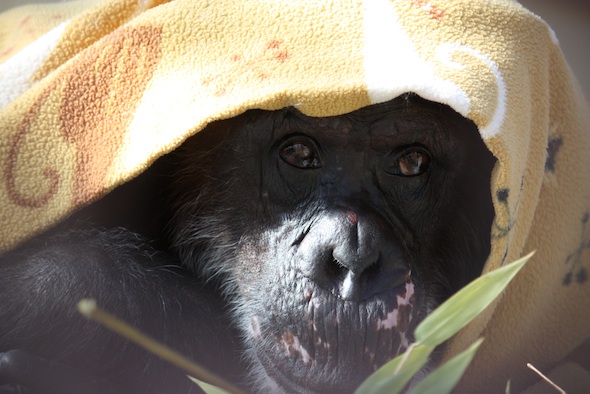
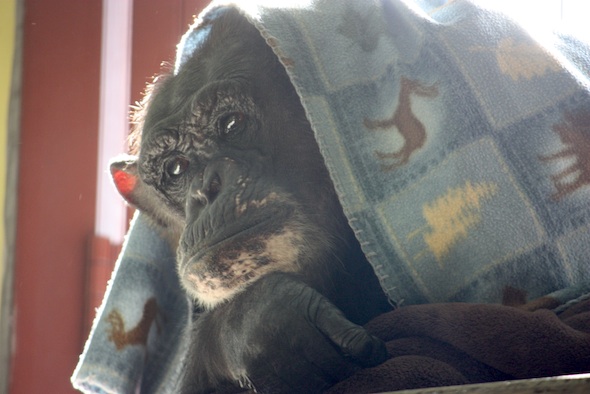
Missy has a tendency to sometimes lie in the “Neggie spot” which is in front of the catwalk window, where Negra likes to sit and gaze out onto the valley below. Sometimes Missy even covers herself in a blanket, in perfect Negra style. When we go to say hi to the chimps, sometimes Missy trips us up and we mistake her for Negra at first, because of her perfect impersonation. This is what we call “Fake Neggie.”

Today, Fake Neggie was in the greenhouse on the top platform, soaking in the sun…

web_missy_under_blanket_fake_neggie_GH_dm_IMG_5227

and Real Neggie was in her spot on the catwalk in the playroom.

web_negra_under_blanket_PR_dm_IMG_5234

Filed Under: Missy, Negra, Nesting, Sanctuary Tagged With: animal protection, animal rescue, animal rights, Animal Welfare, chimp, chimp enrichment, chimp sanctuary, chimpanzee, chimpanzee rescue, chimpanzee retirement, chimpanzee sanctuary, Chimpanzee Sanctuary Northwest, Cle Elum 7, Cle Elum Seven, csnw, Missy, Negra, Nesting, primate protection, primate rescue, rescue, Sanctuary

Sky above, earth below

October 2, 2013 by Katelyn

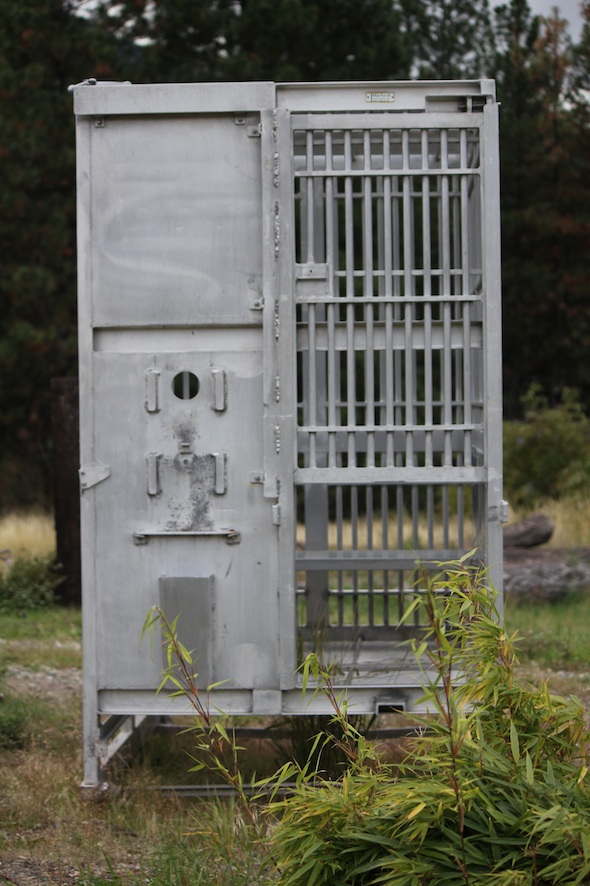
Outside of the entrance to the chimp house we keep one of the protocol cages that the chimpanzees lived in, in a windowless basement, during their decades being used in biomedical research. We must pass it each day as we unlock the door. It provides an opportunity for people who visit the sanctuary to envision to some degree what the chimpanzees’ lives consisted of before coming here. And it helps me remember every day why I’m here. It’s heartbreaking, of course, to look at. Imagine having spent every day of your life for over three decades living inside this (minus the scenery):

web_Protocol_cage_kd_IMG_4717

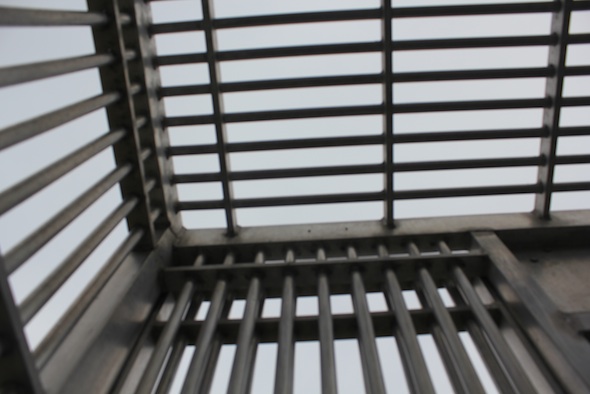
You never see the sky or green grass, you never feel the sun or the breeze, and for the most part you are unaware that anything exists outside of this view:

web_view_sky_from_cage_kd_IMG_4731

I spent several minutes today sitting inside this cage. I couldn’t stand up to my full height. It was hard to balance on the floor made of bars. And there is only a small, cold metal bench to sit on. The chimpanzees would not have had blankets to build nests with and no enrichment to engage their intelligent and active minds. I thought of my seven dear friends having lived every day this way in so much fear, uncertainty, boredom, and at many times, pain. You can imagine the wave of heartfelt sorrow and anger I felt for all they have endured. And what so many still do.

And then I looked out to the view of Young’s Hill from the cage:

web_vertical_view_yh_from_cage_kd_IMG_4730

Earlier today I told Jamie we would walk around Young’s Hill to her heart’s content. And boy did we. Around and around, up one side and turning to retrace our steps back down the other way. I lost count of how many times we went around. And for the first time that I’ve experienced, Burrito joined us in our patrol of the perimeter the entire way! Foxie and Dora, and even Jody came along for part of the way, while Annie and Missy chased each other up and down the hill. (It was cold today and Negra chose to stay in the comfort of  her warm, cozy nest). Finally, after several laps around Young’s Hill, I suddenly lost sight of Jamie and had to go looking for her. This was a first! I eventually found her back in the front rooms, waiting for me to give her the cowgirl boot (which I had of course been wearing). I guess she had indeed walked to her heart’s content.

Imagine what it must feel like to these seven chimpanzee people to be able to see the sky above and feel the earth below, unobstructed.

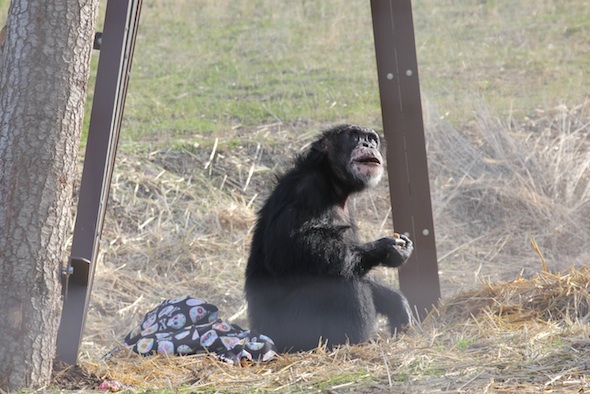
Burrito:

web Burrito sit in Negra's cabin blanket hold chow look up Young's Hill YH IMG_9703

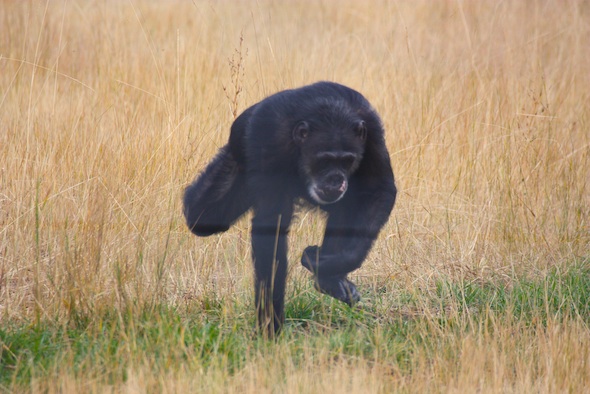
And to MOVE for the sheer joy of moving like Missy:

web Missy run full speed youngs hill IMG_0148

Several days ago Jamie gifted me with an amazing moment. During a walk around the hill she had me wait while she foraged and climbed over every inch of the structures. At one point she suddenly climbed up a post, stood bipedally on the very top with her arms hanging at her sides and threw her head back as she stared up at the sky for several seconds. A simple, yet profound moment. Then she turned and looked at me, climbed down and raced me all the way back to the greenhouse with a huge play face. I am immeasurably grateful that the chimpanzees have the chance to call a sanctuary home. And I remember all those languishing in cages and labs who are still in need of their sanctuary.

Though that moment with Jamie will forever be burned into my mind, I unfortunately didn’t get a photo. But this is one of my favorites and I think it speaks volumes all the same.

web Jamie YH view of valley below_MG_4302

Filed Under: Annie, Burrito, Chimpanzees in Biomedical Research, Foxie, Jamie, Jody, Missy, Negra, Sanctuary, Young's Hill Tagged With: animal rescue, Animal Welfare, Annie, Burrito, chimp sanctuary, chimpanzee rescue, chimpanzee sanctuary, Chimpanzee Sanctuary Northwest, Foxie, Jamie, Jody, Missy, Negra, Sanctuary, young's hill

The Landmine Snare

September 30, 2013 by Debbie

Maureen McCarthy, PhD candidate at the University of Southern California, was our very first guest blogger. She is doing field research in Uganda, and while there she has been featured as a regular on Scientific American’s blog. The entry that follows is particularly moving. WARNING: some disturbing images are included in this entry.

—

This is our last week of data collection. It was supposed to be a laid-back week to collect a few more samples and enjoy a few final days tracking chimpanzees, a fieldwork victory lap of sorts. It didn’t turn out as I’d hoped, though. Instead, things went very, very wrong.

On Tuesday, we ventured back to a forest reserve south of the Budongo Forest. It’s one we’ve visited numerous times before…a much larger forest than most we visit, one which helps functionally connect the fragmented forests of this corridor region to the much larger Budongo Forest to the north. On the surface, chimpanzees here have a good habitat compared to our friends to the south in most forest fragments I’ve been studying. A closer look, however, reveals an abundance of illegal logging and snare hunting sites within the forest. Though snare hunting is illegal, it is a leading cause of injury and death among chimpanzees in Uganda. Up to one third of chimpanzees in forests of Western Uganda have sustained snare injuries (Reynolds, 2005; Wrangham and Goldberg, 1997; Wrangham and Mugume, 2000).

We received news that chimpanzees had been heard far inside the forest early that morning. Jack and I, along with a field assistant and a guide from the National Forestry Authority, began traveling through the forest en route to the area where they were heard. Around mid-morning, we too began hearing pant hoot vocalizations from the chimpanzees, as well as occasional whimpers and screams, which are not unusual, especially among larger parties. We projected waypoints for their location and followed trails in that direction until we knew we were close. It sounded like a large party was present, with a second party approximately 200 meters away.

We decided to leave the nearby party so as not to disturb them, instead backtracking along their trail in the hopes of finding nests from the previous night. After successfully locating numerous nests and dung samples, we followed their trail back to where they’d been calling in the hopes of finding that they’d gone, leaving some dung samples behind. Instead, we saw a number of chimpanzees, which, along with their earlier vocalizations, suggested a large party was still present. We watched as a subadult male climbed a tree. He produced a dung sample, and we noted its location so we could find it there after they had moved. When it seemed that the chimpanzees may be preparing to leave, we decided to slowly and carefully move closer to the tree where we saw the male, in an attempt to collect the dung. As we approached, we found that a young chimpanzee was watching us from deep within the dense vegetation. The youngster was about three years old. He watched us fearfully and whimpered from a limb about one meter off the ground, then became more fearful and began to scream. We wondered why he didn’t simply leave his leafy perch. Was he injured or trapped? One of our field assistants, who led in the front of our party, assured us confidently that he could see both hands and feet, and that all limbs were free. Despite these assurances, I was left with an uneasy feeling. However, a large party of chimpanzees was still nearby. An adult started to climb down from his position in a tree. I decided that it would be too risky to move closer through the dense vegetation. Given the thickness of the undergrowth, we would have to approach very closely to see the young chimp well enough to assess the situation thoroughly. If he then became very upset, others in the party could come to his defense and we could risk being seriously attacked. I would have to rely on my field assistant’s assessment that the youngster was fine despite what seemed to be unusual behavior. At least, we noted hopefully, there was no distressed mother visible. We left the possibility of sample collection behind and went home for the day.

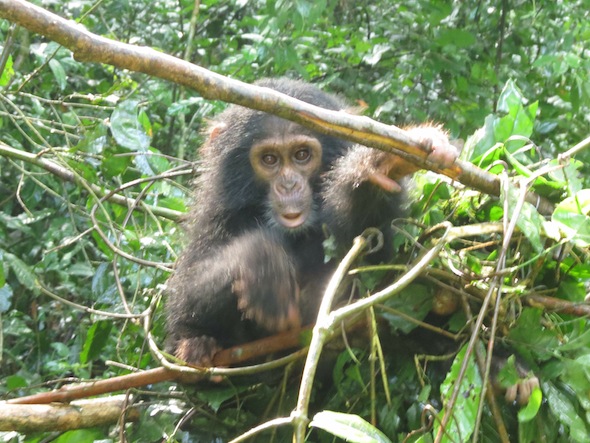
The next morning, we came back in the hopes that the chimpanzees had all left and the dung samples remained. As we approached, we heard and saw no sign of chimpanzee presence. However, we soon heard the unmistakable whimpers of the same young chimpanzee. Jack and I looked at each other with sinking, awful dread. The infant chimpanzee was indeed trapped there. I approached, passing through the vegetation to get a close look at the chimpanzee. He had a wire snare around his left foot. He still seemed strong and relatively healthy despite being trapped. We suspected that he had been ensnared there sometime after the party arrived on Tuesday morning. We left the area immediately to get phone reception and called our colleagues at the Budongo Conservation Field Station for assistance. We hoped their veterinary staff could provide the necessary help to free the chimp from his snare.

maureen landmine snare Photo 1

The ensnared chimpanzee. Note the trapped left foot, with the snare wire visible on the branch above. Photo © Maureen McCarthy.

Phone signals were poor and transportation was challenging between Budongo and our location. We spent hours waiting but eventually received word that help was on the way. Finally, two veterinarians from Budongo met us in a nearby village. I was relieved that help had finally arrived and that this chimpanzee could be given a chance to be free again and to go on with his young life. We trekked through the forest until we finally arrived again at the location of our little friend. As we pushed through the dense vegetation, I couldn’t see the chimp at his usual post. For a brief moment, my heart leapt as I thought he may have escaped his snare. A moment later, however, I was devastated by reality—he was not visible because he had died and was now hanging below the branch where we found him earlier.

My mind was reeling. How could he have died so soon? Sure, it took hours for help to arrive, but he looked so strong earlier. Dozens of “what ifs” flooded my thoughts. What if we had ignored the risks and pushed in further yesterday to assess the situation fully and see that he was truly ensnared? What if we had stayed by his side today? What if we had just tried to release him on our own before help arrived? If we did release him, could we have helped him find the other chimpanzees in his community? I was heartbroken and guilt-ridden with thoughts that I should have done more.

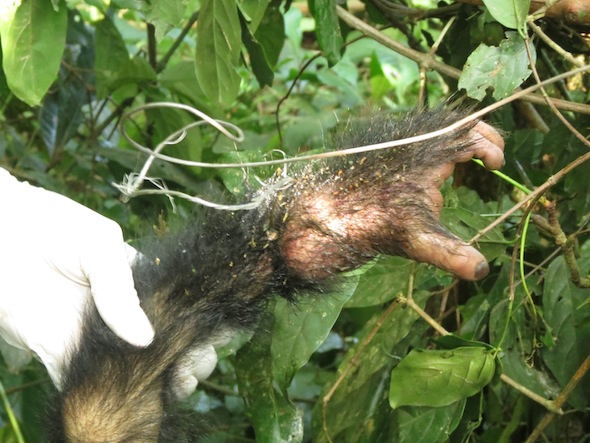
Thankfully, the veterinary staff from Budongo could not have been more calming and professional. Their assessment was that the chimpanzee was likely an orphan since there was no sign of his mother in the vicinity. We should expect a chimpanzee mother to remain nearby if her infant is trapped in a snare. They also assessed the cause of the infant’s death. The infant was found hanging upside down by the trapped leg. It seems that he had fallen from the leafy cushion of branches on which he was seated and was unable to right himself. Perhaps he was simply too tired after all the trauma he’d experienced since the previous day. As he hung upside down, the oxygen-poor blood accumulated in his head as the heart was unable to pump it back up to his chest and replenish his brain with oxygen-rich blood. The wound, along with our account of where the chimpanzees traveled, corroborated the notion that the injury had occurred the previous day. Perhaps most tragically, he had only just died. If we had been able to intervene only an hour sooner, the outcome could have been very different. This particular detail is staggeringly difficult for me…

maureen landmine snare Photo 2

The snare injury, post-mortem. Photo © Maureen McCarthy.

The vets also assessed the reason for his injury. It was caused by what is known as a landmine snare, a particularly complex snare devised to catch a large animal such as a bushbuck. The complex construction made it clear that it would have been difficult if not impossible for the chimpanzee to free himself, at least not without losing his foot in the process. This snare was likely set by an illegal logger in one of the nearby camps within the forest, perhaps one of the men who went crashing through the forest to avoid being seen by us just earlier that morning.

The veterinarians freed the chimpanzee’s body from the snare and carefully collected it for post-mortem analysis and a respectful burial. He was so small, so vulnerable, and so beautiful. Life had only just left him, and I was simultaneously so sorry for him and so grateful that he no longer had to suffer the fear and pain he had been feeling.

What can we make of this tragedy? I feel distraught and helpless over the loss of this young innocent life. I can find comfort in a couple of thoughts, though. First, I am grateful that none of our team members was injured in what potentially could have been a very dangerous situation. If I had insisted that we push in to get a closer look when other chimps surrounded us, I could instead be writing an account of one of our team members being attacked by a chimpanzee. Second, I am grateful that, if he had to die, at least the loss of consciousness he experienced was relatively painless compared to a week or more of suffering slow starvation, a fate endured by some chimpanzees similarly caught in snares.

max

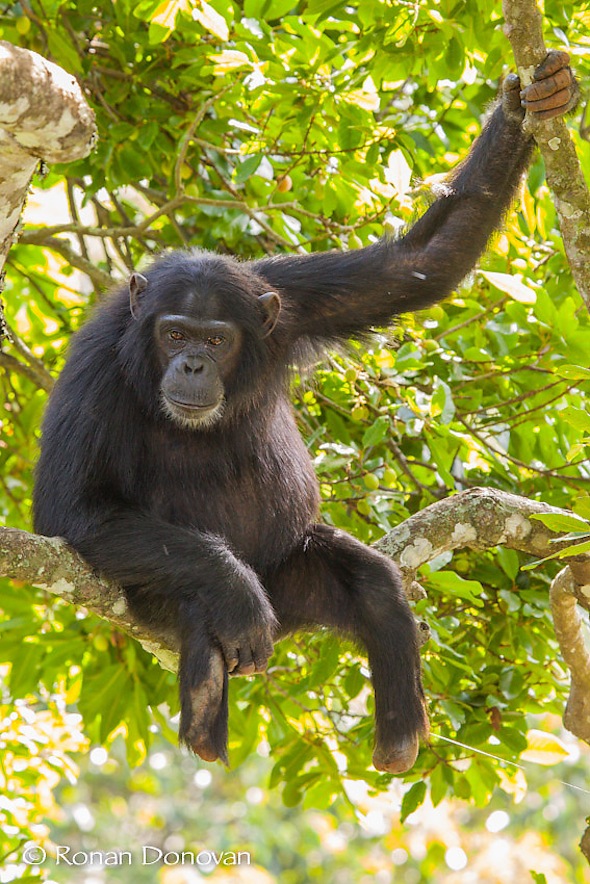
Max, a snare injury survivor in Kibale National Park, Uganda. Photo courtesy of Ronan Donovan.

I can take one more comfort. That is, I can hope we learn something from this awful situation and create some sort of positive outcome. I hope the plight of this innocent chimpanzee can help shed light on the gravity of snare hunting as a threat to our closest living relatives. There are committed individuals in Uganda trying to ensure that this won’t happen to another chimpanzee. For example, please consider supporting a snare removal program such as the Jane Goodall Institute Snare Removal Program or the Kibale Snare Removal Program. Here’s hoping snare hunting becomes a thing of the past.

This post was originally published at Scientific American.

Works cited:

Reynolds, V. (2005). Chimpanzees of the Budongo Forest. New York: Oxford University Press.
Wrangham, R.W., Goldberg, T. (1997). An overview of chimpanzee conservation and management strategies. In Conserving the chimpanzees of Uganda: a population and habitat viability assessment for Pan troglodytes schweinfurthii (ed. E. Edroma, N. Rosen and P.S. Miller). IUCN/SSC, Apple Valley, MN.

Wrangham, R.W., Mugume, S. (2000). Snare removal program in Kibale National Park: a preliminary report. Pan Africa News 7: 18-20.

Filed Under: Advocacy, Free-living chimps Tagged With: advocacy, animal protection, animal rescue, animal rights, Animal Welfare, budongo, bushmeat orphan, chimpanzee, chimpanzee rescue, chimpanzee retirement, chimpanzee sanctuary, Chimpanzee Sanctuary Northwest, free-living chimps, kibale national park, maureen mccarthy, primate rescue, rescue, scientific american blog, snare trap, uganda

Happy Birthday, Sarah!

September 25, 2013 by Katelyn

Today’s day of sanctuary was sponsored by Ida Chan, in honor of Sarah Wong’s birthday! Ida shared the following: “We share this planet with all living things and must act responsibly toward all creatures big and small.” Ida and Sarah, thank you so much not only for caring about the chimpanzees, but for the lovely reminder of our interconnectedness to all of the amazing beings we are so fortunate to share our lives with. Sarah, have a wonderful birthday!!

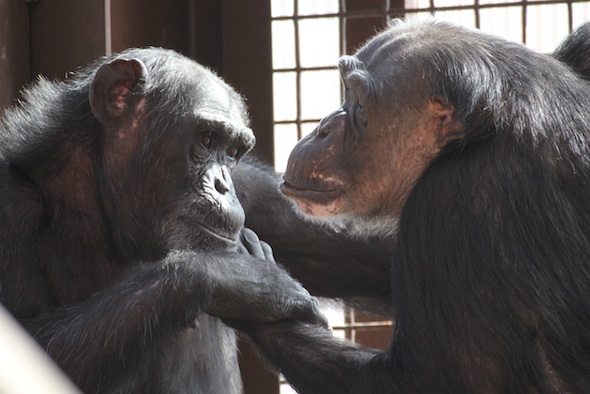
Foxie and Negra enjoying some grooming time together:

web negra foxie groom cute greenhouse GH IMG_9848

Filed Under: Foxie, Grooming, Negra, Sanctuary, Sponsor-a-day Tagged With: animal protection, animal rescue, Animal Welfare, Chimpanzee Sanctuary Northwest, Foxie, Negra, Sanctuary, Sponsor-a-day

Young’s Hill party forage

September 20, 2013 by Debbie

I mentioned earlier on the blog that today is the second anniversary of the opening of Young’s Hill. Watch the video of their first day out here and check out the previous post for some photos of the chimps on that very emotional and moving day!

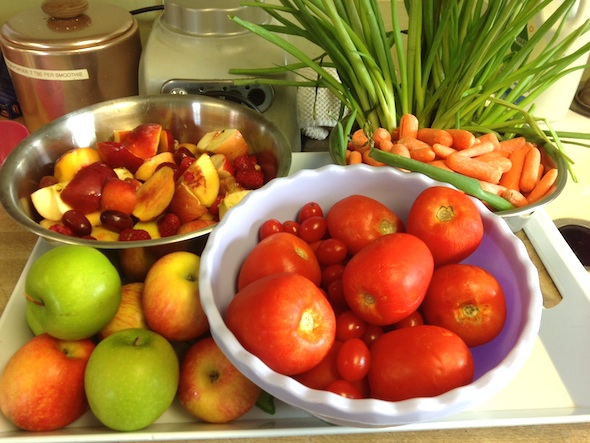
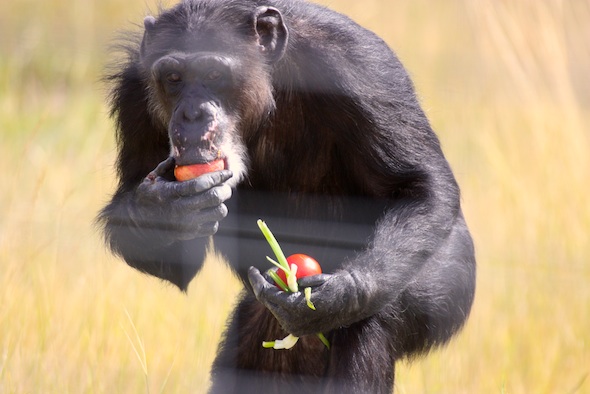
Today we wanted to celebrate the anniversary in the best way we know how for chimps—a big food forage! The chimps usually are served their meals (so we know that everyone is getting appropriate portions) but a few times a week we do put out a forage for them to do what chimps would do in the wild. In order to scatter the food around and make the forages last for awhile, we usually cut up the food into small chunks so it takes some time for them to find everything.

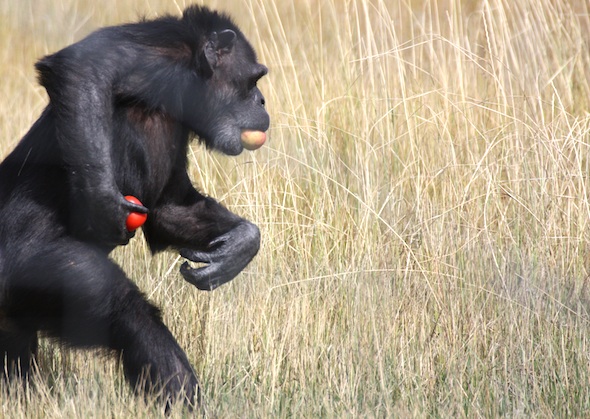
This time, we not only included a fruit salad of some chopped peaches, raspberries, and grapes, as well as baby carrots and green onions—but we also included WHOLE apples and tomatoes. The chimps were so excited as we headed out to spread the food around! Mixing things up like that keeps the chimps super enriched and happy.

web_YH_anniversary_forage_dm_phone

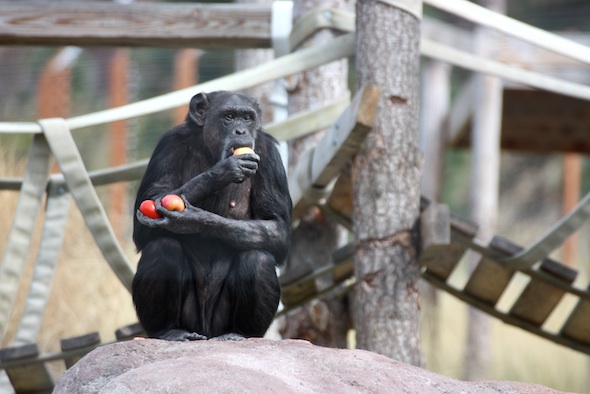
Everyone really loved all the whole apples and tomatoes! Jody was the first to get a hand (and mouth) full!

web_jody_eat_forage_treat_rock_YH_dm_IMG_4707

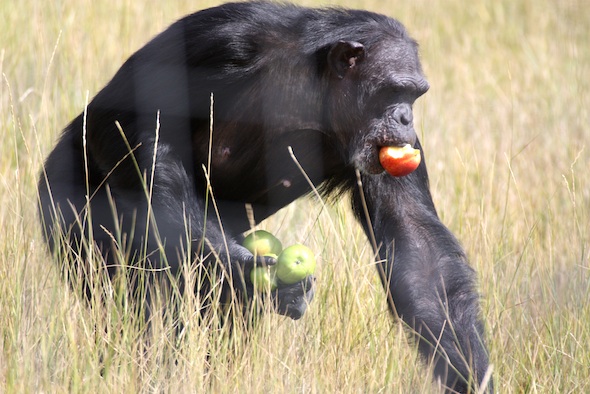
Jamie collected at least four apples:

web_jamie_eat_forage_whole_apples_YH_dm_IMG_4750

web_jamie_perfect_posture_treat_rock_termite_mound_YH_dg_MG_4843

Annie:

web_annie_bipedal_forage_YH_dm_IMG_4720

web_annie_grass_YH_dg_MG_4842

Burrito searching for goodies:

web_burrito_walk_tall_grass_YH_dm_IMG_4783

And then taking a quick rest:

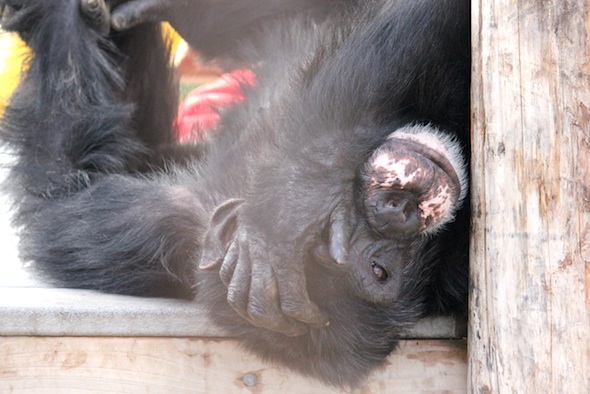
web_burrito_lay_down_silly_cover_face_cute_GH_dg_IMG_4632

Foxie:

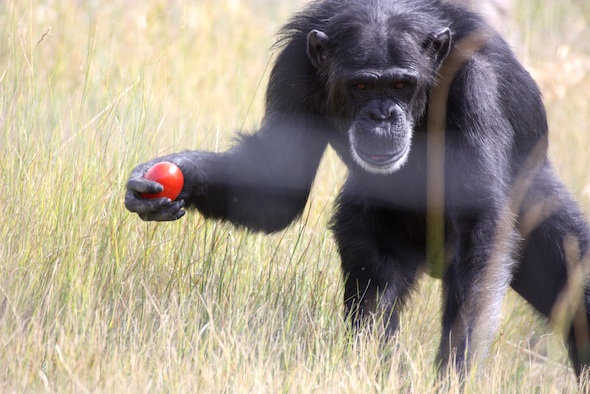
web_foxie_hold_tomato_forage_YH_dm_IMG_4801

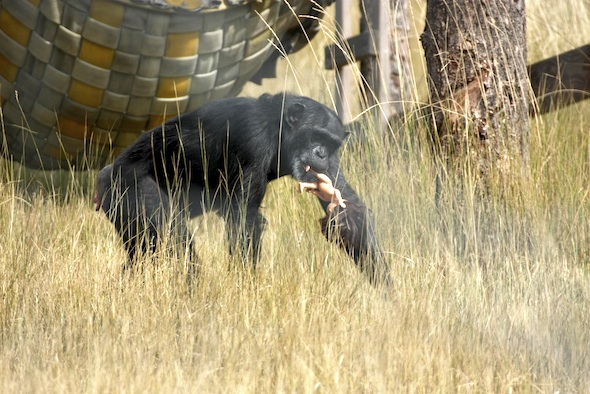
web_foxie_carry_dora_in_mouth_YH_dg_MG_4830

Missy:

web_missy_eat_forage_YH_dm_IMG_4763

Thank you so much to everyone who helped with Young’s Hill, and to everyone who has helped the Cle Elum Seven along this amazing and considerable journey!

web_young's_hill_plaque_second_anniversary_dm_IMG_4728

Filed Under: Annie, Burrito, Food, Foxie, Jamie, Jody, Missy, Sanctuary, Young's Hill Tagged With: animal protection, animal rescue, animal rights, Animal Welfare, Annie, Burrito, chimpanzee, chimpanzee rescue, chimpanzee retirement, chimpanzee sanctuary, Chimpanzee Sanctuary Northwest, Cle Elum 7, Cle Elum Seven, csnw, Foxie, Jamie, Jody, Missy, northwest, primate protection, primate rescue, Sanctuary, young's hill

Jamie helps flush the drain

September 19, 2013 by Debbie

Jamie is always trying to help us get our jobs done the right way. Sometimes she helps scrub the mesh fencing for us, other times she wipes the floor down. She monitors us while we clean, almost as if she is there to make sure we are doing it right!

Yesterday I caught her doing something new: holding down one of the water spigots. I’m not really sure why she was doing it, but it went on for quite awhile! Jamie wasn’t being very environmentally friendly… but she was helping us flush the drain.

Filed Under: Enrichment, Jamie, Sanctuary Tagged With: animal protection, animal rescue, animal rights, Animal Welfare, chimp enrichment, chimpanzee, chimpanzee rescue, chimpanzee retirement, Chimpanzee Sanctuary Northwest, Cle Elum 7, Cle Elum Seven, csnw, Jamie, primate protection, primate rescue, rescue, Sanctuary

  • « Go to Previous Page
  • Page 1
  • Interim pages omitted …
  • Page 63
  • Page 64
  • Page 65
  • Page 66
  • Page 67
  • Interim pages omitted …
  • Page 108
  • Go to Next Page »

Primary Sidebar

Subscribe To the Blog and Get Notified of New Posts First!

Archives

Calendar of Blog Posts

June 2026
S M T W T F S
 123456
78910111213
14151617181920
21222324252627
282930  
« May    

Categories

SUBSCRIBE TO OUR NEWSLETTER

Footer

PO Box 952
Cle Elum, WA 98922
[email protected]
509-699-0728
501c3 registered charity
EIN: 68-0552915

Official DDAF Grantee

Menu

  • The Chimpanzees
  • Blog
  • About Us
  • You can help
  • Resources
  • Contact
  • Donate

Proud Member of

Connect With Us

Search

Copyright © 2026 Chimpanzee Sanctuary Northwest. All Rights Reserved. Site by Vegan Web Design