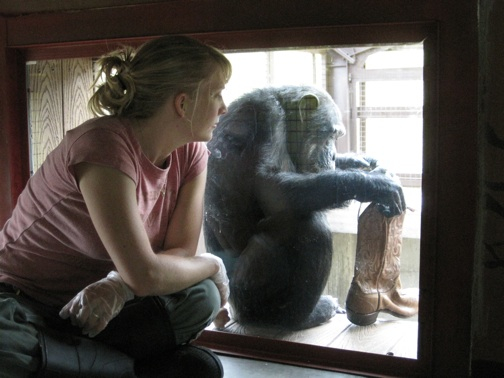
Jamie isn’t the only chimp that loves boots here at the sanctuary! Every once in awhile, we notice someone else inspecting the boots when Jamie sets them down for a moment.
Jody:
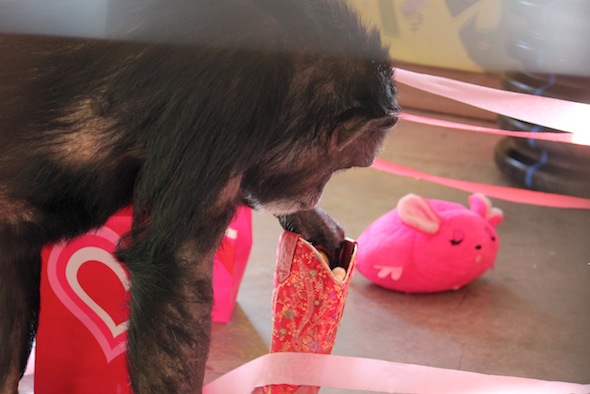
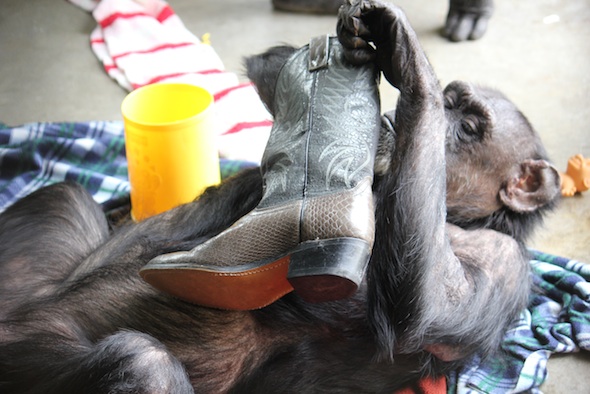
Negra:

Missy: (and Diana)
Chimpanzee Sanctuary Northwest
Hope. Love. Home. Sanctuary
Jamie isn’t the only chimp that loves boots here at the sanctuary! Every once in awhile, we notice someone else inspecting the boots when Jamie sets them down for a moment.
Jody:
Negra:
Missy: (and Diana)
Volunteers Connie, Annie, Lynn and myself finished cleaning the playroom and I was about to let them go enjoy a pumpkin seed forage appetizer before their lunch on Young’s Hill, but had to pause for a minute to watch these two unusual play partners wrestle and laugh. At 40, Negra is the eldest of the Cle Elum Seven but Annie isn’t far behind her. She will be turning 39 in a couple of weeks! As J.B. mentioned on yesterday’s blog about Missy’s 38th birthday, it’s definitely as if the chimps are aging backwards since they arrived at CSNW. I never tire of seeing these old ladies play like kids 🙂
Annie:
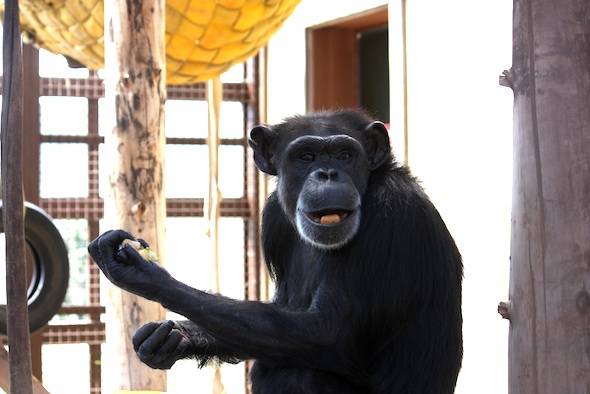
Negra:
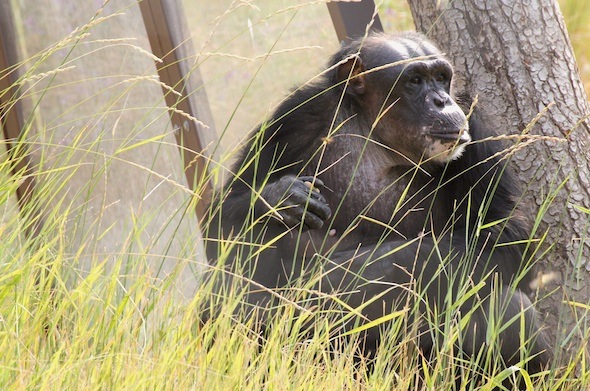
People often ask me who my favorite chimpanzee is. I don’t really like trying to pick one—and to be honest, I can’t. Each of the Cle Elum Seven are unique and awesome in their own way and I love them all. But I would say that I have the best relationship with Jamie. Sometimes, there are just different people that you “click” with a little more than others.
So, I wouldn’t want to say that Jamie is my favorite, but I definitely find that we spend more time together. Perhaps this is because Jamie is more human-oriented than the other chimps, and so we end up liking the same things. We also happen to share a birthday, which I think is pretty cool.
She likes to check out all of the caregivers’ shoes and boots, and we are more than happy to oblige. She loves to write and draw and use tools. I was thinking today about all the interesting and awesome things Jamie does on a day-to-day basis and what we have featured on our blog over the years, so I decided to compile a “best of” list.
As Katelyn described yesterday, Jamie occasionally likes to wear scarves or other clothing accessories. I love this blog post from awhile ago called “How to ruin a perfectly good scarf.” Fashion is important to Jamie, but sometimes playing can take precedence.
Speaking of playing, Foxie and Jamie are pretty great friends. Foxie is a total goof! Here’s a video from awhile ago of the two of them wrestling in a giant box:
I like this post from just a few months after the chimps arrived. We were still learning about all their personalities, and this captures Jamie’s fairly well.
Jamie also really likes to help us clean up. She will sometimes sit and watch us clean, as if she’s evaluating our work. As the Boss of the sanctuary, I suppose that is her job!
She’s also really good about testing out new things and making sure we’ve done things up to her standards. You could say she’s in charge of the quality control department at CSNW. She loves to also take new things apart using tools!

Probably one of the highlights of our day is when Jamie asks to go on a walk around the hill. This is the post where J.B. explains how we came to realize this is also Jamie’s highlight of the day!
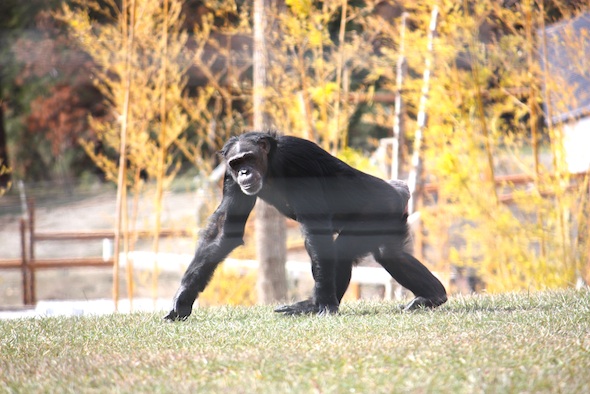
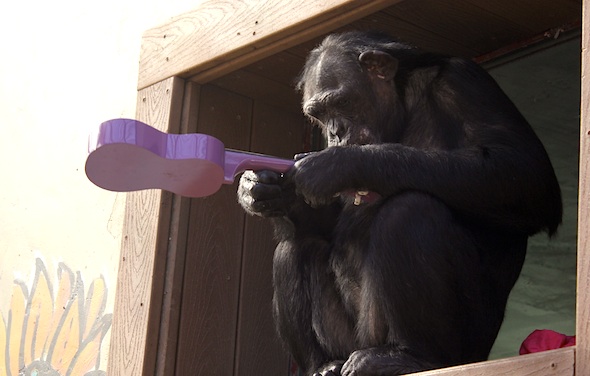
I also really love remembering the day we gave a ukulele to Jamie. She was thrilled! She treated it just like any of her other projects—investigate every possible piece of it!
It is sometimes hard to describe Jamie, and maybe that just speaks to her uniqueness. I love this blog where Diana explains that Jamie is, well, a complicated chimpanzee.
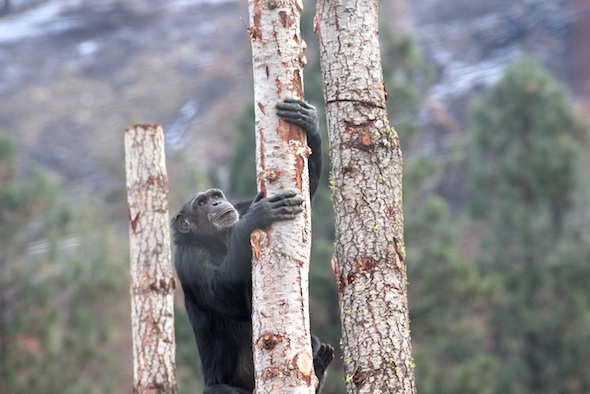
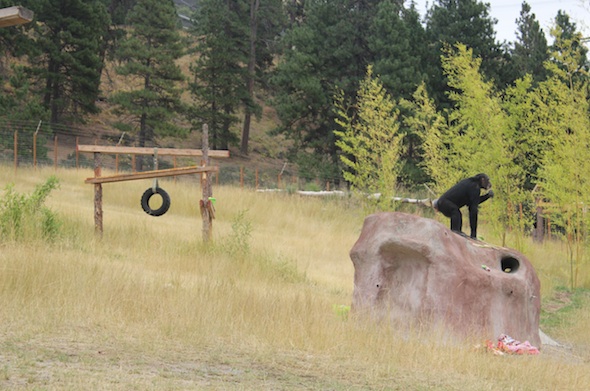
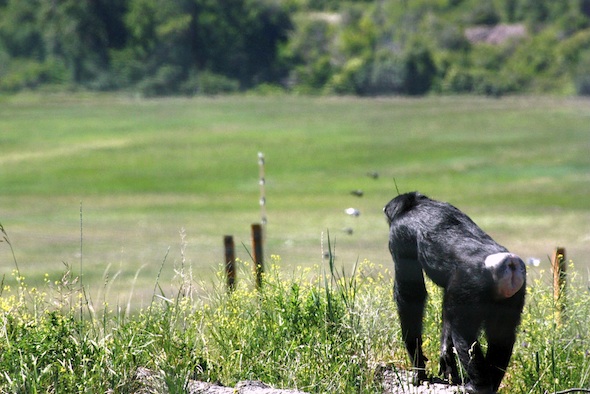
Finally, as we all know, Jamie is an artist. Here’s some retrospective posts on a few of her artistic endeavors:
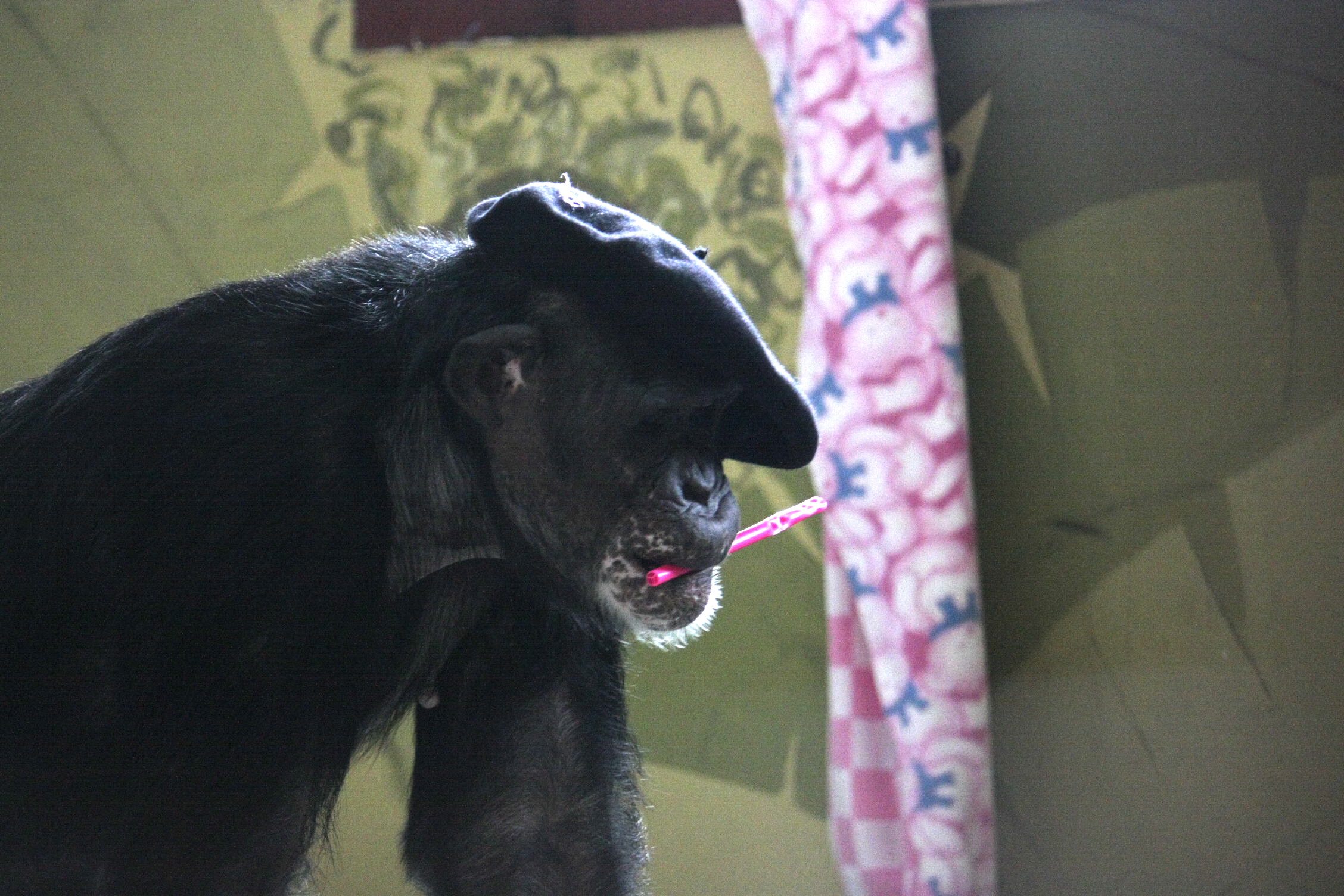
Jamie’s an artist! (June 21, 2008)
Jamie’s paintings (August 20, 2008)
Scribbling (September 9, 2008)
Jamie’s dexterity (April 1, 2009)
Jamie, the artiste (November 10, 2010)
Art (August 24, 2011)
Jamie’s letter to you (March 22, 2012)
Jamie’s artistic side (January 11, 2013)
Lend your vote to support Jamie’s wonderful mixed-media art in the HSUS Art Contest going on now until Thursday. You are permitted to vote once per day, so please keep voting for Jamie!
Most of our advocacy work focuses on issues close to home, like the entertainment industry, apes as pets, and biomedical research. As caregivers for the Cle Elum Seven, our expertise at CSNW lies in the plight of captive chimpanzees. We see the Cle Elum Seven as ambassadors for other chimpanzees that still are used in research or entertainment and deserve better.
We also see them as ambassadors for wild chimpanzees. They never got to experience the love from their mother, learning how to forage and use tools, and living in a large group of other wild chimpanzees. Though sadly, chimpanzees in the wild have problems of their own. Some are being hunted for their meat to be sold on the black market, some are losing their homes to human encroachment, and some are fighting for their lives after being caught—but not killed, by a snare trap.
Our guest blogger project aims at raising more awareness about these issues from the perspective of those that work in that environment, analogous to the CSNW staff’s expertise with chimpanzees in captivity. Dr. Zarin Machanda works in the Kibale National Park in Uganda, and we are thrilled to have her stories of her experience working with chimpanzees in the wild, just as we tell stories about the Cle Elum Seven. Here’s her introduction to the chimpanzees of Kanyawara.
—
Hi everyone! My name is Zarin Machanda and I’m going to do a few guest blog posts over here this summer. I know JB and Diana from when I volunteered at the Fauna Foundation. I have a very distinct memory of JB with a torn up t-shirt after an encounter with a grumpy ostrich! I’m still not sure what happened, but I think the ostrich won.
I left Montreal for Harvard where I have been studying wild chimpanzees in Uganda for the last 10 years. I’ll describe my research in another post but my main interest is understanding how and why social relationships develop. Today, I want to tell you about our field site and introduce you to some of our amazing chimpanzees. Many of the photos here were taken by Ronan Donavan, a friend and photographer who worked in Uganda for many months.
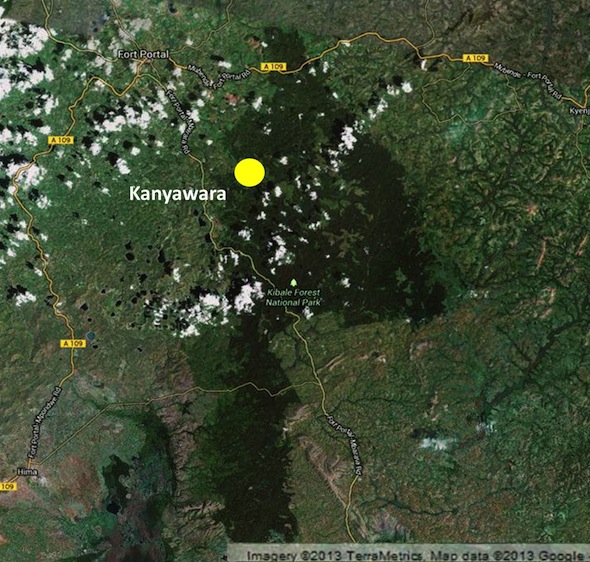
Satellite image of Kibale National Park with the Kanyawara chimpanzee community range in the northwest sector. Image courtesy of Google Maps.
I work for the Kibale Chimpanzee Project, a long-term research project studying the Kanyawara community of chimpanzees. They live in Kibale National Park in Uganda, a beautiful equatorial rainforest that is home to over 250 species of trees, over 325 species of birds and over 60 species of mammals, including 13 species of primates. This is one of the densest and most diverse populations of primates anywhere in the world and includes approximately 1500 wild chimpanzees (Pan troglodytes schweinfurthii).
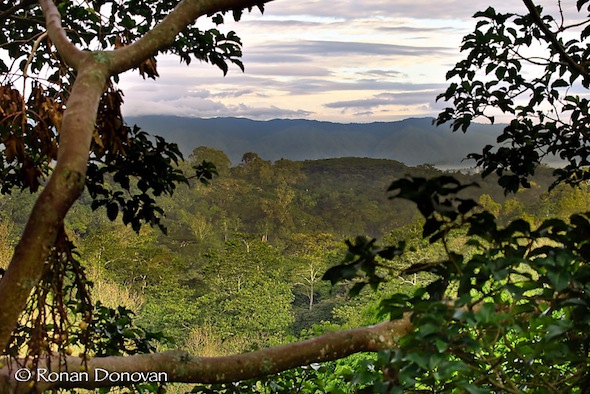
The canopy of Kibale National Park with the Rwenzori Mountains in the background. Photo courtesy of Ronan Donavan.
Every day, our field assistants and researchers enter the forest to follow the chimps and collect data on their behavior. We don’t have any physical contact with them—we just observe them, take notes about what they do, and collect samples of their urine and feces for later analysis. How do you collect urine from a chimp? Well you’ll have to come back later to find out!
All of our chimpanzees are given names and we can recognize them just as easily as we can tell each other apart. Every chimp research site has a different philosophy for naming chimps—some pick philosophers, others like jazz musicians but we like to name our individuals after important world figures and world events. For example, in the year 2000, we named a chimp Tuke (pronounced Two-kay)—get it?
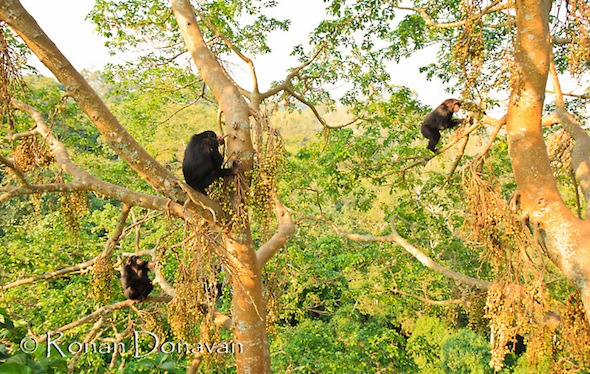
The Kanyawara chimpanzees feeding on figs. Photo courtesy of Ronan Donavan.
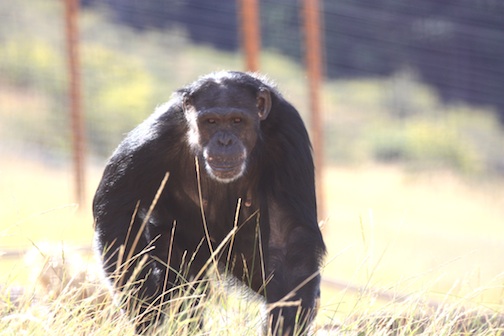
I wish I could tell you about all 53 of our chimps because each one is special in their own way, but I’ve chosen just a few for you to meet: Lanjo, Outamba, Max, Tsunami, and Tembo.
Lanjo was born in 1995. He is quite large for his age and he’s recognizable because his hair is light brown compared to the more typical black hair of the other chimps. He is not only handsome, but he is also loved by all the researchers and field assistants. Our alpha male, Kakama, recently passed away and we have been taking bets on who is going to take over. My money is on Lanjo although some other folks favor Eslom. Interestingly, these two couldn’t be more different—while Eslom is likely to display, chase everyone and generally cause chaos wherever he goes, Lanjo is as cool as a cucumber and just watches it all happen. That’s the kind of alpha that I would want and I have a feeling most of chimps would prefer cool over crazy! It’s going to be an interesting couple of months in our community since we know that changes in the hierarchy really shake up relationships among the males. Individuals jockey for position and need to figure out which of their friends will be most useful to them as they vie for dominance. Fingers and toes crossed for Lanjo, although Kakama will be greatly missed.
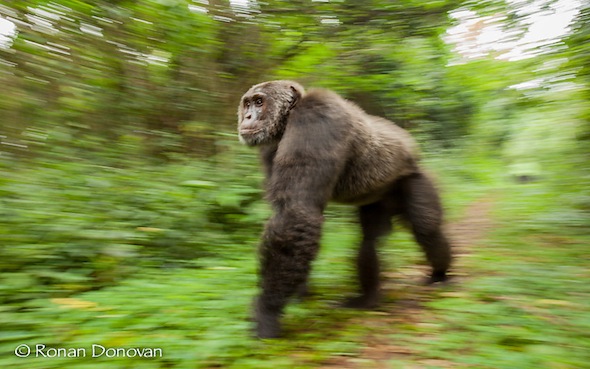
Lanjo showing off his muscles for the camera. Photo courtesy of Ronan Donavan.
Outamba is a high ranking female and is recognizable because of her narrow mouth and prominent brow. We think she is about 34 although it’s hard to know her exact age because females transfer into new communities during adolescence and we make educated guesses about their age. Outamba is Kanyawara’s baby-making machine! She has had 5 infants in 15 years—that’s one baby every 3 years compared to the average female who generally has one baby every 5-6 years. It’s even more impressive that all of Outamba’s babies have survived, so she’s not just making babies quickly but she’s doing a great job of taking care of them too. We think she is such a successful mother because as a high-ranking female, she has access to the areas of the highest quality food. For mammals, more food means more babies and higher infant survival rates—so Outamba must be eating well.
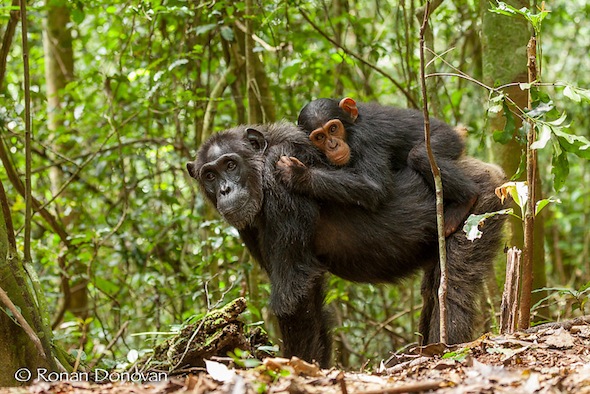
Outamba carrying her youngest daughter Gola on her back. Photo courtesy of Ronan Donavan.
Max is one of our shy individuals and we don’t see him very often because he prefers to stay near his mother in a remote part of the Kanyawara range. This is unusual for an adolescent male because as he grows up he should spend more time with the adult trying to integrate into the male dominance hierarchy. Max’s odd behavior most likely stems from the fact that he lost both of his feet to wire snares set by poachers when he was younger. I’ll write more about these snares and our conservation efforts in another post, but they affect our young chimps more often than adults because these guys barrel through the forest without looking where they are going. Another reminder that baby chimpanzees and baby humans are very similar. Despite these injuries, Max is a trooper! He can still climb trees like a champ and has survived for a number of years without his feet.
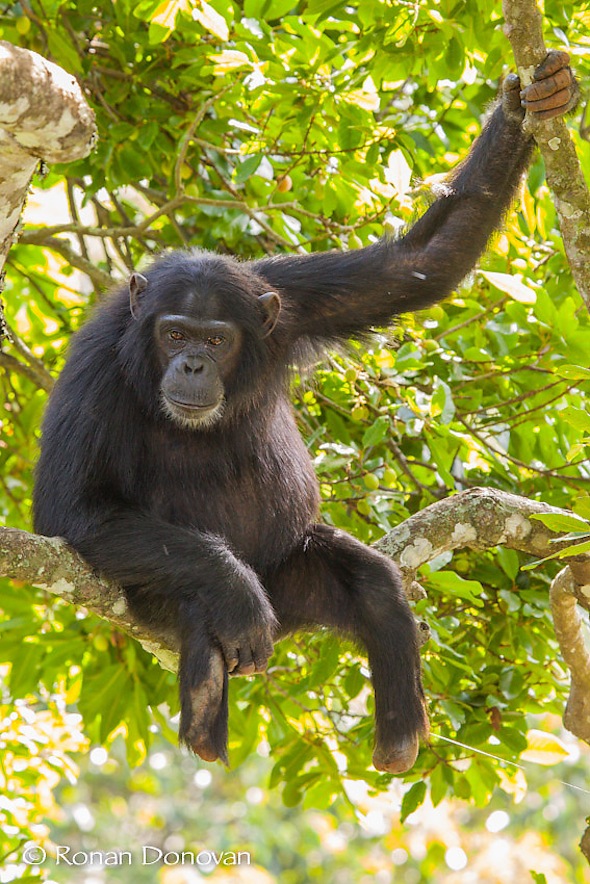
Max sitting in a tree. He lost both his feet to wire snares. Photo courtesy of Ronan Donavan.
Tsunami was born in January of 2005. Her mother is Tongo and she is Lanjo’s younger sister. Right now, her face is still pink with a few dark freckles but this will change as she gets older and her face darkens. Like our other young chimps, Tsunami likes playing with objects such as rocks and sticks and she will even carry these things around for days. She is often seen playing with and trying to carry her siblings. In 2011, tragedy struck when Tsunami’s baby sister, Teddy, died after accidentally falling out of a tree. Tongo couldn’t carry the body and had to leave it on the ground but Tsunami stayed with Teddy and even tried carrying her—it was heartbreaking. I think Tsunami is going to make a great mom when she grows up—she certainly has a good role model in Tongo and she is one amazing big sister.
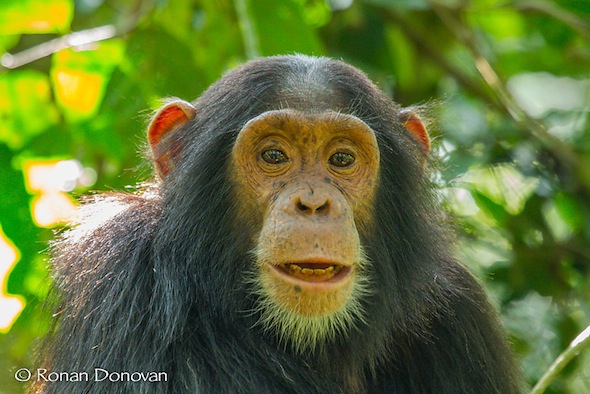
Tsunami, one of our juvenile females. Photo courtesy of Ronan Donavan.
At 1.5 years, Tembo is one of our youngest chimpanzees. We gave him the Swahili word for elephant as a name, because he was born the same day that elephants came to camp and knocked over a tree. Tembo is a special guy because he is not only the son of Tenkere but also the grandson of Outamba. Since female chimpanzees are supposed to transfer to new communities at adolescence, it’s unusual to have maternal grandmothers in a group. We’re not sure why Tenkere decided to stay but it is likely that it’s because she also has access to high quality food like her mom, which she may not have as a new immigrant to another community. Not leaving may end up being a poor choice because Tenkere is genetically related to many of the males in the group. We’ll have to keep an eye on Tembo and get DNA samples from him to do a paternity test. But, so far he seems healthy and playful and he has quite a family looking out for him. I’m hoping he lives up to his name—big and strong and able to knock over trees.
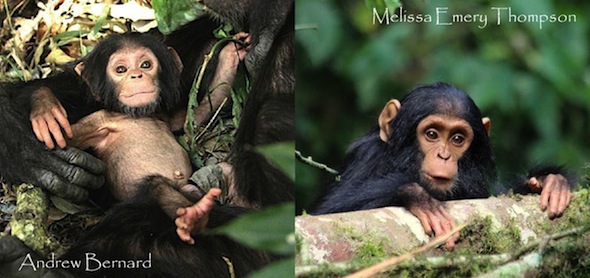
(Left) Newborn Tembo lying with his mother Tenkere. Even as a newborn he had sideburns just like his mother. (Right) Tembo at 1.5 years of age. Photos courtesy of Andrew Bernard and Melissa Emery Thompson, respectively.
Well that’s all for now. Next time, I’ll describe a little bit more about my research and some of the other projects that we are working on. In the meantime, please check out our website for more news from the field.
Chimps have amazing lips. They’re called “prehensile” which means they actually can grab things with their lips. (That word might be familiar… you may have heard of some monkey species with prehensile tails, and they can grab things and hang from things with their tail).
Because of this super awesome trait, chimps use their lips for everything. Wouldn’t you? They turn pages of magazines with their lips, open packages, and Foxie even “vacuums” the floor with her lips when collecting a sunflower seed forage after playroom cleaning.
Their teeth are also very strong, and can bite things open like whole nut shells. Can you imagine breaking open a brazil nut with your teeth? It’s really impressive, but yet another reason they like to use their mouths to manipulate things.
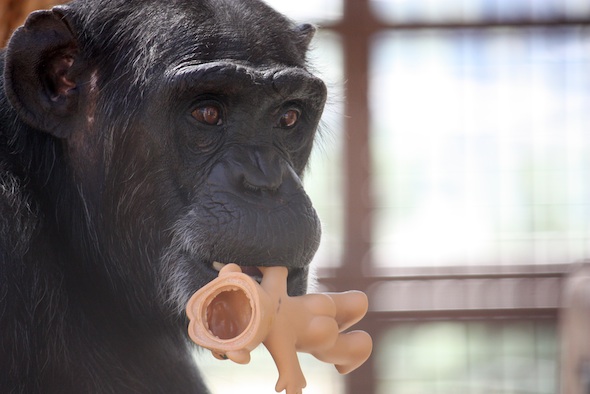
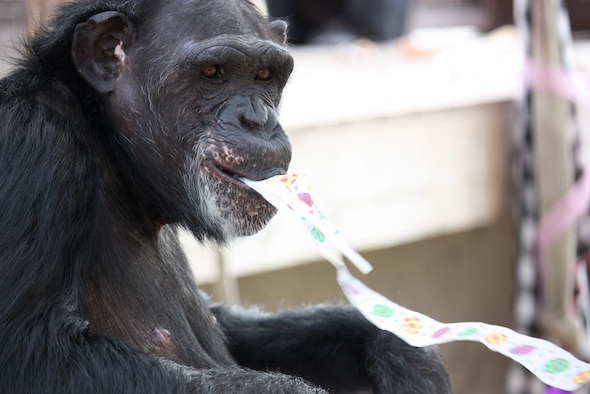
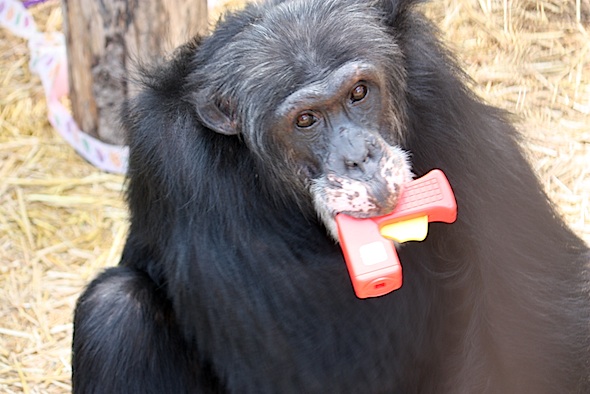
Often times the chimps carry things in their mouths, such as toys, blankets, and of course food. I found these photos taken in the last couple weeks that demonstrate the variety of things we see the mouths of the chimps.
Foxie carrying one of her troll dolls in her mouth:
Jamie using her lips to tear some streamers down from Foxie’s recent birthday party:
Burrito especially has a tendency to manipulate things in his mouth. Here was his toy of choice a few days ago:
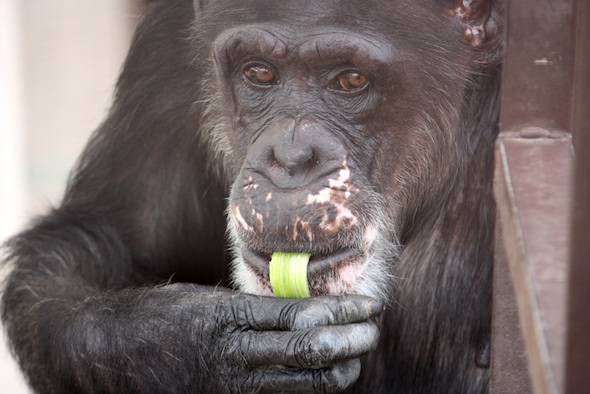
And of course, food is the most common thing the chimps manipulate with their mouths. Here’s Missy stripping some celery like it’s string cheese:
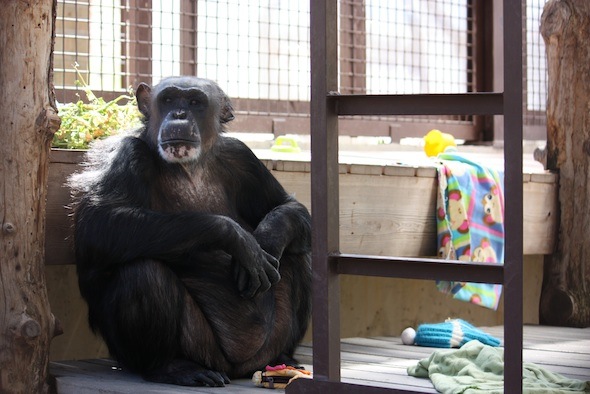
Some of you may have seen this photo posted on our Facebook page yesterday, but if you missed it—here it is. Sure to make anyone smile!
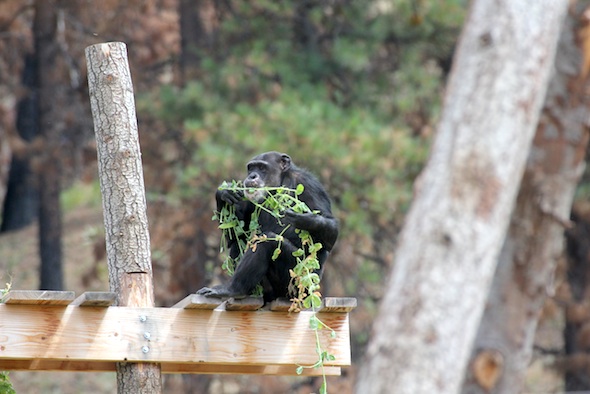
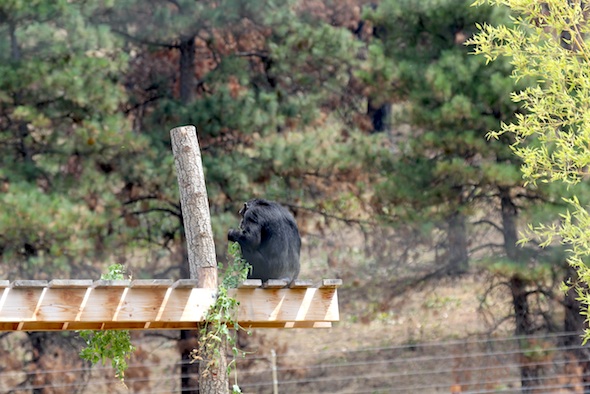
Today we put out a lunch forage which included peas, as well as the pea shoots and tendrils which the chimps love! Missy gathered some up:
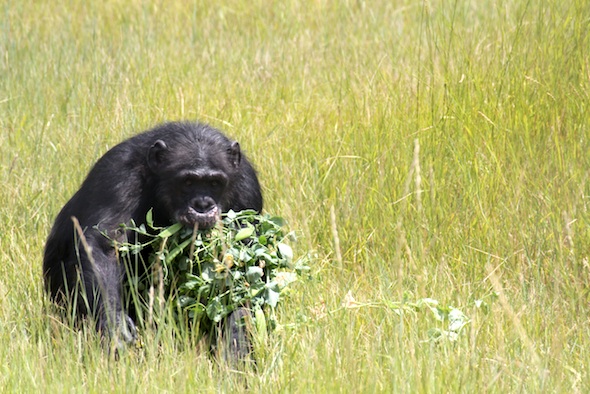
and went to a nice high spot to munch on them. I love the vast space they have on Young’s Hill—this really captures that.
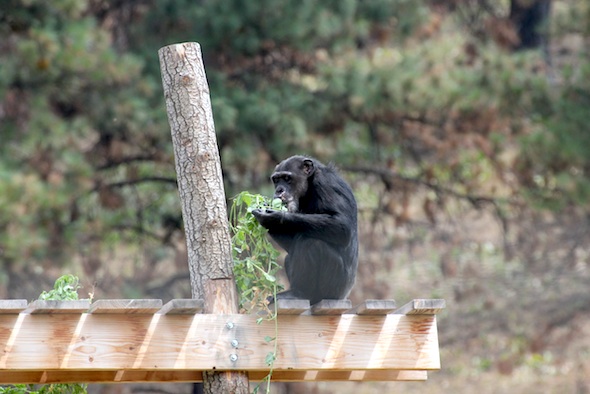

As if that didn’t brighten your day enough, here’s a photo that’s sure to make you laugh of Annie: