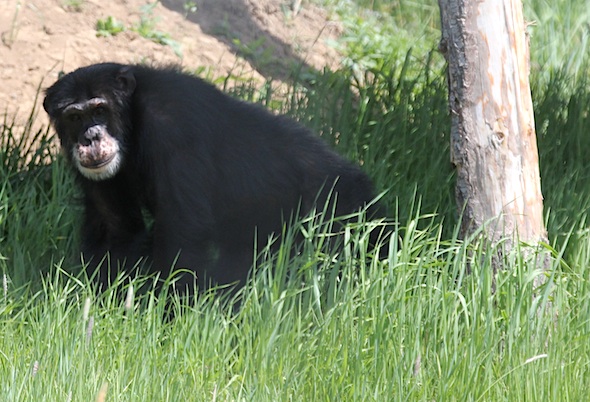
Sunny summer days are amazing, but so is getting to relax in some cool shade.
Chimpanzee Sanctuary Northwest
Hope. Love. Home. Sanctuary
Sunny summer days are amazing, but so is getting to relax in some cool shade.
One of our goals as a sanctuary is to give the chimps as much independence and autonomy as we can, given the inherent limitations of captivity. So we’re thrilled to see them finding their own food on Young’s Hill. Right now, their favorites include grass, dandelion leaves, and prickly lettuce. There are two bamboo groves on the hill, but the chimps haven’t taken much of an interest in eating them as of yet (climbing them is a different story). Of course, none of this will take the place of the meals we serve throughout the day, but it’s nice that the chimps can head out and grab a light snack whenever they want.
Recently, an infant chimpanzee at the L.A. Zoo was killed by an adult member of the troop in full view of zoo visitors. A few days later, a student volunteering at the Chimp Eden sanctuary in South Africa was pulled into an enclosure and attacked by two adult male chimpanzees. Both incidents served as startling reminders of the capacity for violence in our closest relatives and have left many people wondering what makes chimpanzees commit such severe acts of aggression.
Unfortunately, while incidents like these are rare, they are not abnormal. Put simply, violence is a fact of life in chimpanzee society. While males typically grab all the attention with their aggressive dominance struggles and their lethal intergroup raids, females also kill on occasion, with infants and other adult females being their most likely victims. In chimpanzee communities, severe aggression can be a means to reduce or prevent resource competition. This can result in the killing of members of other communities, as well as immigrant females and even infants within the troop. In some cases, the killing of an infant can increase mating opportunities for males. For instance, if a female gives birth, she will not enter estrus for another four to five years while she nurses and raises her new child. If that child dies, however, she will quickly become receptive again. Thus, there can be an incentive for a male who is not the parent to kill the infant so that he can mate with the mother (this is one reason primatologists believe that females may try to confuse paternity).
Violent behavior can serve many functions in chimpanzee society. What functions did these incidents at the L.A. Zoo and Chimp Eden serve? Honestly, we don’t know. It’s much easier to offer an evolutionary explanation for why violence exists in general than it is to explain specific acts.
As caregivers for captive chimpanzees, we witness aggressive behavior on a daily basis. Sometimes the motivation behind it is clear; other times we are left scratching our heads. The way I think about it is this: evolution has endowed chimpanzees with certain tendencies for aggressive behavior, but it does not control how those tendencies are applied. Aggression towards non-group members in the wild can help chimpanzees defend territory and the resources located therein. But that same aggressive tendency can also result in an attack on the very people trying to care for them in captivity.
All we really know is that violence in chimpanzees is not an aberration, nor is it all they are capable of. In fact, one of the reasons why we might be uncomfortable with chimpanzee violence is that it hits a little too close to home. To be sure, aggression in chimpanzees is shocking in its sheer physicality – teeth and fists instead of knives and guns. But even though chimpanzees exhibit higher rates of aggression overall, rates of lethal violence in chimpanzees are similar to those in some human societies. In some ways, we are more alike than we’d like to believe.
One of the things that I like about the GoPro camera is that you can hear some of the sounds that the chimps are making when they are way out on the hill. In this video, you can hear food grunts from Jamie and Jody and of course a couple of Burrito’s famous food squeaks.
You can also hear Foxie’s breathy panting as she reassures Burrito. Chimps will often reassure one another with vocalizations like this, as well as through touch and embrace, when the potential for conflict exists. If there is a limited resource, like nuts and seeds spread on the ground on Young’s Hill, the chimps will sometimes try to make nice before a conflict erupts over who stole food from whom, in an effort to prevent this kind of conflict. Normally, the chimp receiving the reassurance would provide some sort of acknowledgement, but that’s not Burrito’s style – he prefers to close his eyes and pretend that uncomfortable situations don’t exist.
The chimps are able to find plenty of native plants to eat on Young’s Hill but they still love cattails, which only grow by the edge of the pond on the sanctuary grounds. So once and a while we cut some down and hide them throughout their enclosure.
The Cle Elum Seven are fortunate to have a huge family of supporters from around the world. We are touched by how much you have grown to care about each of them, so we want to share with you some news about Burrito’s health.
We have recently started treating Burrito for congestive heart disease. In basic terms, his heart is not working as efficiently as it once did and as a result, his body has begun to accumulate fluids. While this sounds frightening, don’t be alarmed. Congestive heart disease is a chronic condition and with proper care it can often be managed quite successfully. We believe that we have caught it early, so that will be an advantage in his treatment.
CSNW has an amazing team of veterinarians overseeing Burrito’s care and we are working closely with other chimpanzee veterinarians with experience in treating this condition, so he is in great hands. I can assure you that at this point, Burrito is as happy and full of energy as he has ever been. We will of course do all we can to make sure he stays that way.
Below you will find a list of questions and answers to help explain things in more detail. If you have any questions that are not answered here, please feel free to leave a comment on this post or send us an email and we will do our best to answer it for you.
Thank you for being such an important part of Burrito’s family.
…
What is congestive heart disease?
Congestive heart disease is a condition in which the heart can not pump
blood efficiently enough to take care of the body’s needs. In response,
the body has difficulty expelling fluid and becomes “congested,”
particularly in the extremities.
What are the symptoms of congestive heart disease?
In chimpanzees, the most common initial symptom is swelling (edema). In
Burrito’s case, the first and at this point only sign of visible
swelling was in the scrotum. Other symptoms may include shortness of
breath, weakness, fatigue, and coughing due to fluid in the lungs.
Why do chimpanzees get heart disease?
In chimpanzees, heart disease includes both congestive heart disease and
idiopathic cardiomyopathy, in which the heart muscle becomes enlarged,
fibrous, or rigid. Heart disease is the leading cause of death in
captive chimpanzees. One study found that 68% of all chimpanzees
examined during necropsy at a large laboratory in the United States
showed evidence of heart disease. No one can say definitively at this
point why the prevalence of heart disease is so great in chimpanzees,
but it is most likely influenced by a combination of genetics, diet,
inactivity, and chronic stress.
What is CSNW doing to treat Burrito’s illness?
As is the case with humans, the best treatment for heart disease
includes a combination of medication, diet, and exercise. Burrito is
currently on medications that will help to improve his heart function
and eliminate excess fluid. The chimps at CSNW have always been on a
no-salt diet due to the general risk of heart disease in chimpanzees,
and that will continue. And with the opening of Young’s Hill last fall,
Burrito’s activity levels have increased even further since his days in
a laboratory cage.
What is Burrito’s prognosis?
Burrito’s care is being discussed and overseen by many of the world’s
best great ape veterinarians. We believe that we have caught Burrito’s
illness in its early stages. This, combined with medication, proper
diet, and exercise, should allow Burrito to enjoy many more years at
Chimpanzee Sanctuary Northwest.
Does Burrito’s illness cause him any pain or stress?
At this point, Burrito is not showing any signs of illness besides
swelling. In fact, he is happier and more playful now than he has been
in many months.

In celebration of Negra’s 39th birthday and the 4th anniversary of the chimps’ arrival at the sanctuary, we take a look back on the journey that brought Negra to us.
Thank you for all that you do to help us provide a home for Negra and her family.
(This video is narrated so you will need to turn your volume up)