• Skip to main content
  • Skip to primary sidebar
  • Skip to footer

Chimpanzee Sanctuary Northwest

Hope. Love. Home. Sanctuary

  • Our Family
    • The Chimpanzees
    • The Cattle
  • Blog
  • About Us
    • Visiting the Sanctuary
    • Philosophy
      • FAQs
      • Mission, Vision & Goals
      • Privacy Policy
    • The Humans
      • Staff
      • Board of Directors
      • Founder
    • Annual Reports
    • The Future of CSNW
    • CSNW In The News
  • You can help
    • Donate
      • Become a Chimpanzee Pal
      • Sponsor A Day
      • Transfer Stock
      • Be A Produce Patron
      • Be a Bovine Buddy
      • Give from your IRA
      • Personalized Stones
      • Bring Them Home Campaign
    • Leave A Legacy
    • Employment Opportunities
    • Volunteer
    • See Our Wish List
    • Events
  • Resources
    • About Chimpanzees
    • Enrichment Database
    • Advocacy
      • Advocacy Action Center
      • Apes in Entertainment
        • Trainers
        • Role of the AHA
        • Greeting Cards
      • Chimpanzees as Pets
      • Roadside Zoos
      • Chimpanzees in Biomedical Research
      • Conservation
        • African Apes
        • Orangutans
  • Shop
    • Merchandise Store
  • Contact
  • DONATE NOW

Archives for August 2013

Jamie’s creative expression

August 19, 2013 by Katelyn

Like most artists, Jamie chooses to express her creative mind in a variety of ways. Jamie spent the first nine years of her life living with a human as a “pet” and being used in the entertainment industry. While we know virtually nothing about this time in Jamie’s life, she often chooses to engage in human oriented activities, most likely as a result of her unnatural childhood. For example, today Jamie chose to arrive for lunch wearing a red bandana tied around her neck (which she untied and re-adjusted half way through her meal). While we certainly do not advocate for chimpanzees being dressed in clothing, here at CSNW we do try to offer a variety of enrichment (including clothing) to accommodate their individuals interests. If the chimpanzees want to wear things, tear them up, play tug-o-war, make a nest with them, or ignore them, it’s their choice. Choice being the key word here. We recognize that each of the chimpanzees have unnatural histories which have influenced their individual interests and that plays a key role in developing individualized enrichment to keep their intelligent minds active.

web_Jamie_wearing_bandana_eating_greenpepper_lunch_GH_ls_IMG_1316

Notice the perfect knot Jamie incorporated into her bandana!

web_Jamie_wearing_bandana_closeup_profile_GH_ls_IMG_1328

Jamie chooses to wear clothing less and less since arriving at the sanctuary. While we want Jamie and her family to be able to engage in whatever interests them, it also thrills us to see their unique “chimpanzee-ness” coming out more and more. For Jamie, that sometimes still means wearing a bandana to lunch, patrolling the perimeter of Young’s Hill with her cowgirl boot, and occasionally drawing and painting when there is no “business” to take care of as Boss of the sanctuary. And that’s what sanctuary is all about, choices and the ability to express one’s self as one wants. And the art of expressing herself as she wants is something Jamie is a true artist at.

web_Jamie_wearing_bandana_looking_at_camera_cling_on_caging_GH_ls_IMG_1337

If you haven’t cast your vote for Jamie’s artwork yet in the Humane Society’s chimpanzee-only art contest, please do so now! It’s a wonderful way to help our artist-in-residence and her chimpanzee family!

Filed Under: Art, Enrichment, Fundraising, Jamie, Sanctuary Tagged With: advocacy, animal protection, animal rescue, Animal Welfare, chimpanzee rescue, chimpanzee retirement, chimpanzee sanctuary, Chimpanzee Sanctuary Northwest, Cle Elum 7, Cle Elum Seven, csnw, Enrichment, Fundraising, Jamie, Sanctuary

Engaging the mind, body, and spirit

August 18, 2013 by Lisa

One of the most challenging and rewarding responsibilities of care-giving for chimpanzees in captivity is, I think, coming up with activities and enrichment ideas that are engaging and satisfactory for the chimpanzee mind. Keeping them busy is a full-time job (just ask enrichment coordinator and caregiver, Debbie). Luckily we don’t have to come up with ideas in the dark. Each chimpanzee has individual inclinations about how to spend their days in sanctuary and, as I come to know them better, I can accommodate those preferences more easily.

As you may be aware by now, Jamie does like to create art. But Jamie’s not just an artist. Her mind is so active that she comes up with a myriad of ways to entertain herself. In particular, Jamie is often actively engaged in her environment. She will take the time to inspect any and every new or unusual thing in and around her home. If there is something different at the sanctuary, Jamie will know and make sure it’s been thoroughly investigated and properly dealt with (if necessary). There is a lot of work that goes into being the boss! Good thing she gets the time to relax and create art in between all her other responsibilities.

If you’d like a quick and easy way to help enrich the chimpanzees make sure you’ve voted for Jamie’s artwork in the chimpanzee-only art contest sponsored by the Humane Society of the United States.

web_jamie draw art write pen paper pr IMG_1979

In the meantime, check Jamie out as she checks out the world around her.

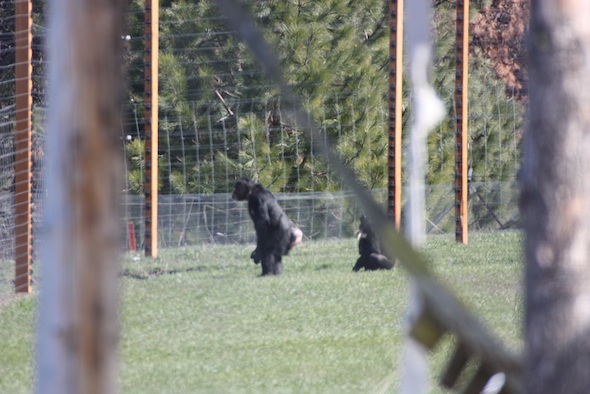
Jamie & Missy spying on the neighbors (as previously seen on our Facebook page):
web_missy jamie bipedal spy on neighbors top of yh IMG_1245

Jamie inspects the camera mount on Young’s Hill:
web_Jamie green grass camera mount Young's Hill YH IMG_8013

Jamie inspects the donors’ sign on Negra’s cabin:
web_Jamie look at cabin donors sign Negras cabin YH IMG_6773

Jamie checks the grass on Young’s Hill:
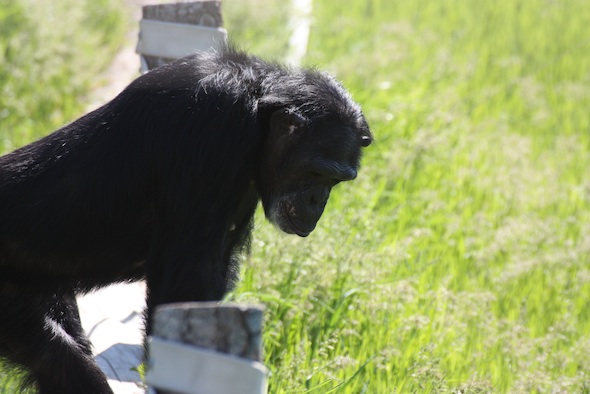
web_Jamie stand log bridge look at grass Young's Hill YH IMG_1847

Filed Under: Art, Caregivers, Fundraising, Jamie, Sanctuary Tagged With: Animal Welfare, chimpanzee rescue, chimpanzee retirement, chimpanzee sanctuary, Chimpanzee Sanctuary Northwest, Cle Elum 7, csnw, Jamie

Jamie’s Brain

August 17, 2013 by Diana

You know that whole thing about right brain vs. left brain and people identifying themselves as one or the other? Well, Jamie seems to be ambidextrous-brained. You know she’s an artist because you’ve been voting for her piece in the chimp art contest every day this week, right?

Her left brain side is pretty strong, though. As J.B.’s video demonstrated yesterday, Jamie is a skilled tool user. And she loves to solve puzzles. Just watch her solve a puzzle that the human’s created for her recently:

Filed Under: Enrichment, Jamie, Sanctuary Tagged With: Art, chimp, chimpanzee, contest, csnw, intelligence, Jamie, problem solve, Sanctuary, tool use

Tool Use and the Termite Mound

August 16, 2013 by J.B.

web Missy tool use treat rock peanut butter sticks youngs hill IMG_0052

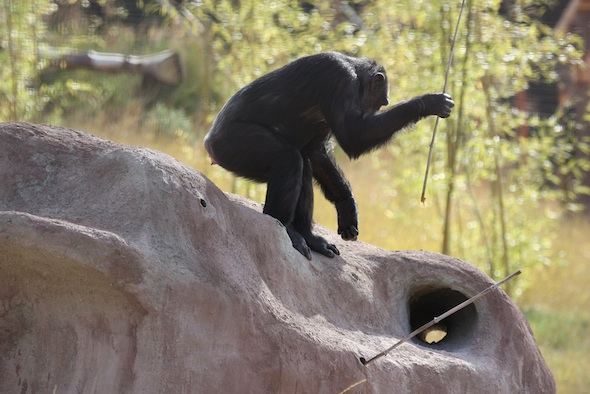
Jane Goodall’s research was ground-breaking in many ways, but one of her most important discoveries was that chimpanzees possess the ability to use tools. At the time, it was thought that tool use was a defining characteristic of the human species. But shortly after she began studying the chimpanzees of Gombe, Dr. Jane saw them using sticks to fish termites out of their nests. When she reported her findings to her mentor, Louis Leakey, he famously wrote, “Now we must redefine tool, redefine Man, or accept chimpanzees as humans.”

Over the last 50 years, primatologists have discovered that the use of tools to “fish” for termites and ants is even more complex than had originally been thought. Chimpanzees have been observed bringing “tool kits,” containing a variety of tools for different purposes, to the nests. For example, some tools are used specifically to perforate the nests of army ants. Breaking nests open by hand tends to result in an aggressive counter-attack by the ants, and may even cause them to relocate the nest. Using the perforating tool results in a less painful experience and allows for the harvesting of the ants to be sustainable. Other tools are used specifically for dipping into the nest, and their size and shape, as well as the technique for ingesting the insects once they are caught, are influenced by the behavior of the insects being harvested. And all of these techniques are influenced by culture, which is to say that they are learned and not determined by genetics and environment alone. They differ from community to community, as each community has its own set of knowledge and traditions.

When we built Young’s Hill, the Young’s provided the funds for us to build an artificial termite mound. The mound is actually hollow and consists of concrete laid over a rebar framework. Stainless steel tubes protrude through the concrete, and we can climb in and attach PVC tubes filled with food treats on the inside. The mound also protects critical irrigation components for the bamboo groves.

Most captive chimpanzees, having been raised outside of the cultures found in free-living communities, do not consider insects to be food. So we stick with what they enjoy – in this case, frozen banana mixed with peanut butter and almond milk.

If you’re impressed with Jamie’s tool-using abilities, vote for her in the Humane Society of the United States’ chimpanzee art contest.

Filed Under: Chimpanzee Behavior, Enrichment, Jamie, Sanctuary, Young's Hill Tagged With: ant, chimpanzee, dipping, northwest, rescue, Sanctuary, termite mound, tool use

Jamie’s sunflower seed painting

August 15, 2013 by Diana

So, by now you hopefully know that Chimpanzee Sanctuary Northwest’s chimpanzee boss-lady Jamie is entered in this very unique chimpanzee-only art contest sponsored by the Humane Society of the United States.

You can and should vote for her piece every day until the contest ends on August 22nd at 5:00 ET. The sanctuary that cares for the winning chimpanzee will receive a $10,000 grant from HSUS!

If you aren’t on our e-news list (which you can remedy by signing up here), or if you missed the email sent out yesterday, below is the video we shared of Jamie during the session where she created her mixed media masterpiece that is in the contest.

There are many things that I like about this video and Jamie’s approach. In particular, I like the way she carefully applies the paint to the sunflower seed shell with her finger and the way she wipes off her hands when she’s done. These are classic Jamie things to do.

I hope you appreciate the effort she put into her art and give her your vote! The voting website even allows you to be reminded to vote each day by texting CHIMPART TO 30644 (message and data rates may apply).

In other good news, MSN shared this video on their page today!

Filed Under: Art, Enrichment, Jamie, Sanctuary Tagged With: Art, chimp, contest, csnw, grant, hsus, Jamie, northwest, paint, Sanctuary

Meet the Chimpanzees of Kanyawara

August 15, 2013 by Debbie

Most of our advocacy work focuses on issues close to home, like the entertainment industry, apes as pets, and biomedical research. As caregivers for the Cle Elum Seven, our expertise at CSNW lies in the plight of captive chimpanzees. We see the Cle Elum Seven as ambassadors for other chimpanzees that still are used in research or entertainment and deserve better.

We also see them as ambassadors for wild chimpanzees. They never got to experience the love from their mother, learning how to forage and use tools, and living in a large group of other wild chimpanzees. Though sadly, chimpanzees in the wild have problems of their own. Some are being hunted for their meat to be sold on the black market, some are losing their homes to human encroachment, and some are fighting for their lives after being caught—but not killed, by a snare trap.

Our guest blogger project aims at raising more awareness about these issues from the perspective of those that work in that environment, analogous to the CSNW staff’s expertise with chimpanzees in captivity. Dr. Zarin Machanda works in the Kibale National Park in Uganda, and we are thrilled to have her stories of her experience working with chimpanzees in the wild, just as we tell stories about the Cle Elum Seven. Here’s her introduction to the chimpanzees of Kanyawara.

—

Hi everyone! My name is Zarin Machanda and I’m going to do a few guest blog posts over here this summer. I know JB and Diana from when I volunteered at the Fauna Foundation. I have a very distinct memory of JB with a torn up t-shirt after an encounter with a grumpy ostrich! I’m still not sure what happened, but I think the ostrich won.

I left Montreal for Harvard where I have been studying wild chimpanzees in Uganda for the last 10 years. I’ll describe my research in another post but my main interest is understanding how and why social relationships develop. Today, I want to tell you about our field site and introduce you to some of our amazing chimpanzees. Many of the photos here were taken by Ronan Donavan, a friend and photographer who worked in Uganda for many months.

map

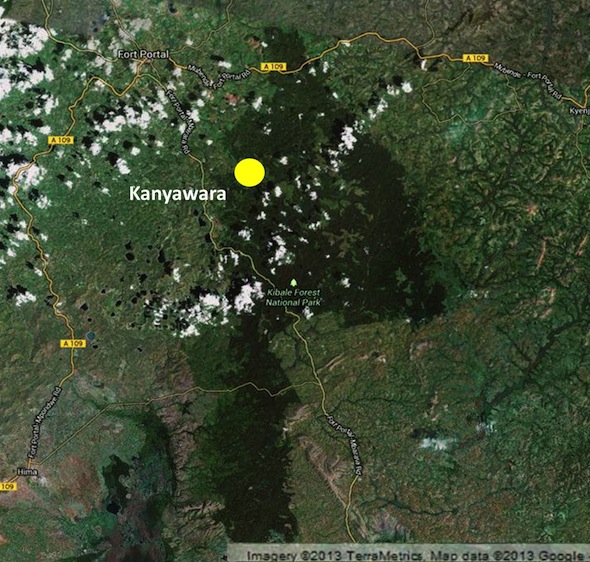
Satellite image of Kibale National Park with the Kanyawara chimpanzee community range in the northwest sector. Image courtesy of Google Maps.

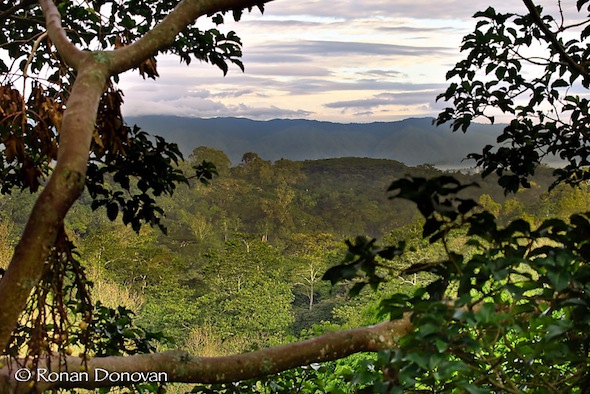
I work for the Kibale Chimpanzee Project, a long-term research project studying the Kanyawara community of chimpanzees. They live in Kibale National Park in Uganda, a beautiful equatorial rainforest that is home to over 250 species of trees, over 325 species of birds and over 60 species of mammals, including 13 species of primates. This is one of the densest and most diverse populations of primates anywhere in the world and includes approximately 1500 wild chimpanzees (Pan troglodytes schweinfurthii).

kanyawara

The canopy of Kibale National Park with the Rwenzori Mountains in the background. Photo courtesy of Ronan Donavan.

Every day, our field assistants and researchers enter the forest to follow the chimps and collect data on their behavior. We don’t have any physical contact with them—we just observe them, take notes about what they do, and collect samples of their urine and feces for later analysis. How do you collect urine from a chimp? Well you’ll have to come back later to find out!

All of our chimpanzees are given names and we can recognize them just as easily as we can tell each other apart. Every chimp research site has a different philosophy for naming chimps—some pick philosophers, others like jazz musicians but we like to name our individuals after important world figures and world events. For example, in the year 2000, we named a chimp Tuke (pronounced Two-kay)—get it?

canopy

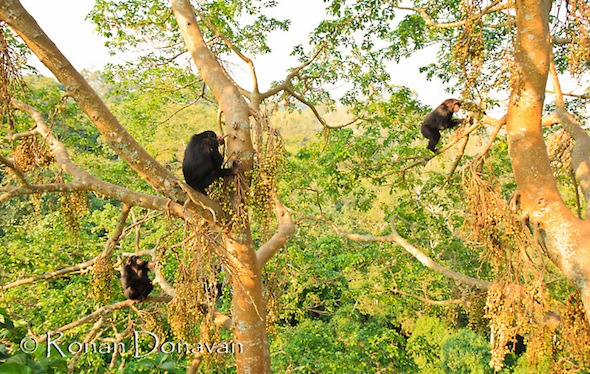
The Kanyawara chimpanzees feeding on figs. Photo courtesy of Ronan Donavan.

I wish I could tell you about all 53 of our chimps because each one is special in their own way, but I’ve chosen just a few for you to meet: Lanjo, Outamba, Max, Tsunami, and Tembo.

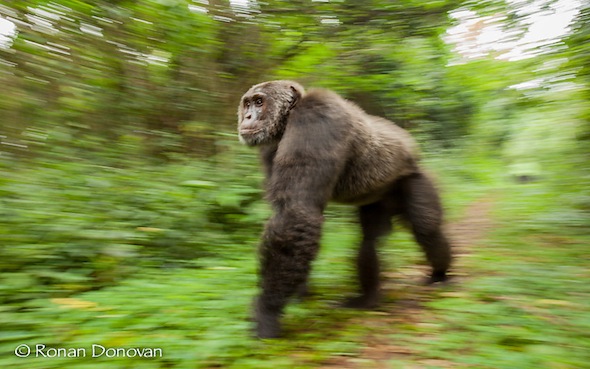
Lanjo was born in 1995. He is quite large for his age and he’s recognizable because his hair is light brown compared to the more typical black hair of the other chimps. He is not only handsome, but he is also loved by all the researchers and field assistants. Our alpha male, Kakama, recently passed away and we have been taking bets on who is going to take over. My money is on Lanjo although some other folks favor Eslom. Interestingly, these two couldn’t be more different—while Eslom is likely to display, chase everyone and generally cause chaos wherever he goes, Lanjo is as cool as a cucumber and just watches it all happen. That’s the kind of alpha that I would want and I have a feeling most of chimps would prefer cool over crazy! It’s going to be an interesting couple of months in our community since we know that changes in the hierarchy really shake up relationships among the males. Individuals jockey for position and need to figure out which of their friends will be most useful to them as they vie for dominance. Fingers and toes crossed for Lanjo, although Kakama will be greatly missed.

lanjo

Lanjo showing off his muscles for the camera. Photo courtesy of Ronan Donavan.

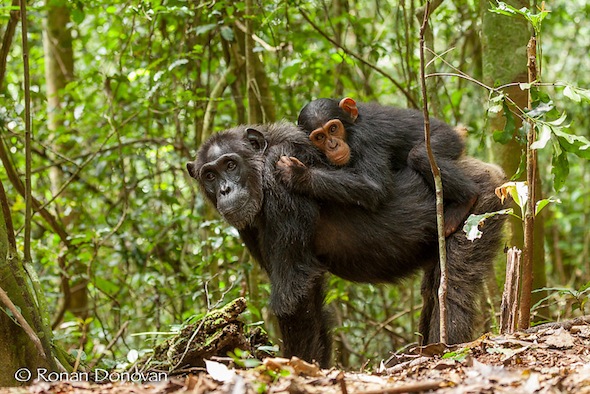
Outamba is a high ranking female and is recognizable because of her narrow mouth and prominent brow. We think she is about 34 although it’s hard to know her exact age because females transfer into new communities during adolescence and we make educated guesses about their age. Outamba is Kanyawara’s baby-making machine! She has had 5 infants in 15 years—that’s one baby every 3 years compared to the average female who generally has one baby every 5-6 years. It’s even more impressive that all of Outamba’s babies have survived, so she’s not just making babies quickly but she’s doing a great job of taking care of them too. We think she is such a successful mother because as a high-ranking female, she has access to the areas of the highest quality food. For mammals, more food means more babies and higher infant survival rates—so Outamba must be eating well.

outamba

Outamba carrying her youngest daughter Gola on her back. Photo courtesy of Ronan Donavan.

Max is one of our shy individuals and we don’t see him very often because he prefers to stay near his mother in a remote part of the Kanyawara range. This is unusual for an adolescent male because as he grows up he should spend more time with the adult trying to integrate into the male dominance hierarchy. Max’s odd behavior most likely stems from the fact that he lost both of his feet to wire snares set by poachers when he was younger. I’ll write more about these snares and our conservation efforts in another post, but they affect our young chimps more often than adults because these guys barrel through the forest without looking where they are going. Another reminder that baby chimpanzees and baby humans are very similar. Despite these injuries, Max is a trooper! He can still climb trees like a champ and has survived for a number of years without his feet.

max

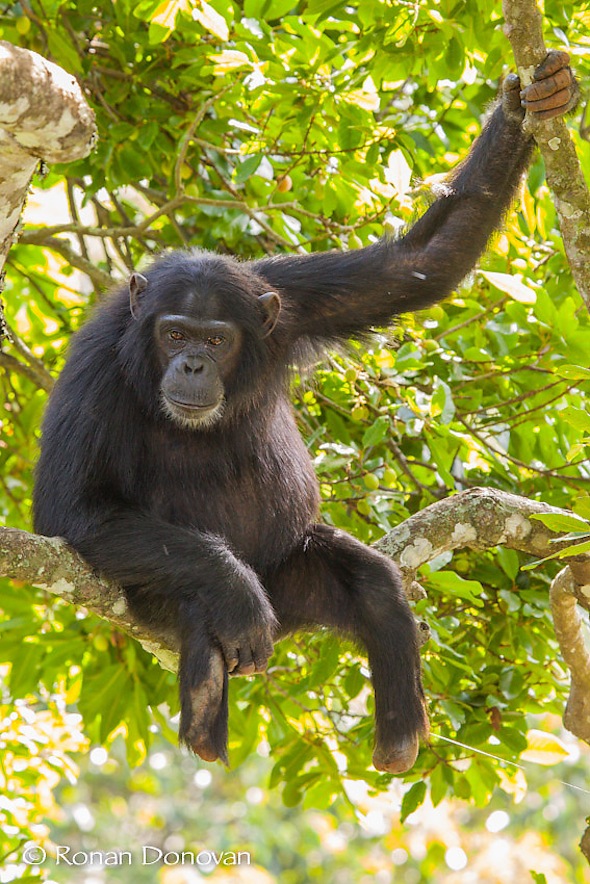
Max sitting in a tree. He lost both his feet to wire snares. Photo courtesy of Ronan Donavan.

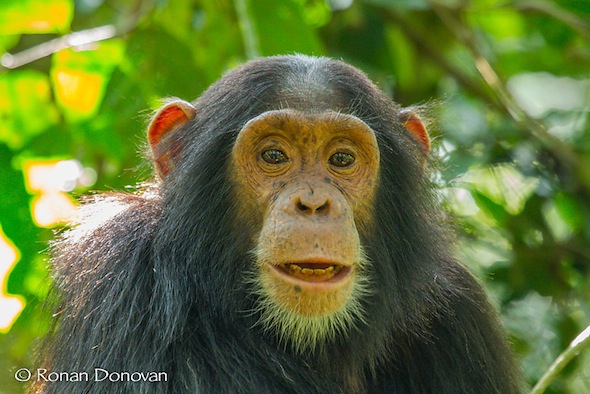
Tsunami was born in January of 2005. Her mother is Tongo and she is Lanjo’s younger sister. Right now, her face is still pink with a few dark freckles but this will change as she gets older and her face darkens. Like our other young chimps, Tsunami likes playing with objects such as rocks and sticks and she will even carry these things around for days. She is often seen playing with and trying to carry her siblings. In 2011, tragedy struck when Tsunami’s baby sister, Teddy, died after accidentally falling out of a tree. Tongo couldn’t carry the body and had to leave it on the ground but Tsunami stayed with Teddy and even tried carrying her—it was heartbreaking. I think Tsunami is going to make a great mom when she grows up—she certainly has a good role model in Tongo and she is one amazing big sister.

tsunami

Tsunami, one of our juvenile females. Photo courtesy of Ronan Donavan.

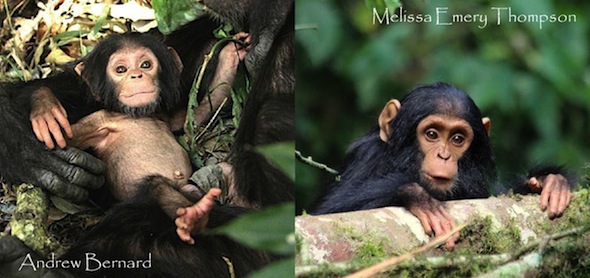
At 1.5 years, Tembo is one of our youngest chimpanzees. We gave him the Swahili word for elephant as a name, because he was born the same day that elephants came to camp and knocked over a tree. Tembo is a special guy because he is not only the son of Tenkere but also the grandson of Outamba. Since female chimpanzees are supposed to transfer to new communities at adolescence, it’s unusual to have maternal grandmothers in a group. We’re not sure why Tenkere decided to stay but it is likely that it’s because she also has access to high quality food like her mom, which she may not have as a new immigrant to another community. Not leaving may end up being a poor choice because Tenkere is genetically related to many of the males in the group. We’ll have to keep an eye on Tembo and get DNA samples from him to do a paternity test. But, so far he seems healthy and playful and he has quite a family looking out for him. I’m hoping he lives up to his name—big and strong and able to knock over trees.

tembo

(Left) Newborn Tembo lying with his mother Tenkere. Even as a newborn he had sideburns just like his mother. (Right) Tembo at 1.5 years of age. Photos courtesy of Andrew Bernard and Melissa Emery Thompson, respectively.

Well that’s all for now. Next time, I’ll describe a little bit more about my research and some of the other projects that we are working on. In the meantime, please check out our website for more news from the field.

Filed Under: Advocacy, Free-living chimps Tagged With: advocacy, animal protection, animal rescue, animal rights, Animal Welfare, chimpanzee, chimpanzee rescue, chimpanzee retirement, chimpanzee sanctuary, Chimpanzee Sanctuary Northwest, free-living chimps, kanyawara, kibale chimpanzee project, kibale national park, wild chimpanzees, wild chimps, zarin machanda

A mouthful

August 14, 2013 by Debbie

Chimps have amazing lips. They’re called “prehensile” which means they actually can grab things with their lips. (That word might be familiar… you may have heard of some monkey species with prehensile tails, and they can grab things and hang from things with their tail).

Because of this super awesome trait, chimps use their lips for everything. Wouldn’t you? They turn pages of magazines with their lips, open packages, and Foxie even “vacuums” the floor with her lips when collecting a sunflower seed forage after playroom cleaning.

Their teeth are also very strong, and can bite things open like whole nut shells. Can you imagine breaking open a brazil nut with your teeth? It’s really impressive, but yet another reason they like to use their mouths to manipulate things.

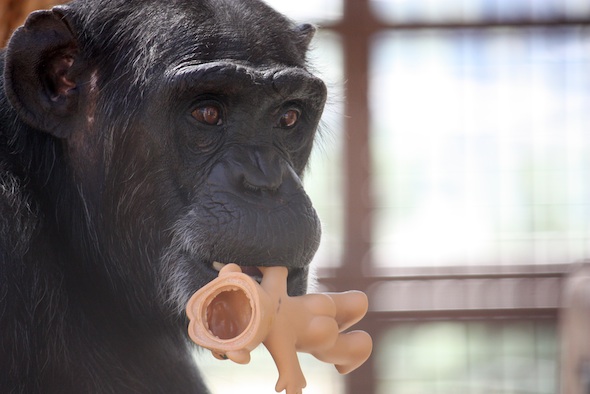
Often times the chimps carry things in their mouths, such as toys, blankets, and of course food. I found these photos taken in the last couple weeks that demonstrate the variety of things we see the mouths of the chimps.

Foxie carrying one of her troll dolls in her mouth:

web_Foxie_troll_in_mouth_GH_ek_IMG_3722

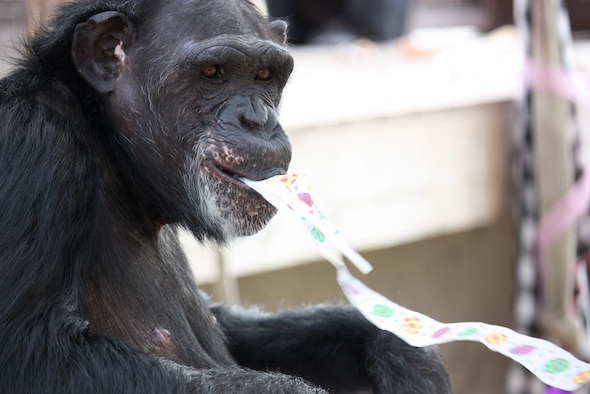
Jamie using her lips to tear some streamers down from Foxie’s recent birthday party:

web_Jamie_streamers_in_mouth_birthday_party_GH_ek_IMG_3500

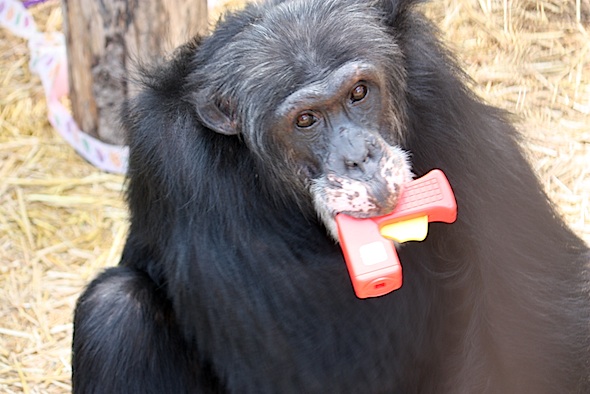
Burrito especially has a tendency to manipulate things in his mouth. Here was his toy of choice a few days ago:

web_Burrito_toy_in_mouth_look_up_at_camera_GH_ek_IMG_3526

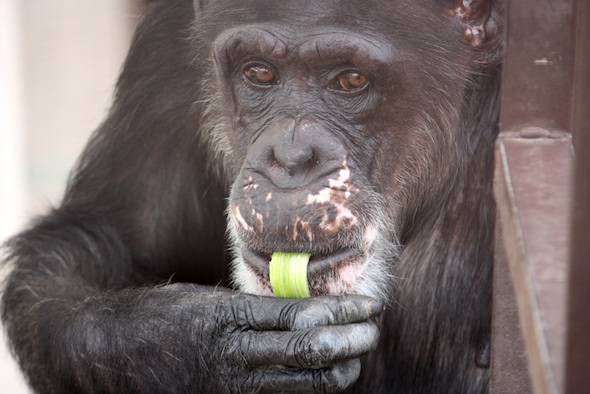
And of course, food is the most common thing the chimps manipulate with their mouths. Here’s Missy stripping some celery like it’s string cheese:

web_Missy_eat_celery_lunch_close_up_GH_ek_IMG_3532


Filed Under: Burrito, Chimpanzee Behavior, Food, Foxie, Jamie, Missy, Sanctuary

  • « Go to Previous Page
  • Page 1
  • Page 2
  • Page 3
  • Page 4
  • Page 5
  • Go to Next Page »

Primary Sidebar

Subscribe To the Blog and Get Notified of New Posts First!

Archives

Calendar of Blog Posts

August 2013
S M T W T F S
 123
45678910
11121314151617
18192021222324
25262728293031
« Jul   Sep »

Categories

SUBSCRIBE TO OUR NEWSLETTER

Footer

PO Box 952
Cle Elum, WA 98922
[email protected]
509-699-0728
501c3 registered charity
EIN: 68-0552915

Official DDAF Grantee

Menu

  • The Chimpanzees
  • Blog
  • About Us
  • You can help
  • Resources
  • Contact
  • Donate

Proud Member of

Connect With Us

Search

Copyright © 2026 Chimpanzee Sanctuary Northwest. All Rights Reserved. Site by Vegan Web Design