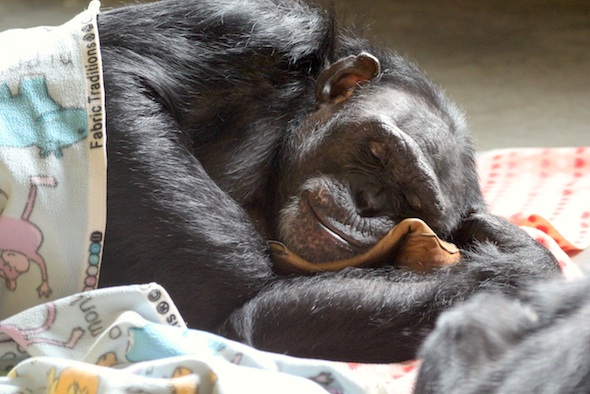
I’ve had shoes that made me pretty happy before, but never have I felt this much contentment. I think Jamie is in love.
Chimpanzee Sanctuary Northwest
Hope. Love. Home. Sanctuary
I’ve had shoes that made me pretty happy before, but never have I felt this much contentment. I think Jamie is in love.

OK, so this isn’t a real Take Action Tuesday post, but check out that spiffy new banner!
Speaking of new things, you really should go check out the Eyes on Apes website. It’s gotten a whole new makeover with an updated homepage (www.eyesonapes.org) and is chock-full of lots of great information on the Learn More pages. There’s a different page on the each issue that apes face, and they all have links throughout the bullet points—be sure to check those out. There’s some PDFs of scholarly articles and links to conservation strategies and action plans that make for really great resources. Also under the Learn More section is a page about Useful Links, and the name doesn’t lie! Lots of great info on other sites that you can check out to further your education.
I updated the Videos page too, so take a look at those… and also of this one below that we’ve put together to promote the program. Share it with your friends and get them to join Eyes on Apes and make a difference for apes everywhere!
We often refer to one of the chimpanzees “asking” us for something – Jamie frequently asks us for a cowgirl boot, Foxie for a troll doll, etc. Luckily for us, the absence of speech does not always impede communication. The chimps have a wide array of behaviors they use to get our attention: foot stomps, head slaps, claps, raspberry sounds, and head nods, to name a few. Jamie is a stomper, while Foxie and Missy usually employ a vigorous head nod when they want something.
In this video, taken right after the chimps were given access to the freshly cleaned playroom, Foxie spies an unclaimed Brazil nut. She’s hesitant to grab it since boss Jamie is sitting nearby, so she makes sure to “ask” Jamie’s permission first.
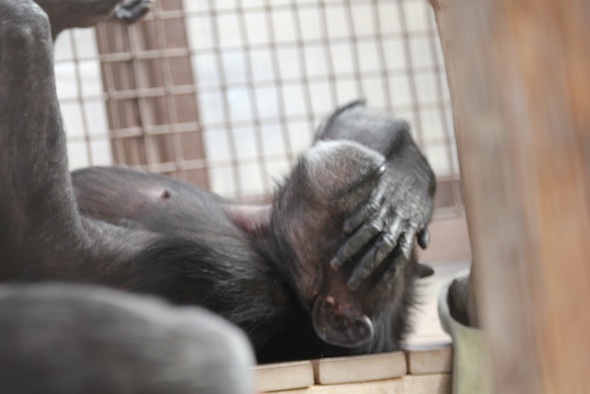
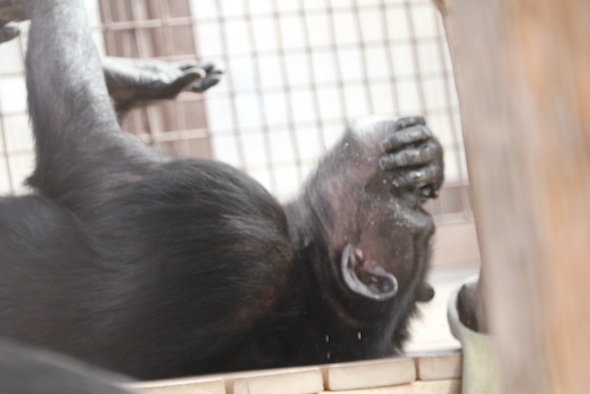
Annie has so many endearing habits and pastimes. Some of my favorites are seen in the video of this blog, including her “bird noises” and the way she lays on her back and claps her feet. I also love to see her in her “yoga poses”. As if all of that wasn’t adorable enough, she has recently found yet another adorable habit. Over the last few months (especially when we were regularly giving the chimps bottled water due to the Taylor Bridge Fire) I’ve seen her occasionally fill her mouth with water, lay on her back and spit the water into the air or in her hand so she can rub it all over her face. Today I caught her lounging in the greenhouse “cleaning her face” after running around on Young’s Hill with Missy. Seems like the perfect refresher.
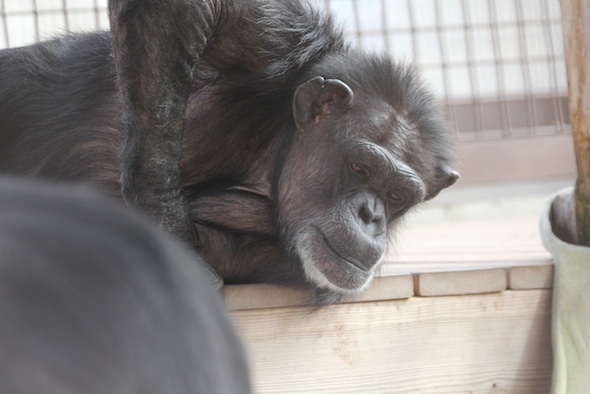
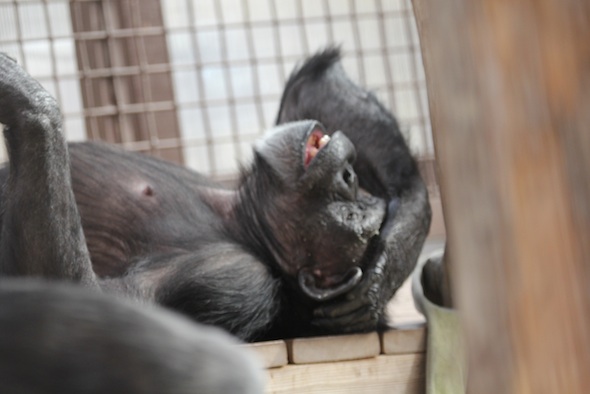
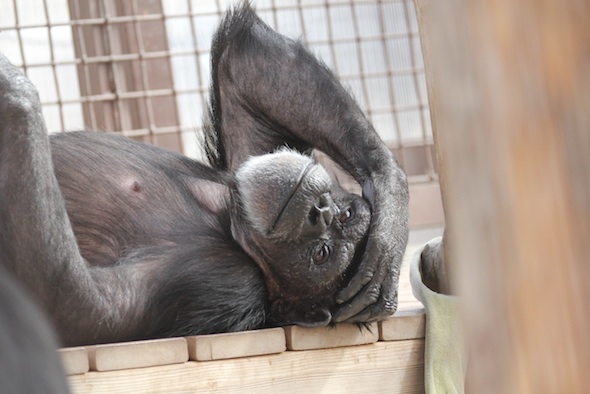
There are very few jobs that provide as much fulfillment as working for Chimpanzee Sanctuary Northwest. It’s not a stress-free occupation, and there are some heavy issues that we deal with every day, but watching the chimpanzees settle into themselves and their lives at the sanctuary is the most rewarding work I’ve ever done. For me, a lot of that reward and the motivation to get through the stress comes from Negra.
It’s too simple to just say that I love her. I am devoted to her. Each new step she takes fills my heart even more. I mentioned this in my reflections for our 3rd Anniversary blog post, which is fun to read and hard to believe that was almost two years ago! I hope that Negra will be with us for many more years, but you never know what the future will bring. Each moment with her, and with all of the chimpanzees, is precious.
This morning was no exception. Volunteer Connie put out some lettuce on Young’s Hill and served the rest of breakfast in the greenhouse. Once Negra discovered the lettuce (one of her favorite foods) outside, she sat herself down in her cabin and enjoyed the warmth and comfort of the cabin that we named for her while all of the other chimpanzees were in the greenhouse. I didn’t want to get too close with the camera because Negra is at times weary of people taking photos when she’s on the hill, but I did take a few photos from a distance. I hope the photos make you as happy as seeing her out there made me.
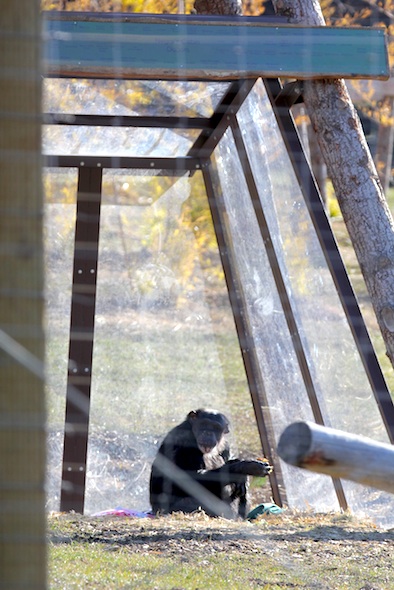
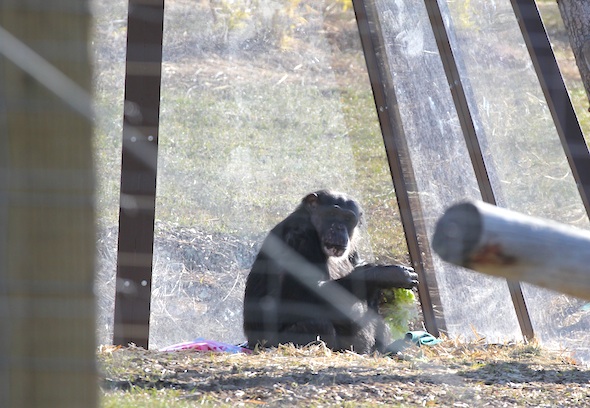
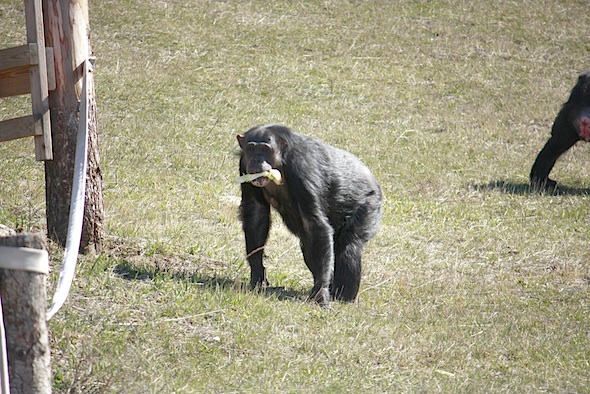
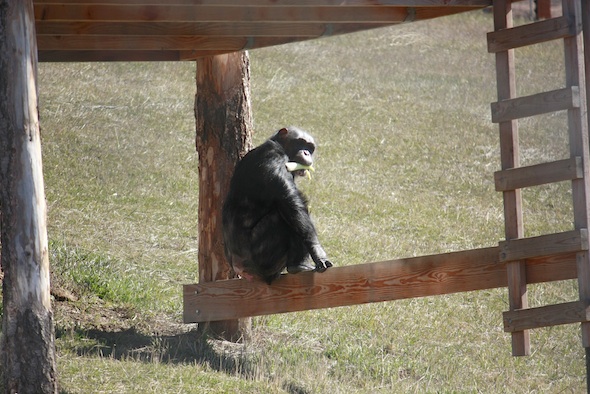
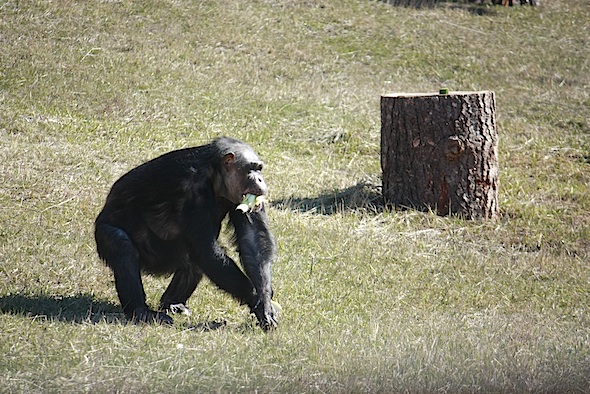
A reward for those of you who stayed awake to the end of my last post…some photos of Negra enjoying a forage on the hill this afternoon:
It’s one of the most commonly asked questions about chimpanzees and for most of the last 15 years I’ve been answering it incorrectly. In my defense, I was not alone. Search the internet for “chimpanzee lifespan” and you will often read that chimpanzees live 40-50 years in the wild and 50-60 years in captivity, or something to this effect. This was the standard line when I first started to learn about chimps, but it now appears to be wildly inaccurate. How could this be?
For such a simple question, the answer for many years was difficult to come by. If, for example, you asked, “How long do fruit flies live?” the answer would be cut and dried. Just follow a bunch of fruit flies from birth to death and record their lifespan, which is measured in days. But for a species like the chimpanzee that has only been studied on a large scale for a handful of generations and whose lifespan is measured in decades, good data was hard to come by. Over the years, however, researchers have collected more and more data on captive and wild chimpanzees and a new picture has emerged, one which has drastically changed my own understanding of chimpanzees.
So…how long do chimpanzees really live?
For chimpanzees in captivity, the best information we have is this: For those who survive to their first birthday, median life expectancy is 31.7 years for males and 38.7 years for females. These figures were provided to us by Lincoln Park Zoo’s ChimpDATA as part of a unique program we participated in to help project future demographic trends in sanctuaries, and are based on 35 years of records from Association of Zoos & Aquariums (AZA) institutions.
A couple of technical points, if you’re interested: First, you’ll notice that this excludes infant mortality. If infant deaths were included, life expectancies would be even lower (closer to 32 years for males and females combined, I believe). The reason why infant deaths are excluded is because infancy remains a particularly high-risk period, even in captivity. If we want to know how long a yet-to-be-born chimpanzee might live, we might include it. But most of the time we are trying to determine the expected lifespan of chimpanzees who are already young adults or adults (typical of chimpanzees coming to sanctuaries), who by definition have already beaten the odds of that early high-risk period. Second, these figures are median ages. The way to interpret this is that for a given figure, half of all chimpanzees in that category will die before that age, and half will die after that age. So you would expect to see many chimpanzees live past the median age – in fact, one chimpanzee in the AZA group lived to 72. However, you would also expect an equal number to die before the median age. Finally, we don’t know how different captive environments and life histories affect life expectancy, so it’s possible that future data from sanctuaries will change our understanding of this unique population.
Life expectancy in wild chimpanzees tends to be the same or lower than in captive chimpanzees. One study found that average life expectancy for chimpanzees across five field study sites was only 15 years. But for those chimpanzees who survived to adulthood, which in this study was defined as 12 years old, their life expectancy was an additional 15 years. Of course, many wild chimpanzees live well beyond 27 years – the oldest wild chimpanzee was estimated to be about 63 years old when she died. Direct comparisons between these types of studies can be difficult because they use different methodologies and analyses, but it gives you a rough idea.
The importance of this issue is not just academic – it has the power to shape the way we think about many different aspects of captive chimpanzee care. As we learned through ChimpDATA, information about life expectancy can help us predict future capacity in sanctuaries, as well as the costs associated with caring for a chimpanzee across his or her lifetime. But just as importantly, it can help give us more realistic expectations about the lives of the chimpanzees that we all care for and support.