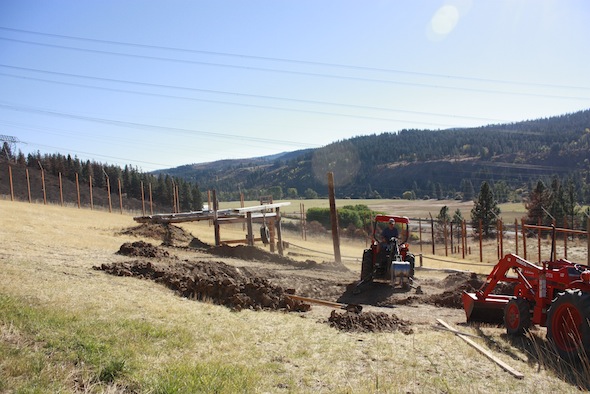
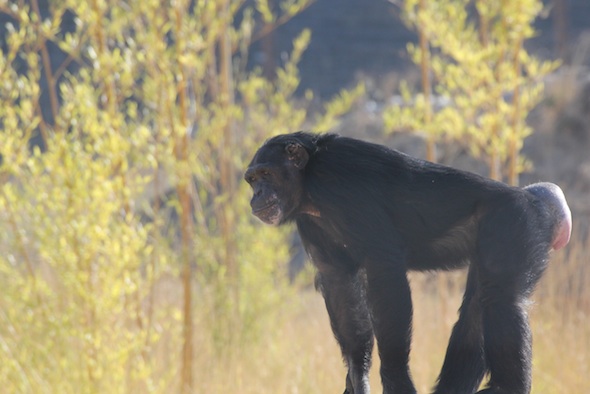
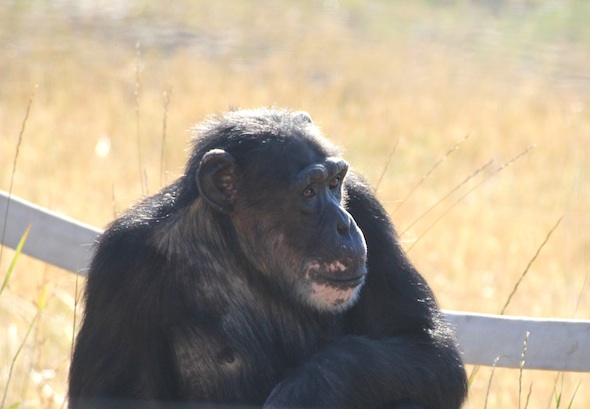
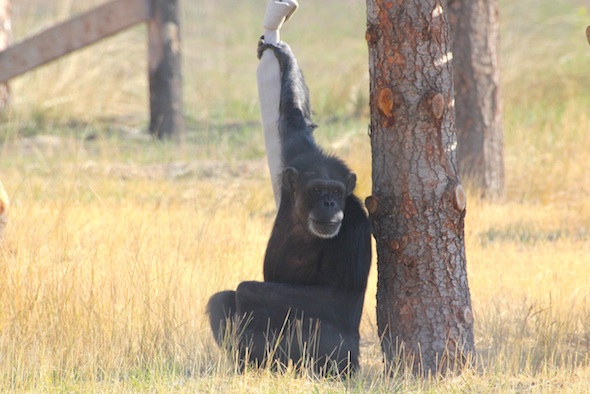
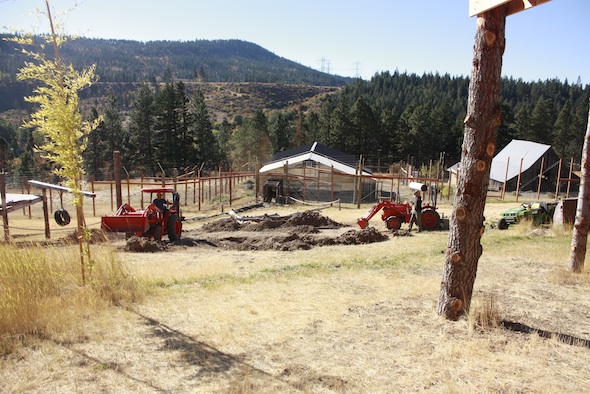
Today, volunteer Ken brought out his backhoe to dig holes for the footings of Negra’s cabin on Young’s Hill. He and J.B. have been out there all day working hard, and we’re hopeful construction will be complete in the next day or so. As you can see from the photos below, it’s going to be fairly close to the raceway/entrance to the hill from the Greenhouse. That is being done with Negra in mind since she doesn’t usually venture out too far from the door, but I’m getting the feeling that everyone is going to love the cabin. I’m envisioning 7 cozy chimps grooming each other in their mini greenhouse on the hill. Ahhhh….
Sanctuary
Take Action Tuesday: Sign our petition! Retire all 110 NIH chimps
As we discussed last week, the National Institute of Health (NIH) recently announced that they are “retiring” 110 chimps from the New Iberia Research Center (NIRC) in Louisiana. Ten of those chimpanzees are going to Chimp Haven, a sanctuary not far from NIRC. The other 100? They are going to Texas Biomedical Research Institute in San Antonio. Though they say they won’t be used in any more invasive testing, this isn’t a true “retirement.” The chimpanzees should be going to a sanctuary like Chimp Haven or the other six members of the North American Primate Sanctuary Alliance (NAPSA).
Please sign our petition to the NIH and help give these 100 chimps a retirement in a true sanctuary. Then spread the petition by sending it to your contacts via email and posting on Facebook, Twitter and other social media. Show the NIH that the public cares about chimpanzees and that we insist former biomedical chimpanzees go to true sanctuaries.
Some recent photos
Look who’s settling in on the hill
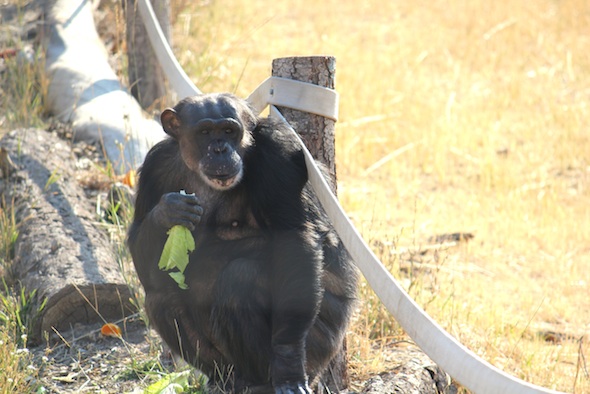
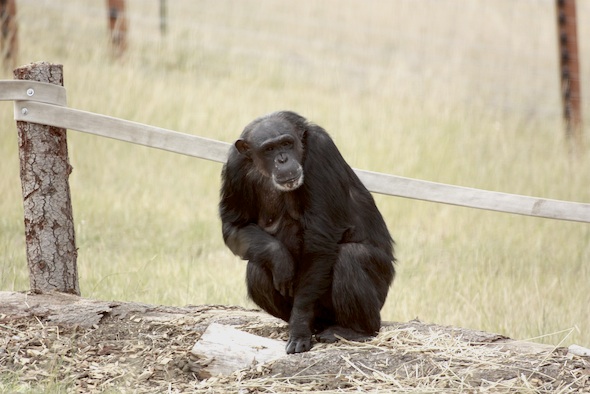
As we’ve mentioned in other posts, Negra has been the most hesitant to fully embrace Young’s Hill, but today she was the first one out of the raceway and sat for quite a long time on the log bridge enjoying the breakfast lettuce forage.
A nest on the hill
When free-living chimpanzees prepare to bed down for the night, most build nests high up in the trees. The reason they do this, as far as we know, is to protect themselves from ground-dwelling predators (though one adventurous researcher discovered some other advantages). Captive chimpanzees, while not at risk of predation, also build nests. The methods for building a nest are culturally learned, but the urge itself is instinctual.
Sometimes I try to imagine what that urge feels like to them. They seem to thoroughly enjoy the process and the ritual of nest-building. Jody, in particular, seems like she is in a state of meditation when she is folding and weaving her blankets. Missy spins 360 degrees as she makes her nest to ensure that each section is symmetrical. Jamie weaves some of her blankets through the caging, as if she is anchoring her nest to the building. The details are different in each case, but each portrays a sense of calmness and comfort throughout the process.
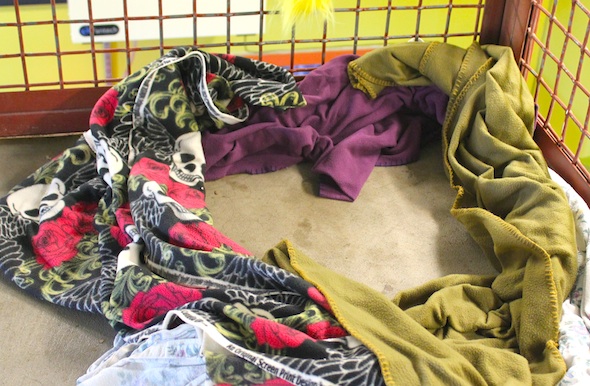
When we sleep we are vulnerable, and nests help chimps feel safe and secure. It’s interesting to note that captive chimpanzees build nests with high sides just like their wild counterparts do to keep from falling out of the tree in the middle of the night. But captive chimps are usually sleeping on the floor or on platforms where there is no risk of falling. And often their nests consist only of sides – there is no bottom. Sometimes the nests look like a doughnut with bare floor in the middle. It’s obvious that the nest is not serving the function of a mattress, to cushion them from the hard ground. Instead, I think it’s fulfilling an instinct that probably goes back millions of years – the urge to be safe and secure, the urge that keeps a sleeping chimpanzee up in the tree where they belong.

This also explains why chimpanzees usually make nests in areas where they feel at ease. You want to close your eyes knowing that nothing strange will happen while you are asleep. At CSNW, the chimps almost always make their night nests on the second story of the playroom or on the benches high up in the front rooms. In the first year that the chimps had access to Young’s Hill, not once did we see someone make a nest outside. But this morning, Jody decided to be the first, and dragged her blankets outside.
This was a big step for Jody, and I think it demonstrates a level of comfort on the hill that we haven’t seen yet. You’ll notice that she made her nest next to the vehicle access gate – the only section of caging on the two-acre enclosure. We often talk about the chimps making gradual transitions, and I think this is a good example. She wants to make a nest outside, but she insists on the security and familiarity of caging as her backdrop.
She didn’t stay in her nest very long, but we are thrilled that she has taken this first step.
Laboratory Life
At Chimpanzee Sanctuary Northwest, we made a conscious decision to focus on sharing the personalities of the chimpanzees with everyone we could – to show who they are and the steps they are taking to recover from their past lives as biomedical research subjects.
There are more happy, goofy, playful, funny moments in a day at the sanctuary than we could possibly share with everyone. We treasure each of these moments and are so thankful to everyone who has helped us to create a place where the Cle Elum Seven can find joy.
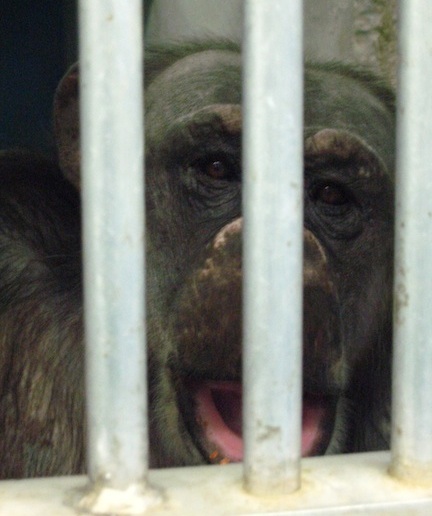
But we know that there are nearly 1,000 other chimpanzees still in biomedical research within the United States who deserve the same opportunity – the chance to live out their lives in a legitimate sanctuary where they can begin to experience happiness. Seeing lists of numbers or names from labs that represent chimpanzees is a haunting experience. Each number is a chimpanzee full of personality just like Burrito, Negra, Foxie, Jamie, Jody, Missy and Annie, and some of those chimpanzees are relatives of the seven – sons, daughters and cousins.
Last week we sent out an e-newsletter about 110 chimpanzees that the government claimed were being retired, though 100 of them are slated to move to another laboratory, not a sanctuary.
For more on this issue, I urge you to take a few moments and read this article published yesterday by Craig Maslow of the Houston Press. After reading it, you will want to want to take some sort of tangible action. A couple of ideas for action are provided here by Animal Protection of New Mexico.
It also happens to be National Primate Liberation Week next week. If you live in the Seattle area, you can participate in events that are being organized by Seattle’s Northwest Animal Rights Network (NARN), Action for Animals, and the Seattle Animal Defense League. Check the NARN calendar for details on all local events. There are no chimpanzees being used in biomedical testing in the state of Washington, but there are countless monkeys used by the University of Washington and by private laboratories. For a list of primate liberation week events happening across the country, check the Stop Animal Experimentation Now! website.
There are definite signs that the end of chimpanzee biomedical research in the United States is coming to an end, particularly with the progress on the Great Ape Protection and Cost Savings Act, but we must keep the pressure up and make sure that the last of the chimpanzees in laboratories are sent to legitimate sanctuaries, and we must advocate for the tens of thousands of non-chimpanzee primates who will never know life outside of a laboratory cage.


Baby love
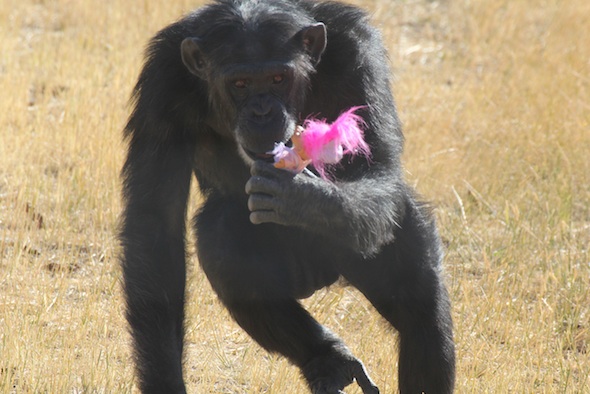
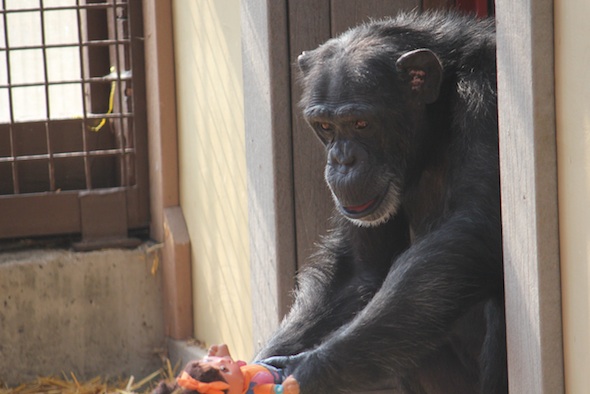
Foxie and I just spent about a half hour going through her doll collection. I was doing some work in the kitchen when she started making raspberry sounds to get my attention. When I looked her way, she pointed towards the bin of dolls. I went through it to see if there were any obvious new favorites I could pass her way but since I was unsure, I decided to pull out the entire bin so that Foxie could help me pick which one she wanted. We often do this for the chimps so that they get the choice, especially with Jamie who so often knows exactly what she wants. When I walked into the chimp area with the bin of dolls, Foxie took off running, starting a game of chase. We ran around the chimp area for a little while, with me chasing Foxie with her bin of dolls and Foxie spinning and laughing hysterically. We then set up in front of one of the front rooms. I sifted through the bin, pulling out ones I thought she might especially love. Foxie made her choices known by pointing and head nodding and I passed a few select dolls her way. With each one that I passed her, she kissed them and held them to her chest for a moment before turning back to the bin to see what else she could choose. We played “pass the troll” for a while, where she tosses a smaller troll out to me and I tickle her with it or we play chase with it, and then I pass it back. All of this typical, every day Foxie stuff– at least for the last 4 years…
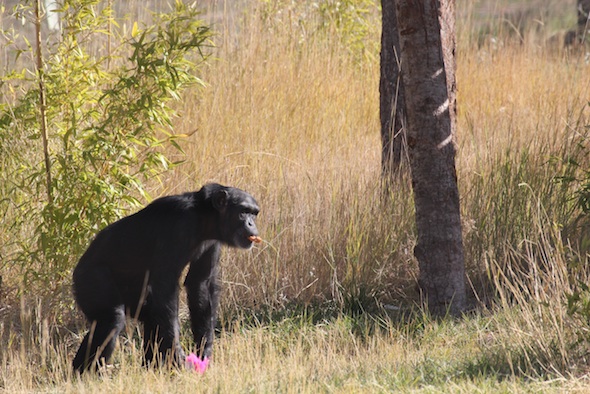
While in the biomedical lab, Foxie was used as a breeder and had five babies, all of whom were taken from her almost immediately after they were born. She was never given the chance to be a mother. A few months after arriving at CSNW, Foxie fell in love with troll dolls, often carrying them around on her back and cradling them like a baby, a love that recently branched out to Dora the Explorer. Her love is complex though, and sometimes we witness her beating her dolls on the floor or with a tool. But a few moments later, she is back to loving and kissing them. We will never know what is going through her head, so it’s hard to say if she truly thinks of them as some sort of surrogate child (though I’m certain Foxie understands they are not real), but after years and years of having her babies taken away from her, it’s such an amazing feeling to be able to not only give her a “baby”, but to have her trust us enough to give it back after a game of “baby” keep away. And it all brings her so much joy! Chimps are resilient– we say it all the time– but after all the Cle Elum Seven have been through, it just can’t be said enough.