• Skip to main content
  • Skip to primary sidebar
  • Skip to footer

Chimpanzee Sanctuary Northwest

Hope. Love. Home. Sanctuary

  • Our Family
    • The Chimpanzees
    • The Cattle
  • Blog
  • About Us
    • Visiting the Sanctuary
    • Philosophy
      • FAQs
      • Mission, Vision & Goals
      • Privacy Policy
    • The Humans
      • Staff
      • Board of Directors
      • Founder
    • Annual Reports
    • The Future of CSNW
    • CSNW In The News
  • You can help
    • Donate
      • Become a Chimpanzee Pal
      • Sponsor A Day
      • Transfer Stock
      • Be A Produce Patron
      • Be a Bovine Buddy
      • Give from your IRA
      • Personalized Stones
      • Bring Them Home Campaign
    • Leave A Legacy
    • Employment Opportunities
    • Volunteer
    • See Our Wish List
    • Events
  • Resources
    • About Chimpanzees
    • Enrichment Database
    • Advocacy
      • Advocacy Action Center
      • Apes in Entertainment
        • Trainers
        • Role of the AHA
        • Greeting Cards
      • Chimpanzees as Pets
      • Roadside Zoos
      • Chimpanzees in Biomedical Research
      • Conservation
        • African Apes
        • Orangutans
  • Shop
    • Merchandise Store
  • Contact
  • DONATE NOW

Sanctuary

Redfin Party Video!

October 23, 2013 by Diana

We had some awesome donations from Redfin left over from the party a couple of weeks ago, so we decided to throw a second Redfin party!

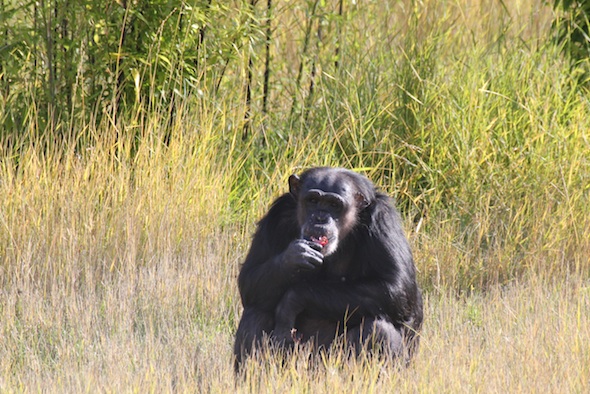
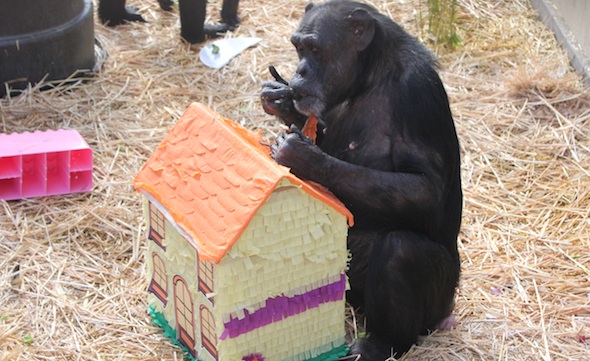
We managed to get some video too (see below). Negra was definitely the star of this party, and both she and Jody got the most out of the terrific house piñatas.

Thank you, Redfin for all of the party supplies and for making such a special day for the chimps not just once, but twice!
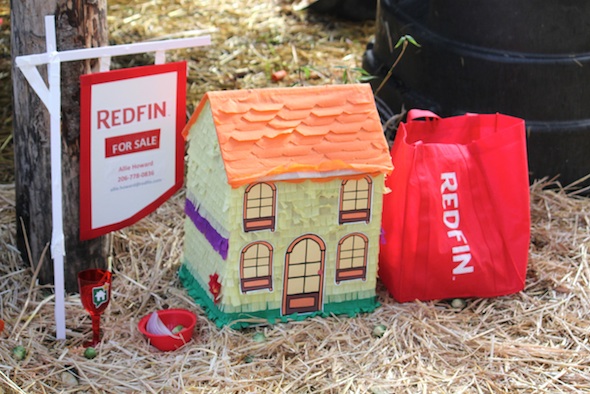


web_Redfin_sign_party_greenhouse_pinata_house_dg_IMG_5538


Jody eating a house


Filed Under: Enrichment, Food, Party, Sanctuary, Thanks Tagged With: chimp, chimpanzee, csnw, Food, northwest, Party, pinata, redfin, Sanctuary

Research at Kanyawara

October 22, 2013 by Debbie

Dr. Zarin Machanda is one of our guest bloggers who is doing a series on the chimpanzees of Kanyawara in the Kibale National Park. Read her introduction post here, to use as a little background for this post about the research they do in the wild. The Kibale chimpanzees were also mentioned in our latest guest blogger post from Maureen McCarthy, a heartbreaking story about a chimpanzee caught in a snare trap. In Kibale, they have snare removal projects and work to help save chimpanzees. Find out more about them here.

—

And now, for the second installment of Zarin’s series:

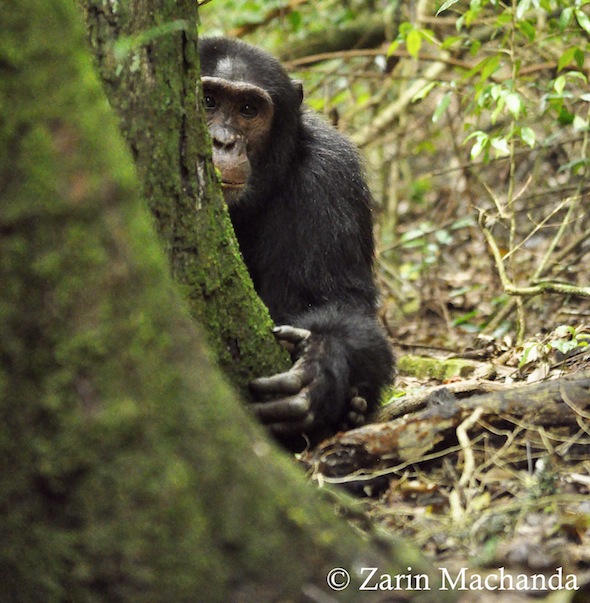
Hi everyone – I’m back to tell you a little bit more about the chimpanzees of Kanyawara. Today, I thought I would write about some of the different research projects that we have going on. But first, a quick update from the field – it seems that Eslom is prevailing against Lanjo in the quest for alpha male status. I know I shouldn’t be disappointed because alpha male transitions are rare (this will be the 4th in 26 years of observation at Kanyawara), so any new observations are bound to be interesting. But why did it have to be Eslom?! I mean, he’s scared of having his picture taken!

Eslom

The only photo I have ever managed to take of Eslom. As soon as I pulled out my camera, he went and hid behind a tree. I managed to get one shot of him peeking out before he got spooked. Alpha male material? I’ll let you decide.

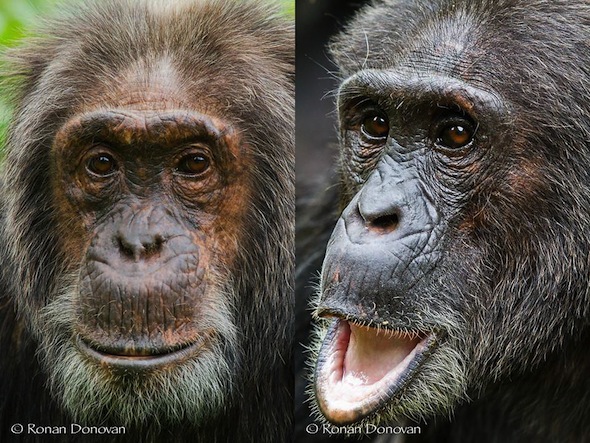
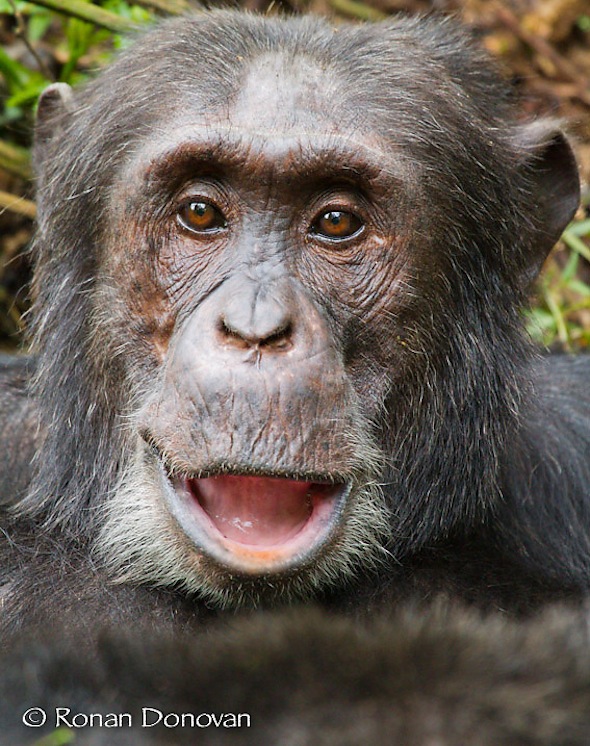
I still have faith that Lanjo is just biding his time and waiting for Eslom to get tired of running around causing havoc. And who knows – there could always be a surprise candidate waiting in the wings: Big Brown, a former alpha wanting to relive his glory days or maybe even dark horse, Makoku. Don’t let that floppy lip fool you, this 30-year old was high-ranking before Kakama died.

big brown and makoku

Two more potential, although unlikely, candidates for alpha male. Big brown (left) was alpha in the mid-1990s but since he’s over 40, I’m not sure he has the fight left in him. Makoku (right) has an older brother Johnny in the community who might prove to be an ally if he decides to go for alpha status – but so far, he doesn’t seem that interested. Photo courtesy of Ronan Donavan.

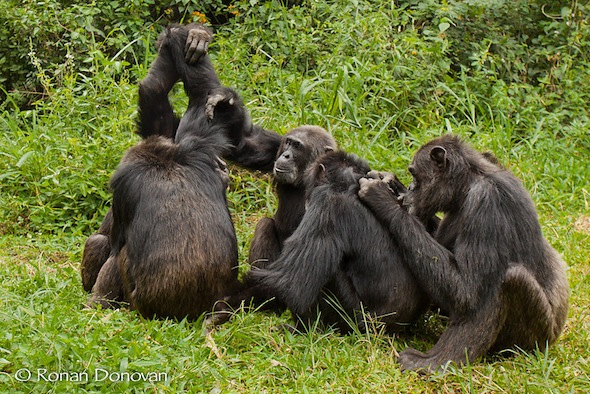
As a research group, we are particularly interested in male dominance and male relationships, so this change in the hierarchy will yield incredibly valuable data for us. Among chimpanzees in the wild, adult males are socially dominant to all the other individuals and they are also much more gregarious – adult males like to be in parties together whereas adult females tend to spend more time alone with just their dependent offspring. Adult males also exhibit more cooperative behaviors like boundary patrols and hunting and we think that tend to have strong relationships with one another to facilitate this cooperation. One of my research interests revolves around understanding how and why individuals form strong long-term social relationships with one another. But to do that, we have to figure out how to identify relationships. Of course, it would be easy to just go with a gut feeling – sometimes you just have a sense watching individuals that they are great friends or that they don’t like each other. But as scientists, we need an objective measure that others can replicate. So how do we measure friendship?

chimps grooming

A pile of male chimpanzees grooming each other. Adult males form very strong bonds with one another and we often use grooming behavior as an indicator of a bond. The chimpanzees at Kanyawara also engage in a behavior called hand-clasp grooming where they raise their hands and clasp them above their heads while grooming each other. Not every chimpanzee community exhibits this kind of behavior and we think that this might be a cultural variant of grooming. Photo courtesy of Ronan Donavan.

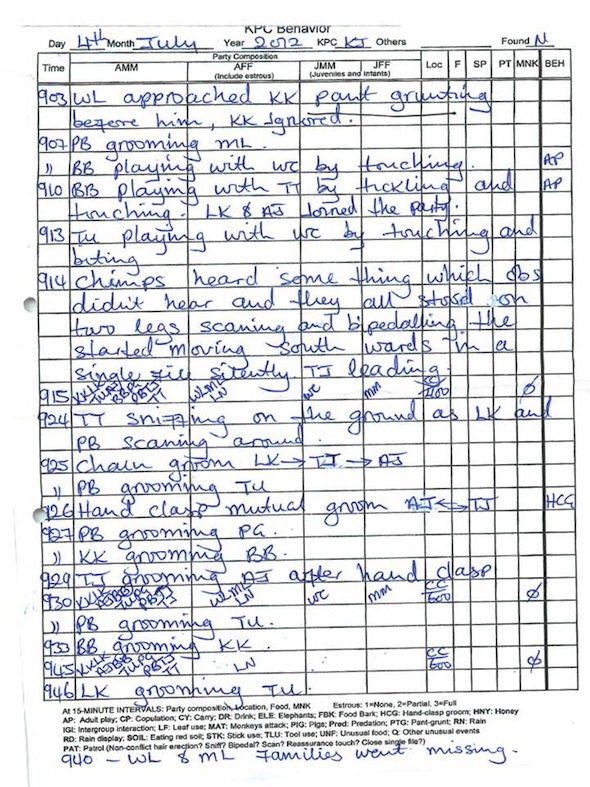
Well first, we have to collect systematic data on the behaviors and activities of the chimpanzees. At Kanyawara, we employ 6 full-time Ugandan field assistants who enter the forest almost every day to collect our long-term field data. We still prefer the old-fashioned method of pen and paper data collection – just like Darwin used to do! One type of data involves identifying all the individuals present in a party every 15 minutes and then writing down the time and description of any interesting behaviors (e.g. grooming, copulations, etc.) that occur. At the same time, another field assistant collects data on one specific individual in the party and records their activity every minute, and who they are sitting near every 15 minutes. From this data, we can figure out which individuals spend time with each other in parties, sit next to each other and groom each other most often. Combining these measures, we can identify individuals with strong bonds. I like to think of it this way – you wouldn’t spend a lot of time with someone you don’t like (let alone let them groom your private parts) and we don’t think that chimps do either.

data

An example of some of the data that we collect. Our field assistant, James, was following a large group of chimps that morning. Around 9:00am there was a lot of social activity including some adult males like Big Brown (BB) and Tofu (TU) playing with some young individuals. Then at 9:14am, the chimps heard something and appeared to be cautious but interested. As they moved south towards the sound – possibly the neighboring community of chimps – the males started grooming each other a lot while some of the females and their families left the party.

Dr. Richard Wrangham started our research site in 1987, so we have over 25 years of this kind of data which means that we can look at relationships over very long periods of time. Our research has shown that not only are males strongly bonded to one another, but almost every male has at least one really close associate – kind of like a BFF, except we call them PSPs (preferred social partners) and these relationships on average last for years. For example, we know that Makoku and his older brother Johnny are PSPs and they have been since at least 1995. As maternal brothers, they share a lot of genes in common and it makes sense that they have a strong bond because from an evolutionary point of view, you should support individuals who share your genes. If they succeed, it’s like a part of you has succeeded as well. By the way, Johnny and Makoku (as well as their mother Lope and sister Rosa) have floppy bottom lips, so there are definitely some shared genes there! It’s a little surprising to me that Makoku isn’t actively trying to be alpha male right now – not only was he the second highest ranking male before Kakama died, but he also has Johnny to get his back if anyone fights him. And Johnny is our biggest male chimpanzee, just the kind of wingman you’d want in a fight. Of course, Makoku could be trying to emulate his older brother’s style since Johnny never cared that much for being high ranking either. This seemed to work for Johnny – although the general pattern is for the alpha male (or at least high-ranking males) to sire the majority of babies in a community, mid-ranking Johnny is one of our most reproductively successful males and has fathered numerous offspring including Lanjo and Eslom. Does anyone else get the feeling that this is a little bit like watching a soap opera? The Days of our Lives: Kanyawara edition!

Johnny

Johnny is Makoku’s older brother and has a floppy bottom lip just like the rest of the members of his family. Johnny has always been medium ranking, but surprisingly, he is also a real ladies man and has fathered a number of offspring. Photo courtesy of Ronan Donavan.

Besides studying long-term relationships, another area of research that Kanyawara has pioneered is the study of behavioral endocrinology. Basically, this involves trying to understand the interaction between the behaviors that we observe and the physiological processes happening inside the body that involve hormones. For example, one interesting question to examine right now is how testosterone levels of our adult males may be fluctuating given the instability in the dominance hierarchy. With all the aggression that Eslom is displaying, I bet his testosterone levels are through the roof!

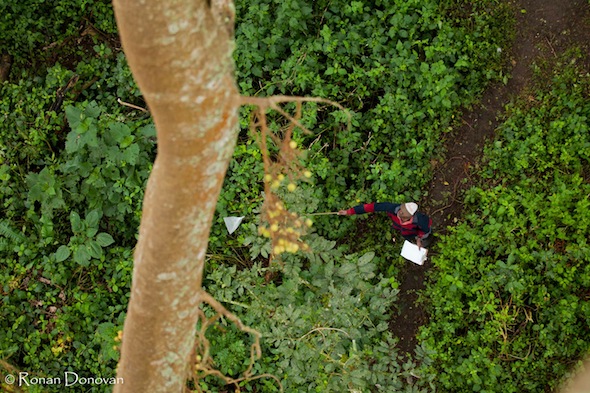
As I mentioned in my previous post, we don’t physically interact with our chimpanzees unless their lives are in danger, so we can’t collect blood samples to measure their hormone levels. Instead, we rely on the urine and feces that they leave behind and it is remarkable how much you can tell about the inner workings of the body from a single urine sample. In our lab at the University of New Mexico, Martin Muller, Melissa Emery Thompson and their students use and develop techniques which can determine the levels of testosterone, estrogen, progesterone, cortisol (a measure of metabolic stress), and C-peptide (a measure of insulin). This means, of course, that we have to collect urine and fecal samples. This fun task most often falls on our field assistants, who have devised a very clever way to get the urine and not get too messy in the process. Basically, you have to find a long branch with a v-shaped end to it. Luckily, we work in a forest so these aren’t too hard to find. Then you take a clean plastic bag and tie it over the v-shaped end and voilà, you have made yourself a urine catcher! When a chimp is in a tree and starts peeing, you take your urine catcher and put the plastic bag end in the stream of urine. Once we have enough (only about 3ml), we can pipette the liquid off the plastic bag and into labeled tubes for storage.

urine collection

A chimps-eye view of John, one of our field assistants, collecting urine using the handy plastic bag on a stick technique. The longer the stick, the less chance of getting splashed. Photo courtesy of Ronan Donavan.

Some of the hormone data that we have collected have changed the way that we think about the chimpanzees and their behavior. For example, the data from Kanyawara has shown that males who are higher ranking tend to have higher levels of testosterone. These guys are also generally more aggressive indicating that the testosterone may be mediating their aggressive behavior. These high ranking males also have higher levels of cortisol which means that they are experiencing increased metabolic costs – in other words, even though there is a benefit to being high ranking, there is also a significant energetic cost to it as well. This dataset has also given us a lot of information about females as well. Remember Outamba, the super mom chimp that I mentioned in my previous post? Well we know she is high ranking and we also have data to suggest that she, and the other high ranking females, have higher levels of estrogen and progesterone. This might be why she is able to have babies more frequently than the other females.

So that’s a little bit about some of the research we do on adult individuals. Next post I’ll tell you what it’s like to be a baby chimpanzee and some of the research that we do on our infants. Chimpanzees are so interesting and complex that I don’t think we’ll ever run out of research questions. Let’s just hope that we can also protect the chimps in the wild so that we can keep learning from these amazing individuals.

Filed Under: Advocacy, Free-living chimps Tagged With: advocacy, animal protection, animal rescue, animal rights, Animal Welfare, chimpanzee, chimpanzee rescue, chimpanzee retirement, chimpanzee sanctuary, Chimpanzee Sanctuary Northwest, free-living chimps, kanyawara, kibale national park, ronan donavan, Sanctuary, wild chimps, zarin machanda

Foxie and Annie Playing

October 19, 2013 by Diana

If you’re subscribed to our e-newsletter, you read about this rambunctious play between Annie and Foxie yesterday and what it says about how things have changed between these two in the last few years at Chimpanzee Sanctuary Northwest. Subscribe here if you’re not already signed up to receive updates!

Filed Under: Annie, Foxie, Missy, Play, Sanctuary Tagged With: Annie, chase, chimp, chimpanzee, csnw, e-news, email, Foxie, Missy, northwest, Play, Sanctuary, sign up, wrestle

Negra in the Sun

October 18, 2013 by J.B.

There’s nothing better than watching Negra sit outside and soak up the sun.

web_Negra_eat_pomegranate_YH_bamboo_jb_IMG_4810

web_Negra_grass_bamboo_look_at_sun_valley_YH_jb_IMG_4825

web_Negra_profile_sun_YH_jb_IMG_5271

Filed Under: Negra Tagged With: chimpanzee, Negra, northwest, rescue, Sanctuary, sun

Undercover Annie

October 16, 2013 by Katelyn

Annie is by nature a sweet and shy soul. Probably due in part to her personality, she is also lowest in the social hierarchy of her chimpanzee family. But don’t think this means that she can’t hold her own when she feels strongly enough about something or doesn’t find a way to get what she wants. We’ve even witnessed her stand face to face with Jamie during arguments! And the backing of her best friend, Missy, will often give her additional courage when needed.

At the same time Annie does a great job at her role of being a subordinate chimpanzee. For example, when taking food she cautiously looks around to make sure it’s OK with everyone else (this usually means Jamie and Missy). This is completely normal behavior in chimpanzee society and there is typically more political savvy exercised than physical force. And while by nature she is less interested in interacting with the humans and prefers the company of her chimpanzee friends, if she wants to interact with us she finds a way to do so without getting into trouble.

web_Annie_lie_close-up_face_climbing_structure_gh_dg_IMG_4544

When I went in to greet the chimpanzees this morning, much to my delight, Annie ran over to say good morning to me. But then she turned her back to me, looked around, and quickly turned her head to the side to offer me a quick kiss on the back of my hand. Then she looked around again to make sure the coast was clear and reached out to tickle my hand. And off she ran to start the rest of her day. These moments with Annie are such a treat. It makes my heart smile to see her becoming more courageous and comfortable in her own skin. She may be quiet but she’s sly!

web_Annie_lie_close-up_face_climbing_structure_gh_dg_IMG_4545

Filed Under: Annie, Chimpanzee Behavior, Sanctuary Tagged With: Annie, chimpanzee, Chimpanzee Sanctuary Northwest, Sanctuary

Chimp ID: Jody

October 13, 2013 by Elizabeth

We’re continuing our series of blog posts on chimpanzee identification today with Jody. (If you missed the posts about Annie, Burrito, Foxie, or Jamie, click on their names.)

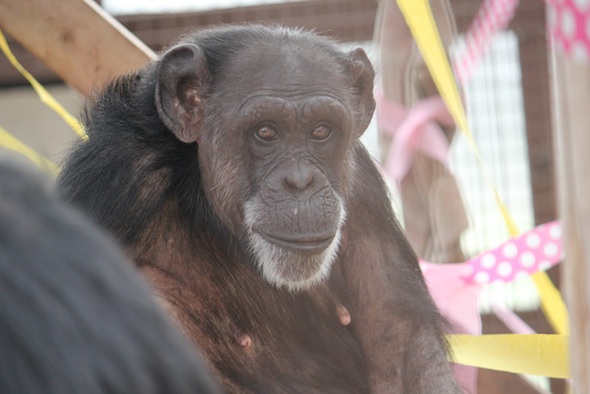
Jody is one of the larger females in the group, though not as muscular as Jamie. She has a very sweet face, with her eyes a little closer together than those of the other chimpanzees.

web Jody close up anniversary birthday greenhouse GH (ek) IMG_2376

web_Jody_look_at_camera_lunch_anniversary_birthday_party_greenhouse_GH_ek_IMG_2402

web Jody close-up light color_MG_7923

She’s missing parts of some of her toes due to old injuries. On her left foot, she’s missing the tips of her three middle toes (I couldn’t find a good photo). And here you can see that the second toe on her right foot is shorter than the rest.

web Jody lie on back stretch blanket nest playroom PR IMG_6884

Jody has distinctly pink nipples:

web Jody streamers in background look at camera birthday party mother's day greenhouse GH IMG_7888

web Jody YH IMG_2701

Her bottom lip is often droopy:

web Jody close up drooped lip Young's Hill YH IMG_5486

web jody relaxed face drooped lip GH (dm) IMG_8183

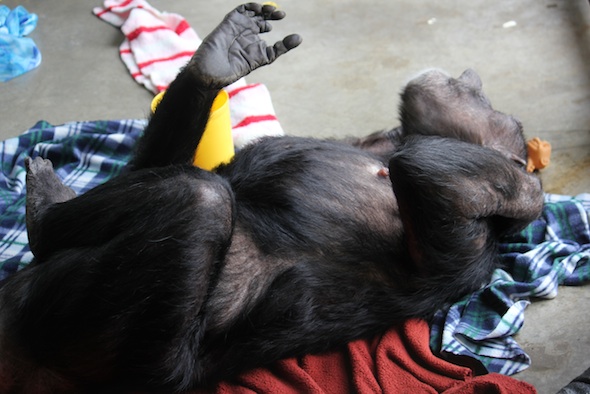
If there’s one thing Jody is known for, it’s her love of comfort. She spends a lot of time reclining. When she’s eating, she likes to lie on her belly:

web Jody lie nest new bamboo chow bag greenhouse GH IMG_7398

web Jody close-up outside breakfast forage_MG_6848

web Jody eat alfalfa cubes pr IMG_3290

Filed Under: Jody, Sanctuary Tagged With: Chimpanzee Sanctuary Northwest, Jody, Sanctuary

an unfortunate privilege

October 12, 2013 by Diana

We were fortunate to have spent a bit of time with Dr. Sheri Speede and some volunteers for IDA Africa when they were in the area the last few days as part of Dr. Speede’s book signing tour for her new book Kindred Beings. She relayed something that we all had in common. It’s related to Debbie’s post from the other day. Here it is: working with chimpanzees is an incredible privilege. It’s not something a lot of people get to do. When I’m walking with Jamie, playing with Burrito, passing a troll to Foxie, taking a photo of Jody, having a quiet interaction with Annie, admiring Missy as she runs on the hill, or simply looking at Negra with my heart swelling with love, I often think about this. But here’s the thing – this is a privilege that we shouldn’t have. I know we’ve expressed this on the blog in direct and indirect ways before. It’s one of those thoughts that you carry with you everyday as a caregiver in a sanctuary. No matter how great the moment is, no matter what amazing and wonderful thing has happened – there shouldn’t be a need for us to have jobs like this, and the chimpanzees we care about so much shouldn’t be here.

But they are here, and so are we. So we do have this privilege, and we are able to pass along this privilege vicariously to you through this blog – to tell their stories and explain what’s it is  like to care for chimpanzees. The greatest aspect of working at Chimpanzee Sanctuary Northwest is that we all feel this way, really without even thinking about it. We all understand that we are here for chimpanzees who deserved better. They are not here for us. And we will continue to be here for them and make their lives in captivity as good as they possibly can be.


Jody lying down:

Jody lie look at camera


Jamie walking on Young’s Hill:

Jamie walking on Young's Hill

Filed Under: Caregivers, Jamie, Jody, Sanctuary Tagged With: caregiver, caring, chimp, chimpanzee, csnw, ida africa, kindred beings, northwest, Sanctuary, sheri speede

  • « Go to Previous Page
  • Page 1
  • Interim pages omitted …
  • Page 522
  • Page 523
  • Page 524
  • Page 525
  • Page 526
  • Interim pages omitted …
  • Page 728
  • Go to Next Page »

Primary Sidebar

Subscribe To the Blog and Get Notified of New Posts First!

Archives

Calendar of Blog Posts

June 2026
S M T W T F S
 123456
78910111213
14151617181920
21222324252627
282930  
« May    

Categories

SUBSCRIBE TO OUR NEWSLETTER

Footer

PO Box 952
Cle Elum, WA 98922
[email protected]
509-699-0728
501c3 registered charity
EIN: 68-0552915

Official DDAF Grantee

Menu

  • The Chimpanzees
  • Blog
  • About Us
  • You can help
  • Resources
  • Contact
  • Donate

Proud Member of

Connect With Us

Search

Copyright © 2026 Chimpanzee Sanctuary Northwest. All Rights Reserved. Site by Vegan Web Design