• Skip to main content
  • Skip to primary sidebar
  • Skip to footer

Chimpanzee Sanctuary Northwest

Hope. Love. Home. Sanctuary

  • Our Family
    • The Chimpanzees
    • The Cattle
  • Blog
  • About Us
    • Visiting the Sanctuary
    • Philosophy
      • FAQs
      • Mission, Vision & Goals
      • Privacy Policy
    • The Humans
      • Staff
      • Board of Directors
      • Founder
    • Annual Reports
    • The Future of CSNW
    • CSNW In The News
  • You can help
    • Donate
      • Become a Chimpanzee Pal
      • Sponsor A Day
      • Transfer Stock
      • Be A Produce Patron
      • Be a Bovine Buddy
      • Give from your IRA
      • Personalized Stones
      • Bring Them Home Campaign
    • Leave A Legacy
    • Employment Opportunities
    • Volunteer
    • See Our Wish List
    • Events
  • Resources
    • About Chimpanzees
    • Enrichment Database
    • Advocacy
      • Advocacy Action Center
      • Apes in Entertainment
        • Trainers
        • Role of the AHA
        • Greeting Cards
      • Chimpanzees as Pets
      • Roadside Zoos
      • Chimpanzees in Biomedical Research
      • Conservation
        • African Apes
        • Orangutans
  • Shop
    • Merchandise Store
  • Contact
  • DONATE NOW

evolution

Sky Walking

August 10, 2025 by Diana

The original publication mentioned in the video from Frontiers in Ecology and Evolution is called: Foraging strategy and tree structure as drivers of arboreality and suspensory behaviour in savannah-dwelling chimpanzees. Click here for the link to the publication.

Click here for one popular science translation of the study: Walking on Two Legs May Have Evolved in Trees, Not on the Ground.

There’s more to the study than the quick video above. It includes discussion of the type of habitat in Tanzania where the study chimpanzees live. Unlike the dense forest ecosystems where many chimpanzees live, the habitat of the site in Tanzania is called savanna-mosaic, which always strikes me as poetic or romantic or something. It’s thought to be similar to the type of ecosystem where early humans adapted to thrive.

I was talking about the study with J.B., and that conversation caused me to think about studying chimpanzees in order to learn more about humans or human origins.

I’ve definitely said it before, but it doesn’t hurt to reflect again on how and why chimpanzees have been bought/sold/traded by humans in the pet, entertainment, and biomedical industries. They are frequently thought of and used as stand-ins for humans, yet they are different and separate enough that humans tend to feel less moral obligation towards them.

Their likeness to us has been, all to often, to their detriment. I don’t think that’s the case in this particular study. I do find theories about early humans interesting. But I think it is the case in an update to another story that has been in the news.

A couple of weeks ago, I wrote a blog post sharing a sad update to the Tonia Haddix / Chimp Crazy saga. If you missed that update, you can read the full post here. Just two days ago, Haddix was finally sentenced to almost four years in prison for lying under oath that a chimpanzee named Tonka had died, when in fact she was secretly keeping him in her basement. She has not yet been charged for the second chimpanzee she was trying to hide just months ago.

Her lawyer made a statement that Haddix had a difficult upbringing and history with humans, so had turned instead to animals for comfort. I think it was clear in the documentary Chimp Crazy that she felt chimpanzees in particular filled a need she had, even referring to Tonka as being more of a human than a chimpanzee. If she saw evidence of that it was because the humans around him were attempting to assimilate him into their world, rather than seeing him for who he is.

Haddix is an extreme example of this warped vision, but it’s easy to slip into this view because chimpanzees are so similar to humans and so culturally and socially adaptive. Celebrating and understanding their differences is perhaps more important to helping them than seeing their similarities.

I hope we can do both.

Filed Under: Education, Jamie, Latest Videos, Missy, Rayne Tagged With: bipedalism, evolution, foraging strategy, free-living chimps, wild chimpanzees

A Show of Hands

April 5, 2019 by J.B.

I saw this illustration of primate hands shared on social media recently and thought it was a great example of how diverse the primate order is.

Almécija, Sergio & C Shwerwood, Chet. (2017). Hands, Brains, and Precision Grips: Origins of Tool Use Behaviors. 10.1016/B978-0-12-804042-3.00085-3.

The most unusual hand belongs to the aye-aye (Daubetonia). It taps its long, slender fingers on trees in search of food. After opening up a hollow with its rodent-like incisors, it uses its specialized middle digit to extract grubs. Think of them as the primate version of a woodpecker.

Some primates, like the slow loris (Nycticebus) and potto (Perodicticus), have evolved hands that allow for better arboreal grasping. Notice how the index fingers have become mostly vestigial and the thumb has rotated away from the other digits. This is part of a suite of adaptations that allow them to maintain a strong grip for long periods of time. It’s probably not a coincidence that they look more like birds’ feet.

In another example of form following function, the long digits of tarsiers (Tarsius) have rounded, frog-like pads, allowing them to cling and leap like…yes, frogs!

Many arboreal species, like orangutans (Pongo), have evolved small thumbs while others, like the spider monkey (Ateles), lack an external thumb entirely to aid in climbing. While it’s tempting to think of opposable thumbs as somehow better or more advanced (even the spider monkey’s genus name sounds judgmental – Ateles, meaning incomplete or imperfect, is a reference to their missing thumbs), this is simply not true. The ancestor to the spider monkey had opposable thumbs but in the course of adapting to their environment, spider monkeys got those lousy things out of the way so that they could grip and swing better. They are perfectly complete for the niche they inhabit.

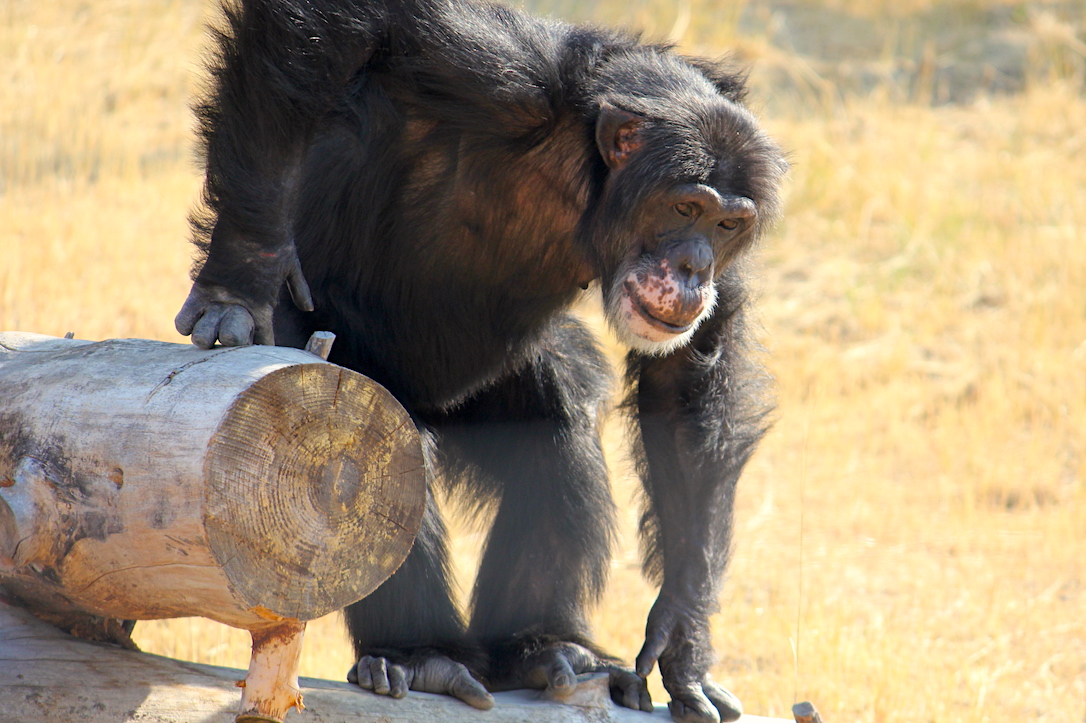
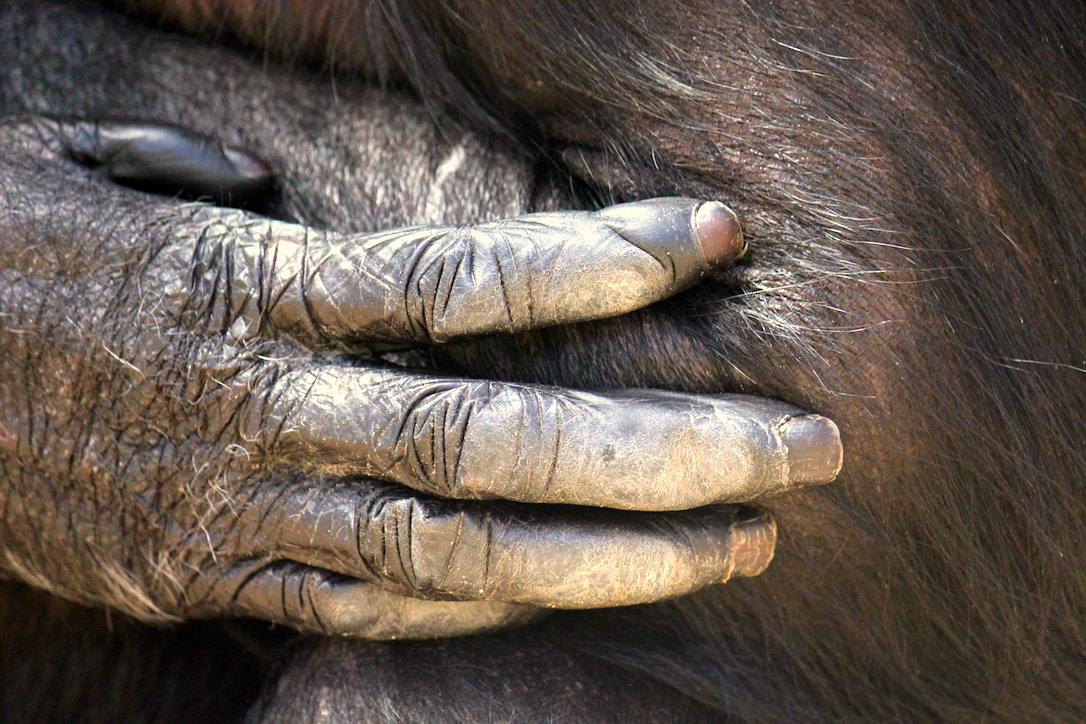
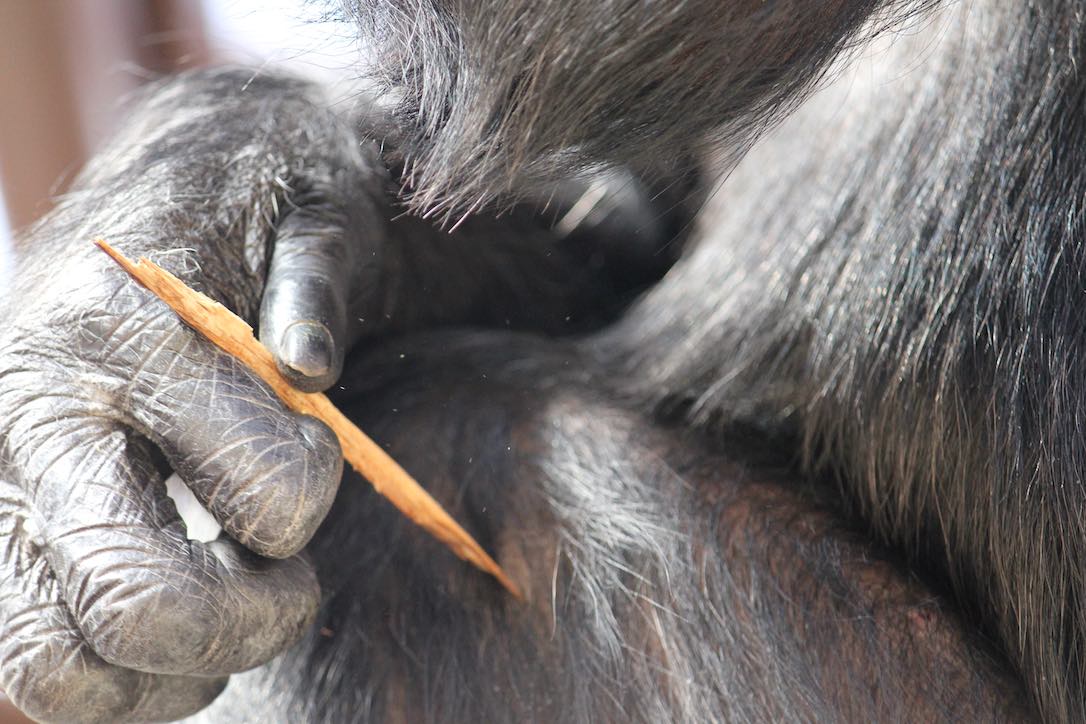
Looking at a chimpanzee’s hand, you can see that they are far less specialized than those of many other primates, making them generally well-suited to both climbing and walking. While chimpanzees walk on the soles of their feet, they flex their hands and bear weight on the outside of the intermediate phalanges (the part of the finger between the second and third knuckle).

Thick pads develop on this part of the hand for protection.

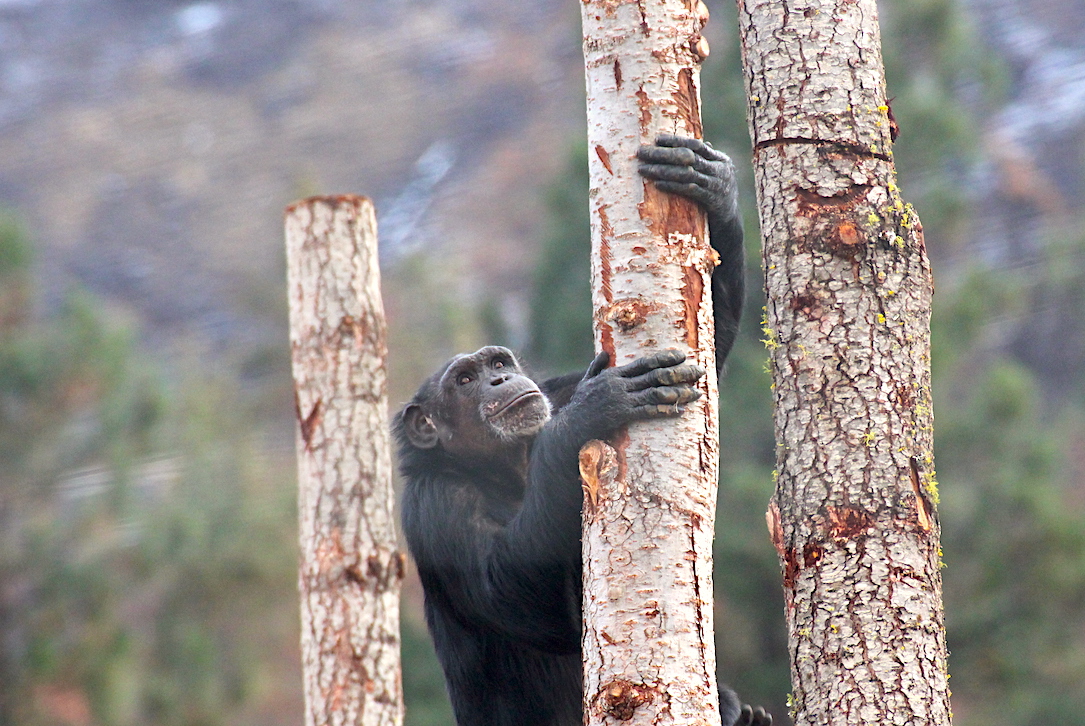
Long palms and fingers and short thumbs aid in gripping large trunks and branches.

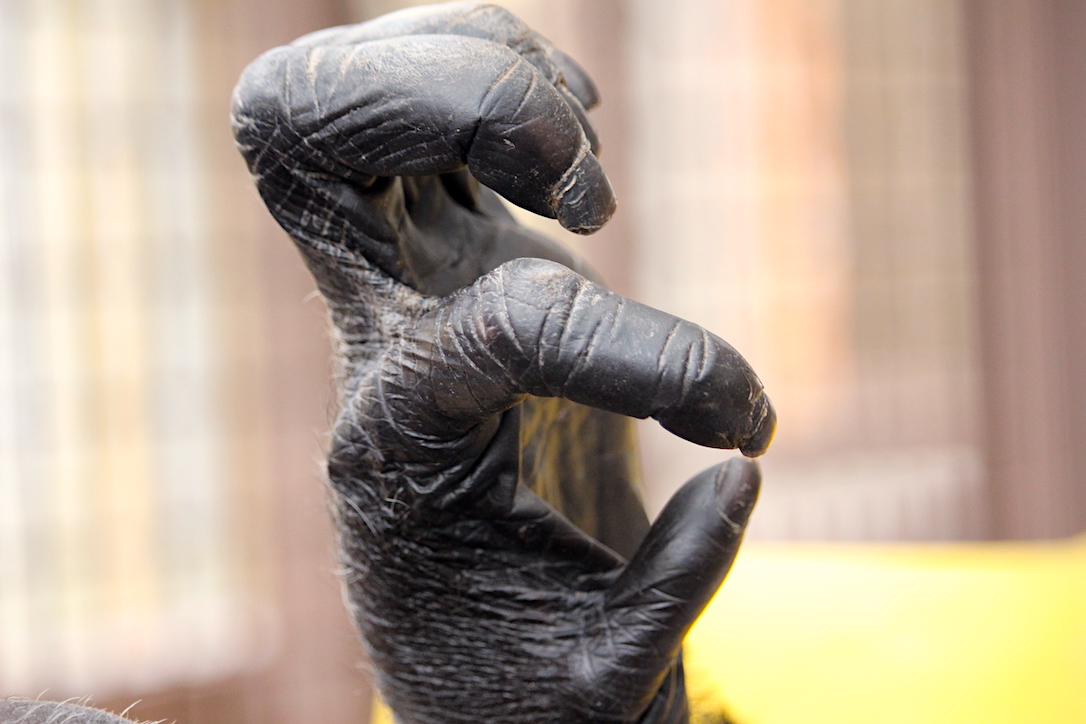
The trade-off, when compared to human hands, is less power and control in the precision grip.

The length of a chimpanzee’s hand and more limited rotation and flexion of the thumb prevent pad-to-pad gripping or pinching, but they are still able to grasp and manipulate objects between the thumb and fingers, allowing for the use of tools.


Filed Under: Sanctuary Tagged With: anatomy, chimpanzee, evolution, grip, hand, morphology, northwest, rescue, Sanctuary

Primary Sidebar

Subscribe To the Blog and Get Notified of New Posts First!

Archives

Calendar of Blog Posts

June 2026
S M T W T F S
 123456
78910111213
14151617181920
21222324252627
282930  
« May    

Categories

SUBSCRIBE TO OUR NEWSLETTER

Footer

PO Box 952
Cle Elum, WA 98922
[email protected]
509-699-0728
501c3 registered charity
EIN: 68-0552915

Official DDAF Grantee

Menu

  • The Chimpanzees
  • Blog
  • About Us
  • You can help
  • Resources
  • Contact
  • Donate

Proud Member of

Connect With Us

Search

Copyright © 2026 Chimpanzee Sanctuary Northwest. All Rights Reserved. Site by Vegan Web Design