• Skip to main content
  • Skip to primary sidebar
  • Skip to footer

Chimpanzee Sanctuary Northwest

Hope. Love. Home. Sanctuary

  • Our Family
    • The Chimpanzees
    • The Cattle
  • Blog
  • About Us
    • Visiting the Sanctuary
    • Philosophy
      • FAQs
      • Mission, Vision & Goals
      • Privacy Policy
    • The Humans
      • Staff
      • Board of Directors
      • Founder
    • Annual Reports
    • The Future of CSNW
    • CSNW In The News
  • You can help
    • Donate
      • Become a Chimpanzee Pal
      • Sponsor A Day
      • Transfer Stock
      • Be A Produce Patron
      • Be a Bovine Buddy
      • Give from your IRA
      • Personalized Stones
      • Bring Them Home Campaign
    • Leave A Legacy
    • Employment Opportunities
    • Volunteer
    • See Our Wish List
    • Events
  • Resources
    • About Chimpanzees
    • Enrichment Database
    • Advocacy
      • Advocacy Action Center
      • Apes in Entertainment
        • Trainers
        • Role of the AHA
        • Greeting Cards
      • Chimpanzees as Pets
      • Roadside Zoos
      • Chimpanzees in Biomedical Research
      • Conservation
        • African Apes
        • Orangutans
  • Shop
    • Merchandise Store
  • Contact
  • DONATE NOW

free-living chimps

Along the Bushmeat Highway: Part 2

May 25, 2013 by Debbie

This is the second installment of a series of posts from Dr. Cleve Hicks. Cleve did his PhD research in the DRC studying chimps in the Bili Forest. Read Part 1 of this story about some of his experiences here. WARNING: some disturbing images are included in this entry.

—

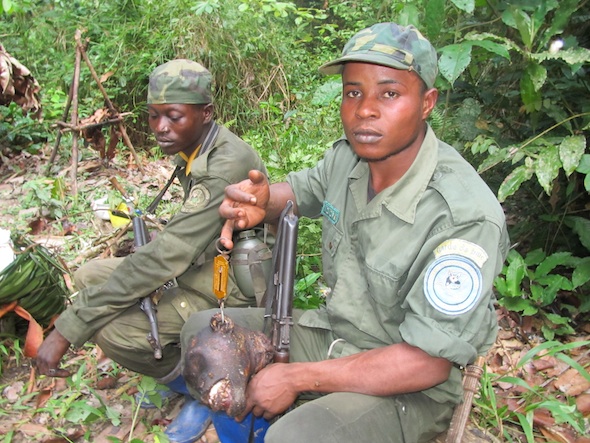
I was encouraged to see that a strong ICCN contingent of 20 Ecoguards was now installed inside Rubi-Tele, actively arresting poachers and confiscating bushmeat. Another twenty guards were scheduled to join them soon. This team patrols the forests of the reserve during the first three weeks of every month, and then on the last week they pass through the roadside villages down the highway bisecting the game reserve. Together with the road block erected at Sukisa, we can hope that these patrols will make a difference for the embattled wildlife of these forests. On this trip I counted the carcasses of 15 monkeys on the road between Kisangani and the southern border of Rubi-Tele. Of the four un-smoked carcasses we could identify to species, three were red tailed guenons and one was a red colobus; we also saw two hornbills, an African civet, a turacao, and a duiker for sale. Encouragingly, inside the Rubi-Tele reserve, we saw no primate carcasses, save for one cast-aside monkey tooth next to a village hearth 12 km south of Buta Town. We also saw the fresh carcass of a duiker pass us on a bike.

If enough chimpanzees in the far corners of the reserve have managed to survive the poaching onslaught of the last decade, Rubi-Tele might provide us with a convenient research base, being close to village markets and protected by guards. I also hope that it might serve as an ICCN spearhead into the more remote reaches of northern DRC, in particular, into the much larger and less-disturbed Bili-Uéré Domaine de Chasse. Our team of six guards, I hope, will be the vanguard of that movement.

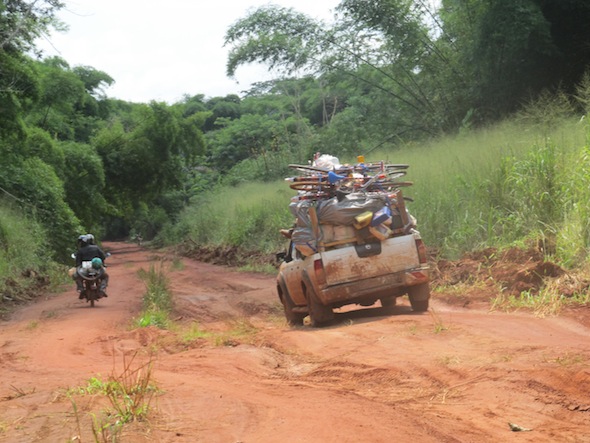
The next day, our goal was to reach Buta Town by nightfall. From our caravan of motorbikes, we held our breath as we watched the Nissan catapult across the 35 km warren of mud pits separating Sukisa from Buta. It seemed a miracle that Karsten’s delicate camera traps survived the truck’s repeated lurching out of one rut and down into the next.

Our entry into Buta Town was heralded by a conflict between our ICCN guards and the local military police, who were stationed at the Rubi River Bridge. In order to avoid confusion, Henri had planned that our phalanx of vehicles would cross the city bridge together, but as the Nissan forged ahead onto the bridge, at the last minute one of our of motorbikes stalled. Pichou the wily mechanic leaped off our bike and in a flash fixed the problem. The motorbike’s engine revved, and we sped across the bridge in the wake of the truck, but it was too late. The military police (MPs), confronted with a truck-full of armed Ecoguards, were irate that they had not been informed of our mission by a ‘responsable’. As usual, it didn’t matter at all that we had sent an advance message to the Buta authorities. We pulled up to the check-point, into what was rapidly developing into a tense stand-off. Our hired driver was yelling at the MPs, and the MPs and the Ecoguards were shouting and posturing angrily at each one another. Henri ably stepped to the side of the road with the head of the border police and explained the purpose of our mission and the reason we had not all arrived all at one time, while I hung back to diffuse a heated argument between an Ecoguard and an MP. Thanks to Henri’s diplomatic skills, we made it through the checkpoint with little more than a case of frayed nerves.

The rest of our stay in Buta went pretty smoothly, all things considered. The next day, Karsten, Henri, Ephrem, and I made the rounds to visit the important regional authorities: CDD, DGM, ATAR, and ANR. The reception we received was remarkably warm and polite compared to my visit in 2008, a testimony to the professionalism of the TL2 Lukuru Team and the respect with which the ICCN is accorded within the Congo. One thing that struck me as ominous, however, was the large herd of long-horned cattle and asses grazing the lawns of the governmental center; this livestock had undoubtedly been purchased from Mbororo traders. The nomadic Mbororo herders, originally from Mali, are currently migrating in a north-south wave across Northern DRC, with devastating effects on the local fauna. Native ungulates are replaced by cattle, savannahs are burned at the wrong time of year, and lions and other big cats are poisoned to keep them from preying on the domesticated herds. The Mbororo also frequently enter into aggressive conflicts with the local Congolese they meet. Clearly though, by selling cattle to Congolese merchants and authorities they are also now financially entrenched into the economy of Northern DRC.

The following day, Henri accompanied our ICCN guards to meet with the head of the Buta police as well as the regional commandant of the FARDC, the Congolese military, to arrange for our guards’ permission to work at Bili. This also went quite well… but as a reminder of how far we have to go in spreading our conservation ideals into this area, the commandant proudly introduced Henri and Ephrem to his pet orphan chimpanzee ‘Jaques de Bondo’, which he had acquired from the Bondo region to the north of the Uele River. Ephrem snapped the following photograph of the pitiable orphan:
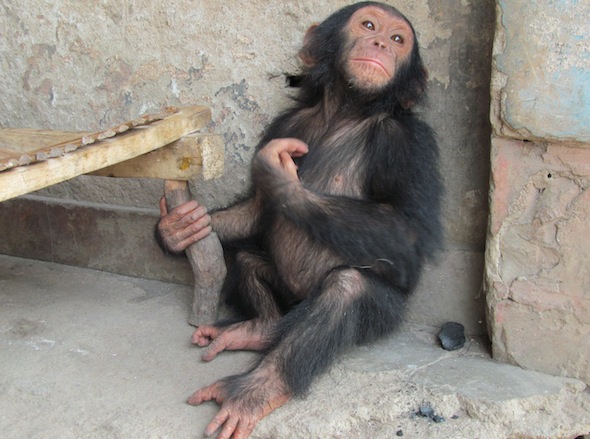
OprhanJaques De Bondo

Jaques de Bondo, a chimpanzee orphan kept by a high-ranking military official in Buta. Photo © Ephrem Mpaka.

(Recall from Hicks et al. 2010 that 25% of the chimpanzee orphans in this region belonged to military, police, or government officials / traditional authorities).

During our five days at Buta we saw a captive baboon, a patas monkey (from the Ango savannas to the northeast), and a guereza colobus monkey, as well as a key chain made from a forest buffalo tail. Little had changed in the four years since I was last here.

The next leg of our voyage, between Buta and the bucolic old colonial town of Titule, was impassable by truck; we returned our rented Nissan to Kisangani and loaded all of our supplies onto bicycles and motorbikes. Along the 130 kilometers of untamed boggy road between Buta and Titule, I counted the carcasses of 12 red-tailed guenons and one Dent’s monkey passing us on bicycles or offered for sale by the roadside, along with one duiker. In one tiny village we spotted two forlorn primate orphans which had been captured from the surrounding forests, an agile mangabey and a baboon. The baboon darted around nervously as we arrived to investigate, and was sniffed at and nuzzled by a number of village dogs. We struggled to communicate to the village patriarch why it was dangerous, unethical, and even foolhardy to keep primates as pets. This section of road remained a veritable bushmeat highway.
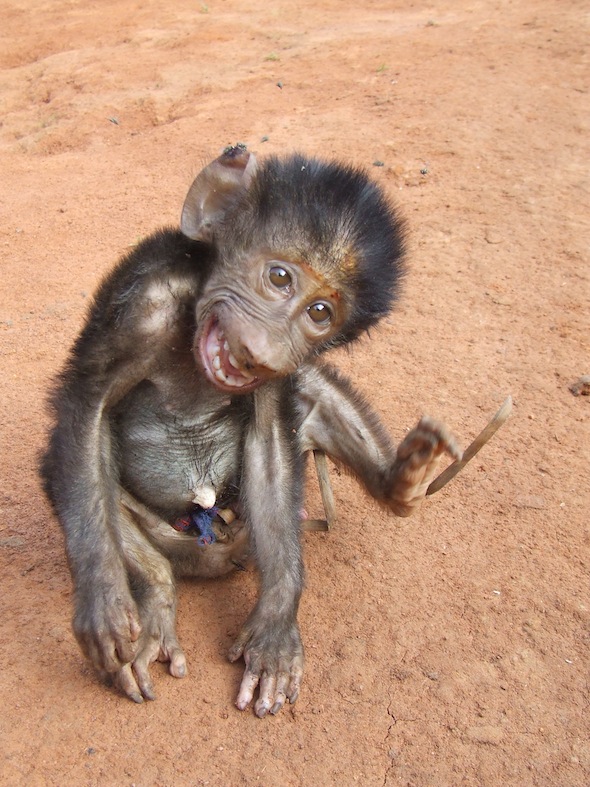
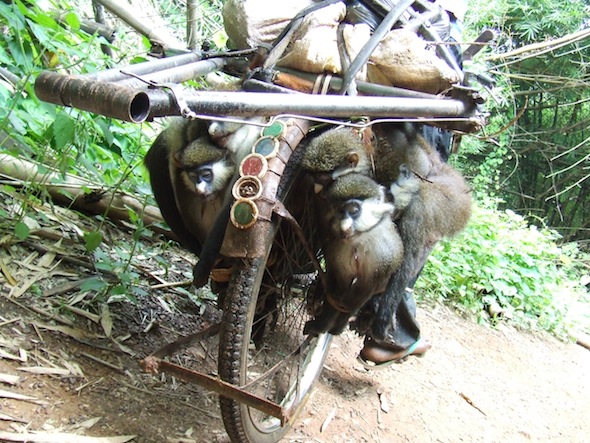
BaboonOrphan

MonkeysBike

Primate orphan and bushmeat encountered along the Buta-Titule Road.


TO BE CONTINUED…

Along the Bushmeat Highway: Part 1
Along the Bushmeat Highway: Part 3

Also by Dr. Cleve Hicks, The FARDC ‘Petting Zoo’ at Bili

This mission was made possible by the generous support of the Max Planck institute for Evolutionary Anthropology, The Lukuru Wildlife Research Foundation, The US Fish and Wildlife Service, l’ Institut Congolais pour la Conservation de la Nature, The Lucie Burgers Foundation, and The African Wildife Foundation.

Works cited:

Hicks TC, Darby L, Hart J, Swinkels J, January N, Menken SBJ. 2010. Trade in orphans and bushmeat threatens one of The Democratic Republic of the Congo’s most important populations of Eastern Chimpanzees (Pan troglodytes schweinfurthii). African Primates 7 (1): 1-18.

Filed Under: Advocacy, Free-living chimps Tagged With: advocacy, animal protection, animal rescue, animal rights, Animal Welfare, bushmeat, bushmeat orphans, chimpanzee, Chimpanzee Sanctuary Northwest, dr. cleve hicks, eyes on apes, free-living chimps

Along the Bushmeat Highway: Part 1

May 24, 2013 by Debbie

Dr. Cleve Hicks has written a very moving story about his encounters with the bushmeat trade and bushmeat orphans in central Africa as part of our guest blogging project. Dr. Hicks earned his master’s degree working with the chimps just down the road from us at the Chimpanzee & Human Communication Institute, and continues to study chimps in free-living Africa. He has worked for several years in the northern DRC studying chimps in the Bili Forest. This story is going to be split into three segments, so check back over the next few days for the continued pieces. WARNING: some disturbing images included in this entry (the most graphic ones are included as links in their caption).

—

LUKURU MISSION TO BILI, JULY 2012

As our caravan rumbled along the recently-repaired dirt road leading from Kisangani to Buta, I felt a sense of relief. We had temporarily left behind us the flurry of stamps, signatures, and copies in triplicate necessary to get us back to the forest of Bili, and I felt the same sense of expectation I had when I first arrived in DR Congo back in 2004. Every kilometer we put behind us was getting us closer to the chimpanzees of Gangu Forest. Our caravan consisted of four motorbikes and a Nissan rented from the Institut Congolais pour la Conservation de la Nature (ICCN), which was brimming over with bicycles, trunks, researchers, and Ecoguards.

TeamBili2July2012

Team Bili, 2 July 2012, preparing for our departure from Kisangani (together with TL2 researcher Dino Schwa; photo by team member Gilbert Paluku).

Our truck had briefly broken down back in Banalia, putting us several hours behind schedule, and it was now clear that we would not reach our destination, the frontier town of Buta, by nightfall. Project Pro-Routes had done an excellent job repairing the road since I last suffered to travel over it back in 2008, but we had been told that the final 35 km before Buta remained a morass of muddy pits, lurching divets, and lop-sided gulleys, which we could not risk getting stuck in at night. Fortunately at around sundown we found ourselves pulling up at the road block set up by ICCN guards at Sukisa, the guard station established to check vehicles for bushmeat as they passed through the Rubi-Tele game reserve. As Lukuru team leader Henri Silegowa and I watched our six ICCN guards greet their Rubi-Tele compadres, Henri said, “Nous sommes chez nous.” (“We are at our house.”) The Rubi-Tele guards were sharply outfitted in new uniforms, carried arms, and projected a highly motivated and professional demeanor. The station had come a long way since Terese Hart visited it in 2007 on her faunal survey of the forest (Hart 2007). After having spent so many years working to raise awareness about the neglected wildlife of northern DRC, it was exciting to see that the region was no longer being ignored.

Caravan

We stretched our cramped limbs, wiped the red road mud off our faces, and happily accepted the chairs offered us by Monsieur Jean Robert Lobela, the station’s Chef des Gardes. He apologized that the chief conservateur was away in Kisangani, but then enthusiastically asked us if we would like to see some of the items they had confiscated here recently. He led us across the road to a mud building, from out of which his men pulled two tattered but still gorgeously-striped okapi skins confiscated within the last year from poachers’ camps inside the game reserve.  We could see from the tag attached the ear of the first horned skin, which belonged to a male, that it was taken in 2011. The female skin beside it was only three months old. With the distressing news from the previous week of the slaughter of park guards and okapis at Epulu still fresh in our minds, it was disturbing to see the killing taking place here as well, but at the same time heartening to see that someone was taking the problem seriously.

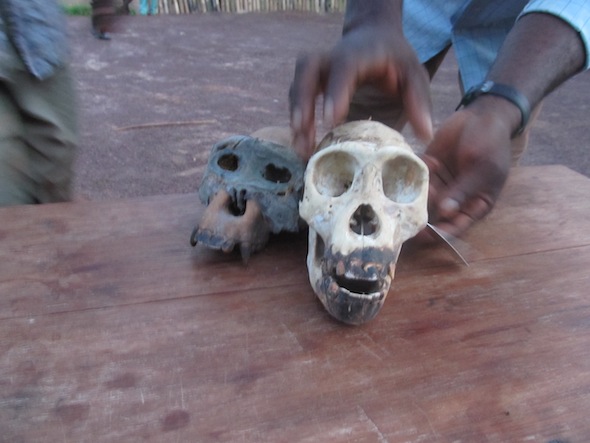
Next, Monsieur Lobela brought us two scarred, blackened skulls of chimpanzees, each tagged and inscribed with the date and location of confiscation. One, tagged from 2012, had belonged to a small male with large pointy canines, and came from a poachers’ camp about a day’s walk to the north. I then inspected the tag on the larger skull, that of an adult female. Her incisors had been charred black from being slowly smoked over a campfire, and a dingy ring of soot circled her mouth.

ChimpSkullsSukisa

Chimpanzee skulls recently confiscated from hunting camps within Rubi-Tele.

I was startled to see a familiar name on her tag: Ephrem Mpaka, 4 September 2011. Our very own Ephrem, TL2 researcher and now part of our Bili team, who was part of the group gathered around this macabre collection of carcasses. Later, in his typical animated style, Ephrem recounted the story to us:

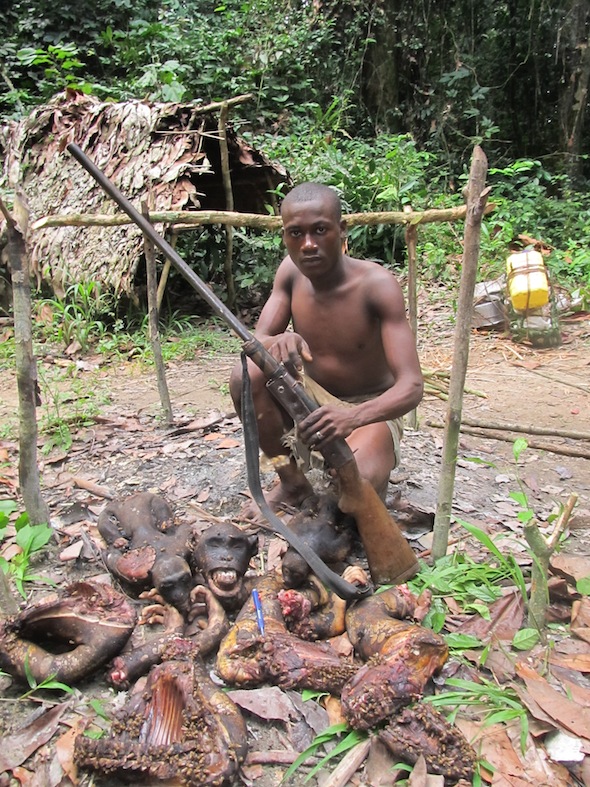
In September 2011, Ephrem was on a mission for Lukuru Foundation to collect okapi dung samples inside Rubi-Tele, but he was also interested in other protected species. One evening he was on a patrol with ICCN guards about seven km west into the forest. They had already spotted a number of fresh chimpanzee nests in this region, and heard their pant hoots and drums. As he and the guards walked down a hunters’ trail, they heard resonating through the still forest the whacks of a machete against a tree. Someone was gathering firewood. Following the trail to the sounds, they arrived at a small hunting camp, for the moment occupied by only one woman. Spread across a smokestack above a smoldering fire was the blackened carcass of a female chimpanzee along with two monkeys. Acting quickly before the woodchoppers returned, the guards grabbed the 12-gauge shotgun they found by the hunting shack, apprehended the woman, and then fanned out into the forest to arrest the two male residents of the camp. The poachers, Basoko people from a village located within the reserve, offered no resistance. When asked why they had decided to hunt inside the reserve, they explained that there was a mourning ceremony taking place at their village, and they had been sent out into the forest to bring back meat. Ephrem documented the scene with the following disturbing photographs which he kindly shared with me. He later returned with the chimpanzee skull to Sukisa base and tagged it.

In September 2011, Ephrem Mpaka of Lukuru Wildlife Research Foundation took this photograph of the confiscation by ICCN guards of a smoked chimpanzee (along with an Angolan colobus and a red tailed guenon) at a poachers’ camp inside Rubi-Tele DC. In addition, during the month he was there, Ephrem documented 11 okapi skins that had been taken from the reserve in addition to the ones we had just been shown.

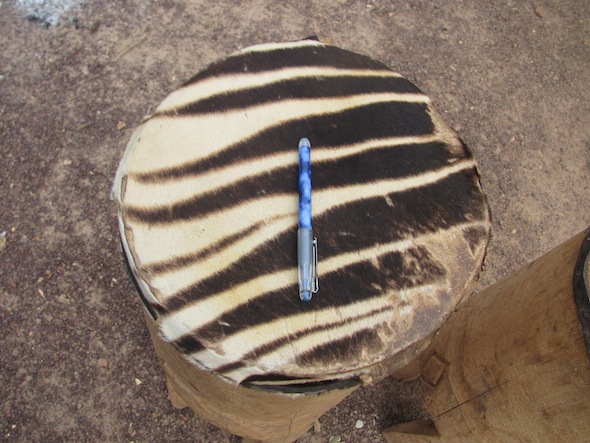
OkapiChurchDrum

Is this the best use we can think of for the beautiful okapi? An okapi skin church drum in the Rubi-Tele region in 2011.  Perhaps religious leaders could be convinced to speak out against this custom. Photo © Ephrem Mpaka.

It was clear that the large-scale killing of chimpanzees and other primates which I had documented in the area between 2007 and 2008 (Hicks et al. 2010) had continued unabated in the intervening years. But one question remained unanswered: had it spread to the forests of Bili in the north?

TO BE CONTINUED…

Along the Bushmeat Highway: Part 2
Along the Bushmeat Highway: Part 3

Also by Dr. Cleve Hicks, The FARDC ‘Petting Zoo’ at Bili

This mission was made possible by the generous support of the Max Planck institute for Evolutionary Anthropology, The Lukuru Wildlife Research Foundation, The US Fish and Wildlife Service, l’ Institut Congolais pour la Conservation de la Nature, The Lucie Burgers Foundation, and The African Wildife Foundation.

Works cited:

Hart T. 2007. Evaluation de l’Etat de Conservation Domaine de Chasse de Rubi-Télé : Inventaires fauniques, contexte historique et recommandations pour assurer la conservation du site en rapport avec la réhabilitation de la Route National 4. Un rapport soumis à l’ AGRECO dans le cadre de la mise en oeuvre de l’Etude d’Impact Environnemental et Social dans la Zone du Projet PROROUTES.

Hicks TC, Darby L, Hart J, Swinkels J, January N, Menken SBJ. 2010. Trade in orphans and bushmeat threatens one of The Democratic Republic of the Congo’s most important populations of Eastern Chimpanzees (Pan troglodytes schweinfurthii). African Primates 7 (1): 1-18.
Filed Under: Advocacy, Free-living chimps Tagged With: advocacy, animal protection, animal rescue, animal rights, Animal Welfare, bushmeat, bushmeat orphans, chimpanzee, Chimpanzee Sanctuary Northwest, dr. cleve hicks, eyes on apes, free-living chimps, primate rescue

Resilience

May 21, 2013 by Debbie

This is the first of a series of guest blogger posts from researchers that work with free-living apes. Maureen McCarthy graduated from the Chimpanzee and Human Communication Institute and is currently a PhD candidate at the University of Southern California. She is doing research with chimpanzees in Uganda and has a regular featured blog on Scientific American’s blog. Here’s her most recent entry that mentions Foxie:

—

Their chorus of pant hoots gave them away in dramatic fashion. The chimpanzees we’d been looking for were nearby, and we knew exactly where to find them. Though farmland and trees blocked our view, we could hear that the chimpanzees had arrived at a particular fig tree laden with ripe fruits. As ripe fruit specialists, chimpanzees seek out fruiting figs like this Ficus exasperata. On a good day, we can use our knowledge of when these figs are ripening to help us find the chimpanzees.

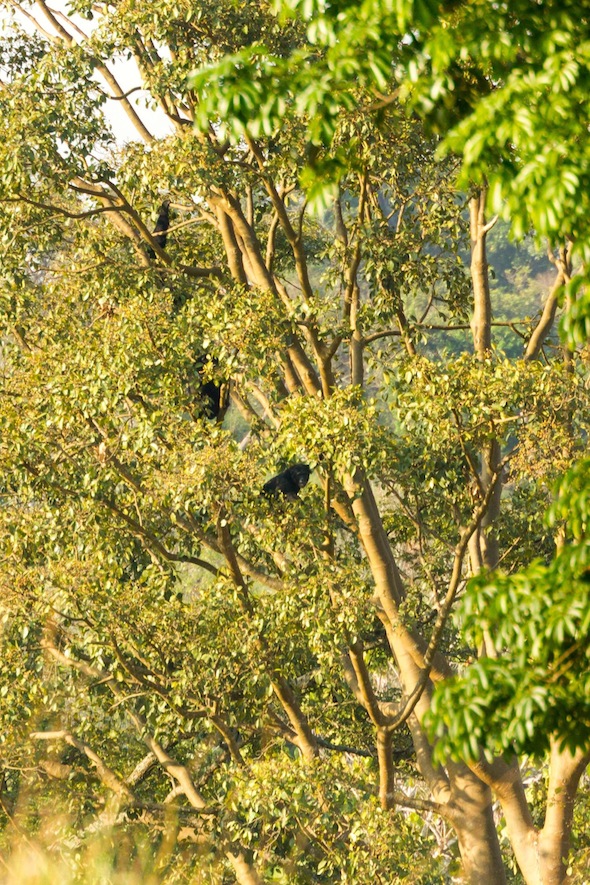
We took a circuitous route through the gardens to a grassy hilltop with a clear, albeit distant, view of the Ficus.  I dropped my backpack and pulled out my binoculars. I began to scan the tree in an attempt to identify the large dark figures foraging. I could make out the silhouettes of at least seven or eight chimpanzees, all foraging on figs or seated in the huge tree.

Photo 1

Chimpanzees feed in a Ficus exasperata tree. Photo © Jack Lester.

After observing their foraging for a few peaceful moments, I heard a jarring but familiar sound. A man working in a garden nearby shouted at the chimpanzees. Though the tree was in an isolated area of grassland several dozen meters from where he worked, he was clearly uncomfortable with their presence. A few threatening shouts were enough to convince the chimpanzees it was best to cut short their breakfast. They descended quickly from the fig. I now counted twelve chimpanzees as they walked in a single file line back across the grassland and to a small patch of forest nearby. As we watched them go, field assistant Nick commented that he felt sorry for the chimps.

At times like these, I am reminded of one of the most recurrent lessons from my research thus far: chimpanzees are surprisingly resilient. They may have waited until later to forage, or perhaps they found another source of nutrition (which, unfortunately, may have involved risky crop-raiding). However, as long as no one hunted them or set a mantrap to ensnare them, as is sometimes the case, they probably found something to eat and survived another day. Despite the rapid rate of forest degradation in their habitat, they have persisted. They continue to forage, reproduce, and tend to the complex political matters of chimpanzee life, even if these behaviors must be modified somewhat to fit a drastically altered environment.

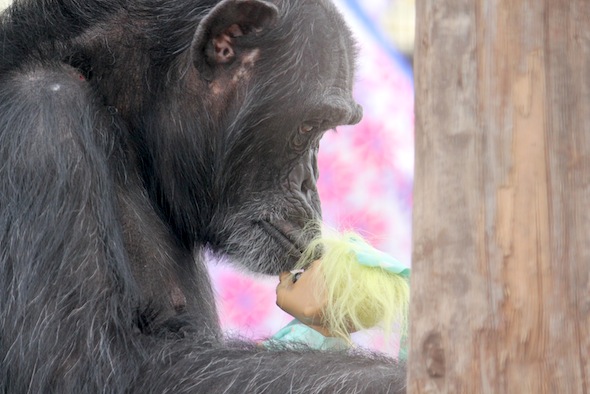
I was again reminded of chimpanzee resilience when, on a recent visit to my mother’s home, I opened an old box to find my childhood collection of troll dolls. After a moment’s consideration, I decided to send them to a chimpanzee named Foxie. Foxie is a resident of Chimpanzee Sanctuary Northwest (CSNW), a sanctuary in Cle Elum, Washington that serves as home to seven chimpanzees. The “Cle Elum Seven,” as they are known, have lived in biomedical laboratories for most of their lives. They were involved in invasive hepatitis vaccine research and used for laboratory breeding. Foxie gave birth to five infants, but was forced to give them all up, just like so many other breeding female chimpanzees in laboratories. Perhaps as a fulfillment of the maternal behaviors she was never able to express, Foxie can now usually be found carrying a troll or other doll with her.

Photo 2

Foxie cares for a troll doll.

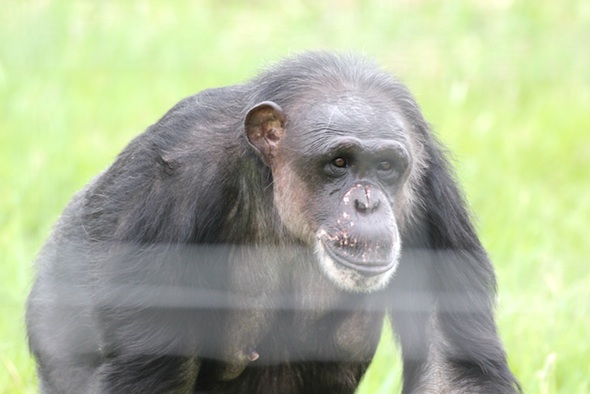
The caregivers who know Foxie and the other members of the Cle Elum Seven can attest to this adaptability. All seven have displayed drastic changes in both behavior and physical appearance since arriving at CSNW several years ago. The shift from a windowless laboratory basement to a spacious sanctuary with dedicated caregivers and outdoor access has—not surprisingly—had an unambiguously positive effect on them.

Why might chimpanzees be so adaptable to change?  It may have aided the survival of their ancestors–and ours. For example, many primates regularly face drastic seasonal changes in rainfall, temperature, and food availability. Some primates have specialized adaptations that help them survive under harshly changing seasonal conditions. For chimpanzees, a learned knowledge of the fruit tree locations, even during periods of low fruit availability, is critical. Chimpanzees acquire this knowledge over a prolonged period of development, with high reliance on their mothers until full weaning at age 5, followed by juvenile and sub-adulthood learning periods lasting until age 15. A high degree of neural plasticity facilitates this learning ability. In humans, an especially high degree of plasticity may aid our strong reliance on learning. Plasticity may also play a key role in what we call resilience, enabling both humans and our chimpanzee kin to roll with the punches during trying times. For chimpanzees today, this may mean finding a new fruit tree when one due to ripen has been felled, or basking in the sun for the first time after decades inside a laboratory.

This post was originally published at Scientific American.

Filed Under: Advocacy, Free-living chimps Tagged With: advocacy, animal protection, animal rescue, animal rights, Animal Welfare, chimpanzee, chimpanzee rescue, chimpanzee retirement, Chimpanzee Sanctuary Northwest, Cle Elum 7, Cle Elum Seven, csnw, eyes on apes, Foxie, free-living chimps, maureen mccarthy, primate rescue, rescue, resilience, Sanctuary, uganda

Upcoming guest bloggers

May 18, 2013 by Debbie

I’m pretty excited to announce that we’re going to be featuring some guest bloggers who work with apes in the wild! Our mission at the sanctuary is to provide quality lifetime care for the Cle Elum Seven, but also to advocate for apes everywhere. If you’re signed up for our Take Action list, you’ve probably received some action alerts from Eyes on Apes before. These are usually for issues that our nonhuman ape cousins face close to home, like the entertainment, pet, and biomedical industries.

Free-living apes are facing a whole different set of issues. In Africa their habitat is slowly being torn down, and the logging roads create access for hunters to easily hunt chimpanzees, gorillas, bonobos, and a whole slew of other exotic animals and sell their meat on the black market (it’s called the bushmeat trade). In Southeast Asia, orangutans are losing much of their habitat to palm oil plantations and other agricultural development.

From afar, there’s only so much detail we can provide—but those who are right there witnessing these issues can paint a very different picture. Our goal is to have them tell their stories, and help us to help our closest living relatives who are literally facing extinction.

We already have folks lined up for this exciting project: Dr. Cleve Hicks (former graduate student at the Chimpanzee and Human Communication Institute just down the road) who is now working with apes in the Bili Forest in central Africa; Dr. Debra Durham who is currently in east Africa and has expertise in both captive and free-living issues (you might remember this article about PTSD in ex-biomedical lab chimps, including Negra); and Dr. Zarin Machanda who met JB and Diana at the Fauna Foundation years ago, and has worked with chimpanzees in east Africa. Stay tuned for these stories with great information coming very soon!

Here’s a photo of Negra, who now gets to have sunshine, friends, and choices after being stolen from Africa and used in biomedical research for decades. Let’s raise awareness about others like Negra still in labs, and for her relatives in Africa that need our help. Share this video and subscribe to the blog if you haven’t already, so you’ll be sure to get notified of the upcoming guest blogger posts!

web Negra green grass Young's Hill YH IMG_8027

—

Guest blog posts:

Resilience and The Landmine Snare by Maureen McCarthy

Along the Bushmeat Highway: Part One, Two, and Three and The FARDC ‘Petting Zoo’ at Bili by Dr. Cleve Hicks

Video interview Part One and Part Two with Dr. Debra Durham (presented as a Take Action Tuesday posts)

Jacky and Nama by Dr. Sheri Speede

Meet the Chimpanzees of Kanyawara and Research at Kanyawara by Dr. Zarin Machanda

Margot and Is successful reintroduction possible? by Dr. Gwendy Reyes-Illg

Why are orangutans endangered in the wild? by Rich Zimmerman

Filed Under: Advocacy, Free-living chimps, Negra, Sanctuary Tagged With: advocacy, africa, african rainforest logging, animal protection, animal rescue, animal rights, Animal Welfare, bushmeat trade, chimpanzee, chimpanzee rescue, chimpanzee retirement, chimpanzee sanctuary, Chimpanzee Sanctuary Northwest, Cle Elum 7, Cle Elum Seven, cleve hicks, csnw, debra durham, eyes on apes, free-living chimps, free-living orangutans, indonesia, malaysia, Negra, orangutan, palm oil, primate protection, primate rescue, Sanctuary, wild chimpanzees, wild orangutans, zarin machanda

Take Action Tuesday: Chimpanzee populations in crisis

October 16, 2012 by Debbie

Up until recently, our advocacy efforts have focused on apes in entertainment and biomedical research. However as part of Eyes on Apes, we want to help advocate for the plight of free-living apes, too. (And we’ll be featuring some guest blogs from free-living researchers in the coming months, too!) I read an article the other day about chimpanzees attacking humans after they encroached on the chimpanzees’ home. Some people were fearing that the chimpanzees were seeking revenge. I don’t necessarily think that is true (though I can never know for sure since I can’t read minds) but I do think that chimpanzees do not belong in a human world. And when humans involve themselves into a chimpanzees’ world, it is a sad story all around. Chimpanzees do not belong in captivity, they belong in Africa. But what has become of their home? Humans have torn down forests to log expensive woods. We have hunted chimpanzees and sold their meat on the black market, and baby chimpanzees have become orphaned. We have slashed and burned forest to make room for farming. We have mined for coltan in the deep rainforest, causing habitat destruction and allowing access for hunters just like the logging industry. Free-living populations are decreasing from all of these issues.

And what can we do? We can be conscious consumers. Don’t buy wood that comes from Africa—in the U.S. that is mostly teak and mahogany. Recycle old cell phones and laptops and anything with an LCD screen (which contains coltan). But what else can we do? Today, you can write a letter to congress asking them to make these issues that you care about a priority.

One day, I hope there will no longer be chimpanzees in captivity. I hope I will be out of a job because that would mean there would be no need for sanctuaries. Sadly, I don’t know that will happen in our lifetimes but I do think someday, people will stop exploiting chimpanzees for a cheap laugh or invasive research. And, I hope that at that same time, there will be thriving populations in Africa where they belong, and that humans will have reduced our impact so much so that chimpanzees can simply be chimpanzees—no humans involved.

Filed Under: Advocacy, Free-living chimps Tagged With: advocacy, animal protection, animal rescue, animal rights, Animal Welfare, bushmeat, bushmeat orphans, chimp rescue, chimpanzee, chimpanzee rescue, chimpanzee retirement, Chimpanzee Sanctuary Northwest, Cle Elum Seven, coltan, csnw, free-living chimps, habitat destruction, hunting, logging, Sanctuary, take action tuesday

  • « Go to Previous Page
  • Page 1
  • Page 2

Primary Sidebar

Subscribe To the Blog and Get Notified of New Posts First!

Archives

Calendar of Blog Posts

June 2026
S M T W T F S
 123456
78910111213
14151617181920
21222324252627
282930  
« May    

Categories

SUBSCRIBE TO OUR NEWSLETTER

Footer

PO Box 952
Cle Elum, WA 98922
[email protected]
509-699-0728
501c3 registered charity
EIN: 68-0552915

Official DDAF Grantee

Menu

  • The Chimpanzees
  • Blog
  • About Us
  • You can help
  • Resources
  • Contact
  • Donate

Proud Member of

Connect With Us

Search

Copyright © 2026 Chimpanzee Sanctuary Northwest. All Rights Reserved. Site by Vegan Web Design