• Skip to main content
  • Skip to primary sidebar
  • Skip to footer

Chimpanzee Sanctuary Northwest

Hope. Love. Home. Sanctuary

  • Our Family
    • The Chimpanzees
    • The Cattle
  • Blog
  • About Us
    • Visiting the Sanctuary
    • Philosophy
      • FAQs
      • Mission, Vision & Goals
      • Privacy Policy
    • The Humans
      • Staff
      • Board of Directors
      • Founder
    • Annual Reports
    • The Future of CSNW
    • CSNW In The News
  • You can help
    • Donate
      • Become a Chimpanzee Pal
      • Sponsor A Day
      • Transfer Stock
      • Be A Produce Patron
      • Be a Bovine Buddy
      • Give from your IRA
      • Personalized Stones
      • Bring Them Home Campaign
    • Leave A Legacy
    • Employment Opportunities
    • Volunteer
    • See Our Wish List
    • Events
  • Resources
    • About Chimpanzees
    • Enrichment Database
    • Advocacy
      • Advocacy Action Center
      • Apes in Entertainment
        • Trainers
        • Role of the AHA
        • Greeting Cards
      • Chimpanzees as Pets
      • Roadside Zoos
      • Chimpanzees in Biomedical Research
      • Conservation
        • African Apes
        • Orangutans
  • Shop
    • Merchandise Store
  • Contact
  • DONATE NOW

communication

Come and Knock on Our Door, We’ve Been Waiting for You

December 2, 2025 by Chad de Bree

We are ch-ch-chuggin’ along with integrating George into a larger social group. Today marks another milestone in that goal. Rayne has now moved in with George and Cy permanently. This part of the introduction has gone pretty good so far, though it did have some of the challenges mentioned before in other meeting George had with Rayne. There had been some brief conflicts between them, with Cy acting as mediator. The only real time we have seen Cy “take a side” was when George lashed out at Cy for a minute, which really wasn’t taking a side as much as it was defending himself.  Chimp politics, amirite?

But since then, the three have made up and we have caught them playing with each other at various points in the day.

What was the miscommunication? I’m not sure, personally, but they know. Which brings up on of the questions we received from last week’s invitation for questions.

One of our long time followers, Kathleen, had asked about my perspective on the role gestural communication plays in this integration process with George. In my view, it plays a pretty significant role.

As you may remember, for most of his life, George has lived with one other female or completely alone. There are several different theories on how gestural communication is acquired, but really they learn it primarily from their mothers and the community they grow up in. And chimpanzees are remarkably resilient in adaptation. When females leave their group when they become of age to bear children, they will adjust the gestures they have learned growing up to match that of the new group that allows them in.

Why females? Chimpanzees in the wild live in a patriarchal society, meaning the males stay in the groups they are born into and the females leave to ensure the gene pool remains diverse enough to successfully reproduce.

One of the things an advisor on my thesis committee told me when I questioned why it’s easier to study the older male population compared to younger chimpanzees or females is because the older males are just that. Stubborn, “not going to change my ways,” old men. So their gestures are going to be the best representative of that group’s gesture repertoire.

That being said though, George is still a vibrant young man and is learning how to communicate with his new friends. This is my own personal opinion and not supported fully by any research, but I believe there is a basic blueprint to some gestures, but how it’s produce and the meaning it takes on is based on the environmental factor. My apologies but I couldn’t find the reference quick enough for this blog, but there is some kind of understanding chimpanzees in accredited zoos tend to understand each other better when they move between the facilities. Unlike those in other captive settings, zoo chimpanzees get to be raised by their mother for the most part. All the behaviors they have learned have been passed down from generation to generation originating initially from a relatively small group of wild caught chimpanzees. Chimpanzees used in the biomedical field had a different type of upbringing.

To me, the biomedical chimpanzees’ situation is very reminiscent of the case if the Nicaraguan deaf children who spontaneously created their own sign language. It’s a fascinating case study  I encourage you all to read. If you ever find it, there is also a really fun game called “Sign” that is based on it where you have to create your own gesture communication system with those you’re playing with. But again, it is my own personal theory backed by no formal research that those in a sanctuary setting are kind of piecemealing it together as they go. It is why I believe why there can be those misunderstandings in the beginning of introductions even though to our eyes it doesn’t seem like there isn’t any difference in the gestures they use with each other.

In this little example, you can see Rayne doing her group’s infamous “bunny hop” trying to get George to engage in play. It also seems like George is misreading it as a display so he is displaying back by trying to look bigger and hunching his shoulders over.
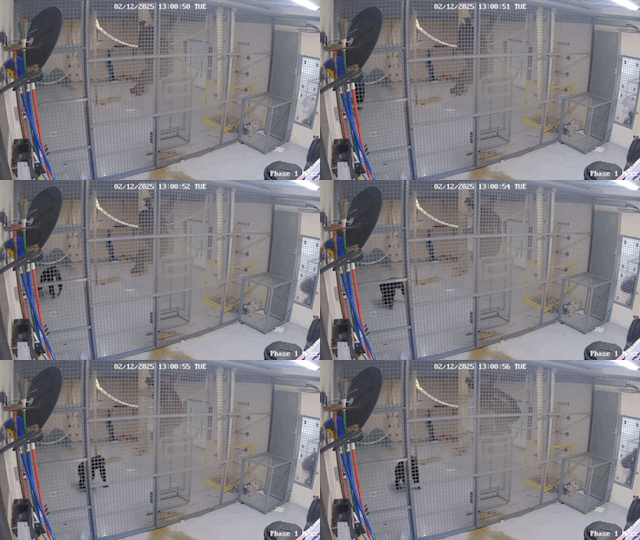
Luckily enough, in this instance, George picked up that Rayne’s intention was non-threatening so he engaged in a game of chase.
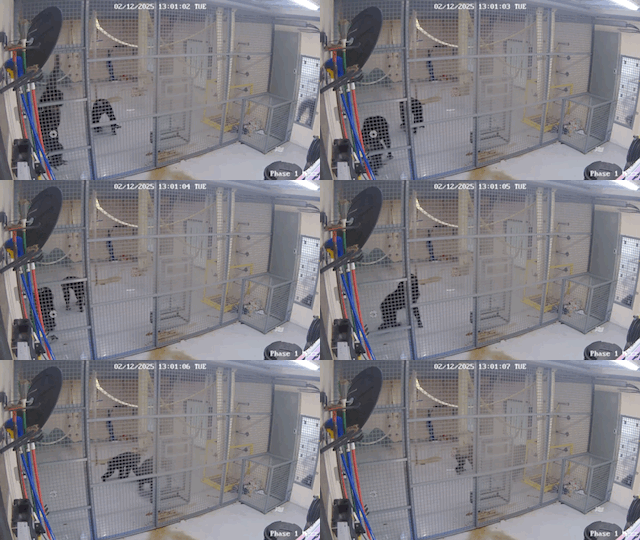
The bunny hops get everybody!

This next little clip is when I interpreted as evidence of George learning and adapting. The little “knocks” you see him doing to get Lucky to play don’t seem like much. If you were to ask any of the caregivers where they have seen this move before, however, there is a high chance they would respond, “Gordo.” That’s an almost exclusive Gordo move. We have not seen George do this until recently and after a recent intro with Gordo.
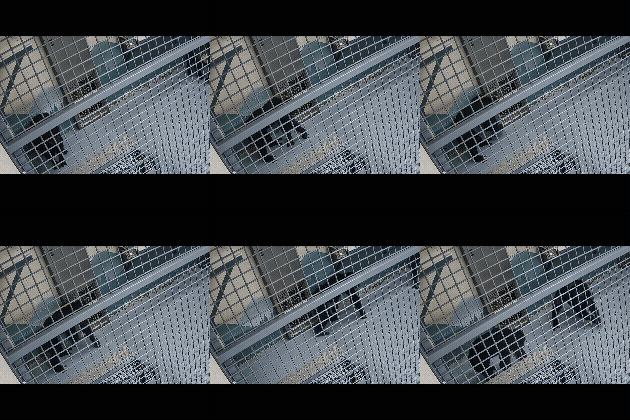
I cannot definitively confirm this because I am not George and can’t tell what he was thinking, but if I had to guess he picked it up to help himself be better understood by Lucky, who lives with Gordo. Again, that is my own guess.

Today is also Giving Tuesday! There is still time to help us reach our goal to help build a new support building for staff to work in! Any little bit gets us closer to helping us fully bring the expansion of our facility to reality!

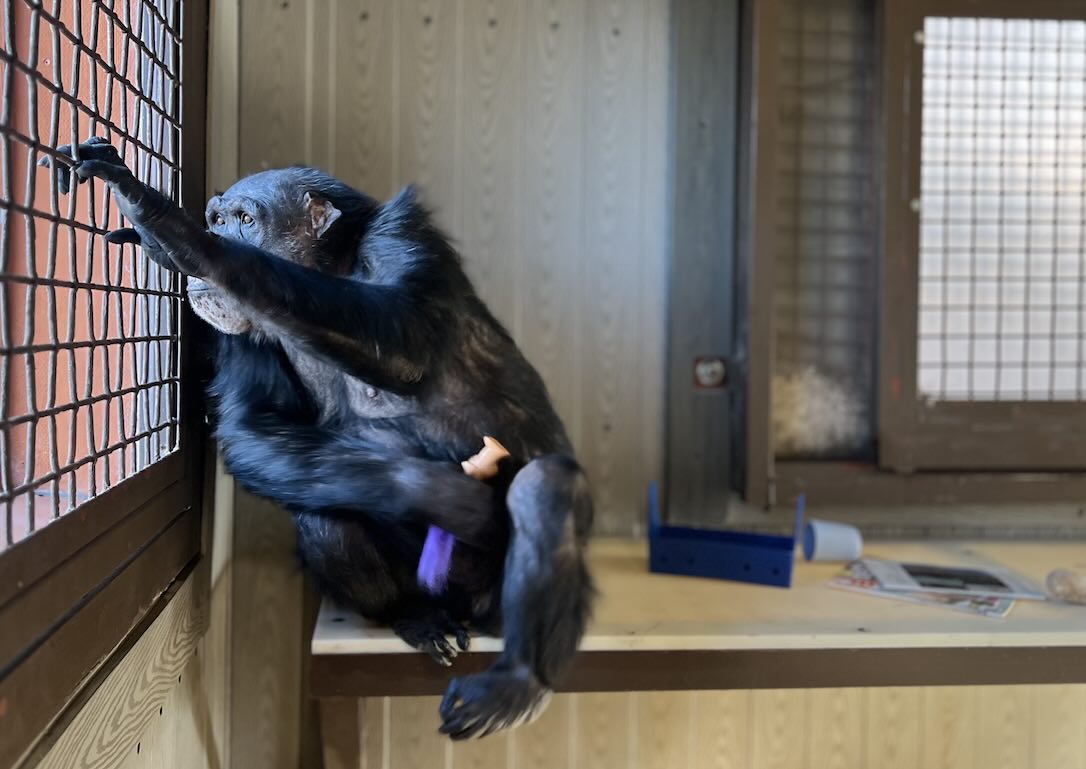
Bonus Photo of Negra coming in for lunch with a purple-haired Troll!
Filed Under: Chimpanzee Behavior, Cy, George, Rayne, Sanctuary Tagged With: communication, Cy, george, gestures, introductions, Rayne

Undercover Gorilla

October 6, 2025 by J.B.

Terry loves to try to impress the ladies next door with his gorilla impression.

Chest-beating is not normally part of a chimpanzee’s behavioral repertoire. However, in areas where chimpanzee and gorilla territories overlap, such as the Republic of Congo, chimps have been seen imitating their gorilla cousins. Having been born in a laboratory, Terry couldn’t have learned his chest-beating from any gorillas, so he must have come up with it on his own.

Or could he actually be a gorilla disguised as a chimpanzee?

Filed Under: Chimpanzee Behavior, Latest Videos, Terry Tagged With: chest-beating, chimpanzee, communication, gorilla, northwest, rescue, Sanctuary, Terry

Reach

June 23, 2025 by J.B.

Chimpanzee gestures carry different meanings depending on the context in which they are delivered. Here we look at the extended arm, or “reach” gesture, which can mean “hello”, “come here”, “give me that”, “hop on my back, it’s time to go”, or “it’s OK to approach me”, among other things.

Filed Under: Chimpanzee Behavior Tagged With: behavior, chimpanzee, communication, gesture, northwest, rescue, Sanctuary

Itching to Go

February 24, 2025 by J.B.

Chimpanzee gestures often have multiple meanings depending on the context. One gesture, known as exaggerated self-scratching or the Big Loud Scratch, can be either a request for grooming or a way to initiate group travel.

Missy, having finished her breakfast, was eager to take a walk up the hill and was seeking traveling companions.

But her friends were still working on their chow.

She waited for them to finish.

And soon she grew impatient.

Time for Quiet Little Missy to do a Big Loud Scratch.

“Let’s GO!”

The Big Loud Scratch is a clear and concise form of communication, but not always a compelling one. Sometimes, your friends will insist on eating before setting off on an adventure.

Filed Under: Chimpanzee Behavior, Missy Tagged With: big loud scratch, chimpanzee, communication, exagerrated, gesture, language, northwest, rescue, Sanctuary, scratching

Chimp-Specific Vocalizations

January 28, 2025 by Jenna

Chimpanzees have a variety of vocalizations: some to warn their group members of potential danger, some when they’re excited, some when they’re anxious or scared, some when they’re happy, playing, or greeting someone… In the captive world, the chimpanzees also use vocalizations to express their specific needs/wants to their caregivers. As CSNW caregivers, we have been conditioned to know what certain vocalizations are, based on who they come from and what the context is.

For today’s blog, I have compiled 6 of the top sounds you would hear from our chimp residents and I explain their special meaning.

Enjoy!

Filed Under: Caregivers, Chimpanzee Behavior Tagged With: captivity, caregivers, communication, hidden meaning, vocalizations

I Love You(r fennel)

June 24, 2024 by J.B.

Research has shown that chimpanzees utilize a wide variety of gestures to communicate with one another and that the meanings of these gestures are often understood by people with no training in chimpanzee behavior, suggesting the possibility of a universal ape vocabulary.

As Dr. Catherine Hobaiter states, “They target them to a specific recipient, and they do that with a specific goal in mind. Several gestures are very similar to those of humans: having your palm up is a begging gesture and pushing away with your hand means “go away,” she says.

With all due respect to Dr. Hobatier, I think she misses some of the more subtle nuances in each of these examples, so allow me (and Mave and Dora) so translate further:

Mave: I love you Dora. You know, I don’t say that enough. I love you. And I would do anything for you.

Dora: Gee, thanks Mave.

Mave: Would you do anything for me?

Dora: I guess so, sure.

Mave Can I have your fennel, then?

Dora: Get lost! You already had one!

Mave. But I love you.

Dora: I know, thanks.

Mave: Anytime, friend. So, about that fennel…

Dora. I’m outta here…

Filed Under: Chimpanzee Behavior, Dora, Intelligence, Latest Videos, Mave Tagged With: chimpanzee, communication, gesture, manipulation, northwest, rescue, Sanctuary

Non-Verbal Communication with the Chimps

February 5, 2023 by Jenna

Last month, I wrote about how we use verbal communication with the chimps. While I focused on their understanding of the English language, I failed to mention that the chimps who have come from Wildlife Waystation also understand some Spanish! Caregivers at Wildlife Waystation used Spanish frequently around the chimps, so they have some understanding of both languages. CSNW Caregiver, Sofìa, still speaks Spanish to them today, as she mentioned on the blog recently.

Today, I want to discuss a little bit about how we non-verbally communicate with the chimps. I think I could write a blog about this topic for several weeks straight, so I will just be scratching the surface today. If I don’t cover a specific question regarding non-verbal communication, please ask!

Like humans, chimpanzees are experts at reading body language. Have you ever encountered someone and you just know they have had the worst day possible, without them saying a word? The chimps can detect that too. Therefore, it is so important for us caregivers to leave our personal problems or stressors at the door. If we are experiencing conflict in our personal lives, we need to be able to switch that off so the chimps aren’t burdened with our problems. After all, we are in their home and we should try to bring the best energy possible. Even if we are feeling tired and have low energy that day, we attempt to come off neutral or peaceful. As their caregivers, we are apart of their social groups (for the better or the worse) and our attitude is important to their well-being. While they may not exactly be worried if they sense a caregiver is having a bad day (although they may), we need to ensure we are being only a positive or neutral presence in their lives so that we’re not affecting their daily group dynamics. Just like how we want them to all have a happy life, I’d like to think they want us to be happy too.

Just like how the chimps read our body language, that is how we read them as well. Chimpanzee facial expressions can help us gauge how they are feeling. From a play face, to a relaxed face, or a face that shows distress, we can use facial expressions as a clue to how the chimps may be feeling in that moment. Please refer to the “Chimpanzee Facial Expression” chart below for visual pictures. We also are able to tell when a chimpanzee may be worked up, as they will be piloerect- meaning their hair is standing on end. A chimpanzee may be piloerect during an intense situation or when something exciting is occurring.

Burrito piloerect on Young’s Hill

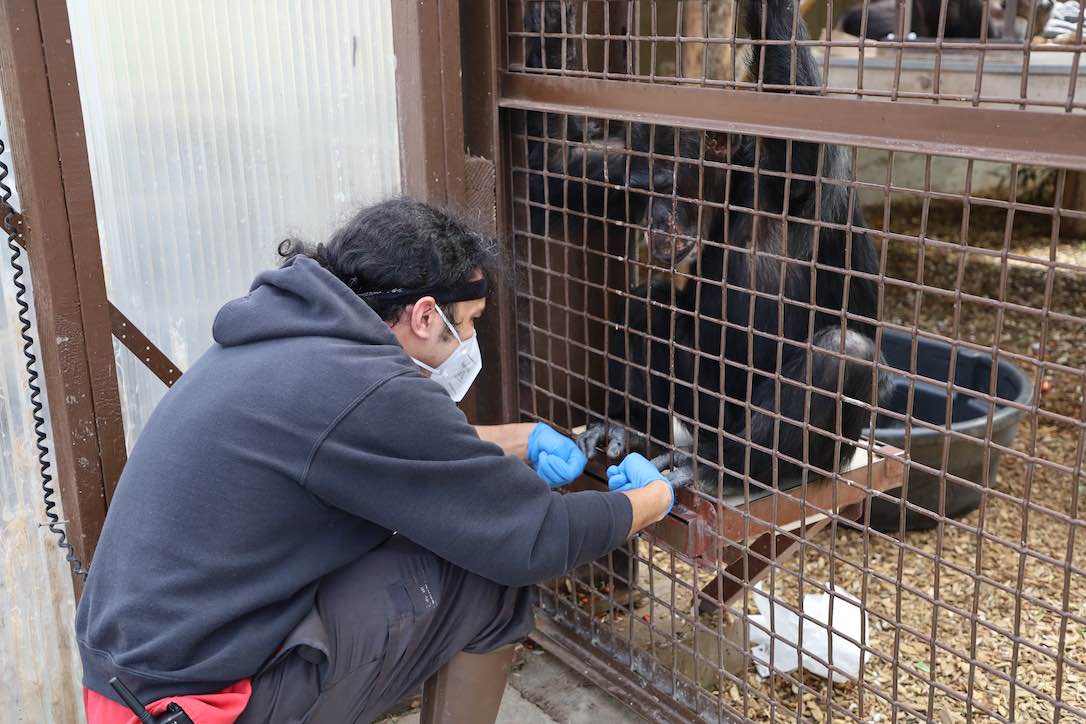
Chimpanzees also use gestures to communicate with each other and caregivers. I found this old video of Foxie asking Jamie for permission to retrieve a nut through head-bobbing (check it out here). And as Grace wrote in an earlier blog, many of our chimps use gestures to ask us for things specific to them (example: Jamie pointing to a specific boot she would like to see us wear). The chimps will point to items they want/need or stare at the item until we catch on. Burrito will use one index finger outside of the caging to indicate he would like to play his favorite game, “Poke a caregivers hand”, paired with a play face or a foot stomp, letting us know that we are about to have a fun, play session. Gordo will give us caregivers one simple look (it’s hard to describe), he will then scratch his torso (letting us know he is about to start to move), and off he goes as that is his way to indicate a game of chase. Cy will stand bipedally at the caging and accompany it with a foot stomp to let us know he is wanting to play chase. Cy also uses a “bronx cheer” (which I talked about in the verbal communication blog) when we aren’t engaging in his game of chase fast enough! Negra uses an “arm-extended” gesture to greet us caregivers in the morning (picture Negra with her arm fully extended while breathy panting from her bed). The list truly goes on and on.

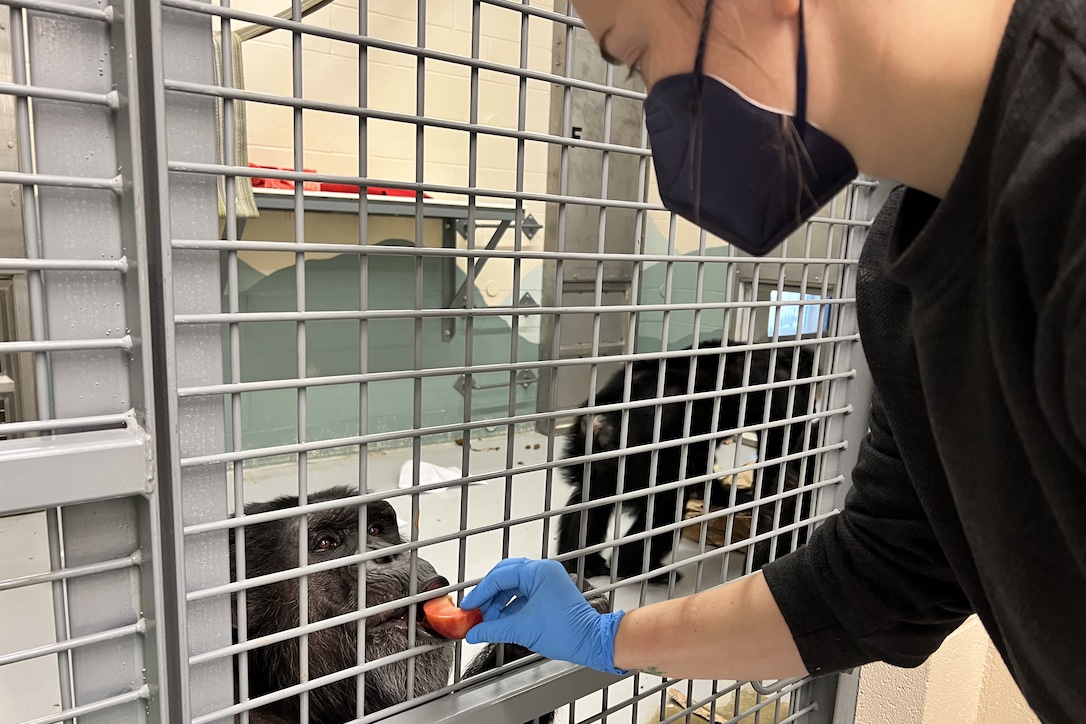
As caregivers, we use species specific behavior while interacting with the chimpanzees. This means that we greet the chimpanzees non-verbally first (through gestures, head nodding, and/or breathy panting), as a chimpanzee would greet another chimpanzee, and then we may use a verbal greeting to follow. When we are playing with the chimps, we will laugh and play like a chimpanzee as appropriate. While we now wear N-95’s around the chimps because of the pandemic, we used to exhibit a chimpanzee play face while engaging in a play session. During meals, we food grunt to let them know that it’s time to eat. We always try to prioritize using appropriate chimpanzee behavior first, then will use verbal communication with them as needed.

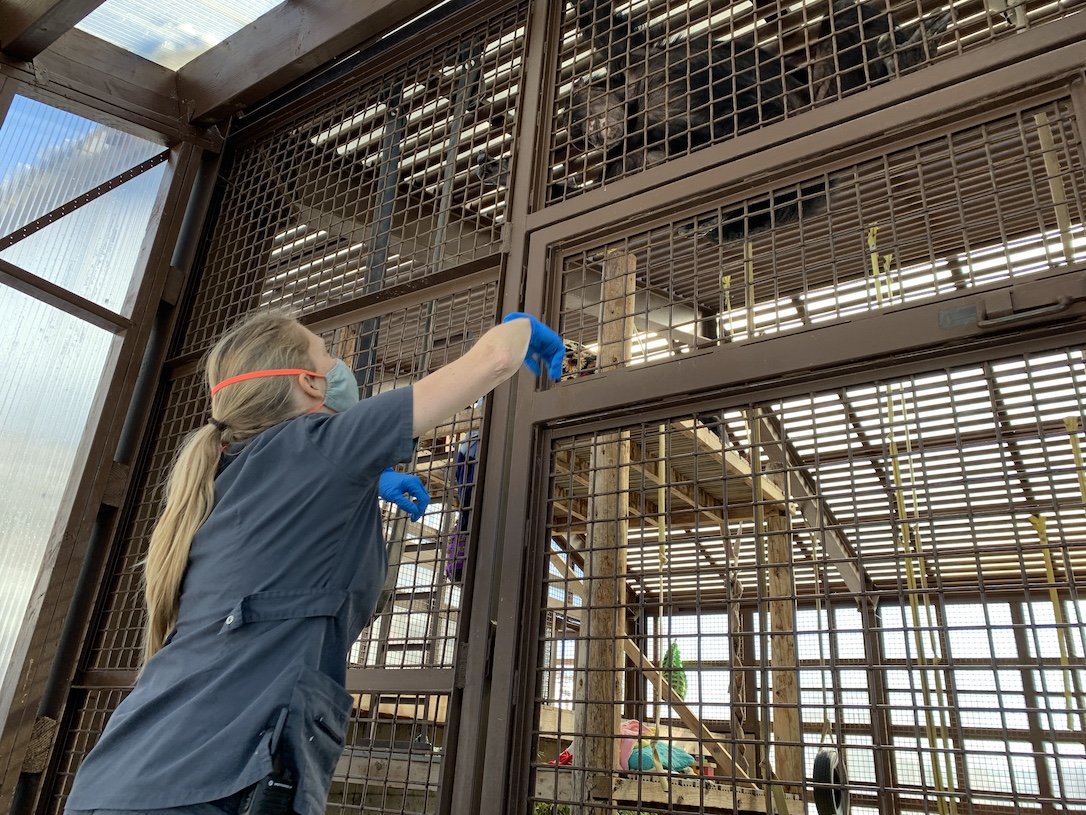
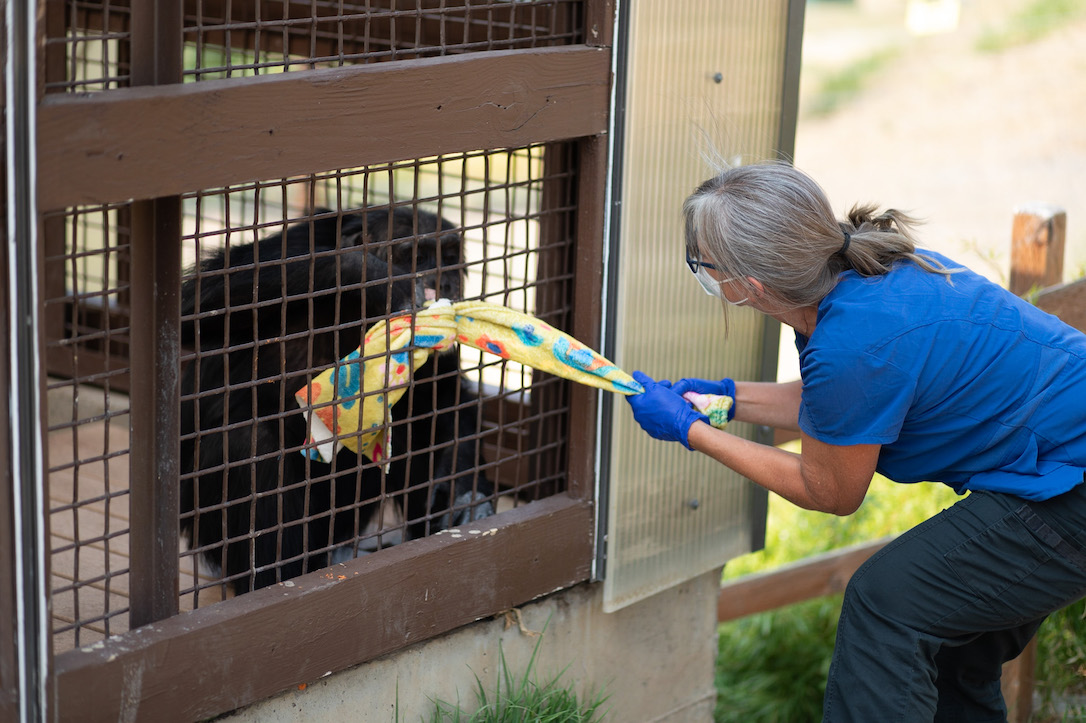
Grace serving Cy

Chad playing with Burrito

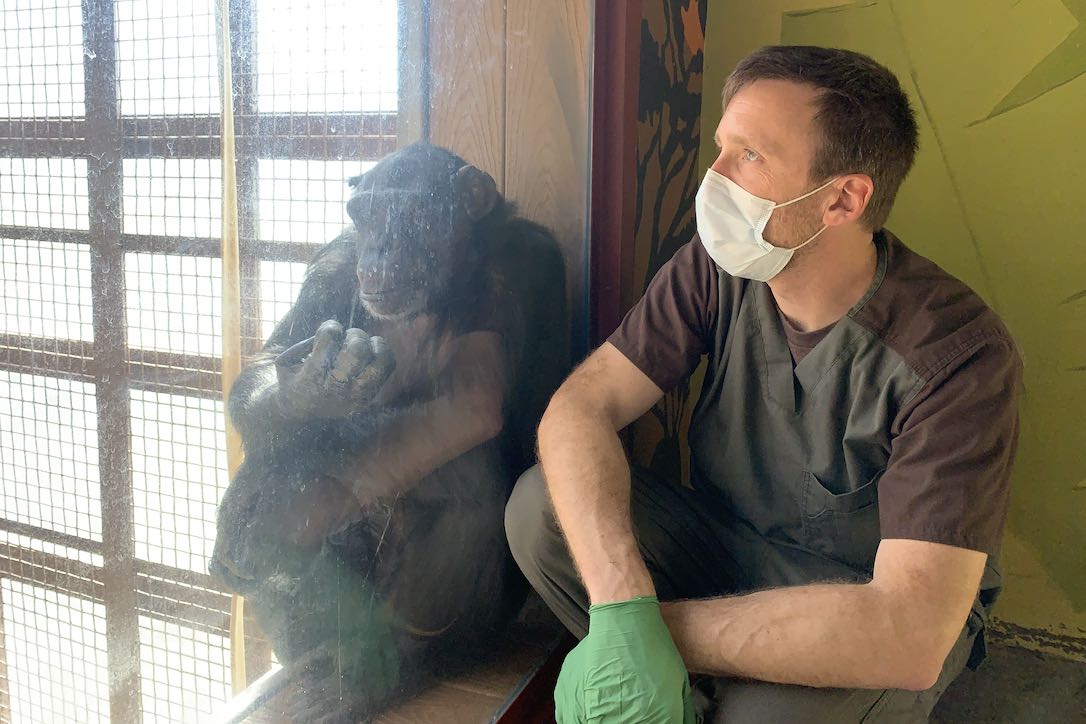
Anna sitting near Mave

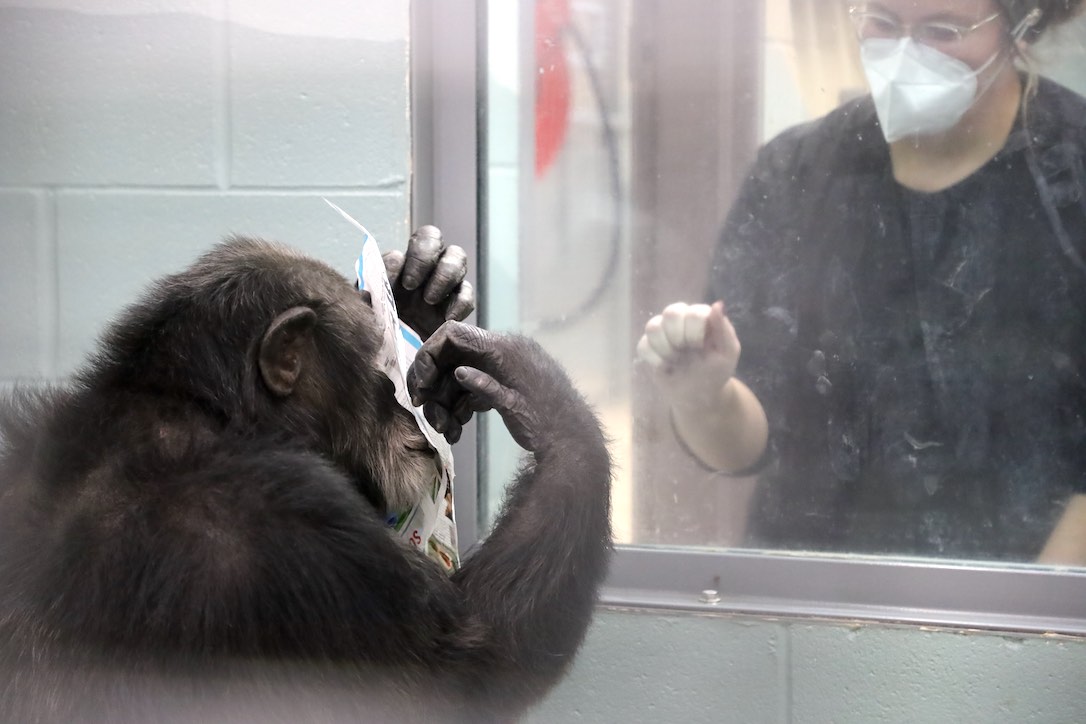
Diana playing with Burrito

JB sitting opposite of Jamie

Katelyn greeting Dora

Jenna playing with Gordo

Sofìa and Gordo

Dr. Erin playing with Burrito

Kelsi receiving Terry’s version of a kiss

Filed Under: Caregivers, Intelligence Tagged With: communication, non-verbal

  • Page 1
  • Page 2
  • Page 3
  • Go to Next Page »

Primary Sidebar

Subscribe To the Blog and Get Notified of New Posts First!

Archives

Calendar of Blog Posts

June 2026
S M T W T F S
 123456
78910111213
14151617181920
21222324252627
282930  
« May    

Categories

SUBSCRIBE TO OUR NEWSLETTER

Footer

PO Box 952
Cle Elum, WA 98922
[email protected]
509-699-0728
501c3 registered charity
EIN: 68-0552915

Official DDAF Grantee

Menu

  • The Chimpanzees
  • Blog
  • About Us
  • You can help
  • Resources
  • Contact
  • Donate

Proud Member of

Connect With Us

Search

Copyright © 2026 Chimpanzee Sanctuary Northwest. All Rights Reserved. Site by Vegan Web Design