• Skip to main content
  • Skip to primary sidebar
  • Skip to footer

Chimpanzee Sanctuary Northwest

Hope. Love. Home. Sanctuary

  • Our Family
    • The Chimpanzees
    • The Cattle
  • Blog
  • About Us
    • Visiting the Sanctuary
    • Philosophy
      • FAQs
      • Mission, Vision & Goals
      • Privacy Policy
    • The Humans
      • Staff
      • Board of Directors
      • Founder
    • Annual Reports
    • The Future of CSNW
    • CSNW In The News
  • You can help
    • Donate
      • Become a Chimpanzee Pal
      • Sponsor A Day
      • Transfer Stock
      • Be A Produce Patron
      • Be a Bovine Buddy
      • Give from your IRA
      • Personalized Stones
      • Bring Them Home Campaign
    • Leave A Legacy
    • Employment Opportunities
    • Volunteer
    • See Our Wish List
    • Events
  • Resources
    • About Chimpanzees
    • Enrichment Database
    • Advocacy
      • Advocacy Action Center
      • Apes in Entertainment
        • Trainers
        • Role of the AHA
        • Greeting Cards
      • Chimpanzees as Pets
      • Roadside Zoos
      • Chimpanzees in Biomedical Research
      • Conservation
        • African Apes
        • Orangutans
  • Shop
    • Merchandise Store
  • Contact
  • DONATE NOW

communication

Bronx Cheers

August 28, 2020 by J.B.

I remember when I first learned that adult house cats “meow” almost exclusively to humans and not to other cats. It’s still fascinating to me that in the course of domestication, not only have we selected for certain vocal tendencies in cats but they have also exploited some natural human perceptual tendencies to be able to express what they want – for example, food, affection, or help when they are in trouble. It’s a language, if you will, that exists only between our two species.

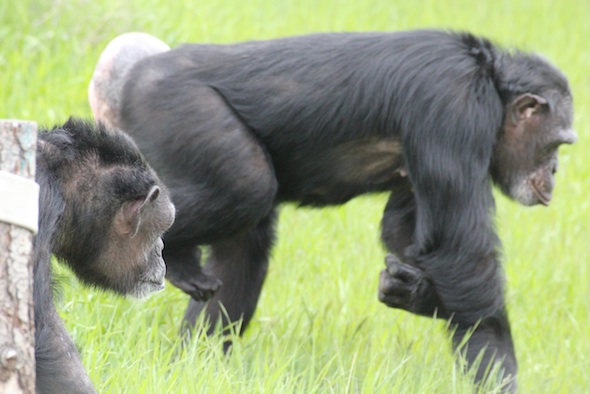
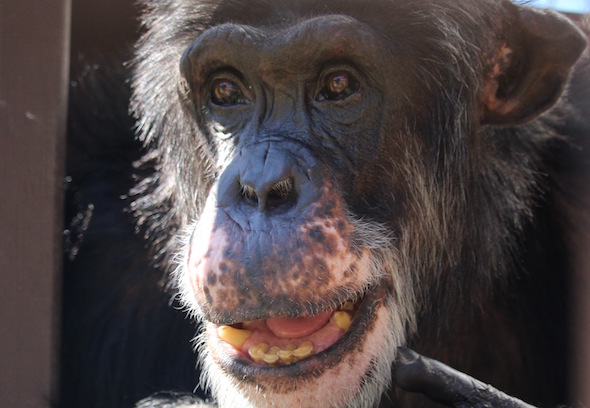
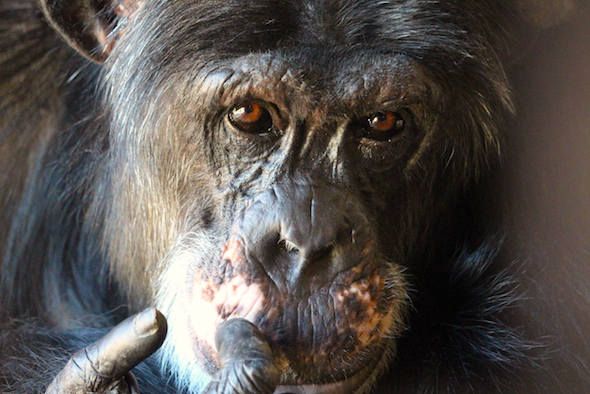
Chimpanzees are obviously not domesticated but they certainly are smart, and they have also found unique ways to communicate with humans. The Bronx cheer, or raspberry, is part of the vocal repertoire of many free-living chimpanzees but it is typically used when grooming. Captive chimpanzees, however, have discovered that at full volume it’s a great way to get the attention of humans. And if you do it over and over again, louder and louder each time, the humans will eventually give in. Or go crazy. Either way, it’s enriching for them.
Filed Under: Chimpanzee Behavior, Foxie, Latest Videos Tagged With: bronx cheer, chimpanzee, communication, northwest, raspberry, rescue, Sanctuary

The Shoes off My Feet

December 22, 2017 by J.B.

As the saying goes, if you really care for someone you’d give them the shirt off your back. For Jamie, it’s going to have to be the shoes off your feet.

Filed Under: Boots, Enrichment, Jamie, Thanks Tagged With: boots, chimpanzee, communication, gesture, Jamie, northwest, rescue, Sanctuary, shoes

A Hug and a High-Five

November 18, 2017 by J.B.

Jody had some enthusiastic greetings for her friends this morning…

Filed Under: Chimpanzee Behavior, Jody Tagged With: chimpanzee, communication, dominance, greet, hug, northwest, rescue, Sanctuary, submit

Selecting the right boot

April 28, 2017 by J.B.

Jamie loves to patrol her 2-acre enclosure in the company of her caregivers. But before the walk begins, she has to select the right boot for us to wear.

Filed Under: Boots, Intelligence, Jamie, Young's Hill Tagged With: boots, chimpanzee, communication, Enrichment, intellligence, northwest, rescue, Sanctuary

Grooming Noises

January 18, 2017 by J.B.

Chimpanzees use distinct sounds to communicate during grooming. Grooming noises such as the lip smack, the teeth clack, and the Bronx cheer are made solely with the lips, tongue, and teeth and not the vocal tract.

Filed Under: Chimpanzee Behavior Tagged With: bronx cheer, chimpanzee, communication, Grooming, lip smack, noises, northwest, raspberry, rescue, Sanctuary, teeth clack

Learning to speak chimp

August 12, 2016 by J.B.

The thing that originally sparked my interest in chimpanzees was the fact that they could learn sign language. Ape language studies of the ’60s and ’70s not only helped bridge the gap between the complex languages of humans and the seemingly much simpler grunts, barks, and chirps of other animals, but they hinted at a possibility almost too magical to believe: could signing chimpanzees actually tell us what they were thinking?

They could, and they did. Many of us at CSNW were lucky enough to help care for some of these signing chimpanzees during their later years and to converse with them in the process. And never have I been as humbled as I was on my first day of training, when I realized that the chimps signed faster and with a greater vocabulary than I could understand. This was a good way to put a new graduate student in his place.

As amazing as that experience was, however, we ultimately learned an even greater lesson from our mentors: Animals don’t need to learn our language to tell us what they are thinking. We can learn theirs.

Spend enough time around chimps and you start to absorb their mannerisms. You bob your head during greetings and crouch down low when placating a dominant chimp. You extend an arm when you need help and stomp your foot on the ground when initiating a game of chase. You pick up on the subtleties of their facial expressions, covering your top teeth when you smile and pouting your lips in sympathy when someone is upset. And if you’re not too self-conscious, you start to sing along when they pant hoot in excitement, or join in breathy laughter when tickling them with a stick.

web_burrito_profile_playface_raceway_kd_IMG_3902

Training as a caregiver at CSNW means training in chimp language, because the chimps never stop communicating their thoughts and desires. From the moment we walk in the door in the morning, they are telling us what’s on their minds. For Jamie, it’s all about boots. She can’t wait for her caregivers to don a pair of her favorite cowboy boots and chase her around the chimp house. She tells us what she wants by gazing and pointing toward the boot bin while stomping her feet. She has a mental catalogue of all the boots in her collection and knows which pair she wants, and if we draw up the wrong pair she shakes her head and tells us to try again.

It’s easy to figure out what Jamie wants, though, because she’s so predictable. The same is true for Negra, who claps to prod her caregivers into action at least 30 minutes before each mealtime. Other situations require more thought. Sometimes Burrito greets us exuberantly first thing in the morning and initiates a game of chase. We chase after him for a while until he stops suddenly and begins to blow raspberries while pointing at something just outside the enclosure. Our eyes scan the ground until we finally come across the real reason for his excitement: a piece of food left over from the previous night’s dinner, just out of reach. Missy does something similar, except that her games of chase always end at the window facing the garden, where ripe cherry tomatoes grow just a few feet away. Her hand points towards the garden while her gaze switches back and forth between our eyes and the tomatoes, drawing an imaginary line between the two. The phrase “ulterior motive” had to have been coined by someone who worked with chimpanzees.

web_Burrito_portrait_studio_look_at_camera_FR4_ek_IMG_5541

Throughout the day we hear updates from the chimps from afar. When a threat bark pierces the silence of an afternoon meal, it means that one of the caregivers has unwittingly violated the chimps’ social order, perhaps by serving food to a low ranking chimpanzee out of turn. Alarm calls can be easily differentiated into degrees of severity – single “hoo” calls mean that one chimp has seen something they can’t quite make sense of, while multiple “waa” calls mean that the group has identified and rallied around a source of danger. Even the “waa” calls can be broken into different levels of intensity, telling you whether they have uncovered a small garter snake or a large, and potentially deadly, rattlesnake.

web Jamie JOdy search for critter log bridge grass YH IMG_6795

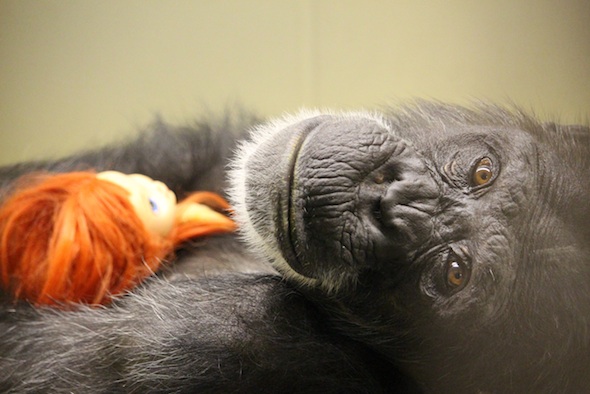
Closing up at night involves a routine that might sound familiar to anyone with young kids, but instead of “can you read me just one more story” or “can I have a glass of water”, it’s “can you give me just one more troll doll” or “can I have the boots you walked in this morning.” This process of making sure the chimps have everything they want before they go to bed can last for the better part of an hour, depending on their moods, and sometimes involves dumping everything out of the toy bins so that they can pick out exactly what they want. But when you figure out what they want, whether it’s that black pair of boots with the white stitching or the new Dora the Explorer doll, they often let you know with a low moan, while clutching the item gently to their chest. Reminiscent of Chewbacca, the low moan indicates satisfaction, and tells us all is good.

web_Foxie_and_dora_friend_FR_bench_jb_IMG_2993

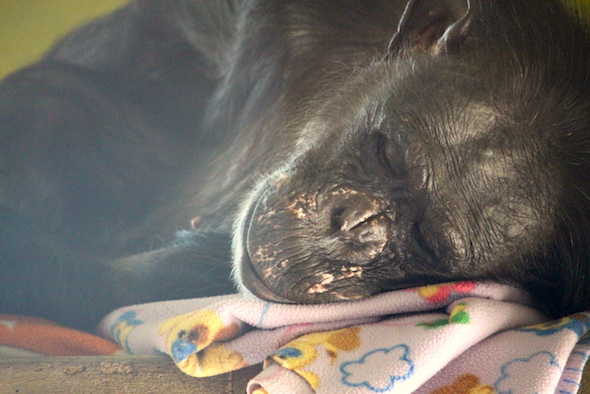
We talk to each other like this all day long and at the end of the day, the only thing left to say is “goodnight”, which in chimp-speak is delivered as a series of soft grunts, pants, and hoo’s known collectively as nest grunts. We caregivers often initiate this as we lock up for the night, and the chimps respond in turn. It’s a subtle and beautiful chorus; a vocalization that began high up in the trees of central Africa but somehow echoes from cozy blanket nests in a small sanctuary in Cle Elum.

It says, “we are all safe now, see you tomorrow,” in a language all their own.

web_Negra_sleep_blanket_nest_catwalk_PR_ek_IMG_5509

Filed Under: Chimpanzee Behavior, Intelligence, Sanctuary Tagged With: asl, chimpanzee, communication, expression, gesture, language, northwest, rescue, Sanctuary, sign language, vocalization, washoe

Foxie’s Secret Language

May 9, 2014 by J.B.

Some forms of chimp communication are universal. Chimps the world over food grunt, make play faces, and pant-hoot. While there are variations to all of these behaviors based on culture and geography, they are all part of a common chimp language.

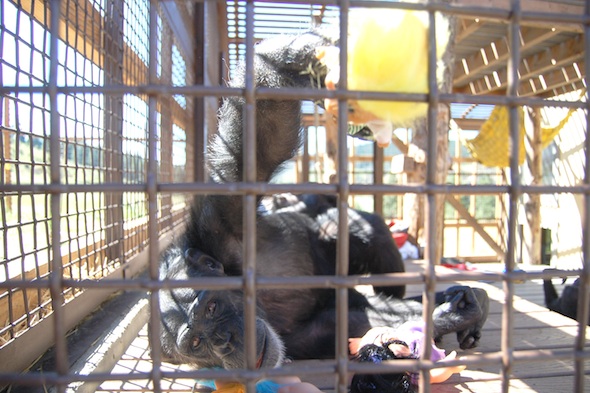
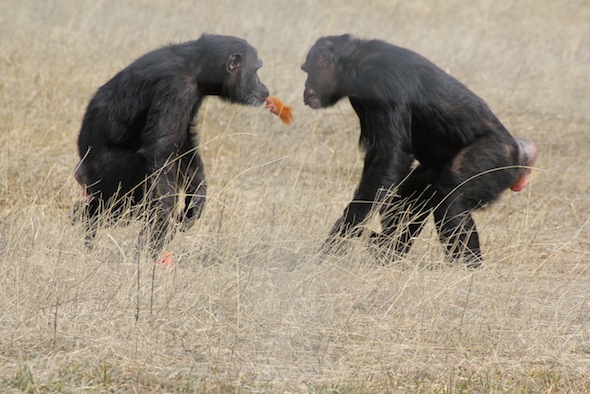
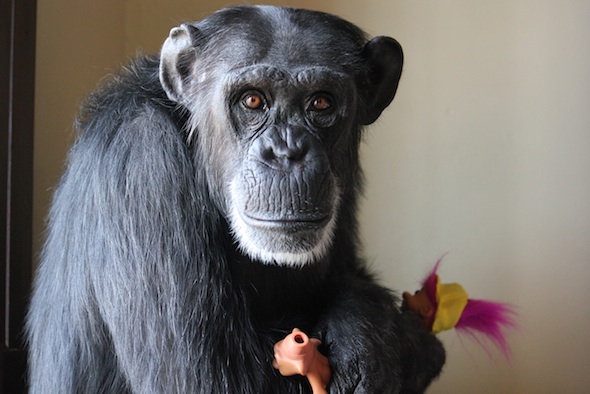
But chimps also develop communicative behaviors all their own. My favorite example is Foxie. When Foxie adopted her first troll doll, she was extremely protective of it and became visibly upset when “Trixie,” as we named her, wound up in the hands of someone else. But over time, she began to trust us with her dolls, and at that point she actually started to use her troll dolls as a way to signify that it was time to socialize with her. While I really have no idea what is going on in Foxie’s mind, I like to think of it like this: She knows that we would never take her doll away from her, so when she hands one to us, she knows we have to stick around. You have my troll, so until I ask for it back, you’re all mine. At least that’s my guess as to how it started. Now we don’t even question it – it’s just how things work around here.

web Foxie pass troll through caging outdoor area DSC_1057

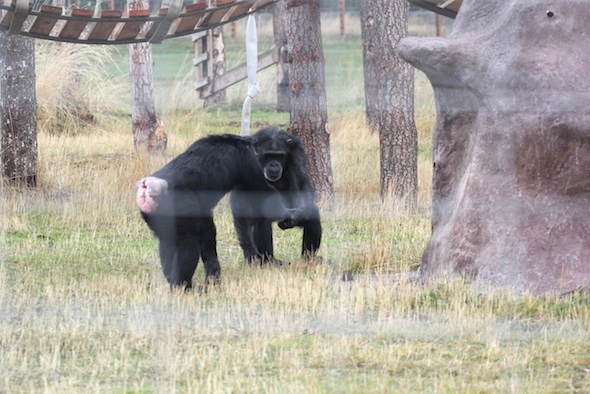
When we come to work in the morning, Foxie passes us a troll to say hello and starts to do her playful acrobatics. And when we are locking up for the night, she often drops a troll on our heads from the loft, as a way of saying: Just five more minutes, then you can go. When she’s done with us, she asks for it back and she goes on with her day.

And it’s not just humans on the receiving end. When Foxie wants to play with Jamie, she will run up, stomp her feet, and hand a troll directly to her.

web 2 Foxie Jamie troll doll cute yh IMG_9990

Jamie knows that this is an invitation to a playful game of keep-away. Some of the best play bouts between Foxie and Jamie, like this one from earlier in the week, involve a troll doll (you’ll see that Jamie has it tucked into her pelvic pocket).

But sometimes Foxie goes from playful to genuinely concerned about her doll, and at that point Jamie knows to give it back immediately. No one likes to see Foxie upset.

web jamie foxie green troll exchange treat rock yh IMG_9444

Who knew that a weird fad toy from the 60’s (sorry, Foxie) would become such an important part of a chimpanzee’s life?

web Foxie trolls portrait front room 4 FRs IMG_6782

Filed Under: Chimpanzee Behavior, Dolls, Enrichment, Foxie, Jamie, Sanctuary Tagged With: chimpanzee, communication, doll, Foxie, northwest, rescue, Sanctuary, troll

  • « Go to Previous Page
  • Page 1
  • Page 2
  • Page 3
  • Go to Next Page »

Primary Sidebar

Subscribe To the Blog and Get Notified of New Posts First!

Archives

Calendar of Blog Posts

June 2026
S M T W T F S
 123456
78910111213
14151617181920
21222324252627
282930  
« May    

Categories

SUBSCRIBE TO OUR NEWSLETTER

Footer

PO Box 952
Cle Elum, WA 98922
[email protected]
509-699-0728
501c3 registered charity
EIN: 68-0552915

Official DDAF Grantee

Menu

  • The Chimpanzees
  • Blog
  • About Us
  • You can help
  • Resources
  • Contact
  • Donate

Proud Member of

Connect With Us

Search

Copyright © 2026 Chimpanzee Sanctuary Northwest. All Rights Reserved. Site by Vegan Web Design