• Skip to main content
  • Skip to primary sidebar
  • Skip to footer

Chimpanzee Sanctuary Northwest

Hope. Love. Home. Sanctuary

  • Our Family
    • The Chimpanzees
    • The Cattle
  • Blog
  • About Us
    • Visiting the Sanctuary
    • Philosophy
      • FAQs
      • Mission, Vision & Goals
      • Privacy Policy
    • The Humans
      • Staff
      • Board of Directors
      • Founder
    • Annual Reports
    • The Future of CSNW
    • CSNW In The News
  • You can help
    • Donate
      • Become a Chimpanzee Pal
      • Sponsor A Day
      • Transfer Stock
      • Be A Produce Patron
      • Be a Bovine Buddy
      • Give from your IRA
      • Personalized Stones
      • Bring Them Home Campaign
    • Leave A Legacy
    • Employment Opportunities
    • Volunteer
    • See Our Wish List
    • Events
  • Resources
    • About Chimpanzees
    • Enrichment Database
    • Advocacy
      • Advocacy Action Center
      • Apes in Entertainment
        • Trainers
        • Role of the AHA
        • Greeting Cards
      • Chimpanzees as Pets
      • Roadside Zoos
      • Chimpanzees in Biomedical Research
      • Conservation
        • African Apes
        • Orangutans
  • Shop
    • Merchandise Store
  • Contact
  • DONATE NOW

animal rights

Fun Inside, Outside, and In-between. Subtitle: Caging is OK

November 28, 2020 by Diana

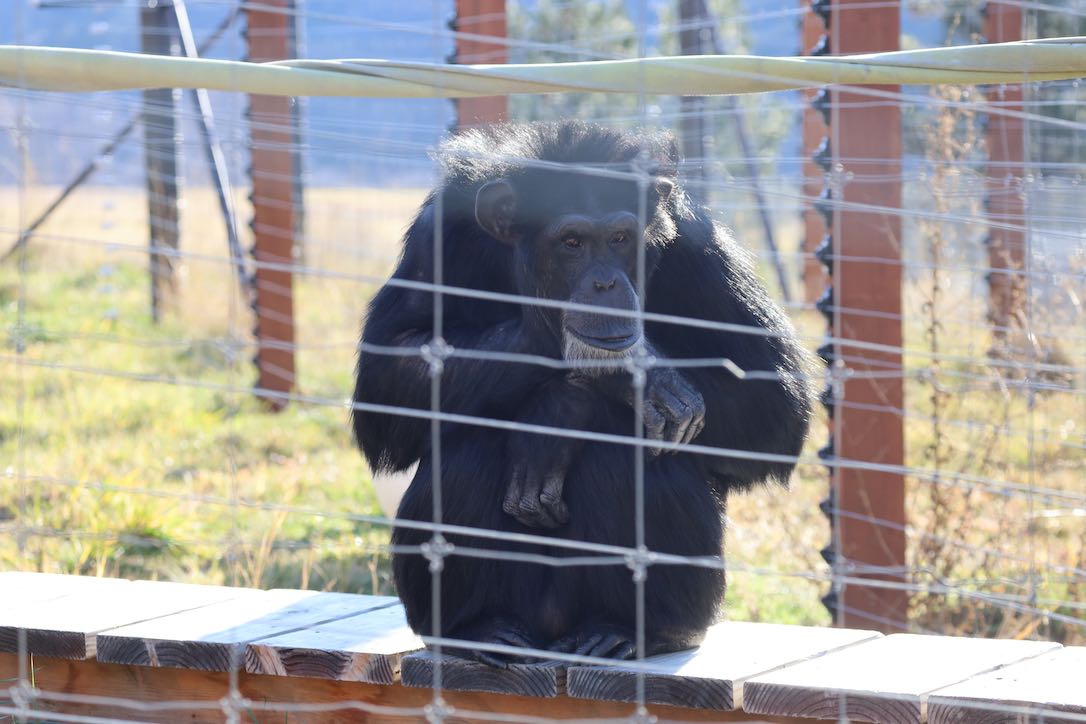
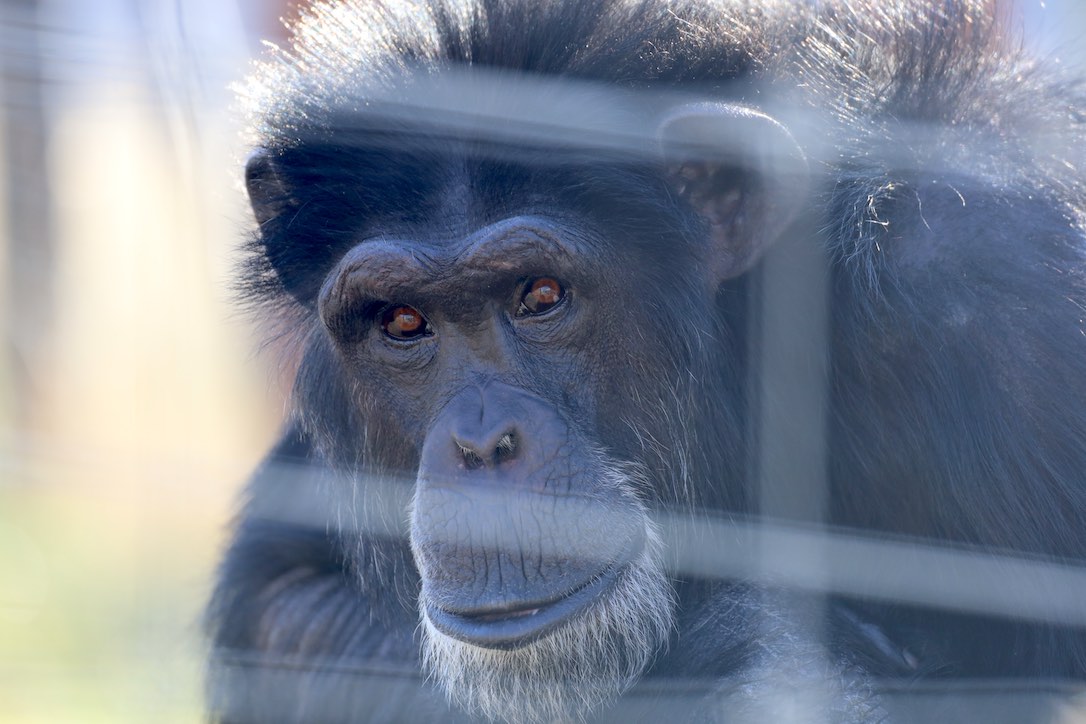
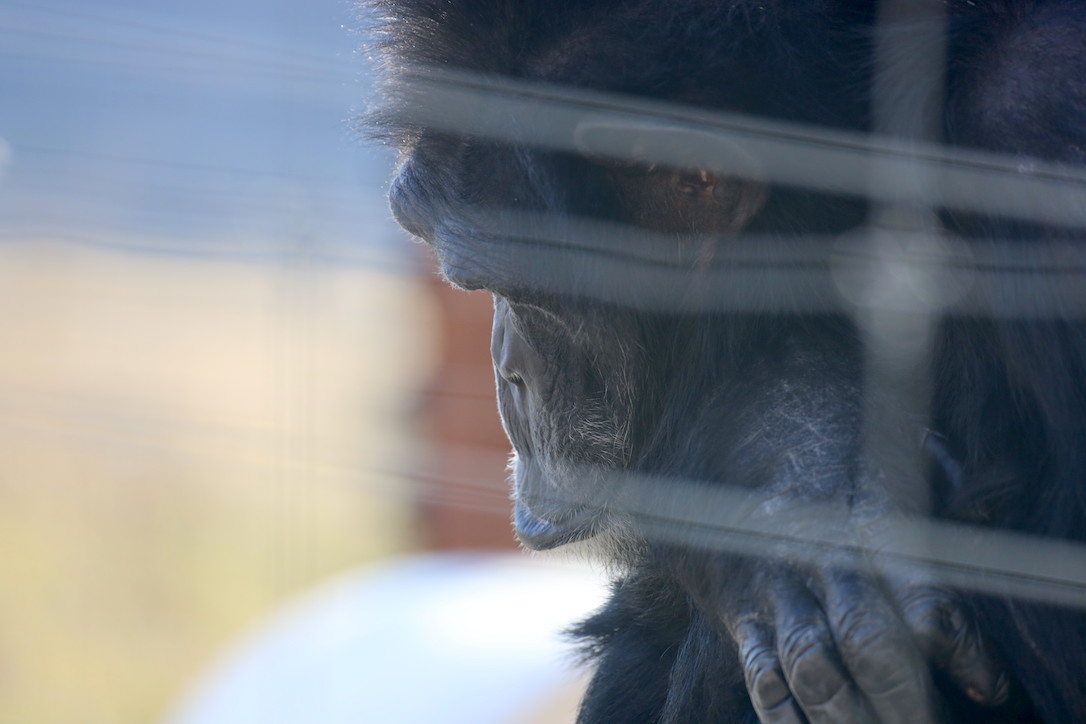
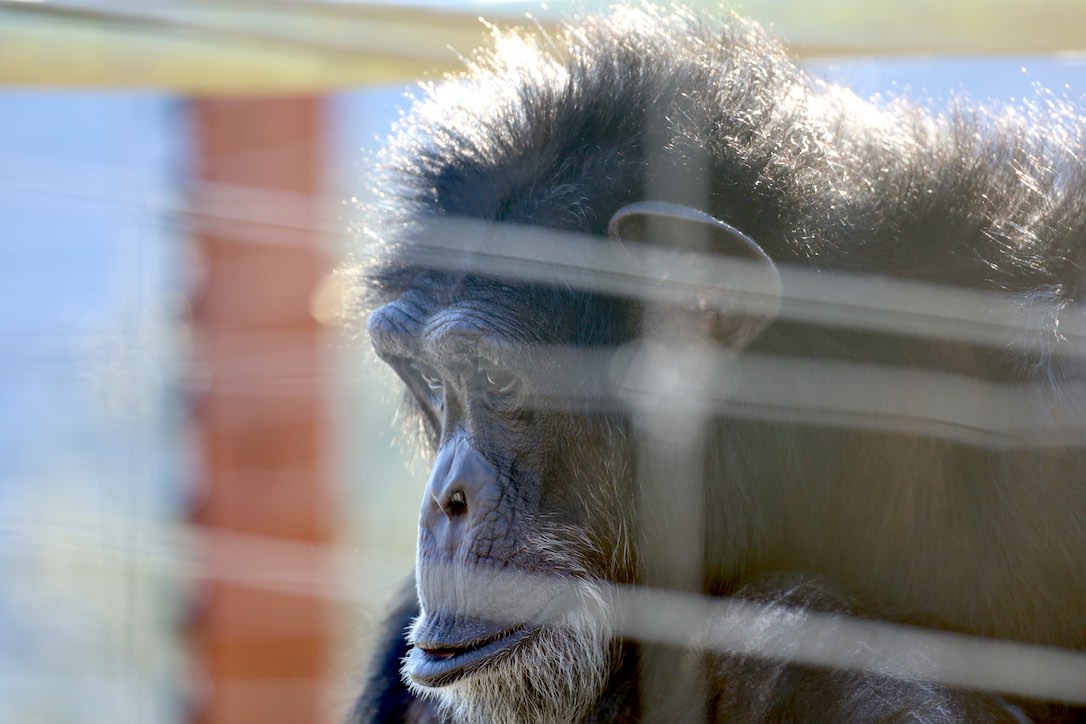
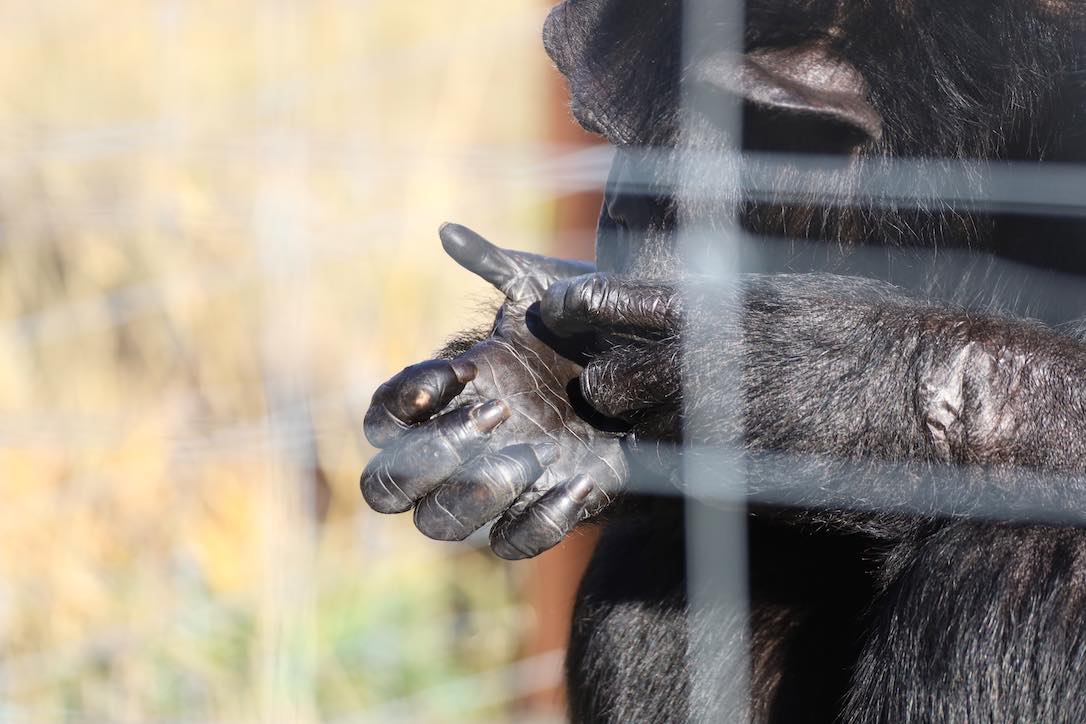
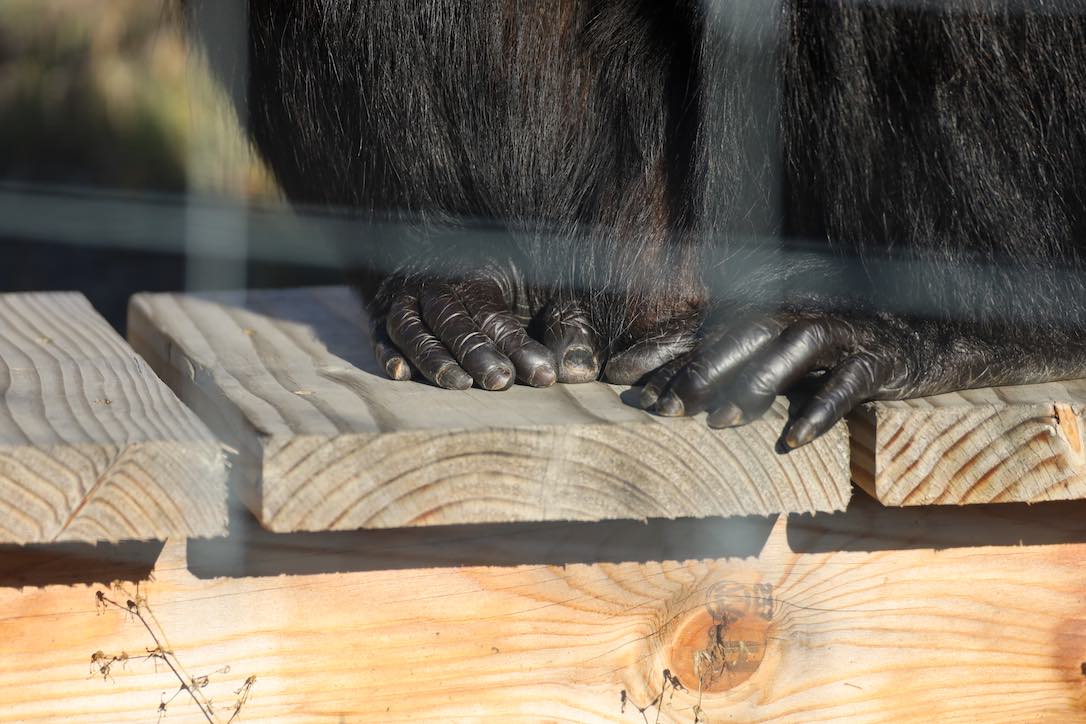
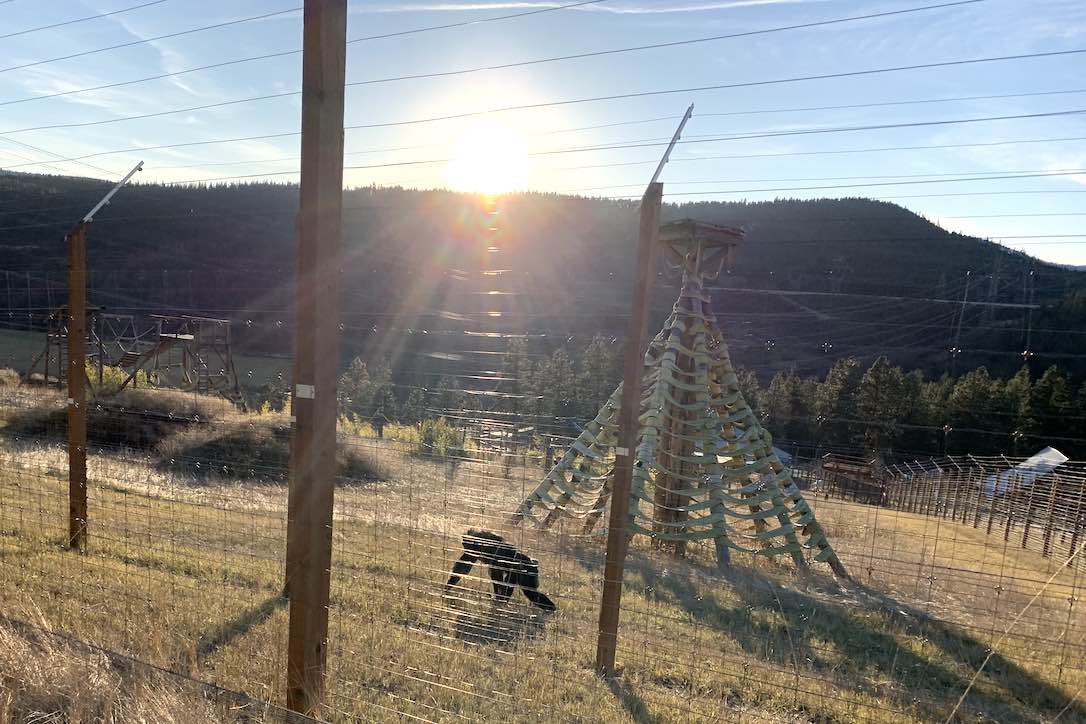
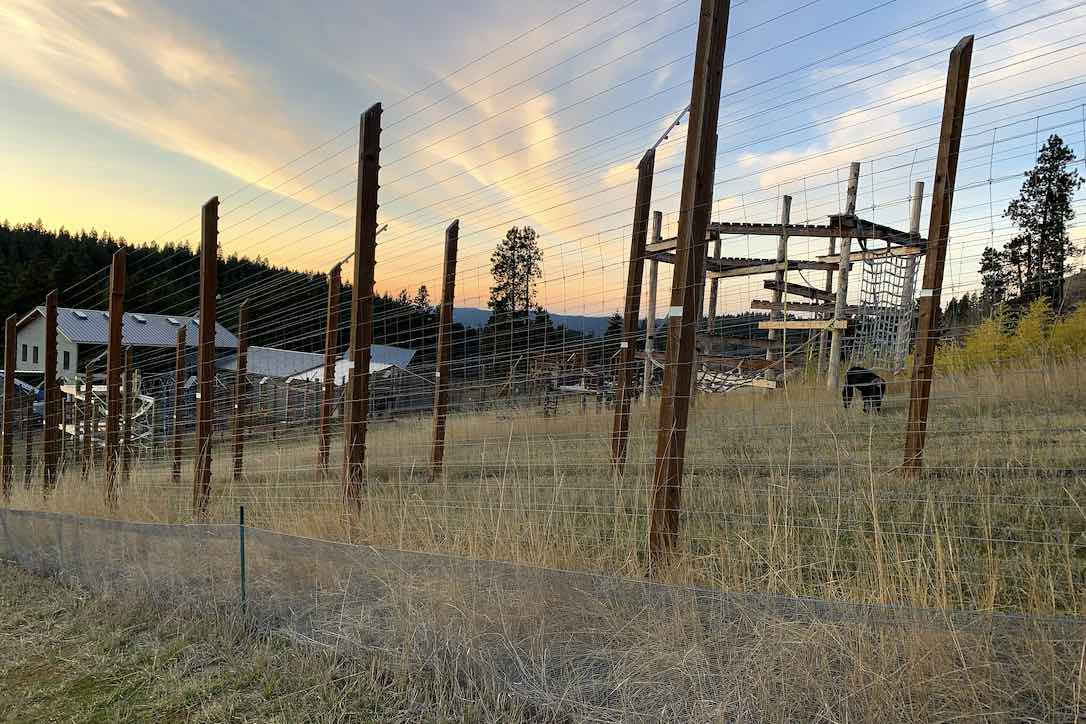
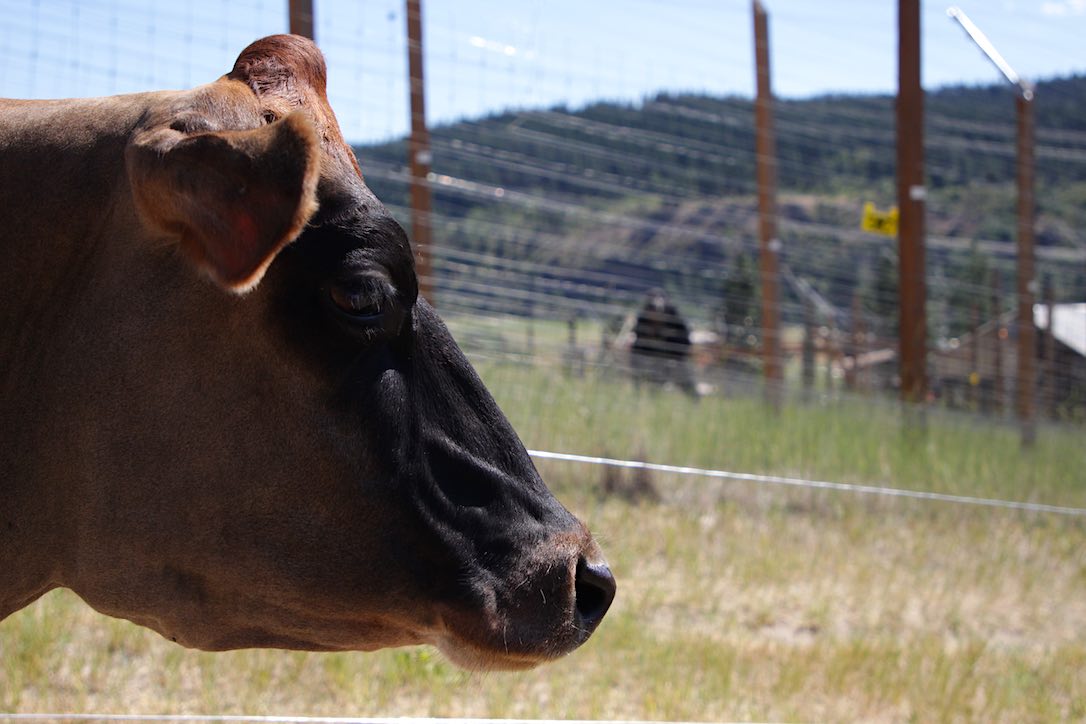
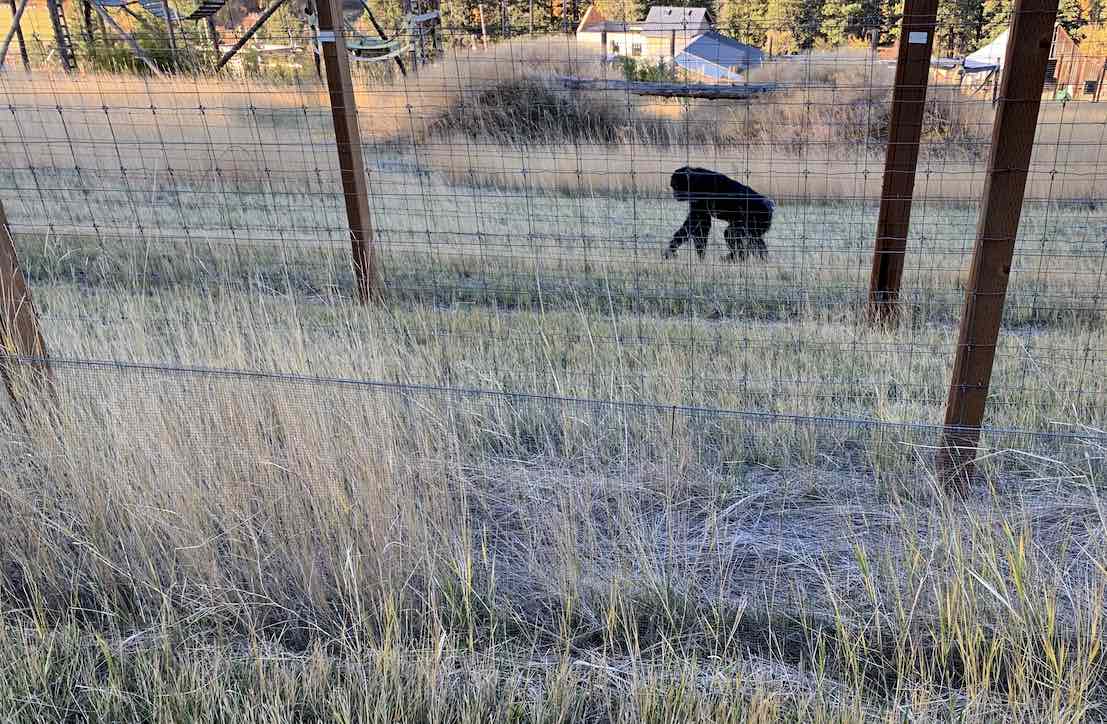
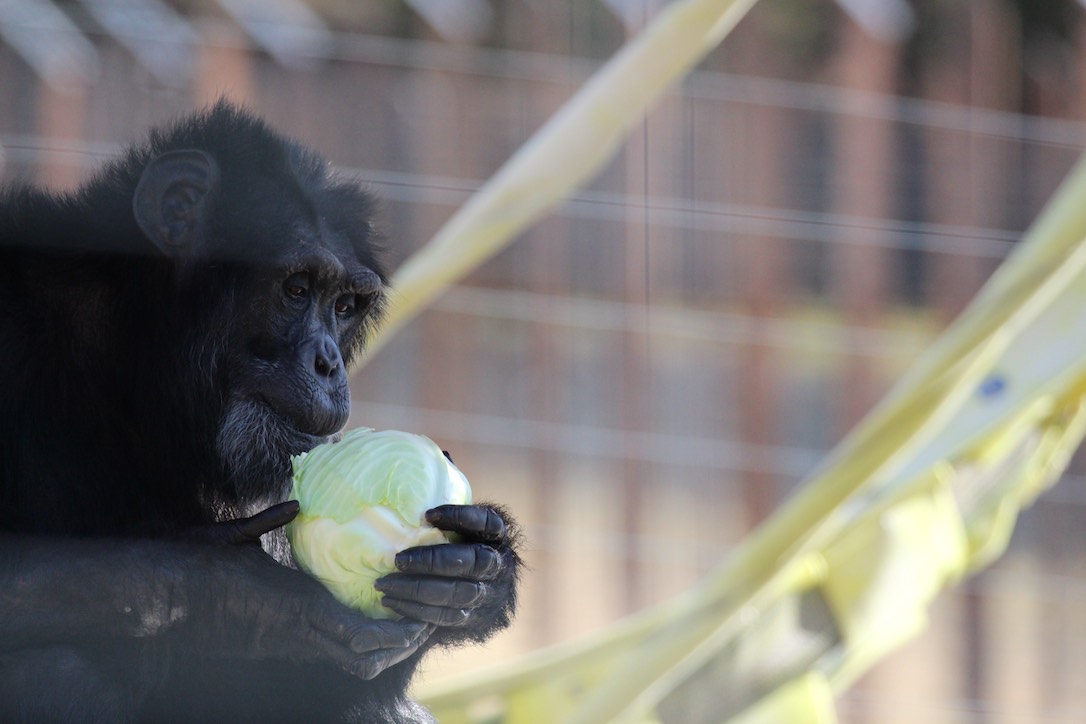
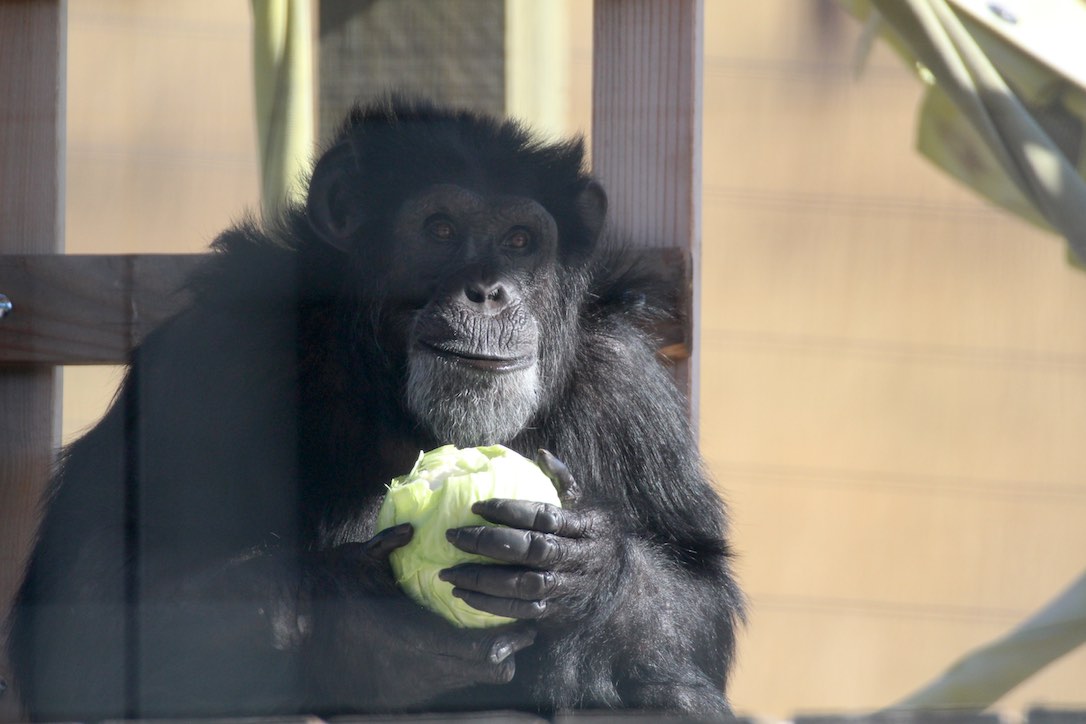
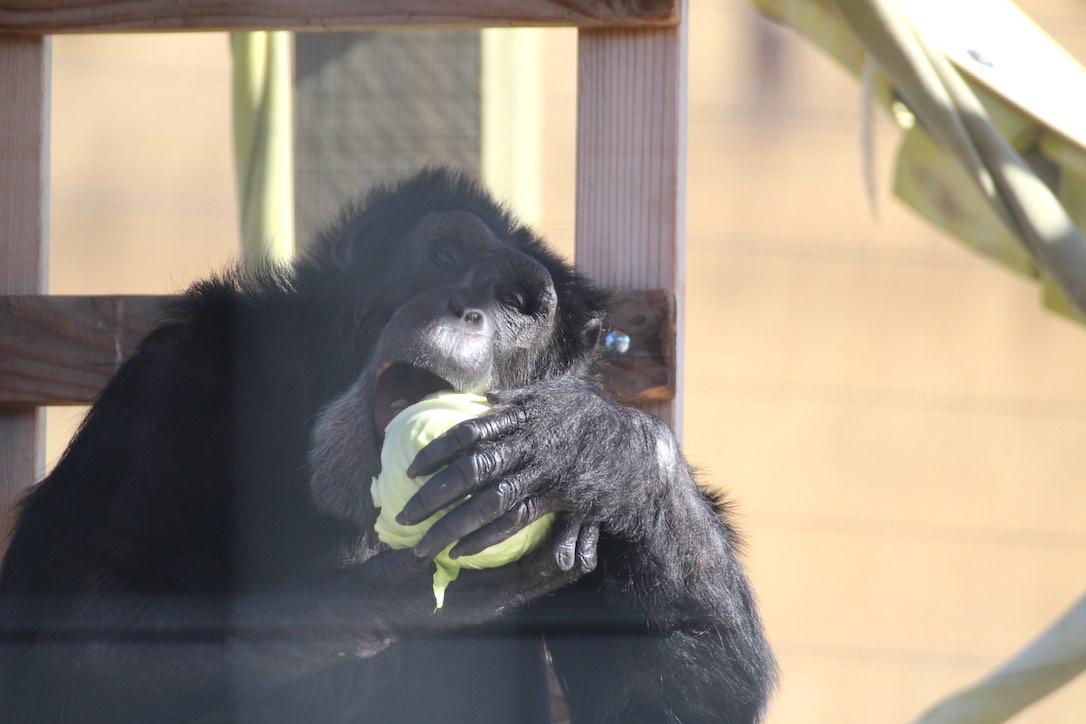
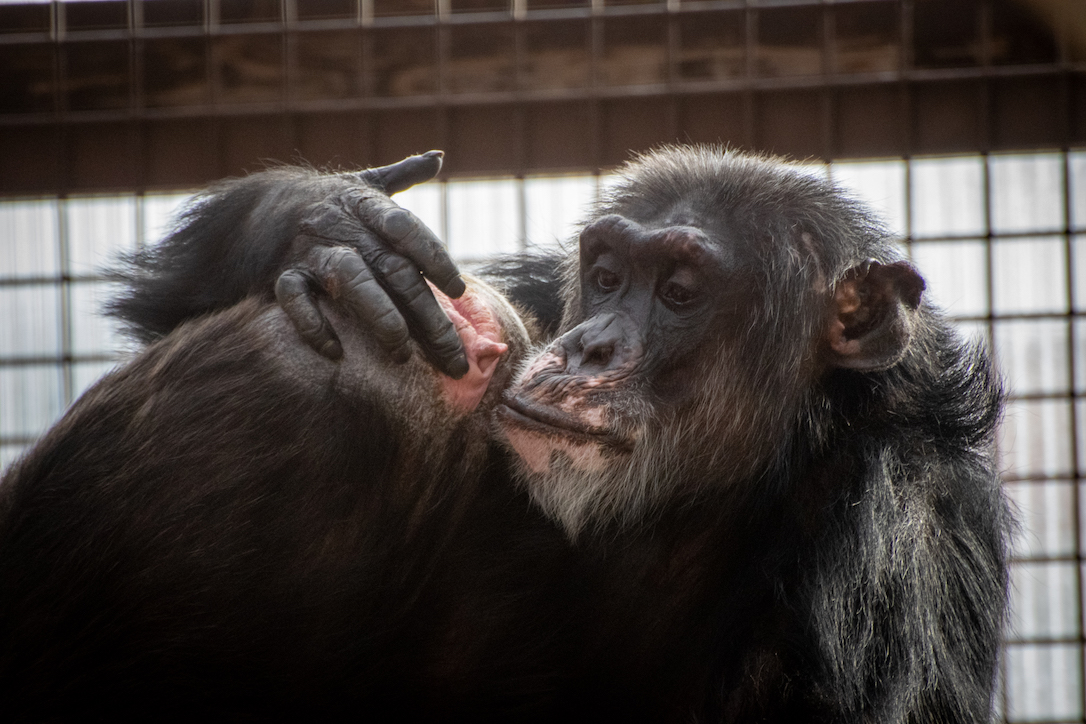
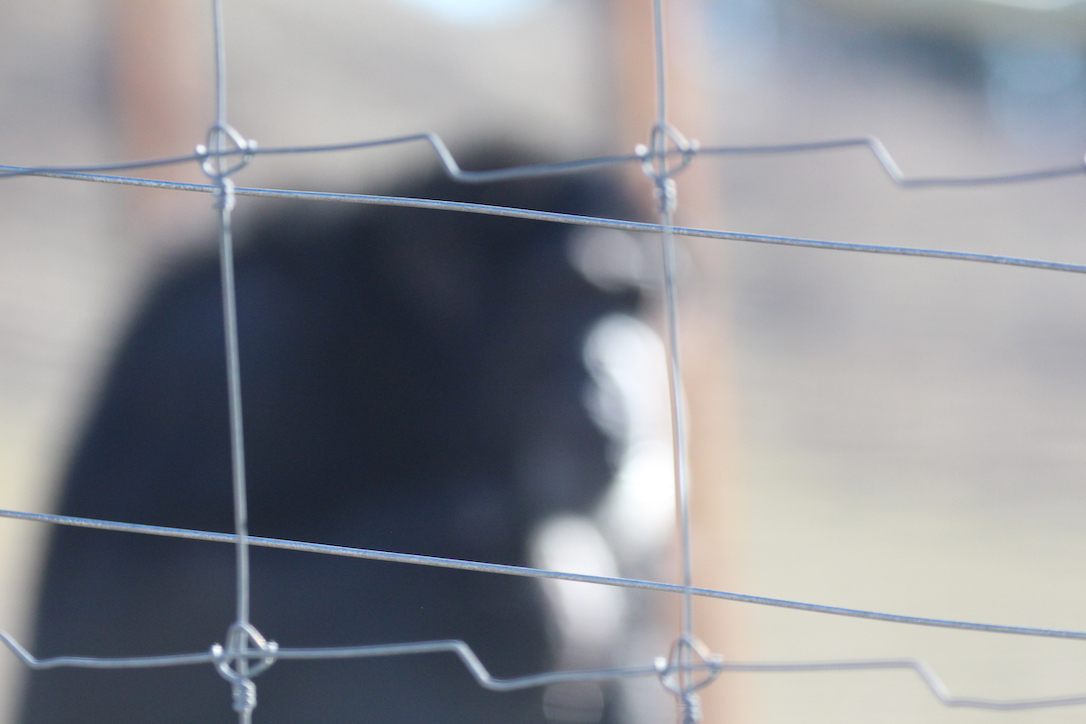
With the right camera lens and the right distance, we can “focus through” the fencing that surrounds the outdoor habitats so the fencing disappears or turns into blurs in the foreground.
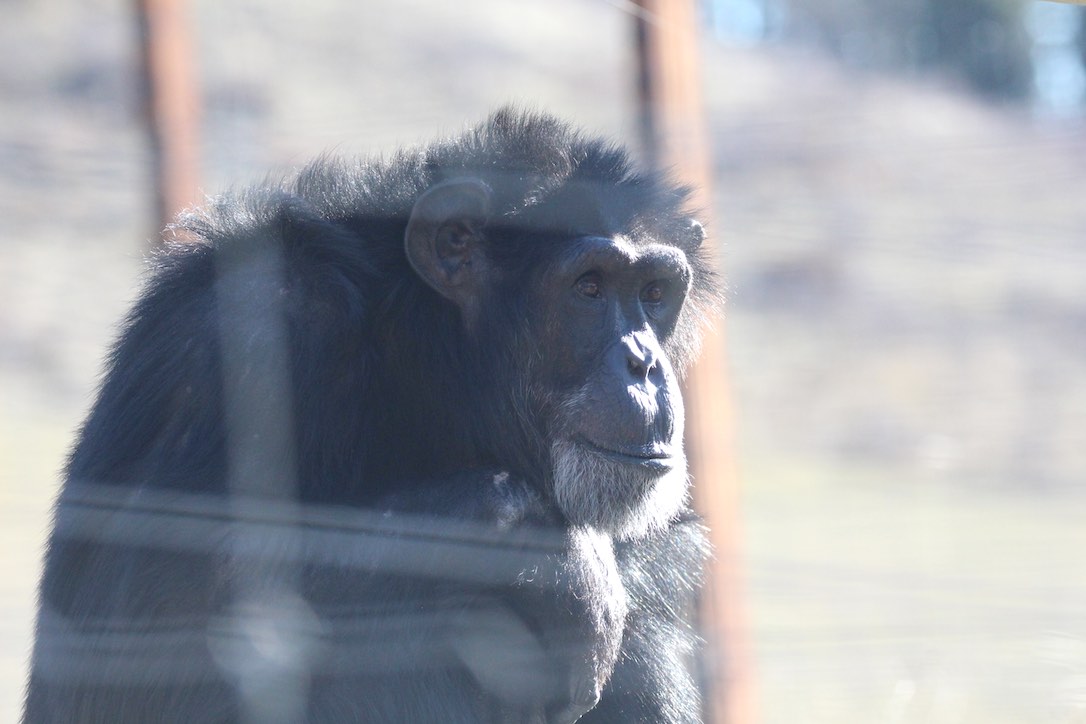
It’s a trick of the camera. The fencing doesn’t actually go away.
But our eyes perform the same trick. This is roughly where Willy B was looking in the photos above and exactly what that hillside looked like to my eyes too.
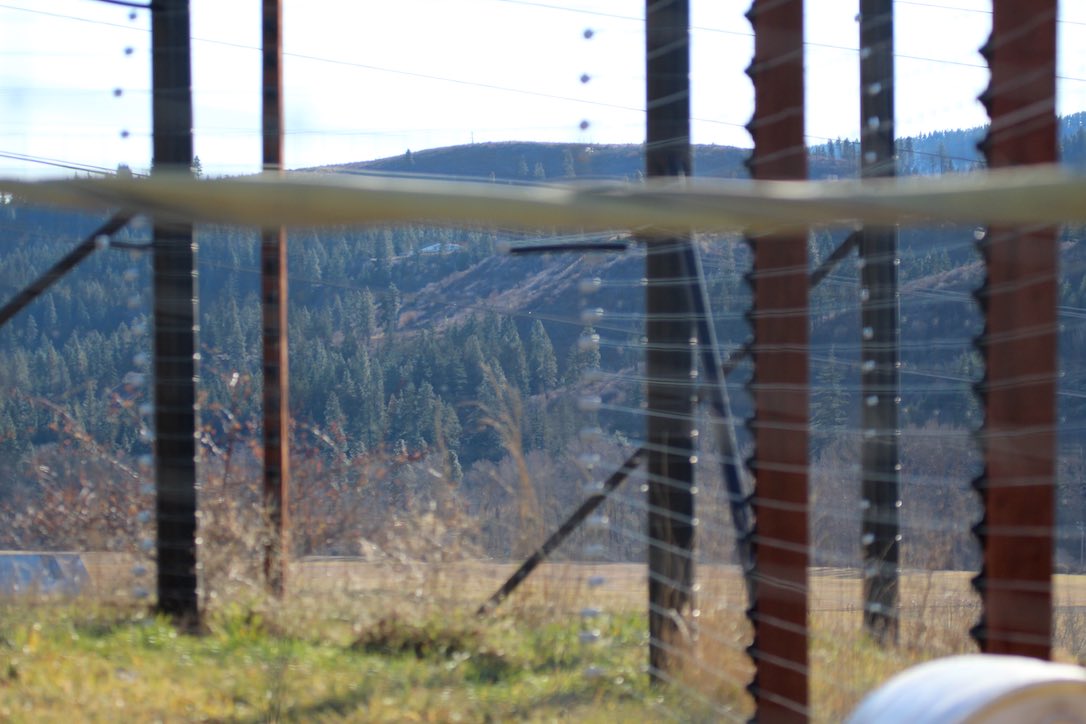
We love sharing the sanctuary with loyal supporters and new interested folks too. One comment that people often make when they see a video from us for the first time on Facebook or Instagram is that the chimpanzees shouldn’t be indoors or “in a cage.”

I tried to answer this years ago in this blog post, but I felt it needed an update.

It is helpful to begin as that post did with the image of the type of cages that many of the chimpanzees at CSNW spent the majority of their lives:
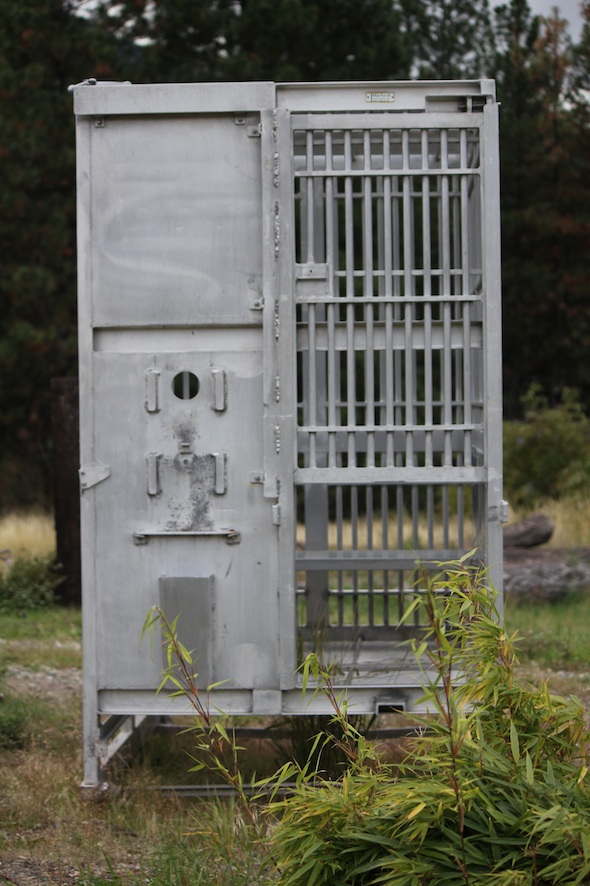
cage outside

That is a cage.

At the sanctuary, there is also caging.
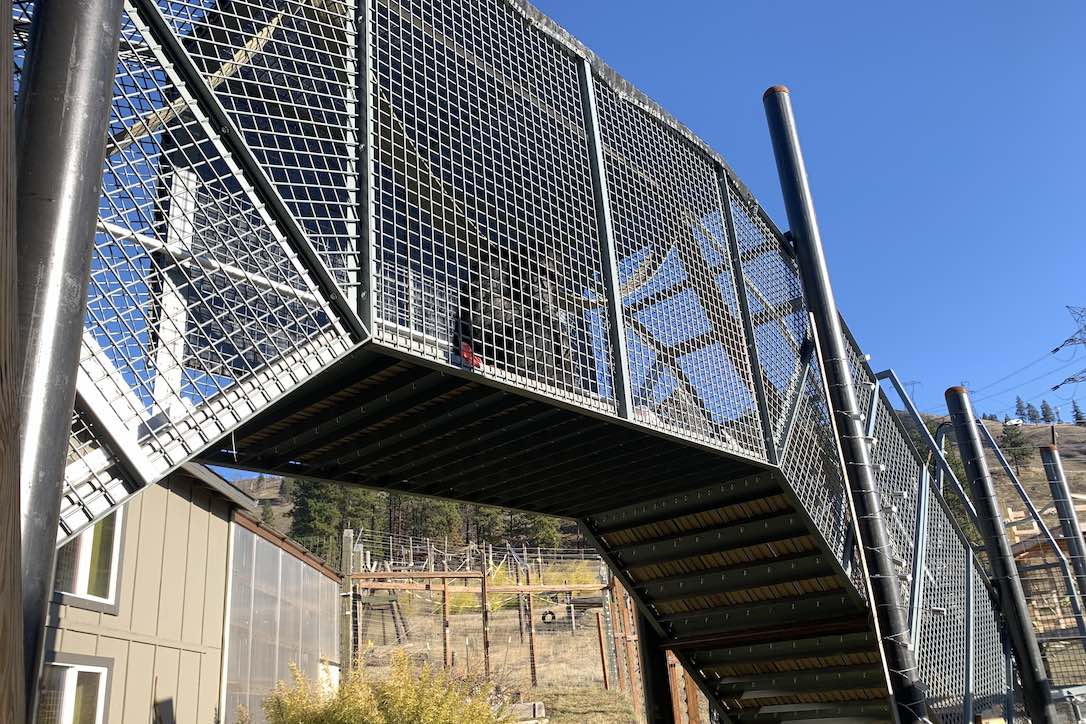
Caging makes people uncomfortable. They want to see chimpanzees outside “where they are meant to be.” They want to imagine that they are free and close to nature.

I’m not immune to it myself.

Just yesterday, I noted what a lovely afternoon it was and tried to implore Jamie to go outside. The voices of my parents echoed in my head as I said, “you should be outside, it’s beautiful.”

When my parents issued similar sentiments, I’m not sure if I ever responded out loud “well then why aren’t you outside?” If Jamie could speak, she would have been right to ask me the same question. She was perfectly happy making a nest by the window in that moment.

We all have individual preferences, and how we want to spend our time can change from one moment to the next. The chimpanzees are the same.

They like different spaces for a multitude of reasons. I hope the video above illustrates both the utility of caging and also how the chimpanzees might view it differently than we do; without all of the symbolism that we humans put on it.

It took us a little more than three years from the time Negra, Burrito, Jamie, Foxie, Missy, Annie, and Jody arrived to give them Young’s Hill – their two-acre habitat surrounded by double electric fences.

In those three years, the chimps were not unhappy. They played, foraged, nested, and spent lots of time in the indoor/outdoor greenhouse.

We knew they should have more, and we wanted to see them truly “outside.”

I can’t imagine Jamie not having Young’s Hill now. She loves it. She owns it.

Negra, on the other hand, can take it or leave it. Seeing her outside in the spring, though, still takes my breath away.

We can’t get inside the heads of the chimpanzees. We can’t ask them what they are thinking. But we can observe them and watch where they choose to spend their time and how they utilize different spaces.

We can (and should) do things to encourage them to GET OUTSIDE, but it’s worth asking ourselves if we are doing that for their sake or for our own – to fulfill the vision we have of what chimpanzees in captivity should be doing instead of what they want to be doing.

These chimpanzees cannot live in the wild. Our job is to give them the best possible captive life possible, with lots of choice and variety, based on their individual needs, personalities, and quirks.

We’ll continue to blur the fencing out of some photos and put the cameras up to the caging for an unobstructed view, but it’s not because we want you to forget that it’s there; it’s so you can fully see the unique and wonderful chimpanzees who are choosing to do whatever they are doing in the moment when the camera shutter closes.
Filed Under: Caregivers, Chimp histories, Chimpanzee Behavior, Courtyard, Featured Post, Sanctuary, Weather, Young's Hill Tagged With: animal protection, animal rights, Animal Welfare, chimp cage, chimp enrichment, chimpanzee rescue, chimpanzee retirement, chimpanzee sanctuary, Chimpanzee Sanctuary Northwest, primate rescue, why are the chimps in cages

The Bud Box

November 22, 2020 by Anthony

Primates and Bovines

Most of our staff were, at one point or another, either primatology students at nearby Central Washington University (CWU) or interns at the university’s Chimpanzee and Human Communication Institute. People are often surprised to learn that CWU students can specialize in primate behavior at the undergraduate, graduate, or professional certificate level. It’s quite the niche.

We sometimes joke about our research-oriented backgrounds whenever we catch ourselves doing strange tasks around the Chimp House (like fishing stray troll dolls out of the septic tank filter, perusing Amazon for Jamie’s next favorite picture book, or shoveling chimp-size paths through the snow on Young’s Hill). Irony aside, the people who use their Primate Behavior degrees exclusively for studying primate behavior are the true anomalies. The skills developed while studying primatology are widely applicable to a variety of different career paths, and most of us end up doing things we never even dreamed of when we were students.
This point was reiterated when I remotely interviewed for a caregiver position at CSNW. One of the topics that came up was that of cattle care, which is quite different from the other Chimp House duties and may have turned off some candidates. When J.B. asked if I had any familiarity with bovines, I responded that “I have never cared for cattle.” The phone went awkwardly silent for a second, and I quickly realized my strange wording suggested I didn’t like cows. Of course, I actually meant that I had literally never worked with them before, and I tried my best to convey that I was in no way prejudiced against cattle. In fact, I knew little about bovine health or behavior but was super stoked to learn.
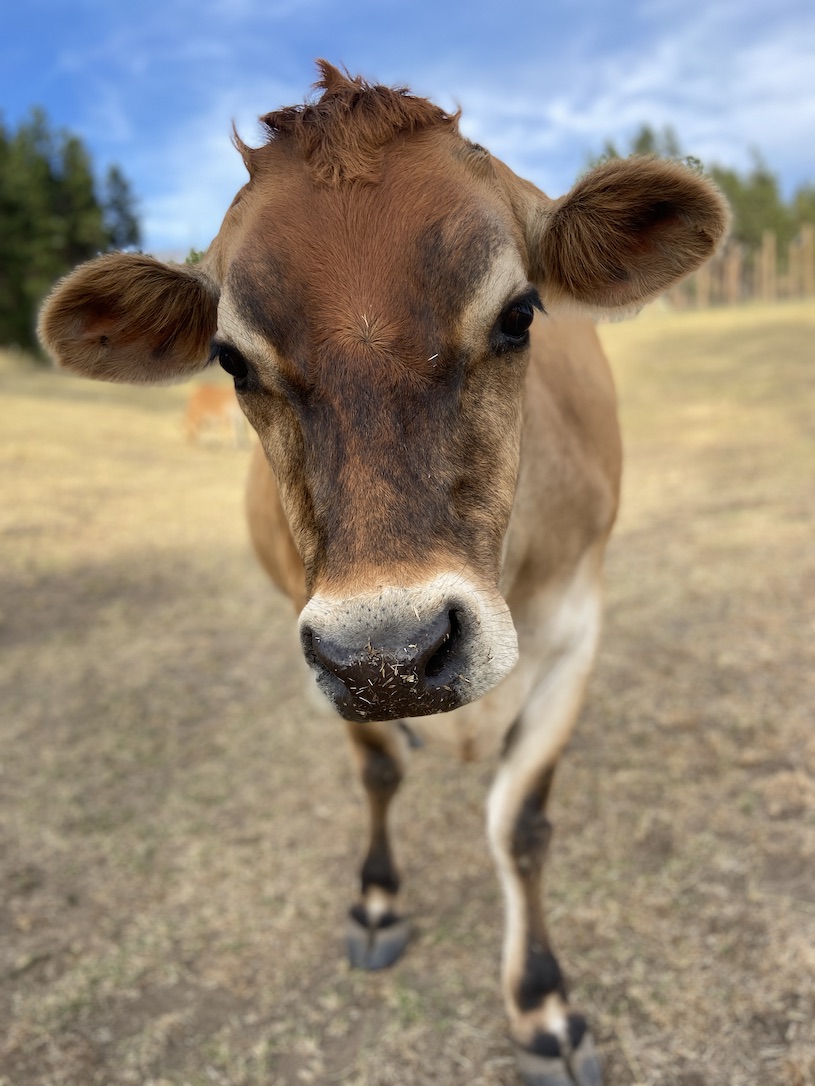
Shifting For Safety

In some respects, taking care of chimpanzees is vastly different from managing domesticated animals such as cattle. Sometimes, though, the overlap is considerable. From my perspective, one similarity shared by all species is the tendency to not go where you want them to, making their care more difficult.

We’ve recently discussed the challenges of shifting chimps around the building so that we can safely unlock areas for cleaning. In some cases, such as Willy B’s epic filibusters in the Courtyard and the chute, we can make alternate plans that align with the chimps’ preferences. However, we don’t always have that luxury. On rare occasions, we encounter situations when we need the chimpanzees to leave an area for their immediate safety. These improbable events may be related to extreme weather, enclosure maintenance, or dangerous wildlife. In these critical moments, confused chimpanzees tend to pay less attention to their caregivers and are less likely to cooperate.

One example is that of Burrito’s rattlesnake encounter in Young’s Hill back in September. On that day, the chimps voluntarily came inside, letting us administer antivenom to Burrito and remove the snake from the habitat. In the weeks after, we prioritized recall training. To execute a recall, we invite the the chimps to return to the building, letting us close the doors in exchange for high-value treats. In a couple of cases, this proactive cooperation helped us to humanely relocate non-venomous snakes that had mistakenly found their way into the chimps’ outdoor enclosure. Once the warm weather returns in the spring, we will surely resume this training.

Note: We are frequently asked whether we intervene in fights by splitting the chimpanzees up. We usually do not. Separating a frenzied group of chimps during an altercation is extremely difficult since they are so focused on each other during these moments. They almost always resolve the conflict and reconcile without our assistance.

Other institutions do similar activities for the sake of their chimpanzee residents. At the closed Wildlife Waystation (from whence came Honey B, Mave and Willy B), caregivers are currently teaching the chimps to willingly shift into transport cages in case nearby wildfires threaten the facility again. This ongoing effort recently garnered some well-deserved media attention. As the sanctuary community works to re-home the remaining chimps, it’s good to know that their immediate wellbeing is still a top priority. When those chimpanzees make their way to accredited facilities like ours, hopefully they’ll be like Honey B and bring their cooperative attitudes with them.

The Bud Box

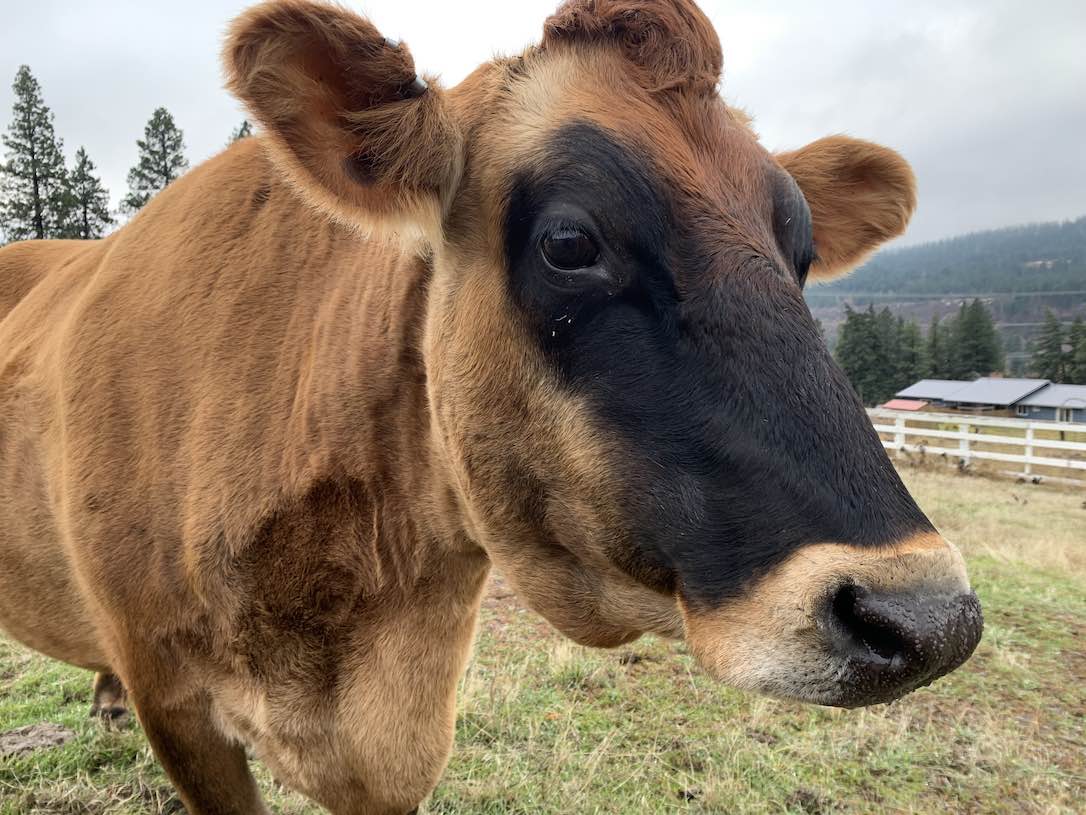
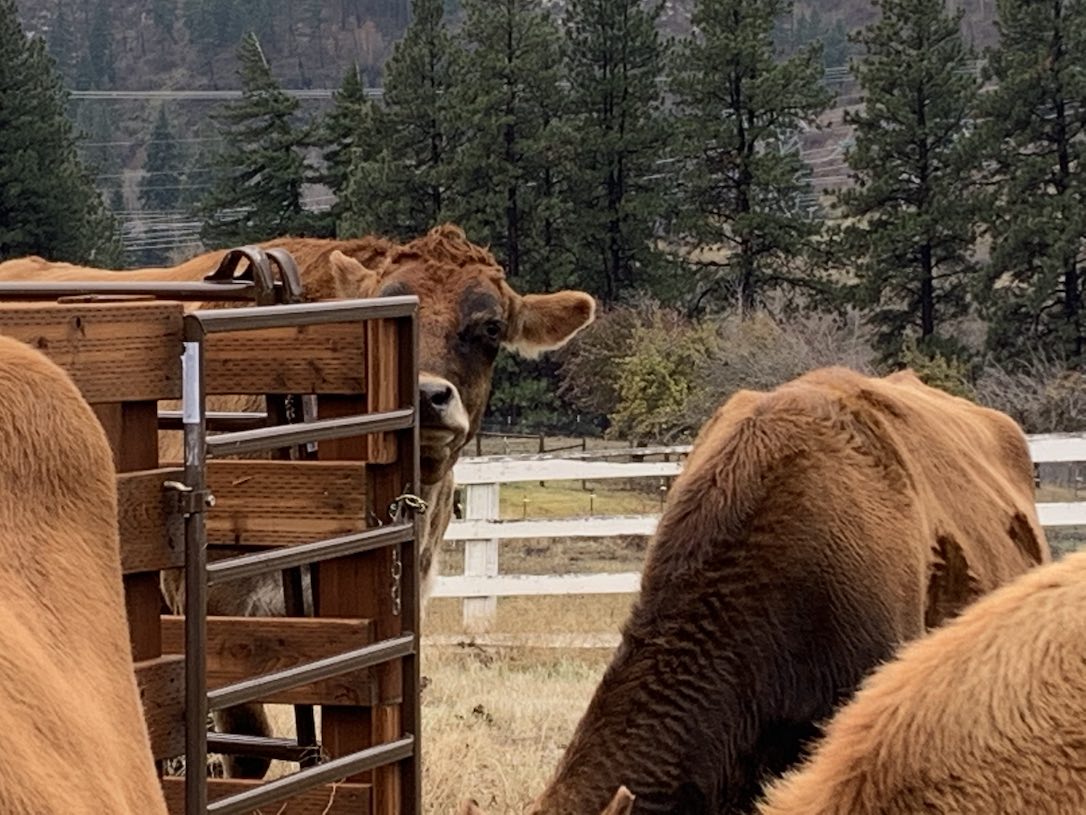
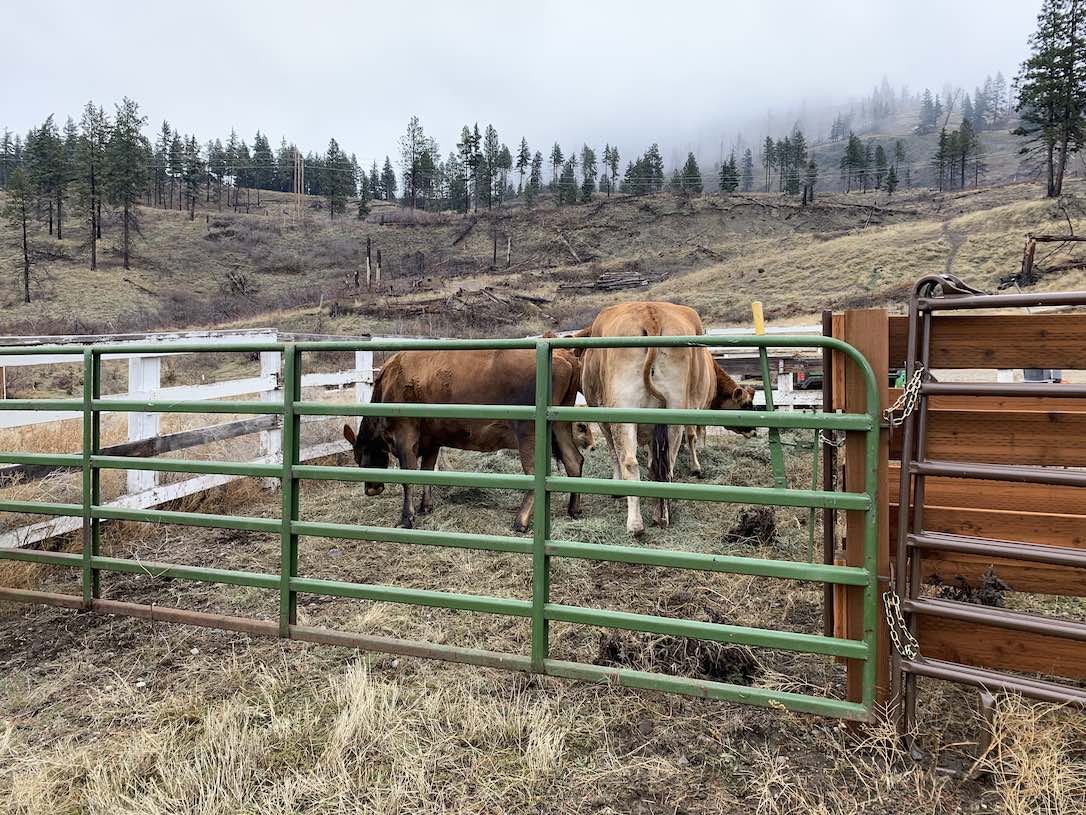
Of course, the chimpanzees aren’t the only CSNW residents who need this kind of training. The sanctuary’s four cattle are also managed using positive reinforcement, and training them to voluntarily enter a smaller corral is one of our top priorities. Plausible scenarios in which we would need to confine the cattle would be to address individual health concerns, to make repairs to the pasture fences, or to evacuate the herd due to a nearby wildfire. We also use a similar process to isolate them for their annual hoof trims and vaccinations. In all of these cases, the first step is to get them out of the larger pasture and into a smaller corral. From there, we herd them into an even smaller pen and then into a narrow chute that allows for safe handling. Cattle are naturally skeptical of anything that seems different (and for good reason), so anything we can do to familiarize them with this process has a positive effect on their welfare.

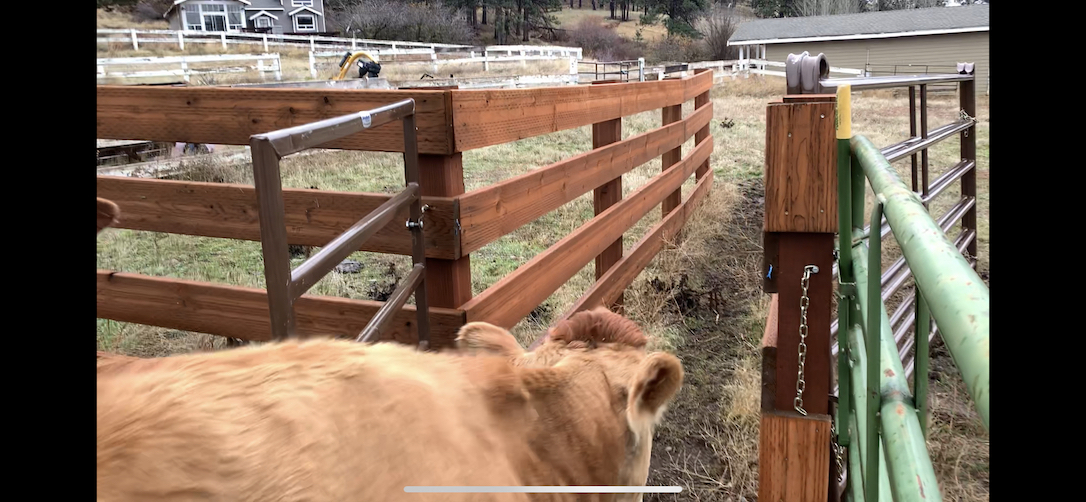
The key to all this is the Bud Box. Although it sounds like a monthly subscription service for cannabis enthusiasts, the Bud Box is actually a type of cattle pen named after its late inventor, Bud Williams. Bud’s design was (and remains) quite simple: a rectangular enclosure that has one or more outflows located near the main entry gate. Cattle will often turn back once they encounter a dead end, at which point they easily divert into a narrow chute for veterinary care or transport. This relatively cheap design is wildly effective and popular. J.B. built our sanctuary’s Bud Box shortly after the cattle arrived, and it’s already proving to be worth all of his hard work.

Source: Michelle Proctor, University of Missouri

As the above diagram shows, the Bud Box is designed to keep the cattle “flowing” into the chute without much human participation or promise of reward; their aversion to containment drives them through. Ideally, all the human operator has to do is close one gate and open another. Still, it can work better if the animals are familiar with the pen and relatively relaxed. Training is one way to achieve this.

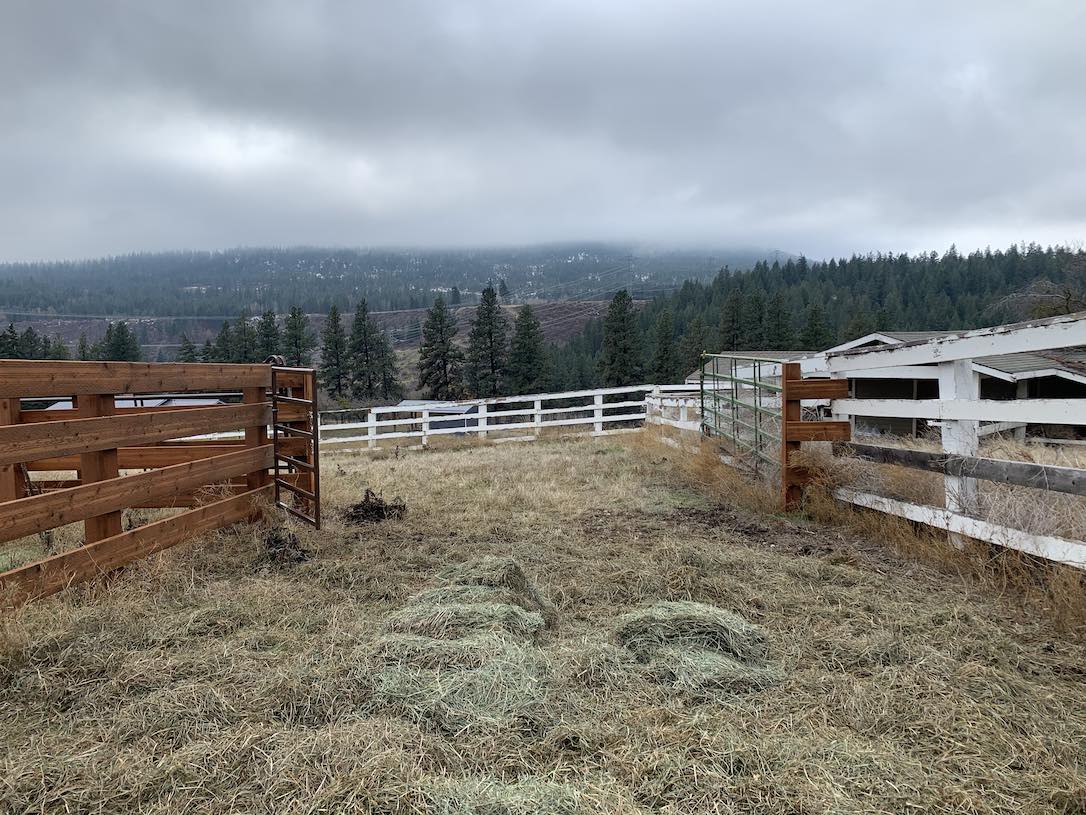
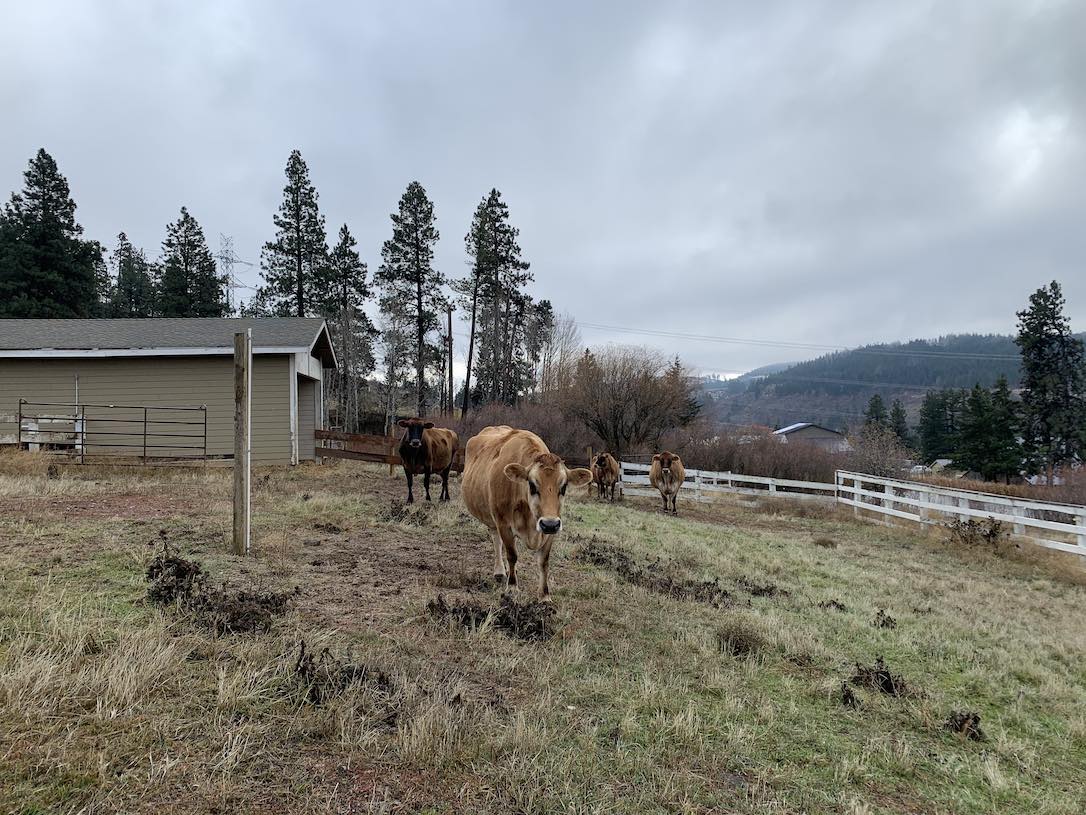
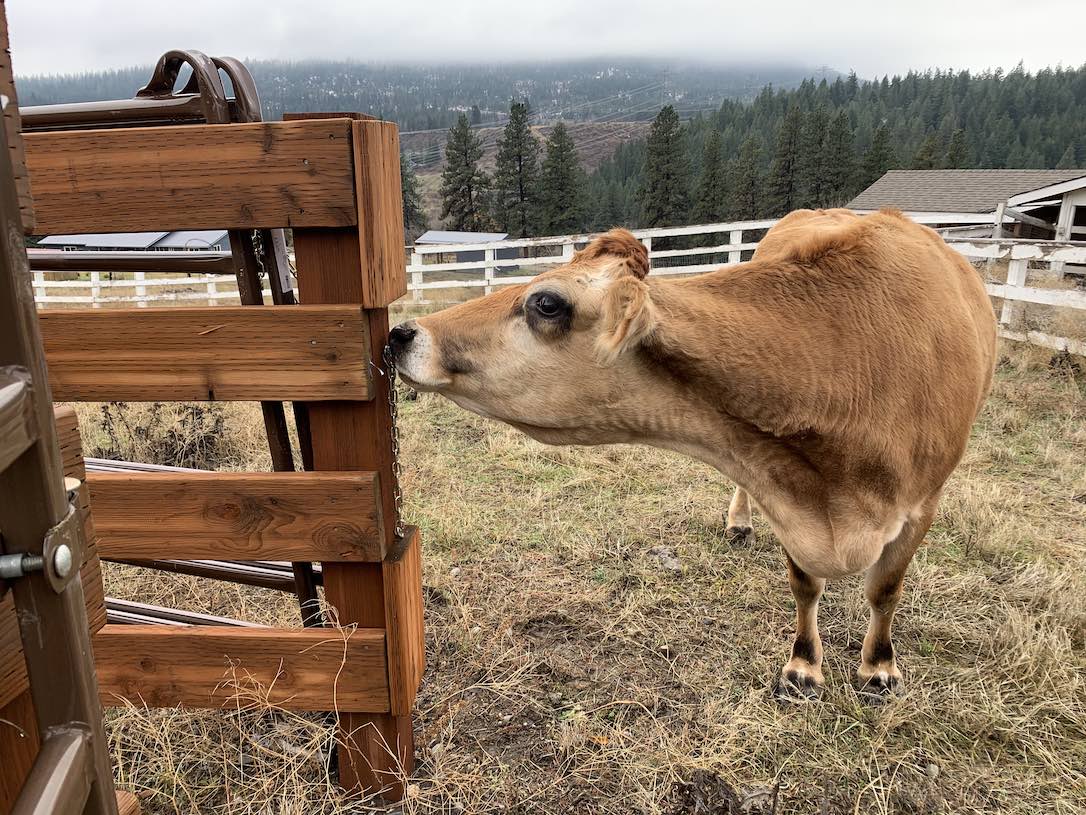
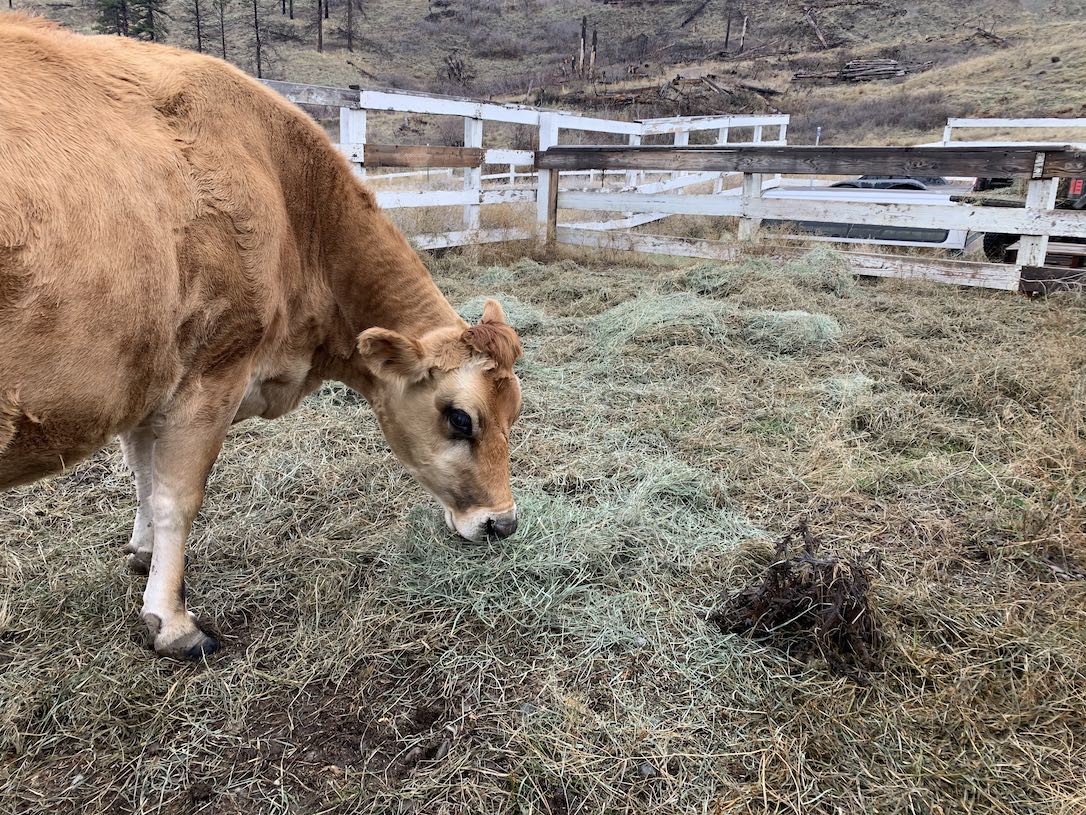
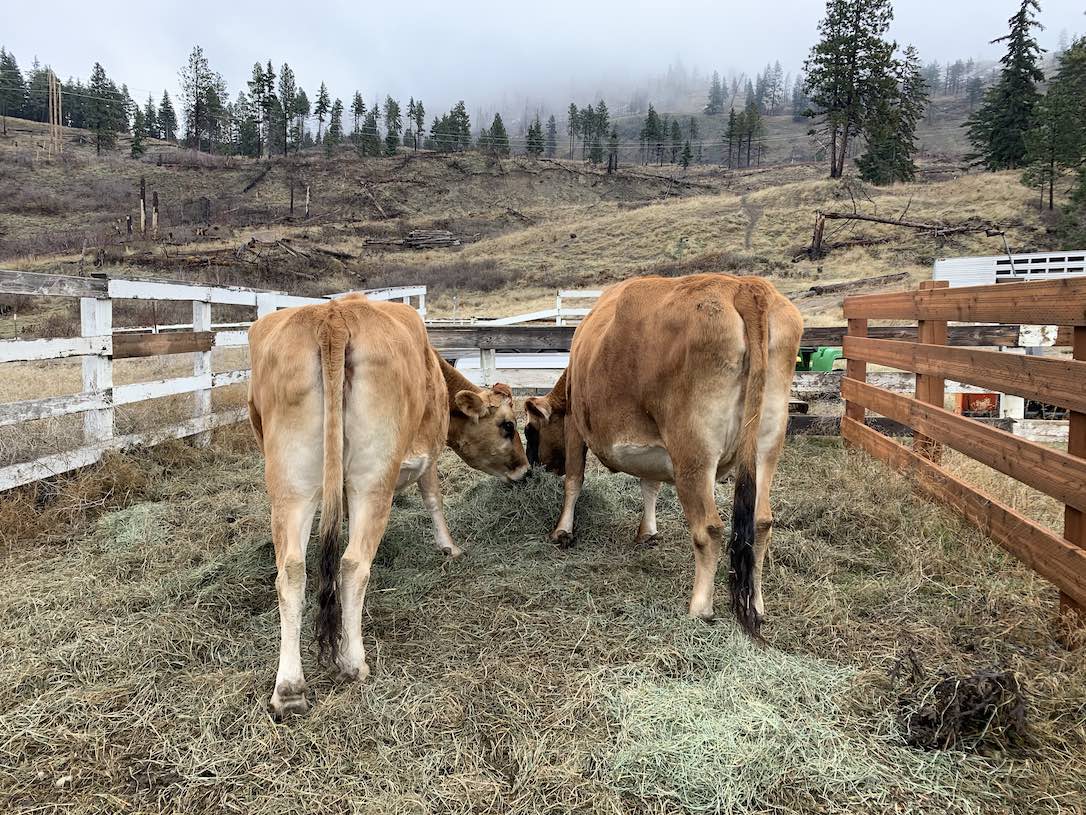
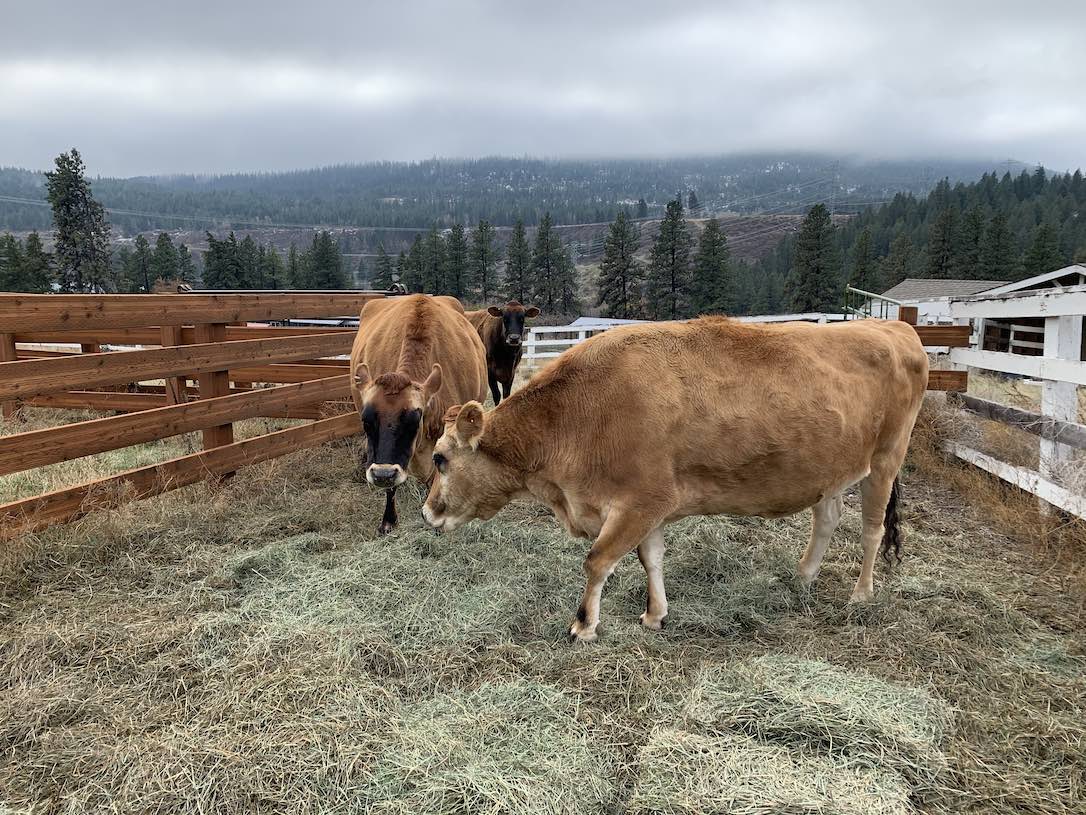
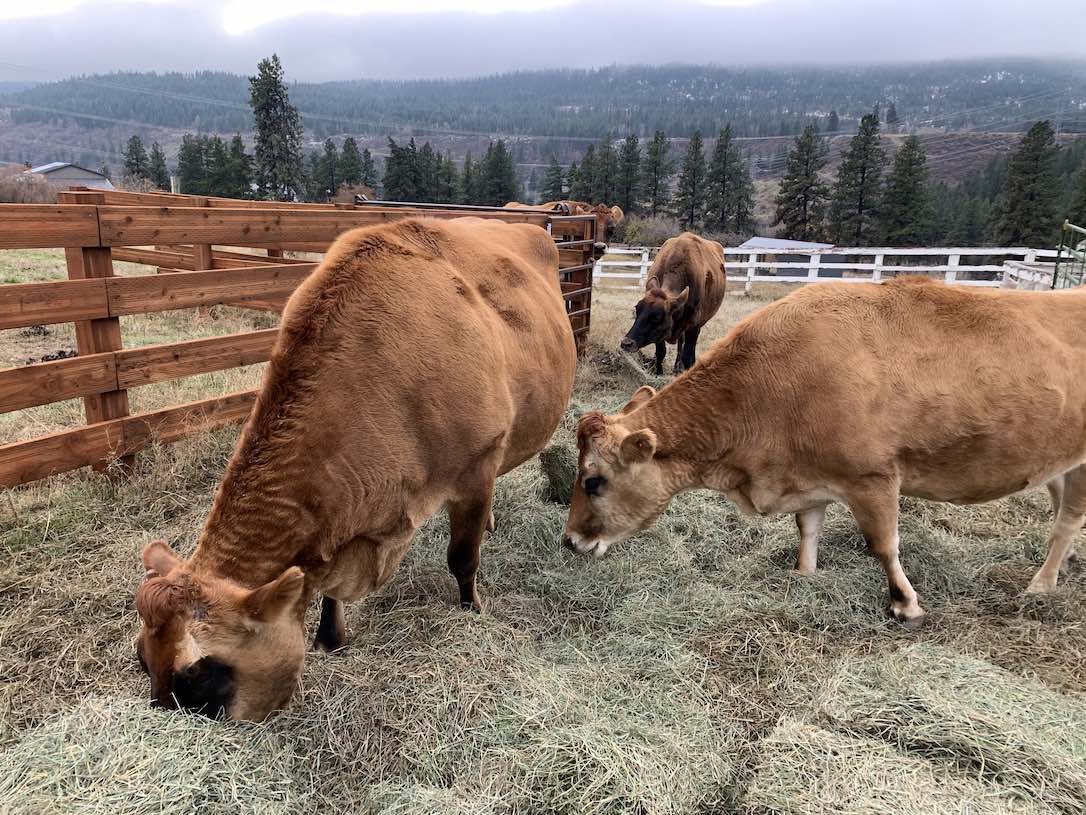
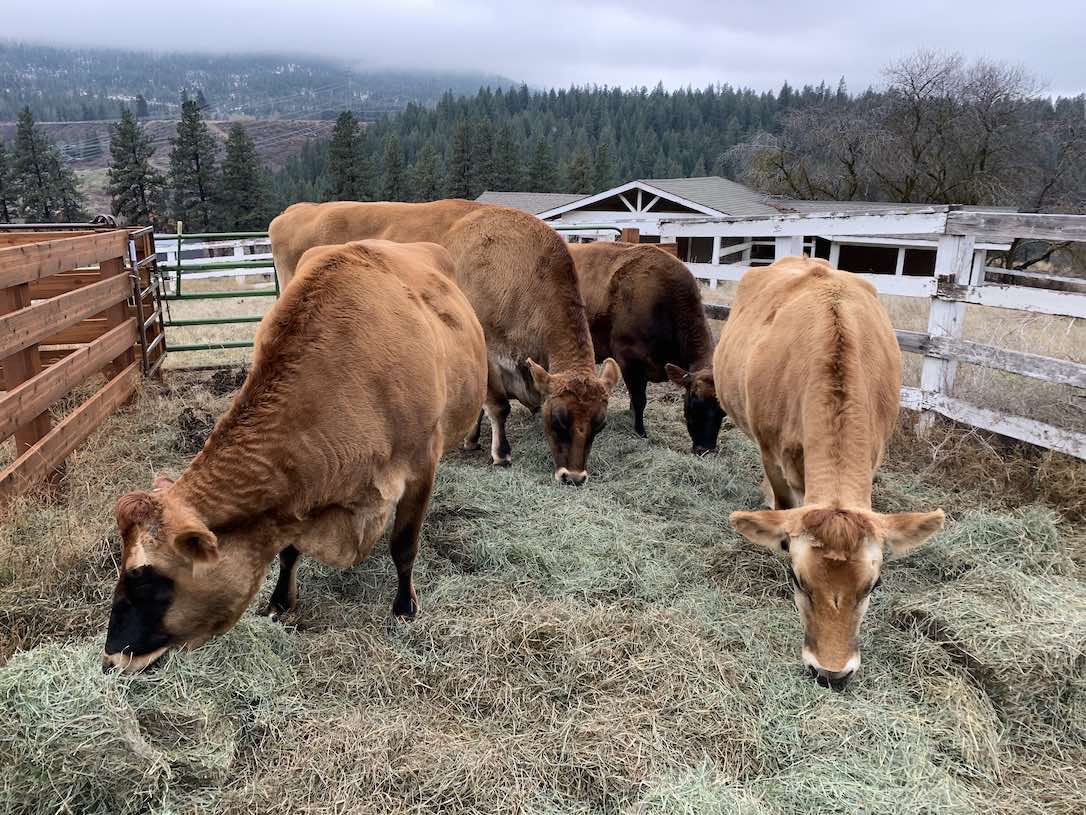
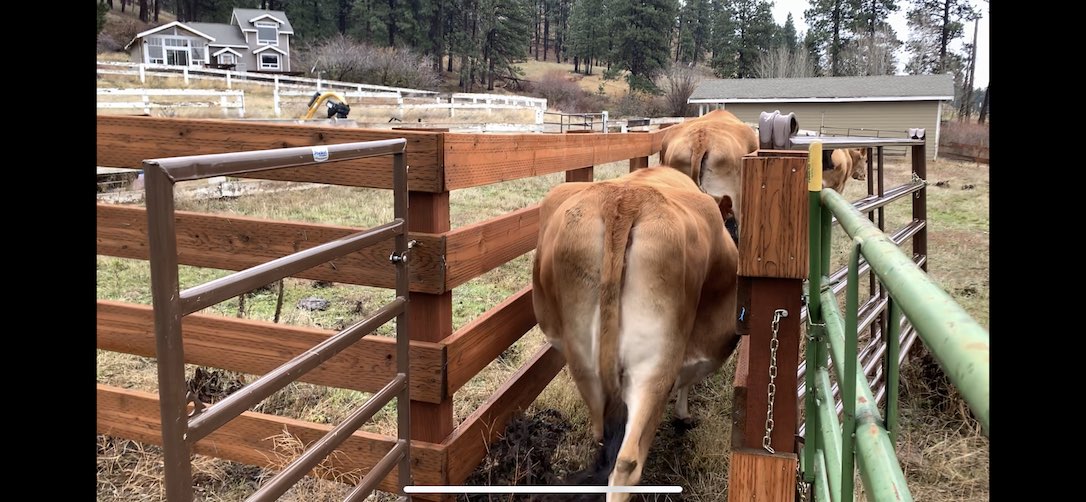
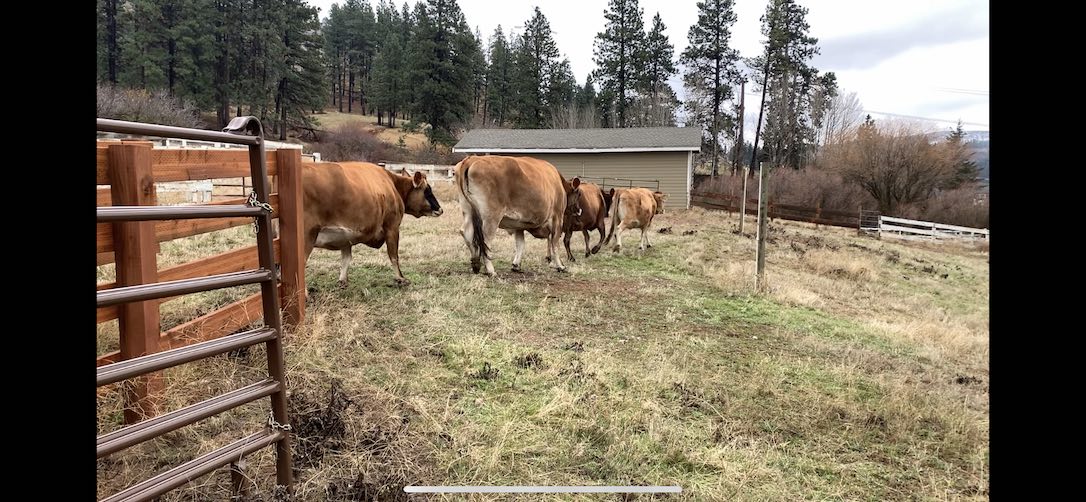
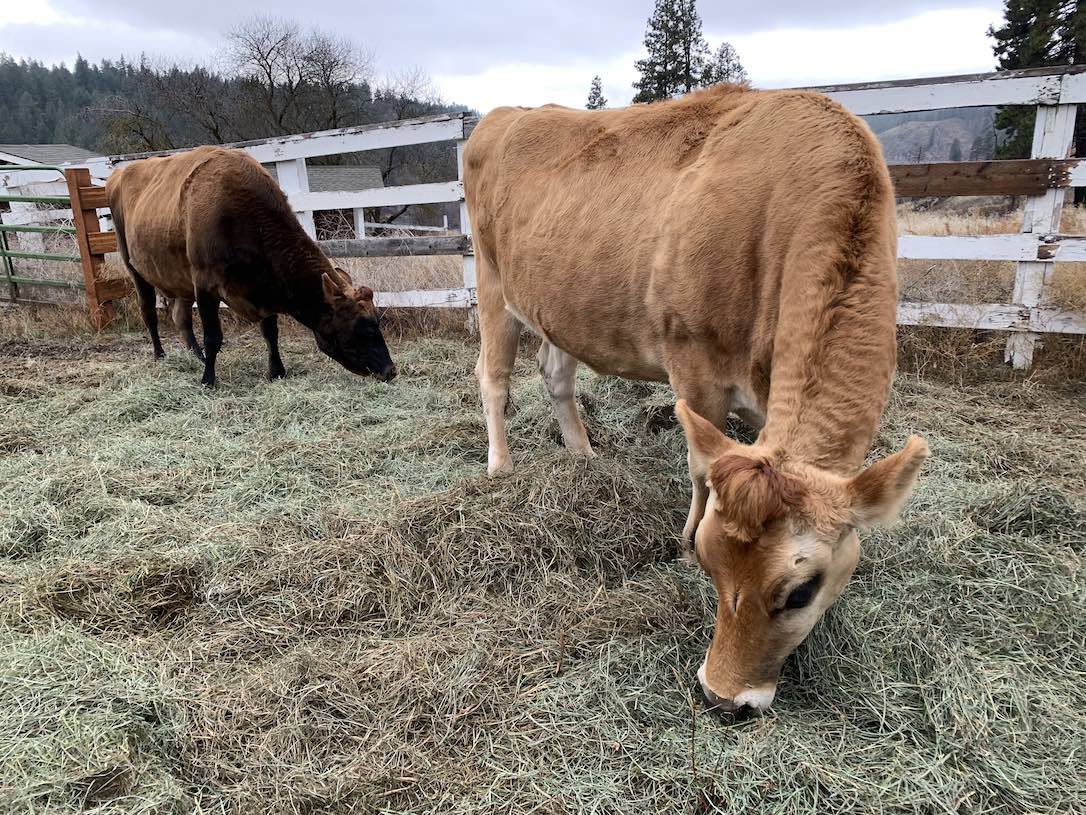
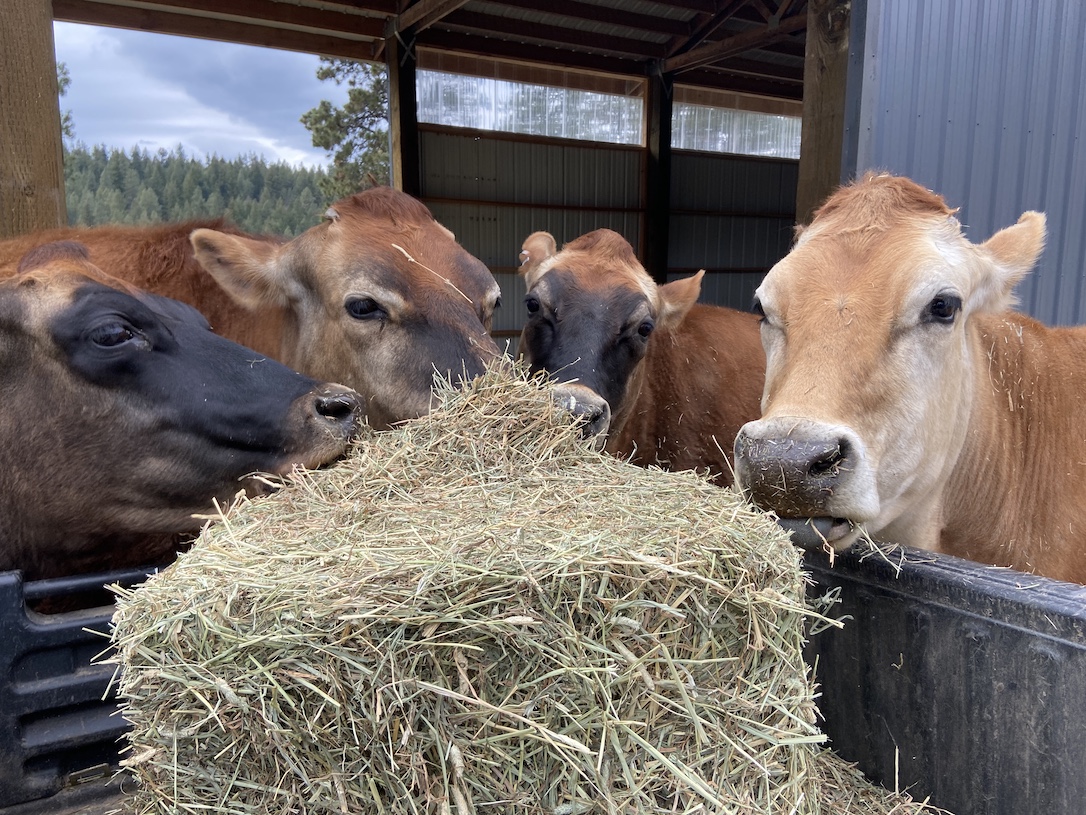
Erin and I have been doing some Bud Box training recently. During these sessions, we put some of the bovines’ regular hay into the box and then briefly close them inside. Then, we open the side gate so they exit through the corresponding chute, receiving the rest of their hay as a reward. Afterwards, we leave the swing gate wide open so that they can re-enter the Bud Box for any leftovers. The following photos show a step-by-step record of the entire process (in case you want to try it with your beloved Jersey cattle at home).

1. With the swing gate open and the chute gate closed, we place an alfalfa/grass hay mixture into the Bud Box and call the cattle over.
2. The cattle come into the corral voluntarily and slowly walk toward the Bud Box. We close the pasture gates behind them.
3. Honey is the bravest. She takes a good sniff of the Bud Box before entering.
4. Honey settles and begins to forage.
5. More skeptical individuals tend to hang back. Meredith need a moment to observe her mother eating safely.
6. The number of cattle in the Bud Box suddenly doubles as Meredith joins Honey inside.
7. Betsy comes over, too.
8. Betsy begins to eat. Nutmeg is the last one to arrive.
9. Nutmeg needs to lick things.
10. With the cattle happily filling their bellies, I close the swing gate behind them.
11. Nom nom nom nom nom
12. Once they’ve eaten a bit, I open the side gate so they can exit via the chute.

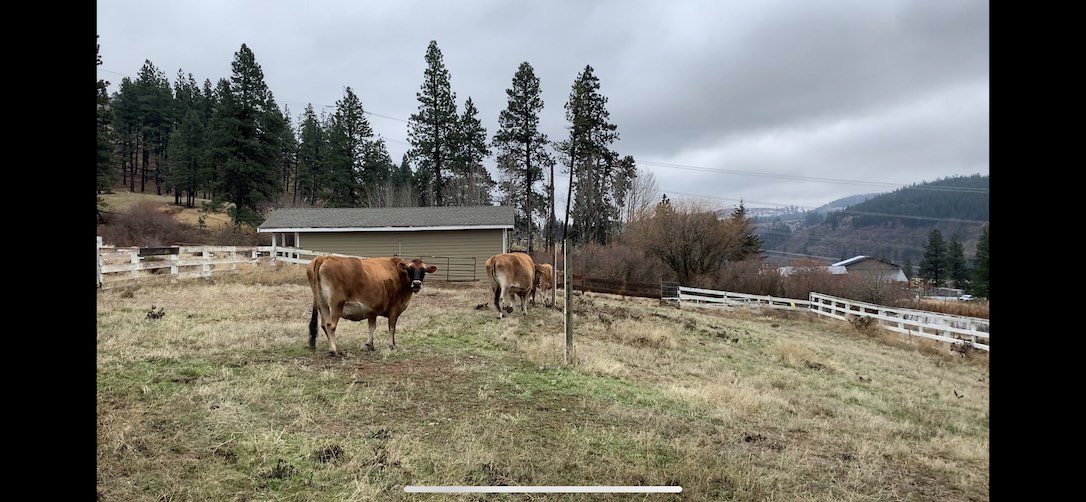
13. Although they eagerly leave the Bud Box, they soon decide to go back to it and scarf down the remaining hay.

Our plan is to continue this training on a weekly basis until the cattle calmly enter the Bud Box and exit via the chute with only a tiny bit of coaxing. It may seem like a lot of work now, especially for a bunch of primatology nerds like us, but this training could prove invaluable if we ever have to round up the cattle in a hurry.

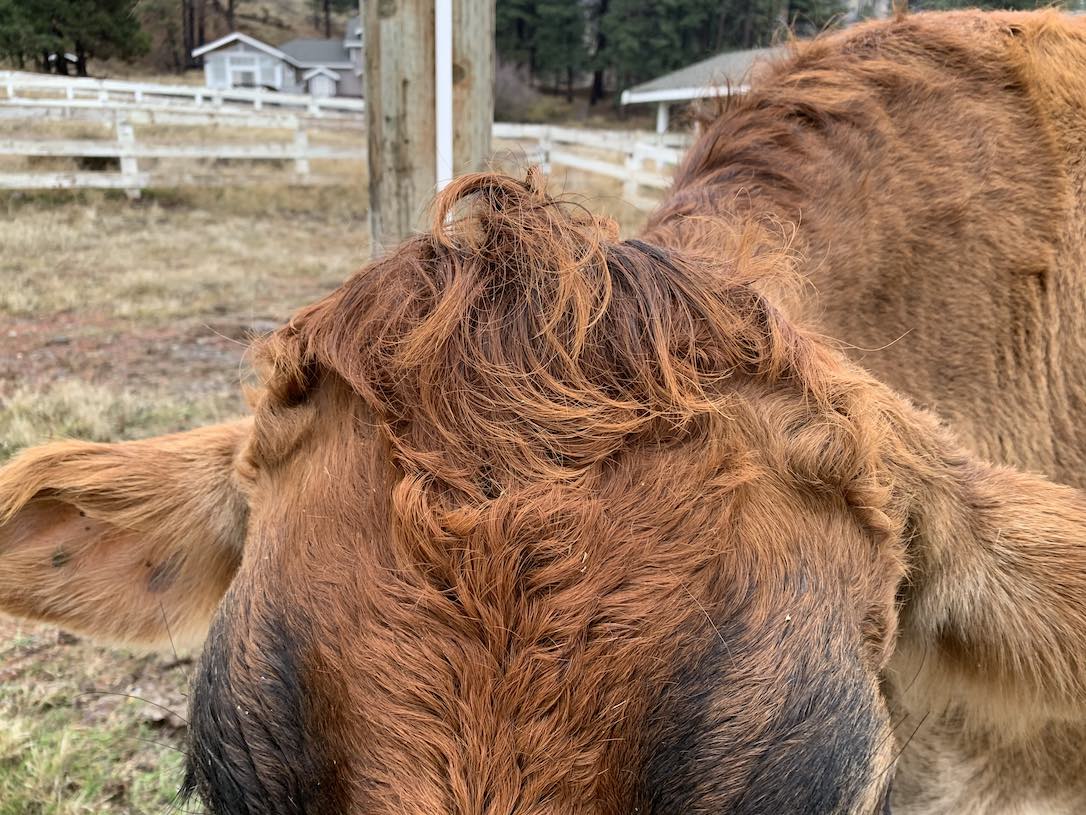
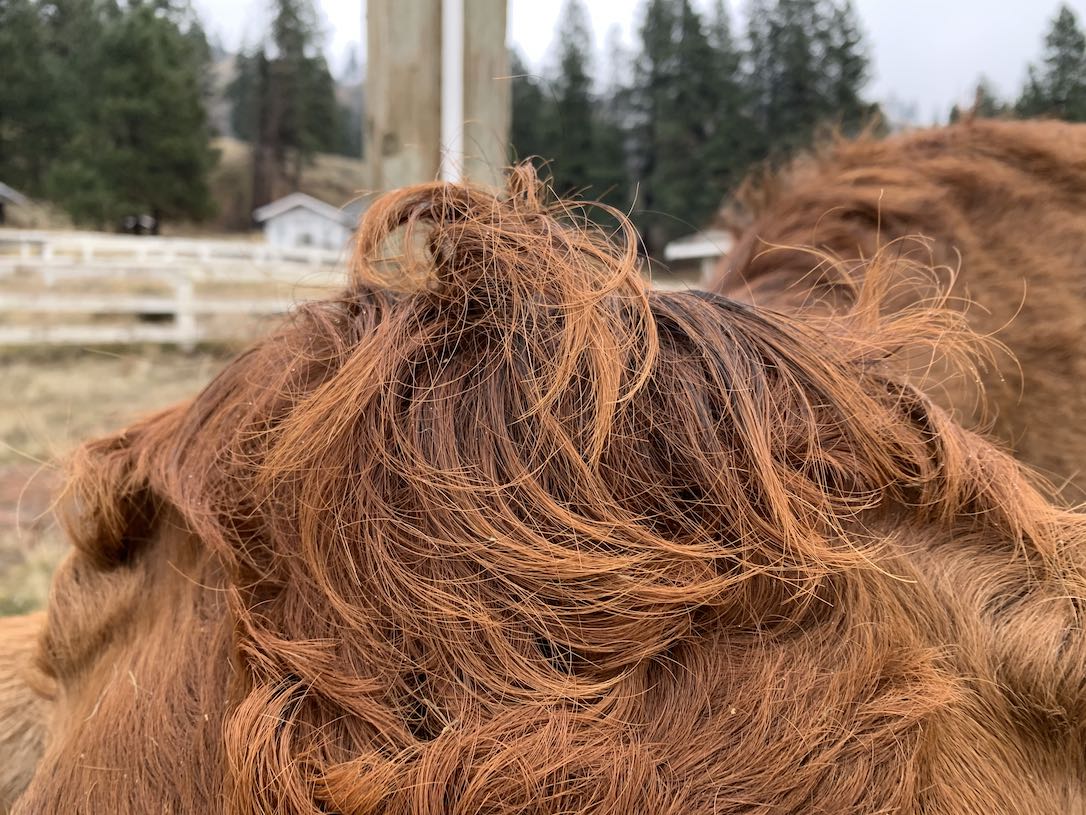
In the meantime, I think we all need to appreciate how awesome Nutmeg’s hairstyle is. This anatomical feature is actually an occipital protrusion called a poll, but I think it looks more like a messy man-bun. Either way, he rocks it.

Filed Under: Cattle, Farmed Animals, News, Training, Weather Tagged With: animal behavior, animal rights, animal training, Animal Welfare, animals, bovines, bud box, cattle, chimpanzees, cows, emergency management, jersey cows, livestock, positive reinforcement, ranching

man of mystery

November 21, 2020 by Diana

If you tuned in yesterday, you read that Willy B has been asserting his desire to disrupt the routine and, instead of shifting for meals, he has one thing on his mind – keeping tabs on the neighbors, we suspect Annie in particular.

Today was a continuation of this trend. Anna, J.B. and I put our heads together yesterday to attempt to problem solve and try to give Willy B what he wants but also ensure we are able to clean their house.

I think I mentioned this a couple of weeks ago, but I have a blog post percolating in my brain all about how much of what we do in caring for captive chimpanzees is balancing different aspects of welfare and safety.

I don’t know if I’ll ever write that grand post. There’s a hundred examples of this sometimes difficult balancing that we do throughout each day. Rarely are there clear right or wrong answers.

Willy B’s new defiance to the routine illustrates several examples.

Because of the construction happening right now that will give Willy B, Mave, and Honey B more space and variety, we decided to not give them access to the courtyard when construction workers are on site.

There are a few reasons we landed on that decision, but mainly it was about safety. Willy B is still getting used to the courtyard and Honey B and Mave are still curious but not curious enough to take steps outside. The Courtyard is right next to where the construction is taking place. We certainly don’t want any incidents while strangers are in the vicinity.

So, this means that Willy B’s Courtyard time has been lessened and we aren’t actively working on encouraging Mave and Honey B to be adventurous, but rather leaving it up to them for the time being.

Also, the Courtyard was a bit of a quick construction project. It’s not their final outdoor space, rather it’s a stop-gap that we created after the integrations didn’t work out so that Willy B, Mave, and Honey B could have an open-top outdoor space while we continue to work on the expansion for them and for another group of chimpanzees coming from Wildlife Waystation.

In order to create the space quickly, there’s just one electric fence running between the Courtyard and the rest of Young’s Hill – the outdoor habitat that the group of seven access. With just one fence between them, we don’t have both groups outside at the same time. This means we have to balance the needs, desires, and welfare of each of the individuals in the two groups when allocating outdoor access.

This is temporary. Both groups will one day have large open-top habitats, but right now we have to work with what we have. And there’s always the possibility of Mave and Honey B never (or take years to) get accustomed to the big open outdoors. So, part of our future plans include a large enclosed outdoor space too. Balancing. Balancing.

Our routine lately has been going along swimmingly for the most part. There was that one day a couple of weeks ago when Willy B decided to camp outside. Anthony’s post that day covers some of this same material I’m relaying here. At the time, that incident was an anomaly and didn’t impact the cleaning routine. Willy B’s decisions this week, however, are putting a wrench in the routine.

Today, I opened up the Chute first thing in the morning, hoping that Willy B would get his fill of monitoring the other group / watching Annie, and would then come in for breakfast so we could clean. I realized at the time, of course, that this was wishful thinking. He chose not to shift for breakfast. And today Honey B decided to join him in his keeping-the-humans-on-their-toes mission. Mave had a fabulous breakfast and was in high spirits all day, inviting the humans to play chase whenever she could catch our eye.

Based on Willy B and Honey B’s decision, I changed up the routine a bit, eventually closing Willy B in the Chute so that we could clean all of the front rooms. Happily for everyone, it was a beautiful sunny day, and he was quite content napping at the top of the Chute.

With the construction crew off, I decided to wait until after lunch to open up the Courtyard so that Willy B could have some extra time out there, if he chose.

He chose.

Anna and I took turns hanging outside with him most of the afternoon.

It wasn’t so much that he wanted to be in the Courtyard as he did not want us to eliminate the option of him being in the Courtyard, so the few times Anna or I approached the controls to close the door, he would move from the Chute to the Courtyard.

It was nice to be able to give him this choice and it allowed me to do a little photo study of this man of mystery.

Eventually, he let Anna close the door and he came inside just before dinner. Whew!

I had a decision to make now. It was right before dinner, but the seven hadn’t been outside on the hill since this morning. They probably would have been just fine getting dinner and ending the day, which would make things easier on the humans. On the other hand, if they could have twenty minutes or so of outside time, that would be nice.

You can probably guess what I decided to do.

The question now was whether Jamie would allow me to close the hill after dinner. Jamie is controlling by nature and often chooses when the caregivers go home by sitting in the doorway to the hill, knowing full well that we won’t leave until all of the chimps are inside for the night.

After dinner, Jamie looked at me and ran outside. The gig was up, there would be no closing of the door; we were going to walk. Actually, a walk was not exactly what she had in mind. I had to get the gator from the barn so we could race.

I have to hand it to Jamie, she knows how to end a day.

Willy B also did not want a door closed during dinner – the door to the Chute. Eventually his stomach and curiosity made the decision for him and I closed the door while Anna passed out grab bags.

Now everyone is tucked in and sleeping soundly, and I’m awake-dreaming about the new spaces taking shape for Willy B, Mave, and Honey B and new chimpanzees and all of the ways they will be able to choose to keep the humans on their toes.

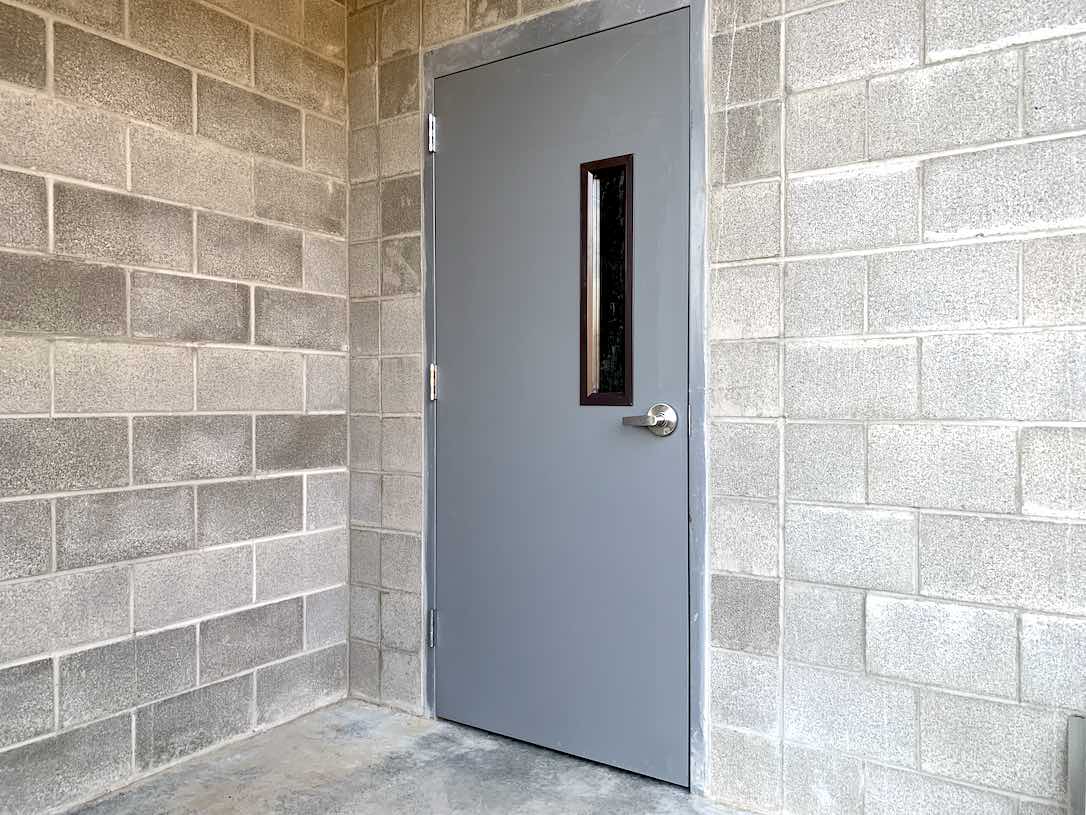
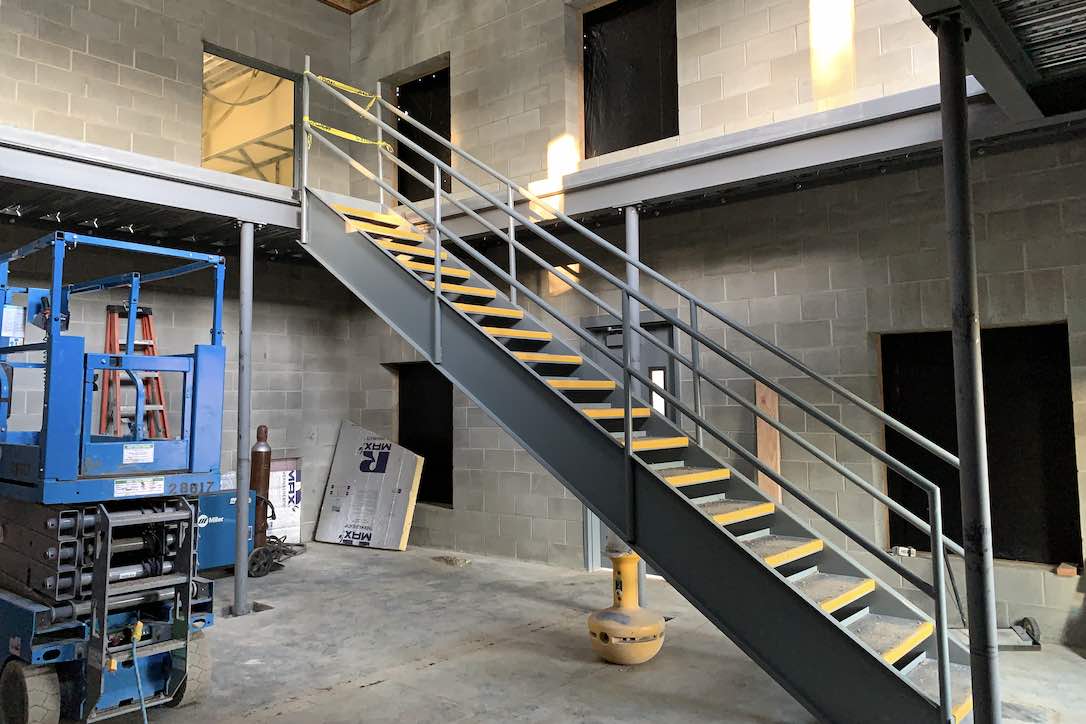
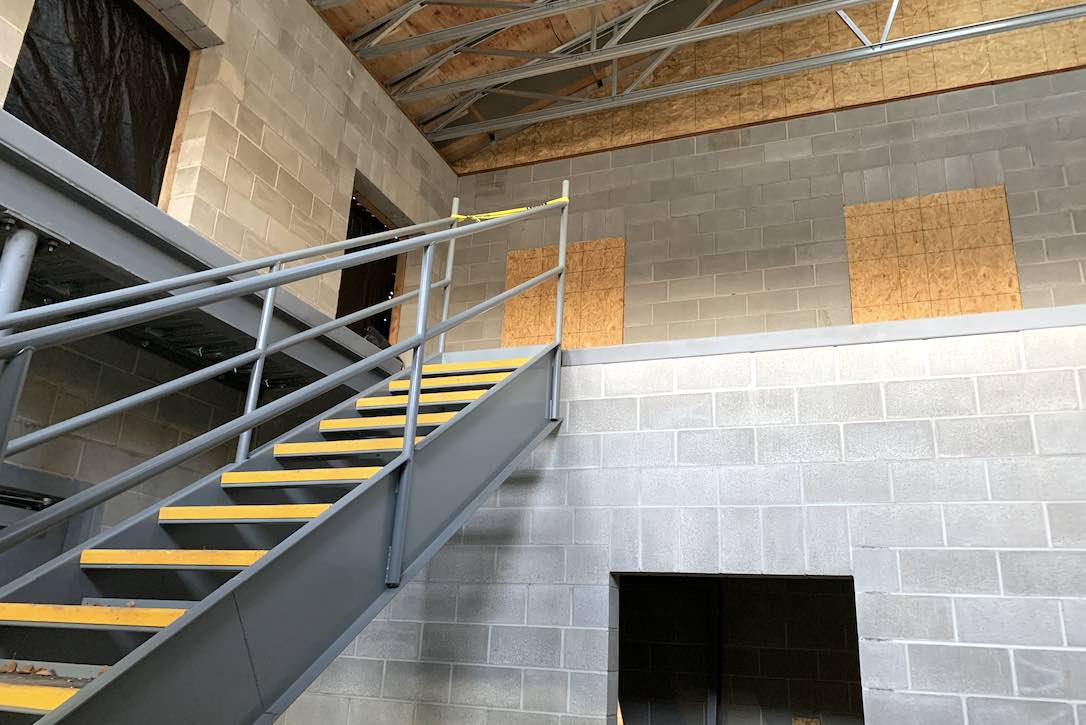
Here’s some exciting progress on the construction.

Doors!

Stairs!

Thanks for tuning in to today’s blog! Happy Thanksgiving week to everyone.

Filed Under: Chimpanzee Behavior, Courtyard, Sanctuary, Weather, Willy B, Young's Hill Tagged With: animal protection, animal rescue, animal rights, Animal Welfare, chimpanzee, chimpanzee rescue, chimpanzee sanctuary, chimpanzees, primate protection, primate rescue, Primates

Two Years Down, Many More to Come!

November 2, 2020 by Chad de Bree

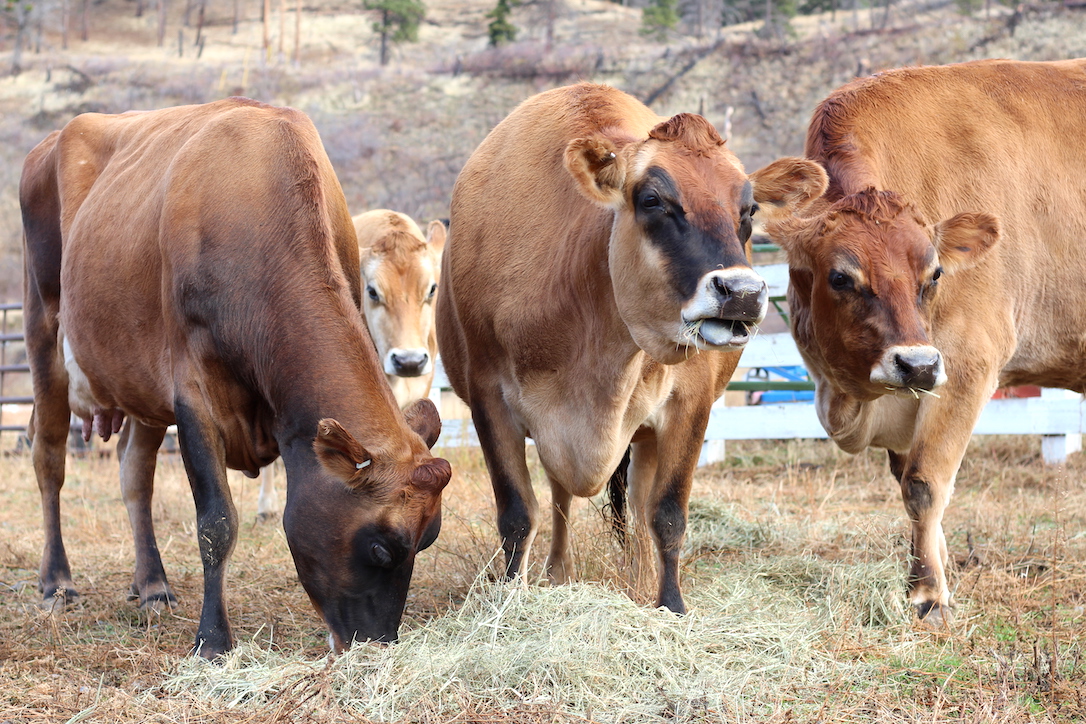
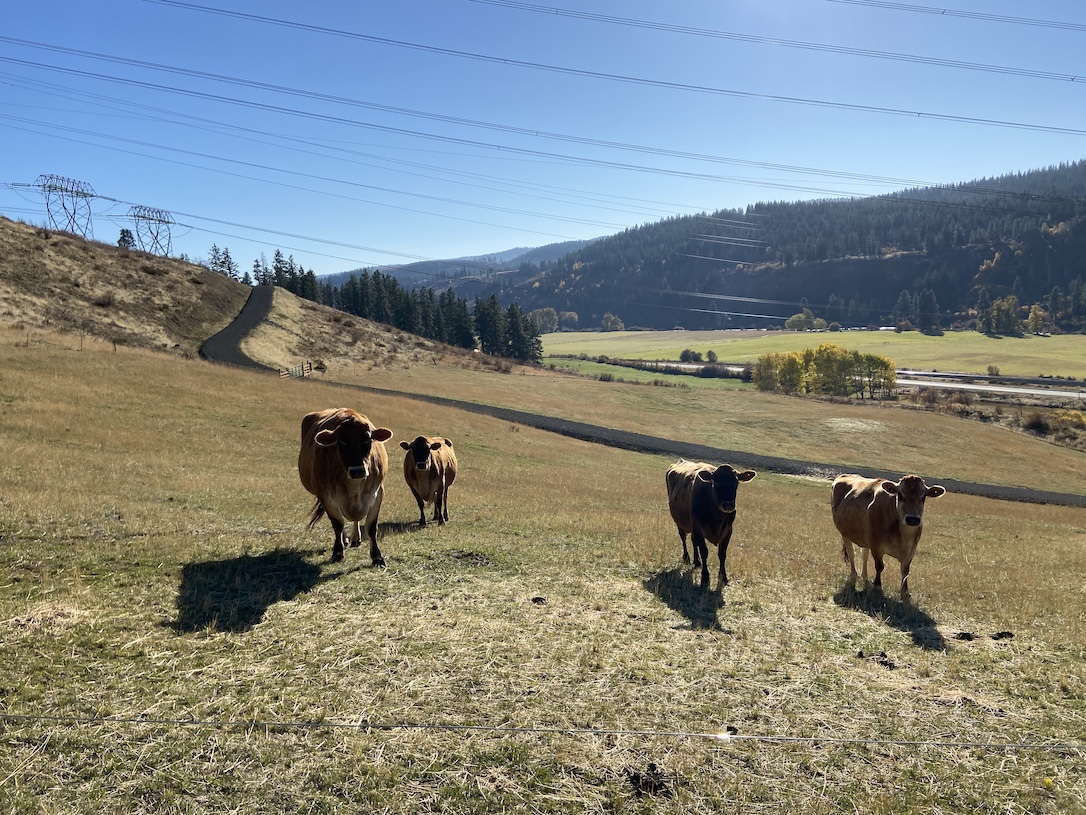
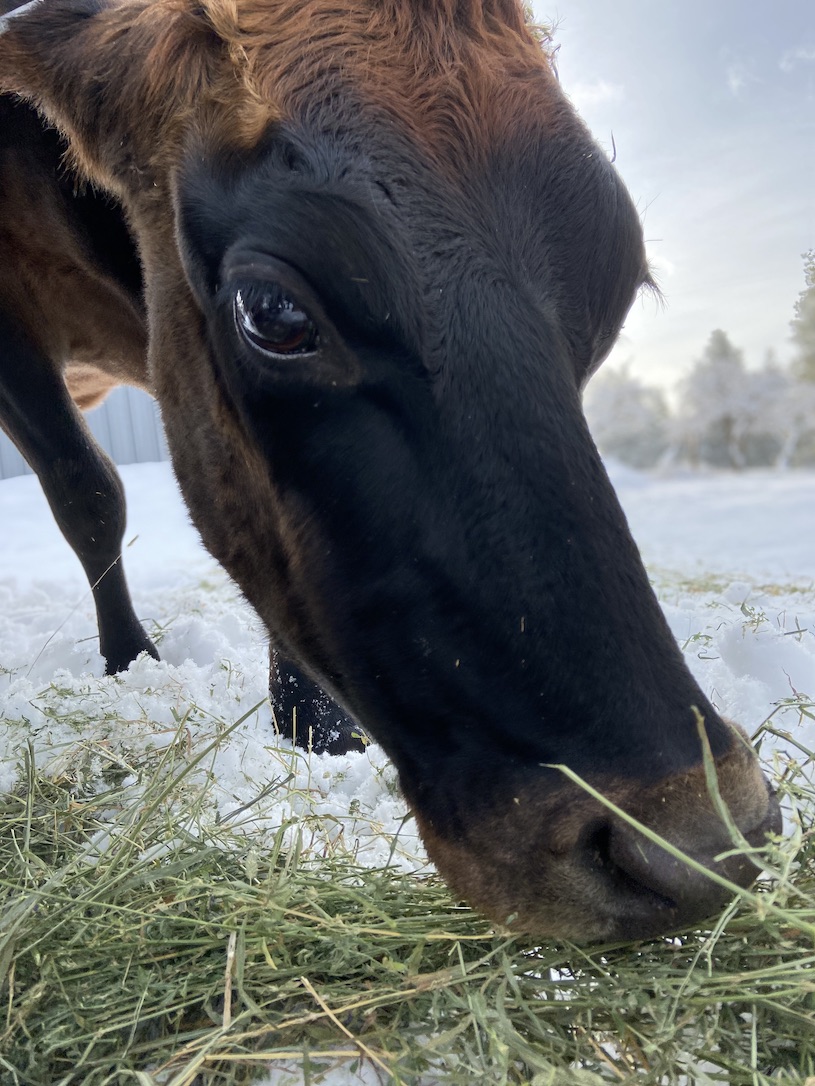
Today is a very special day! It marks 2 years since Betsy, Honey, Meredith, and Nutmeg arrived and began to call Washington their new home!

A photo from the first day they arrived at Chimpanzee Sanctuary Northwest!
Photo from today as they watched Jamie and I sprint around Young’s Hill.

From the first day they arrived in Central Washington to today, these four individuals have been such an honor and treat to be able to get to know!

To honor their second year in Washington, we had planned something special for them. However, similar to the events that unfolded on Meredith’s birthday a couple of months ago, we were unable to photograph or film the events as they were more interested in their hay than their celebratory cob treat today.

So instead, here are some photos from their second year at Chimpanzee Sanctuary Northwest!

Betsy in February eating some alfalfa in the Winter pasture.
That one time they were hiding from me in the Creek back in June.
Mobbing the Gator full of hay in April.
Making the march today to the other pasture where they were treated with cob, but decided hay was better. L to R: Nutmeg, Betsy, Meredith, Honey.
Betsy up near the pine trees that line the top of Young’s Hill in October.
Nutmeg in the Spring pasture in August.
Honey in the Spring pasture in September.
Meredith being beautiful in October.
Honey today!
Betsy (with Jamie in the background) in July!
Meredith in the Summer pasture on her birthday back in September!
Nutmeg making his was back to the barn today.

We can’t wait to celebrate more years to come!

Remember! You can help contribute to their care by becoming a Bovine Buddy to one or all of them! This will help us tremendously to make sure they have many more years to come here!

Filed Under: Cattle, Sanctuary Tagged With: animal rescue, animal rights, Animal Welfare, Sanctuary, shelter

A Jamieween Tale of Two Scarecrows

October 31, 2020 by Diana

Today was Jamieween, a day unlike any other.

Today we celebrated Jamie Chimpanzee’s birthday and Halloween. And boy did we celebrate.

All of the humans truly outdid themselves this year. Enrichment Coordinator Chad has been thinking about and planning some special surprises for Jamie’s 43rd, and there was a lot of improvised fun sprinkled on top. Caregivers came in on their day off to help and share in the celebration.

I’ll start with Jamie. She had a particularly fantastic day. It was chilly early this morning, but as soon as I opened the hill for the chimps, Jamie bolted out and I joined her on the first walk of the day. The morning light choosing spots to illuminate on the hill was so beautiful (the photo below doesn’t quite capture it, but I posted a short video clip on Instagram), and I was glad she invited me along to enjoy it.

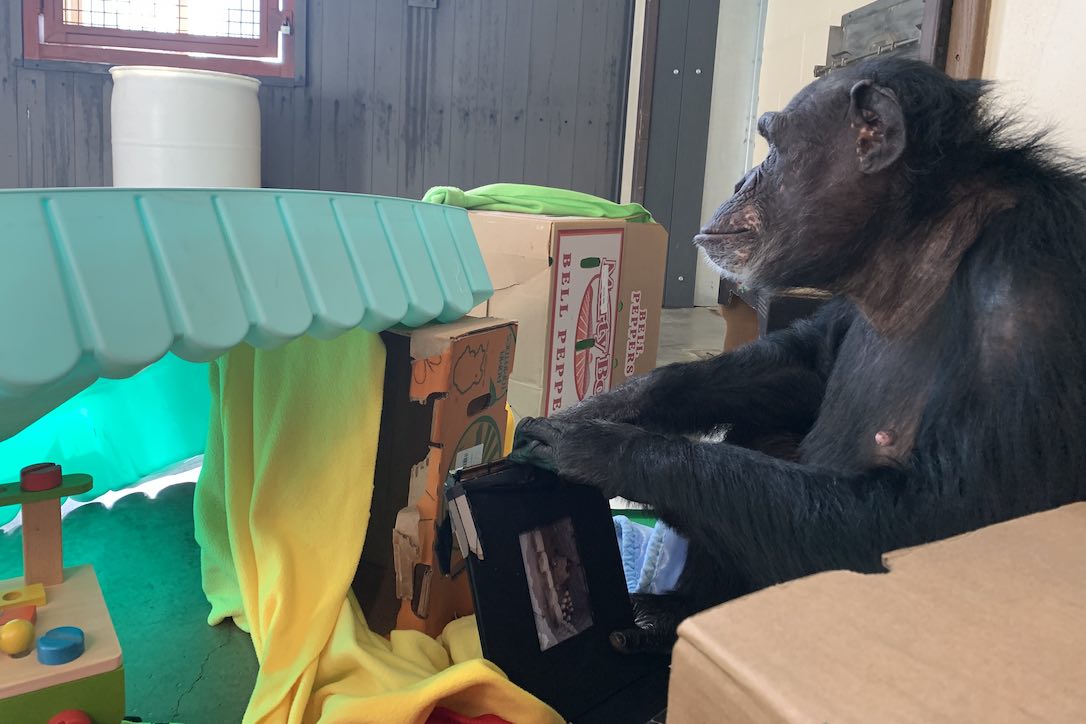
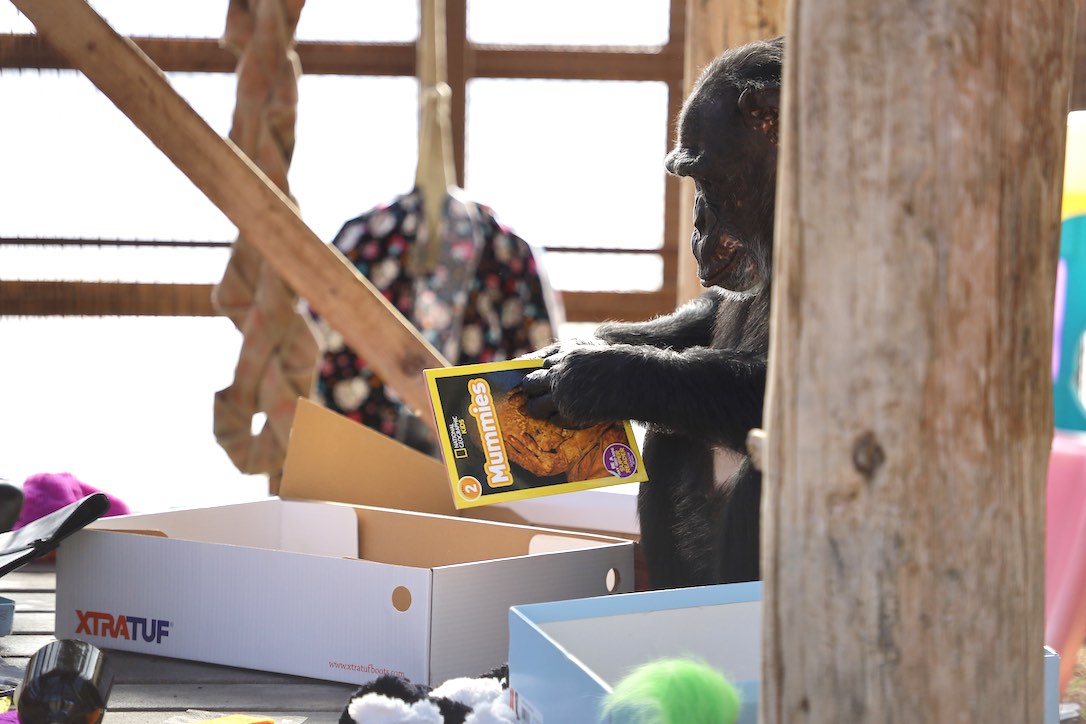
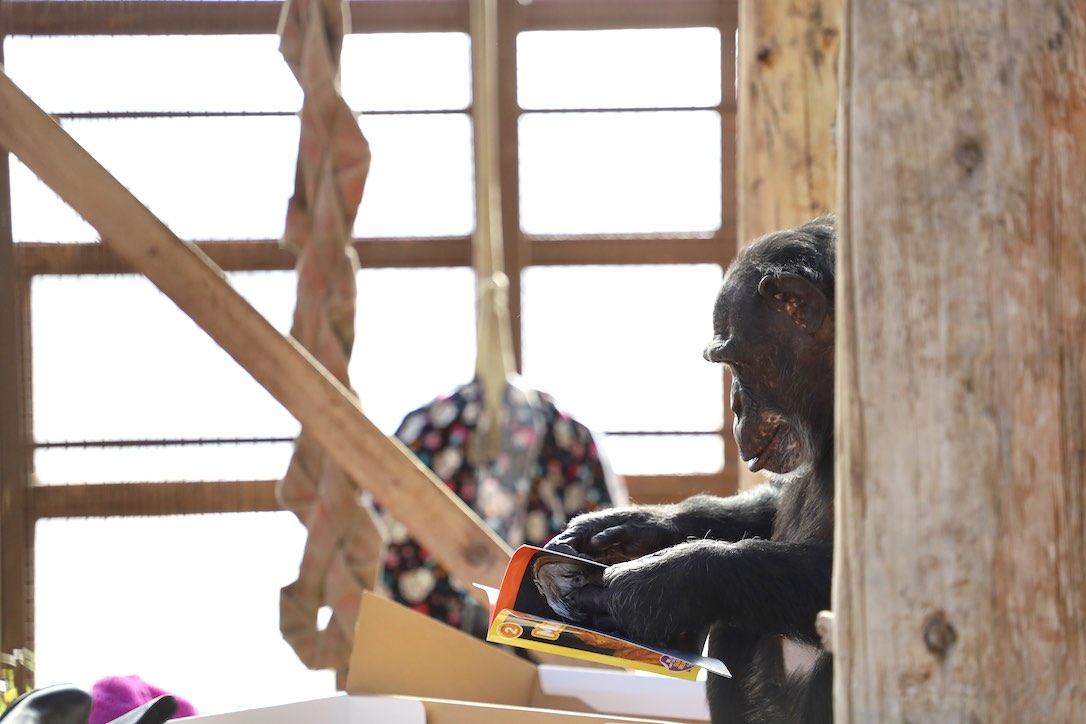
There were many gifts for Jamie throughout the day (thanks to those who purchased items from our wish list for Jamie!). These gifts were left for her in different areas for her to find. Katelyn noticed that Jamie had a particular interest in mummies a while back – she was carrying around a national geographic and paying special attention to some photos about mummies. So of course mummy books were a part of her celebration.

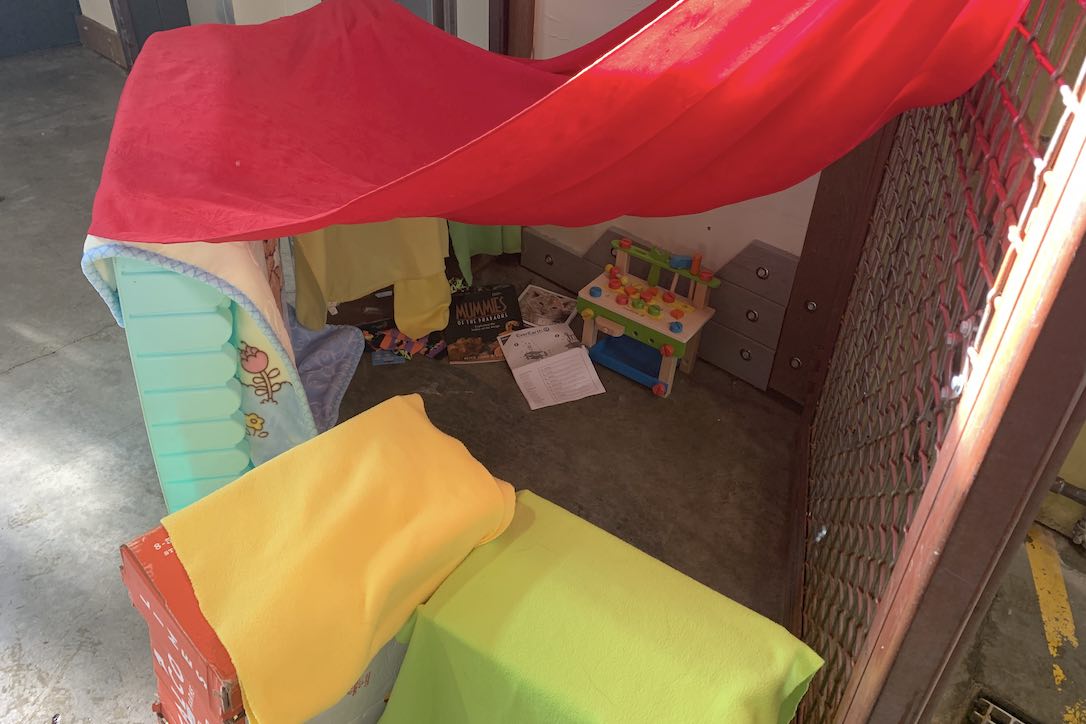
Kelsi and Anna created a “haunted box fort” for her in the playroom so she could enjoy some of her new books.

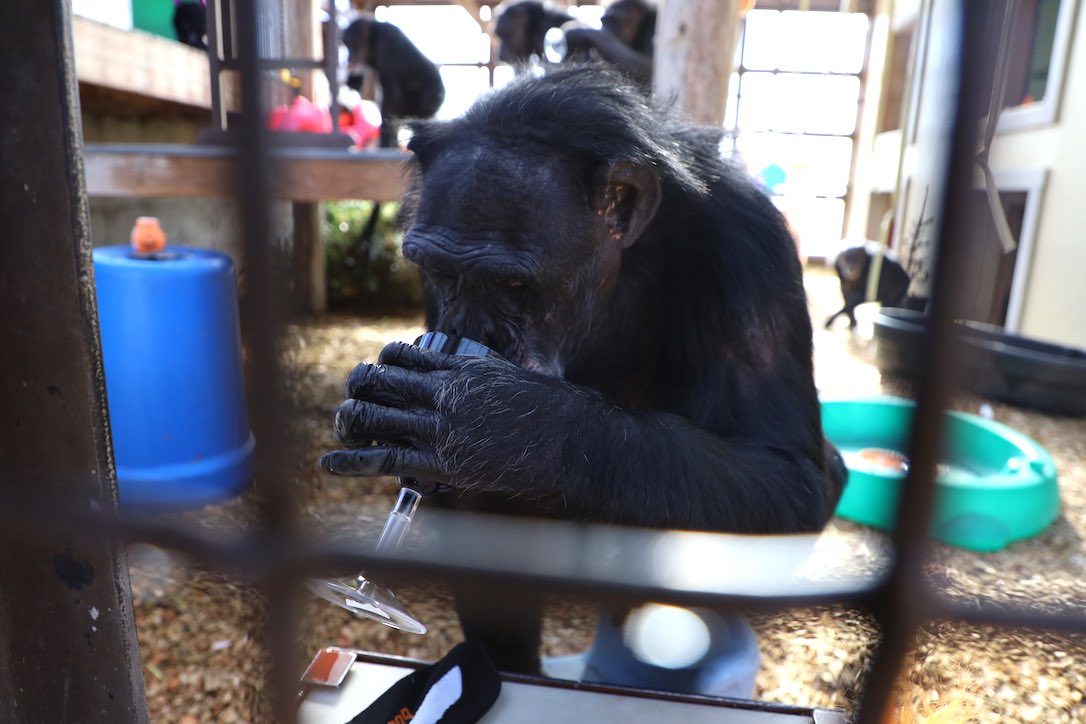
Later, after a refreshment…

…she checked out another one of the mummy books in the greenhouse:

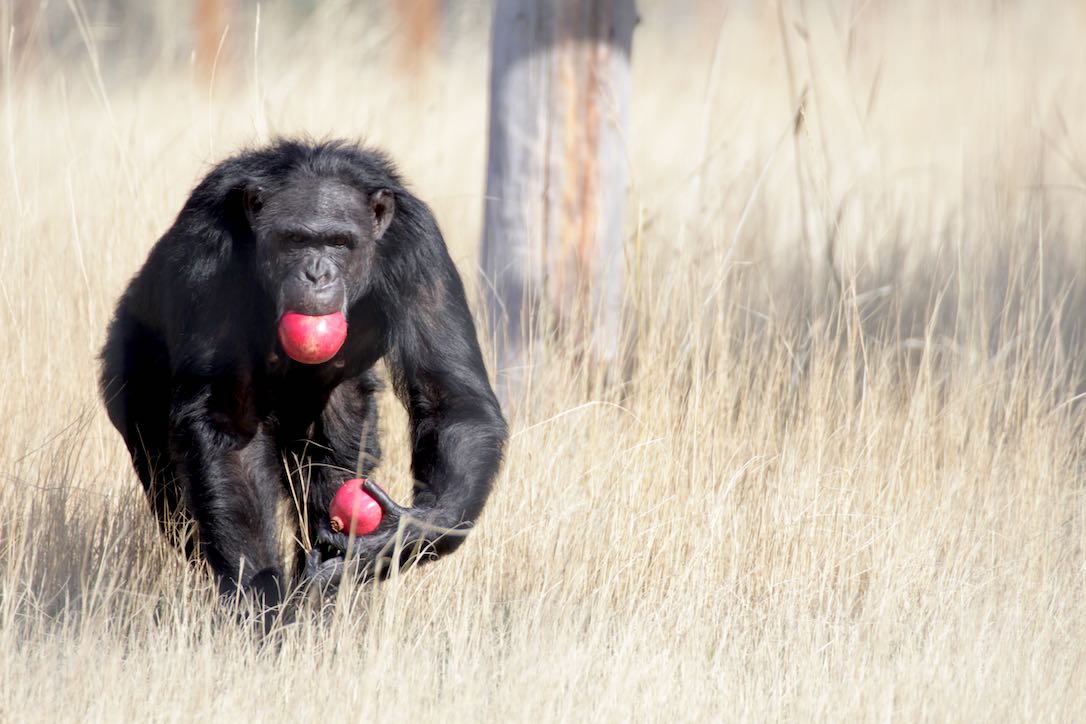
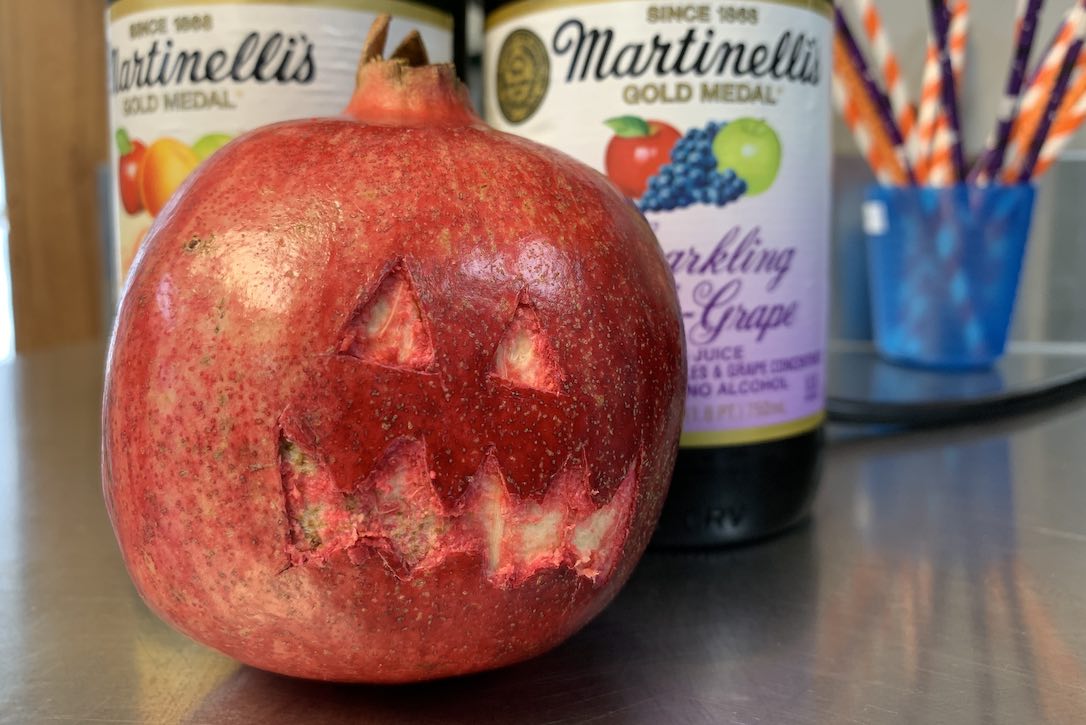
Yesterday the winds were howling, but today was still and crisp and even warm, so of course we had to set up some Halloween food forages outside. The chimpanzees got to enjoy their very first pomegranates of the season – whole pomegranates! Jamie was quite pleased.

If you have seen past Jamieween celebrations, by now you might be wondering about the pumpkin and Jody…

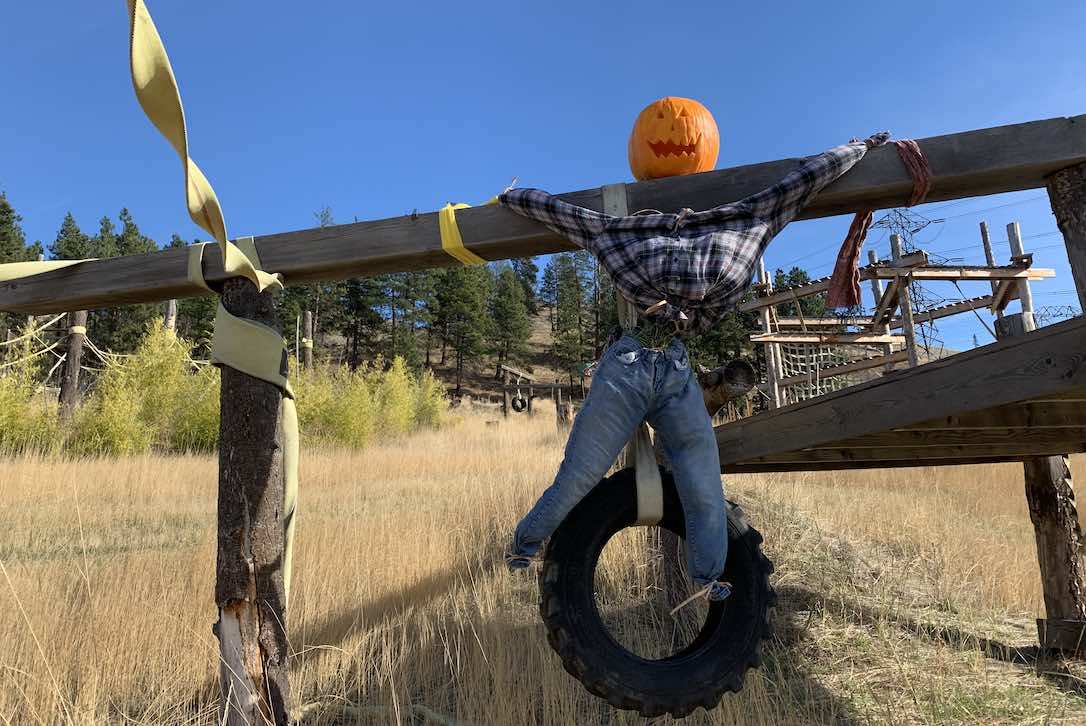
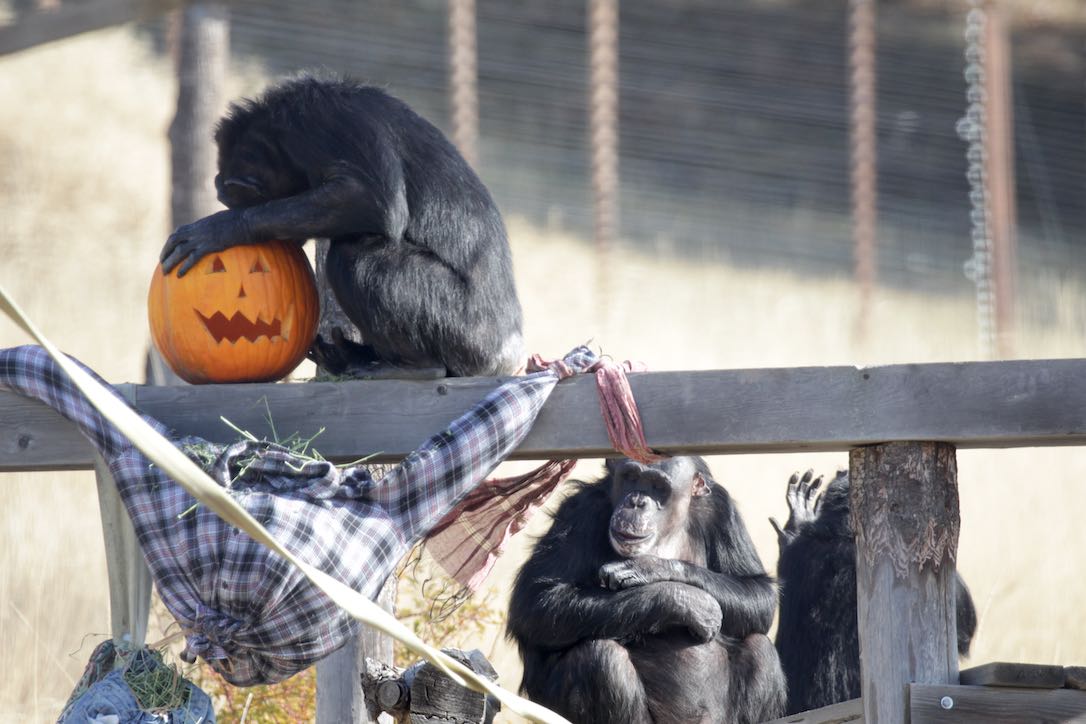
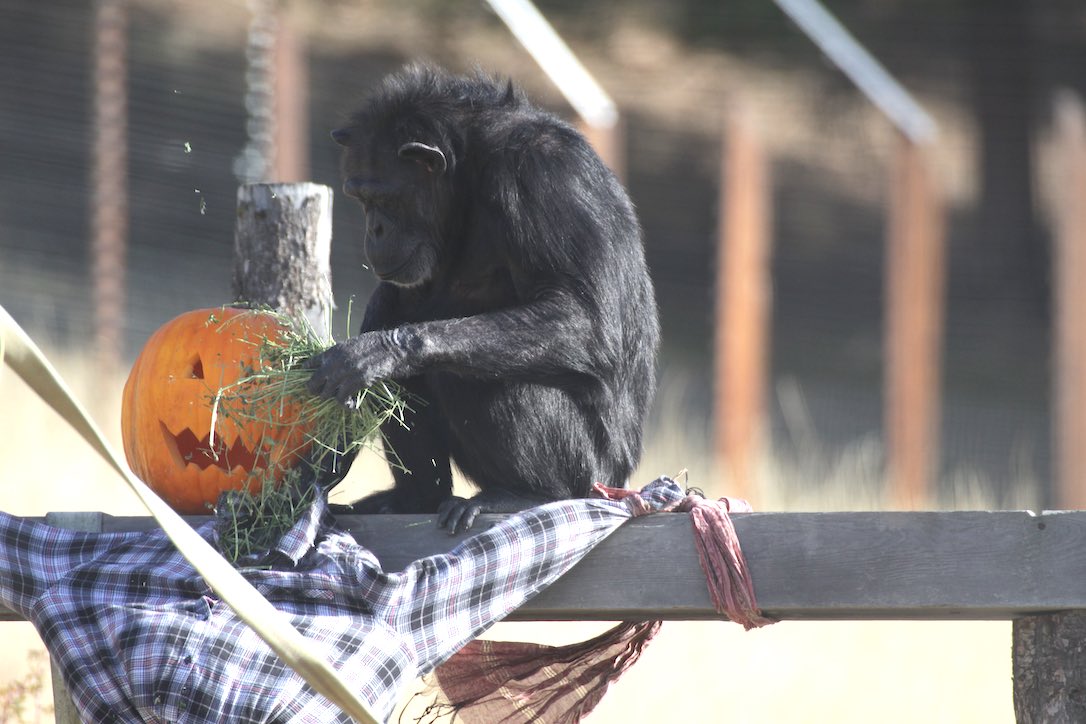
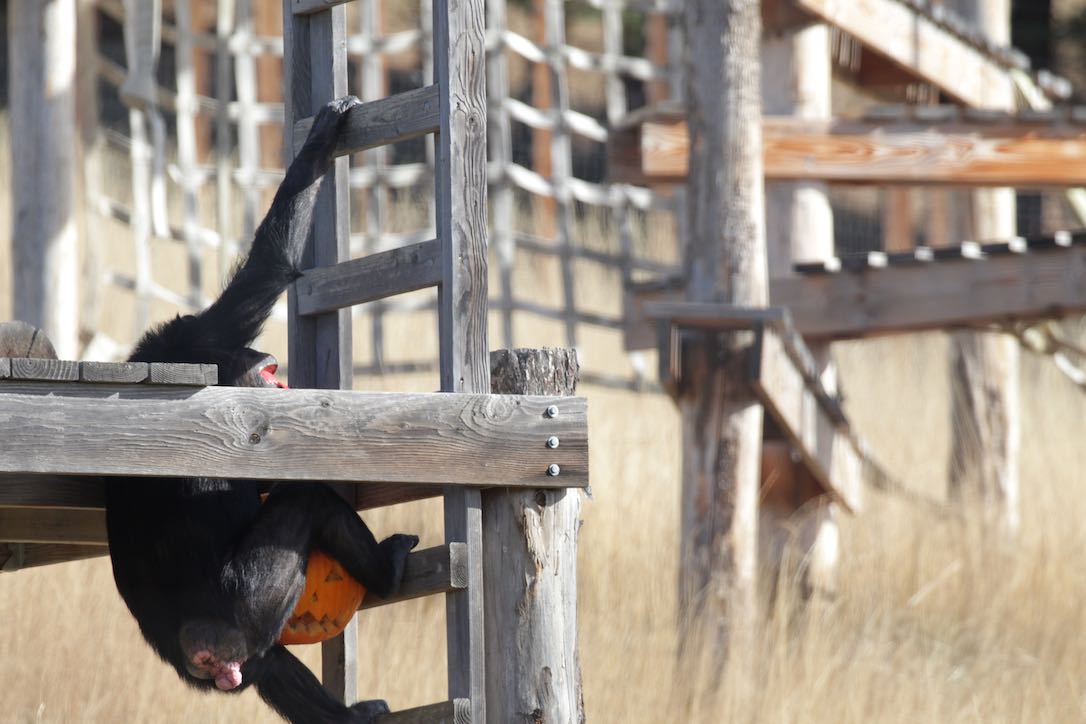
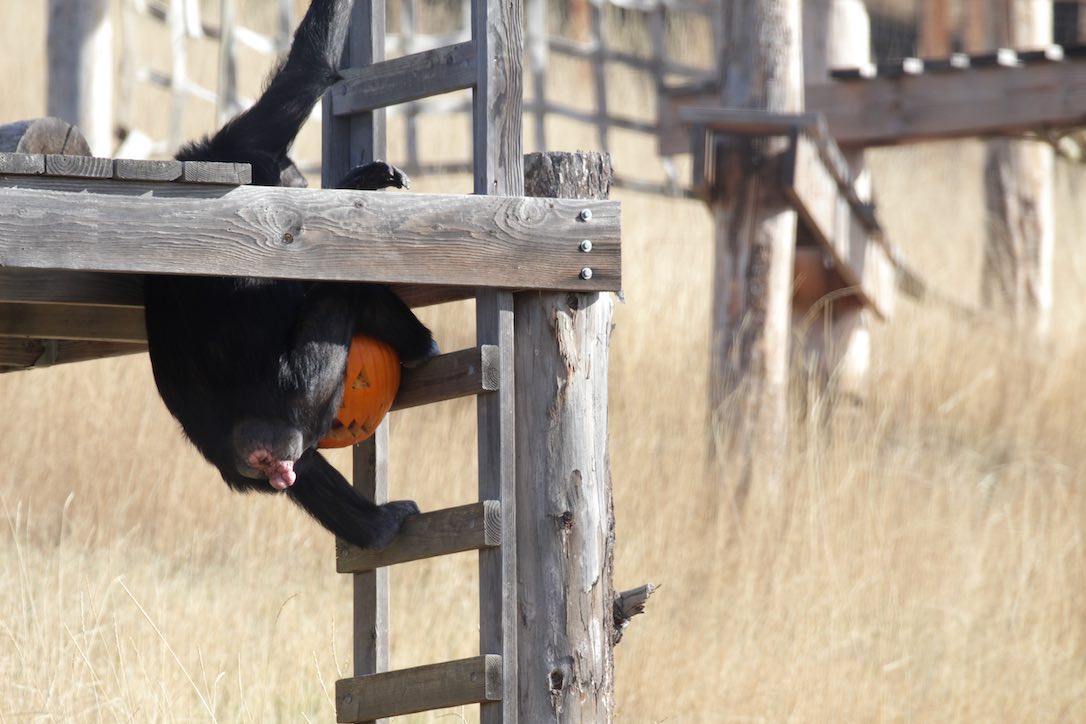
This year, Chad had the idea of making scarecrows for the chimps with edible heads, so the pumpkin stood in as the head of the scarecrow on Young’s Hill.

Behold:

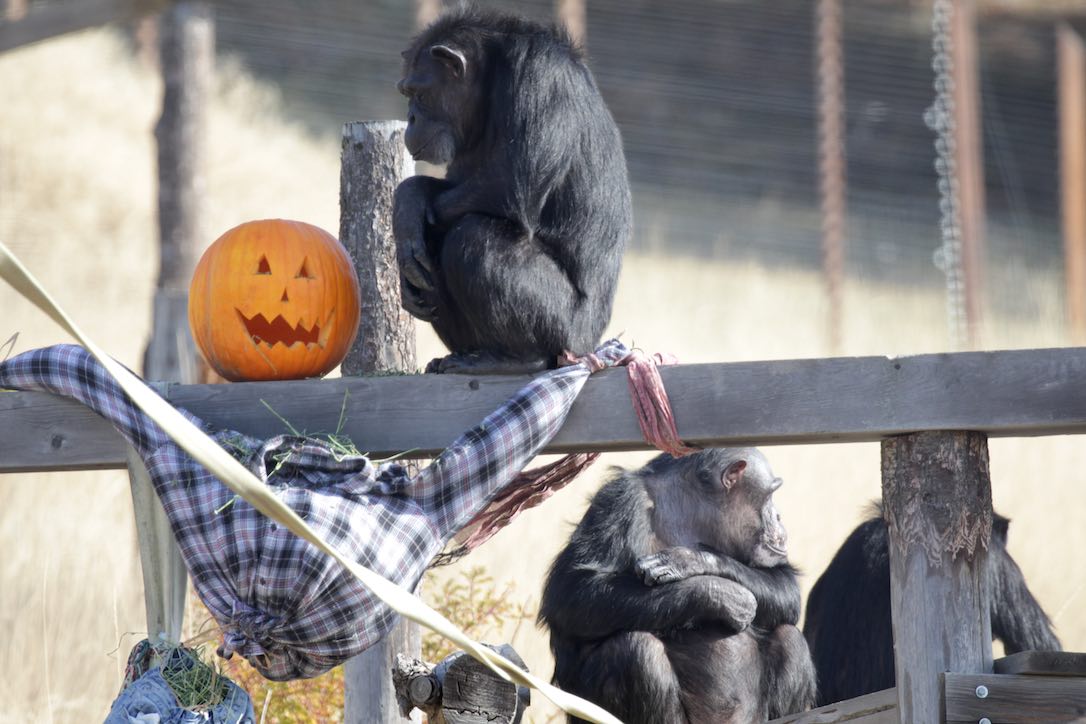
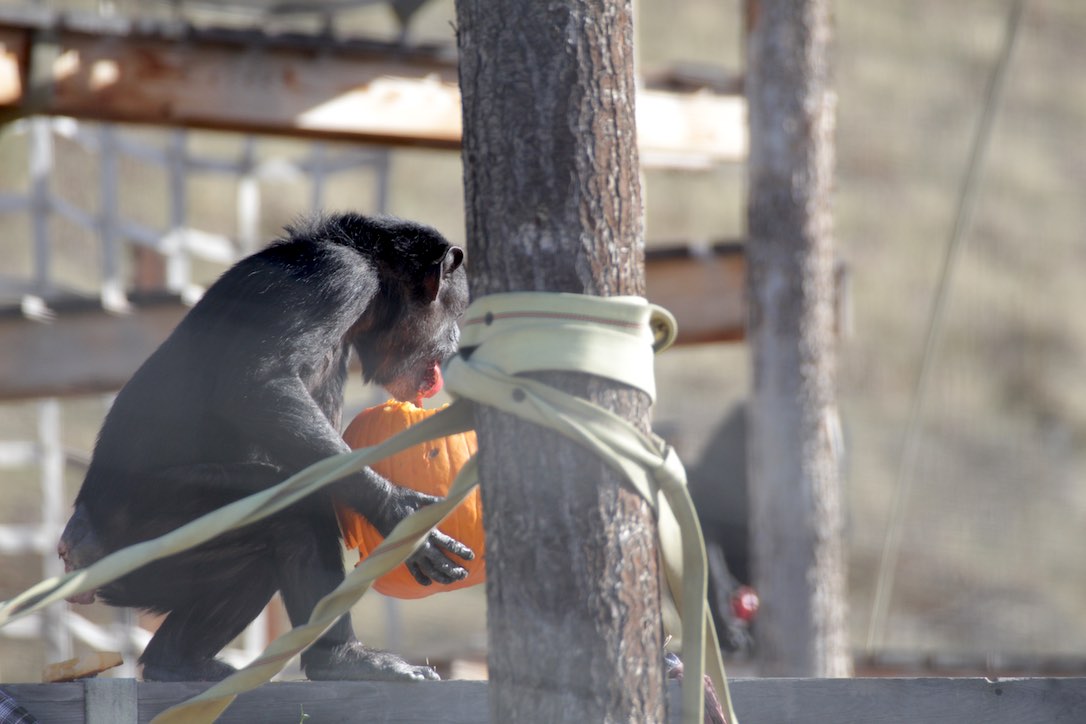
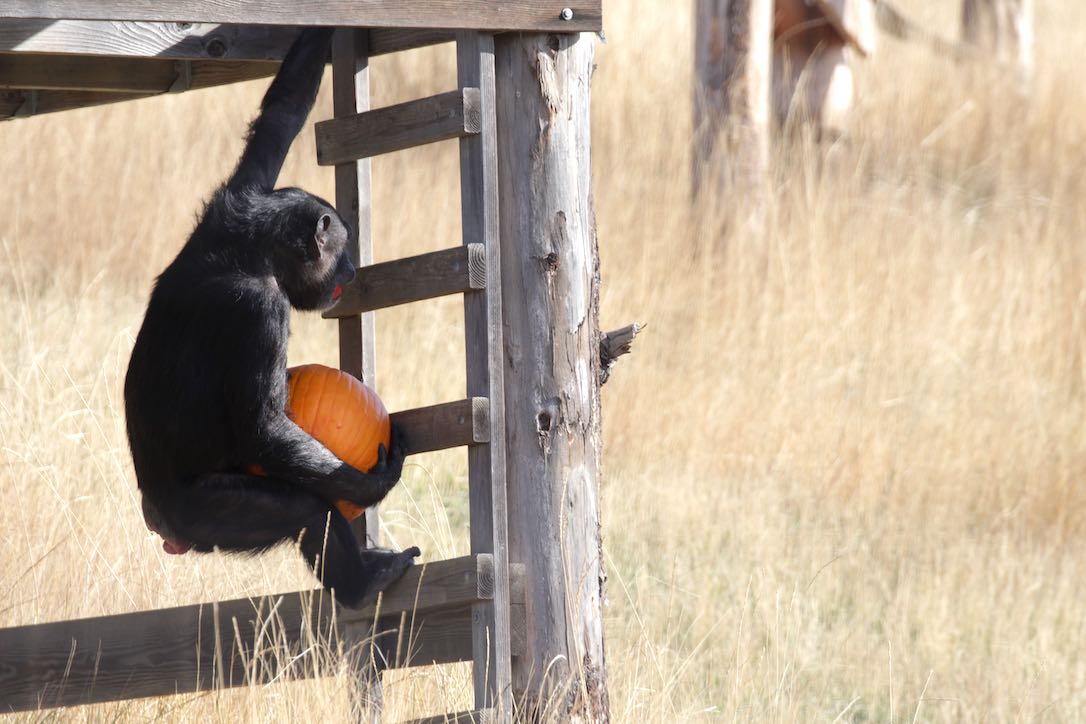
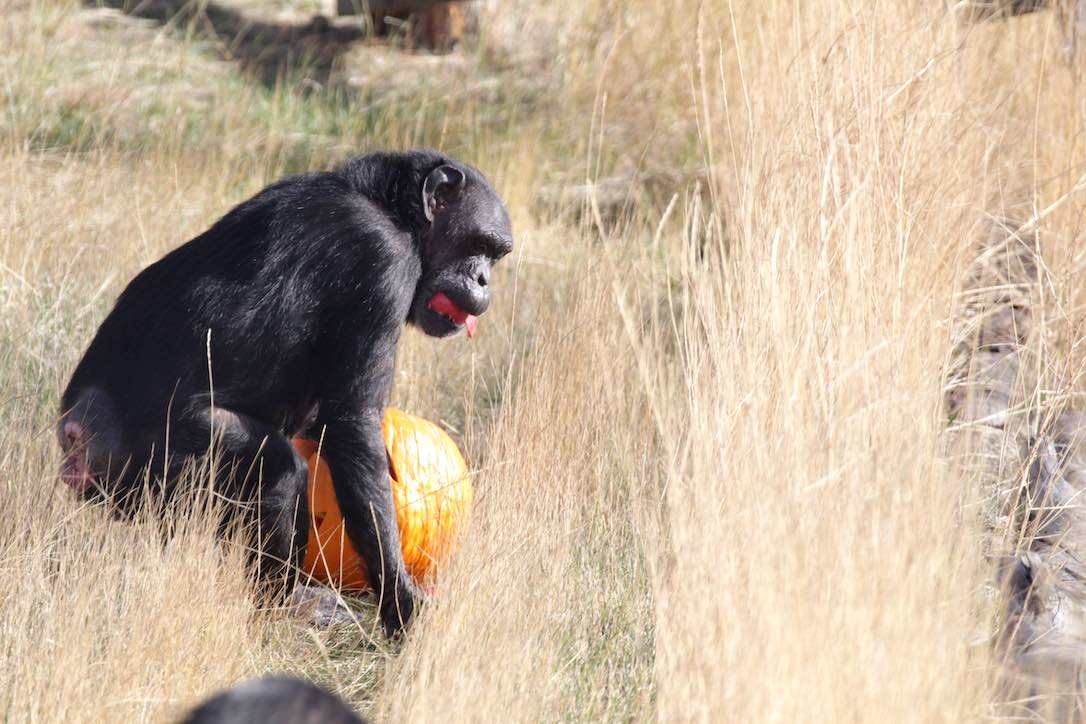
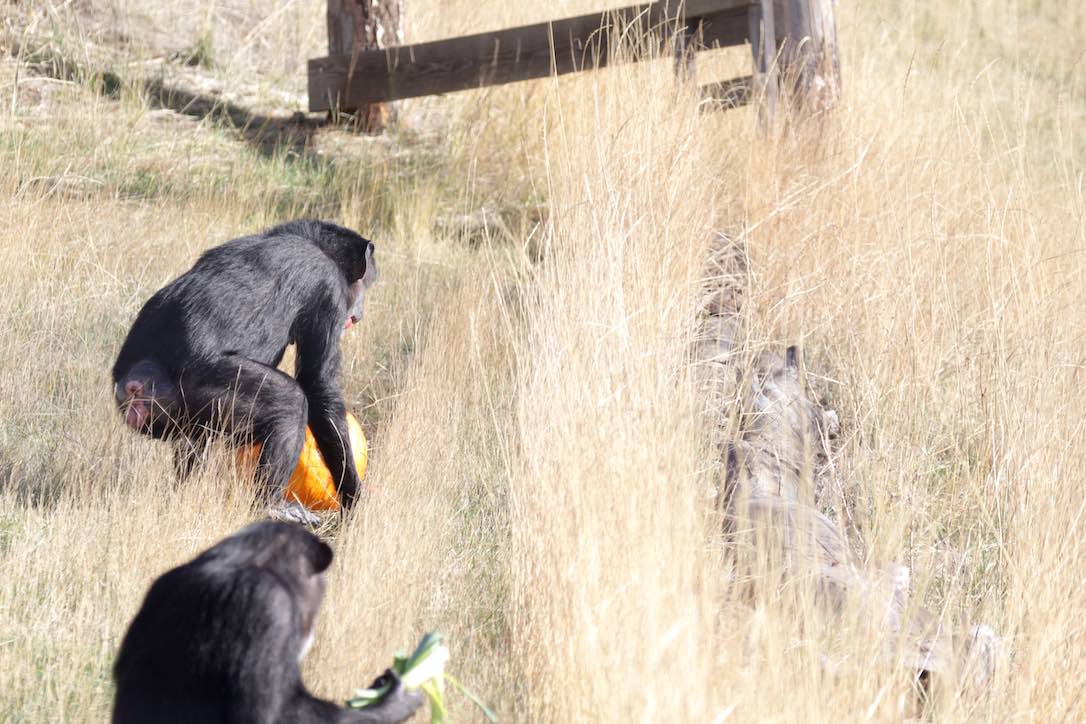
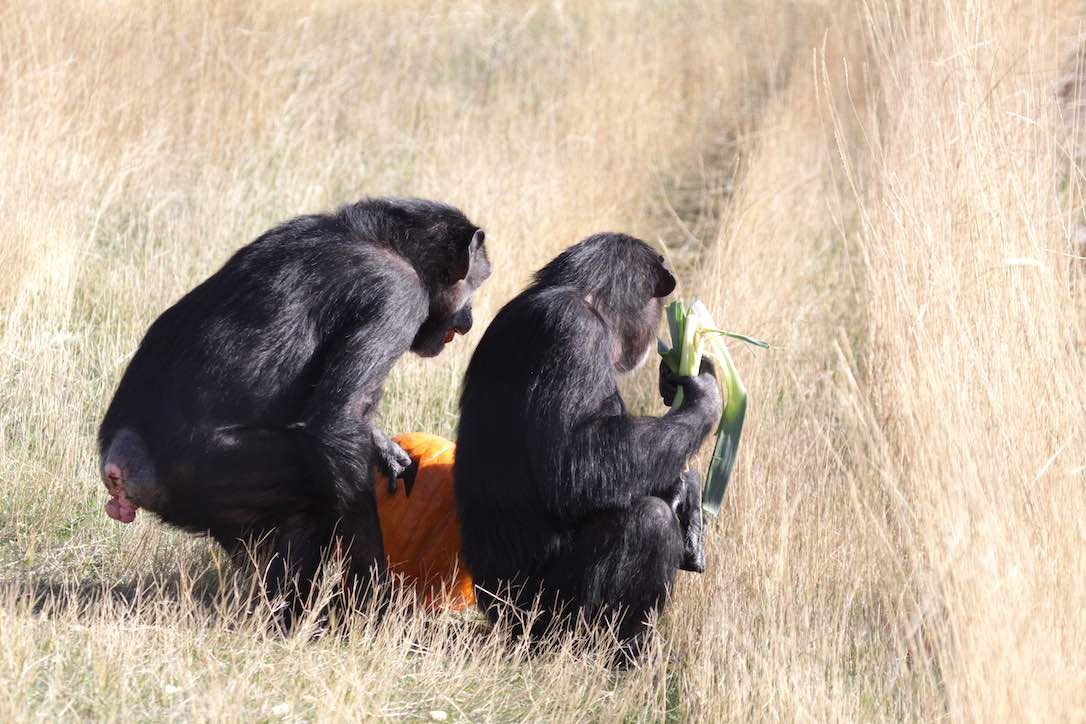
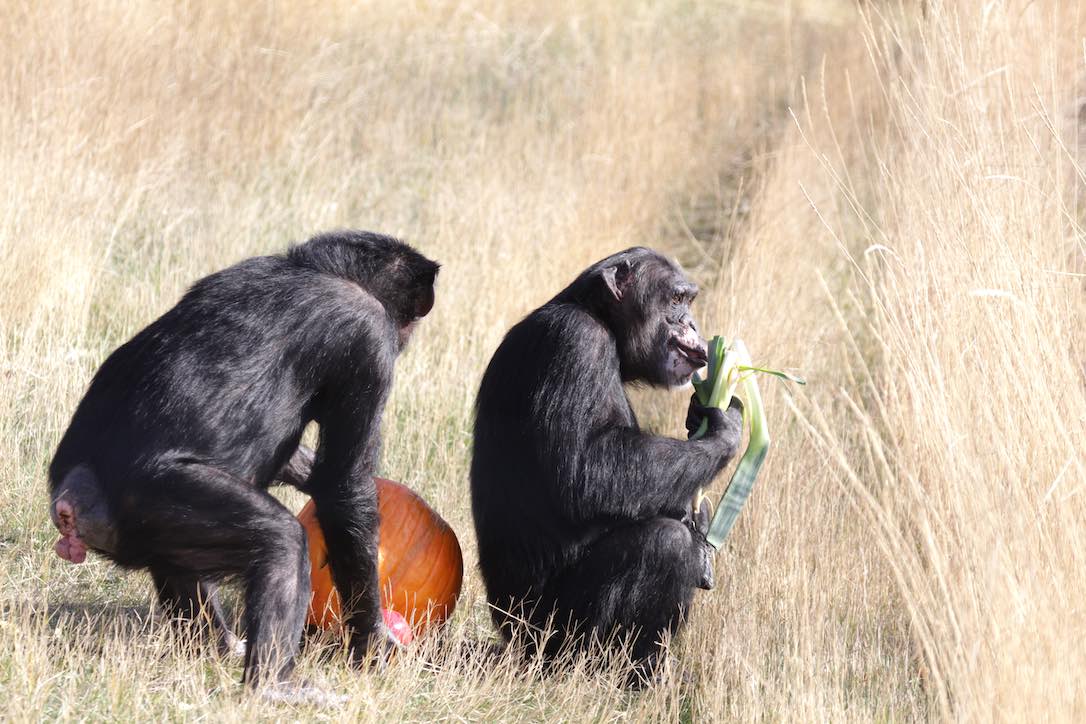
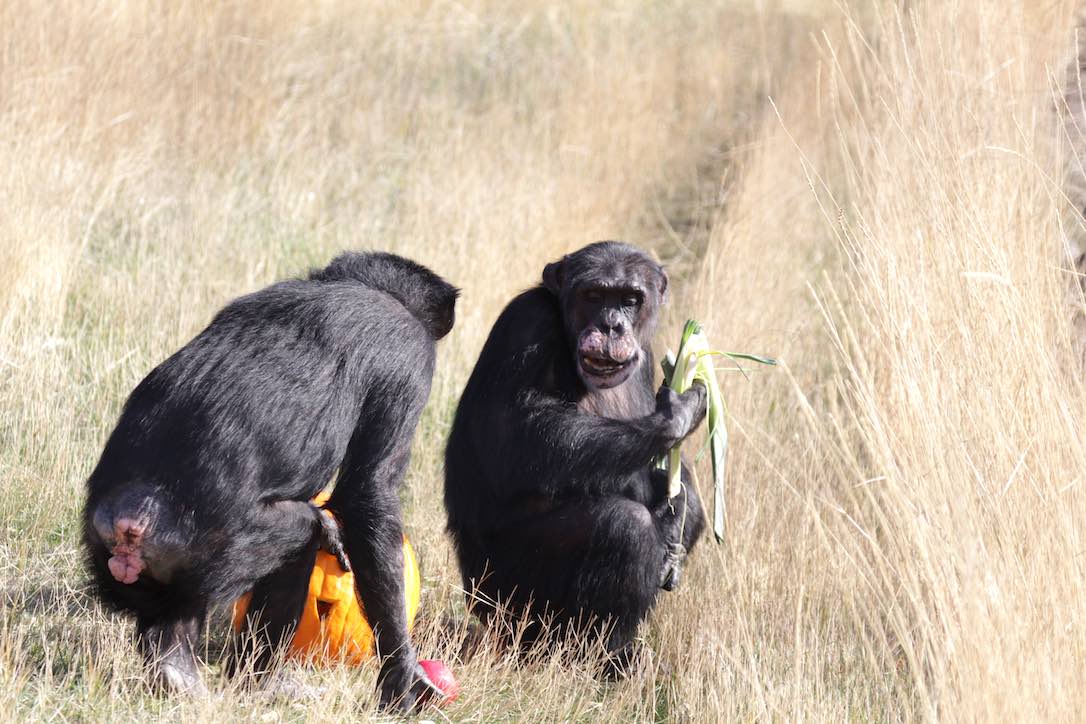
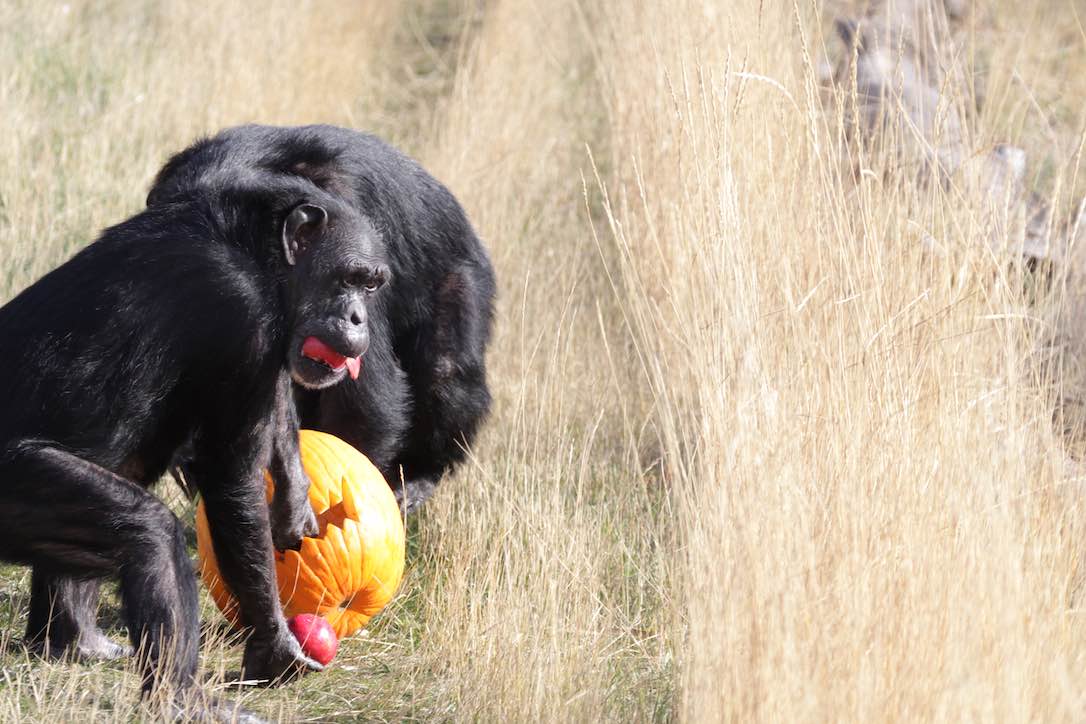
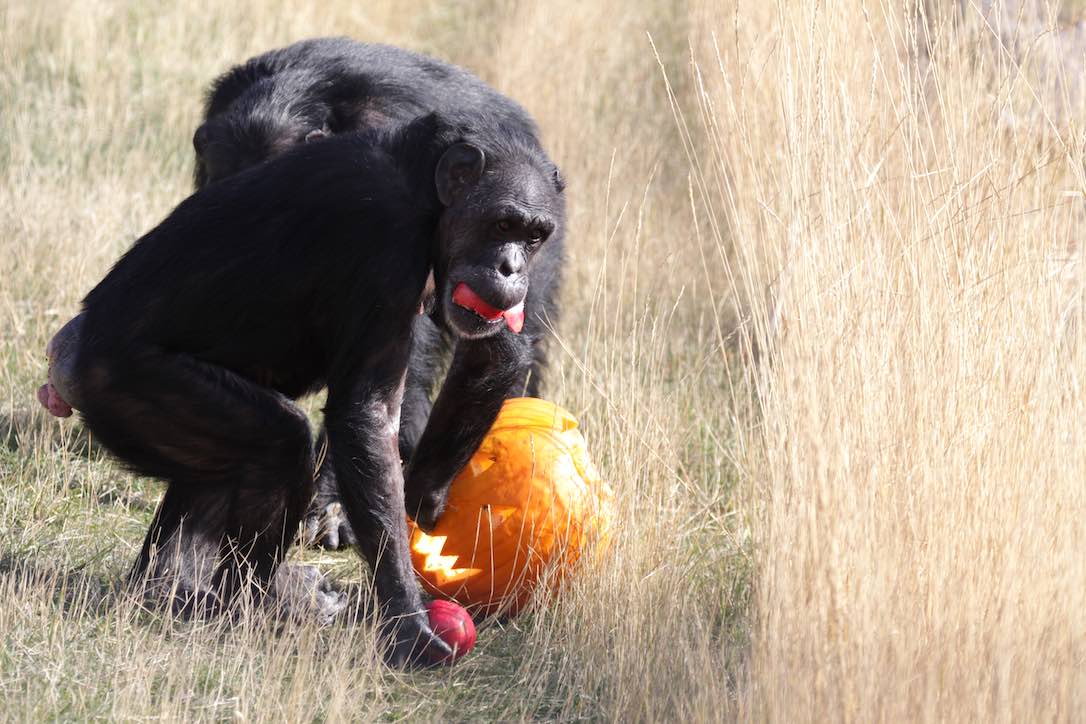
Due to her actions in past years, Jody has been bestowed the title of Great Pumpkin Thief. It wasn’t certain that she would be holding that honorific this year, however, because while Jody was off collecting pomegranates, Annie took an interest in the jack-o’-lantern (minus the lantern):


Annie also un-stuffed the scarecrow a bit and founds some hidden nuts.

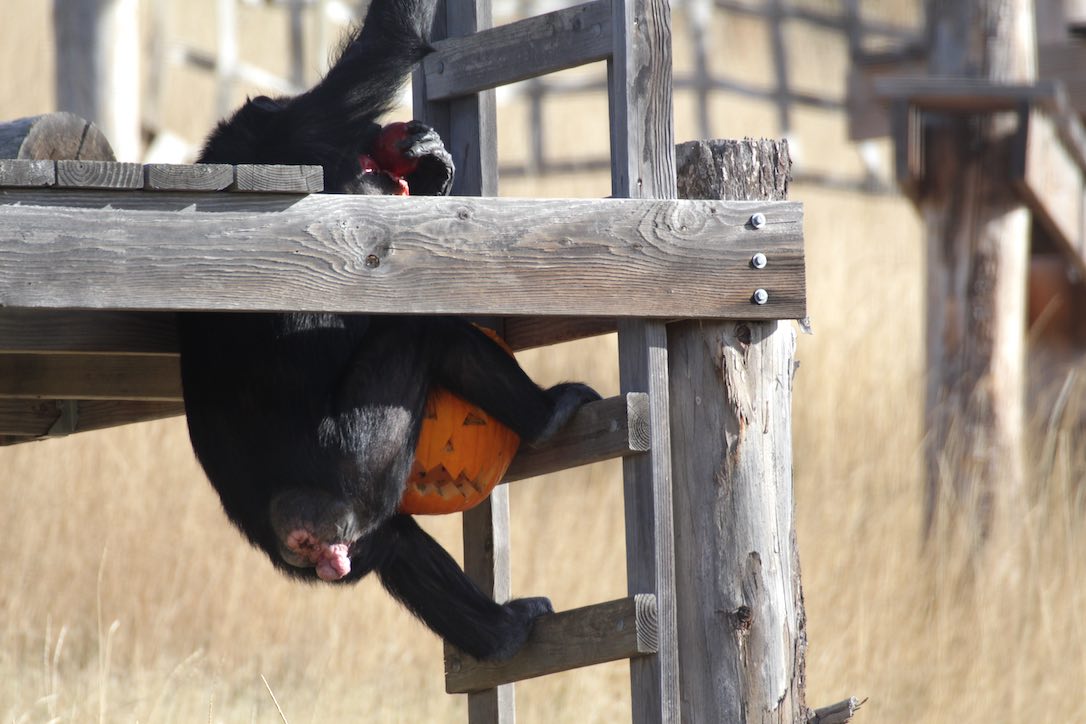
But in the end, Annie left the pumpkin in place for Jody, the true thief, to strike again.

There was no obstacle, including one Burrito Chimpanzee, that would stand in her way:

Just look at that determination:

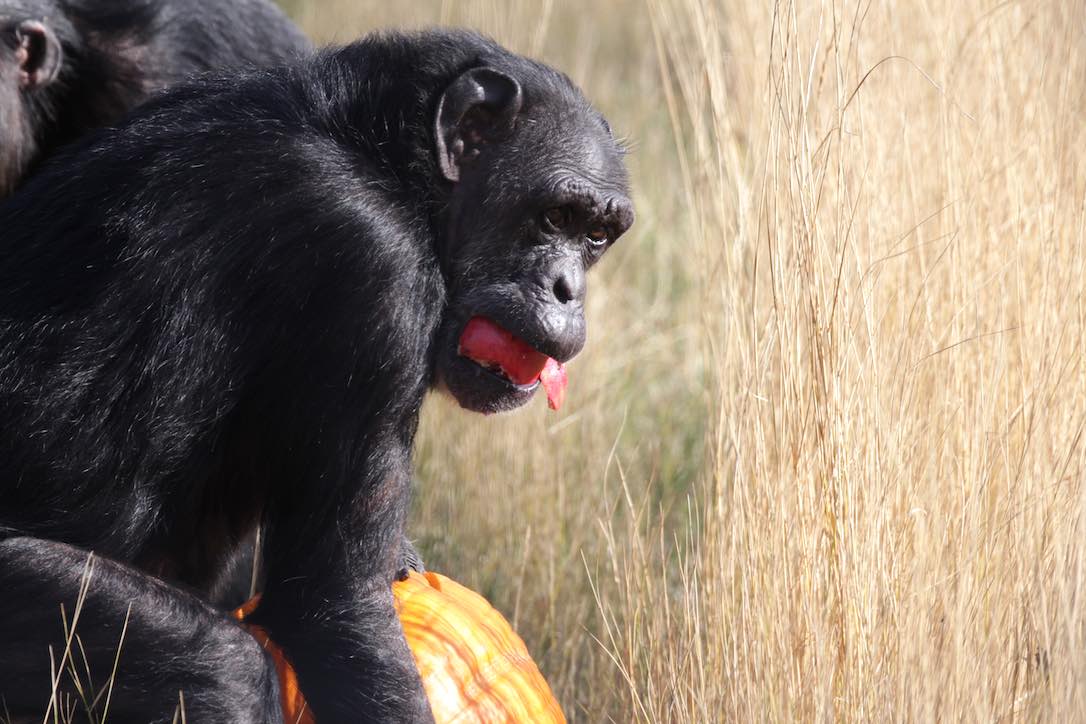
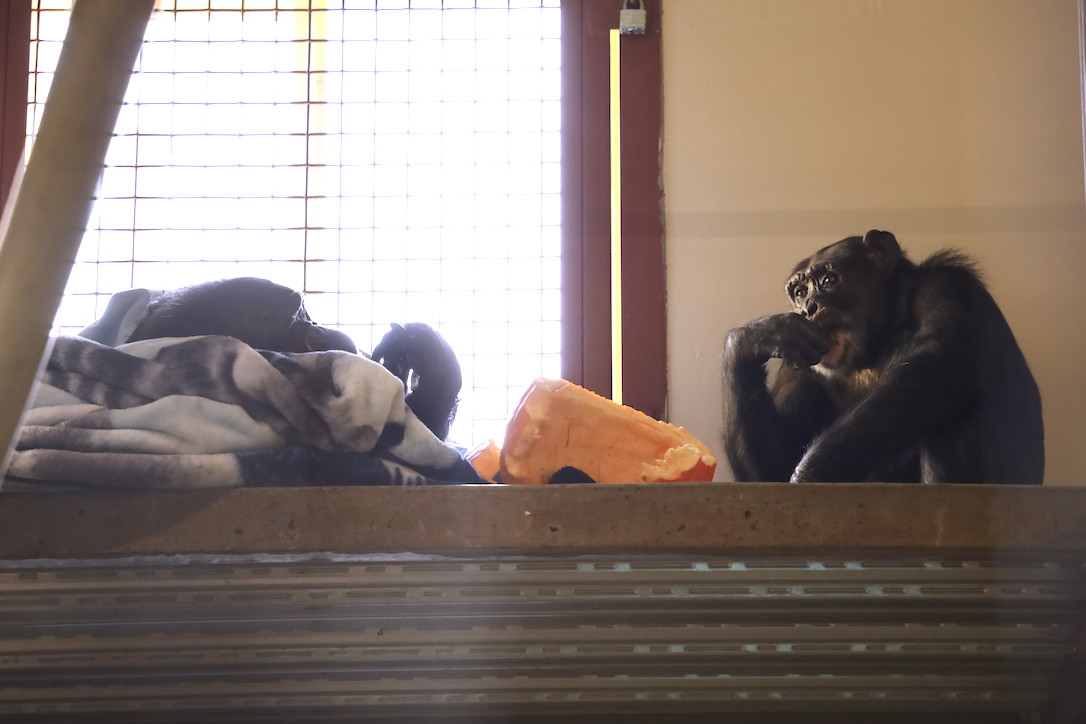
Everyone, as in years past, eventually got to enjoy the fruit of Jody’s labor by partaking in some of the pumpkin. Queen Negra nibbled on some from her bed, sharing with Missy:

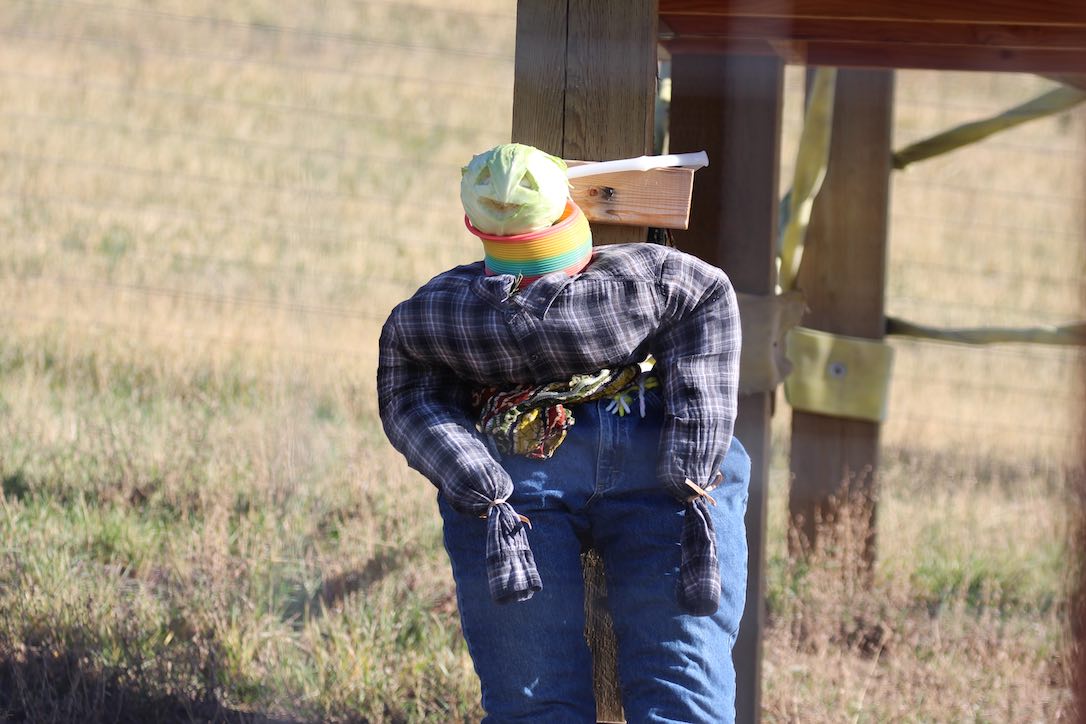
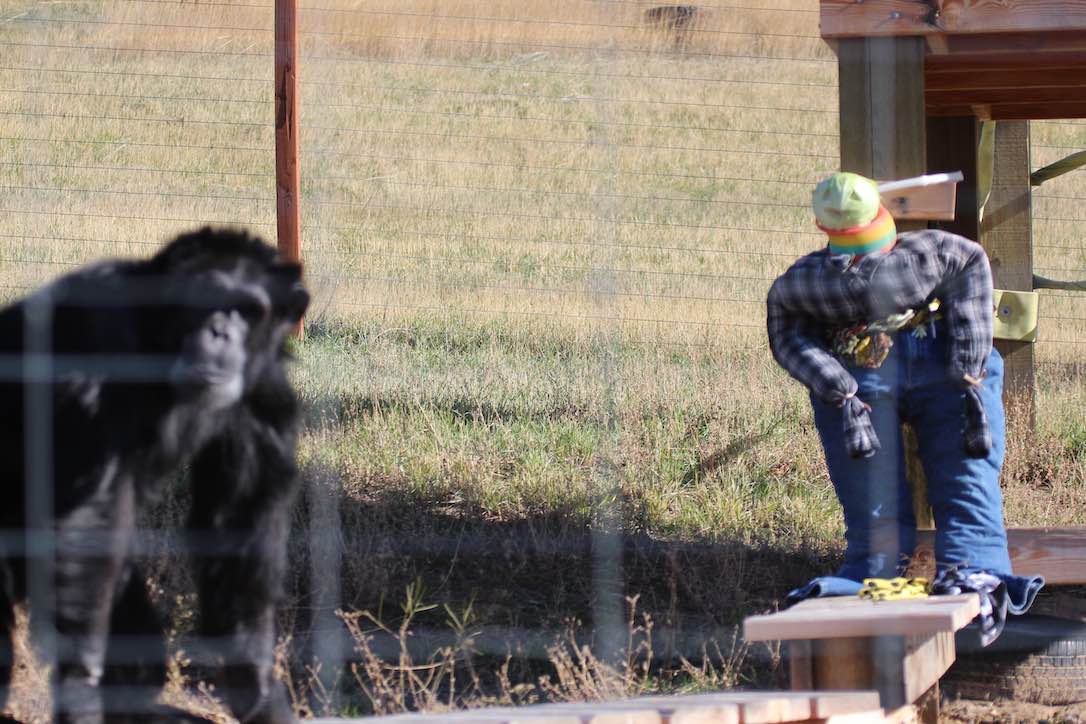
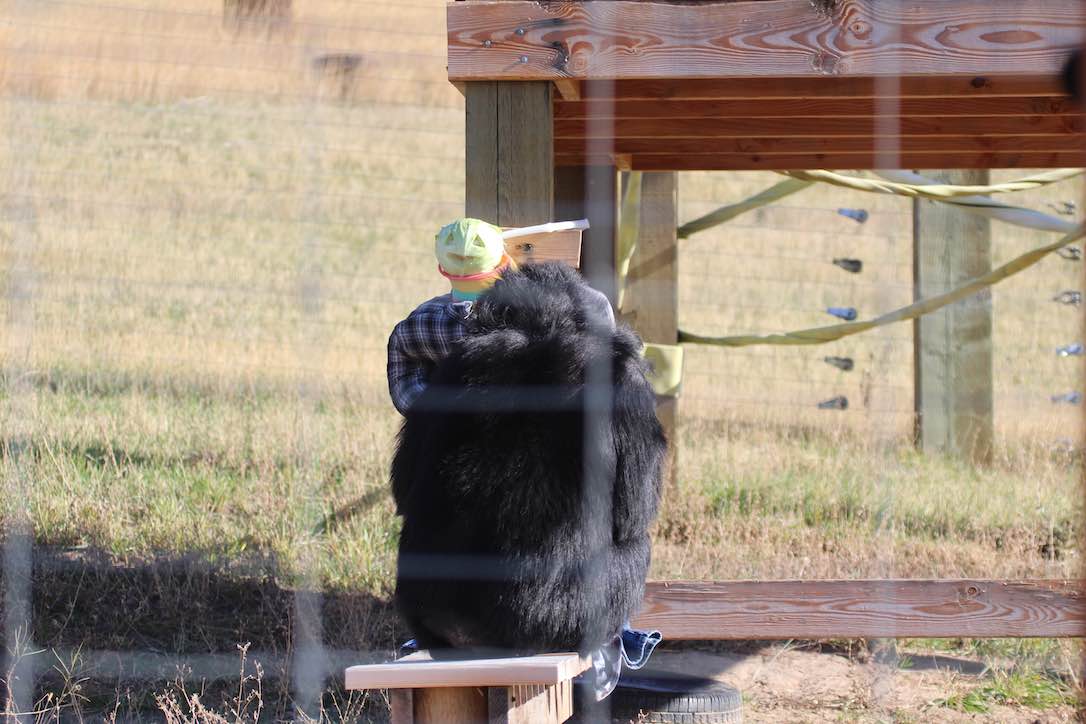
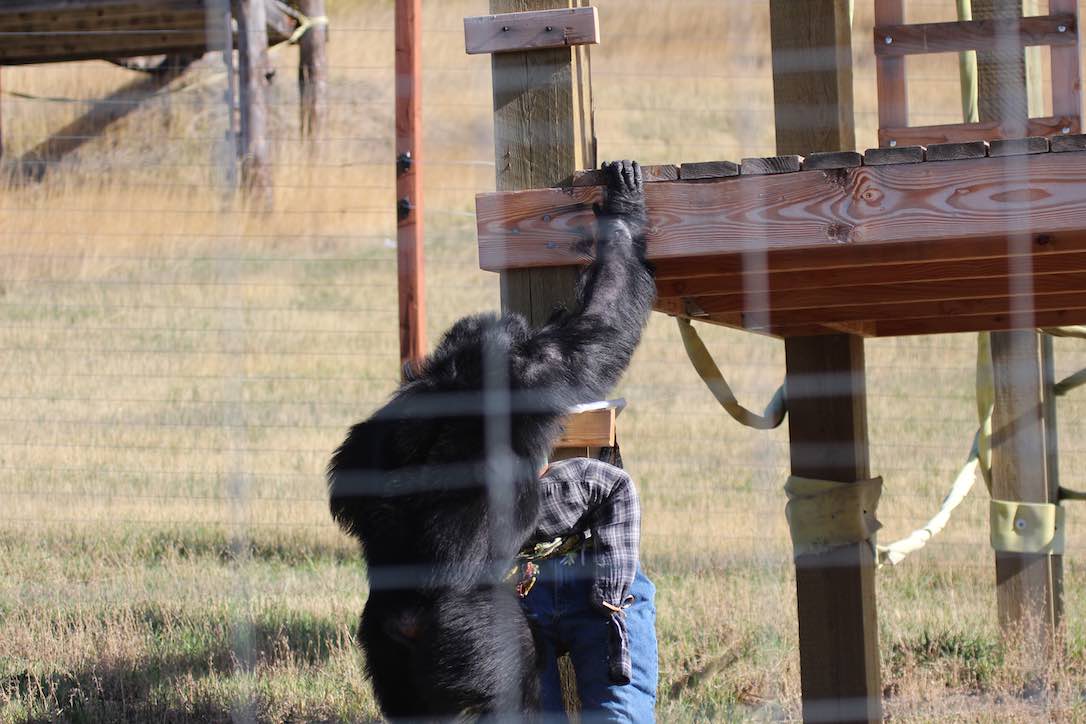
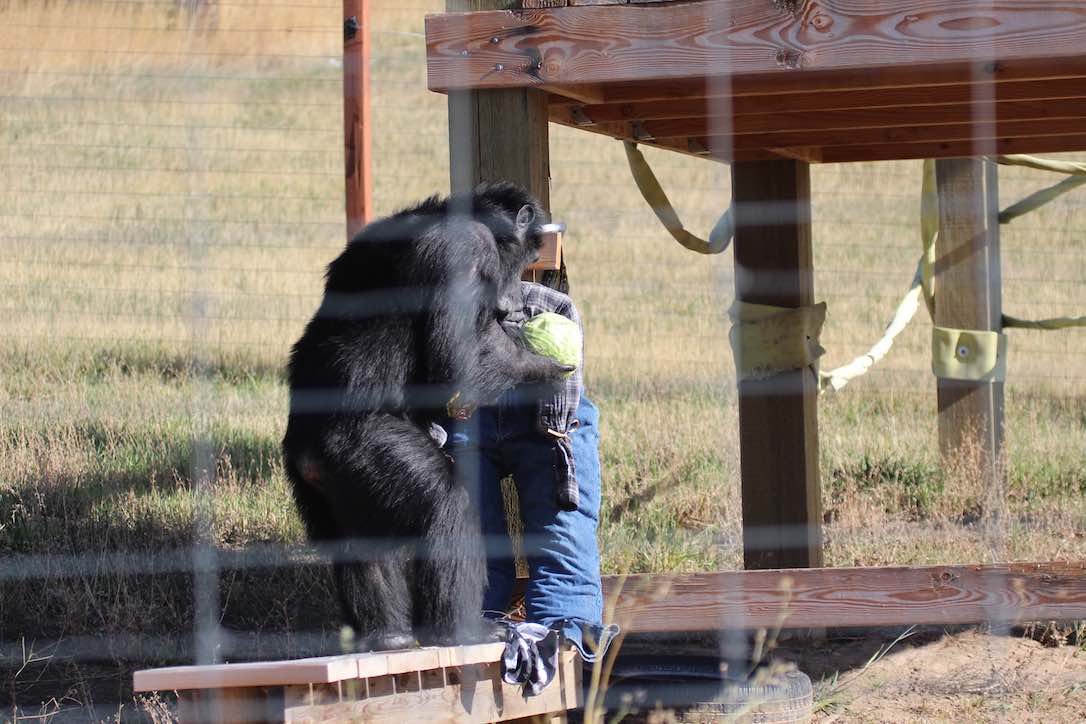
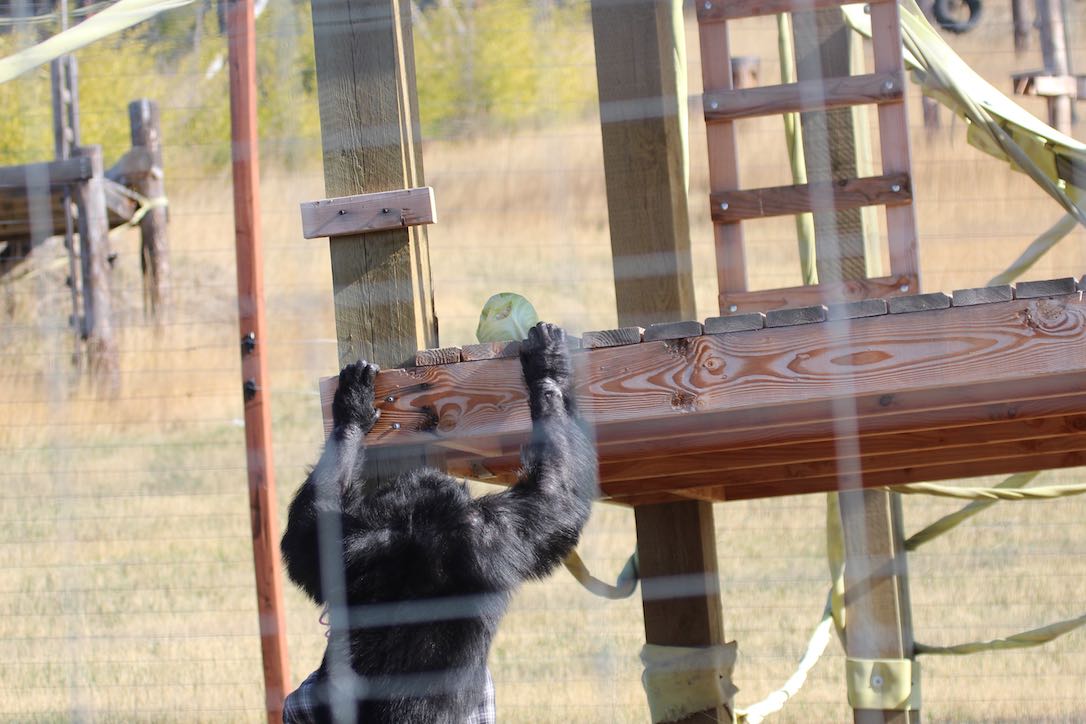
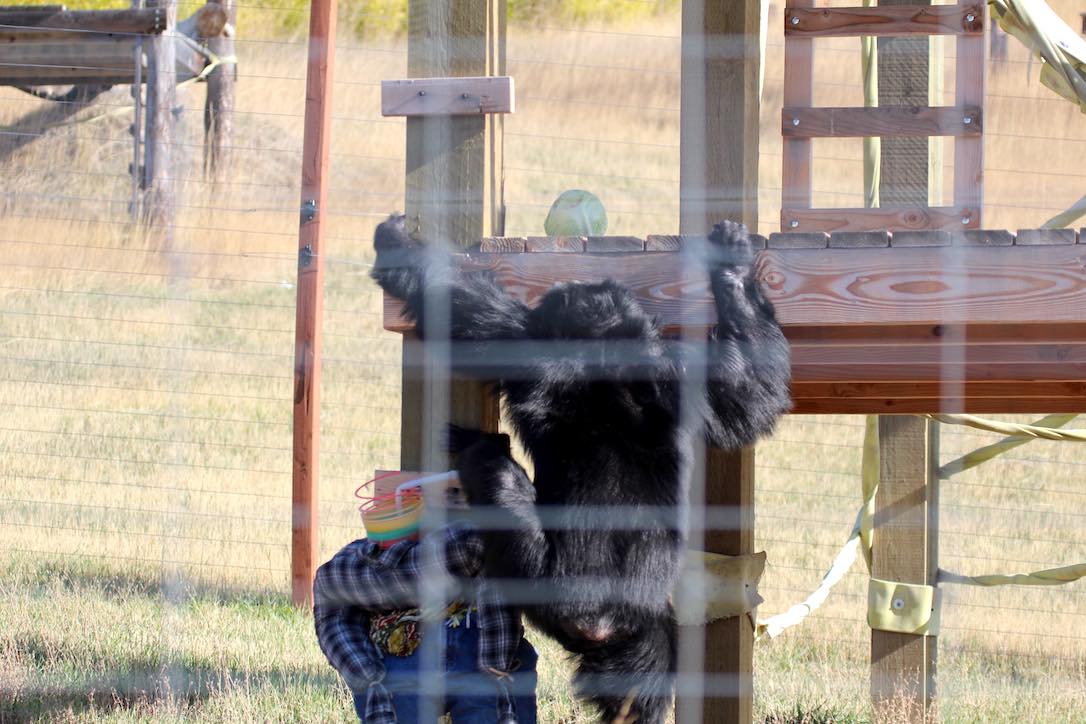
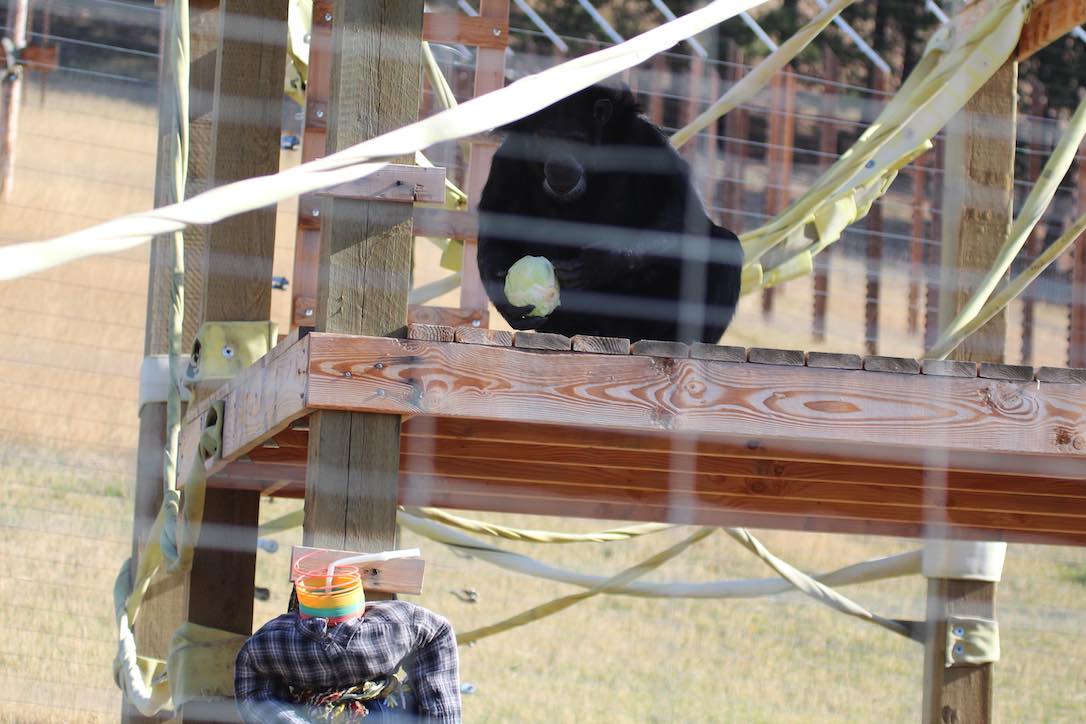
For the other group of chimpanzees, we decided to use a head of cabbage for the scarecrow noggin. Chad added the jack-o’-lantern touch and Anna secured the scarecrow to a post:

I can’t look at that and not laugh. On the other hand, I can also imagine a horror movie with that character.

Willy B may have thought the same. He did not want to interact with the scarecrow, but made a quick job of devouring the cabbage:

Mave and Honey B were enjoying a lettuce forage in the chute while Willy B had his personal Jamieween treat, and later all three had a little party in the mezzanine with sparkling cider and popcorn:

Mave hoots while Honey B eats popcorn

Then for lunch they too got whole pomegranates. These, however, were extra special as they had had a visit from carver Chad. I’m sorry I did not get any photos of Willy B putting a whole pomegranate in his mouth and attempting to chew.

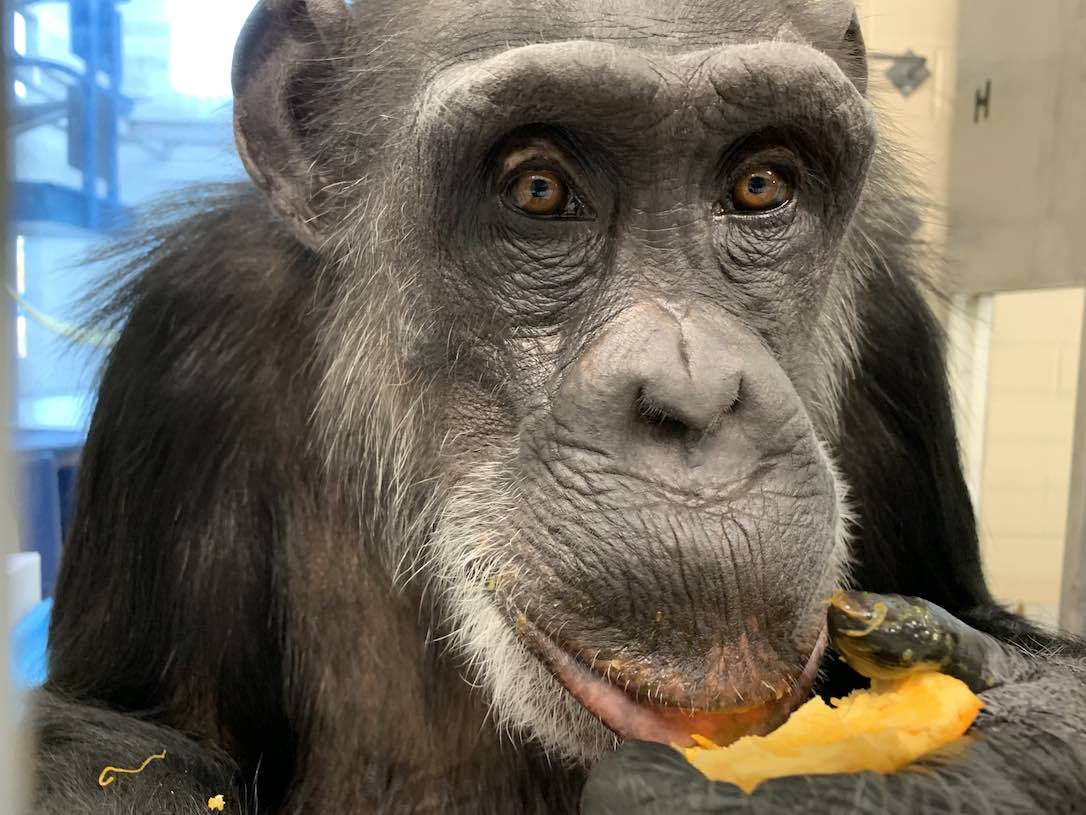
For dinner, Willy B, Mave, and Honey B got their own taste of pumpkin, which they devoured. Here’s Honey B:

Jamie ended her day by grabbing one of her new boot books and collecting some corn cobs in a box to enjoy in the front rooms, emitting low, contented moans as she ate.

All of the chimpanzees had a day of non-stop partying and are now sleeping soundly. There were many other photos as well as videos of the day, but I see that it’s dark and late and I should get home to my own haunted home.

I hope you all had a fun treat-filled day like the chimpanzees and that it continues into the night!

Filed Under: Annie, Caregivers, Enrichment, Honey B, Jamie, Mave, Negra, Party, Sanctuary, Willy B, Young's Hill Tagged With: animal rights, animal sanctuary, Animal Welfare, celebration, chimp, chimpanzee, forage, halloween, jamieween, Party, pomegranate, pumpkin, Sanctuary, scarecrow

Burrito’s Superpower

October 24, 2020 by Diana

You may be asking yourself, does Burrito ever stop playing? The answer lately is, yes, when he’s asleep. I do wonder if even in his dreams he’s tickling and chasing and wrestling, though.

A very special thank to you blog readers who have posed questions on my blog post last week. You have inspired a lot of contemplation and conversation among the staff, and already a blog post or two, with many more to come in the future.

I had considered picking a topic among those questions for today’s blog post, but Burrito dictated that I put together this compilation video.

I trust this is a welcomed decision!

Filed Under: Annie, Burrito, Chimpanzee Behavior, Foxie, Latest Videos, Negra, Play, Sanctuary, Trolls Tagged With: animal protection, animal rescue, animal rights, Animal Welfare, chimpanzee play, chimpanzee retirement, chimpanzee sanctuary, Chimpanzee Sanctuary Northwest, csnw

The Mystery of Love

October 18, 2020 by Anthony

Yesterday, Diana had some thoughtful musings on the sanctuary’s blog and invited you all, our followers and supporters, to ask questions.

One topic that came up several times, as it has in the past, is that of chimpanzee reproductive behavior. I’d like to thank you all for giving me an excuse to write this blog for two main reasons. First, I thrive on awkwardness. Second, the sex lives of chimpanzees can really be fascinating.

For decades, scientists observed the sexual behavior of chimpanzees and other primates with the goal of learning more about our own species’ habits. The initial logic, seemingly, was that our ape cousins must have a system that closely resembles that of our common ancestor. By watching free-ranging primates go about their business, anthropologists hoped to gain a window into our evolutionary past that wasn’t obscured by the filter of our own culture.

Missy is a chimpanzee.

From our modern perspective, we now have a greater appreciation for a simple fact; chimps are related to us, but they’re not necessarily anything like our common ancestor. Chimps and humans have been separate for six million years, during which our respective lineages were subjected to extremely different pressures that caused us to diverge physically, behaviorally, and cognitively. Our branch diversified over time into several types of humans that took over the globe (the rest of which we then subsequently absorbed or drove to extinction). Meanwhile, the nearest branch grew in a different direction and, as far as we know, forked into a pair of twigs: chimpanzees and bonobos. Using this reasoning, the other primates are not really primitive. They’re not human-like oddities that emerged among the animals, nor are they less-evolved versions of early humans. They’re something different entirely. Chimpanzees are just chimpanzees.

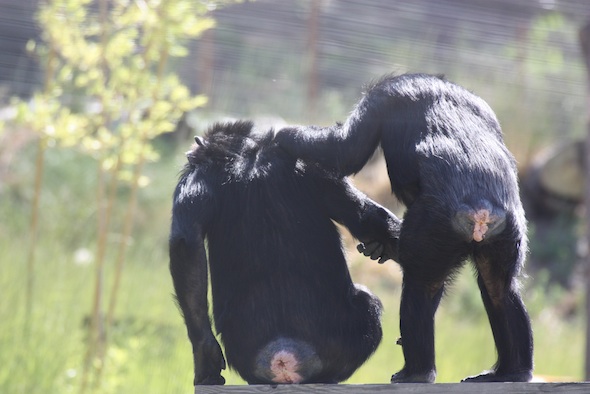
For the most part, chimpanzees do resemble us (and vice versa). They have the same amount of hair (which is just coarser and longer than ours), similar skin and pigmentation, and muscles and bones that are arranged much like a human’s. Upon first glance, it can be difficult to identify any conspicuous trait that is uniquely chimpanzee, but they become familiar over time. Longer fingers… larger canine teeth… a pronounced brow ridge… shorter, stockier bodies… and, of course, the butts.

Annie Missy best friends
Annie and Missy

Male chimpanzees do not have flashy backsides. In fact, the norm is to have a flat, gray callous-like pad that serves as a portable seat cushion and seems to keep the pressure off of their oversized testicles. Relative to humans, adult male chimps have much larger testicles for their body size. (It looks like they’re hiding a pair of mangoes in there.) Meanwhile, their smaller penises stay hidden until they’re needed for copulation. The testes produce crucial hormones that influence behavior and physical development, so neuters are not a recommended form of population control for chimps (nor are they particularly safe or humane). Instead, most sanctuaries rely on less-invasive vasectomies to keep their males from successfully impregnating females, and many also use forms of birth control for females. As stated on our website, there are several good reasons to not breed captive chimpanzees.

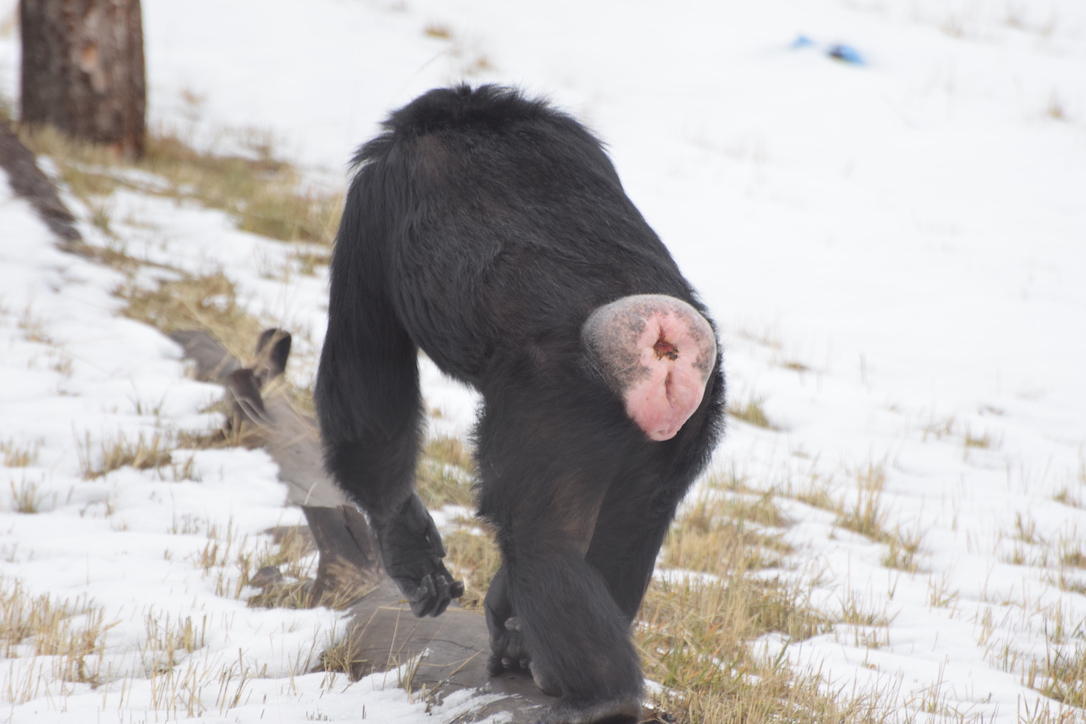
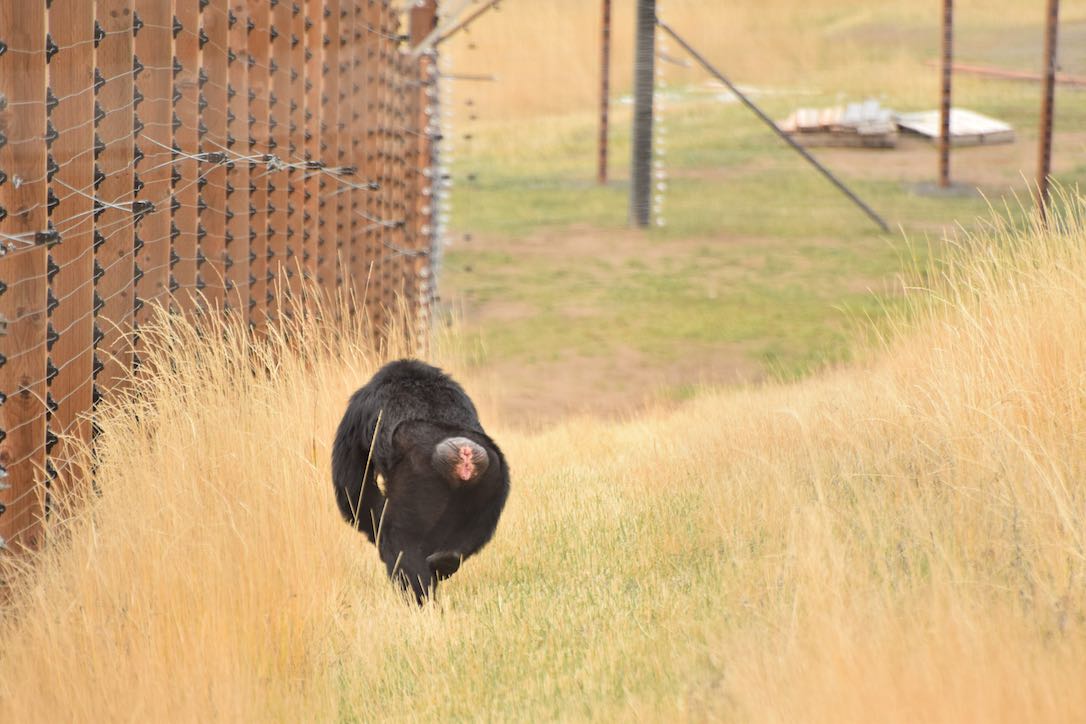
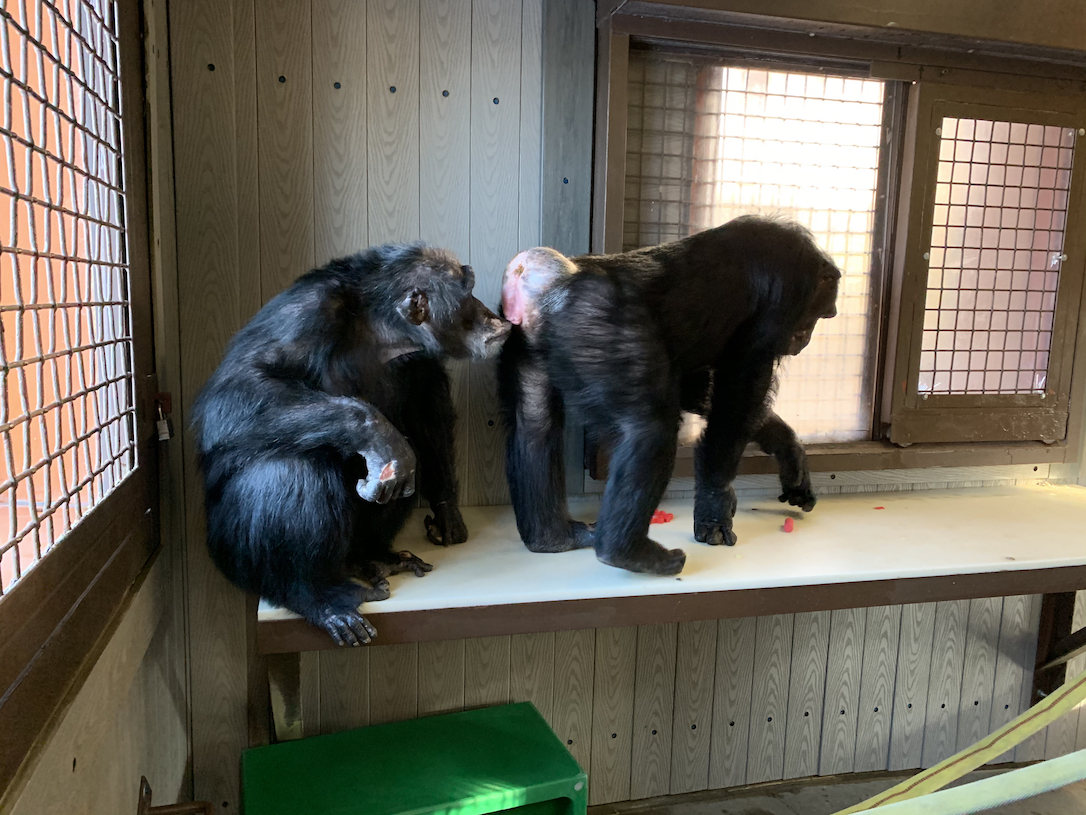
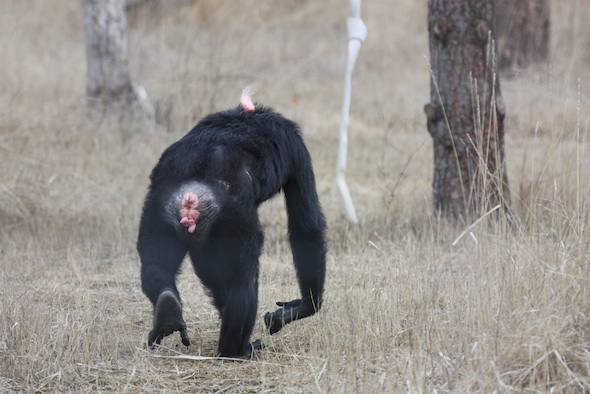
Much like in humans, female chimpanzees are anatomically different from males. Biologists call this disparity sexual dimorphism. In chimps, adult females have an entire appendage dedicated to advertising their reproductive status. Often referred to as a “swelling,” this wrinkly patch of skin is composed of the vulva and surrounds the anal and vaginal openings. This flap of tissue can inflate with over a liter of fluid, causing it to become rosy and bulbous. It looks uncomfortable to be so swollen for almost two weeks, but it’s a natural aspect of the chimpanzee experience. This process is often captured, unintentionally, in the photos we take while developing content for the blog.

Jamie’s swelling – mostly inflated! Note the shiny, stretched appearance and the higher proportion of pink skin to gray skin.
Jamie’s swelling – not inflated! Note the wrinkles and the higher ratio of gray to pink skin

Swellings help chimpanzees to maximize their reproductive potential. Essentially, the bright pink signal lets males know when a female is likely to ovulate, and that female receives a corresponding flood of attention and may even temporarily rise in social rank. As J.B. explained back in 2013, chimpanzee menstrual cycles are quite similar to ours (and notably different from the estrus cycles observed in many other mammals), but the swelling corresponds to some key differences. Ovulating female chimpanzees often choose to mate with any interested males, and those males usually attempt to mate with each swollen female (although the alpha male may guard them from the others). For this reason, females need a way to let the guys know what’s going on, and a bright pink swelling usually does the trick. A tumescent swelling literally brings all the boys to the yard.

Interestingly, females will often allow subordinate males to mate with them and will continue to mate frequently even once pregnancy has begun. Because of this, males have little idea which offspring are theirs and are therefore incentivized to protect them all equally. This pattern of paternity confusion acts as insurance against coups. If a new alpha emerges, he will be less likely to cull his group’s infants because he may have sired them back when he was still a subordinate. Furthermore, male chimps in the same community tend to be related to each other, so the potential costs of infanticide tend to outweigh any competitive advantages. In other primate societies where the alphas have exclusive mating rights, changes in leadership can be tragic for newborn infants.

You may have seen on the blog that the sanctuary’s male residents are fascinated by swellings, but don’t seem to have the social skills required to successfully copulate. This is not uncommon for captive chimps who were raised in abnormal social groups. However, it’s worth noting that Burrito and Willy B’s attractions to the females’ swellings are quite obvious and seem to have developed without the enculturation of a larger chimpanzee society. Furthermore, the life-saving castration that Burrito endured does not seem to affect this behavior, and he still watches over any swollen females with keen interest.

Burrito sniffs Jamie’s swelling.

One question that often arises is that of female contraception. As with many dilemmas relating to captive chimpanzees, we do our best to balance natural processes, physical health, emotional impacts, and logistical challenges. In the case of birth control, our team evaluates each female’s unique needs and consults with outside experts in order to give them the best experience that this environment allows. Therefore, we do not have a comprehensive protocol for administering contraceptives and each individual case is managed separately.

Foxie, Missy and Honey B underwent hysterectomies at their previous facilities due to underlying health issues. We also suspect that Negra had one in the past, although it’s possible that she has simply transitioned through menopause. In all of these cases, no contraception is necessary. These females don’t swell, have little chance of becoming pregnant, and aren’t prone to reproductive health issues.

Foxie’s swelling is permanently deflated.

Mave and Annie have no known health issues and are at low risk of pregnancy because both of the sanctuary’s males, in addition to being sexually naïve, are medically unable to reproduce. (Burrito no longer has testicles and Willy B’s vasectomy is still serving its purpose.) In these cases, we’re not intervening with contraceptives because there is no clinical reason to do so. Without a medical issue, we’re more comfortable with letting Annie and Mave’s respective cycles progress naturally, for now.

Jody and Jamie, on the other hand, receive daily doses of medroxyprogesterone (an oral contraceptive) for reasons other than preventing pregnancy. The medication is relatively bland and dissolves well in juice, so both females will gladly take it from their caregivers each morning. In Jody’s case, her recent medical exams allowed us to detect a small uterine mass that we suspect is a mineralized fibroid, and the medroxyprogesterone is a recommended treatment for managing these. Jamie, meanwhile, has a recurring anal fistula that is not severe but seems to cause more discomfort when she is swollen. Neither Jamie nor Jody swell while they are on “the pill,” although I have seen that female chimpanzees at other sanctuaries may continue to do so (albeit with changes in frequency and intensity).

Burrito inspects Mave’s swelling during their first meeting last year. Willy B did the same when he met Jody, Annie and Jamie.

One advantage of the chimpanzee sexual cycle is that males will be extremely interested in, and friendly to, swollen females. In the wild, females can use this attention to work their way into new communities once they are mature enough to leave the one they were born in. For managers of captive chimpanzees, an awareness of the reproductive cycle can help us to merge smaller social groups into larger ones. Predictably, males will generally be more accepting of an unfamiliar female if she’s dragging an inflated swelling behind her. I’ve even noticed that, in some cases, the excitement of socialization events and proximity to males seems to cause rapid inflation of the swelling. Accordingly, tracking sexual swellings helps us to understand their social behavior in addition to monitoring their physical health.

As the sanctuary grows and the chimpanzees age, their group dynamics and individual health conditions will certainly change, too. Some treatments that don’t make sense now may be more practical, or even imperative, in the future. Alternatively, new developments will surely force us to reconsider existing protocols. Therefore, we will continue to be open-minded about reproductive issues to ensure that all the chimps remain comfortable, healthy and safe throughout their retirement.


Filed Under: Chimpanzee Behavior, Featured Post, Free-living chimps, Introductions, Veterinary Care Tagged With: animal rescue, animal rights, Animal Welfare, chimp, chimp rescue, chimp sanctuary, chimpanzee, chimpanzee sanctuary, Chimpanzee Sanctuary Northwest, chimpanzees, chimps, csnw, Primates, Sanctuary

  • « Go to Previous Page
  • Page 1
  • Interim pages omitted …
  • Page 13
  • Page 14
  • Page 15
  • Page 16
  • Page 17
  • Interim pages omitted …
  • Page 81
  • Go to Next Page »

Primary Sidebar

Subscribe To the Blog and Get Notified of New Posts First!

Archives

Calendar of Blog Posts

June 2026
S M T W T F S
 123456
78910111213
14151617181920
21222324252627
282930  
« May    

Categories

SUBSCRIBE TO OUR NEWSLETTER

Footer

PO Box 952
Cle Elum, WA 98922
[email protected]
509-699-0728
501c3 registered charity
EIN: 68-0552915

Official DDAF Grantee

Menu

  • The Chimpanzees
  • Blog
  • About Us
  • You can help
  • Resources
  • Contact
  • Donate

Proud Member of

Connect With Us

Search

Copyright © 2026 Chimpanzee Sanctuary Northwest. All Rights Reserved. Site by Vegan Web Design