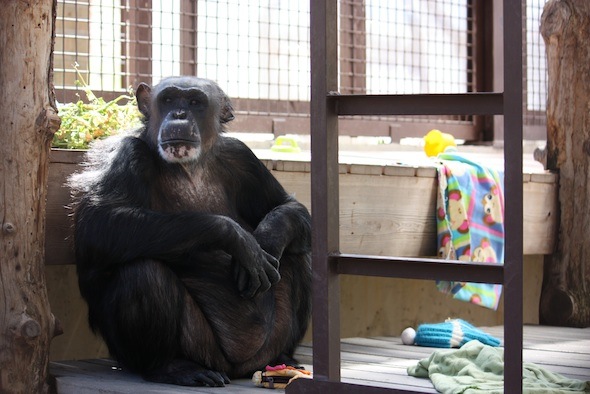
Some of you may have seen this photo posted on our Facebook page yesterday, but if you missed it—here it is. Sure to make anyone smile!
Chimpanzee Sanctuary Northwest
Hope. Love. Home. Sanctuary
Some of you may have seen this photo posted on our Facebook page yesterday, but if you missed it—here it is. Sure to make anyone smile!
Apes (humans included) all have the same dentition pattern, which is a fancy way of saying we have the same number of teeth, and in the same order, across the board. We also have baby teeth, or “milk teeth,” that we loose when the adult teeth come in.
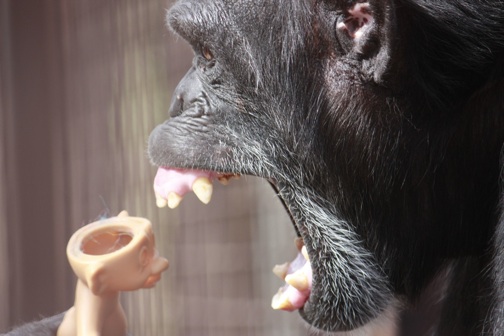
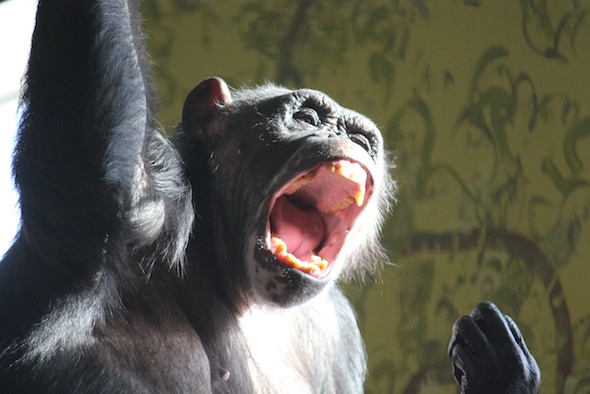
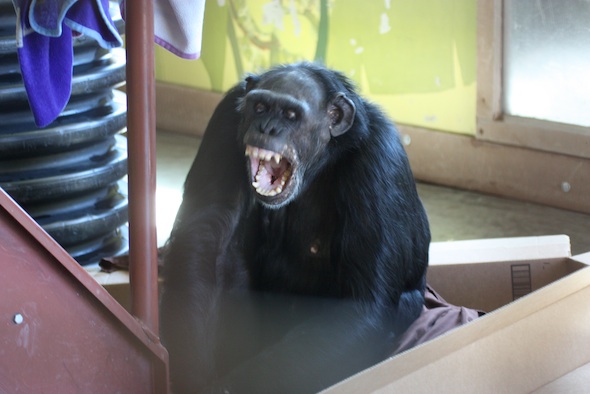
One difference between our dentition is that though non-human apes have canines in the same place as humans, their canines are much larger than ours. What we know about diet probably doesn’t explain why they would have almost carnivore-sized canines. All apes eat mostly fruit, leaves, and other plant items as well as the occasional small mammal meat in the case of chimps. Still, even that small amount of meat wouldn’t be the reason for why non-human apes have such large canines.
What other purpose can teeth serve if not to chew up food? Threat. Certainly large canines are quite intimidating, and can serve as a warning to enemies to stay back, or else you could get bit and boy—it’ll hurt!
In these photos you’ll see the large canines I’m referring to—the chimps are only yawning, but you can see just how intimidating their teeth can be. Just another reason why chimpanzees do not make good pets!
Foxie:
Negra:
Burrito:

Jamie:
As part of our guest blogger series, here is a post by Dr. Sheri Speede. Sheri founded In Defense of Animals-Africa (IDA-Africa), after working as Northwest Director of In Defense of Animals. While working for IDA, she helped advocate for companion, farm, and research animals in the US. After a couple of trips to Cameroon, her focus shifted to providing sanctuary for chimpanzees in Africa who had been part of the illegal pet trade or were bushmeat orphans. In addition to founding IDA-Africa, she also opened Sanaga-Yong Chimpanzee Rescue Center in Cameroon. You might recall that J.B. posted a blog a couple of weeks ago about life and death. He mentioned a very moving story of how the Sanaga-Yong chimpanzees grieved after the passing of one of the residents, Dorothy.
CSNW has had a long-time connection with Sheri and IDA-Africa, and we will always be grateful for her advice on the electric fencing during the development of Young’s Hill!
Here, Dr. Speede tells the story of Jacky.
—
All but one of our 73 chimpanzee residents at Sanaga-Yong Chimpanzee Rescue Center in Cameroon’s Mbargue Forest were born to free-living mothers. Each was orphaned as a nursing infant when a poacher killed his/her mother to supply the illegal bushmeat trade. Working with the government of Cameroon, we rescued some of the orphans from hunters and dealers while they were still infants. Others suffered decades of abuse on chains or in small cages before we reached them. Resilience and capacity for emotional recovery seem to vary among individual chimpanzees as much as these life-defining qualities do among humans.
Although I am equally committed to each of our 73 chimpanzees, the gentleness coupled with profound inner strength of some individuals have inspired my deepest respect and admiration. One awe-inspiring chimpanzee who has touched me deeply is Jacky. He lived in a small cage at a hotel, first taken in as a tourist attraction, for over 30 years. When I met him in 1997 Jacky was furious and dangerous. Local people called him the “mad chimpanzee,” meaning he was crazy, and it wasn’t difficult to see how he had earned that reputation. He refused to make eye contact with us, and his various forms of stereotypy, while heart wrenching, did make him appear lost to the sane world. In one of his most disturbing and frequent manifestations, he placed one open hand in his mouth while rapidly and forcefully pounding the top of his head with his other fisted hand. He abused himself like this frequently and for minutes at a time, causing the top of his head to be bald. Anyone who accidentally veered too close to his cage paid a high price for the mistake. With lightning speed and certain intent Jacky could grab hapless hands, pull them into his cage, and with a single bite inflict irreversible damage.
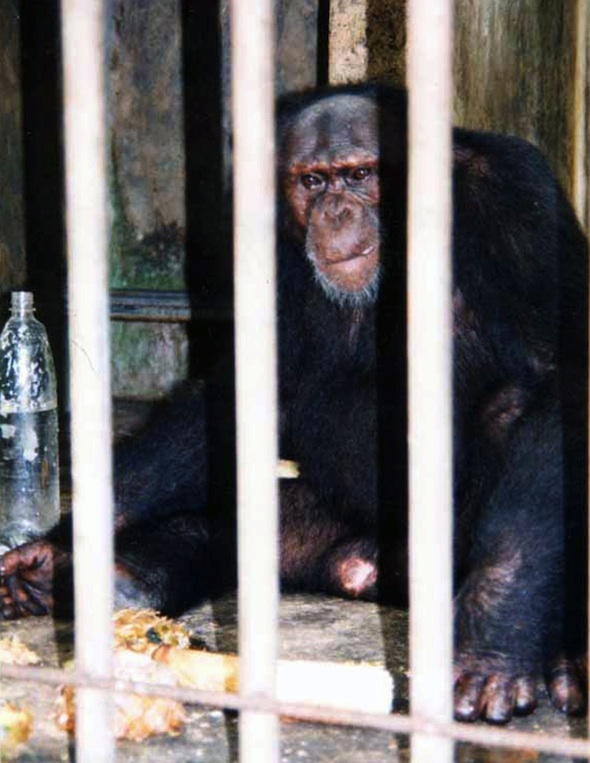
Jacky in his cage at Atlantic Beach Hotel, where he lived for 30 years. Photo © Sheri Speede.
After we finally succeeded in bringing Jacky to Sanaga-Yong Chimpanzee Rescue Center in 1999, he soon stopped his self-abuse. I cautiously kept my distance from him until one day he initiated a change in our relationship. After watching me care for the wound of another chimpanzee, he turned to present me with a laceration on his own back that needed care, and we became friends. While these changes in his temperament were remarkable, his rapidly evolving relationships with other chimpanzees at the sanctuary were most amazing, and his capacity for leadership that survived so many years of deprivation seemed nothing short of miraculous. He formed an alliance with adult female Nama (who had been shackled by a chain at another hotel for 16 years), and together they led a social group of chimpanzees for ten years. Under the gentle and just leadership of this powerful duo, we were able to introduce many young orphans, eventually expanding their social group to twenty-six.
Eventually, a younger, stronger male persistently challenged Jacky, and after a struggle for dominance that lasted many months, he eventually pant-grunted his submission and handed over the reins of leadership about three years ago. Today Jacky is a respected elder, and although he is no longer the alpha male, we still call the group “Jacky’s group.” Without a lot of responsibility, he spends his days playing and avoiding conflict, which seems a form of contented retirement.
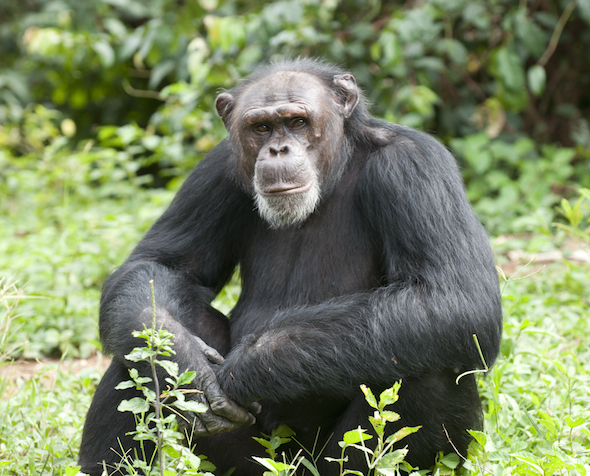
Jacky at Sanaga-Yong Chimpanzee Rescue Center. Photo: Carol Yarrow.
Sheri has written about Jacky and other chimpanzees in her book Kindred Beings, which will be published by HarperCollins in September 2013.
There are some people who are simply intense, even their resting face is intimidating to the uninitiated! Their approach to life and every experience in it can seem so serious that it’s hard to imagine them ever being a kid. If you asked my husband, that’s a fairly accurate description of me. If you asked me I’d say it’s a fairly accurate description of both Jamie chimpanzee and me. I do love Jamie’s serious face. Isn’t it intense?
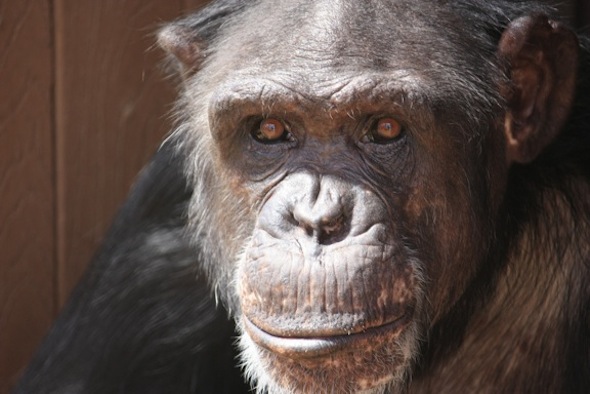
But I also know that, just like me, Jamie doesn’t always wear her serious pants. We’ve often posted about Foxie’s ability to draw out Jamie’s silly side but, really, she can be silly all on her own when she chooses. Today, during cleaning, Jamie initiated an exuberant game of chase, roll, repeat with me and I was happy to oblige. Taking Jamie on her own terms allows her to express her complex character completely and I’m so thankful to provide her that opportunity, especially when it involves laughter!
Here’s photo evidence of Jamie with a not-so-serious face. You may notice that the only photo evidence I could find of Jamie with a playface was in the company of Foxie!
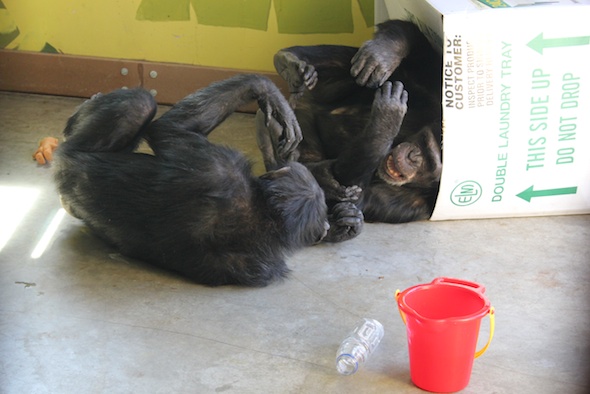
The other day I caught a pretty funny trio in a game of wrestle and chase:
Today was sponsored by Paige Powell in honor of the staff and volunteers here at Chimpanzee Sanctuary Northwest! Paige, this is such a kind and generous thing to do. I am pretty sure I speak for all of us when I say the honor is all ours. And we couldn’t give the chimpanzees all that they so deserve if it were not for the care and support of so many amazing people such as yourself. Thank you so much, Paige, from the humans and chimpanzees alike!
And here is the beautiful cover girl herself, Jody, who was featured in an article on the front page of yesterday’s New York Times! Learn more here!
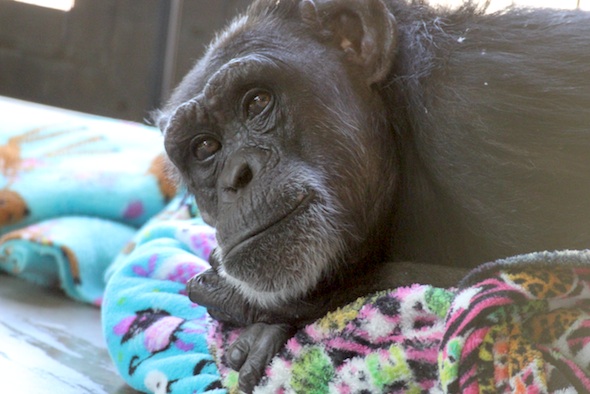
Mornings here at the sanctuary are busy times. The caregivers arrive, prepare breakfast for the chimpanzees, and, then, are usually engaged in quite a lot of cleaning. I love cleaning, it’s like having my own personal workout regimen that does wonders for my arms! My absolute favorite part of the day though is after we’ve accomplished some work and we can enjoy the company of good friends. Grooming and play are the most frequent forms of social enrichment for the humans as well as the chimpanzees. A quiet afternoon, hanging out with chimpanzee friends is the best way I know of to while away time in this heat!
Learn more about the function of chimpanzees grooming from previous posts.