• Skip to main content
  • Skip to primary sidebar
  • Skip to footer

Chimpanzee Sanctuary Northwest

Hope. Love. Home. Sanctuary

  • Our Family
    • The Chimpanzees
    • The Cattle
  • Blog
  • About Us
    • Visiting the Sanctuary
    • Philosophy
      • FAQs
      • Mission, Vision & Goals
      • Privacy Policy
    • The Humans
      • Staff
      • Board of Directors
      • Founder
    • Annual Reports
    • The Future of CSNW
    • CSNW In The News
  • You can help
    • Donate
      • Become a Chimpanzee Pal
      • Sponsor A Day
      • Transfer Stock
      • Be A Produce Patron
      • Be a Bovine Buddy
      • Give from your IRA
      • Personalized Stones
      • Bring Them Home Campaign
    • Leave A Legacy
    • Employment Opportunities
    • Volunteer
    • See Our Wish List
    • Events
  • Resources
    • About Chimpanzees
    • Enrichment Database
    • Advocacy
      • Advocacy Action Center
      • Apes in Entertainment
        • Trainers
        • Role of the AHA
        • Greeting Cards
      • Chimpanzees as Pets
      • Roadside Zoos
      • Chimpanzees in Biomedical Research
      • Conservation
        • African Apes
        • Orangutans
  • Shop
    • Merchandise Store
  • Contact
  • DONATE NOW

eyes on apes

Resilience

May 21, 2013 by Debbie

This is the first of a series of guest blogger posts from researchers that work with free-living apes. Maureen McCarthy graduated from the Chimpanzee and Human Communication Institute and is currently a PhD candidate at the University of Southern California. She is doing research with chimpanzees in Uganda and has a regular featured blog on Scientific American’s blog. Here’s her most recent entry that mentions Foxie:

—

Their chorus of pant hoots gave them away in dramatic fashion. The chimpanzees we’d been looking for were nearby, and we knew exactly where to find them. Though farmland and trees blocked our view, we could hear that the chimpanzees had arrived at a particular fig tree laden with ripe fruits. As ripe fruit specialists, chimpanzees seek out fruiting figs like this Ficus exasperata. On a good day, we can use our knowledge of when these figs are ripening to help us find the chimpanzees.

We took a circuitous route through the gardens to a grassy hilltop with a clear, albeit distant, view of the Ficus.  I dropped my backpack and pulled out my binoculars. I began to scan the tree in an attempt to identify the large dark figures foraging. I could make out the silhouettes of at least seven or eight chimpanzees, all foraging on figs or seated in the huge tree.
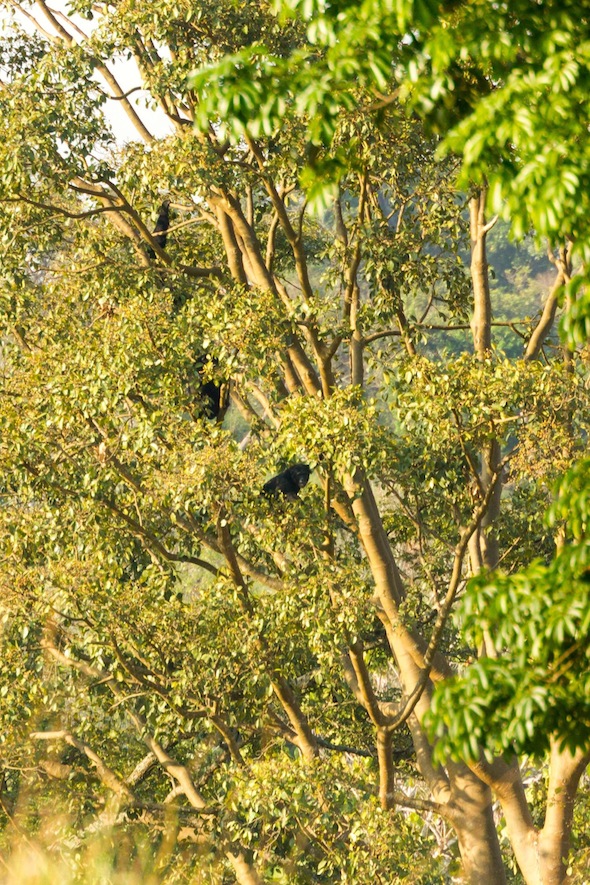
Photo 1

Chimpanzees feed in a Ficus exasperata tree. Photo © Jack Lester.

After observing their foraging for a few peaceful moments, I heard a jarring but familiar sound. A man working in a garden nearby shouted at the chimpanzees. Though the tree was in an isolated area of grassland several dozen meters from where he worked, he was clearly uncomfortable with their presence. A few threatening shouts were enough to convince the chimpanzees it was best to cut short their breakfast. They descended quickly from the fig. I now counted twelve chimpanzees as they walked in a single file line back across the grassland and to a small patch of forest nearby. As we watched them go, field assistant Nick commented that he felt sorry for the chimps.

At times like these, I am reminded of one of the most recurrent lessons from my research thus far: chimpanzees are surprisingly resilient. They may have waited until later to forage, or perhaps they found another source of nutrition (which, unfortunately, may have involved risky crop-raiding). However, as long as no one hunted them or set a mantrap to ensnare them, as is sometimes the case, they probably found something to eat and survived another day. Despite the rapid rate of forest degradation in their habitat, they have persisted. They continue to forage, reproduce, and tend to the complex political matters of chimpanzee life, even if these behaviors must be modified somewhat to fit a drastically altered environment.

I was again reminded of chimpanzee resilience when, on a recent visit to my mother’s home, I opened an old box to find my childhood collection of troll dolls. After a moment’s consideration, I decided to send them to a chimpanzee named Foxie. Foxie is a resident of Chimpanzee Sanctuary Northwest (CSNW), a sanctuary in Cle Elum, Washington that serves as home to seven chimpanzees. The “Cle Elum Seven,” as they are known, have lived in biomedical laboratories for most of their lives. They were involved in invasive hepatitis vaccine research and used for laboratory breeding. Foxie gave birth to five infants, but was forced to give them all up, just like so many other breeding female chimpanzees in laboratories. Perhaps as a fulfillment of the maternal behaviors she was never able to express, Foxie can now usually be found carrying a troll or other doll with her.
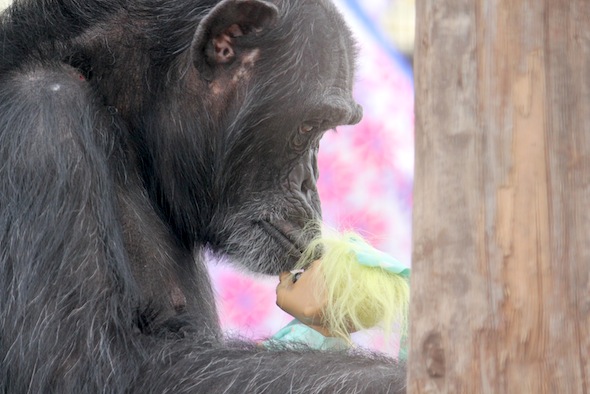
Photo 2

Foxie cares for a troll doll.

The caregivers who know Foxie and the other members of the Cle Elum Seven can attest to this adaptability. All seven have displayed drastic changes in both behavior and physical appearance since arriving at CSNW several years ago. The shift from a windowless laboratory basement to a spacious sanctuary with dedicated caregivers and outdoor access has—not surprisingly—had an unambiguously positive effect on them.

Why might chimpanzees be so adaptable to change?  It may have aided the survival of their ancestors–and ours. For example, many primates regularly face drastic seasonal changes in rainfall, temperature, and food availability. Some primates have specialized adaptations that help them survive under harshly changing seasonal conditions. For chimpanzees, a learned knowledge of the fruit tree locations, even during periods of low fruit availability, is critical. Chimpanzees acquire this knowledge over a prolonged period of development, with high reliance on their mothers until full weaning at age 5, followed by juvenile and sub-adulthood learning periods lasting until age 15. A high degree of neural plasticity facilitates this learning ability. In humans, an especially high degree of plasticity may aid our strong reliance on learning. Plasticity may also play a key role in what we call resilience, enabling both humans and our chimpanzee kin to roll with the punches during trying times. For chimpanzees today, this may mean finding a new fruit tree when one due to ripen has been felled, or basking in the sun for the first time after decades inside a laboratory.

This post was originally published at Scientific American.
Filed Under: Advocacy, Free-living chimps Tagged With: advocacy, animal protection, animal rescue, animal rights, Animal Welfare, chimpanzee, chimpanzee rescue, chimpanzee retirement, Chimpanzee Sanctuary Northwest, Cle Elum 7, Cle Elum Seven, csnw, eyes on apes, Foxie, free-living chimps, maureen mccarthy, primate rescue, rescue, resilience, Sanctuary, uganda

Upcoming guest bloggers

May 18, 2013 by Debbie

I’m pretty excited to announce that we’re going to be featuring some guest bloggers who work with apes in the wild! Our mission at the sanctuary is to provide quality lifetime care for the Cle Elum Seven, but also to advocate for apes everywhere. If you’re signed up for our Take Action list, you’ve probably received some action alerts from Eyes on Apes before. These are usually for issues that our nonhuman ape cousins face close to home, like the entertainment, pet, and biomedical industries.

Free-living apes are facing a whole different set of issues. In Africa their habitat is slowly being torn down, and the logging roads create access for hunters to easily hunt chimpanzees, gorillas, bonobos, and a whole slew of other exotic animals and sell their meat on the black market (it’s called the bushmeat trade). In Southeast Asia, orangutans are losing much of their habitat to palm oil plantations and other agricultural development.

From afar, there’s only so much detail we can provide—but those who are right there witnessing these issues can paint a very different picture. Our goal is to have them tell their stories, and help us to help our closest living relatives who are literally facing extinction.

We already have folks lined up for this exciting project: Dr. Cleve Hicks (former graduate student at the Chimpanzee and Human Communication Institute just down the road) who is now working with apes in the Bili Forest in central Africa; Dr. Debra Durham who is currently in east Africa and has expertise in both captive and free-living issues (you might remember this article about PTSD in ex-biomedical lab chimps, including Negra); and Dr. Zarin Machanda who met JB and Diana at the Fauna Foundation years ago, and has worked with chimpanzees in east Africa. Stay tuned for these stories with great information coming very soon!

Here’s a photo of Negra, who now gets to have sunshine, friends, and choices after being stolen from Africa and used in biomedical research for decades. Let’s raise awareness about others like Negra still in labs, and for her relatives in Africa that need our help. Share this video and subscribe to the blog if you haven’t already, so you’ll be sure to get notified of the upcoming guest blogger posts!

web Negra green grass Young's Hill YH IMG_8027

—

Guest blog posts:

Resilience and The Landmine Snare by Maureen McCarthy

Along the Bushmeat Highway: Part One, Two, and Three and The FARDC ‘Petting Zoo’ at Bili by Dr. Cleve Hicks

Video interview Part One and Part Two with Dr. Debra Durham (presented as a Take Action Tuesday posts)

Jacky and Nama by Dr. Sheri Speede

Meet the Chimpanzees of Kanyawara and Research at Kanyawara by Dr. Zarin Machanda

Margot and Is successful reintroduction possible? by Dr. Gwendy Reyes-Illg

Why are orangutans endangered in the wild? by Rich Zimmerman

Filed Under: Advocacy, Free-living chimps, Negra, Sanctuary Tagged With: advocacy, africa, african rainforest logging, animal protection, animal rescue, animal rights, Animal Welfare, bushmeat trade, chimpanzee, chimpanzee rescue, chimpanzee retirement, chimpanzee sanctuary, Chimpanzee Sanctuary Northwest, Cle Elum 7, Cle Elum Seven, cleve hicks, csnw, debra durham, eyes on apes, free-living chimps, free-living orangutans, indonesia, malaysia, Negra, orangutan, palm oil, primate protection, primate rescue, Sanctuary, wild chimpanzees, wild orangutans, zarin machanda

Take Action Tuesday: Petition to Merck

April 30, 2013 by Debbie

EOA take action tuesday

Have you heard about Brandon Wood? He is one of the most active chimpanzee advocates, always working tirelessly to help chimps through petitions, fundraisers, and tabling events. Did I mention he’s just 12 years old? He’s an inspiration! His latest project is a petition to a drug company Merck, a private biomedical testing lab, to stop biomedical testing on chimpanzees. Though the National Institutes of Health is moving toward retiring government-funded chimps in research, there are still many chimps in privately-funded labs. Lend Brandon a hand and help the chimps today by signing his petition! And don’t forget to share it with your friends, too.

brandon letter writing

Filed Under: Advocacy, Chimpanzees in Biomedical Research Tagged With: advocacy, animal protection, animal rescue, animal rights, Animal Welfare, biomedical research, brandon wood, chimpanzee, chimpanzee rescue, chimpanzee research, Chimpanzee Sanctuary Northwest, eyes on apes, Sanctuary, take action tuesday

Take Action Tuesday: Urban Tarzan

April 9, 2013 by Debbie

EOA take action tuesday

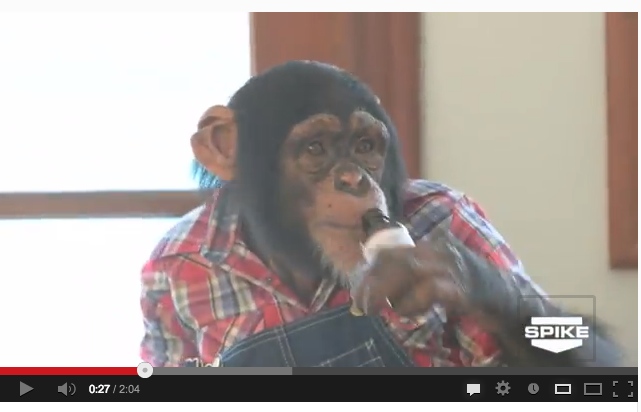
The new Spike TV show called Urban Tarzan is all about wild animals found in human environments. Though the series has a whole slew of wild animals, the premiere episode from a few weeks ago featured a young chimpanzee actor. The show is supposed to be a reality series, but everything is scripted and the scenes are all staged.

Chimpanzee "actor" on the premiere episode of Urban Tarzan
Chimpanzee “actor” on the premiere episode of Urban Tarzan

There is a growing public awareness about the ethical problems with using chimpanzees in entertainment. Please remind the producers of the show about these issues by sending them a polite letter. Ask them to remove the episode from the air and pledge to never use primates in their productions again. Your letters can make a difference! In the last couple months both Great Clips and CR Fashion Book have removed content with chimpanzee actors after receiving educational letters from advocates like you!

Let the producers of Urban Tarzan know that brutal training practices in the entertainment industry are well documented. Remind them that in addition to welfare concerns, using chimpanzees in the media seriously hinders conservation efforts of free-living chimpanzees.

You may submit your comments to Spike TV’s Facebook page, or post Tweets that express your concern, such as @1UrbanTarzan very disappointed to see a chimp in your show. Please remove the episode! www.EyesOnApes.org

Sample Letter to Spike TV/Urban Tarzan:

I was extremely disappointed to hear that Urban Tarzan featured a young chimpanzee actor in the first episode. You should know that chimpanzees used in entertainment are torn away from their mothers as infants, often repeatedly beaten during training, and then discarded when they become too strong to be managed.

The show is supposed to be about rescuing wild animals from human homes, but since it is staged you are not following your own advice! Chimpanzees do not belong in human homes and they do not belong on TV either. Aside from welfare concerns, their appearance in the media seriously hinders conservation efforts. Surely you are aware that chimpanzees are endangered species in critical need of protection?

Please make the compassionate decision to remove the chimpanzee episode from rotation, and please consider to never exploit great apes for entertainment purposes again. Thank you for your consideration of my comments on this urgent matter.

Sincerely,

[Your name here]

Filed Under: Advocacy, Apes in Entertainment Tagged With: advocacy, animal protection, animal rescue, animal rights, Animal Welfare, chimpanzee, chimpanzee rescue, chimpanzee retirement, Chimpanzee Sanctuary Northwest, chimps in entertainment, eyes on apes, primate protection, primate rescue, take action tuesday, urban tarzan

New iPad thanks to Apps for Apes! (and a plea for a chimp-proof case)

March 18, 2013 by Debbie

(UPDATE: Thank you Jody! We’ve got our case on the way! If you want to still support the fun iPad project—we could use some iTunes giftcards for cool apps! You can send an e-card to [email protected])

A few weeks ago, Orangutan Outreach reached out to us after seeing my blog post about wanting an iPad for Jamie (and the other chimps, too!) They have this great program called “Apps for Apes” (featured on NBC news) which has mostly been used in zoos and with orangutans. The Center for Great Apes is involved in the program and they are a sanctuary for both chimps and orangutans, but we’re the first sanctuary to be involved with only chimps. I’m really excited to see what apps they want to interact with the most! Orangutan Outreach raises awareness about orangutan conservation while also providing great enrichment for captive orangutans. Their project falls perfectly in line with what we have going on with Eyes on Apes, our advocacy group.

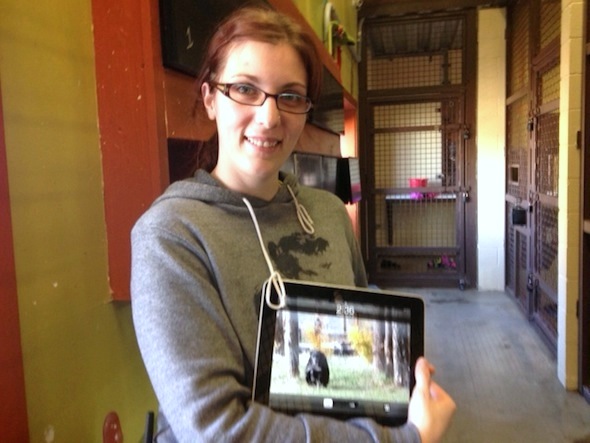
Here’s me (so excited!) with the iPad. I set a photo from today’s earlier blog post of Jody as the background:

web caregiver debbie hold new ipad

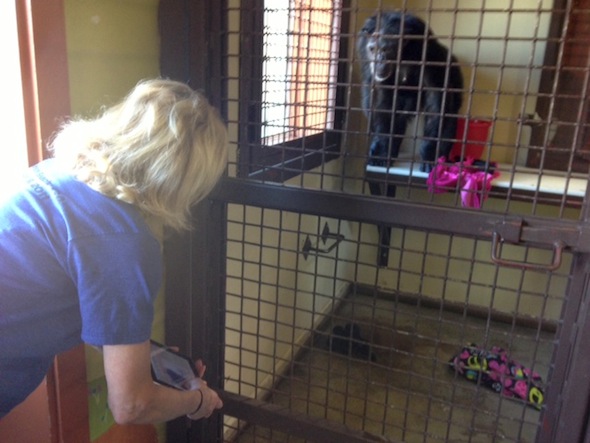
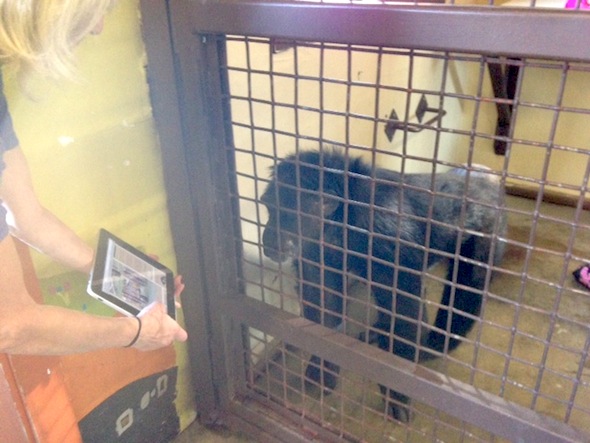
And here volunteer Deb and myself show Jamie and Foxie the iPad.

web caregiver deb show jamie new ipad

web jamie look at ipad

web foxie jamie look at ipad

I can’t WAIT to be able to let the chimps touch the iPad themselves. First we need to have a durable case so we can safely have it against the fencing and the chimps won’t break it 🙂

J.B. has done a bit of research and this is what we’ve decided will be the best option: Life Jacket Waterproof Case. We’d like the case as well as the extra mounting bracket which is an additional cost. If someone would be willing to donate the case, the mounting bracket, (or both!) I would be forever thankful (and so would the chimps!)

Though we don’t know for sure exactly what will happen when they’re able to interact with it themselves, I imagine based on how enriching it is just to look at, that they’ll be very interested to touch it!

Filed Under: Caregivers, Enrichment, Foxie, Jamie, Sanctuary, Thanks Tagged With: advocacy, animal protection, animal rescue, animal rights, Animal Welfare, apps for apes, chimp enrichment, chimp sanctuary, chimpanzee, chimpanzee rescue, chimpanzee retirement, chimpanzee sanctuary, Chimpanzee Sanctuary Northwest, Cle Elum 7, Cle Elum Seven, conservation, csnw, Enrichment, eyes on apes, Foxie, Jamie, Keith LaChappelle, orangutan, primate protection, primate rescue, Sanctuary

Take Action Tuesday: CR Fashion Book features young chimpanzee, Bently

February 26, 2013 by Debbie

CR Fashion Book has a new issue set to hit stands on Thursday with a big spread featuring Bently, an infant chimpanzee. Bently is owned by Mike Casey, who you might remember was put in front of county commissioners in Las Vegas because he lacked a permit to house his chimpanzees. He has a record of abusing his chimps, punching them, hitting them with a rod, and throwing hot water in their face. Casey also was responsible for breeding Travis, who as an adult escaped and mauled a Connecticut woman in 2009.

In their post about Bently’s upcoming appearance, CR Fashion Book also boasts that Bently’s brother Kenzy was the star of the Speed Racer movie, which actually got an unacceptable rating from the American Humane Association due on-set abuse.

Bently, Kenzy, and others like them deserve to be in a sanctuary where they can receive lifetime quality care. By featuring Bently in their magazine alongside humans, CR Fashion Book is perpetuating the pubic misunderstanding of chimpanzee nature.

Bently in his feature in CR Fashion Book magazine

Please send a polite letter to CR Fashion Book and ask them to remove the spread from the issue before sending it to stands on Thursday, and ask them to pledge to never use primates in future publications. Your letters make a difference – just earlier this year, Great Clips pulled a commercial featuring a young chimpanzee after they heard from concerned advocates like you.

You may send your letter to the editor-in-chief, Carine Roitfeld at [email protected]

You may also submit your comments to their Facebook page, or comment on this picture they posted from “behind-the-scenes” of the shoot.

Sample Brief Facebook Comment:

Bently the young chimpanzee should not be used in this way. His trainer has a history of abuse! Chimpanzees bred for the pet and entertainment industry eventually become big and strong and it is within their nature to be aggressive. Bently and other chimpanzees simply do not belong with humans, and your magazine spread is suggesting otherwise. Please remove the spread and pledge to never use primates in future publications!

Sample Letter to the Editor-in-Chief:

Dear Ms. Roitfeld:

I was shocked and disappointed to hear that CR Fashion Book is planning to feature Bently, a young chimpanzee. You should know that chimpanzees used in entertainment are torn away from their mothers as infants, often repeatedly beaten during training, and then discarded when they become too strong to be managed. Bently’s trainer has a history of abuse.

Featuring Bently alongside humans sends the message that these amazing beings are simply props. Surely you are aware that chimpanzees are endangered species in critical need of protection? You are exploiting chimpanzees for your own profits and this is an unacceptable business practice.

Please make the compassionate decision to remove the chimpanzee spread from your magazine, and consider making a pledge to never use primates in future publications. Thank you for your consideration of my comments on this urgent matter.

Sincerely,
[Your name here]
[Your city & state]

If you send a e-mail to CR Fashion Book, please remember to BCC Eyes on Apes at [email protected] for tracking purposes. Thank you!

Filed Under: Advocacy, Apes in Entertainment Tagged With: advocacy, animal protection, animal rescue, animal rights, Animal Welfare, apes in entertainment, bently chimp, chimpanzee, chimpanzee rescue, chimpanzee retirement, Chimpanzee Sanctuary Northwest, Cle Elum 7, Cle Elum Seven, csnw, eyes on apes, kenzy chimp, mike casey, primate patrol, primate protection, primate rescue, Sanctuary, take action tuesday

Take Action Tuesday: NIH comment form

January 29, 2013 by Debbie

Last week we sent out a newsletter regarding the good news from the NIH working group who met last Tuesday. To review some of the main points from the report, read Sarah’s blog here. They made several recommendations, but the biggest bottom line is: most of the chimpanzees currently being used in research should be retired into the Federal Sanctuary System, but a small number (they suggested around 50) should be held back in a reserve colony for possible future research.

The next step in the process is to solicit public comment regarding the recommendations, which is located here. It is quite daunting in its length and detail—but don’t let that stop you. All you need to do is fill in your name, email, and then scroll all the way to the bottom to fill in a box labeled “Overall Comments.” If you want to be more specific, leave a comment in the field for “Chimpanzee Research Colony Size and Placement: Recommendation SP2.” You can get to that field easily by selecting the “colony size and placement” option from the drop menu at the top of the page.

In your comments, encourage the NIH to accept the recommendations, but also remind them that there is no reason to have any chimpanzees in research—not even a small group of 50. You could mention that no other industrialized nation tests on chimpanzees. Chimpanzees have complex social, psychological, and physical needs that cannot be met in labs. They have been imprisoned for a crime they did not commit, and are injected with diseases or vaccines, forced to undergo surgeries, sometimes kept in solitary confinement, and regularly shot with darts to be anesthetized. Remember to remain polite and be succinct. If you want to share what you submit in the comments section here for others to see, feel free! We’ll share a copy of what we submit soon too.

If you haven’t seen it already, check out this site called “The Last 1000” that is a countdown to the end of chimpanzees in biomedical laboratories. You’ll notice that Negra’s daughter Heidi is on the list along with Jody’s children Levi and April, and Foxie’s son David. These remaining research chimpanzees deserve the kind of life that the Cle Elum Seven have—one with friends, laughter, sunshine, good food, giant nests, fun enrichment, and perhaps most importantly—choices.

Negra's daughter, Heidi
Negra’s daughter, Heidi


Filed Under: Advocacy, Chimpanzees in Biomedical Research, Sanctuary Tagged With: animal protection, animal rescue, animal rights, Animal Welfare, biomedical research, chimpanzee, chimpanzee rescue, chimpanzee retirement, chimpanzee sanctuary, Chimpanzee Sanctuary Northwest, Cle Elum Seven, csnw, eyes on apes, primate patrol, primate rescue, Sanctuary, take action tuesday

  • « Go to Previous Page
  • Page 1
  • Page 2
  • Page 3
  • Page 4
  • Go to Next Page »

Primary Sidebar

Subscribe To the Blog and Get Notified of New Posts First!

Archives

Calendar of Blog Posts

June 2026
S M T W T F S
 123456
78910111213
14151617181920
21222324252627
282930  
« May    

Categories

SUBSCRIBE TO OUR NEWSLETTER

Footer

PO Box 952
Cle Elum, WA 98922
[email protected]
509-699-0728
501c3 registered charity
EIN: 68-0552915

Official DDAF Grantee

Menu

  • The Chimpanzees
  • Blog
  • About Us
  • You can help
  • Resources
  • Contact
  • Donate

Proud Member of

Connect With Us

Search

Copyright © 2026 Chimpanzee Sanctuary Northwest. All Rights Reserved. Site by Vegan Web Design