• Skip to main content
  • Skip to primary sidebar
  • Skip to footer

Chimpanzee Sanctuary Northwest

Hope. Love. Home. Sanctuary

  • Our Family
    • The Chimpanzees
    • The Cattle
  • Blog
  • About Us
    • Visiting the Sanctuary
    • Philosophy
      • FAQs
      • Mission, Vision & Goals
      • Privacy Policy
    • The Humans
      • Staff
      • Board of Directors
      • Founder
    • Annual Reports
    • The Future of CSNW
    • CSNW In The News
  • You can help
    • Donate
      • Become a Chimpanzee Pal
      • Sponsor A Day
      • Transfer Stock
      • Be A Produce Patron
      • Be a Bovine Buddy
      • Give from your IRA
      • Personalized Stones
      • Bring Them Home Campaign
    • Leave A Legacy
    • Employment Opportunities
    • Volunteer
    • See Our Wish List
    • Events
  • Resources
    • About Chimpanzees
    • Enrichment Database
    • Advocacy
      • Advocacy Action Center
      • Apes in Entertainment
        • Trainers
        • Role of the AHA
        • Greeting Cards
      • Chimpanzees as Pets
      • Roadside Zoos
      • Chimpanzees in Biomedical Research
      • Conservation
        • African Apes
        • Orangutans
  • Shop
    • Merchandise Store
  • Contact
  • DONATE NOW

eyes on apes

Take Action Tuesday: One Direction’s wrong turn

November 11, 2014 by Debbie

EOA take action tuesday

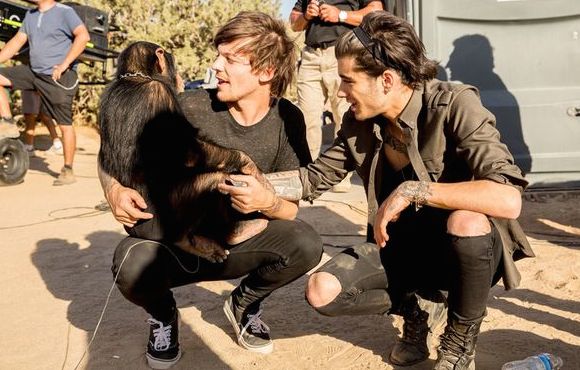
Last month, we sent out an action alert about the band One Direction’s new music video with a chimpanzee named Eli. Several advocacy groups, experts, and supporters from around the world wrote to the band, but so far we haven’t heard any kind of commitment from the boys to avoid working with apes in future productions. Since their new album is releasing next week, we want to continue to put pressure on the band and ask that they make the pledge before their album release—and until they do, we will spread the word to fans and tell them not to buy the album.

Many of our readers are aware of the tragic lives of chimpanzees in entertainment—chimps like Jamie, for instance, live with trainers when they are young and when they are too big to be managed, they have to live inside a cage for the rest of their lives. Jamie is lucky to have reached a sanctuary, but many others have not had that chance. Some of Eli’s trainer’s former chimp “actors” have been cast off to decrepit roadside zoos. The trainer himself, Steve Martin, has been cited numerous times for things such as failure to have an environmental-enhancement program to promote the psychological well-being of primates, failure to supply adequate shelter from the elements and inadequate ventilation, failure to provide animals with minimum space, filthy cages, and improper feeding.
louis-zyan-eli-chain

We’re so disappointed that the One Direction band members are promoting the exotic animal trade rather than using their celebrity statuses to protect chimpanzees, who are critically endangered in the wild.

We urge you to continue to put pressure on One Direction to remove the photos and promise to never use apes again. Please post on their Facebook and Twitter pages and let them know that chimps like Eli should not be used in entertainment. Not only are there numerous welfare concerns, but seeing chimpanzees in close contact with humans perpetuates the idea that they can be treated as pets.

You may also send a letter to the band c/o Lisa Wolfe at [email protected]

Sample Comment on One Direction’s Facebook:

I am disappointed to see that One Direction went ahead and included clips with Eli in the Steal My Girl video, despite hearing from concerned advocates. Chimpanzees do not belong in music videos and you should know that Eli’s trainer is cited for dozens of animal welfare violations (www.eyesonapes.org/eli). Showing these images perpetuates the idea that chimps make good pets. Please make the compassionate decision pledge to never exploit great apes for entertainment purposes again. I won’t be buying your new album until you make that promise, and I’ll tell all my friends to do the same. Thank you for your consideration of my comments on this urgent matter.

Sample Tweets to One Direction:

@OneDirection sad to see Eli in #StealMyGirlVideo. I won’t buy your new album until you pledge to never use apes again! www.EyesOnApes.org/eli

@Louis_Tomlinson @zaynmalik Eli had a nasty chain on his neck in the #StealMyGirlVideo pics! Please promise you won’t work with apes again.

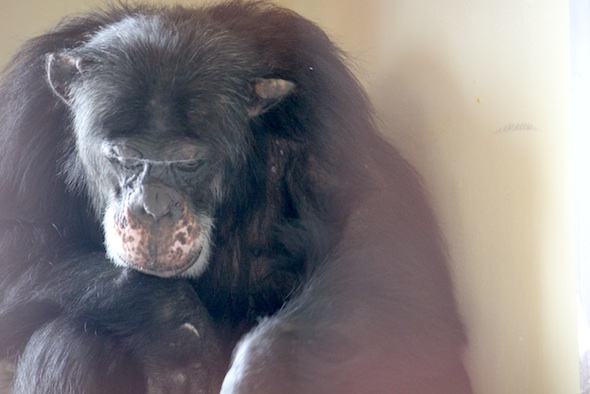
We would love to see Eli and all remaining chimpanzees in entertainment reach a sanctuary, so they can receive the lifetime quality care they deserve and get a second chance at life like Jamie. We’d love to hear stories about sanctuary life someday for Eli and others like this one of Jamie:

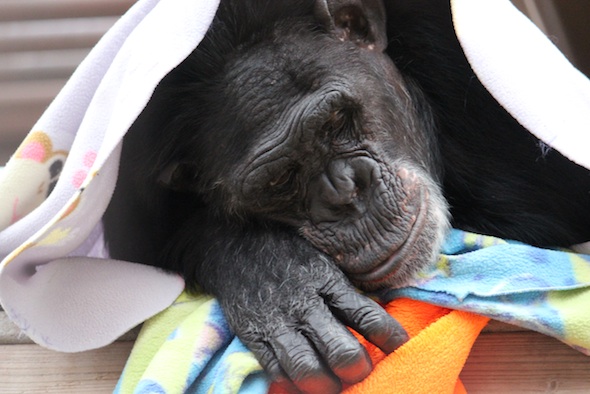
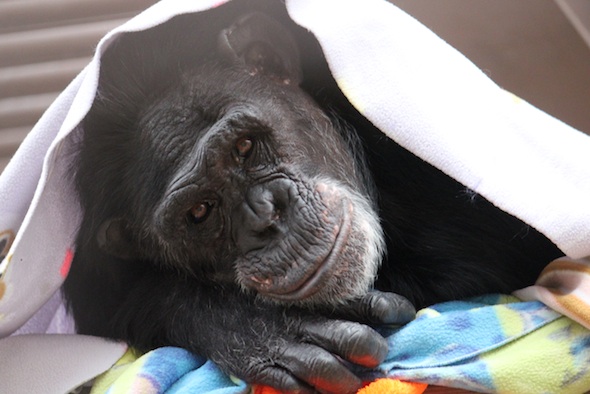
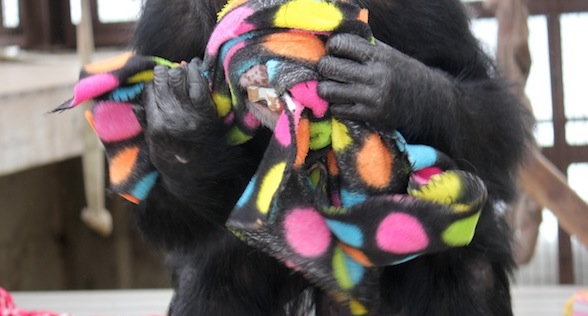
This morning, new volunteer caregiver-in-training Lizz kept Jamie busy for quite awhile by dropping a piece of banana just outside the fencing. Jamie first used a magazine, but when that didn’t help much, Denice gave her a plastic tube which was much more helpful. Once she got the banana up against the fencing she used her fingers to delicately move the banana to spot where she could pull it through. We’ve talked a lot before about Jamie’s knack for projects and keeping busy, but when she’s not working on various projects—she’s quite talented at nest-making, and consequently, nap-taking.
web_Jamie_rest_lie_down_platform_closeup_cover_self_nest_GH_kh_IMG_5726

web_Jamie_rest_lie_down_platform_blanket_cover_body_head_out_closeup_GH_kh_IMG_5710

The final thing you can do to help Eli is to spread the word! Please share this blog on social media and encourage your friends to speak up for him, too.
Filed Under: Advocacy, Apes in Entertainment, Jamie, Sanctuary, Volunteers Tagged With: #stealmygirlvideo, advocacy, animal protection, animal rescue, animal rights, Animal Welfare, chimp, chimp sanctuary, chimpanzee, chimpanzee rescue, chimpanzee retirement, chimpanzee sanctuary, Chimpanzee Sanctuary Northwest, Cle Elum 7, Cle Elum Seven, csnw, eli chimp, eyes on apes, Jamie, one direction, primate protection, primate rescue, rescue, Sanctuary, steve martin's working wildlife

More ways to follow us

February 25, 2014 by Debbie

If you are on Facebook, you’ve probably seen a few pictures posted from our new Instagram account. If you have Instagram, please start following us @chimpsanctuary! Today, I posted this picture, with the caption “Guess who?” And I’d like to pose that question to our blog readers as well. So, go ahead and guess! After you figure it out, I will post more pictures of that chimp later today!

UPDATE: It’s Burrito 🙂 Scroll down to see his pretty cute face.

web-guess_who

If you aren’t on Facebook or Instagram, but you regularly read the blog, you might have noticed on the right hand sidebar that there’s a new link to a page called News on Apes. This is simply a feed of news stories (with links to the original articles) all in one place for any issue apes are facing in the news. If something noteworthy comes out on chimps in entertainment or biomedical research, or conservation issues for wild gorillas, chimps, and orangutans—we will post it there. Subscribe to get an email notification any time we post a link to a new article, to stay updated on what is going on with apes around the world.

web_Burrito_chin_on_hand_sit_on_bench_FR_ls_IMG_9107

web_Burrito_bite_hand_look_toward_window_FR_ls_IMG_9110

Filed Under: Advocacy, Burrito, Play, Sanctuary Tagged With: advocacy, animal protection, animal rescue, animal rights, apes, Cle Elum Seven, conservation, csnw, eyes on apes, instagram, News, Sanctuary

Help others Take Action – share Eyes on Apes!

July 2, 2013 by Debbie

CSNW is a really unique place. We have seven amazing beings under our care, whom as you know are of utmost importance around here and truly run the show! Well, Jamie does anyway 😉 And we love to share stories about each of their personalities and their day-to-day lives.

For instance, today has been a continuation of the heat wave that has hit Cle Elum, but before the hot afternoon sun came around we did a breakfast forage on the hill which everyone loved. Here’s Foxie enjoying a piece of grapefruit:

web_Foxie_dora_orange_platform_YH_jb_IMG_2561

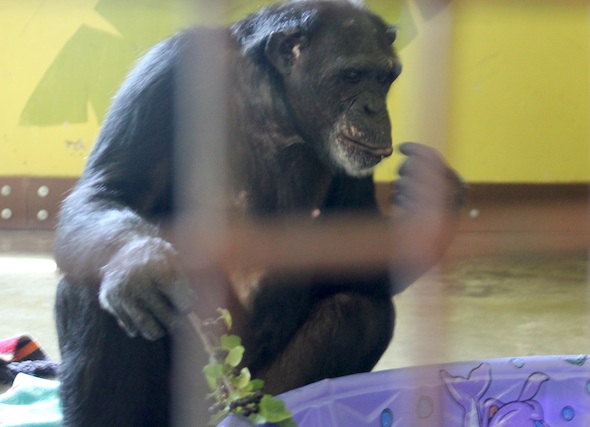
After we cleaned the playroom, Denice and I filled a kiddie pool with cool water, and harvested some black currents we have growing in the garden. We spread the currents around as a forage and also dropped some into the water. Jody and Jamie especially loved it!

web_jody_eat_black_current_forage_stairs_PR_dm_IMG_0013

web_jamie_eat_black_current_forage_pool_PR_dm_IMG_0017

CSNW is also pretty big on education and advocacy. Eyes on Apes is our advocacy group and we really want to help make a difference for apes everywhere. The Cle Elum Seven truly serve as ambassadors for the life that all chimpanzees in captivity deserve, and for their wild counterparts who need our help to protect their habitat. This is only something we can achieve with your help! If you haven’t joined the Take Action e-mail list, do that today! Share our Facebook page, and re-tweet our plea for more followers on Twitter.

web_jamie_up_close_PR_dm_IMG_0018

Filed Under: Advocacy, Food, Foxie, Jamie, Jody, Sanctuary, Young's Hill Tagged With: advocacy, animal protection, animal rescue, animal rights, Animal Welfare, chimp enrichment, chimp sanctuary, chimpanzee, chimpanzee rescue, chimpanzee retirement, chimpanzee sanctuary, Chimpanzee Sanctuary Northwest, Cle Elum 7, Cle Elum Seven, csnw, eyes on apes, Foxie, Jamie, Jody, primate protection, primate rescue, rescue, Sanctuary

Take Action Tuesday: Split-listing may be removed!

June 11, 2013 by Debbie

EOA take action tuesday

This morning the US Fish and Wildlife Service (FWS)  announced that they are proposing to remove the split listing between captive and free-living chimpanzees, making ALL chimpanzees endangered. This potentially will have a major influence on how chimpanzees are treated in this country. It will certainly have an impact on invasive research and most likely entertainment as well.

Read our press release on the proposal and see this news article featuring a photo of CSNW’s resident, Jody (read her story here).

At this moment, the FWS  has only made a proposal and this does not guarantee that it will be passed.  The FWS is currently accepting public comment, so we need your help! Please leave a comment here to express your thoughts on this issue. Let them know that chimpanzees should be regarded as an endangered species and that the hundreds of chimps still in labs and entertainment truly deserve to be in sanctuaries. Spread the word!


Filed Under: Advocacy, Apes in Entertainment, Chimpanzees in Biomedical Research, Free-living chimps, Sanctuary Tagged With: advocacy, animal protection, animal rescue, animal rights, Animal Welfare, chimpanzee, chimpanzee rescue, chimpanzee retirement, chimpanzee sanctuary, Cle Elum Seven, csnw, endangered, eyes on apes, FWS, Jody, primate protection, primate rescue, Sanctuary, split-listing, US fish and wildlife

Along the Bushmeat Highway: Part 3

May 26, 2013 by Debbie

This is the third installment of a series of posts from Dr. Cleve Hicks. Cleve did his PhD research in the DRC studying chimps in the Bili Forest. Read Part 1 of this story and Part 2 first! (To add some context to the story, look at the map of the “Bushmeat Highway” here).

—

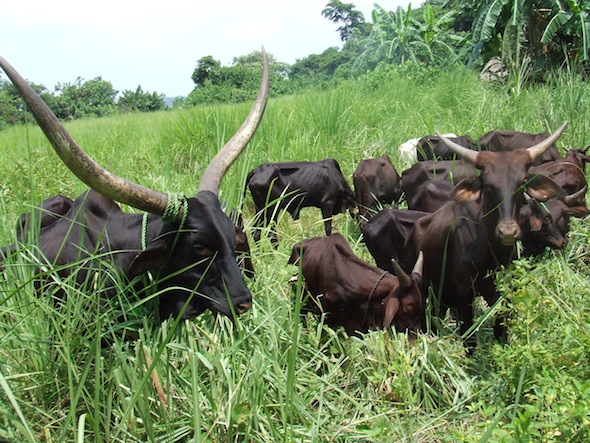
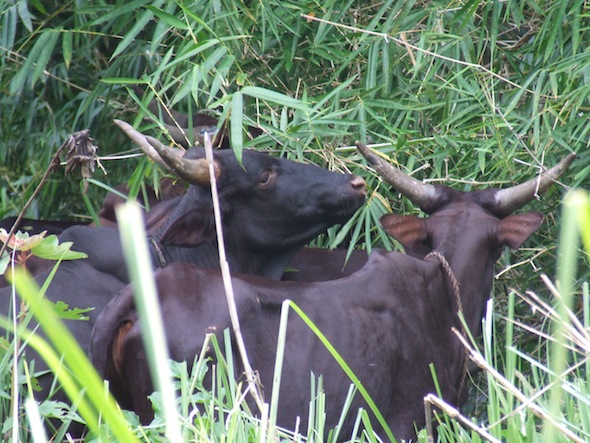
Our stay in Titule was prolonged an extra day due to an illness suffered by one of our Ecoguards. Fortunately we were able to sleep at the house of my old friend Chief Mangay of Lebo. Upon departing from Titule, we veered north towards Bili, crossing the mighty Uele River on pirogues. Villagers on the south bank of the Uele proudly showed us a large eagle they had captured from its nest. On the north bank of the river, we left behind the continuous cover of forest to the south and entered into savannah / forest mosaic territory. This road was, as it had been in 2006, much less heavily trafficked than the roads to the south of the Uele. Not only did we see no monkey or duiker carcasses or monkey orphans, but just to the north of the Uele we got of first glimpse of free-living monkeys in the trees above the road: a black and white colobus and a bit further along a tree-full of chittering red-tailed guenons. Lukuru researchers Ephrem Mpaka and Gilbert Paluku had noticed the same pattern (no monkey or duiker meat) on their trip from Buta to Bili two days earlier. This was encouraging, but there were also signs that times and circumstances were changing. In the north bank riverside town of Lisala, as we stopped to snack on binyes (simple concoctions of flour, sugar, and palm oil), we were confronted with a bustling herd of long-horned cattle, about 15 in number, munching on bamboo and riverside herbs. They were being herded by local Congolese, whom we were told had recently bought them from Mbororo herders to the north. We watched the bovines munch their way through the roadside forest and the lush vegetation lining the Uele River. Are these cattle destined to replace the abundant hippopotamuses that forage under the cover of night along the river’s edge?

MbororCattleUele

A large herd of cattle purchased by local Congolese from Mbororo herders, on the north bank of the Uele River, Lisala.

CattleEatBambo

Cattle feasting on bamboo at the forest edge.

Further to the north, in the shadow of a collapsed bridge across the Api River, we were told by a local man that Mbororo herders were massed just 30 km away from us, with tens of thousands of cattle ready to sweep across the savannahs. In their wake, he claimed, sometimes travelled child soldiers of the dreaded Lord’s Resistance Army (although according to him, the two groups were not friends). Later, as we travelled north, we would hear from a number of Azande that the Mbororo would frequently raid their fields for crops, leading to pitched battles. Such observations reinforced my impression of an inherent contradiction in the policy of the authorities of Northern DRC. Government officials were both sending military to confront Mbororo herders but at the same time buying cattle from them. Where this will lead is impossible to say.

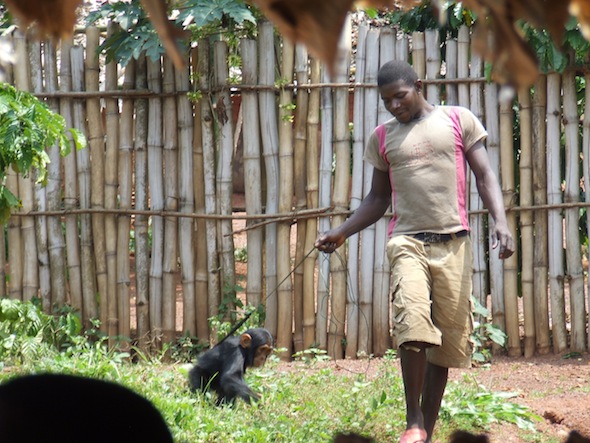
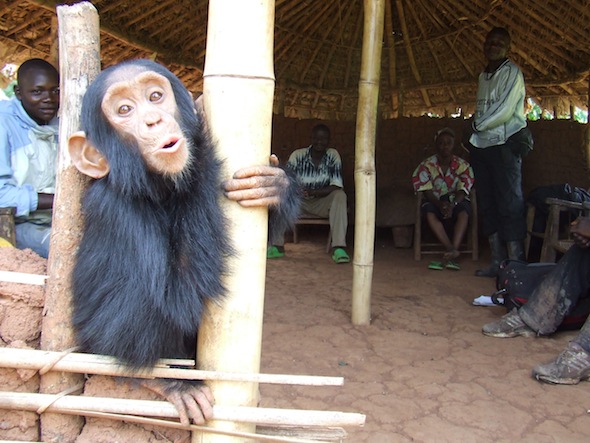
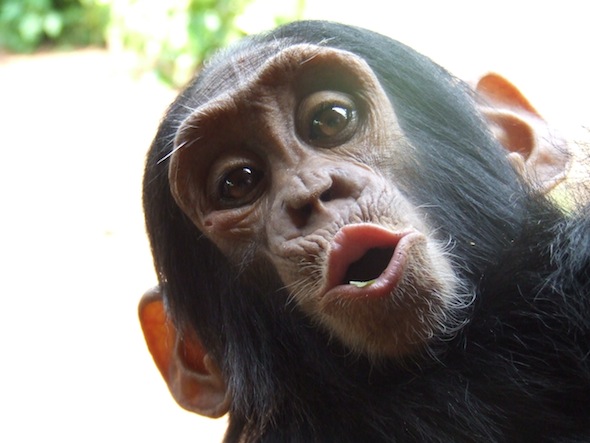
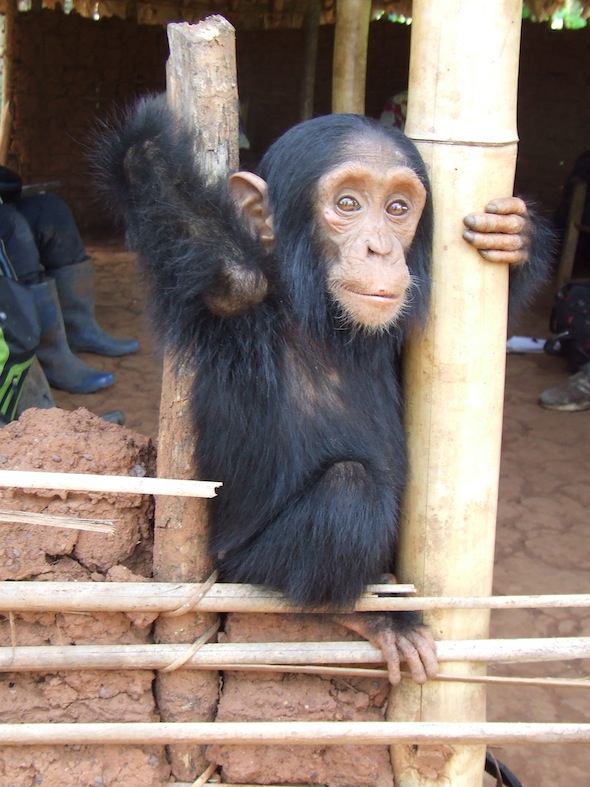
Sadly, although commerce in monkeys and duikers seemed to be much less common in this region, as was the case at Bili 5 years ago, we did hear the distressing news that the traditional chief of Lisala was keeping an orphan chimpanzee at his house about 1 km north of the Uele River. In the past, we had received a number of reports of orphan chimpanzees having been captured from this narrow belt along the north bank of the Uele River. Henri and I paid the chief a visit. Henri carefully explained the ICCN mission and asked the chief if we could see the orphan. He sent someone up to his house, and in a few minutes we heard a shrill, near-human scream. Shortly after, we watched as a tiny infant chimpanzee was dragged down to the paillote on a leash. I readied my camera and began taking photos as the orphan was placed onto a bamboo pole beneath the chief’s paillote.

On my previous mission south of the Uele River I had looked into the desperate eyes of over 35 orphan chimpanzees, but one never really gets used to the shock of it—the unimaginable sense of loss and helplessness registered in those haunted, searching brown eyes. Although in the past we had been able to save a number of the orphans we had encountered on our travels, today there was nothing I could do for Lisala, only photograph him as he raised his eyes skyward and emitted a plaintive pant-hoot to which he will never hear a response.

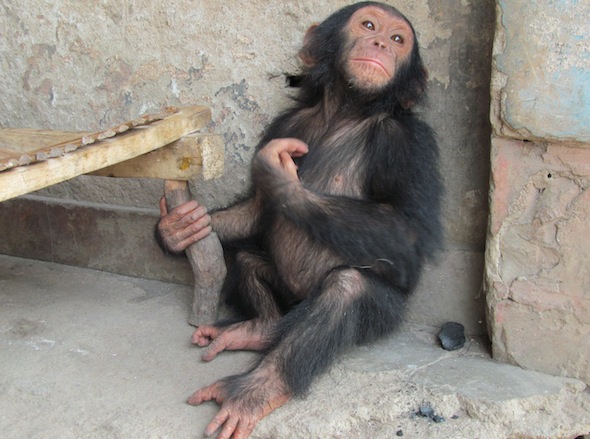
Henri got the story of Lisala’s capture from the chief: about two months ago, in the forest about a two hours’ walk east from the town, a group of local bow-hunters came across a party of chimpanzees. According to the chief, the apes fled in terror, abandoning the baby for the hunters to capture. This is often the story given, but I find it extremely unlikely that a mother chimpanzee would desert her baby. Far more likely, she was shot for bushmeat, which the chief would not want to admit to the ICCN. Indeed, Lisala had a vivid red bruise on his right brow ridge, possibly acquired when he tumbled out of the trees clutching onto his dying mother.

LisalaOrphan1

LisalaOrphan2

LisalaOrphan3

Lisala the orphan chimpanzee, kept by a traditional chief just north of the Uele River.

The hunters presented the baby as a gift to the chief. Now the chief wanted cigarettes and / or money from us for the privilege of seeing his baby chimpanzee. We politely deferred, of course, and went into our standard speech about the danger of keeping chimpanzees as a pets, and the damage that such a practice inflicts on populations of free-living apes. As we left his parcel, the chief called out after us in Lingala as a parting shot: ‘Ezali mabe te – ey ko batela mboka ya mokondji!’ (It isn’t a bad thing – he will guard the chief’s village!’).

As we sped northwards on our motorbikes, I was left with a heavy heart. There are only a limited number of times that this tragic situation can repeat itself before the African forests will be emptied of our closest evolutionary cousins. We have little time left to come up with a solution.

LisalaOrphan4

What can we do to keep this tragedy from repeating itself over and over again?

A few hours and a couple of motorbike breakdowns later, near sunset, we crossed into the hinterlands of Bili, 12 km south of the town center. We stopped to stretch our sore backs and munch on some soft pink peanuts offered us by a friendly villager. A tiny and rather brazen kitten approached us and made fast friends with Karsten. We wondered what awaited us in the frontier town just over the horizon. The last time I set foot in Bili was over five years ago. Although at that time bushmeat was certainly consumed locally, there was little evidence that, with the exception of ivory, it had become linked to the commercial trade networks proliferating rapidly to the south. But will the situation remain the same in 2012? We shall see…

BiliWoman

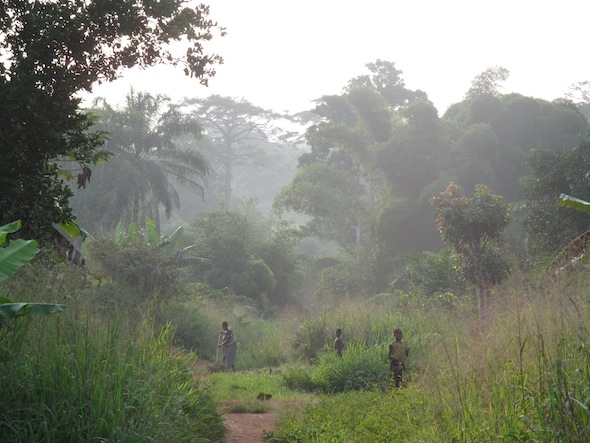
The outskirts of Bili at sunset.

Along the Bushmeat Highway: Part 1
Along the Bushmeat Highway: Part 2

Also by Dr. Cleve Hicks, The FARDC ‘Petting Zoo’ at Bili

This mission was made possible by the generous support of the Max Planck institute for Evolutionary Anthropology, The Lukuru Wildlife Research Foundation, The US Fish and Wildlife Service, l’ Institut Congolais pour la Conservation de la Nature, The Lucie Burgers Foundation, and The African Wildife Foundation.

Filed Under: Advocacy, Free-living chimps Tagged With: advocacy, animal protection, animal rescue, animal rights, Animal Welfare, bushmeat, bushmeat orphans, chimpanzee, Chimpanzee Sanctuary Northwest, dr. cleve hicks, eyes on apes, free-living chimps, primate protection

Along the Bushmeat Highway: Part 2

May 25, 2013 by Debbie

This is the second installment of a series of posts from Dr. Cleve Hicks. Cleve did his PhD research in the DRC studying chimps in the Bili Forest. Read Part 1 of this story about some of his experiences here. WARNING: some disturbing images are included in this entry.

—

I was encouraged to see that a strong ICCN contingent of 20 Ecoguards was now installed inside Rubi-Tele, actively arresting poachers and confiscating bushmeat. Another twenty guards were scheduled to join them soon. This team patrols the forests of the reserve during the first three weeks of every month, and then on the last week they pass through the roadside villages down the highway bisecting the game reserve. Together with the road block erected at Sukisa, we can hope that these patrols will make a difference for the embattled wildlife of these forests. On this trip I counted the carcasses of 15 monkeys on the road between Kisangani and the southern border of Rubi-Tele. Of the four un-smoked carcasses we could identify to species, three were red tailed guenons and one was a red colobus; we also saw two hornbills, an African civet, a turacao, and a duiker for sale. Encouragingly, inside the Rubi-Tele reserve, we saw no primate carcasses, save for one cast-aside monkey tooth next to a village hearth 12 km south of Buta Town. We also saw the fresh carcass of a duiker pass us on a bike.

If enough chimpanzees in the far corners of the reserve have managed to survive the poaching onslaught of the last decade, Rubi-Tele might provide us with a convenient research base, being close to village markets and protected by guards. I also hope that it might serve as an ICCN spearhead into the more remote reaches of northern DRC, in particular, into the much larger and less-disturbed Bili-Uéré Domaine de Chasse. Our team of six guards, I hope, will be the vanguard of that movement.

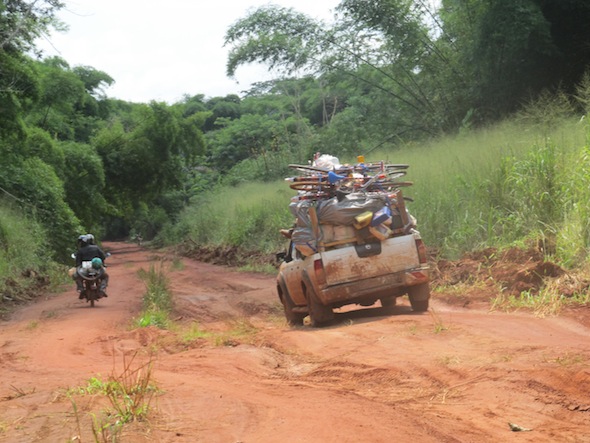
The next day, our goal was to reach Buta Town by nightfall. From our caravan of motorbikes, we held our breath as we watched the Nissan catapult across the 35 km warren of mud pits separating Sukisa from Buta. It seemed a miracle that Karsten’s delicate camera traps survived the truck’s repeated lurching out of one rut and down into the next.

Our entry into Buta Town was heralded by a conflict between our ICCN guards and the local military police, who were stationed at the Rubi River Bridge. In order to avoid confusion, Henri had planned that our phalanx of vehicles would cross the city bridge together, but as the Nissan forged ahead onto the bridge, at the last minute one of our of motorbikes stalled. Pichou the wily mechanic leaped off our bike and in a flash fixed the problem. The motorbike’s engine revved, and we sped across the bridge in the wake of the truck, but it was too late. The military police (MPs), confronted with a truck-full of armed Ecoguards, were irate that they had not been informed of our mission by a ‘responsable’. As usual, it didn’t matter at all that we had sent an advance message to the Buta authorities. We pulled up to the check-point, into what was rapidly developing into a tense stand-off. Our hired driver was yelling at the MPs, and the MPs and the Ecoguards were shouting and posturing angrily at each one another. Henri ably stepped to the side of the road with the head of the border police and explained the purpose of our mission and the reason we had not all arrived all at one time, while I hung back to diffuse a heated argument between an Ecoguard and an MP. Thanks to Henri’s diplomatic skills, we made it through the checkpoint with little more than a case of frayed nerves.

The rest of our stay in Buta went pretty smoothly, all things considered. The next day, Karsten, Henri, Ephrem, and I made the rounds to visit the important regional authorities: CDD, DGM, ATAR, and ANR. The reception we received was remarkably warm and polite compared to my visit in 2008, a testimony to the professionalism of the TL2 Lukuru Team and the respect with which the ICCN is accorded within the Congo. One thing that struck me as ominous, however, was the large herd of long-horned cattle and asses grazing the lawns of the governmental center; this livestock had undoubtedly been purchased from Mbororo traders. The nomadic Mbororo herders, originally from Mali, are currently migrating in a north-south wave across Northern DRC, with devastating effects on the local fauna. Native ungulates are replaced by cattle, savannahs are burned at the wrong time of year, and lions and other big cats are poisoned to keep them from preying on the domesticated herds. The Mbororo also frequently enter into aggressive conflicts with the local Congolese they meet. Clearly though, by selling cattle to Congolese merchants and authorities they are also now financially entrenched into the economy of Northern DRC.

The following day, Henri accompanied our ICCN guards to meet with the head of the Buta police as well as the regional commandant of the FARDC, the Congolese military, to arrange for our guards’ permission to work at Bili. This also went quite well… but as a reminder of how far we have to go in spreading our conservation ideals into this area, the commandant proudly introduced Henri and Ephrem to his pet orphan chimpanzee ‘Jaques de Bondo’, which he had acquired from the Bondo region to the north of the Uele River. Ephrem snapped the following photograph of the pitiable orphan:

OprhanJaques De Bondo

Jaques de Bondo, a chimpanzee orphan kept by a high-ranking military official in Buta. Photo © Ephrem Mpaka.

(Recall from Hicks et al. 2010 that 25% of the chimpanzee orphans in this region belonged to military, police, or government officials / traditional authorities).

During our five days at Buta we saw a captive baboon, a patas monkey (from the Ango savannas to the northeast), and a guereza colobus monkey, as well as a key chain made from a forest buffalo tail. Little had changed in the four years since I was last here.

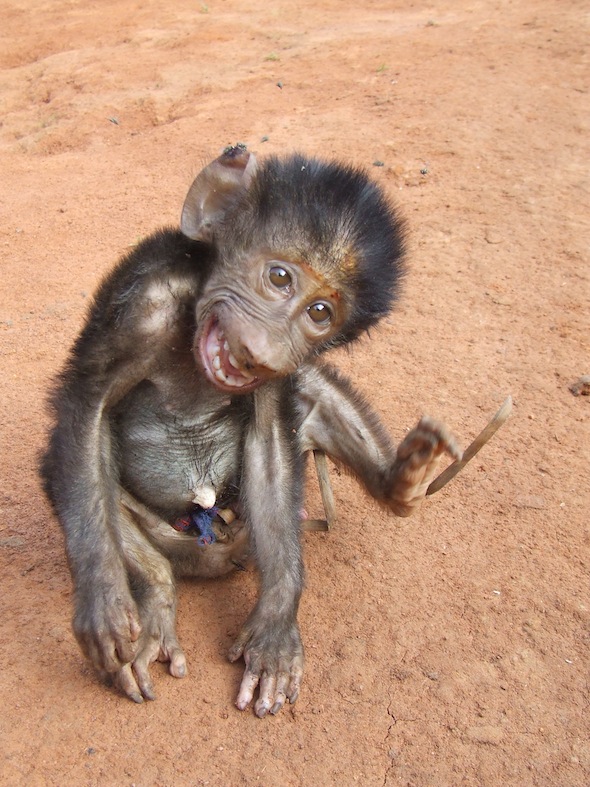
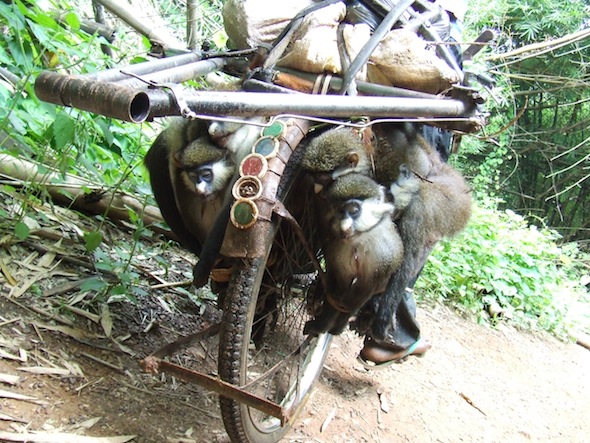
The next leg of our voyage, between Buta and the bucolic old colonial town of Titule, was impassable by truck; we returned our rented Nissan to Kisangani and loaded all of our supplies onto bicycles and motorbikes. Along the 130 kilometers of untamed boggy road between Buta and Titule, I counted the carcasses of 12 red-tailed guenons and one Dent’s monkey passing us on bicycles or offered for sale by the roadside, along with one duiker. In one tiny village we spotted two forlorn primate orphans which had been captured from the surrounding forests, an agile mangabey and a baboon. The baboon darted around nervously as we arrived to investigate, and was sniffed at and nuzzled by a number of village dogs. We struggled to communicate to the village patriarch why it was dangerous, unethical, and even foolhardy to keep primates as pets. This section of road remained a veritable bushmeat highway.

BaboonOrphan

MonkeysBike

Primate orphan and bushmeat encountered along the Buta-Titule Road.


TO BE CONTINUED…

Along the Bushmeat Highway: Part 1
Along the Bushmeat Highway: Part 3

Also by Dr. Cleve Hicks, The FARDC ‘Petting Zoo’ at Bili

This mission was made possible by the generous support of the Max Planck institute for Evolutionary Anthropology, The Lukuru Wildlife Research Foundation, The US Fish and Wildlife Service, l’ Institut Congolais pour la Conservation de la Nature, The Lucie Burgers Foundation, and The African Wildife Foundation.

Works cited:

Hicks TC, Darby L, Hart J, Swinkels J, January N, Menken SBJ. 2010. Trade in orphans and bushmeat threatens one of The Democratic Republic of the Congo’s most important populations of Eastern Chimpanzees (Pan troglodytes schweinfurthii). African Primates 7 (1): 1-18.

Filed Under: Advocacy, Free-living chimps Tagged With: advocacy, animal protection, animal rescue, animal rights, Animal Welfare, bushmeat, bushmeat orphans, chimpanzee, Chimpanzee Sanctuary Northwest, dr. cleve hicks, eyes on apes, free-living chimps

Along the Bushmeat Highway: Part 1

May 24, 2013 by Debbie

Dr. Cleve Hicks has written a very moving story about his encounters with the bushmeat trade and bushmeat orphans in central Africa as part of our guest blogging project. Dr. Hicks earned his master’s degree working with the chimps just down the road from us at the Chimpanzee & Human Communication Institute, and continues to study chimps in free-living Africa. He has worked for several years in the northern DRC studying chimps in the Bili Forest. This story is going to be split into three segments, so check back over the next few days for the continued pieces. WARNING: some disturbing images included in this entry (the most graphic ones are included as links in their caption).

—

LUKURU MISSION TO BILI, JULY 2012

As our caravan rumbled along the recently-repaired dirt road leading from Kisangani to Buta, I felt a sense of relief. We had temporarily left behind us the flurry of stamps, signatures, and copies in triplicate necessary to get us back to the forest of Bili, and I felt the same sense of expectation I had when I first arrived in DR Congo back in 2004. Every kilometer we put behind us was getting us closer to the chimpanzees of Gangu Forest. Our caravan consisted of four motorbikes and a Nissan rented from the Institut Congolais pour la Conservation de la Nature (ICCN), which was brimming over with bicycles, trunks, researchers, and Ecoguards.

TeamBili2July2012

Team Bili, 2 July 2012, preparing for our departure from Kisangani (together with TL2 researcher Dino Schwa; photo by team member Gilbert Paluku).

Our truck had briefly broken down back in Banalia, putting us several hours behind schedule, and it was now clear that we would not reach our destination, the frontier town of Buta, by nightfall. Project Pro-Routes had done an excellent job repairing the road since I last suffered to travel over it back in 2008, but we had been told that the final 35 km before Buta remained a morass of muddy pits, lurching divets, and lop-sided gulleys, which we could not risk getting stuck in at night. Fortunately at around sundown we found ourselves pulling up at the road block set up by ICCN guards at Sukisa, the guard station established to check vehicles for bushmeat as they passed through the Rubi-Tele game reserve. As Lukuru team leader Henri Silegowa and I watched our six ICCN guards greet their Rubi-Tele compadres, Henri said, “Nous sommes chez nous.” (“We are at our house.”) The Rubi-Tele guards were sharply outfitted in new uniforms, carried arms, and projected a highly motivated and professional demeanor. The station had come a long way since Terese Hart visited it in 2007 on her faunal survey of the forest (Hart 2007). After having spent so many years working to raise awareness about the neglected wildlife of northern DRC, it was exciting to see that the region was no longer being ignored.

Caravan

We stretched our cramped limbs, wiped the red road mud off our faces, and happily accepted the chairs offered us by Monsieur Jean Robert Lobela, the station’s Chef des Gardes. He apologized that the chief conservateur was away in Kisangani, but then enthusiastically asked us if we would like to see some of the items they had confiscated here recently. He led us across the road to a mud building, from out of which his men pulled two tattered but still gorgeously-striped okapi skins confiscated within the last year from poachers’ camps inside the game reserve.  We could see from the tag attached the ear of the first horned skin, which belonged to a male, that it was taken in 2011. The female skin beside it was only three months old. With the distressing news from the previous week of the slaughter of park guards and okapis at Epulu still fresh in our minds, it was disturbing to see the killing taking place here as well, but at the same time heartening to see that someone was taking the problem seriously.

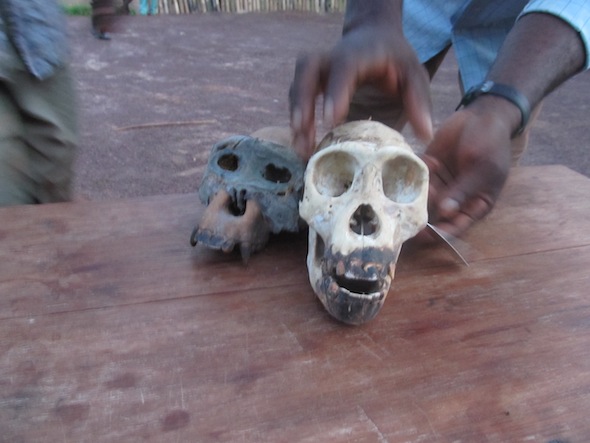
Next, Monsieur Lobela brought us two scarred, blackened skulls of chimpanzees, each tagged and inscribed with the date and location of confiscation. One, tagged from 2012, had belonged to a small male with large pointy canines, and came from a poachers’ camp about a day’s walk to the north. I then inspected the tag on the larger skull, that of an adult female. Her incisors had been charred black from being slowly smoked over a campfire, and a dingy ring of soot circled her mouth.

ChimpSkullsSukisa

Chimpanzee skulls recently confiscated from hunting camps within Rubi-Tele.

I was startled to see a familiar name on her tag: Ephrem Mpaka, 4 September 2011. Our very own Ephrem, TL2 researcher and now part of our Bili team, who was part of the group gathered around this macabre collection of carcasses. Later, in his typical animated style, Ephrem recounted the story to us:

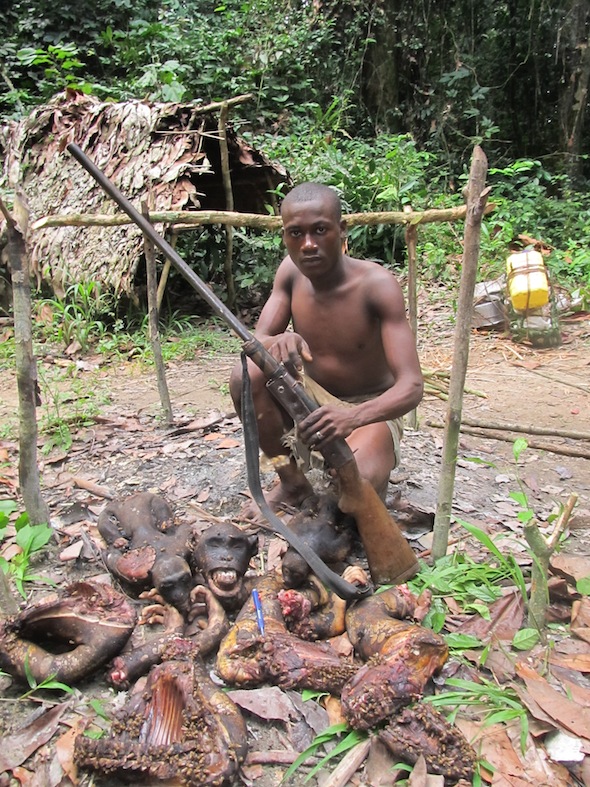
In September 2011, Ephrem was on a mission for Lukuru Foundation to collect okapi dung samples inside Rubi-Tele, but he was also interested in other protected species. One evening he was on a patrol with ICCN guards about seven km west into the forest. They had already spotted a number of fresh chimpanzee nests in this region, and heard their pant hoots and drums. As he and the guards walked down a hunters’ trail, they heard resonating through the still forest the whacks of a machete against a tree. Someone was gathering firewood. Following the trail to the sounds, they arrived at a small hunting camp, for the moment occupied by only one woman. Spread across a smokestack above a smoldering fire was the blackened carcass of a female chimpanzee along with two monkeys. Acting quickly before the woodchoppers returned, the guards grabbed the 12-gauge shotgun they found by the hunting shack, apprehended the woman, and then fanned out into the forest to arrest the two male residents of the camp. The poachers, Basoko people from a village located within the reserve, offered no resistance. When asked why they had decided to hunt inside the reserve, they explained that there was a mourning ceremony taking place at their village, and they had been sent out into the forest to bring back meat. Ephrem documented the scene with the following disturbing photographs which he kindly shared with me. He later returned with the chimpanzee skull to Sukisa base and tagged it.

In September 2011, Ephrem Mpaka of Lukuru Wildlife Research Foundation took this photograph of the confiscation by ICCN guards of a smoked chimpanzee (along with an Angolan colobus and a red tailed guenon) at a poachers’ camp inside Rubi-Tele DC. In addition, during the month he was there, Ephrem documented 11 okapi skins that had been taken from the reserve in addition to the ones we had just been shown.

OkapiChurchDrum

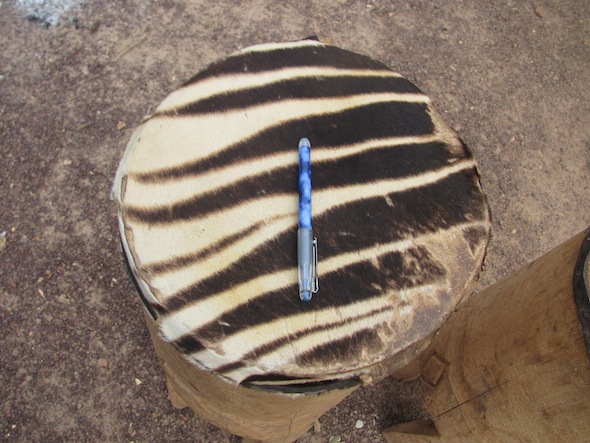
Is this the best use we can think of for the beautiful okapi? An okapi skin church drum in the Rubi-Tele region in 2011.  Perhaps religious leaders could be convinced to speak out against this custom. Photo © Ephrem Mpaka.

It was clear that the large-scale killing of chimpanzees and other primates which I had documented in the area between 2007 and 2008 (Hicks et al. 2010) had continued unabated in the intervening years. But one question remained unanswered: had it spread to the forests of Bili in the north?

TO BE CONTINUED…

Along the Bushmeat Highway: Part 2
Along the Bushmeat Highway: Part 3

Also by Dr. Cleve Hicks, The FARDC ‘Petting Zoo’ at Bili

This mission was made possible by the generous support of the Max Planck institute for Evolutionary Anthropology, The Lukuru Wildlife Research Foundation, The US Fish and Wildlife Service, l’ Institut Congolais pour la Conservation de la Nature, The Lucie Burgers Foundation, and The African Wildife Foundation.

Works cited:

Hart T. 2007. Evaluation de l’Etat de Conservation Domaine de Chasse de Rubi-Télé : Inventaires fauniques, contexte historique et recommandations pour assurer la conservation du site en rapport avec la réhabilitation de la Route National 4. Un rapport soumis à l’ AGRECO dans le cadre de la mise en oeuvre de l’Etude d’Impact Environnemental et Social dans la Zone du Projet PROROUTES.

Hicks TC, Darby L, Hart J, Swinkels J, January N, Menken SBJ. 2010. Trade in orphans and bushmeat threatens one of The Democratic Republic of the Congo’s most important populations of Eastern Chimpanzees (Pan troglodytes schweinfurthii). African Primates 7 (1): 1-18.

Filed Under: Advocacy, Free-living chimps Tagged With: advocacy, animal protection, animal rescue, animal rights, Animal Welfare, bushmeat, bushmeat orphans, chimpanzee, Chimpanzee Sanctuary Northwest, dr. cleve hicks, eyes on apes, free-living chimps, primate rescue

  • « Go to Previous Page
  • Page 1
  • Page 2
  • Page 3
  • Page 4
  • Go to Next Page »

Primary Sidebar

Subscribe To the Blog and Get Notified of New Posts First!

Archives

Calendar of Blog Posts

June 2026
S M T W T F S
 123456
78910111213
14151617181920
21222324252627
282930  
« May    

Categories

SUBSCRIBE TO OUR NEWSLETTER

Footer

PO Box 952
Cle Elum, WA 98922
[email protected]
509-699-0728
501c3 registered charity
EIN: 68-0552915

Official DDAF Grantee

Menu

  • The Chimpanzees
  • Blog
  • About Us
  • You can help
  • Resources
  • Contact
  • Donate

Proud Member of

Connect With Us

Search

Copyright © 2026 Chimpanzee Sanctuary Northwest. All Rights Reserved. Site by Vegan Web Design