• Skip to main content
  • Skip to primary sidebar
  • Skip to footer

Chimpanzee Sanctuary Northwest

Hope. Love. Home. Sanctuary

  • Our Family
    • The Chimpanzees
    • The Cattle
  • Blog
  • About Us
    • Visiting the Sanctuary
    • Philosophy
      • FAQs
      • Mission, Vision & Goals
      • Privacy Policy
    • The Humans
      • Staff
      • Board of Directors
      • Founder
    • Annual Reports
    • The Future of CSNW
    • CSNW In The News
  • You can help
    • Donate
      • Become a Chimpanzee Pal
      • Sponsor A Day
      • Transfer Stock
      • Be A Produce Patron
      • Be a Bovine Buddy
      • Give from your IRA
      • Personalized Stones
      • Bring Them Home Campaign
    • Leave A Legacy
    • Employment Opportunities
    • Volunteer
    • See Our Wish List
    • Events
  • Resources
    • About Chimpanzees
    • Enrichment Database
    • Advocacy
      • Advocacy Action Center
      • Apes in Entertainment
        • Trainers
        • Role of the AHA
        • Greeting Cards
      • Chimpanzees as Pets
      • Roadside Zoos
      • Chimpanzees in Biomedical Research
      • Conservation
        • African Apes
        • Orangutans
  • Shop
    • Merchandise Store
  • Contact
  • DONATE NOW

chimpanzee sanctuary

Engaging the mind, body, and spirit

August 18, 2013 by Lisa

One of the most challenging and rewarding responsibilities of care-giving for chimpanzees in captivity is, I think, coming up with activities and enrichment ideas that are engaging and satisfactory for the chimpanzee mind. Keeping them busy is a full-time job (just ask enrichment coordinator and caregiver, Debbie). Luckily we don’t have to come up with ideas in the dark. Each chimpanzee has individual inclinations about how to spend their days in sanctuary and, as I come to know them better, I can accommodate those preferences more easily.

As you may be aware by now, Jamie does like to create art. But Jamie’s not just an artist. Her mind is so active that she comes up with a myriad of ways to entertain herself. In particular, Jamie is often actively engaged in her environment. She will take the time to inspect any and every new or unusual thing in and around her home. If there is something different at the sanctuary, Jamie will know and make sure it’s been thoroughly investigated and properly dealt with (if necessary). There is a lot of work that goes into being the boss! Good thing she gets the time to relax and create art in between all her other responsibilities.

If you’d like a quick and easy way to help enrich the chimpanzees make sure you’ve voted for Jamie’s artwork in the chimpanzee-only art contest sponsored by the Humane Society of the United States.

web_jamie draw art write pen paper pr IMG_1979

In the meantime, check Jamie out as she checks out the world around her.

Jamie & Missy spying on the neighbors (as previously seen on our Facebook page):
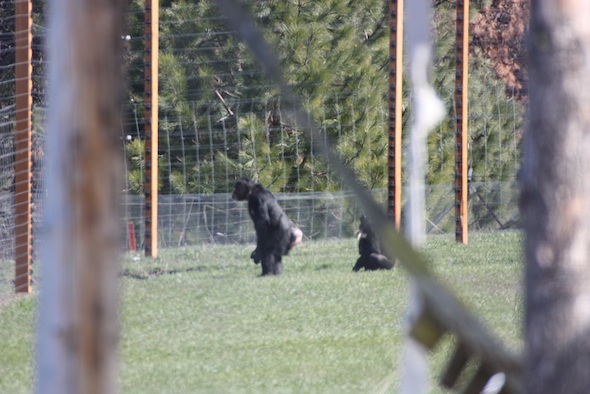
web_missy jamie bipedal spy on neighbors top of yh IMG_1245

Jamie inspects the camera mount on Young’s Hill:
web_Jamie green grass camera mount Young's Hill YH IMG_8013

Jamie inspects the donors’ sign on Negra’s cabin:
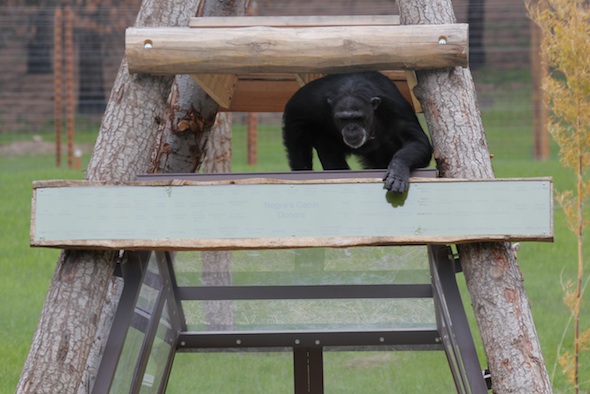
web_Jamie look at cabin donors sign Negras cabin YH IMG_6773

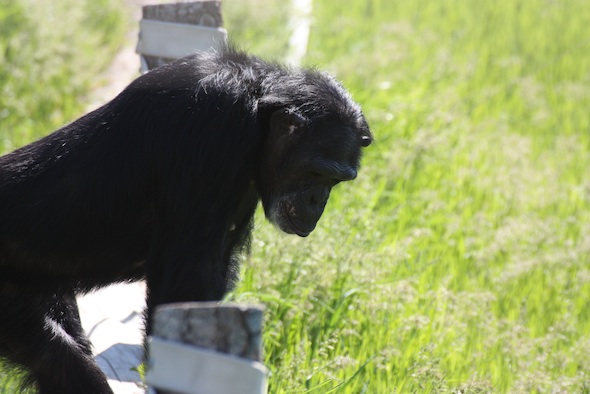
Jamie checks the grass on Young’s Hill:
web_Jamie stand log bridge look at grass Young's Hill YH IMG_1847

Filed Under: Art, Caregivers, Fundraising, Jamie, Sanctuary Tagged With: Animal Welfare, chimpanzee rescue, chimpanzee retirement, chimpanzee sanctuary, Chimpanzee Sanctuary Northwest, Cle Elum 7, csnw, Jamie

Meet the Chimpanzees of Kanyawara

August 15, 2013 by Debbie

Most of our advocacy work focuses on issues close to home, like the entertainment industry, apes as pets, and biomedical research. As caregivers for the Cle Elum Seven, our expertise at CSNW lies in the plight of captive chimpanzees. We see the Cle Elum Seven as ambassadors for other chimpanzees that still are used in research or entertainment and deserve better.

We also see them as ambassadors for wild chimpanzees. They never got to experience the love from their mother, learning how to forage and use tools, and living in a large group of other wild chimpanzees. Though sadly, chimpanzees in the wild have problems of their own. Some are being hunted for their meat to be sold on the black market, some are losing their homes to human encroachment, and some are fighting for their lives after being caught—but not killed, by a snare trap.

Our guest blogger project aims at raising more awareness about these issues from the perspective of those that work in that environment, analogous to the CSNW staff’s expertise with chimpanzees in captivity. Dr. Zarin Machanda works in the Kibale National Park in Uganda, and we are thrilled to have her stories of her experience working with chimpanzees in the wild, just as we tell stories about the Cle Elum Seven. Here’s her introduction to the chimpanzees of Kanyawara.

—

Hi everyone! My name is Zarin Machanda and I’m going to do a few guest blog posts over here this summer. I know JB and Diana from when I volunteered at the Fauna Foundation. I have a very distinct memory of JB with a torn up t-shirt after an encounter with a grumpy ostrich! I’m still not sure what happened, but I think the ostrich won.

I left Montreal for Harvard where I have been studying wild chimpanzees in Uganda for the last 10 years. I’ll describe my research in another post but my main interest is understanding how and why social relationships develop. Today, I want to tell you about our field site and introduce you to some of our amazing chimpanzees. Many of the photos here were taken by Ronan Donavan, a friend and photographer who worked in Uganda for many months.

map

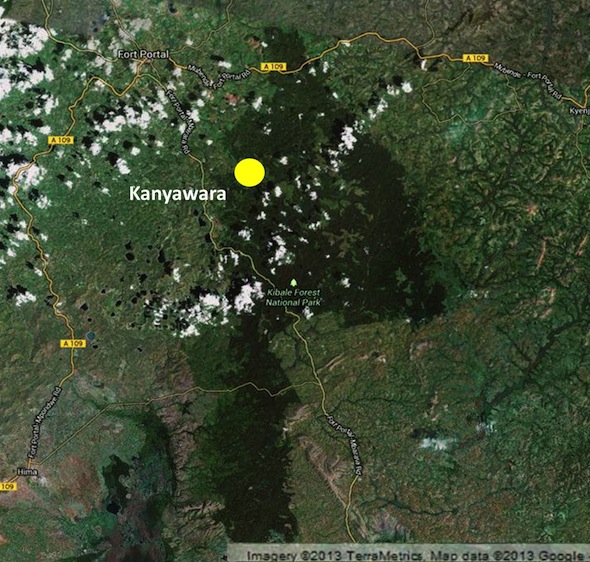
Satellite image of Kibale National Park with the Kanyawara chimpanzee community range in the northwest sector. Image courtesy of Google Maps.

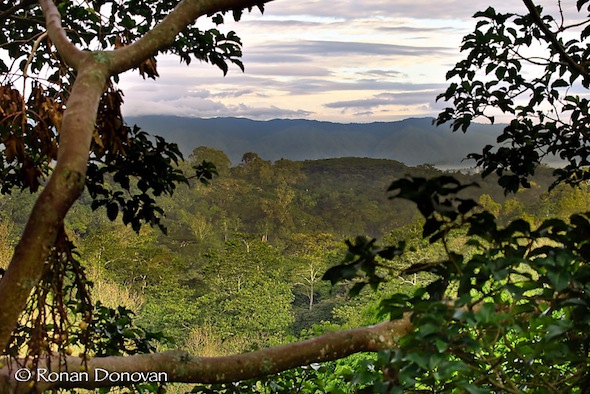
I work for the Kibale Chimpanzee Project, a long-term research project studying the Kanyawara community of chimpanzees. They live in Kibale National Park in Uganda, a beautiful equatorial rainforest that is home to over 250 species of trees, over 325 species of birds and over 60 species of mammals, including 13 species of primates. This is one of the densest and most diverse populations of primates anywhere in the world and includes approximately 1500 wild chimpanzees (Pan troglodytes schweinfurthii).

kanyawara

The canopy of Kibale National Park with the Rwenzori Mountains in the background. Photo courtesy of Ronan Donavan.

Every day, our field assistants and researchers enter the forest to follow the chimps and collect data on their behavior. We don’t have any physical contact with them—we just observe them, take notes about what they do, and collect samples of their urine and feces for later analysis. How do you collect urine from a chimp? Well you’ll have to come back later to find out!

All of our chimpanzees are given names and we can recognize them just as easily as we can tell each other apart. Every chimp research site has a different philosophy for naming chimps—some pick philosophers, others like jazz musicians but we like to name our individuals after important world figures and world events. For example, in the year 2000, we named a chimp Tuke (pronounced Two-kay)—get it?

canopy

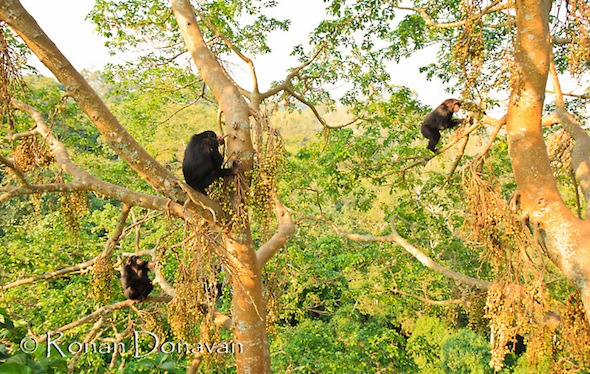
The Kanyawara chimpanzees feeding on figs. Photo courtesy of Ronan Donavan.

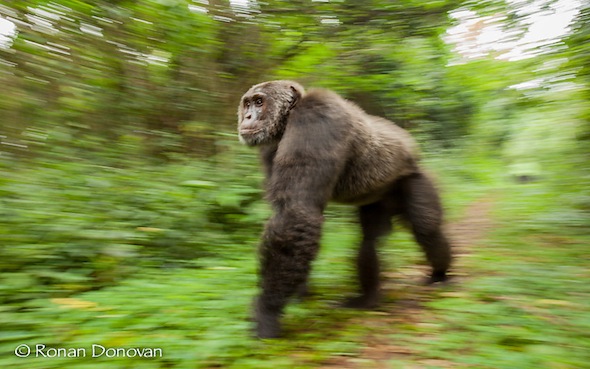
I wish I could tell you about all 53 of our chimps because each one is special in their own way, but I’ve chosen just a few for you to meet: Lanjo, Outamba, Max, Tsunami, and Tembo.

Lanjo was born in 1995. He is quite large for his age and he’s recognizable because his hair is light brown compared to the more typical black hair of the other chimps. He is not only handsome, but he is also loved by all the researchers and field assistants. Our alpha male, Kakama, recently passed away and we have been taking bets on who is going to take over. My money is on Lanjo although some other folks favor Eslom. Interestingly, these two couldn’t be more different—while Eslom is likely to display, chase everyone and generally cause chaos wherever he goes, Lanjo is as cool as a cucumber and just watches it all happen. That’s the kind of alpha that I would want and I have a feeling most of chimps would prefer cool over crazy! It’s going to be an interesting couple of months in our community since we know that changes in the hierarchy really shake up relationships among the males. Individuals jockey for position and need to figure out which of their friends will be most useful to them as they vie for dominance. Fingers and toes crossed for Lanjo, although Kakama will be greatly missed.

lanjo

Lanjo showing off his muscles for the camera. Photo courtesy of Ronan Donavan.

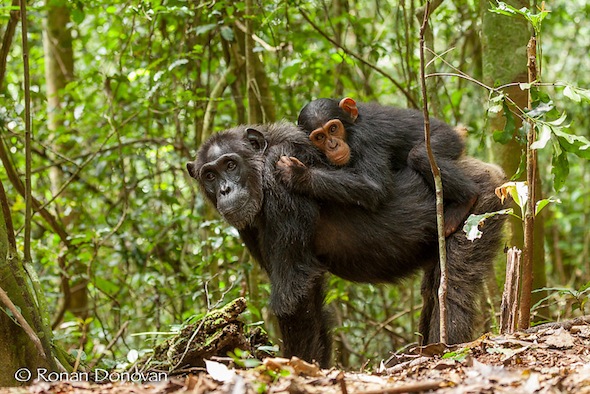
Outamba is a high ranking female and is recognizable because of her narrow mouth and prominent brow. We think she is about 34 although it’s hard to know her exact age because females transfer into new communities during adolescence and we make educated guesses about their age. Outamba is Kanyawara’s baby-making machine! She has had 5 infants in 15 years—that’s one baby every 3 years compared to the average female who generally has one baby every 5-6 years. It’s even more impressive that all of Outamba’s babies have survived, so she’s not just making babies quickly but she’s doing a great job of taking care of them too. We think she is such a successful mother because as a high-ranking female, she has access to the areas of the highest quality food. For mammals, more food means more babies and higher infant survival rates—so Outamba must be eating well.

outamba

Outamba carrying her youngest daughter Gola on her back. Photo courtesy of Ronan Donavan.

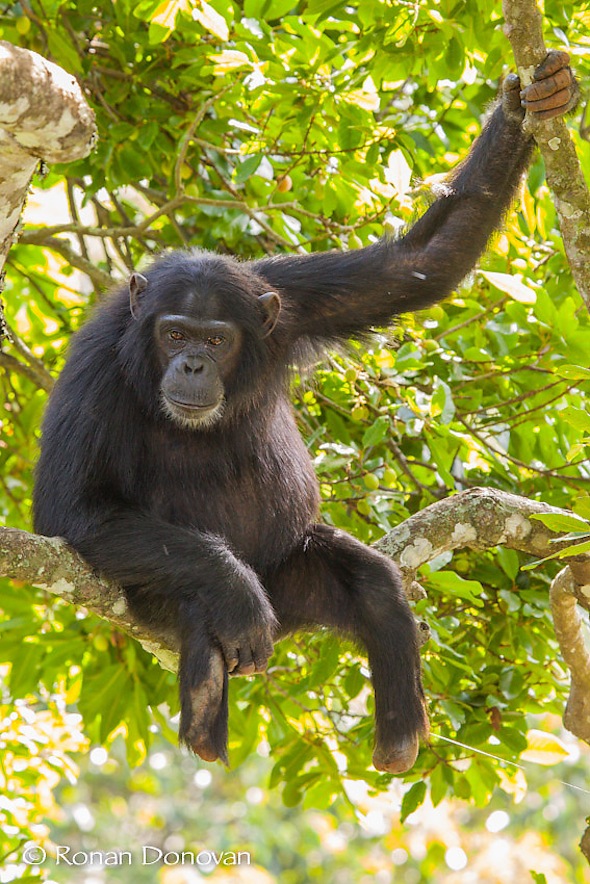
Max is one of our shy individuals and we don’t see him very often because he prefers to stay near his mother in a remote part of the Kanyawara range. This is unusual for an adolescent male because as he grows up he should spend more time with the adult trying to integrate into the male dominance hierarchy. Max’s odd behavior most likely stems from the fact that he lost both of his feet to wire snares set by poachers when he was younger. I’ll write more about these snares and our conservation efforts in another post, but they affect our young chimps more often than adults because these guys barrel through the forest without looking where they are going. Another reminder that baby chimpanzees and baby humans are very similar. Despite these injuries, Max is a trooper! He can still climb trees like a champ and has survived for a number of years without his feet.

max

Max sitting in a tree. He lost both his feet to wire snares. Photo courtesy of Ronan Donavan.

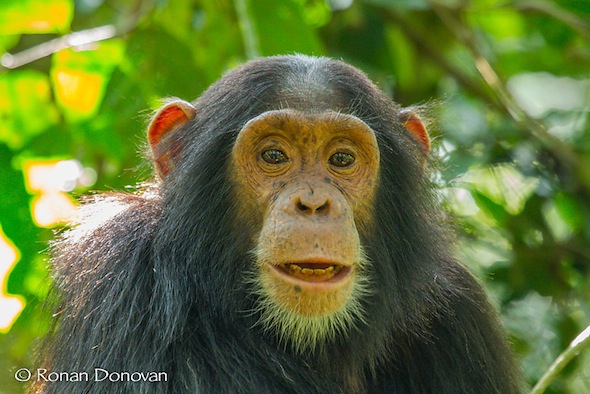
Tsunami was born in January of 2005. Her mother is Tongo and she is Lanjo’s younger sister. Right now, her face is still pink with a few dark freckles but this will change as she gets older and her face darkens. Like our other young chimps, Tsunami likes playing with objects such as rocks and sticks and she will even carry these things around for days. She is often seen playing with and trying to carry her siblings. In 2011, tragedy struck when Tsunami’s baby sister, Teddy, died after accidentally falling out of a tree. Tongo couldn’t carry the body and had to leave it on the ground but Tsunami stayed with Teddy and even tried carrying her—it was heartbreaking. I think Tsunami is going to make a great mom when she grows up—she certainly has a good role model in Tongo and she is one amazing big sister.

tsunami

Tsunami, one of our juvenile females. Photo courtesy of Ronan Donavan.

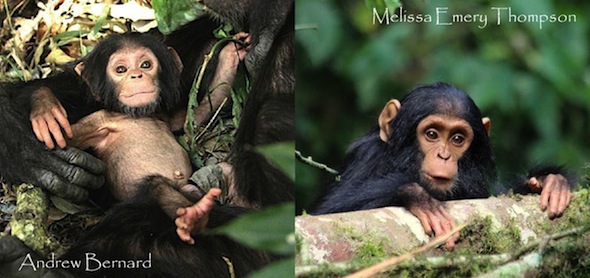
At 1.5 years, Tembo is one of our youngest chimpanzees. We gave him the Swahili word for elephant as a name, because he was born the same day that elephants came to camp and knocked over a tree. Tembo is a special guy because he is not only the son of Tenkere but also the grandson of Outamba. Since female chimpanzees are supposed to transfer to new communities at adolescence, it’s unusual to have maternal grandmothers in a group. We’re not sure why Tenkere decided to stay but it is likely that it’s because she also has access to high quality food like her mom, which she may not have as a new immigrant to another community. Not leaving may end up being a poor choice because Tenkere is genetically related to many of the males in the group. We’ll have to keep an eye on Tembo and get DNA samples from him to do a paternity test. But, so far he seems healthy and playful and he has quite a family looking out for him. I’m hoping he lives up to his name—big and strong and able to knock over trees.

tembo

(Left) Newborn Tembo lying with his mother Tenkere. Even as a newborn he had sideburns just like his mother. (Right) Tembo at 1.5 years of age. Photos courtesy of Andrew Bernard and Melissa Emery Thompson, respectively.

Well that’s all for now. Next time, I’ll describe a little bit more about my research and some of the other projects that we are working on. In the meantime, please check out our website for more news from the field.

Filed Under: Advocacy, Free-living chimps Tagged With: advocacy, animal protection, animal rescue, animal rights, Animal Welfare, chimpanzee, chimpanzee rescue, chimpanzee retirement, chimpanzee sanctuary, Chimpanzee Sanctuary Northwest, free-living chimps, kanyawara, kibale chimpanzee project, kibale national park, wild chimpanzees, wild chimps, zarin machanda

Happy Birthday, Lindsay!

August 11, 2013 by Katelyn

Today was sponsored in honor of Lindsay Zager by her parents who shared the following sentiments:

“This is in honor of our beautiful daughter, Lindsay’s, birthday! Lindsay’s passion for chimpanzees has motivated and inspired many to learn and know and LOVE the world of these amazing primates. We thank you and love you sweet girl! HAPPY BIRTHDAY!”

Thank you so much to the Zager family for caring about the chimpanzees and including them in your special day. Have a wonderful day, Lindsay!

web foxie mid-yawn YH IMG_9337


Filed Under: Foxie, Party, Sanctuary, Sponsor-a-day, Young's Hill Tagged With: Animal Welfare, chimp sanctuary, chimpanzee, chimpanzee rescue, chimpanzee sanctuary, Chimpanzee Sanctuary Northwest, Cle Elum 7, Cle Elum Seven, csnw, Foxie, primate protection, primate rescue, Sanctuary, Sponsor-a-day

Zen Negra

August 6, 2013 by Debbie

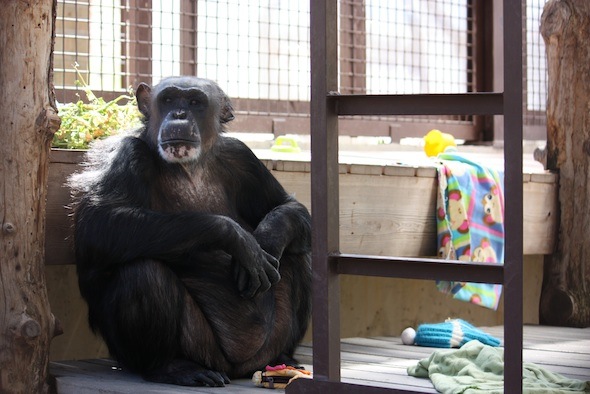
Some of you may have seen this photo posted on our Facebook page yesterday, but if you missed it—here it is. Sure to make anyone smile!

web_Negra_sit_on_platform_buddha_belly_GH_kd_IMG_3323

Filed Under: Negra, Sanctuary Tagged With: animal protection, animal rights, Animal Welfare, chimp sanctuary, chimpanzee, chimpanzee rescue, chimpanzee sanctuary, Chimpanzee Sanctuary Northwest, Cle Elum 7, Cle Elum Seven, csnw, Negra, primate protection, primate rescue, Sanctuary

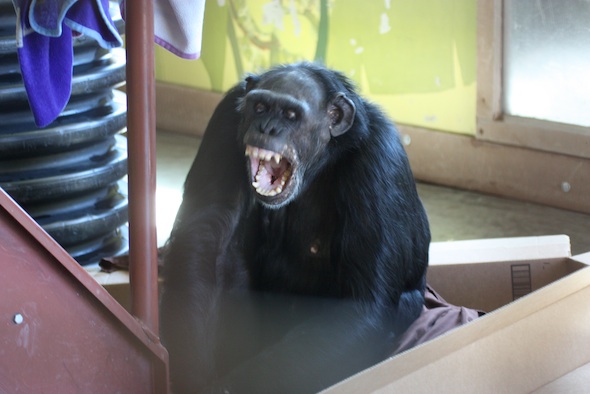
Chimpanzee teeth

July 30, 2013 by Debbie

Apes (humans included) all have the same dentition pattern, which is a fancy way of saying we have the same number of teeth, and in the same order, across the board. We also have baby teeth, or “milk teeth,” that we loose when the adult teeth come in.

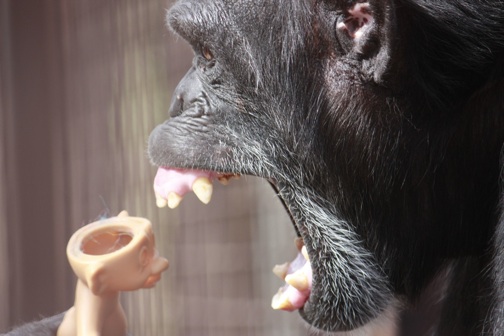
One difference between our dentition is that though non-human apes have canines in the same place as humans, their canines are much larger than ours. What we know about diet probably doesn’t explain why they would have almost carnivore-sized canines. All apes eat mostly fruit, leaves, and other plant items as well as the occasional small mammal meat in the case of chimps. Still, even that small amount of meat wouldn’t be the reason for why non-human apes have such large canines.

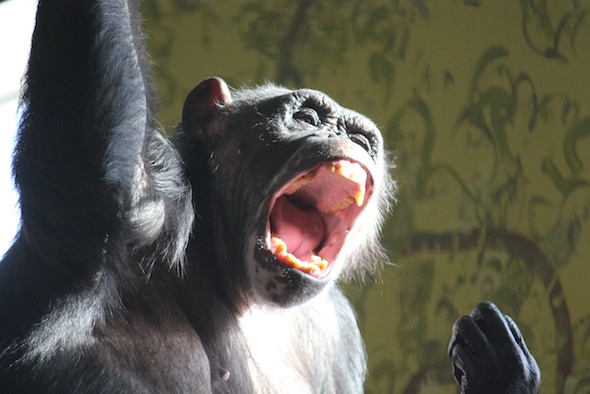
What other purpose can teeth serve if not to chew up food? Threat. Certainly large canines are quite intimidating, and can serve as a warning to enemies to stay back, or else you could get bit and boy—it’ll hurt!

In these photos you’ll see the large canines I’m referring to—the chimps are only yawning, but you can see just how intimidating their teeth can be. Just another reason why chimpanzees do not make good pets!

Foxie:

web Foxie teeth troll_MG_8035

Negra:

web Negra yawn teeth PR IMG_2266

Burrito:

web_burrito_mid_yawn_lay_Jody_pr_dm_IMG_3267

Jamie:

web_Jamie_mid_yawn_pr_nest_dm_IMG_3254

Filed Under: Burrito, Chimpanzee Behavior, Foxie, Jamie, Negra, Sanctuary Tagged With: animal protection, animal rescue, animal rights, Animal Welfare, Burrito, chimp, chimpanzee, chimpanzee rescue, chimpanzee retirement, chimpanzee sanctuary, Chimpanzee Sanctuary Northwest, Cle Elum 7, Cle Elum Seven, csnw, Foxie, Jamie, Negra, primate protection, primate rescue, Sanctuary

Jacky

July 23, 2013 by Debbie

As part of our guest blogger series, here is a post by Dr. Sheri Speede. Sheri founded In Defense of Animals-Africa (IDA-Africa), after working as Northwest Director of In Defense of Animals. While working for IDA, she helped advocate for companion, farm, and research animals in the US. After a couple of trips to Cameroon, her focus shifted to providing sanctuary for chimpanzees in Africa who had been part of the illegal pet trade or were bushmeat orphans. In addition to founding IDA-Africa, she also opened Sanaga-Yong Chimpanzee Rescue Center in Cameroon. You might recall that J.B. posted a blog a couple of weeks ago about life and death. He mentioned a very moving story of how the Sanaga-Yong chimpanzees grieved after the passing of one of the residents, Dorothy.

CSNW has had a long-time connection with Sheri and IDA-Africa, and we will always be grateful for her advice on the electric fencing during the development of Young’s Hill!

Here, Dr. Speede tells the story of Jacky.

—

All but one of our 73 chimpanzee residents at Sanaga-Yong Chimpanzee Rescue Center in Cameroon’s Mbargue Forest were born to free-living mothers. Each was orphaned as a nursing infant when a poacher killed his/her mother to supply the illegal bushmeat trade. Working with the government of Cameroon, we rescued some of the orphans from hunters and dealers while they were still infants. Others suffered decades of abuse on chains or in small cages before we reached them. Resilience and capacity for emotional recovery seem to vary among individual chimpanzees as much as these life-defining qualities do among humans.

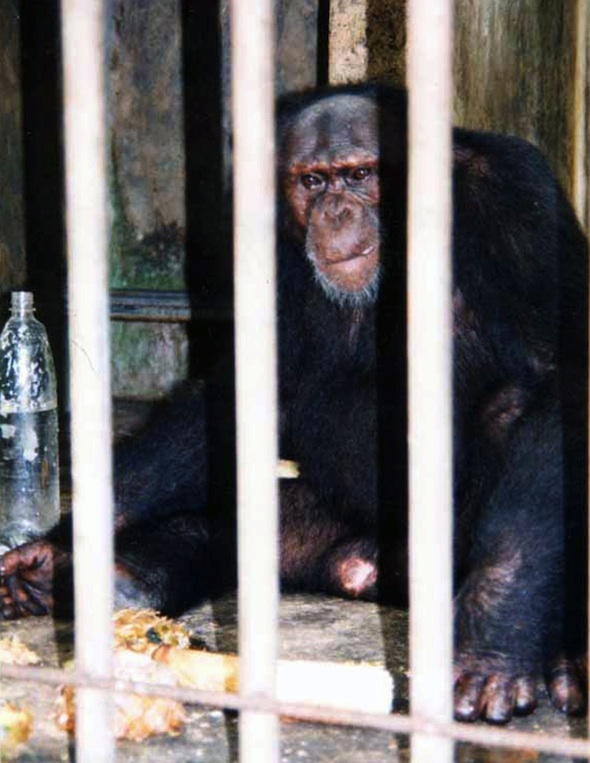
Although I am equally committed to each of our 73 chimpanzees, the gentleness coupled with profound inner strength of some individuals have inspired my deepest respect and admiration. One awe-inspiring chimpanzee who has touched me deeply is Jacky. He lived in a small cage at a hotel, first taken in as a tourist attraction, for over 30 years. When I met him in 1997 Jacky was furious and dangerous. Local people called him the “mad chimpanzee,” meaning he was crazy, and it wasn’t difficult to see how he had earned that reputation. He refused to make eye contact with us, and his various forms of stereotypy, while heart wrenching, did make him appear lost to the sane world. In one of his most disturbing and frequent manifestations, he placed one open hand in his mouth while rapidly and forcefully pounding the top of his head with his other fisted hand. He abused himself like this frequently and for minutes at a time, causing the top of his head to be bald. Anyone who accidentally veered too close to his cage paid a high price for the mistake. With lightning speed and certain intent Jacky could grab hapless hands, pull them into his cage, and with a single bite inflict irreversible damage.

web_Jacky_Atlantic_Beach_Hotel_Sheri

Jacky in his cage at Atlantic Beach Hotel, where he lived for 30 years. Photo © Sheri Speede.

After we finally succeeded in bringing Jacky to Sanaga-Yong Chimpanzee Rescue Center in 1999, he soon stopped his self-abuse. I cautiously kept my distance from him until one day he initiated a change in our relationship. After watching me care for the wound of another chimpanzee, he turned to present me with a laceration on his own back that needed care, and we became friends. While these changes in his temperament were remarkable, his rapidly evolving relationships with other chimpanzees at the sanctuary were most amazing, and his capacity for leadership that survived so many years of deprivation seemed nothing short of miraculous. He formed an alliance with adult female Nama (who had been shackled by a chain at another hotel for 16 years), and together they led a social group of chimpanzees for ten years. Under the gentle and just leadership of this powerful duo, we were able to introduce many young orphans, eventually expanding their social group to twenty-six.

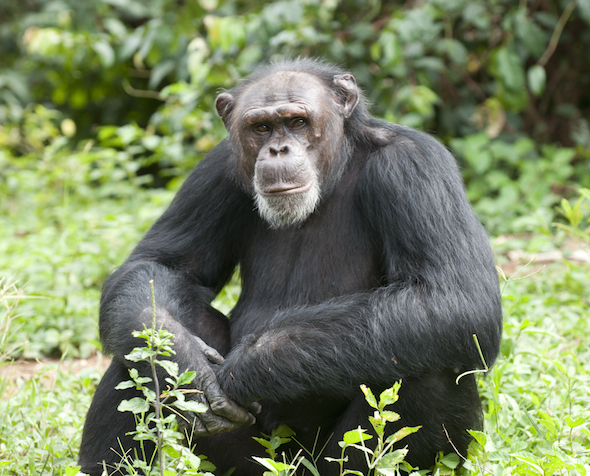
Eventually, a younger, stronger male persistently challenged Jacky, and after a struggle for dominance that lasted many months, he eventually pant-grunted his submission and handed over the reins of leadership about three years ago. Today Jacky is a respected elder, and although he is no longer the alpha male, we still call the group “Jacky’s group.” Without a lot of responsibility, he spends his days playing and avoiding conflict, which seems a form of contented retirement.

web_Jacky_Carol_Yarrow

Jacky at Sanaga-Yong Chimpanzee Rescue Center. Photo: Carol Yarrow.

Sheri has written about Jacky and other chimpanzees in her book Kindred Beings, which will be published by HarperCollins in September 2013.

Filed Under: Advocacy, Free-living chimps, Sanctuary Tagged With: advocacy, animal protection, animal rescue, animal rights, Animal Welfare, chimpanzee, chimpanzee rescue, chimpanzee retirement, chimpanzee sanctuary, Chimpanzee Sanctuary Northwest, ida africa, jacky, primate protection, primate rescue, sanaga-yong, Sanctuary, sheri speede

Jamie’s not-so-serious pants

July 21, 2013 by Lisa

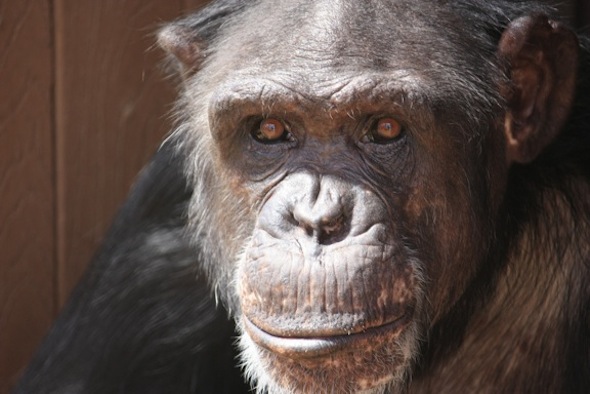
There are some people who are simply intense, even their resting face is intimidating to the uninitiated! Their approach to life and every experience in it can seem so serious that it’s hard to imagine them ever being a kid. If you asked my husband, that’s a fairly accurate description of me. If you asked me I’d say it’s a fairly accurate description of both Jamie chimpanzee and me. I do love Jamie’s serious face. Isn’t it intense?

web facebook Jamie close-up bright-eyed outside oa_MG_7112

But I also know that, just like me, Jamie doesn’t always wear her serious pants. We’ve often posted about Foxie’s ability to draw out Jamie’s silly side but, really, she can be silly all on her own when she chooses. Today, during cleaning, Jamie initiated an exuberant game of chase, roll, repeat with me and I was happy to oblige. Taking Jamie on her own terms allows her to express her complex character completely and I’m so thankful to provide her that opportunity, especially when it involves laughter!

Here’s photo evidence of Jamie with a not-so-serious face. You may notice that the only photo evidence I could find of Jamie with a playface was in the company of Foxie!

web jamie foxie laugh play box play face playroom IMG_0132

Filed Under: Caregivers, Foxie, Jamie, Play, Sanctuary Tagged With: animal rescue, chimpanzee rescue, chimpanzee retirement, chimpanzee sanctuary, Chimpanzee Sanctuary Northwest, Cle Elum 7, Cle Elum Seven, csnw, Jamie, Play, primate rescue, Sanctuary

  • « Go to Previous Page
  • Page 1
  • Interim pages omitted …
  • Page 261
  • Page 262
  • Page 263
  • Page 264
  • Page 265
  • Interim pages omitted …
  • Page 345
  • Go to Next Page »

Primary Sidebar

Subscribe To the Blog and Get Notified of New Posts First!

Archives

Calendar of Blog Posts

June 2026
S M T W T F S
 123456
78910111213
14151617181920
21222324252627
282930  
« May    

Categories

SUBSCRIBE TO OUR NEWSLETTER

Footer

PO Box 952
Cle Elum, WA 98922
[email protected]
509-699-0728
501c3 registered charity
EIN: 68-0552915

Official DDAF Grantee

Menu

  • The Chimpanzees
  • Blog
  • About Us
  • You can help
  • Resources
  • Contact
  • Donate

Proud Member of

Connect With Us

Search

Copyright © 2026 Chimpanzee Sanctuary Northwest. All Rights Reserved. Site by Vegan Web Design