• Skip to main content
  • Skip to primary sidebar
  • Skip to footer

Chimpanzee Sanctuary Northwest

Hope. Love. Home. Sanctuary

  • Our Family
    • The Chimpanzees
    • The Cattle
  • Blog
  • About Us
    • Visiting the Sanctuary
    • Philosophy
      • FAQs
      • Mission, Vision & Goals
      • Privacy Policy
    • The Humans
      • Staff
      • Board of Directors
      • Founder
    • Annual Reports
    • The Future of CSNW
    • CSNW In The News
  • You can help
    • Donate
      • Become a Chimpanzee Pal
      • Sponsor A Day
      • Transfer Stock
      • Be A Produce Patron
      • Be a Bovine Buddy
      • Give from your IRA
      • Personalized Stones
      • Bring Them Home Campaign
    • Leave A Legacy
    • Employment Opportunities
    • Volunteer
    • See Our Wish List
    • Events
  • Resources
    • About Chimpanzees
    • Enrichment Database
    • Advocacy
      • Advocacy Action Center
      • Apes in Entertainment
        • Trainers
        • Role of the AHA
        • Greeting Cards
      • Chimpanzees as Pets
      • Roadside Zoos
      • Chimpanzees in Biomedical Research
      • Conservation
        • African Apes
        • Orangutans
  • Shop
    • Merchandise Store
  • Contact
  • DONATE NOW

Animal Welfare

Sunday, Crummy Sunday

December 6, 2020 by Anthony

Sundays are usually quiet around here but today was unusually busy and a bit chaotic.

We experienced some of those bright moments that we expect when working around happy and healthy chimps, but we also encountered a few unexpected hang-ups that ensured this day would not go as smoothly as we initially hoped.

These days happen from time to time. Such is the life of a sanctuary caregiver.

Today’s minor obstacles included staff car troubles, sheets of ice on our vehicles and sidewalks, and mechanical issues around the building that required substantial effort to fix. I even hit snooze too many times and missed out on my usual dose of coffee. We’ll be fine (especially since I keep emergency coffee grounds in the Chimp House), but I would have been happier if everyone made it through the day without further setbacks.

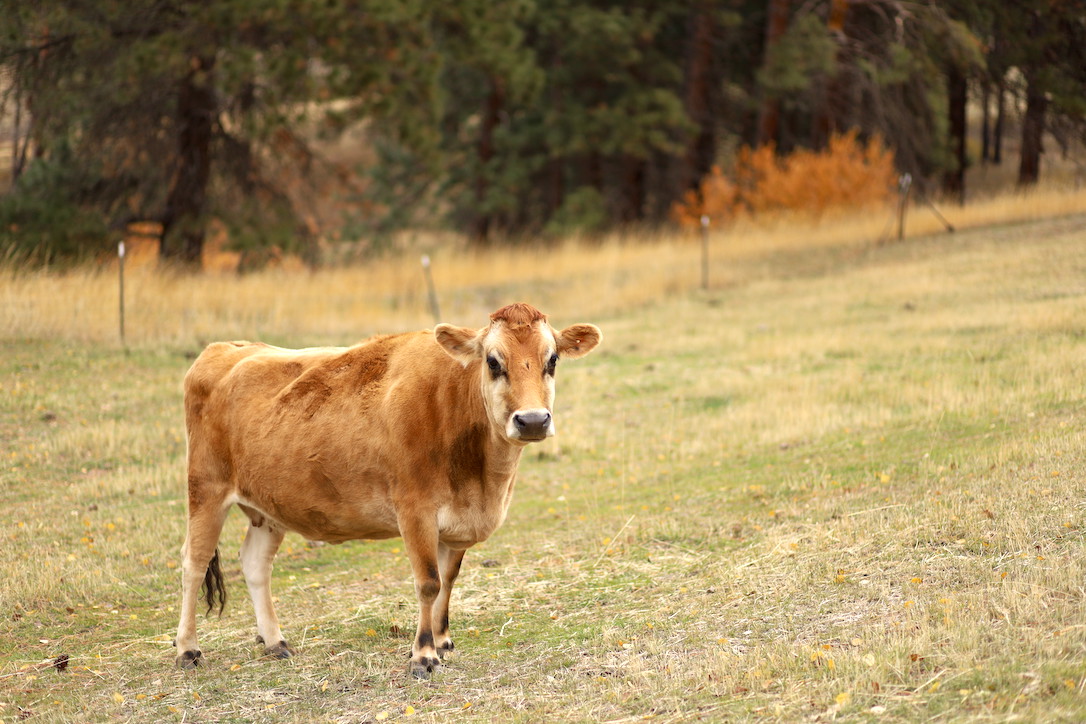
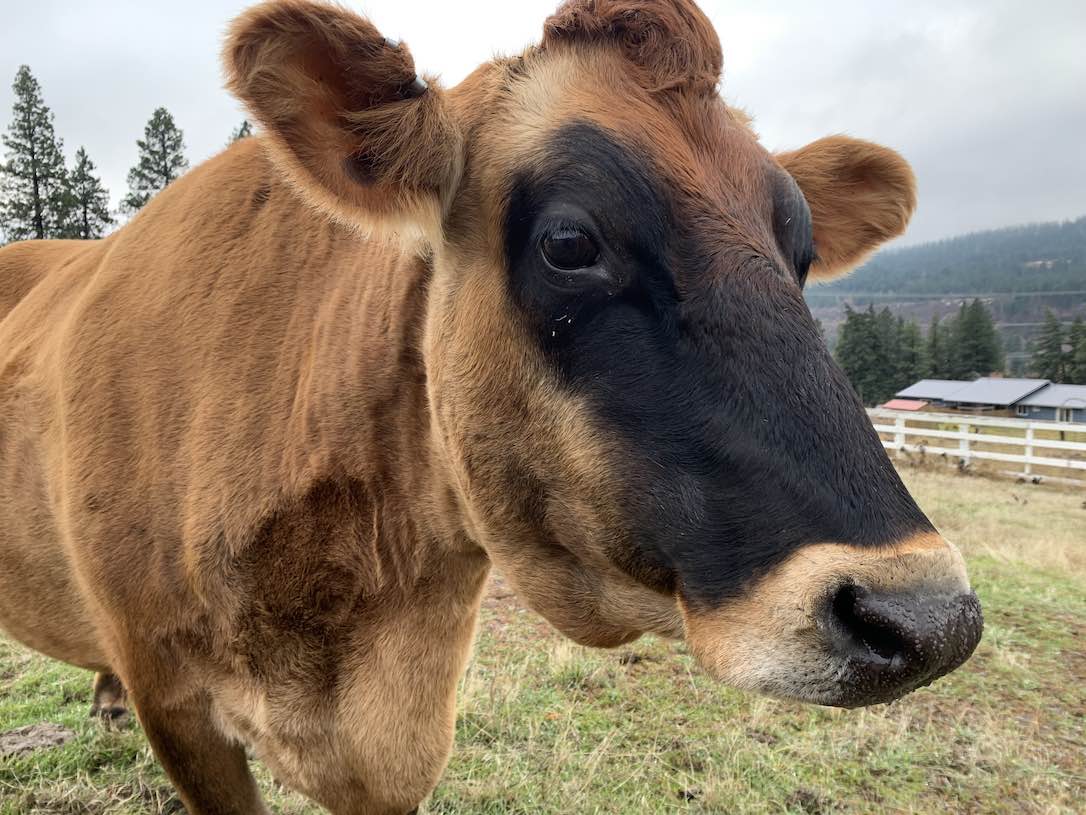
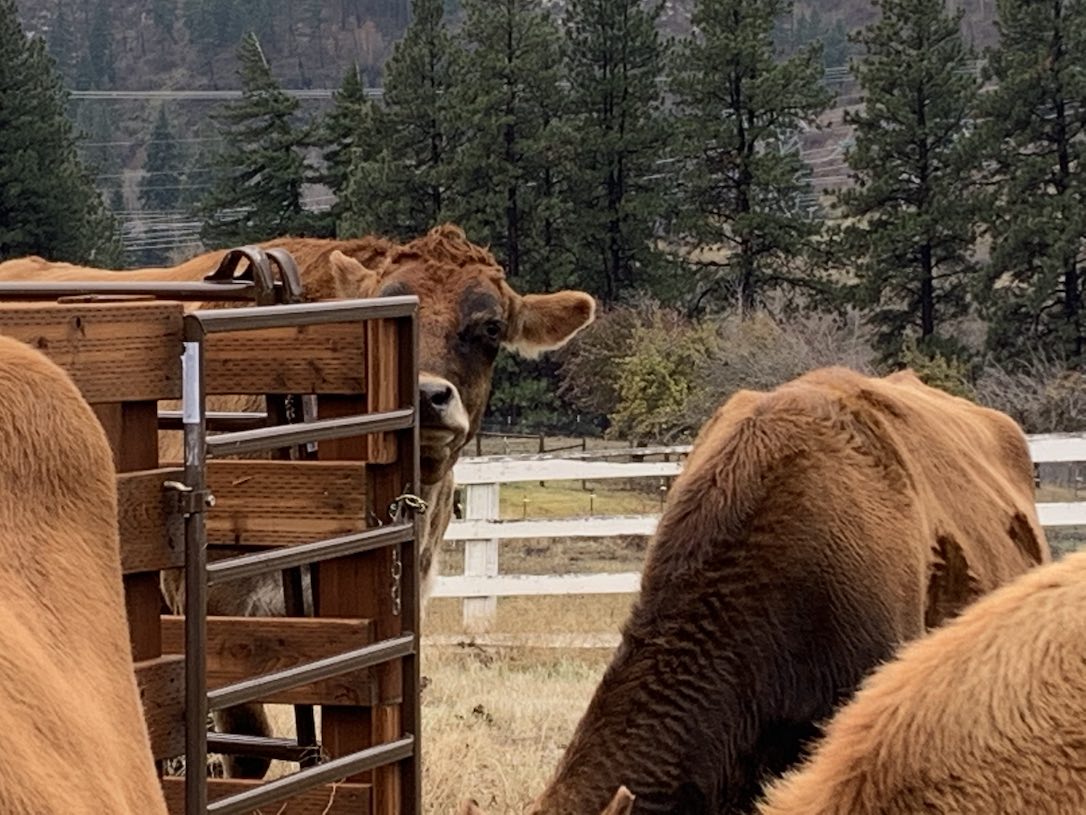
To add some sour frosting to this moldy cake, Chad noticed that Meredith was acting strangely (even for a Jersey cow) and we gave her a preliminary diagnosis of A.D.R. (the common but dreaded condition of simply “ain’t doin’ right”). Of course, this condition warrants a follow-up exam by a veterinarian, so we called in Dr. Erin.

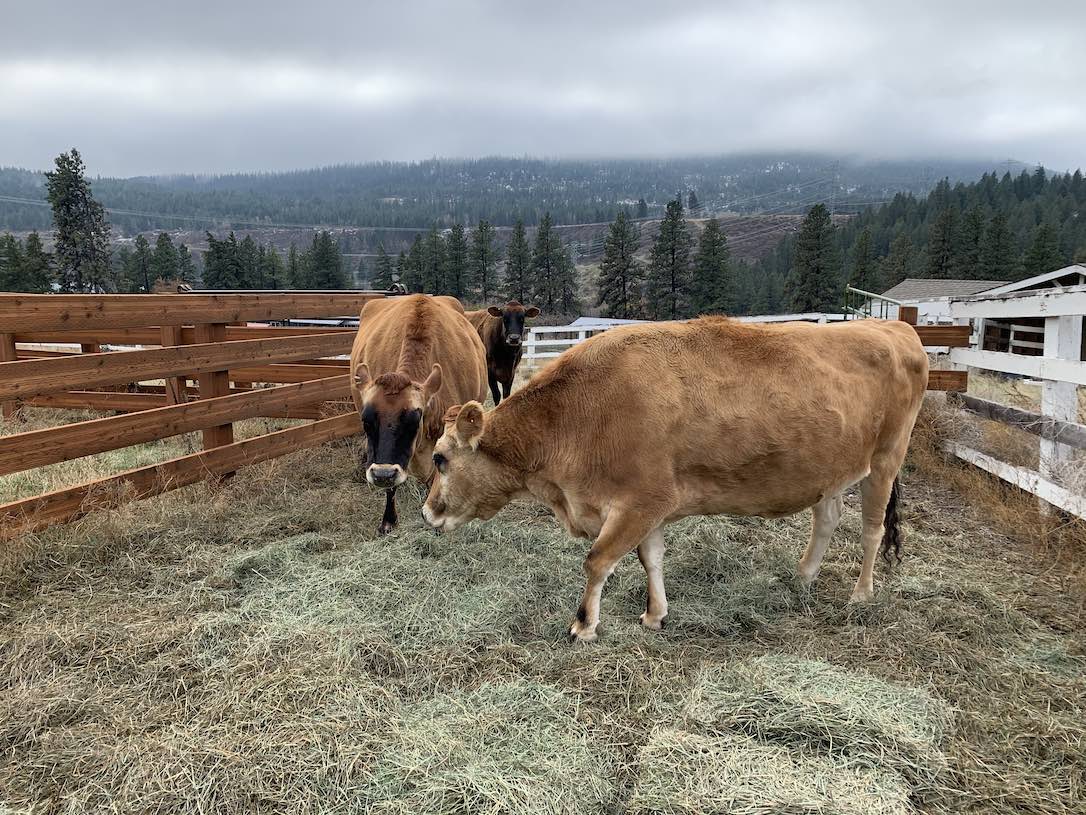
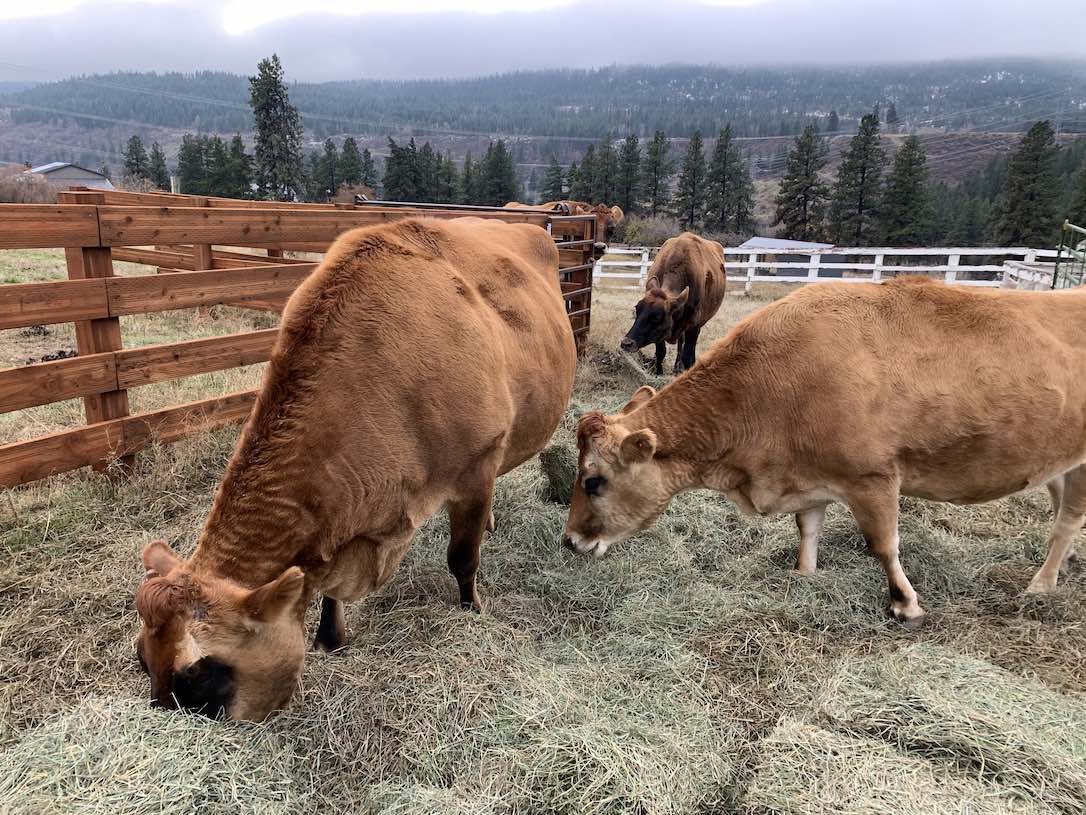
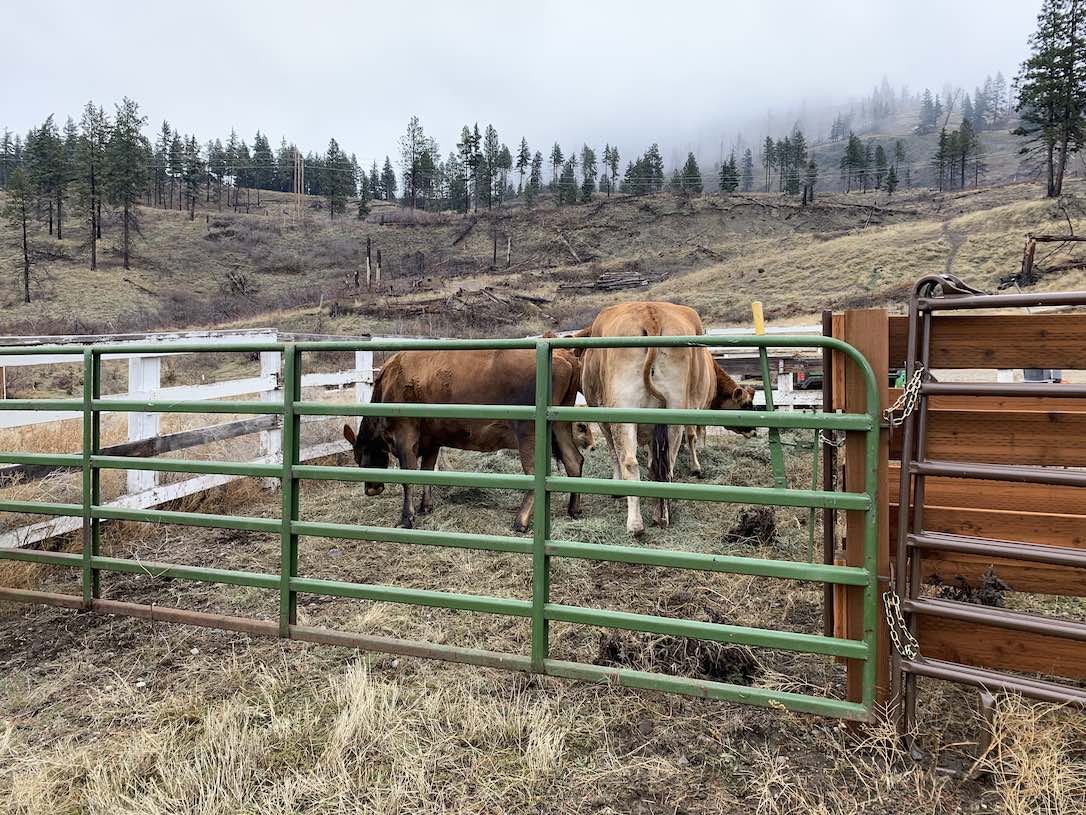
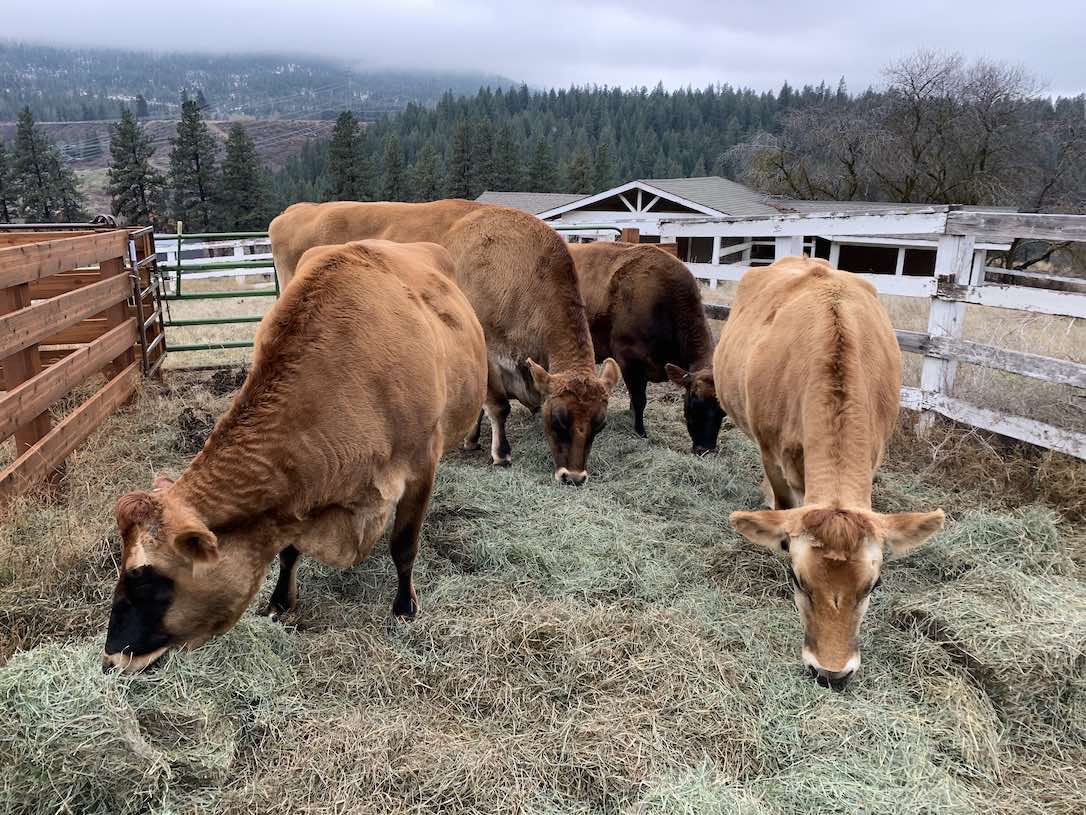
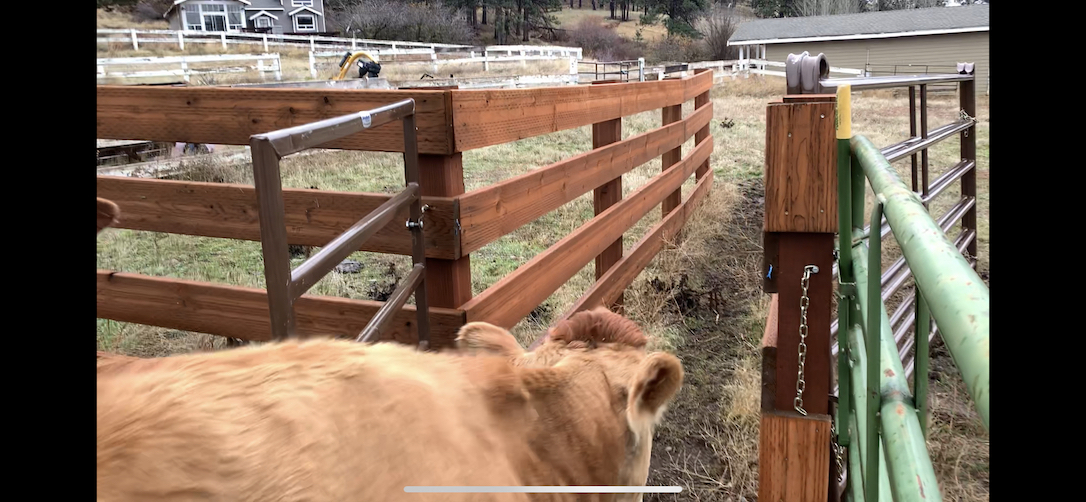
We love seeing Dr. Erin at the sanctuary, but we definitely prefer when she’s hanging with the chimps or delivering supplies for the vet clinic. Having to do an unexpected physical exam on a curiously-behaving bovine is not ideal, and it was difficult to get the suspicious cattle isolated as the sun rapidly set and plunged the pasture into darkness. We eventually secured Meredith and her companions into the winter paddock for what we hope is a quick check-up tomorrow morning. Hopefully, this is just some temporary discomfort and the cattle will be back to their usual activities soon.

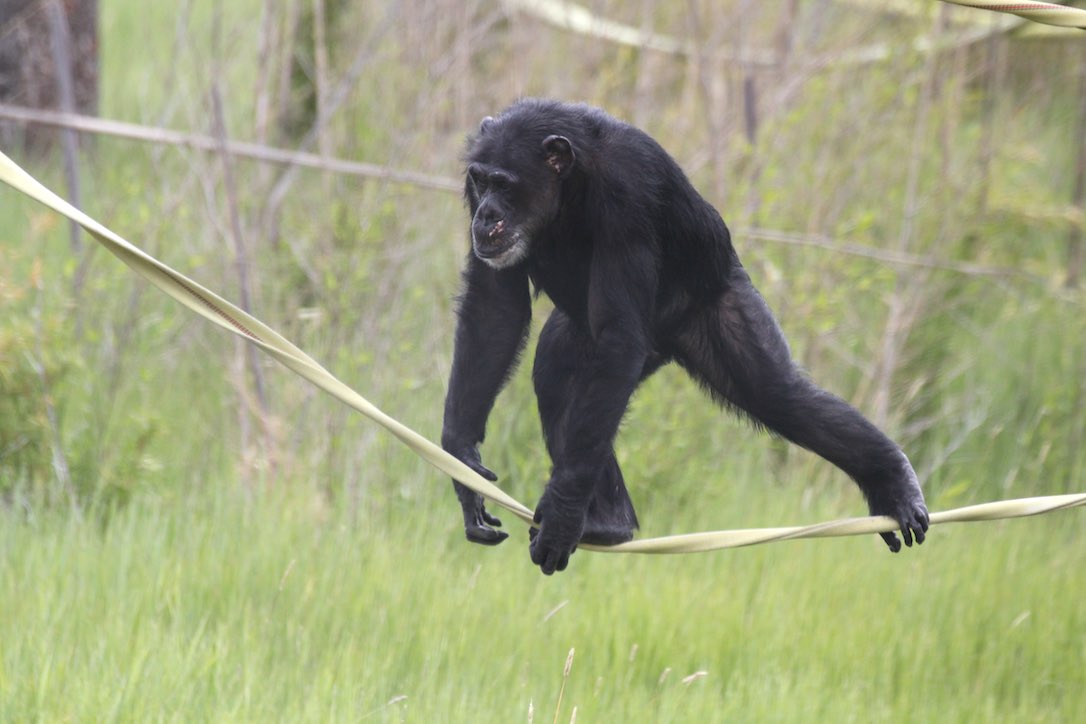
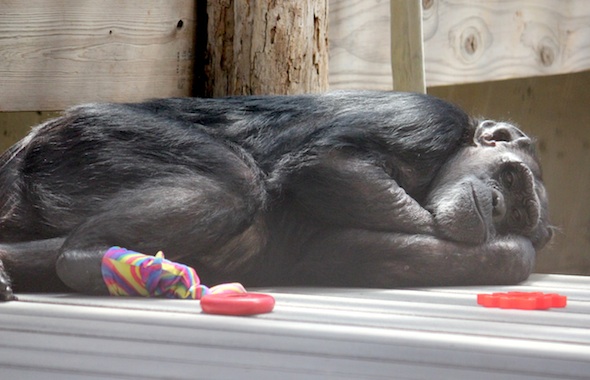
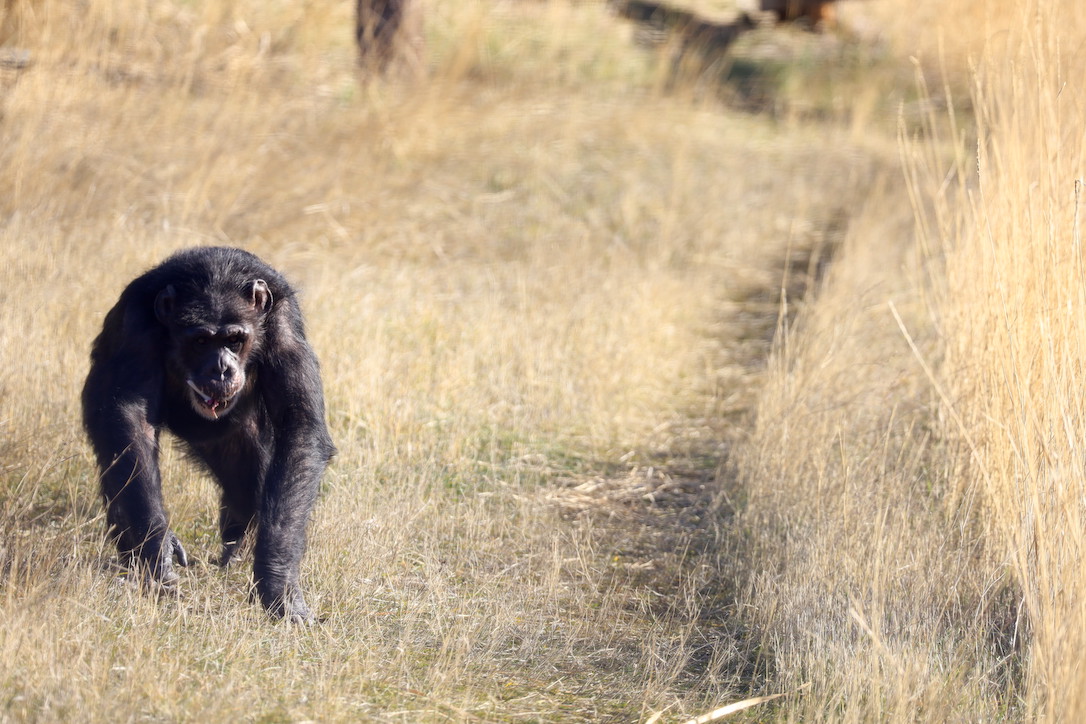
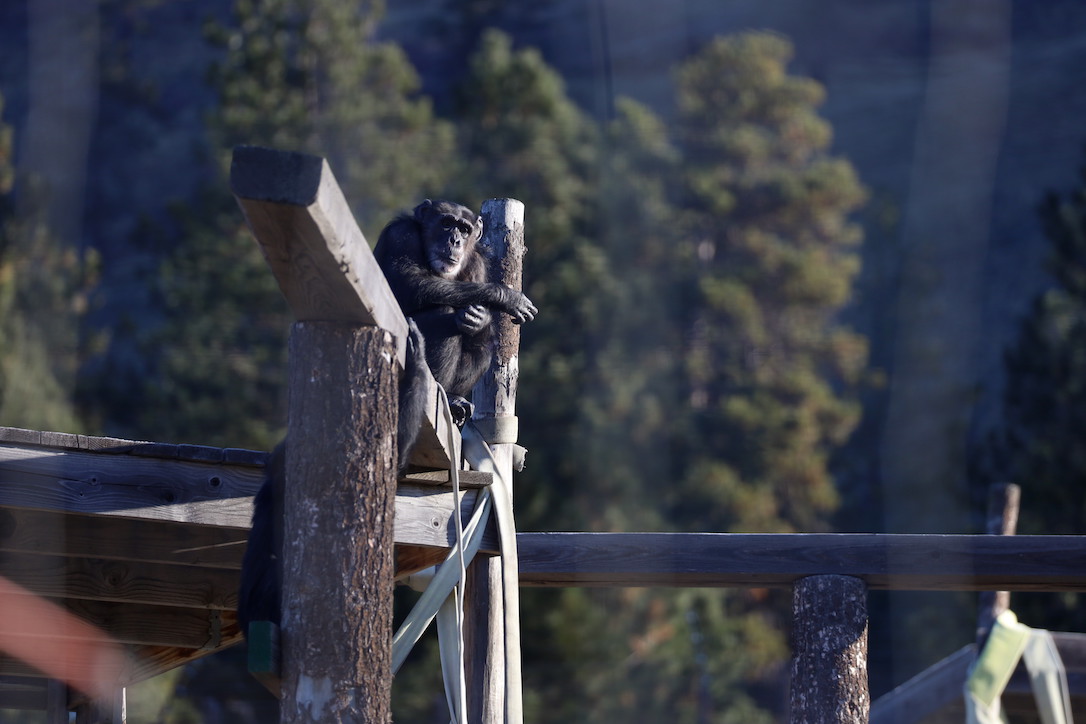
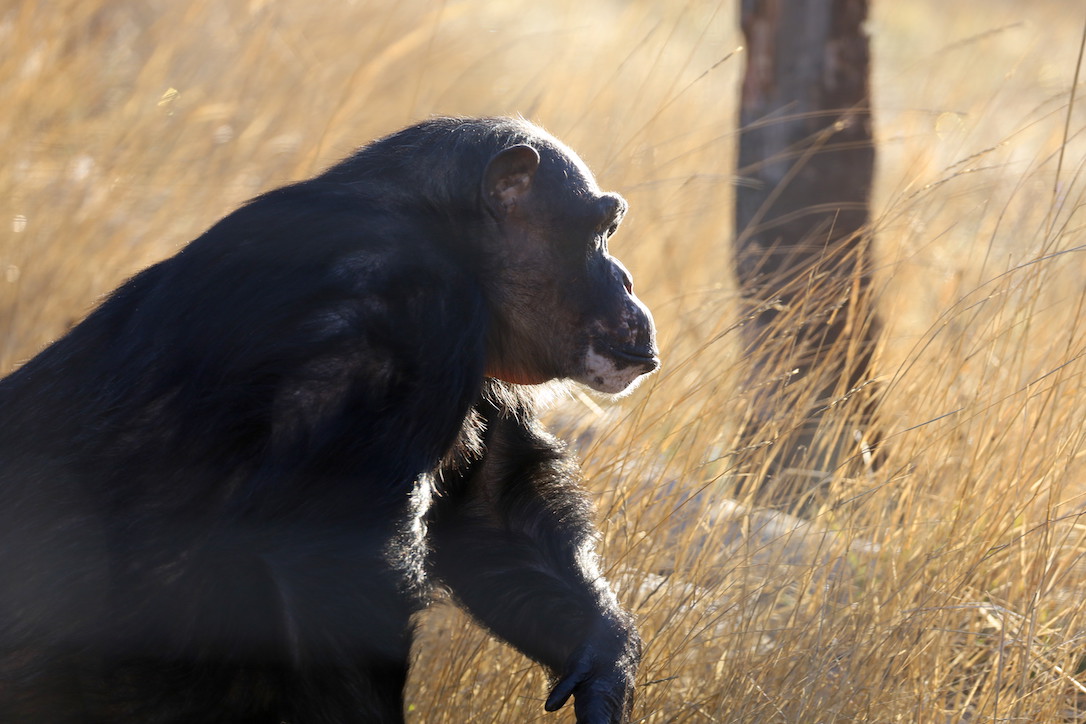
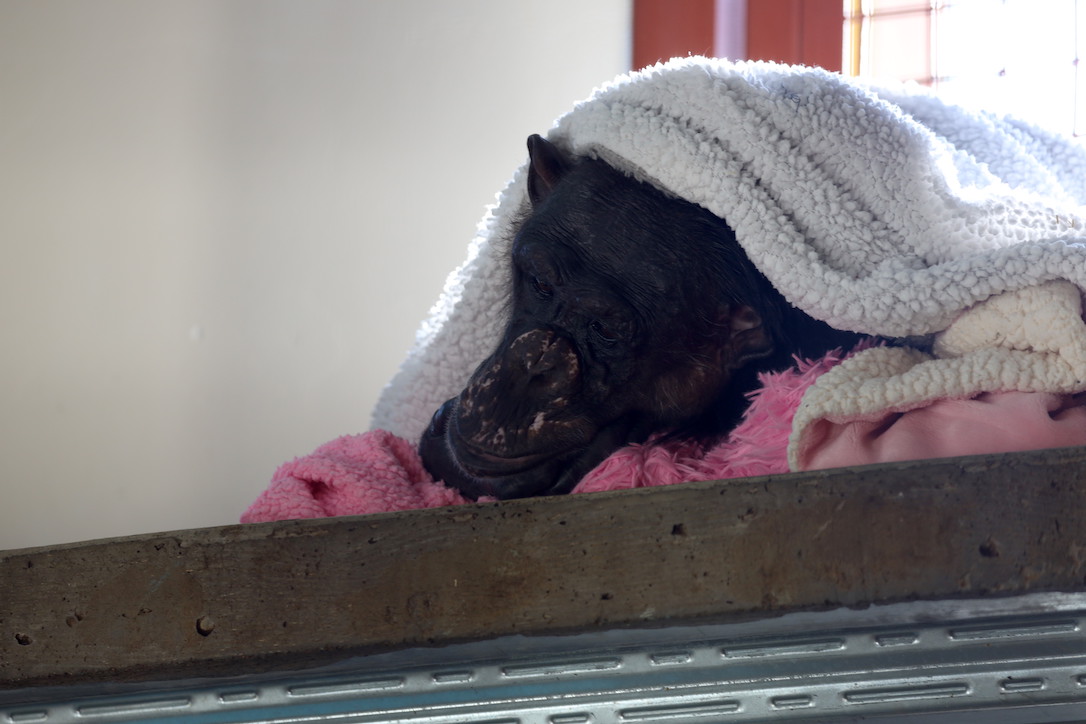
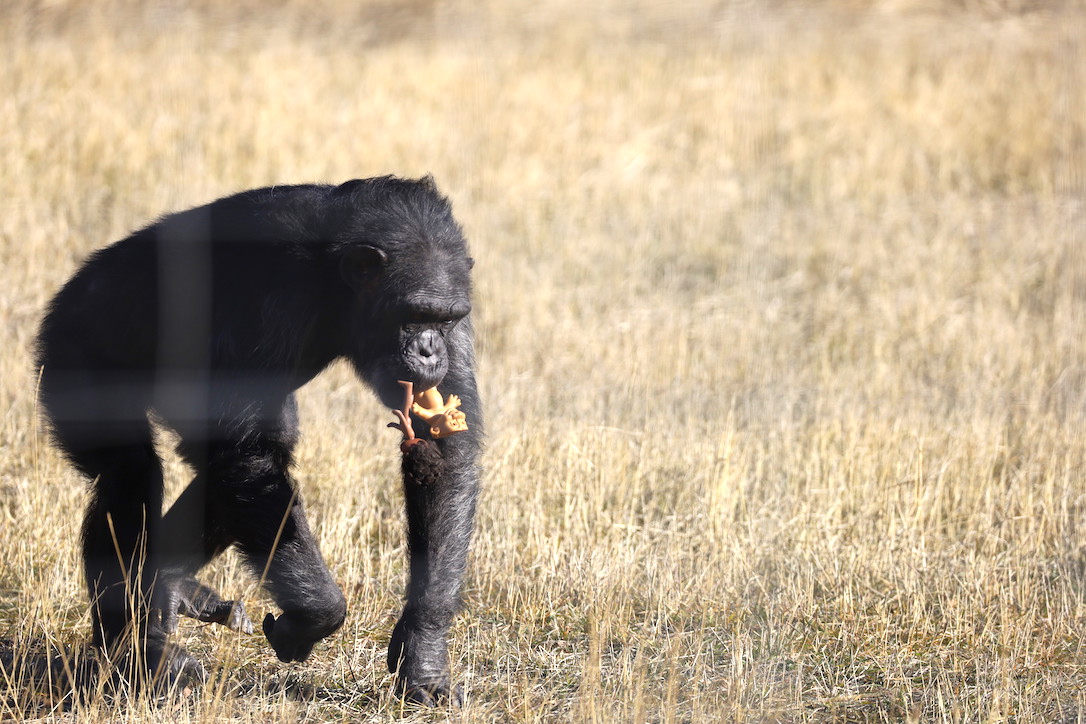
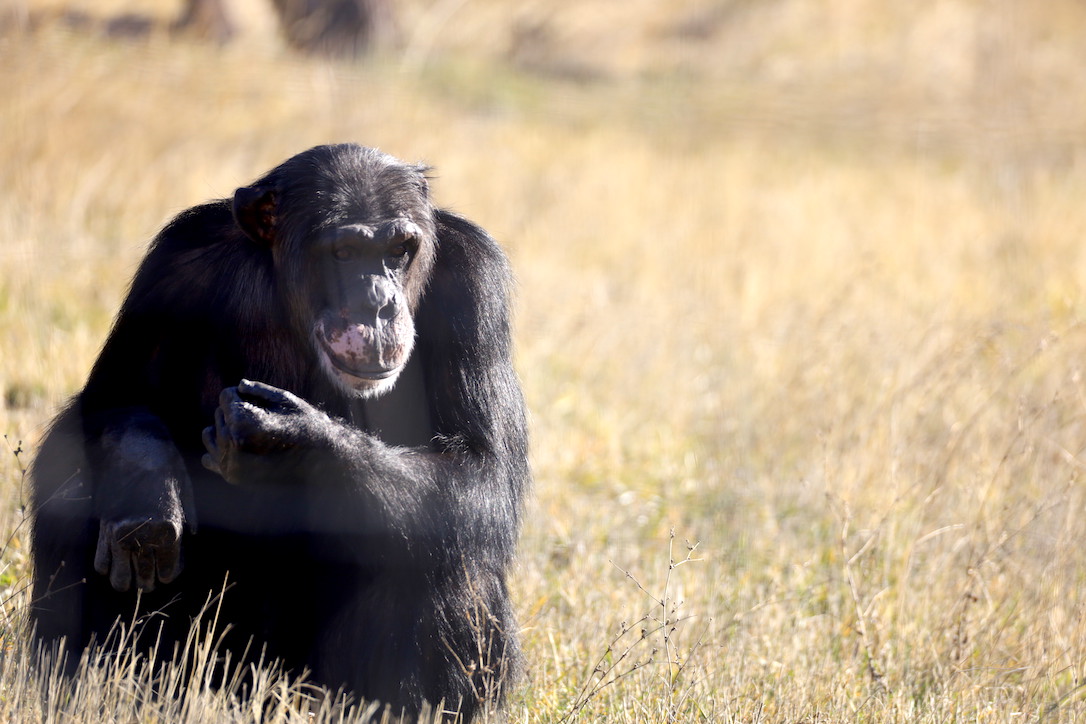
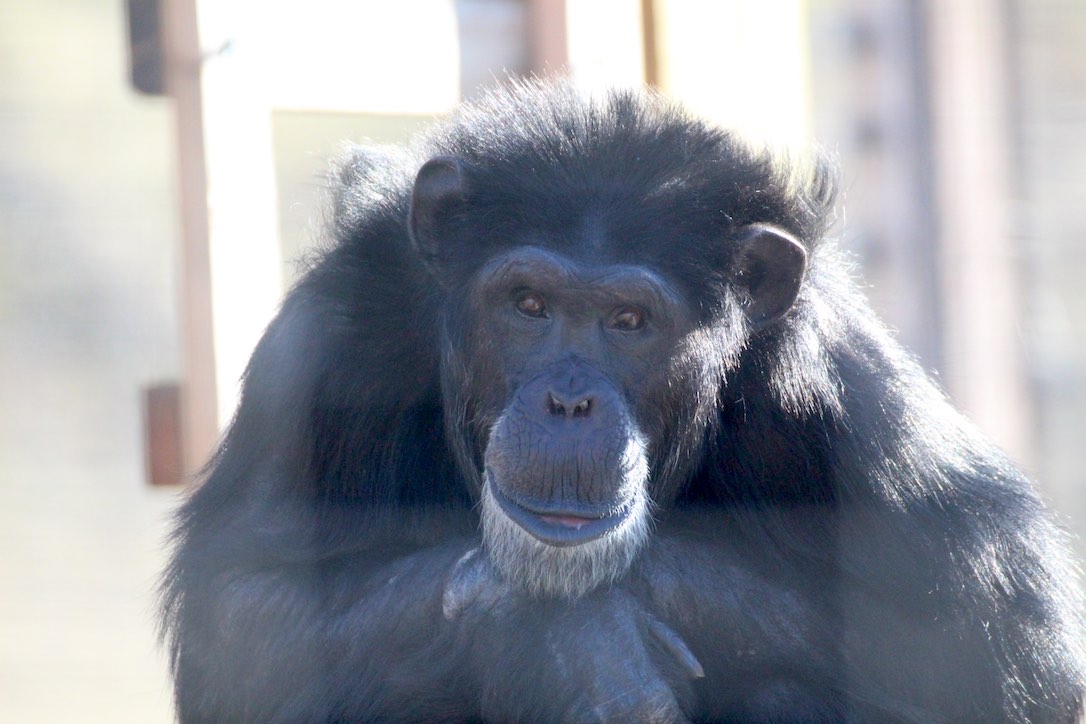
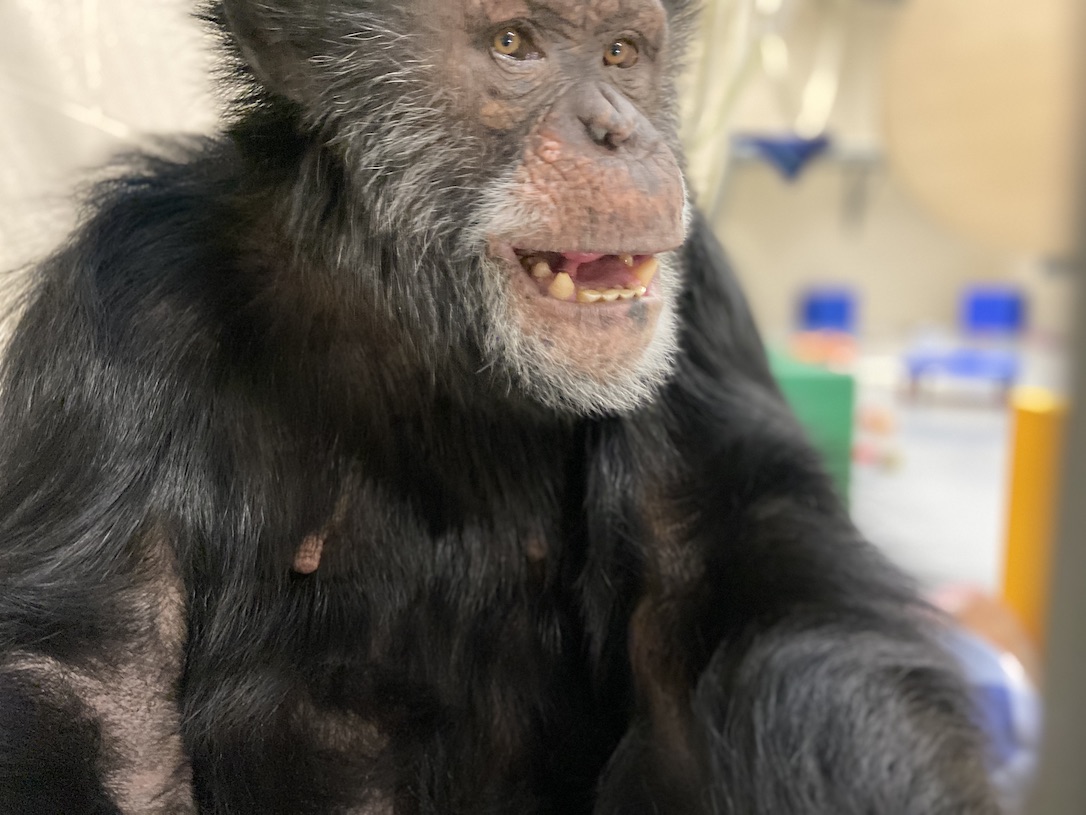
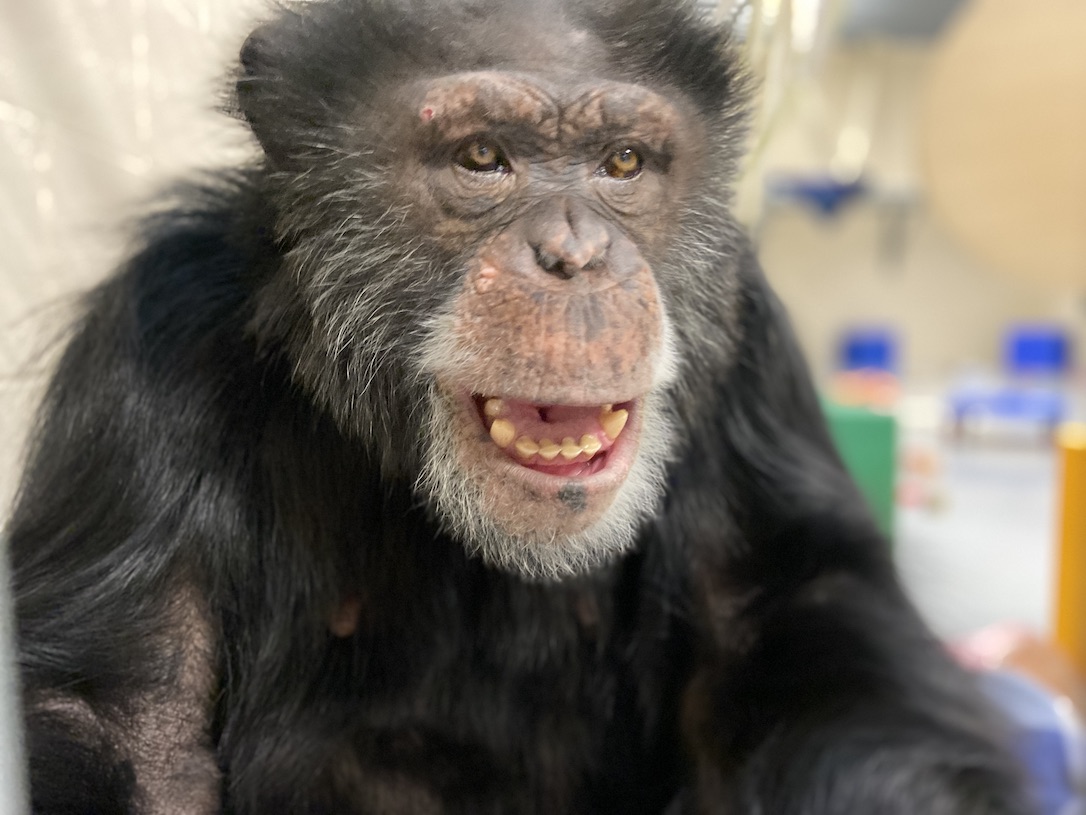
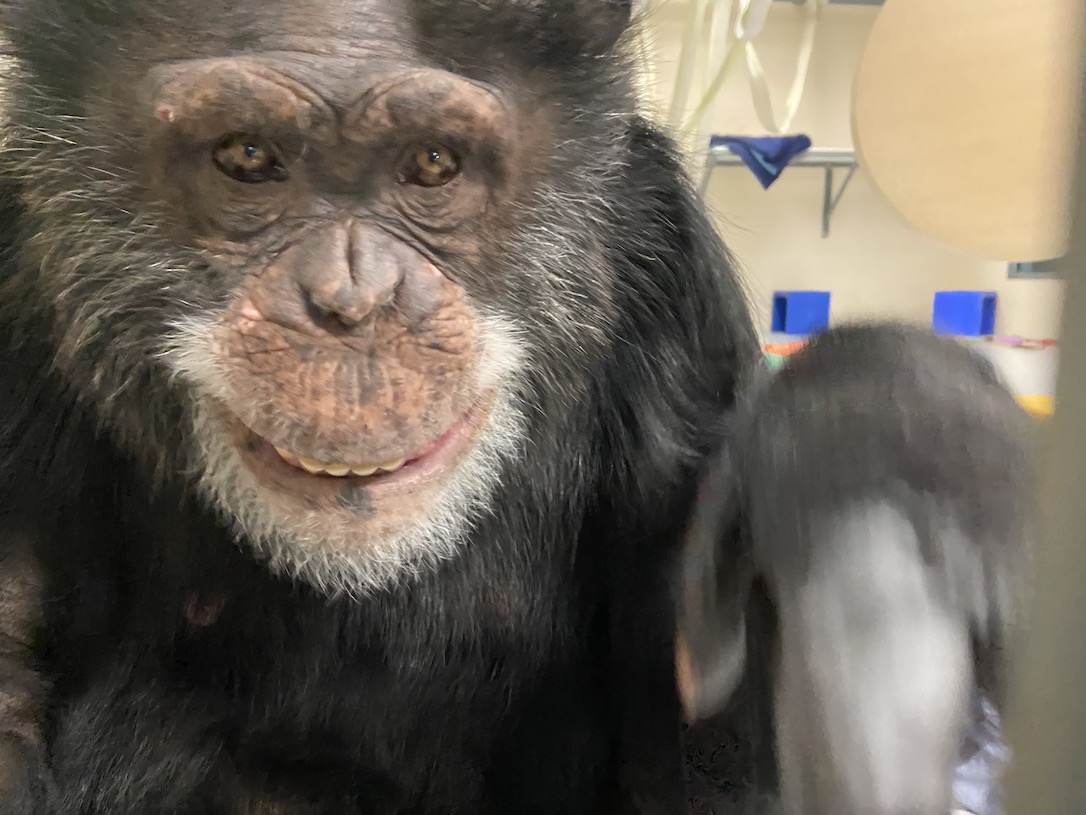
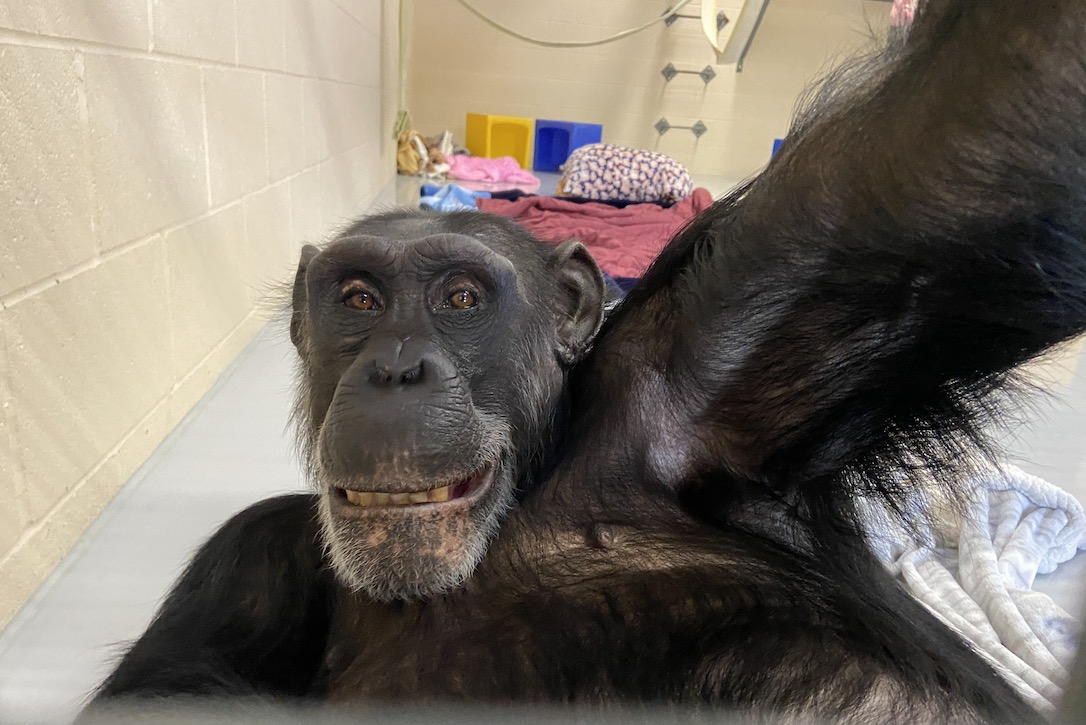
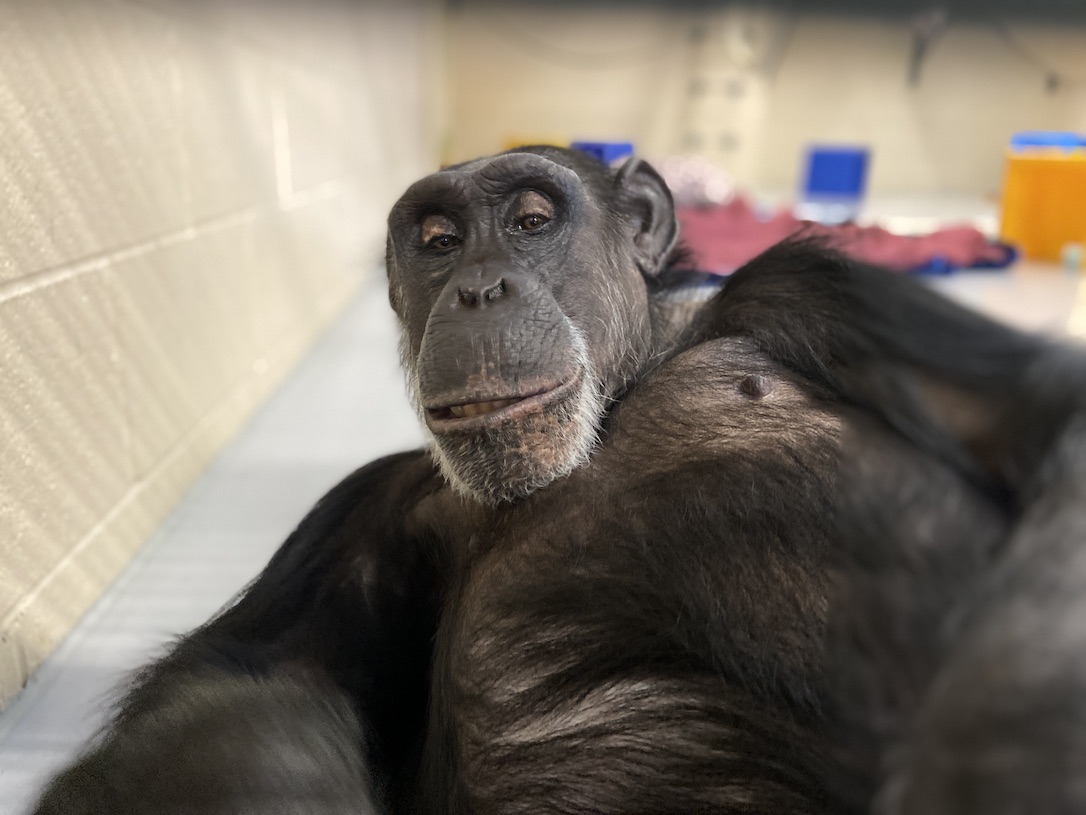
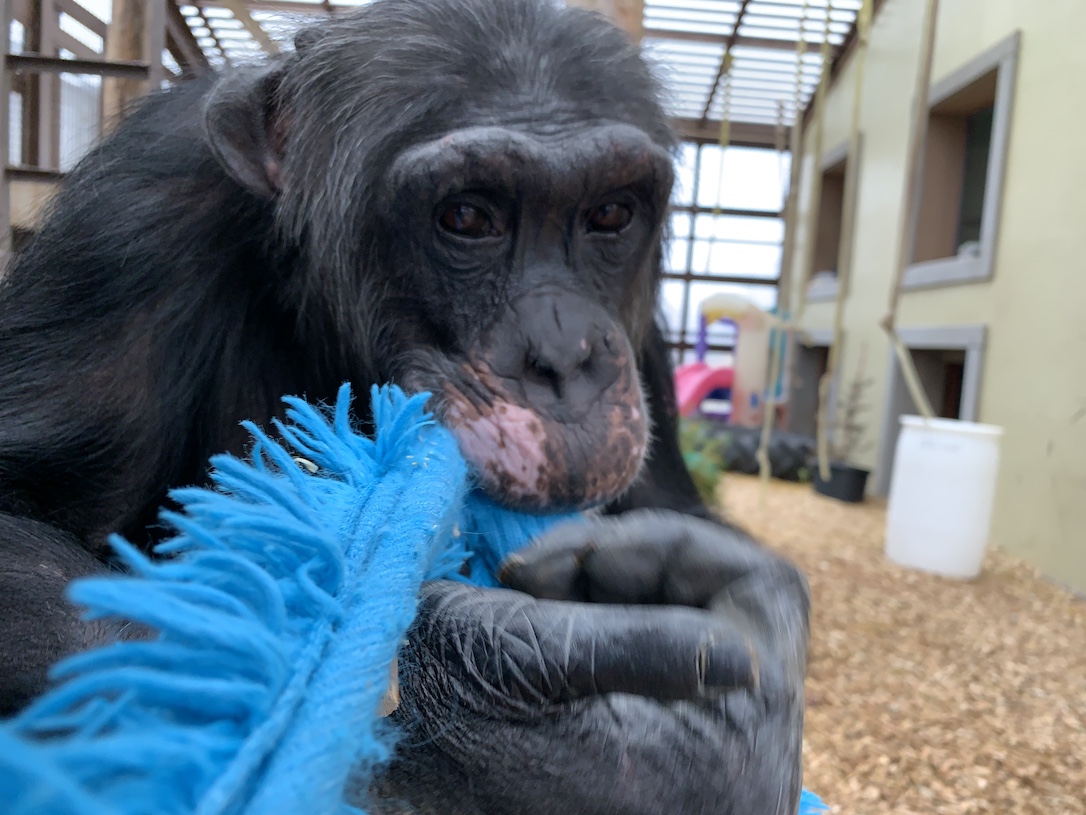
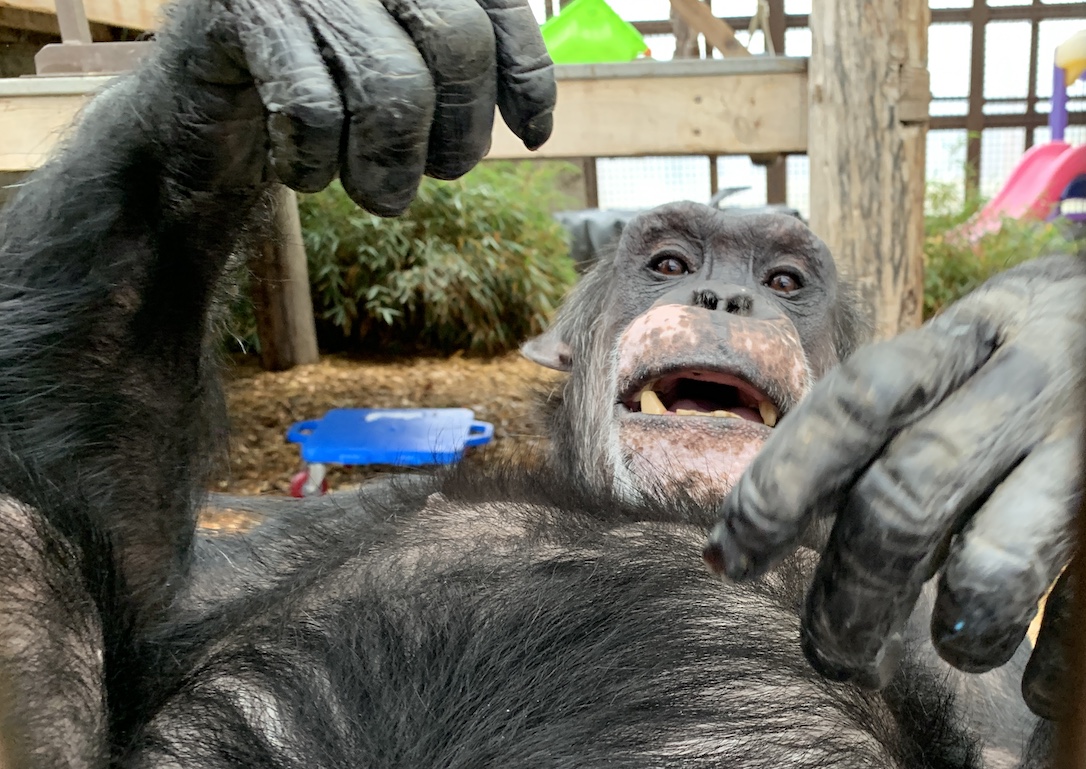
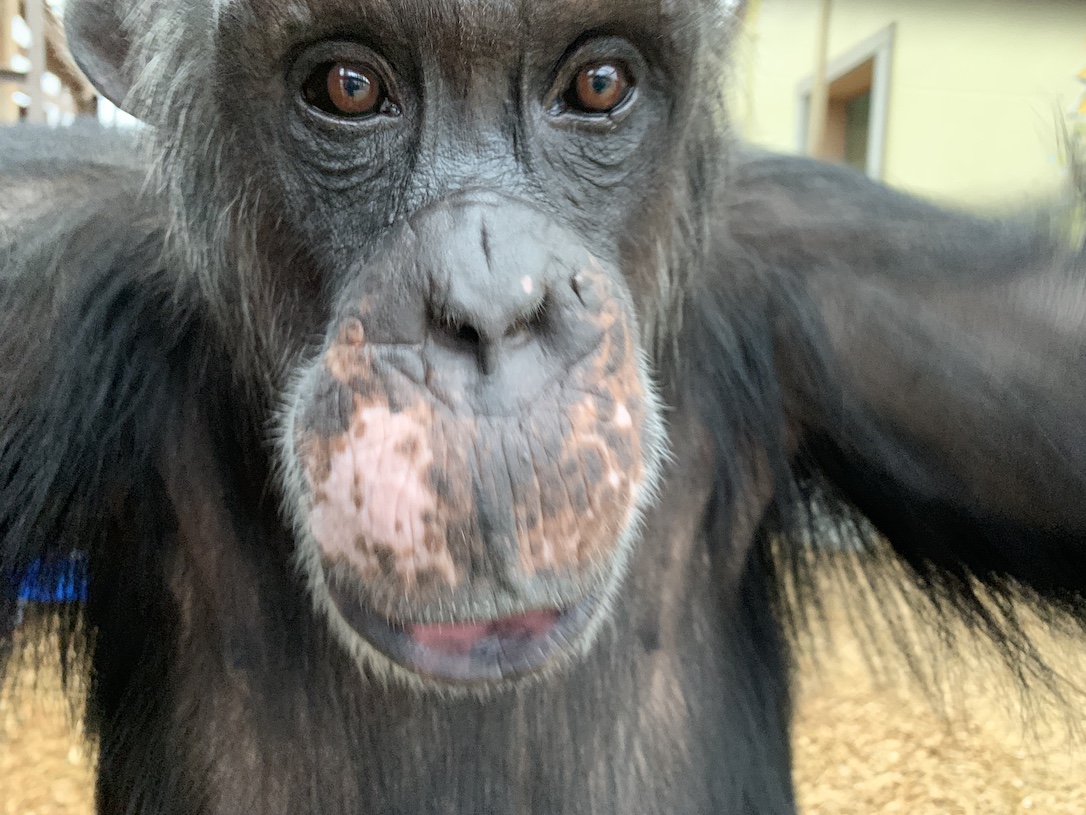
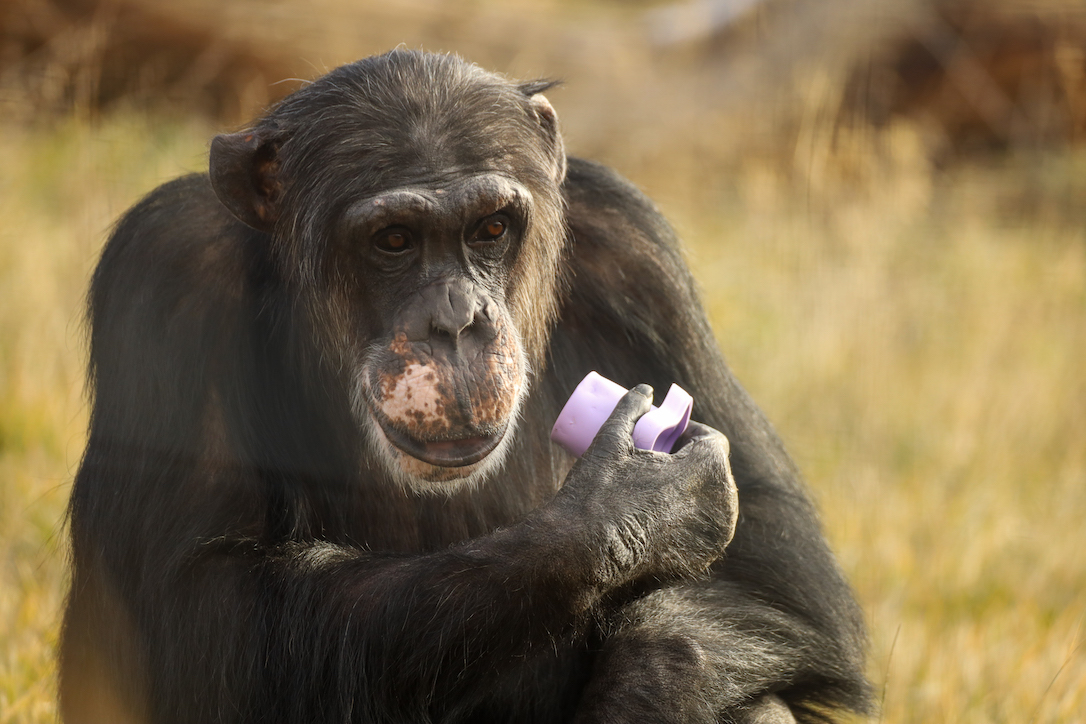
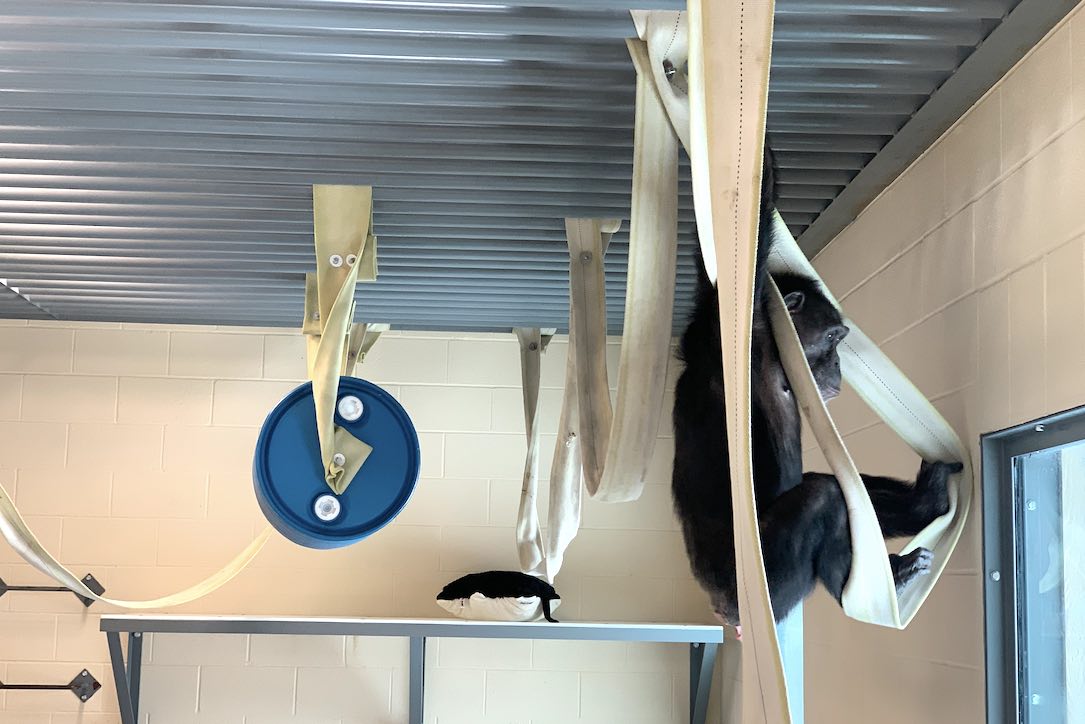
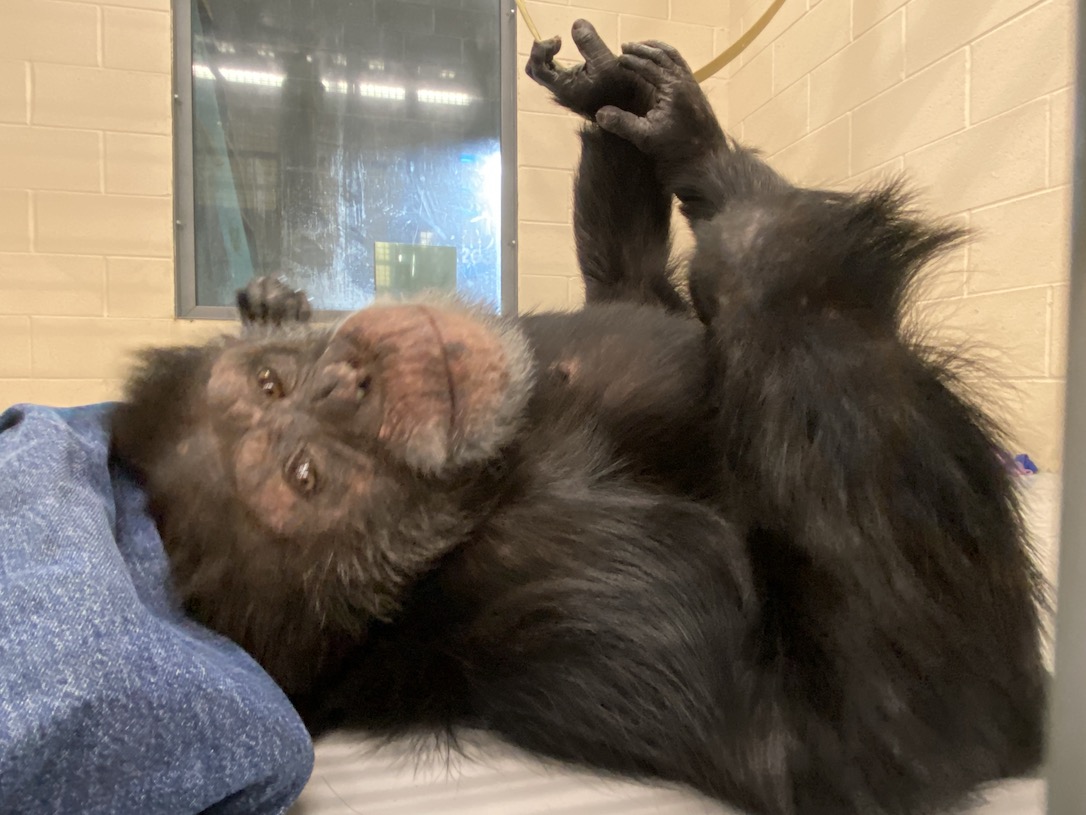
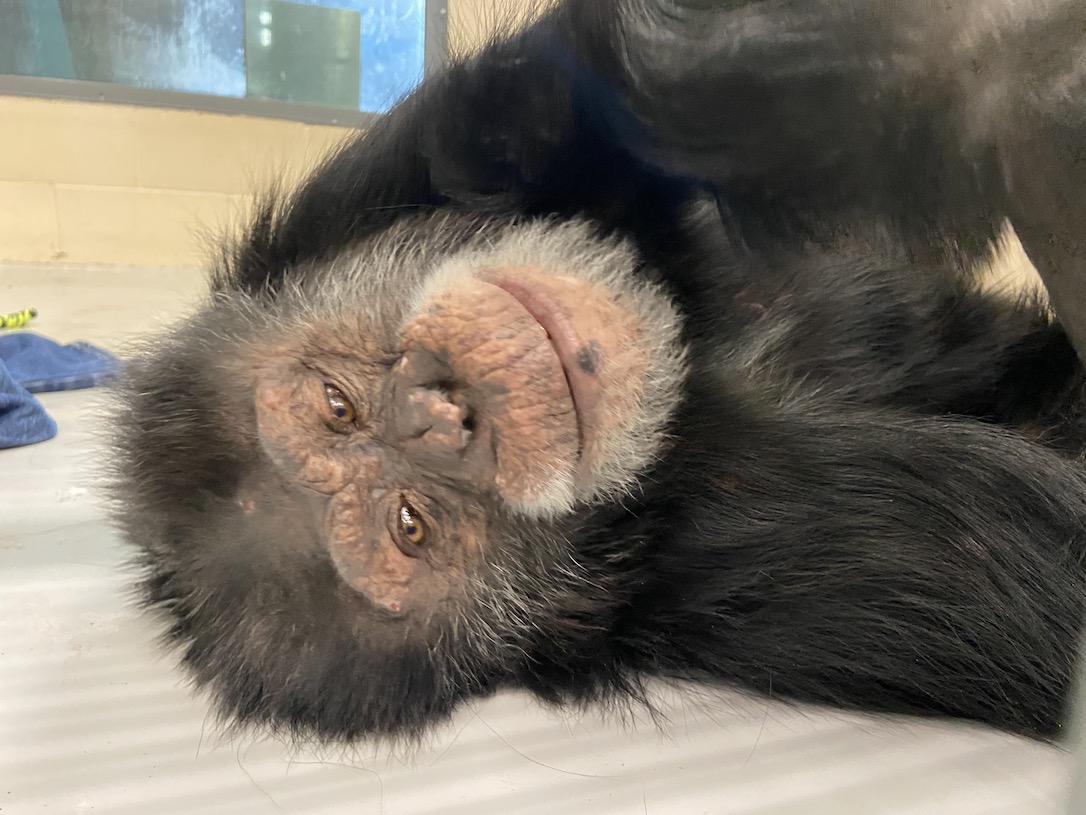
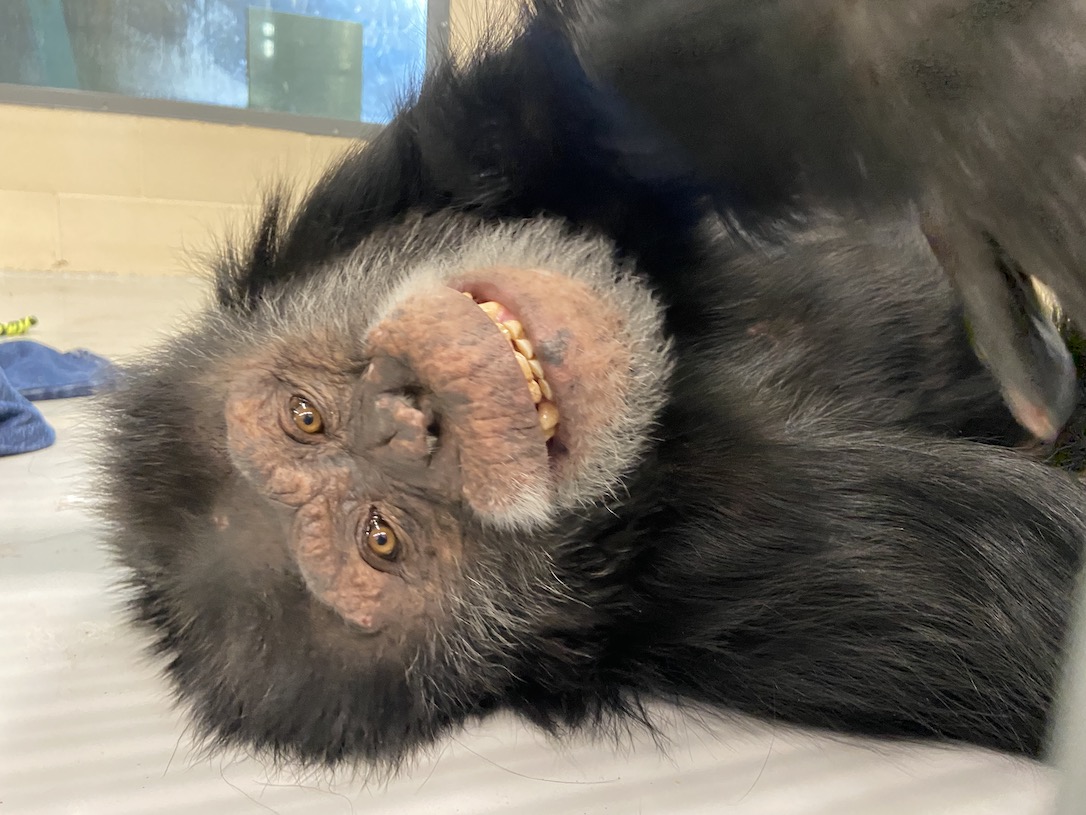
With all this stuff to do, I didn’t have time to take many photos or type out any additional thoughts. Therefore, today’s blog will center around this portrait series of Burrito, the Most Charismatic Chimpanzee in the World. I happened to capture this moment as he ventured out onto the Hill this morning (before everything else unraveled).
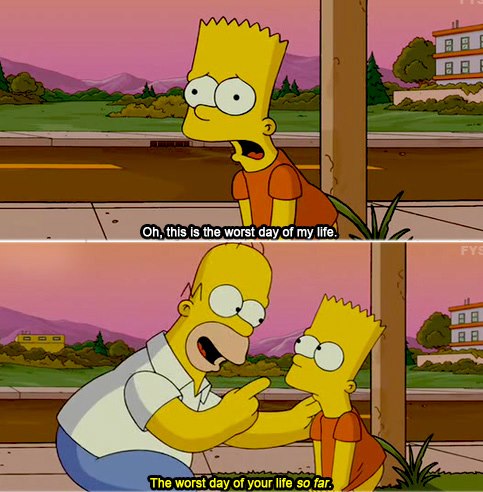
As with most of the unusual events that transpire around here, it’s much easier to get through if you maintain a wry sense of humor and a little optimism. Of course, as with any life situation, there’s also a Simpsons bit that encapsulates my feelings perfectly.
Filed Under: Burrito, Cattle, Sanctuary, Veterinary Care Tagged With: Animal Welfare, Burrito, cattle, cattle rescue, chimp, chimpanzee, chimpanzee sanctuary, Chimpanzee Sanctuary Northwest, chimpanzees, Cle Elum Seven, cows, csnw, jersey cattle, jersey cows, primate veterinarian, Sanctuary, veterinarian, veterinary care

Like Mother, Like Daughter?

December 5, 2020 by Diana

I stand by Katelyn’s post from the summer that there is no doubt that Honey B is her own unique person, quite separate from her biological history of having been born to Missy. But just as time shows us her own special uniqueness, new similarities between mom and daughter have also revealed themselves.

These two formidable and intelligent beings were tragically separated from one another at the Laboratory for Experimental Medicine and Surgery in Primates (LEMSIP), shortly after Honey B was born on June 11, 1989.

Missy was forced to continue her life of servitude as a laboratory test subject and breeder and Honey B went to the lab’s “nursery” where she was raised by humans in preparation for the same future. Unlike many other chimpanzees at LEMSIP who moved to a notorious laboratory in New Mexico called the Coulston Foundation, Honey B escaped that future when she and dozens of other young chimpanzees were moved to Wildlife Waystation in California as LEMSIP closed permanently.
Missy and Honey B were only reunited here at Chimpanzee Sanctuary Northwest 30 years after their separation.

As Katelyn mentioned in her post, there were no signs of particular recognition or even fondness between the pair when they met face to face before we abandoned the introductions of the two groups last fall.

Though they do not share the same rooms or have close interactions with one another, they do still see each other every day.

Just today, I spied Missy in a window of the playroom spying on her daughter as Honey B snacked on some lettuce in the Chute.

To be clear, there are shared preferences, quirks, and other similarities among some of the unrelated chimpanzees (the stand-out example is both Honey B and Annie wearing stretchy headbands around their waists), so who’s to say if the similarities between Missy and Honey B are inherited or simply coincidental. If you’ve ever taken a psychology or biology class or just on your own pondered the “nature vs nurture” question, you know the answer is almost always “both”.

Yet, it’s fun to consider that some of these traits just might have an element of heredity to them.

Similarities were brought up by other staff earlier this week, so it seemed a good time to reflect on what I’ve noticed that seem to characterize both mom and daughter.

Athleticism

Kelsi’s and Chad’s posts earlier this week that included the videos below clearly showed that Honey B and Missy are both quite quick on their feet and run for sheer enjoyment. That is not really the case for the majority of the other chimps.

It’s not just running that defines their love of movement. On any given day we see both of them climbing, swinging, leaping, and balancing.

Honey B
Missy

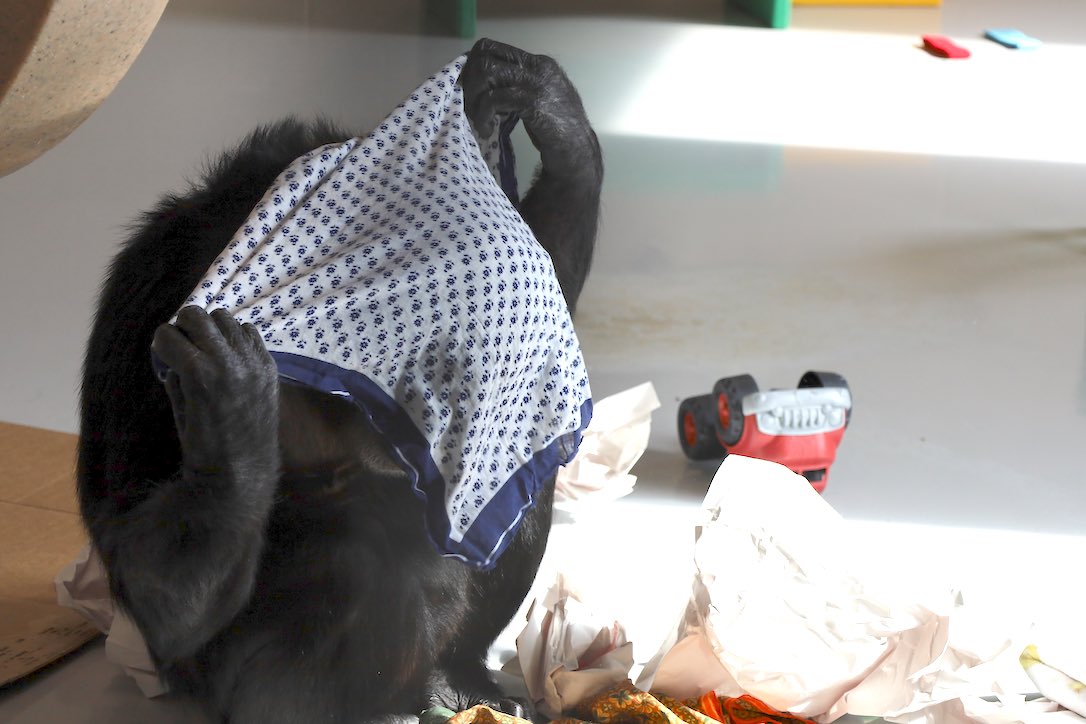
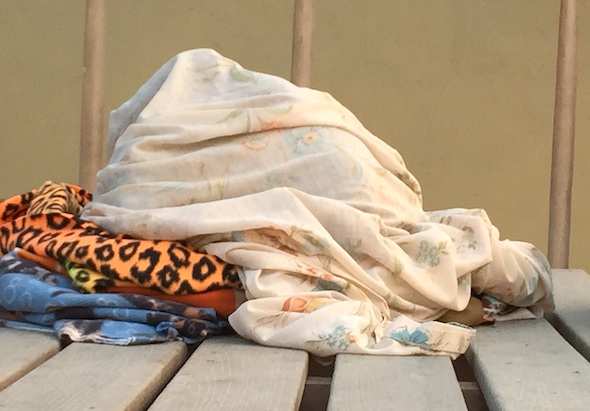
Playing Ghost

This was again inspired by a post earlier this week, this time Anna’s. Check out Missy’s ghost play with Annie from a few years ago compared to Honey B playing with Mave this week in the two videos below:

Playing Ghost is not specific to Honey B and Missy. Notably, Jamie sometimes ghosts around too:

Even when by themselves, Honey B and Missy seem to enjoy their version of ghosting.

Honey B


Missy covered in sheet
Missy

A Love of Tomatoes

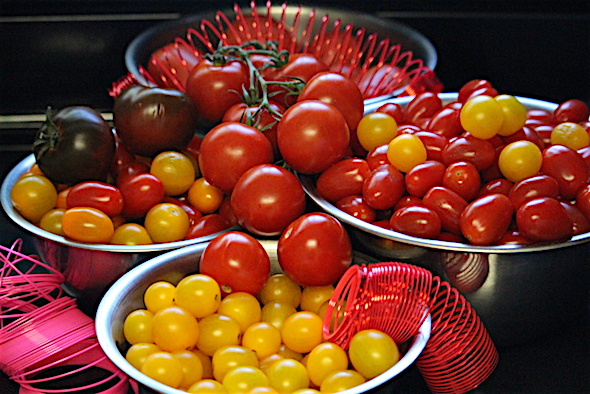
If Missy could have one food for every meal for the rest of her life, that food would be tomatoes. I have never known another chimpanzee to like tomatoes with the sincerity and fervor of Missy.

Honey B, however, comes a close second, though she is pickier about the quality.

Headstands

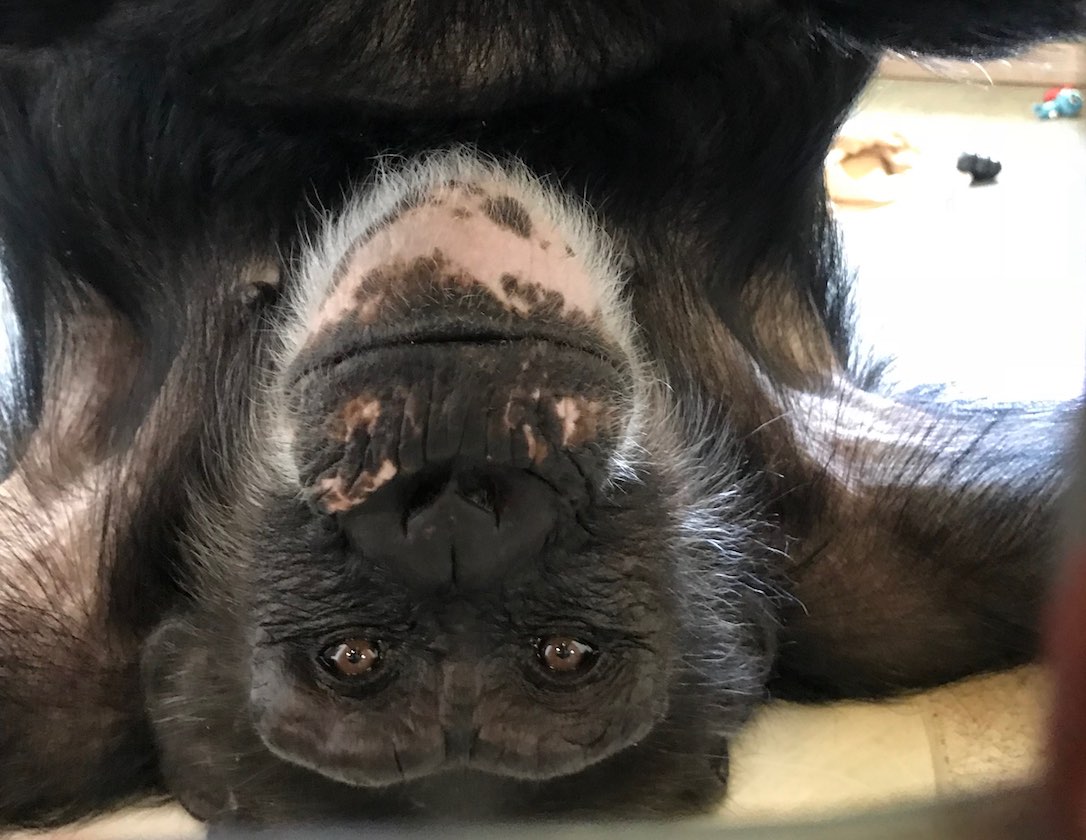
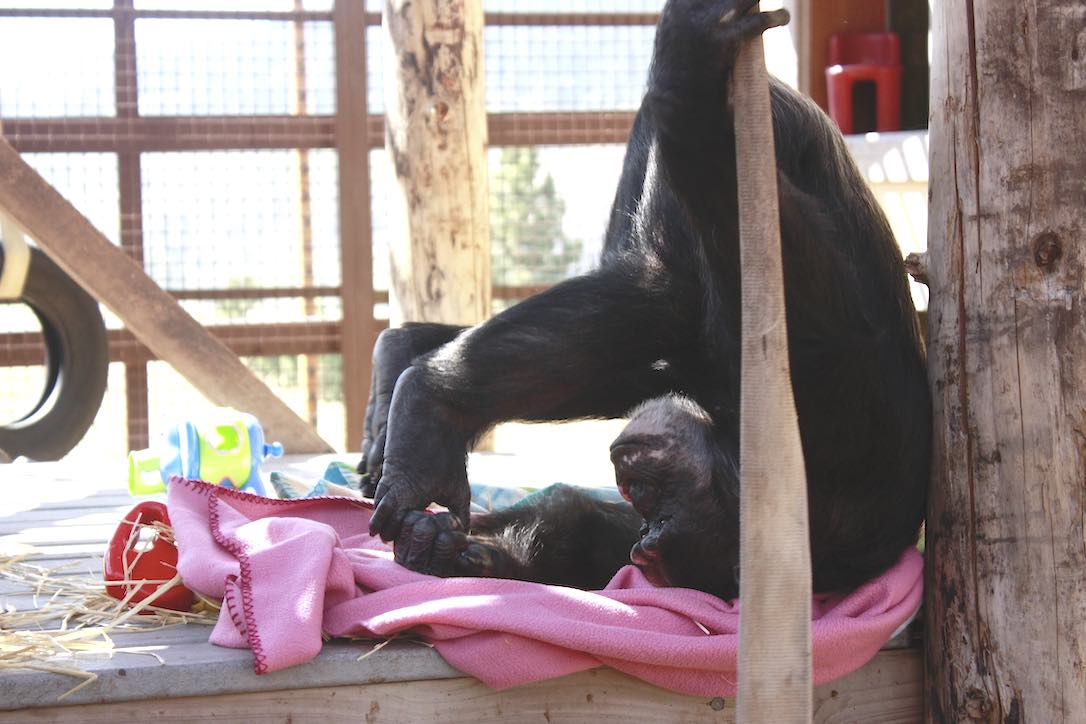
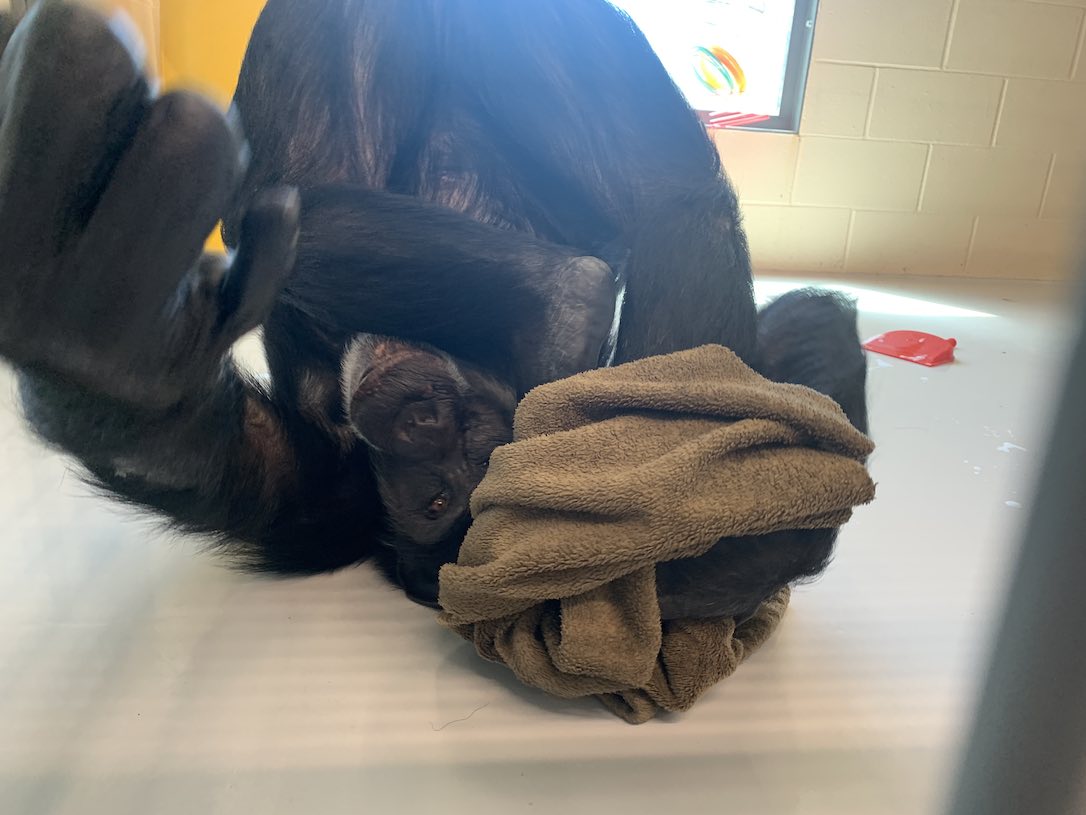
Perhaps this goes along with athleticism? I’m really not sure. Either way, both mom and offspring seem to like being inverted, both during play and sometimes when making a nest.

Missy upside down


Missy

The photo above of Missy comes from a blog post that I wrote over ten years ago. For some reason I remember putting it together like it was yesterday.

Honey B upside down

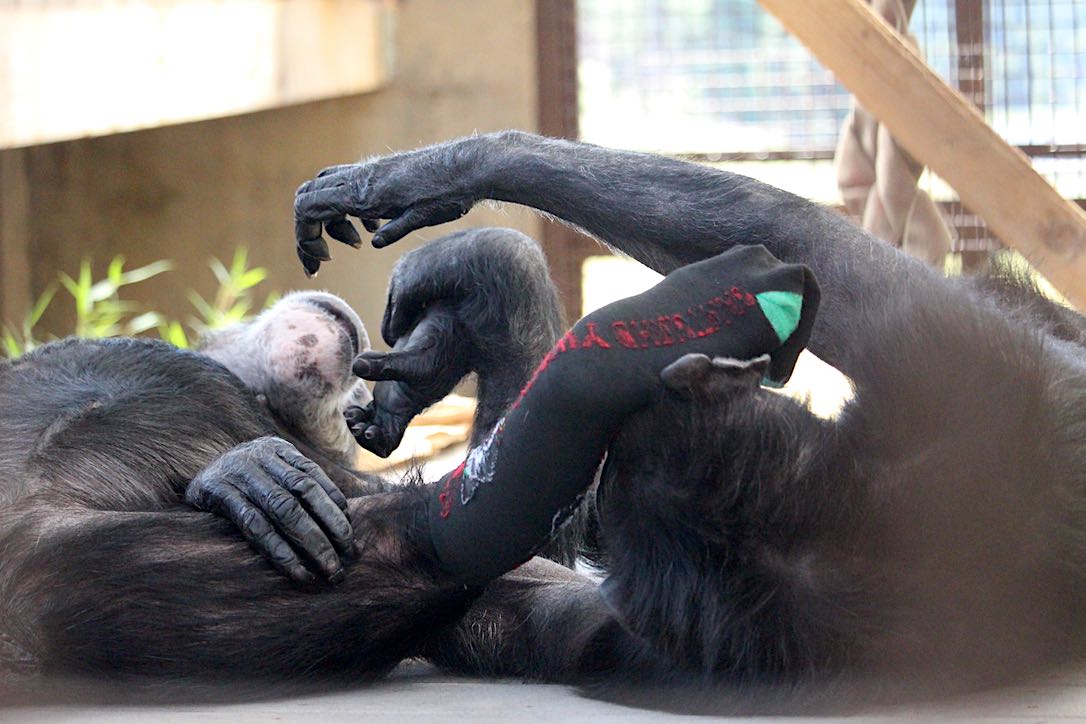
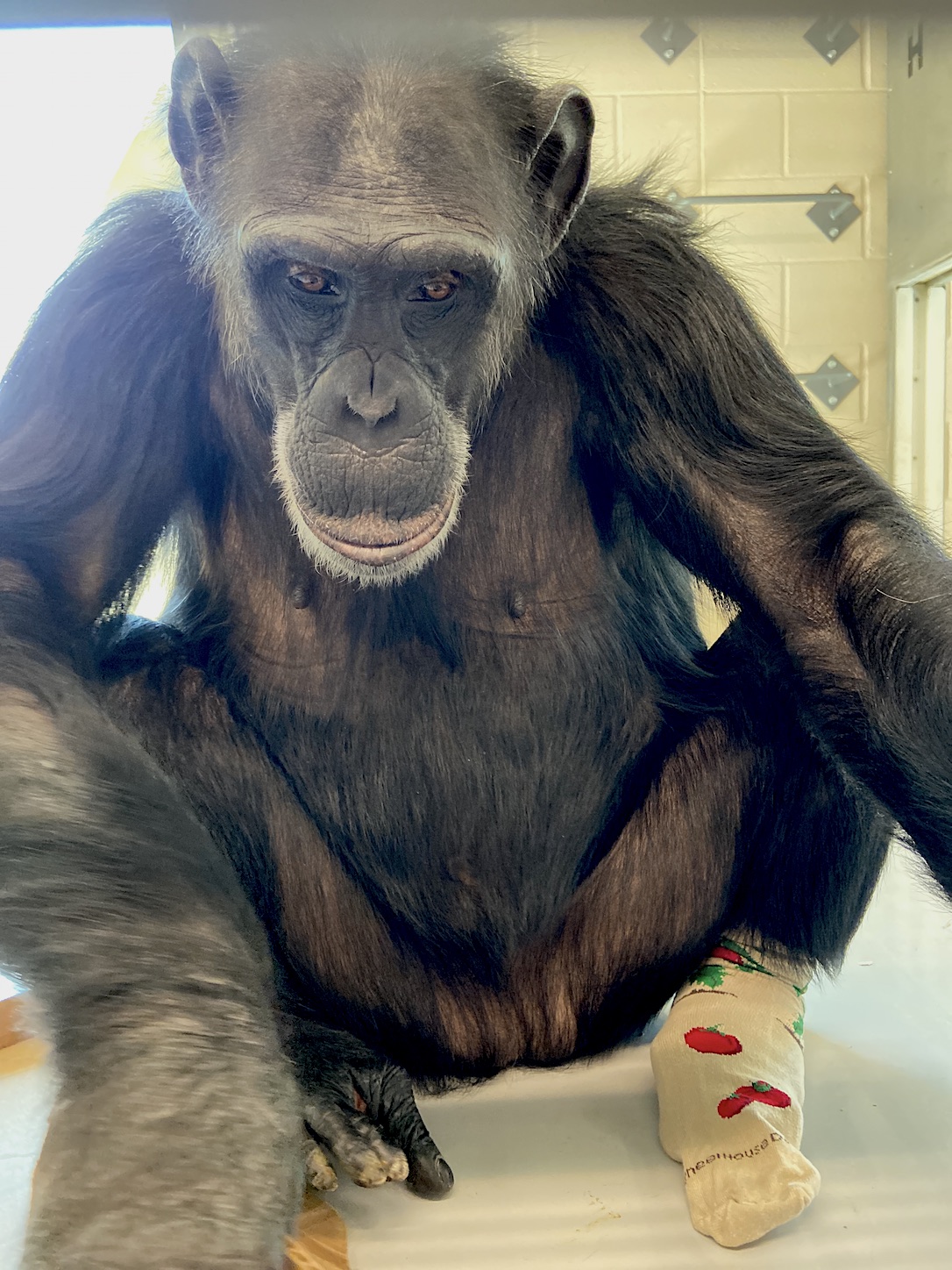
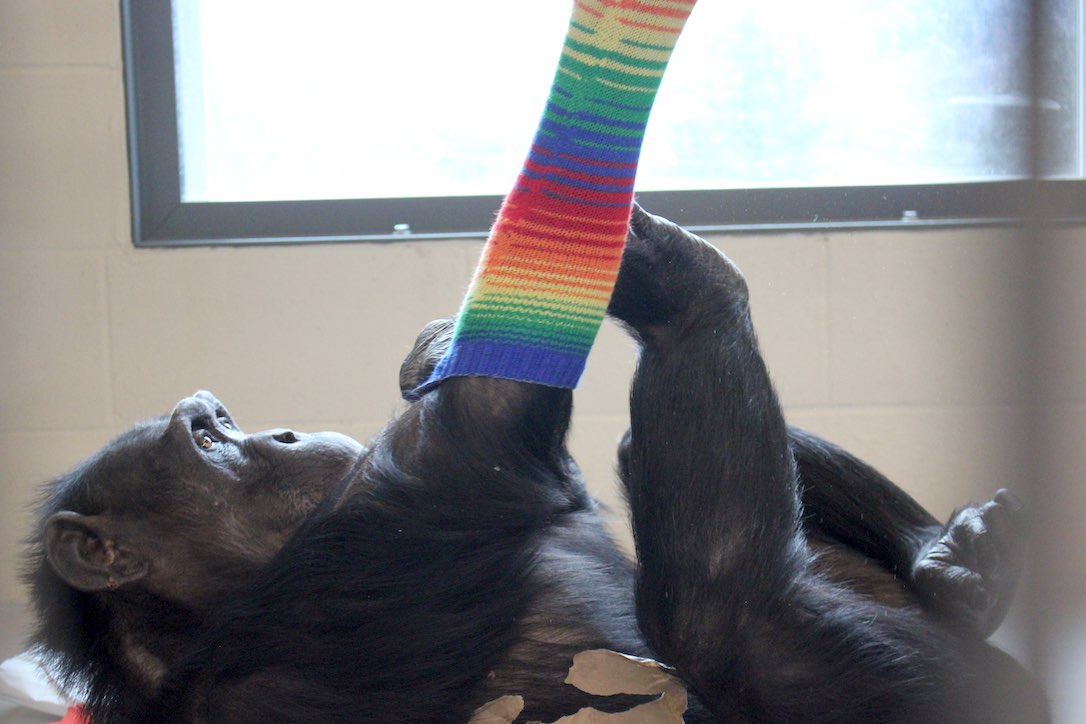
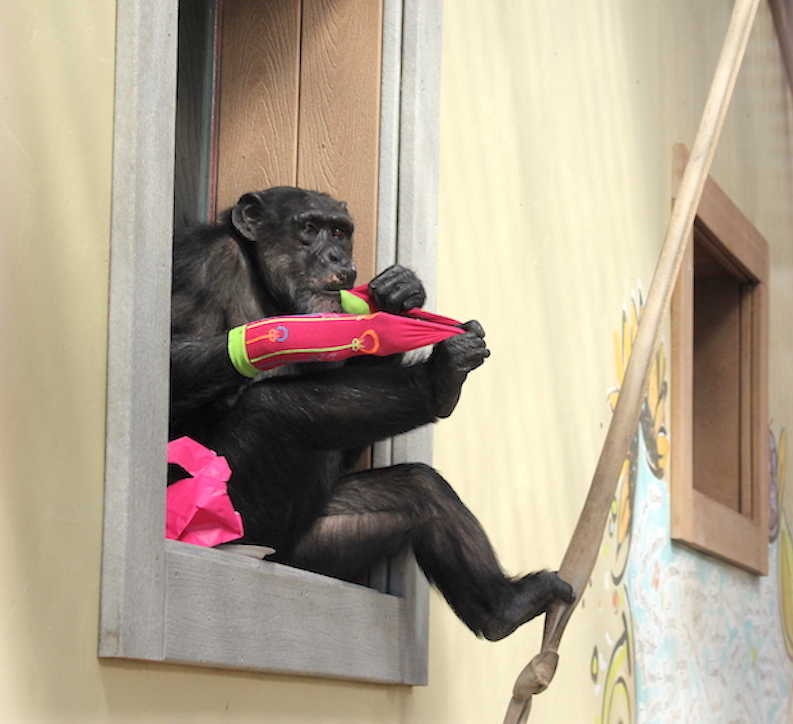
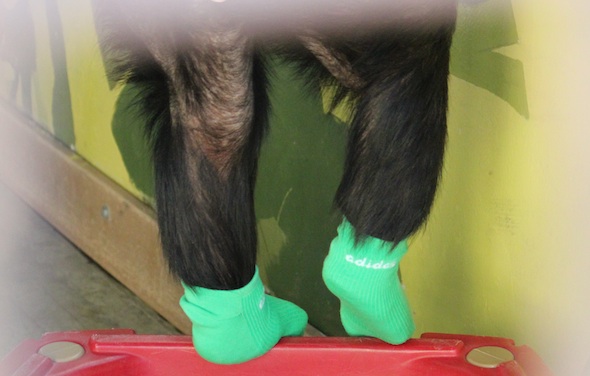
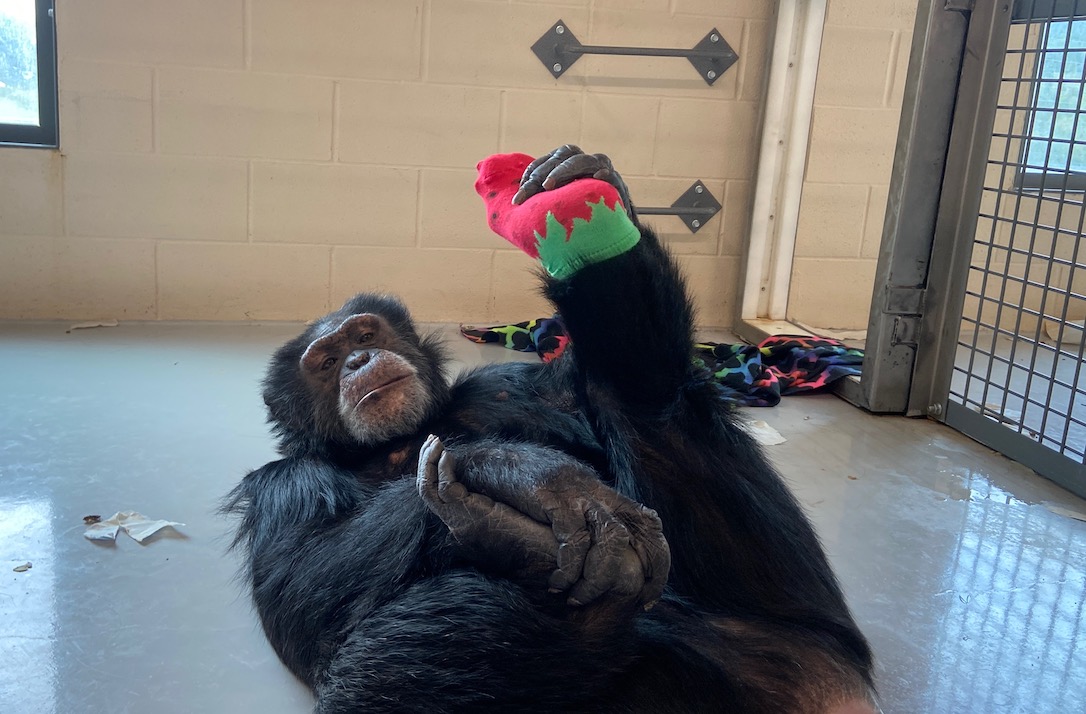
Socks

Missy wearing a sock while playing
Honey B wearing a tomato sock
Honey B pulling a sock on her arm
Missy with a sock on her arm

The photo of Missy above with a sock on her arm is from the first month that the seven arrived at the sanctuary. You can still see Missy’s shaved belly from the medically indicated hysterectomy she had before coming here. Our photography equipment and file saving procedures were in their infancy – that’s why I couldn’t find a larger photo.

Missy removing a sock from her arm


Missy’s feet in socks

To be fair, Mave and Jody are also pretty into socks:

Mave

Jody’s style is to wear the sock just over her toes

Jody

I was reminded of one other similarity today as I was shifting the chimpanzees during meals to make it safe for us to enter a space for cleaning; if you were a betting person and you had to bet on which chimpanzee in each group would hold up shifting, it would be very safe to put your money on Missy and Honey B (Willy B’s more recent bout of rebellion notwithstanding). Missy is generally the last person in her group to leave a space and the least motivated by food. Her daughter? Pretty much the same.

Filed Under: Honey B, Missy, Nesting, Play, Sanctuary Tagged With: animal protection, animal rescue, animal rights, Animal Welfare, chimpanzee, chimpanzee rescue, chimpanzee retirement, chimpanzee sanctuary, Chimpanzee Sanctuary Northwest, chimpanzees, Honey B, Missy, primate rescue, Primates

Running Toward The Future

December 1, 2020 by Chad de Bree

Before I get into the happenings of today, there was some BIG news announced today in our newsletter and social media sites (here is the Instagram post). Today, we announced the names of the group of six who will hopefully be able to call Chimpanzee Sanctuary Northwest home next year! We are all beyond excited to meet Cy, Lucky, Rayne, Terry, Dora, and Gordo! We are also truly grateful to all of you, the followers of this sanctuary, who have donated and spread the word about us on Giving Tuesday! All of your donations will help us continue to complete our expansion as quickly as possible so they can arrive next year! We all know this year has not been the easiest on anybody, but your constant generosity not only helps us provide care for our current residents, but also plan to bring more home! So thank you! Thank You! THANK YOU!

Lately, both Jamie and Burrito have been inviting caregivers to races around Young’s Hill. Some of you already know, Missy is not one to pass up a good run around Young’s Hill. Sometimes she just seemingly appears out of nowhere and passes you within a blink of an eye!

I am truly convinced she waits for everybody to leave first, so she can catch up! I found her today waiting at the bottom of the hill as Burrito and J.B. raced around.

She even found a place to stake out where on the hill Burrito and J.B. were.

And like a bolt of lightening, she was off! (Long before I could bring the camera up and realize she was gone!)

Missy even likes to take her lunch on the go!

Missy is known to have two speeds: 0 and 100. When she isn’t a chimpanzee pinball, darting and bouncing around Young’s Hill, she likes to take in the sights and sounds usually from the tallest structures.

Missy is amazing and we couldn’t imagine a life without her here!

BONUS PHOTOS:

Here are a couple extra photos of some other adventures today.

After breakfast, Negra was one of the first people to go out onto Young’s Hill, even before Jamie!

After she had her moment of basking in the morning sun, it was back to her nest.

Foxie decided today called for not one, but TWO dolls!

And Burrito pondering if this outing on Young’s Hill will be a race or stroll. (Luckily for this human, this time was just a stroll!)

Filed Under: Burrito, Jamie, Latest Videos, Missy, Young's Hill Tagged With: Animal Welfare, chimpanzee, chimpanzee rescue, chimpanzee sanctuary, Chimpanzee Sanctuary Northwest, chimpanzees, Sanctuary

Bovine Thanksgiving

November 29, 2020 by Anthony

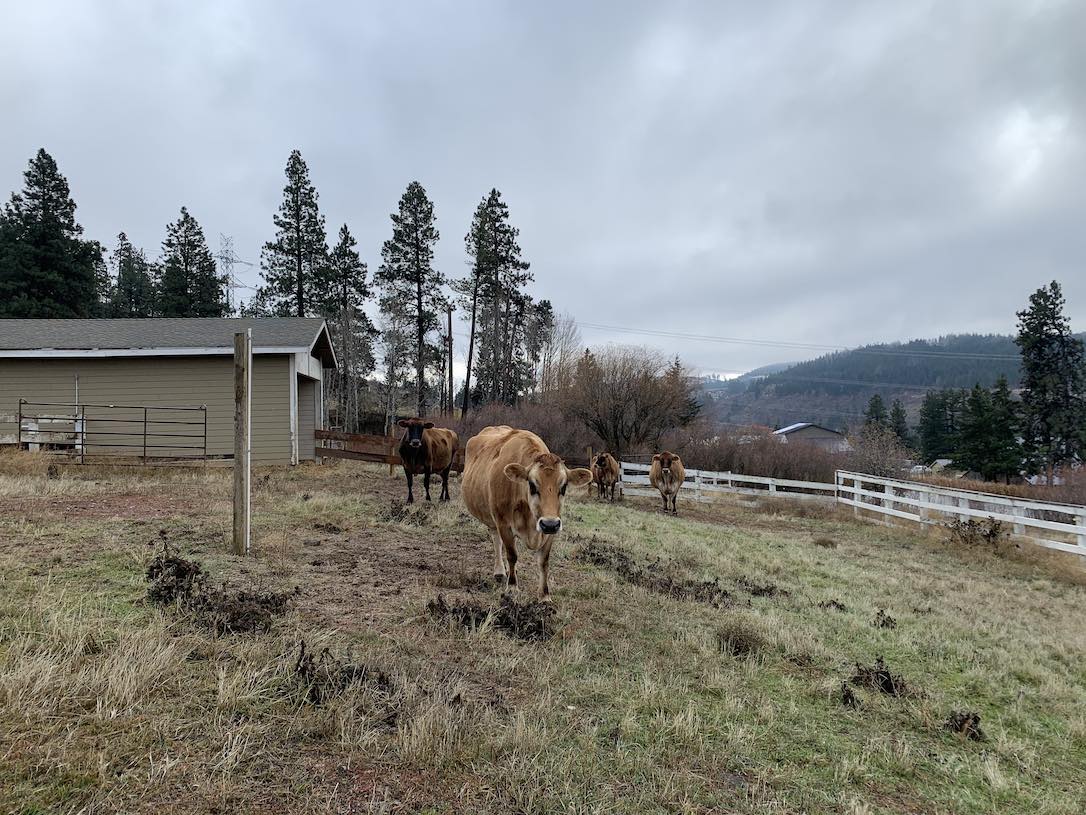
The sanctuary’s four rescued cattle have a pretty good life.

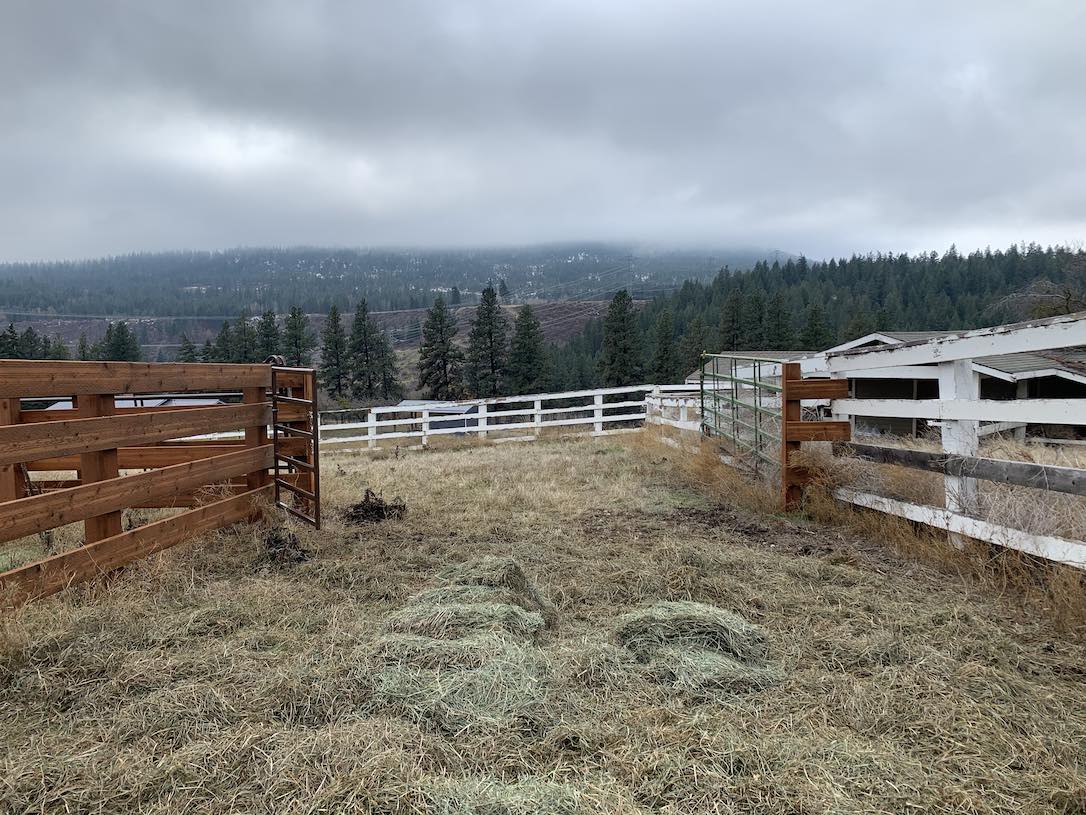
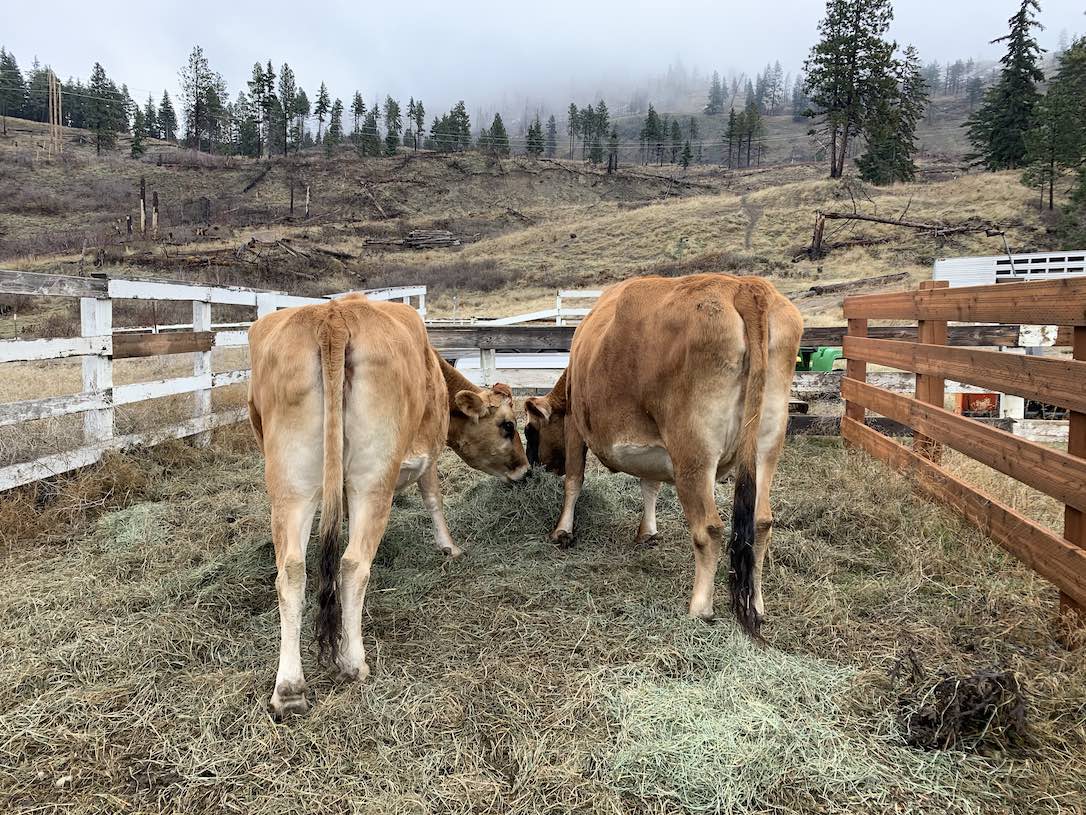
During the colder months, the bovines live in the winter paddock. Although it’s not as expansive as their full complex of pastures, this smaller area contains everything they need to stay happy and healthy. They have 24/7 access to fresh hay, heated water, and a couple of warm, straw-lined shelters. (Caregivers, on the other hand, have to muck these areas each day. That’s a story for another blog post.)

In the warmer seasons, they roam the grassy hillsides without much need for human interaction. You’ve probably seen a lot of this idyllic lifestyle on the blog. As with the chimps, we don’t always emphasize the barriers that contain these individuals, but we don’t want you to forget about them, either. The picturesque backdrops and dedicated caregivers cannot change that these four domestic cattle are living in captivity against their will. At times, it may even be necessary to confine them for their own safety. To offset the injustices of captivity, we are obligated to give them more freedom in whatever way we can, facilitating a lifestyle of relative comfort and choice.

For the cattle, the ability to roam around at will is paramount. Each winter, we typically keep the bovines in the paddock because the steep trails that lead to the other pastures turn into muddy slush. This slick terrain is not ideal for four Jersey cattle, so we close off the pastures to be safe. This year, we had to shut the gates in the middle of November, much earlier than we’d normally prefer.

Fortunately, the weather dried out and warmed up a bit last week; Thanksgiving brought us sunny and clear blue skies. While the chimps were napping off their holiday feast, we decided to open the swing gates to let the cattle back out onto their pastures.

When bovines get excited, they will trot, gallop and buck until they are content. The best time to see this behavior is when they get access to a new pasture. Even though it’s almost winter and it had only been a few weeks, they still seemed to appreciate having their familiar pastures once again.

P.S. Thanksgiving may be behind us, but there’s a lot to be excited about. In just a couple of days, we will be participating in Giving Tuesday and we have some exciting news to share!

Filed Under: Cattle, Farmed Animals, Latest Videos, Sanctuary, Thanks, Weather Tagged With: animal rescue, animal rights, Animal Welfare, bovines, cattle, chimp, chimpanzee, chimpanzee sanctuary, Chimpanzee Sanctuary Northwest, chimpanzees, Cle Elum, cows, farm animals, jersey cattle, jerseys, Sanctuary

Fun Inside, Outside, and In-between. Subtitle: Caging is OK

November 28, 2020 by Diana

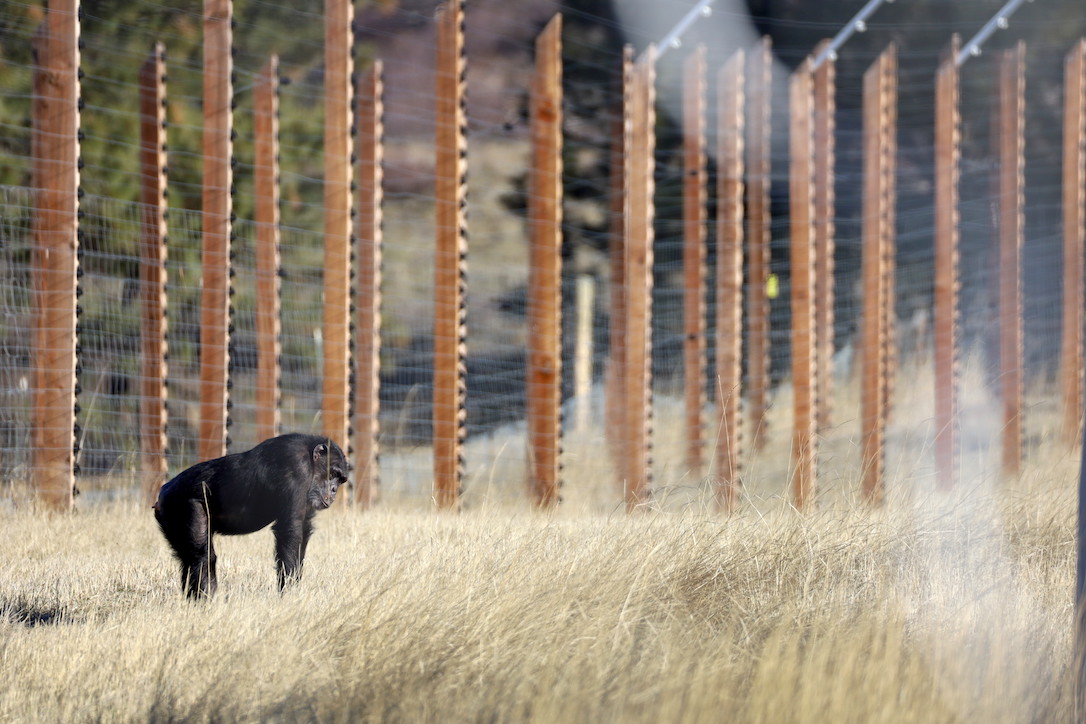
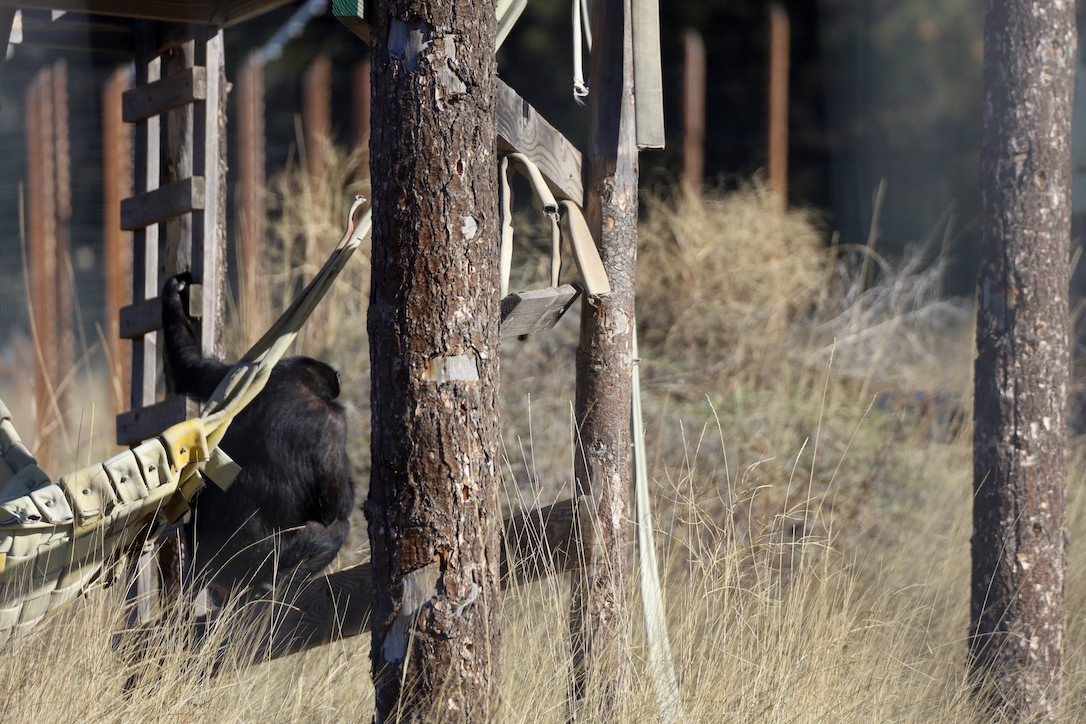
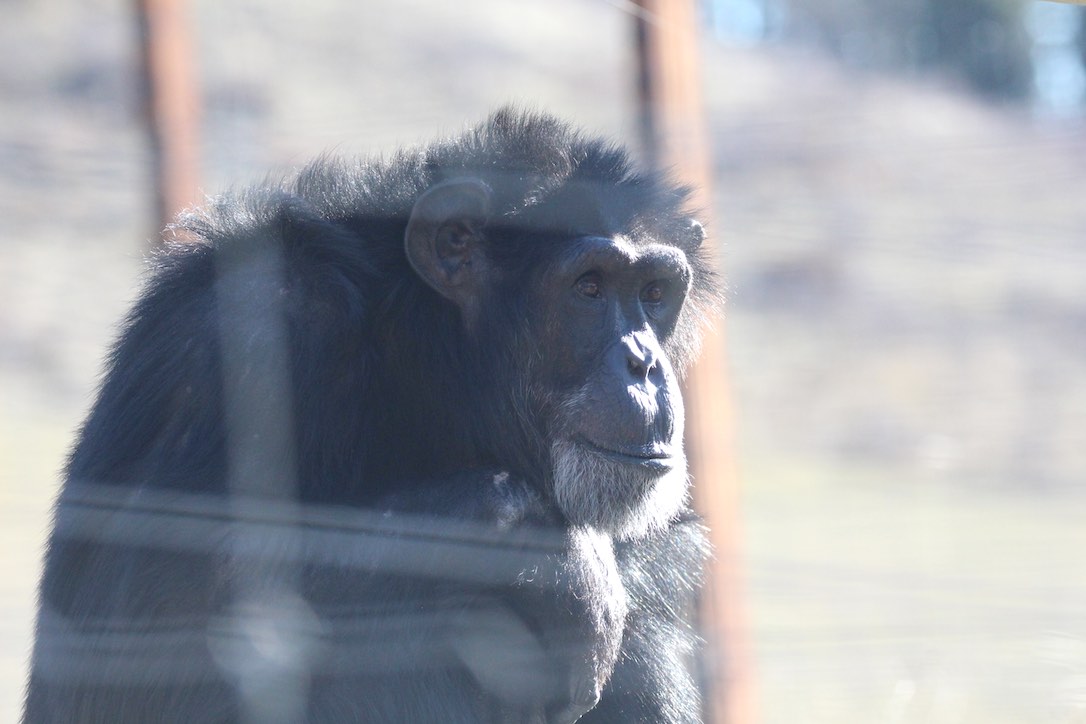
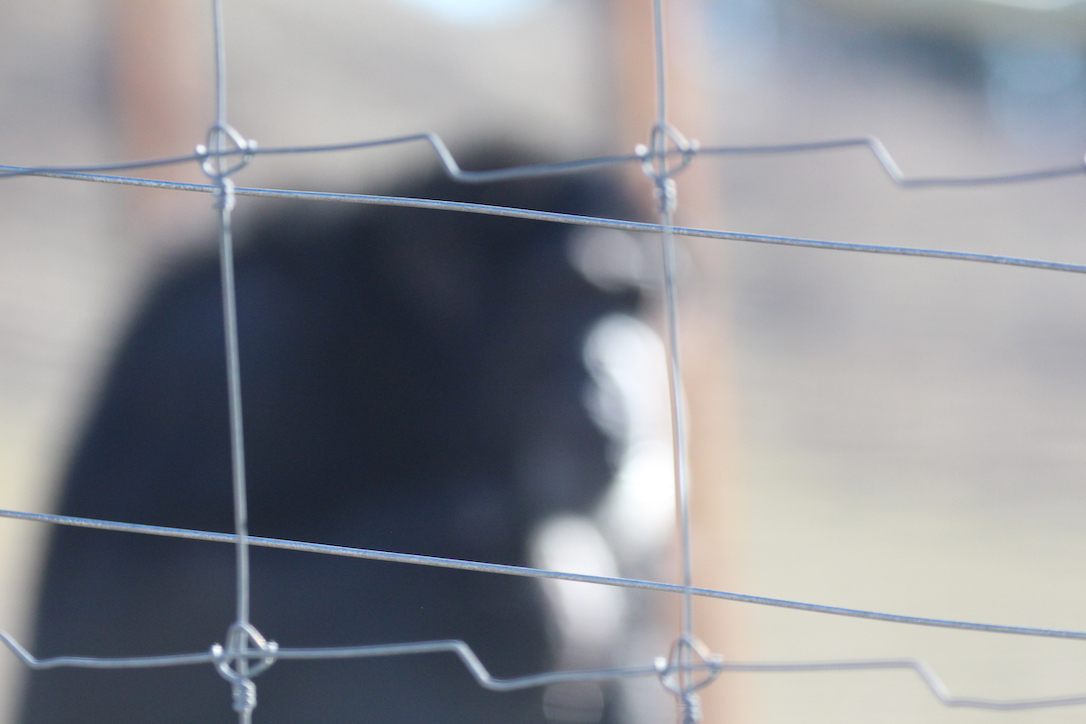
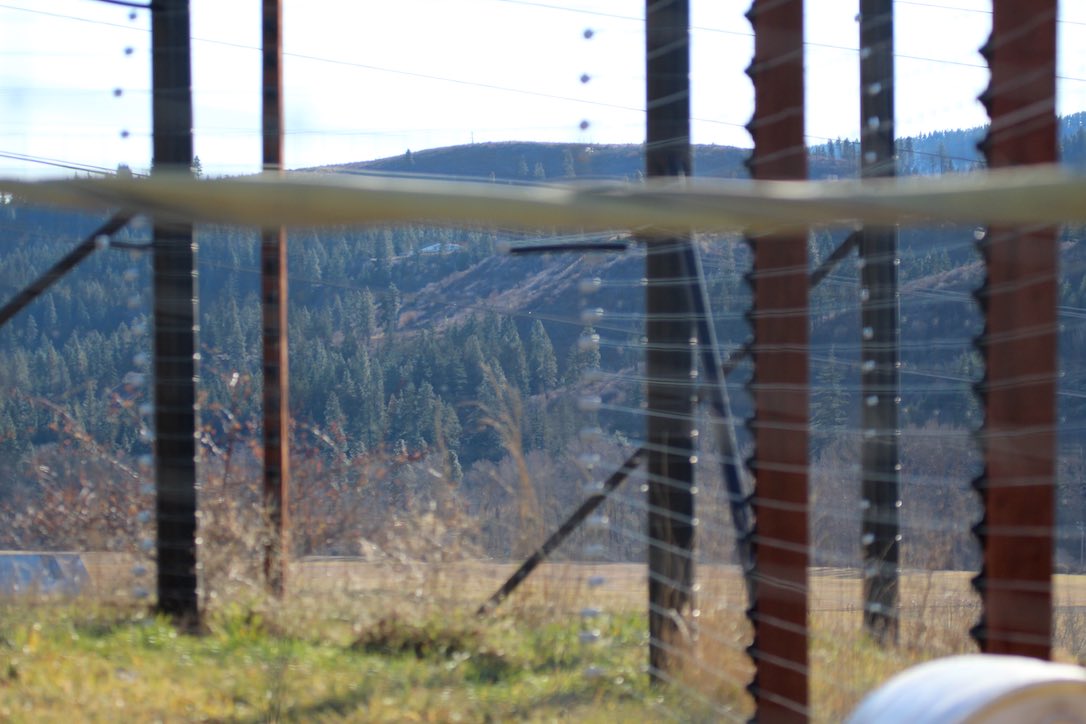
With the right camera lens and the right distance, we can “focus through” the fencing that surrounds the outdoor habitats so the fencing disappears or turns into blurs in the foreground.

It’s a trick of the camera. The fencing doesn’t actually go away.

But our eyes perform the same trick. This is roughly where Willy B was looking in the photos above and exactly what that hillside looked like to my eyes too.

We love sharing the sanctuary with loyal supporters and new interested folks too. One comment that people often make when they see a video from us for the first time on Facebook or Instagram is that the chimpanzees shouldn’t be indoors or “in a cage.”

I tried to answer this years ago in this blog post, but I felt it needed an update.

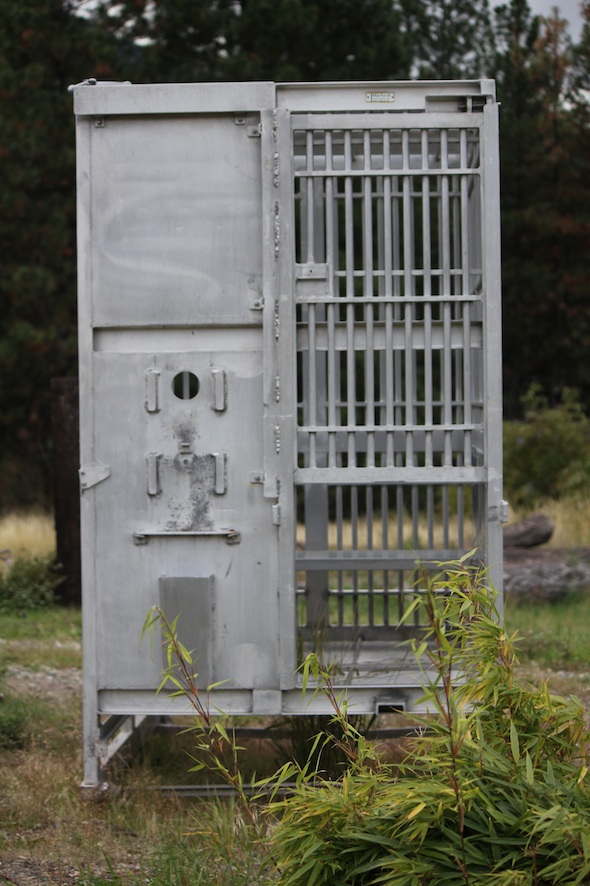
It is helpful to begin as that post did with the image of the type of cages that many of the chimpanzees at CSNW spent the majority of their lives:

cage outside

That is a cage.

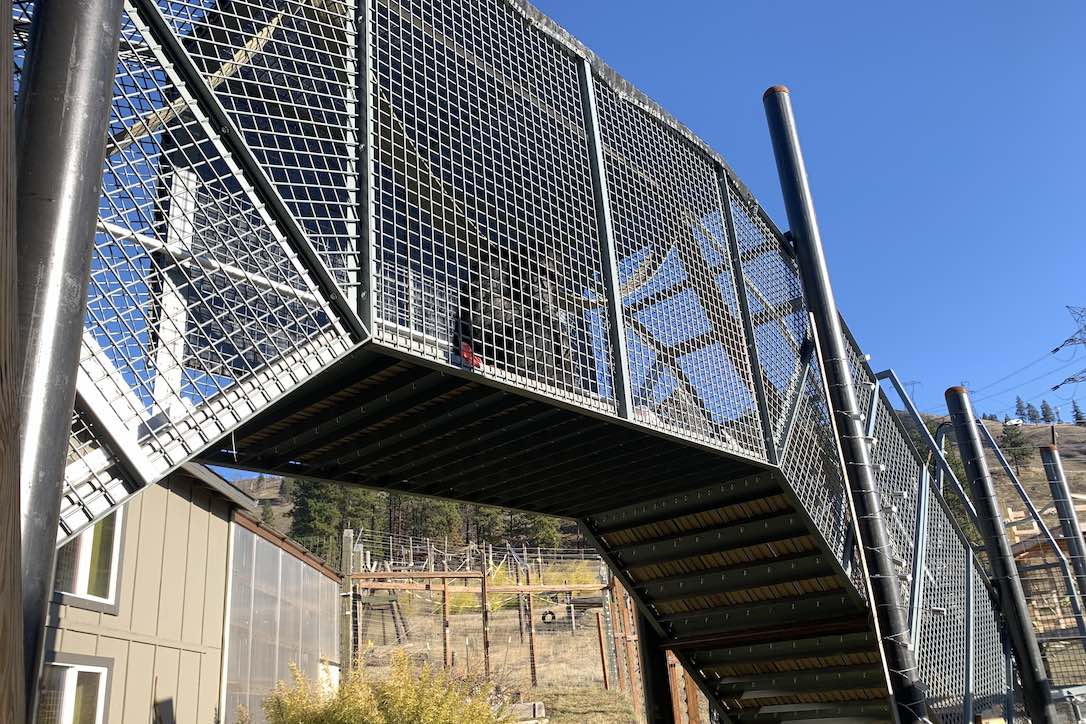
At the sanctuary, there is also caging.

Caging makes people uncomfortable. They want to see chimpanzees outside “where they are meant to be.” They want to imagine that they are free and close to nature.

I’m not immune to it myself.

Just yesterday, I noted what a lovely afternoon it was and tried to implore Jamie to go outside. The voices of my parents echoed in my head as I said, “you should be outside, it’s beautiful.”

When my parents issued similar sentiments, I’m not sure if I ever responded out loud “well then why aren’t you outside?” If Jamie could speak, she would have been right to ask me the same question. She was perfectly happy making a nest by the window in that moment.

We all have individual preferences, and how we want to spend our time can change from one moment to the next. The chimpanzees are the same.

They like different spaces for a multitude of reasons. I hope the video above illustrates both the utility of caging and also how the chimpanzees might view it differently than we do; without all of the symbolism that we humans put on it.

It took us a little more than three years from the time Negra, Burrito, Jamie, Foxie, Missy, Annie, and Jody arrived to give them Young’s Hill – their two-acre habitat surrounded by double electric fences.

In those three years, the chimps were not unhappy. They played, foraged, nested, and spent lots of time in the indoor/outdoor greenhouse.

We knew they should have more, and we wanted to see them truly “outside.”

I can’t imagine Jamie not having Young’s Hill now. She loves it. She owns it.

Negra, on the other hand, can take it or leave it. Seeing her outside in the spring, though, still takes my breath away.

We can’t get inside the heads of the chimpanzees. We can’t ask them what they are thinking. But we can observe them and watch where they choose to spend their time and how they utilize different spaces.

We can (and should) do things to encourage them to GET OUTSIDE, but it’s worth asking ourselves if we are doing that for their sake or for our own – to fulfill the vision we have of what chimpanzees in captivity should be doing instead of what they want to be doing.

These chimpanzees cannot live in the wild. Our job is to give them the best possible captive life possible, with lots of choice and variety, based on their individual needs, personalities, and quirks.

We’ll continue to blur the fencing out of some photos and put the cameras up to the caging for an unobstructed view, but it’s not because we want you to forget that it’s there; it’s so you can fully see the unique and wonderful chimpanzees who are choosing to do whatever they are doing in the moment when the camera shutter closes.

Filed Under: Caregivers, Chimp histories, Chimpanzee Behavior, Courtyard, Featured Post, Sanctuary, Weather, Young's Hill Tagged With: animal protection, animal rights, Animal Welfare, chimp cage, chimp enrichment, chimpanzee rescue, chimpanzee retirement, chimpanzee sanctuary, Chimpanzee Sanctuary Northwest, primate rescue, why are the chimps in cages

All Smiles

November 24, 2020 by Chad de Bree

Chimpanzee smiles are one of the greatest things to see. Granted let’s not confuse a true chimpanzee smile with a fear grimace. What most humans recall when they think of a chimpanzee smile are those usually found on cards or advertisements. Usually a juvenile chimpanzee dressed up in some costume, and full teeth showing with the edges of their mouth going from ear-to-ear. For those of us who work with or study chimpanzees, fully showing the upper and bottom rows of their teeth is the indication they are fear grimacing. Chimpanzees use the grimacing to show that something is causing them anxiousness or fear, or to show off their impressive canine teeth to intimidate another.

A true chimpanzee smile, one used for play and enjoyment, only the bottom teeth are usually exposed. I say usually because there are occasions where something may be super exciting or really funny is too hard to contain. In these circumstances, other chimpanzee behaviors are looked for such as laughter, breathy pants, etc. But once we, as caregivers, confirm they are indeed chimpanzee smiles, and if directed toward us, it makes the day so much brighter.

Here are a few I was able to capture of Mave. Both the lead up and the actual smiles.

First was last week as I entered the Willy B, Honey B, and Mave’s side of the building. She really wanted to play an interaction called “shoe tickle.” As J.B. described in his blog a few weeks back, “shoe tickle” is when the chimpanzees fully extend their fingers through the mesh and can only touch the bottoms of our shoes with just the tips of their fingertips. This is to avoid them grabbing us in some way.

Then there is this sequence from Sunday of her in serious play mode.

Yesterday I was able to catch Honey B’s smile during a play session as well!

(Note the coloration of Honey B’s eyelids! It’s one of the many, many, many things I love about her that makes her unique!)

I tried to round this off by getting some photos of Willy B’s smile and play face. However, as some of you know, he is really difficult to get photos of. Either he’s too close for the cameras we have on hand, or he stops doing what he’s doing if a phone is brought out. Though Willy B is serious about 85% of the day, the other 15% he can really be a goofball. Though most of the time he doesn’t showcase a smile or play face, once in a while he’ll let one slip and it’s amazing!

I tried to supplement it with someone who almost always has a smile on his face and can be heard throughout the sanctuary laughing nearly 95% of the day.

Though Burrito spends nearly the entire day laughing and playing, it actually can be difficult to get photos of his smile. But this is what I could get.

Hopefully these smiles brightened up your day as they do ours!

And remember:

When you’re smilin’, keep on smilin’ and the world smiles with you.”

-Louis Armstrong

Filed Under: Burrito, Chimpanzee Behavior, Honey B, Mave, Play Tagged With: Animal Welfare, chimp rescue, chimp sanctuary, chimpanzee, chimpanzee rescue, chimpanzee retirement, chimpanzee sanctuary, Chimpanzee Sanctuary Northwest, chimps, csnw, Sanctuary

The Bud Box

November 22, 2020 by Anthony

Primates and Bovines

Most of our staff were, at one point or another, either primatology students at nearby Central Washington University (CWU) or interns at the university’s Chimpanzee and Human Communication Institute. People are often surprised to learn that CWU students can specialize in primate behavior at the undergraduate, graduate, or professional certificate level. It’s quite the niche.

We sometimes joke about our research-oriented backgrounds whenever we catch ourselves doing strange tasks around the Chimp House (like fishing stray troll dolls out of the septic tank filter, perusing Amazon for Jamie’s next favorite picture book, or shoveling chimp-size paths through the snow on Young’s Hill). Irony aside, the people who use their Primate Behavior degrees exclusively for studying primate behavior are the true anomalies. The skills developed while studying primatology are widely applicable to a variety of different career paths, and most of us end up doing things we never even dreamed of when we were students.

This point was reiterated when I remotely interviewed for a caregiver position at CSNW. One of the topics that came up was that of cattle care, which is quite different from the other Chimp House duties and may have turned off some candidates. When J.B. asked if I had any familiarity with bovines, I responded that “I have never cared for cattle.” The phone went awkwardly silent for a second, and I quickly realized my strange wording suggested I didn’t like cows. Of course, I actually meant that I had literally never worked with them before, and I tried my best to convey that I was in no way prejudiced against cattle. In fact, I knew little about bovine health or behavior but was super stoked to learn.

Shifting For Safety

In some respects, taking care of chimpanzees is vastly different from managing domesticated animals such as cattle. Sometimes, though, the overlap is considerable. From my perspective, one similarity shared by all species is the tendency to not go where you want them to, making their care more difficult.

We’ve recently discussed the challenges of shifting chimps around the building so that we can safely unlock areas for cleaning. In some cases, such as Willy B’s epic filibusters in the Courtyard and the chute, we can make alternate plans that align with the chimps’ preferences. However, we don’t always have that luxury. On rare occasions, we encounter situations when we need the chimpanzees to leave an area for their immediate safety. These improbable events may be related to extreme weather, enclosure maintenance, or dangerous wildlife. In these critical moments, confused chimpanzees tend to pay less attention to their caregivers and are less likely to cooperate.

One example is that of Burrito’s rattlesnake encounter in Young’s Hill back in September. On that day, the chimps voluntarily came inside, letting us administer antivenom to Burrito and remove the snake from the habitat. In the weeks after, we prioritized recall training. To execute a recall, we invite the the chimps to return to the building, letting us close the doors in exchange for high-value treats. In a couple of cases, this proactive cooperation helped us to humanely relocate non-venomous snakes that had mistakenly found their way into the chimps’ outdoor enclosure. Once the warm weather returns in the spring, we will surely resume this training.

Note: We are frequently asked whether we intervene in fights by splitting the chimpanzees up. We usually do not. Separating a frenzied group of chimps during an altercation is extremely difficult since they are so focused on each other during these moments. They almost always resolve the conflict and reconcile without our assistance.

Other institutions do similar activities for the sake of their chimpanzee residents. At the closed Wildlife Waystation (from whence came Honey B, Mave and Willy B), caregivers are currently teaching the chimps to willingly shift into transport cages in case nearby wildfires threaten the facility again. This ongoing effort recently garnered some well-deserved media attention. As the sanctuary community works to re-home the remaining chimps, it’s good to know that their immediate wellbeing is still a top priority. When those chimpanzees make their way to accredited facilities like ours, hopefully they’ll be like Honey B and bring their cooperative attitudes with them.

The Bud Box

Of course, the chimpanzees aren’t the only CSNW residents who need this kind of training. The sanctuary’s four cattle are also managed using positive reinforcement, and training them to voluntarily enter a smaller corral is one of our top priorities. Plausible scenarios in which we would need to confine the cattle would be to address individual health concerns, to make repairs to the pasture fences, or to evacuate the herd due to a nearby wildfire. We also use a similar process to isolate them for their annual hoof trims and vaccinations. In all of these cases, the first step is to get them out of the larger pasture and into a smaller corral. From there, we herd them into an even smaller pen and then into a narrow chute that allows for safe handling. Cattle are naturally skeptical of anything that seems different (and for good reason), so anything we can do to familiarize them with this process has a positive effect on their welfare.

The key to all this is the Bud Box. Although it sounds like a monthly subscription service for cannabis enthusiasts, the Bud Box is actually a type of cattle pen named after its late inventor, Bud Williams. Bud’s design was (and remains) quite simple: a rectangular enclosure that has one or more outflows located near the main entry gate. Cattle will often turn back once they encounter a dead end, at which point they easily divert into a narrow chute for veterinary care or transport. This relatively cheap design is wildly effective and popular. J.B. built our sanctuary’s Bud Box shortly after the cattle arrived, and it’s already proving to be worth all of his hard work.

Source: Michelle Proctor, University of Missouri

As the above diagram shows, the Bud Box is designed to keep the cattle “flowing” into the chute without much human participation or promise of reward; their aversion to containment drives them through. Ideally, all the human operator has to do is close one gate and open another. Still, it can work better if the animals are familiar with the pen and relatively relaxed. Training is one way to achieve this.

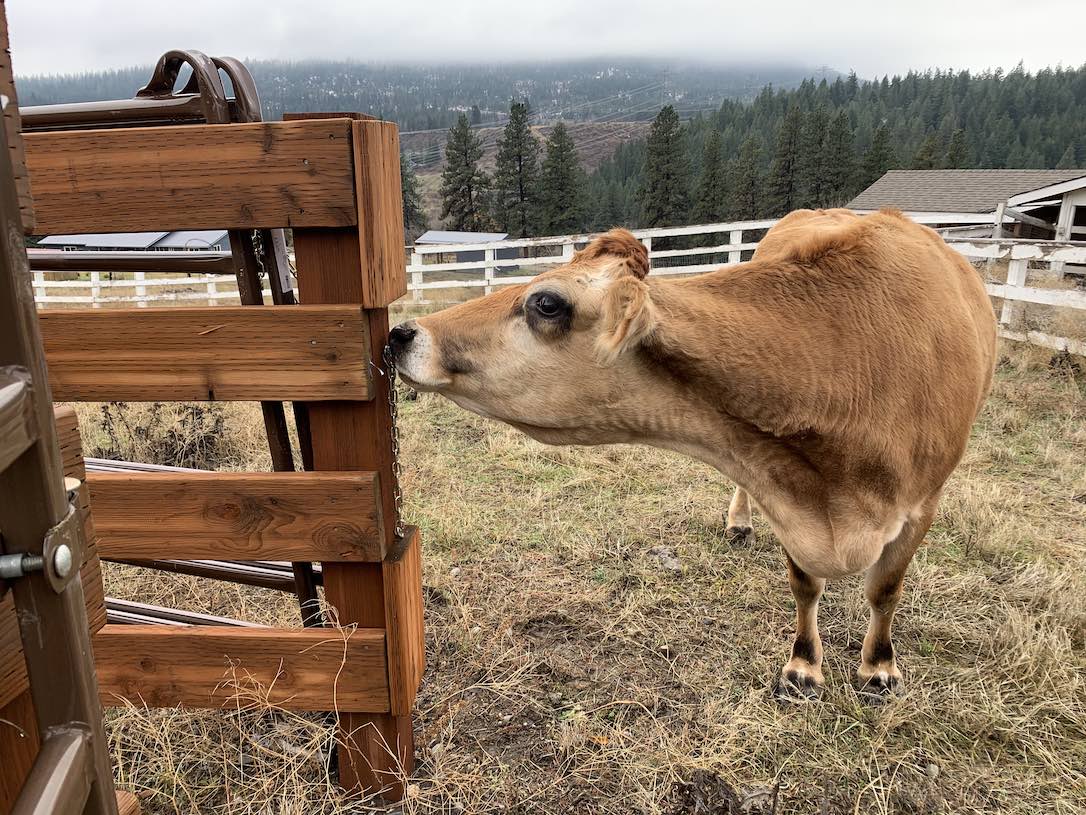
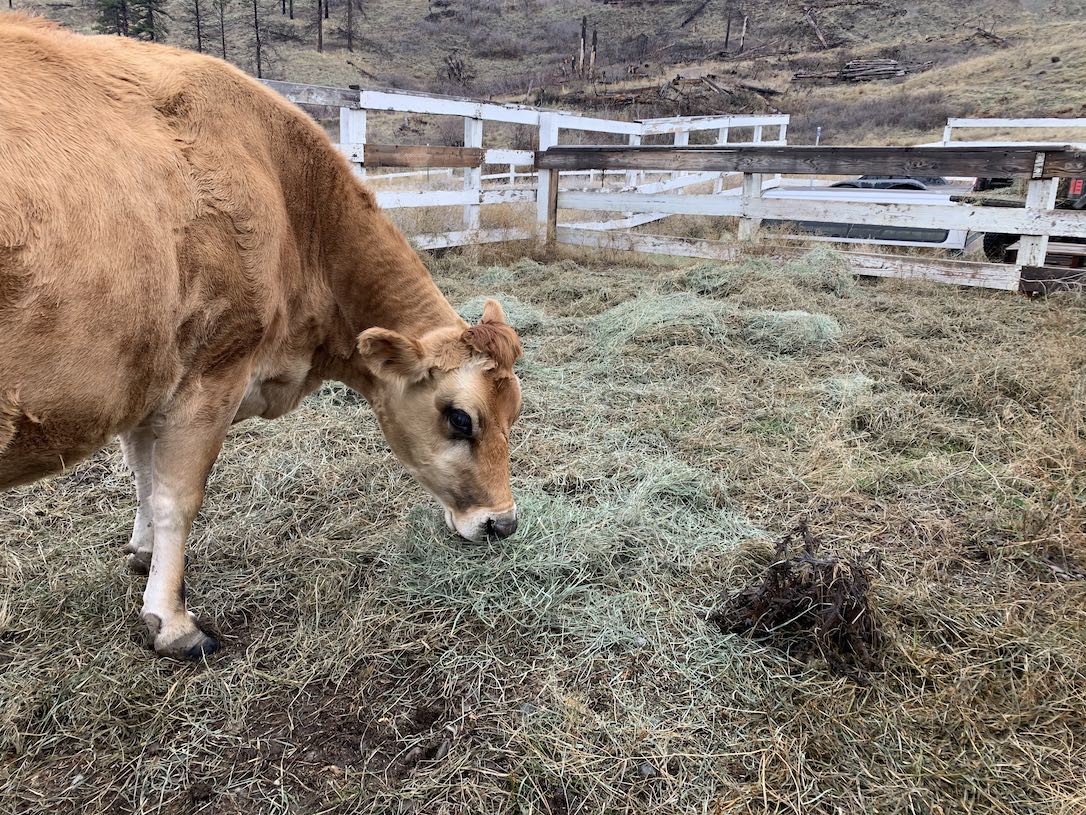
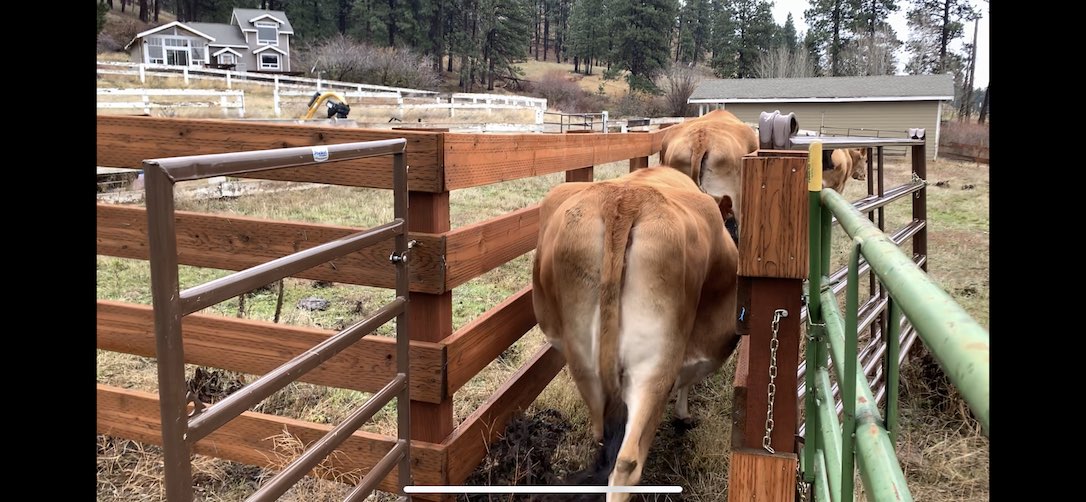
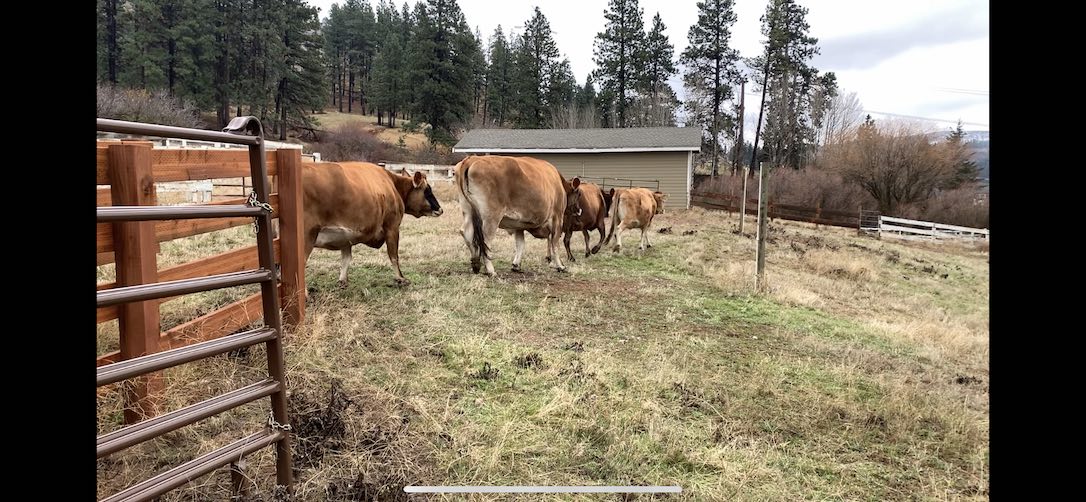
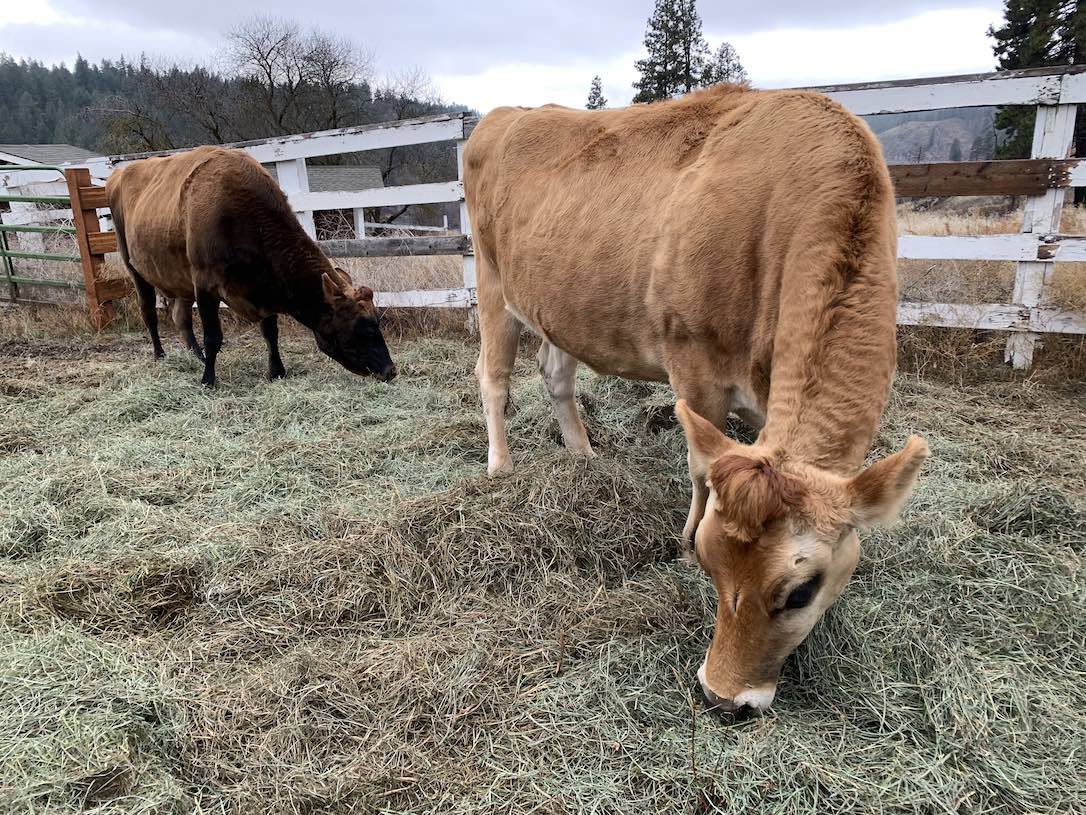
Erin and I have been doing some Bud Box training recently. During these sessions, we put some of the bovines’ regular hay into the box and then briefly close them inside. Then, we open the side gate so they exit through the corresponding chute, receiving the rest of their hay as a reward. Afterwards, we leave the swing gate wide open so that they can re-enter the Bud Box for any leftovers. The following photos show a step-by-step record of the entire process (in case you want to try it with your beloved Jersey cattle at home).
1. With the swing gate open and the chute gate closed, we place an alfalfa/grass hay mixture into the Bud Box and call the cattle over.
2. The cattle come into the corral voluntarily and slowly walk toward the Bud Box. We close the pasture gates behind them.
3. Honey is the bravest. She takes a good sniff of the Bud Box before entering.
4. Honey settles and begins to forage.
5. More skeptical individuals tend to hang back. Meredith need a moment to observe her mother eating safely.
6. The number of cattle in the Bud Box suddenly doubles as Meredith joins Honey inside.
7. Betsy comes over, too.
8. Betsy begins to eat. Nutmeg is the last one to arrive.
9. Nutmeg needs to lick things.
10. With the cattle happily filling their bellies, I close the swing gate behind them.
11. Nom nom nom nom nom
12. Once they’ve eaten a bit, I open the side gate so they can exit via the chute.

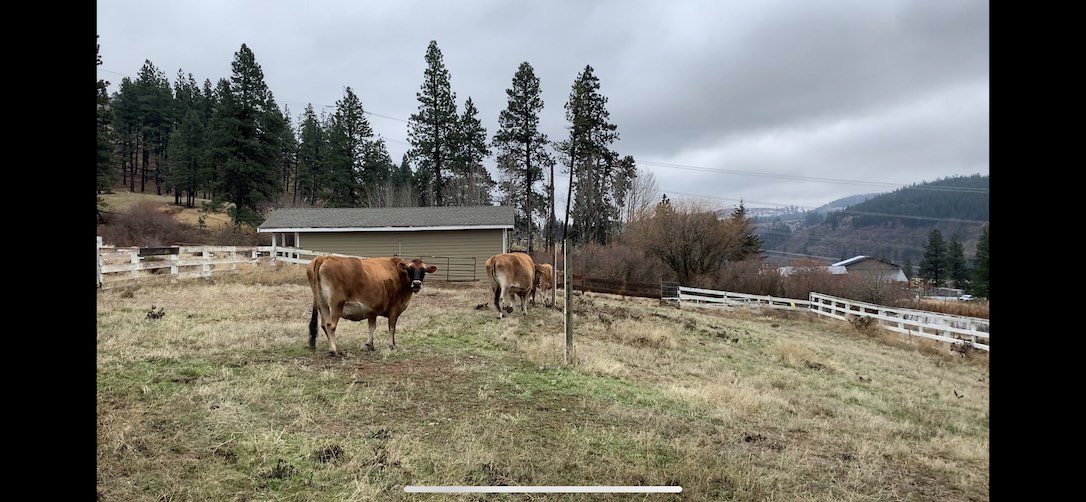
13. Although they eagerly leave the Bud Box, they soon decide to go back to it and scarf down the remaining hay.

Our plan is to continue this training on a weekly basis until the cattle calmly enter the Bud Box and exit via the chute with only a tiny bit of coaxing. It may seem like a lot of work now, especially for a bunch of primatology nerds like us, but this training could prove invaluable if we ever have to round up the cattle in a hurry.

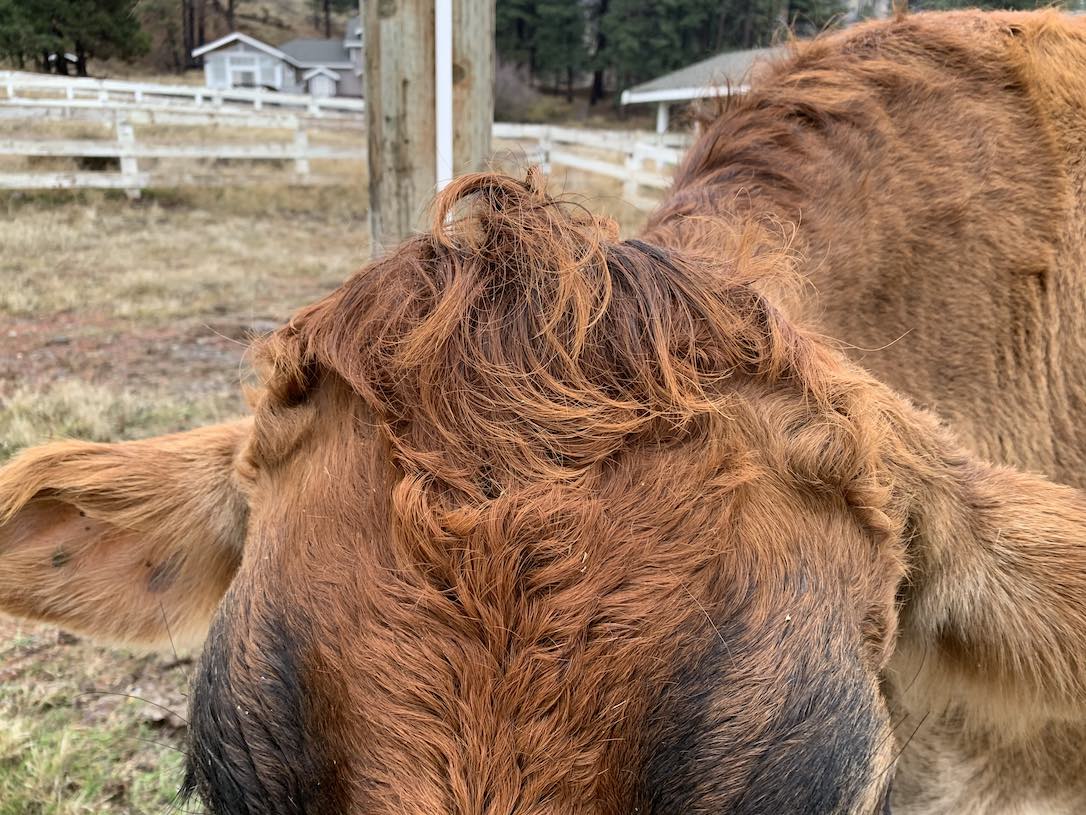
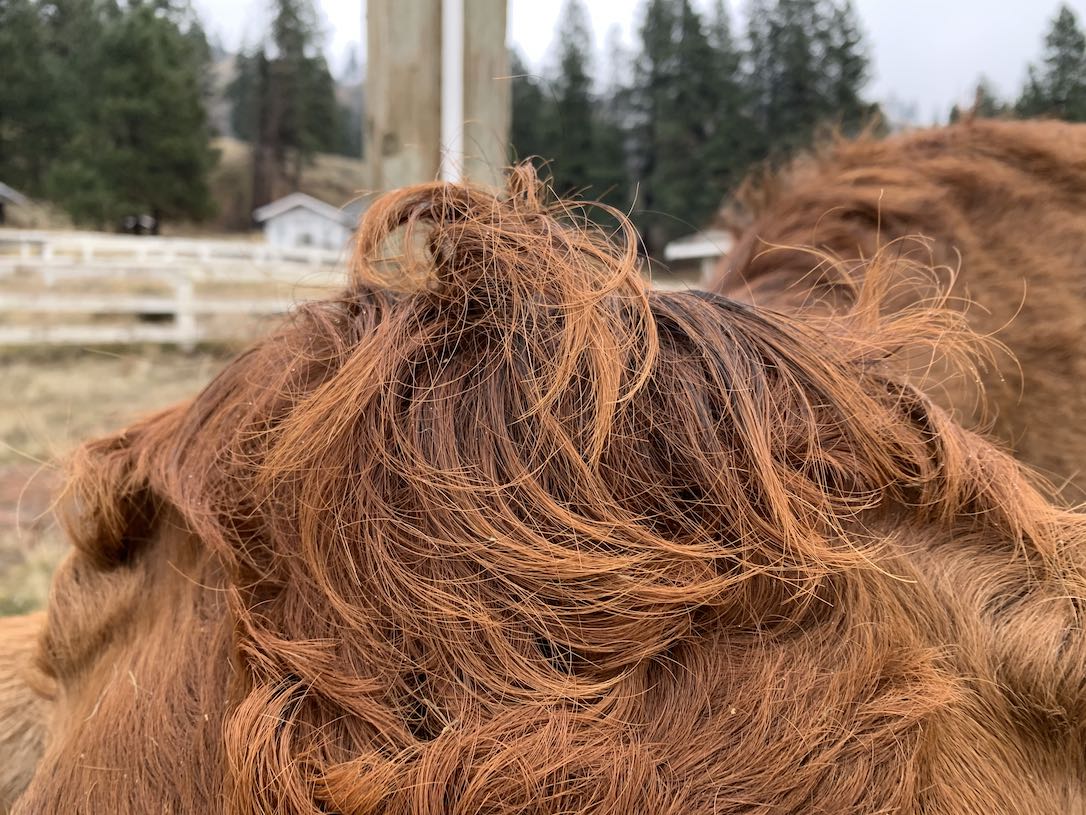
In the meantime, I think we all need to appreciate how awesome Nutmeg’s hairstyle is. This anatomical feature is actually an occipital protrusion called a poll, but I think it looks more like a messy man-bun. Either way, he rocks it.

Filed Under: Cattle, Farmed Animals, News, Training, Weather Tagged With: animal behavior, animal rights, animal training, Animal Welfare, animals, bovines, bud box, cattle, chimpanzees, cows, emergency management, jersey cows, livestock, positive reinforcement, ranching

  • « Go to Previous Page
  • Page 1
  • Interim pages omitted …
  • Page 29
  • Page 30
  • Page 31
  • Page 32
  • Page 33
  • Interim pages omitted …
  • Page 235
  • Go to Next Page »

Primary Sidebar

Subscribe To the Blog and Get Notified of New Posts First!

Archives

Calendar of Blog Posts

June 2026
S M T W T F S
 123456
78910111213
14151617181920
21222324252627
282930  
« May    

Categories

SUBSCRIBE TO OUR NEWSLETTER

Footer

PO Box 952
Cle Elum, WA 98922
[email protected]
509-699-0728
501c3 registered charity
EIN: 68-0552915

Official DDAF Grantee

Menu

  • The Chimpanzees
  • Blog
  • About Us
  • You can help
  • Resources
  • Contact
  • Donate

Proud Member of

Connect With Us

Search

Copyright © 2026 Chimpanzee Sanctuary Northwest. All Rights Reserved. Site by Vegan Web Design