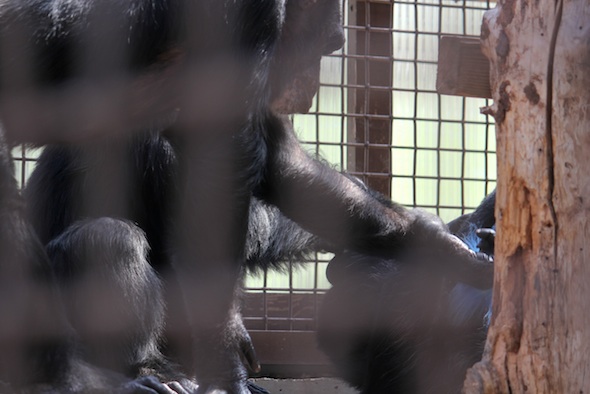
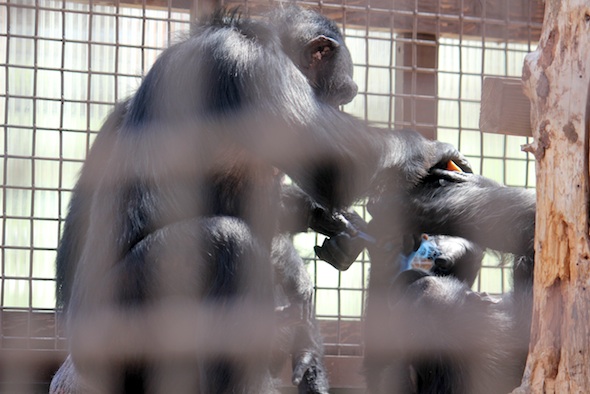
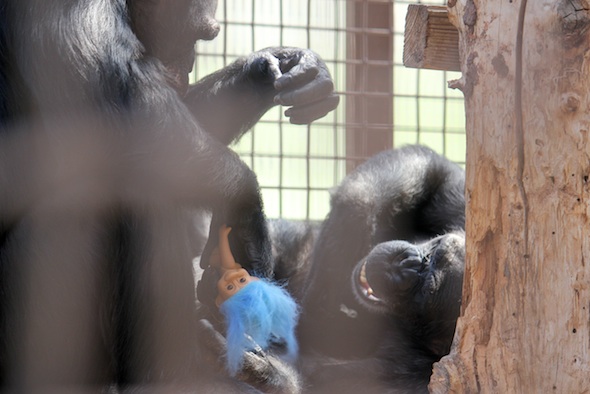
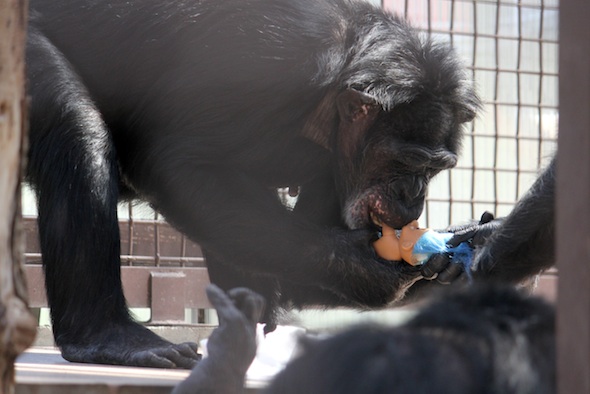
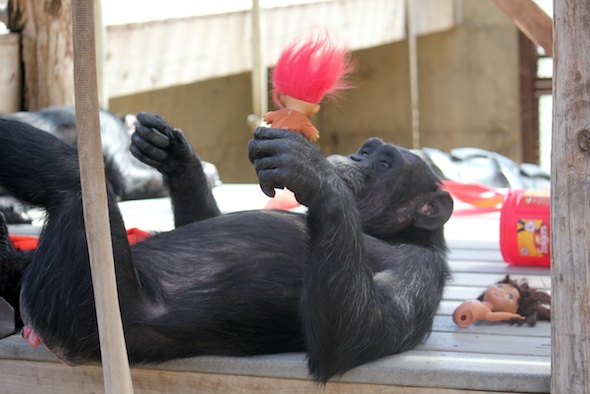
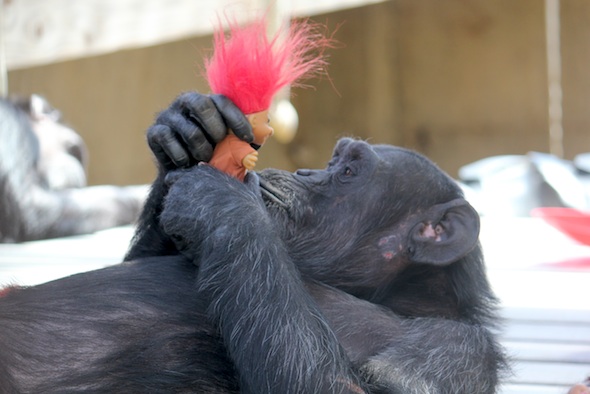
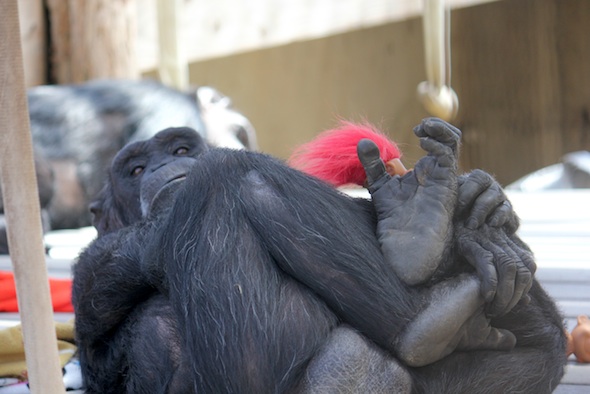
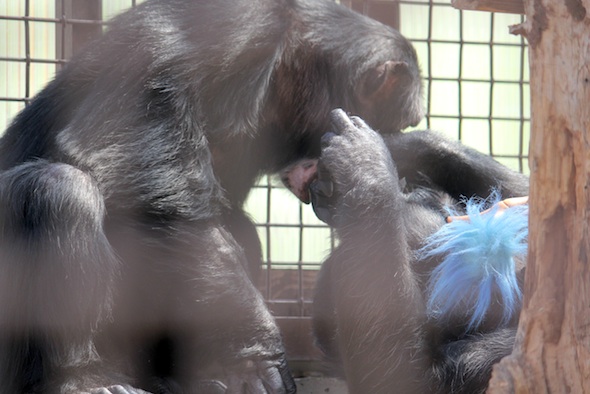
Okay, okay — I know I just posted a bunch of Foxie photos yesterday, but this video was just too much fun to not post. So, here she is, the nearly 38 year old chimp who is going on six. 🙂
animal protection
Foxie with a new troll and outreach updates
If you are active on our Facebook pages and like to see updates about the chimps there—I have some important news! We have decided to share more photos of the chimps on our main page and close down the individual chimp pages, so it’s all in one place and more people will get to see stories about the Cle Elum Seven. We have made dedicated photo albums of each chimp and will be transferring photos from their individual pages to these albums this week.
We’re also going to participate in the social media challenge of 100 Happy Days. The idea is that for 100 days in a row, we will post a picture of something that represents happiness for the sanctuary. Really, every day is a happy day in sanctuary, so this shouldn’t be too hard! We will use the hashtag #100HappyDays so that any other person participating in the challenge will see our posts, too. I think it will be a lot of fun and I hope you all will enjoy it. We will do the majority of the posts on our Instagram and Pinterest pages, but will post them to our Facebook page as well once a week. Even if you don’t use those social media sites, you can still view the photos!
As a side, we are SO close to reaching 10,000 likes. How awesome would it be to reach that goal? Anytime you like, comment, or share a post from our page you help to get more friends for the sanctuary, and we can always use more friends! I’m making it a personal goal to reach 10,000 likes by the end of the 100 Happy Days. Even if it means I have to hunt down another 300 friends just to make it! But something tells me that with all our wonderful and caring supporters, it won’t be too hard to get you all to share some of our posts and encourage yours friends to like the page.
Anyway, on to the most important part of this post—Foxie with a new troll! 🙂


Friendships
It’s Friend Friday! Okay, well, we may have made that up last week—but it turns out that it actually is a thing! So, we thought we’d keep the trend going and post about some friendships today.
This morning I got a video of rambunctious play between Foxie, Diana, and Burrito. At one point, Burrito turned toward Foxie and they started to play with each other. This is really important for their bonding, and we as caregivers tend to take a step back and let them play on their own. You’ll see in the video that Diana did just that. Later on, Jody joined in too, and started to play tug with Foxie. Foxie looked toward Diana to keep playing with her, but Jody was so insistent that Foxie play with her that Diana encouraged Foxie to direct her attention back to Jody.
This is a little bit longer than the videos I usually post, but the whole thing was so great I had a hard time cutting anything out. Enjoy, and please share on social media with the hashtag #FriendFriday!
Photos from today and Negra’s Journey
Check out this post on One Green Planet we posted today about Negra. It’s truly a wonderful story and we’d love it if you would share it on social media, or just forward the link to your friends!
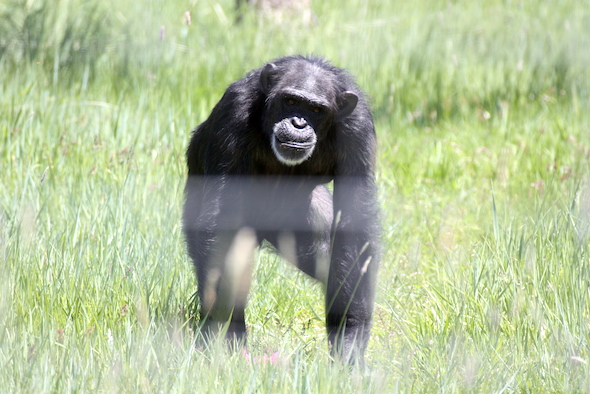
Here’s some pictures I took today — the weather is absolutely gorgeous so we set up a quick lunch forage for the chimps to enjoy!
Foxie:
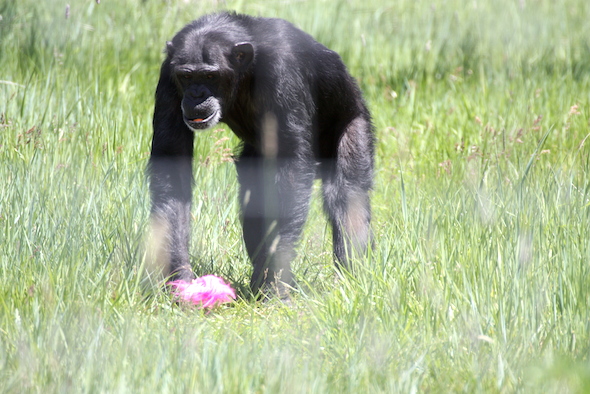
Burrito:
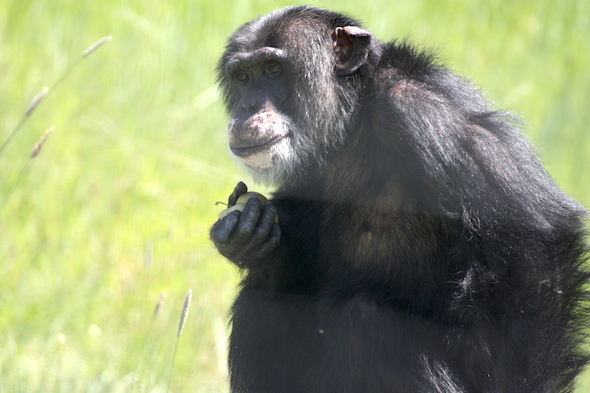

Jamie checking out some welding work J.B. was doing down at the caregiver house:

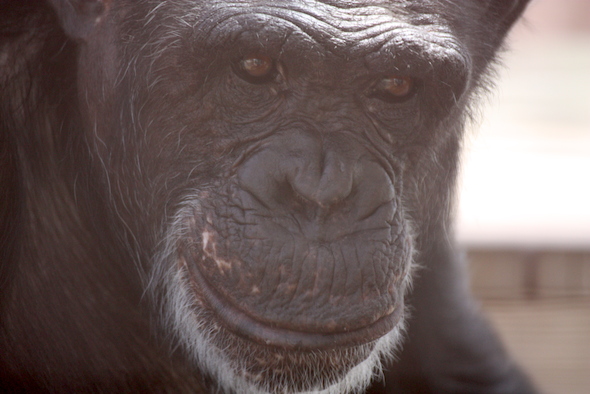
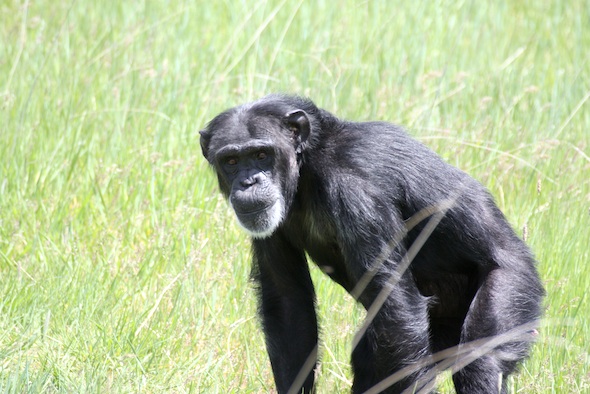
And then she took her pile inside to enjoy and let me snap this nice head shot of her:
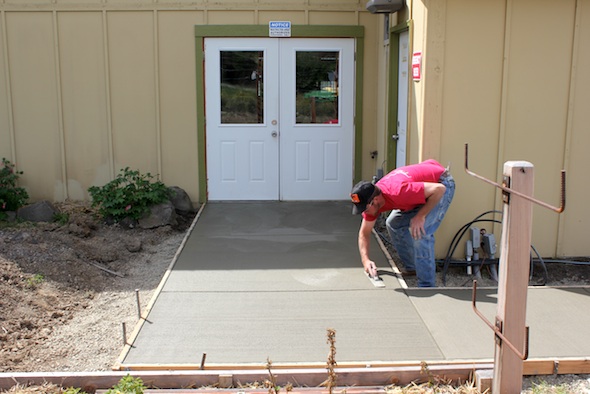
Sidewalks!
You may have picked up that Katelyn mentioned that J.B. and Ken Mikkelson were prepping the areas around the chimp house for sidewalks on Wednesday, and yesterday the Poppoff crew came out and started work on forming the concrete. Today they finished the sidewalks and now they are curing and drying so we can start using them in a few days. The Poppoffs are long-time supporters of the sanctuary and have helped us with other construction projects including Young’s Hill and even years ago when we created the greenhouse.
So, why sidewalks? It’s all part of the veterinary clinic project that we started last year. The cement pad in front of the gate will make it easier if we need to move big equipment in or out of the chimp house, including the trailer itself. The sidewalks go from the chimp area doors to the clinic, so we can easily transfer a chimp to the clinic if we need to. They also will be much nicer to shovel and put ice melt on in the winter! So, we are pretty excited about these sidewalks.

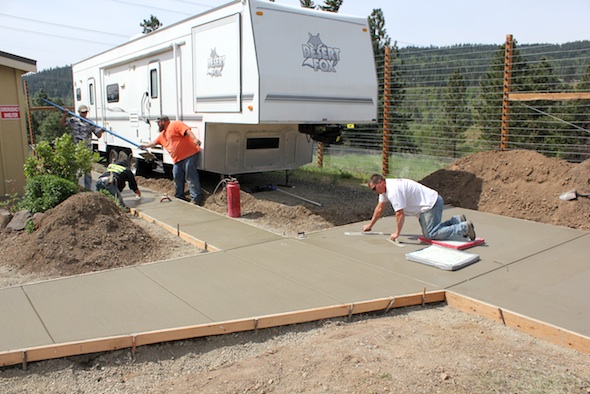
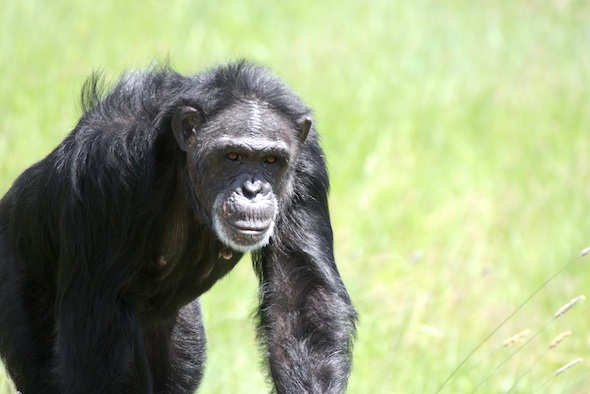
The chimps were very interested in all the work going on, and watched from Young’s Hill:
Protecting Mountain Gorillas through Community Involvement
This is our first guest blog post about gorilla conservation, written by Gretchen Clymer. Gretchen first became passionate about primate conservation after reading Gorillas in the Mist by Dian Fossey as a teenager. She went on to complete undergraduate and graduate studies in Biological Anthropology, conducting behavioral research on different primate species, including golden lion tamarins, rhesus macaques, and chacma baboons. She has worked for the Dian Fossey Gorilla Fund International (DFGFI) in both Atlanta and Musanze, Rwanda. As a primatologist, she has remained active in primate conservation and welfare, including currently working with Chimpanzee Sanctuary Northwest.
—
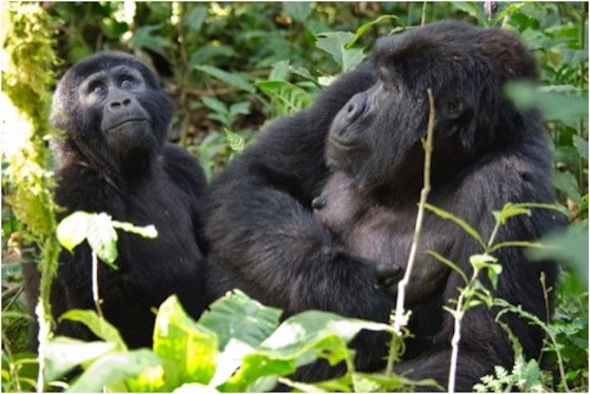
Bwindi Impenetrable Forest, Uganda. Photo: Ian and Kate Bruce, 2013.
The threats to the survival of mountain gorillas, and all of the great apes, are severe and multi-faceted. Habitat loss due to logging and industry, armed conflict, the illegal bushmeat and pet trades, and infectious disease represent significant threats to the populations of chimpanzees, gorillas, and orangutans. Over the past 50 years, approaches to ape conservation have shifted as conservationists understand more and more that survival of ape populations is inextricably linked with the welfare and involvement of the communities that live near chimpanzee, gorilla, and orangutan habitats.
Early approaches in conservation
The pioneering research conducted by Jane Goodall, Dian Fossey, and Birut? Galdikas in the 1960’s-1970’s brought the world’s attention to the fascinating behaviors of the great apes. Their work also brought to light the pressures that threatened the very survival of chimpanzees, gorillas, and orangutans. Conservation approaches at that time were largely focused on preservation of habitat, and the assumption that conservation of apes and their habitat was primarily realized through enforcement. Dian Fossey, in particular, championed methods she called “active conservation,” that were often antagonistic towards communities residing on the fringes of mountain gorilla habitat. This method of conservation focused only on protecting mountain gorilla populations while failing to take into account that poachers, loggers, and encroachers were not motivated by maliciousness, but rather the simple and stark need to provide for themselves and their families.
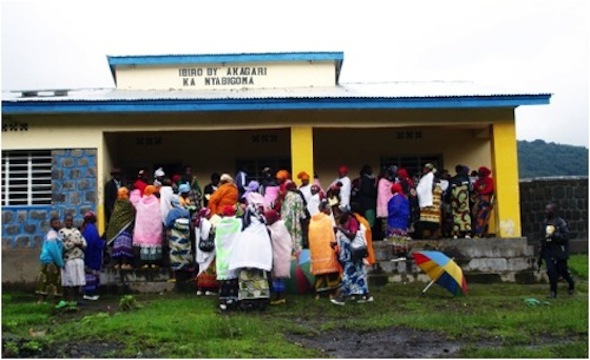
Bisate Health Clinic, Musanze, Rwanda. Photo: Gretchen Clymer, 2007.
The shift towards community-involved conservation
Habitat preservation is certainly paramount in working for the survival of the great apes, and this requires legislation to protect habitat as well as enforcement of existing legal protections for ape habitat and poaching bans. However, as approaches in ape conservation have been refined over the last 50 years, conservationists have learned the importance of embracing local communities in conservation, and of the intertwined relationship between human welfare and ape conservation.
Since Dian Fossey’s untimely and tragic death in 1985, the Dian Fossey Gorilla Fund International (DFGFI) and other mountain gorilla conservation groups have taken a different approach to conservation, focusing on including the local community into conservation efforts, through community programs, research, and eco-tourism.
It is estimated that “gorilla tourism may exceed $30 million USD shared between Rwanda, Uganda and the Democratic Republic of Congo (DRC)” (International Gorilla Conservation Program, 2014). Gorilla and other great ape eco-tourism not only brings money directly to conservation efforts by providing funds for anti-poaching patrols and research studies, but also helps to create a link to the local community by establishing a tourism industry, which in turn provides financial security to the area while actively discouraging unsustainable poaching and deforestation practices. Providing social services for population areas where community needs are great and currently unmet is an additional effective strategy to involve the community in conservation efforts. For example, the DFGFI, partnering with other organizations, provides funding for the Bisate Health Clinic, a rural health clinic in Musanze, Rwanda, by helping to promote health, education, and economic growth in an attempt to provide these communities with the opportunities to become more self-sufficient and less dependent on resources gathered from within the boundaries of the park.
Another program, in the Bwindi Impenetrable National Forest of Uganda, is Conservation through Public Health, which has focused on preventing “the spread of disease from wild animals to humans, and vice versa, by improving primary healthcare for people and animals in and around protected areas in Africa” (Whitley Fund for Nature, 2011). The program has sought to engage the local community by enlisting their help with gorilla population surveys and monitoring, as well as devoting efforts to community-led outreach and education. Conservation through Public Health also strengthens eco-tourism programs by improving facilities for this important conservation sector and ensuring that disease from visiting guests is not then spread to vulnerable mountain gorillas.
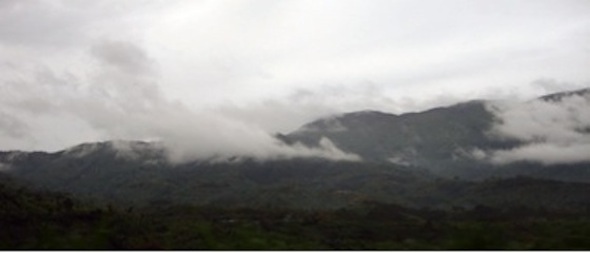
Virungas Volcanic Range, Rwanda. Photo: Gretchen Clymer, 2007.
Educational programs and support are another important realm in community-involved conservation. Practical education programs on health and sustainability can support local communities and ease resource or ecological pressures on ape habitat resources. Conservation education (from primary through graduate education levels), fosters local pride and involvement in conservation and can be hugely impactful in ongoing conservation efforts for apes. The Dian Fossey Gorilla Fund International is active in nearly every level of educational opportunity in the communities near mountain gorilla habitat – from health education programs in local communities, to conservation education in local schools, up through graduate research training at the Karisoke research center. These efforts not only demonstrate that conservation is beneficial to the local communities, they show respect to communities as key stakeholders in conservation.
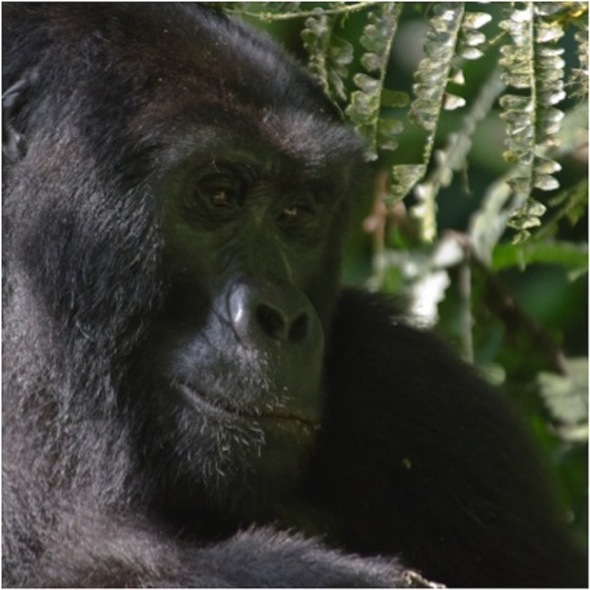
Bwindi Impenetrable Forest. Photo: Ian and Kate Bruce, 2013.
Signs for Hope
In the past decade, it appears community-outreach focused conservational approaches show promising signs of success for the mountain gorillas. A 2010 census of mountain gorillas showed a ~26% increase in their numbers in the Virungas since the prior census in 2003 (Gray et al, 2010). While still critically endangered, an increase in population – particularly with ongoing conflict in the region – is a significant victory for the efforts of conservationists and the local communities.
The close proximity between human populations and endangered great apes is undoubtedly a factor in the threat to ape survival. However, fifty years of conservation efforts have demonstrated the importance of protecting apes with the cooperation and support of the populations that reside in proximity to ape habitat. Providing training and material support in sustainable agriculture helps to mitigate the need to log or hunt in critical ape habitat. Using ape conservation funds to provide basic health services such as clean water and medical clinics makes ape conservation beneficial to both the apes and humans in the area. Lastly, educational outreach can instill a sense of local pride in the majestic gorillas, and will hopefully bring about the next generation of conservationists sharing a common homeland with the apes, who will then strive to increase mountain gorilla populations to sustainable levels.
Works Cited:
International Gorilla Conservation Programme (IGCP). 2014. “Tourism.”
Whitely Fund for Nature, 2011. “Mountain Gorilla Conservation through Public Health, Uganda.”
Gray, M. Fawcett, K., Basabose, A., Cranfield, M., Vigilant, L., Roy, J., Uwingeli, P., Mburanumwe, I., Kagoda, E., Robbins, M. 2010. Virunga Massif Mountain Gorilla Census — 2010 Summary Report.
Interrupted play
Today Burrito and Foxie were wrestling and chasing and just being super playful in the greenhouse. Their laughter got to be pretty loud, and I think it caught Jamie’s attention…
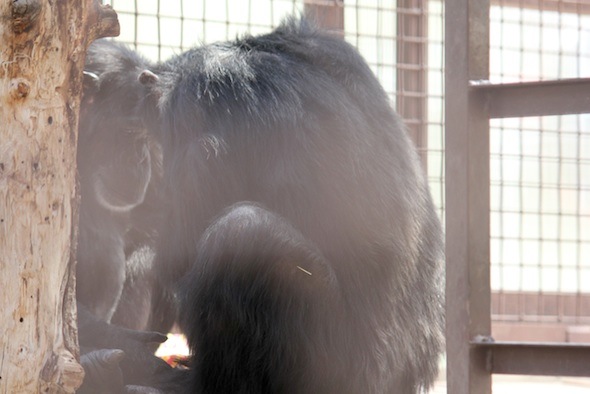
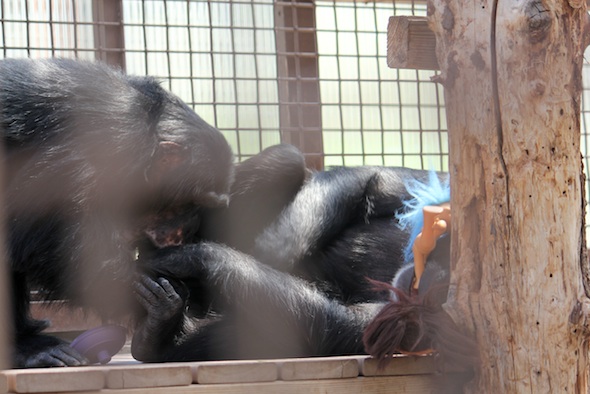
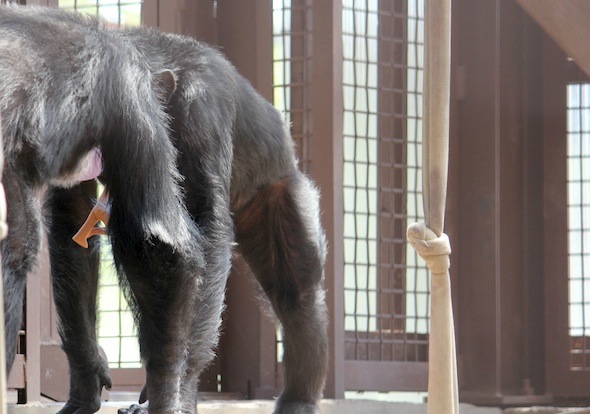
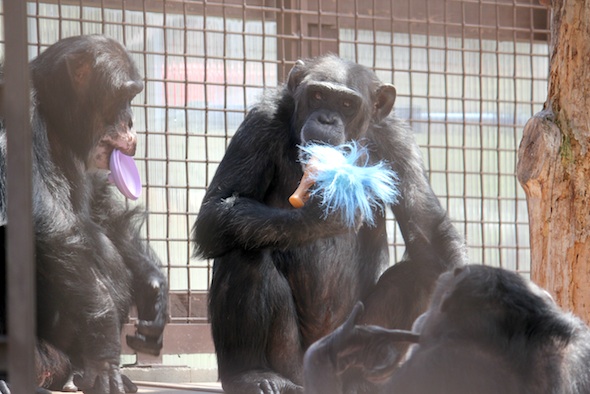
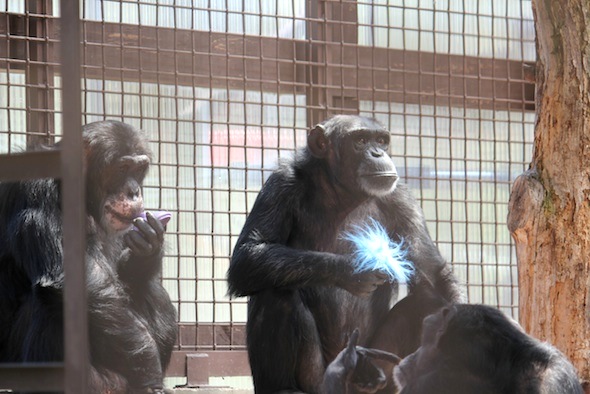
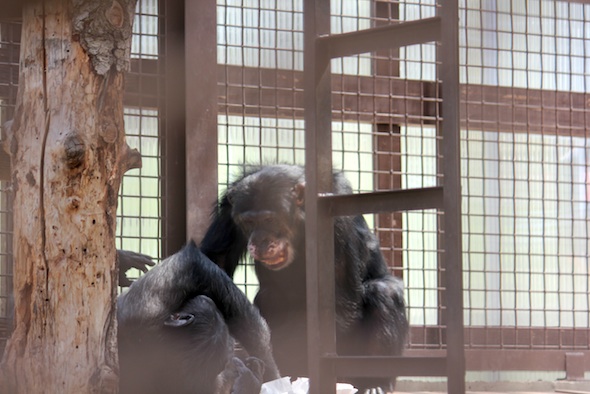
…She came out to see what was going on, and stepped right between Burrito and Foxie to interrupt their play.
This is a very boss-like thing to do in chimp society. We (lovingly) refer to Jamie as the “party police” because of instances like this.
But this time, she didn’t cease all playing—instead, she immediately started wrestling with Foxie and began to play “tug-o-troll” with her.