• Skip to main content
  • Skip to primary sidebar
  • Skip to footer

Chimpanzee Sanctuary Northwest

Hope. Love. Home. Sanctuary

  • Our Family
    • The Chimpanzees
    • The Cattle
  • Blog
  • About Us
    • Visiting the Sanctuary
    • Philosophy
      • FAQs
      • Mission, Vision & Goals
      • Privacy Policy
    • The Humans
      • Staff
      • Board of Directors
      • Founder
    • Annual Reports
    • The Future of CSNW
    • CSNW In The News
  • You can help
    • Donate
      • Become a Chimpanzee Pal
      • Sponsor A Day
      • Transfer Stock
      • Be A Produce Patron
      • Be a Bovine Buddy
      • Give from your IRA
      • Personalized Stones
      • Bring Them Home Campaign
    • Leave A Legacy
    • Employment Opportunities
    • Volunteer
    • See Our Wish List
    • Events
  • Resources
    • About Chimpanzees
    • Enrichment Database
    • Advocacy
      • Advocacy Action Center
      • Apes in Entertainment
        • Trainers
        • Role of the AHA
        • Greeting Cards
      • Chimpanzees as Pets
      • Roadside Zoos
      • Chimpanzees in Biomedical Research
      • Conservation
        • African Apes
        • Orangutans
  • Shop
    • Merchandise Store
  • Contact
  • DONATE NOW

advocacy

Take Action Tuesday: Help save chimpanzees in Cameroon!

August 27, 2013 by Debbie

EOA take action tuesday

A U.S. company called Herakles Farms is planning to begin a palm oil plantation in Cameroon near the border of Nigeria. Chimpanzees and gorillas live in these forests, and in fact the most endangered subspecies of each ape are living in that region. The Nigeria-Cameroon chimpanzee population (a.k.a. Elliot’s chimpanzee) is estimated to be approximately 3,500 individuals remaining. The Cross River gorilla population is estimated to be fewer than 300 individuals.

Endangered chimpanzees, forest elephants, and monkeys all live within the Herakles Farms concession. These already diminishing populations need our help!

Chimpanzee, Nigeria

This form letter has been put together to make it very easy for us to lend our voice in support of the apes, courtesy of Greenpeace. Although it is very convenient to just fill in your name and email and hit “send”—it really helps to make your letter unique. Tell the CEO of Herakles Farms why it is important to you that their plans for a palm oil plantation in Cameroon be canceled immediately.

We know from the plight of orangutans in Southeast Asia that palm oil directly negatively affects their population, sometimes driving orangutans and other forest dwellers to starvation when their homes are slashed and burned to the ground to make room for the plantations. In your day-to-day life, try to be a conscious consumer and avoid palm oil where you can. You can help be an advocate for apes every day by taking this extra effort to check the ingredient list of products you buy!

After sending your letter, take a few minutes to watch the second installment of a video interview with Dr. Debra Durham, where she talks a little bit about her conservation efforts with wild chimpanzees. Her current project is called Compassion in Action Mushroom Project (it’s a really innovative plan to help protect wild chimpanzees—be sure to check it out!)

Filed Under: Advocacy, Free-living chimps Tagged With: advocacy, animal protection, animal rescue, animal rights, Animal Welfare, cameroon, chimp, chimpanzee, chimpanzee rescue, chimpanzee retirement, chimpanzee sanctuary, Chimpanzee Sanctuary Northwest, Cle Elum 7, Cle Elum Seven, compassion in action mushroom project, conservation, dr. debra durham, herakles farms, palm oil, pan troglodytes ellioti, primate protection, primate rescue, rescue, Sanctuary

Jamie’s creative expression

August 19, 2013 by Katelyn

Like most artists, Jamie chooses to express her creative mind in a variety of ways. Jamie spent the first nine years of her life living with a human as a “pet” and being used in the entertainment industry. While we know virtually nothing about this time in Jamie’s life, she often chooses to engage in human oriented activities, most likely as a result of her unnatural childhood. For example, today Jamie chose to arrive for lunch wearing a red bandana tied around her neck (which she untied and re-adjusted half way through her meal). While we certainly do not advocate for chimpanzees being dressed in clothing, here at CSNW we do try to offer a variety of enrichment (including clothing) to accommodate their individuals interests. If the chimpanzees want to wear things, tear them up, play tug-o-war, make a nest with them, or ignore them, it’s their choice. Choice being the key word here. We recognize that each of the chimpanzees have unnatural histories which have influenced their individual interests and that plays a key role in developing individualized enrichment to keep their intelligent minds active.

web_Jamie_wearing_bandana_eating_greenpepper_lunch_GH_ls_IMG_1316

Notice the perfect knot Jamie incorporated into her bandana!

web_Jamie_wearing_bandana_closeup_profile_GH_ls_IMG_1328

Jamie chooses to wear clothing less and less since arriving at the sanctuary. While we want Jamie and her family to be able to engage in whatever interests them, it also thrills us to see their unique “chimpanzee-ness” coming out more and more. For Jamie, that sometimes still means wearing a bandana to lunch, patrolling the perimeter of Young’s Hill with her cowgirl boot, and occasionally drawing and painting when there is no “business” to take care of as Boss of the sanctuary. And that’s what sanctuary is all about, choices and the ability to express one’s self as one wants. And the art of expressing herself as she wants is something Jamie is a true artist at.

web_Jamie_wearing_bandana_looking_at_camera_cling_on_caging_GH_ls_IMG_1337

If you haven’t cast your vote for Jamie’s artwork yet in the Humane Society’s chimpanzee-only art contest, please do so now! It’s a wonderful way to help our artist-in-residence and her chimpanzee family!

Filed Under: Art, Enrichment, Fundraising, Jamie, Sanctuary Tagged With: advocacy, animal protection, animal rescue, Animal Welfare, chimpanzee rescue, chimpanzee retirement, chimpanzee sanctuary, Chimpanzee Sanctuary Northwest, Cle Elum 7, Cle Elum Seven, csnw, Enrichment, Fundraising, Jamie, Sanctuary

Meet the Chimpanzees of Kanyawara

August 15, 2013 by Debbie

Most of our advocacy work focuses on issues close to home, like the entertainment industry, apes as pets, and biomedical research. As caregivers for the Cle Elum Seven, our expertise at CSNW lies in the plight of captive chimpanzees. We see the Cle Elum Seven as ambassadors for other chimpanzees that still are used in research or entertainment and deserve better.

We also see them as ambassadors for wild chimpanzees. They never got to experience the love from their mother, learning how to forage and use tools, and living in a large group of other wild chimpanzees. Though sadly, chimpanzees in the wild have problems of their own. Some are being hunted for their meat to be sold on the black market, some are losing their homes to human encroachment, and some are fighting for their lives after being caught—but not killed, by a snare trap.

Our guest blogger project aims at raising more awareness about these issues from the perspective of those that work in that environment, analogous to the CSNW staff’s expertise with chimpanzees in captivity. Dr. Zarin Machanda works in the Kibale National Park in Uganda, and we are thrilled to have her stories of her experience working with chimpanzees in the wild, just as we tell stories about the Cle Elum Seven. Here’s her introduction to the chimpanzees of Kanyawara.

—

Hi everyone! My name is Zarin Machanda and I’m going to do a few guest blog posts over here this summer. I know JB and Diana from when I volunteered at the Fauna Foundation. I have a very distinct memory of JB with a torn up t-shirt after an encounter with a grumpy ostrich! I’m still not sure what happened, but I think the ostrich won.

I left Montreal for Harvard where I have been studying wild chimpanzees in Uganda for the last 10 years. I’ll describe my research in another post but my main interest is understanding how and why social relationships develop. Today, I want to tell you about our field site and introduce you to some of our amazing chimpanzees. Many of the photos here were taken by Ronan Donavan, a friend and photographer who worked in Uganda for many months.

map

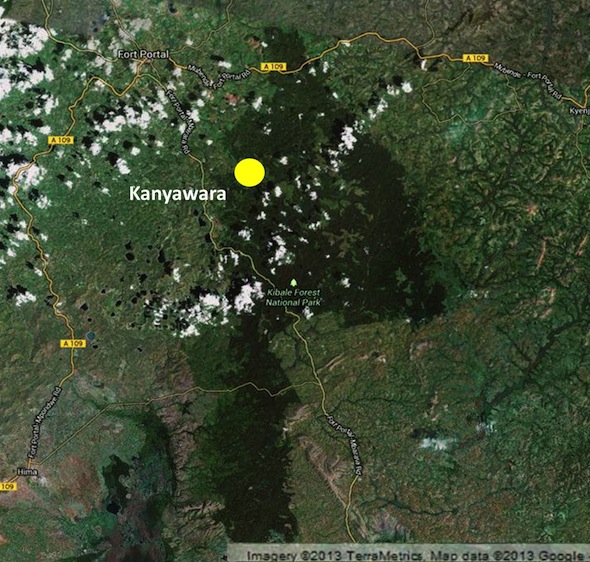
Satellite image of Kibale National Park with the Kanyawara chimpanzee community range in the northwest sector. Image courtesy of Google Maps.

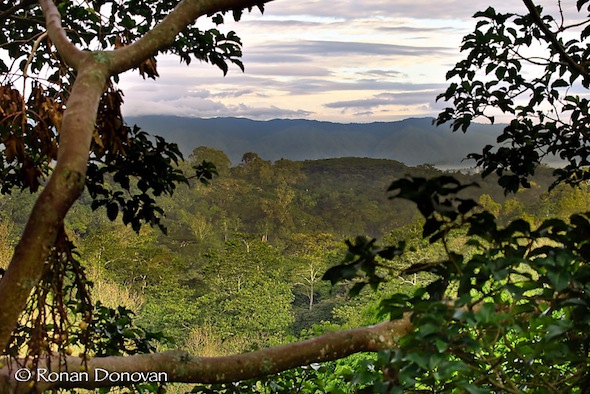
I work for the Kibale Chimpanzee Project, a long-term research project studying the Kanyawara community of chimpanzees. They live in Kibale National Park in Uganda, a beautiful equatorial rainforest that is home to over 250 species of trees, over 325 species of birds and over 60 species of mammals, including 13 species of primates. This is one of the densest and most diverse populations of primates anywhere in the world and includes approximately 1500 wild chimpanzees (Pan troglodytes schweinfurthii).

kanyawara

The canopy of Kibale National Park with the Rwenzori Mountains in the background. Photo courtesy of Ronan Donavan.

Every day, our field assistants and researchers enter the forest to follow the chimps and collect data on their behavior. We don’t have any physical contact with them—we just observe them, take notes about what they do, and collect samples of their urine and feces for later analysis. How do you collect urine from a chimp? Well you’ll have to come back later to find out!

All of our chimpanzees are given names and we can recognize them just as easily as we can tell each other apart. Every chimp research site has a different philosophy for naming chimps—some pick philosophers, others like jazz musicians but we like to name our individuals after important world figures and world events. For example, in the year 2000, we named a chimp Tuke (pronounced Two-kay)—get it?

canopy

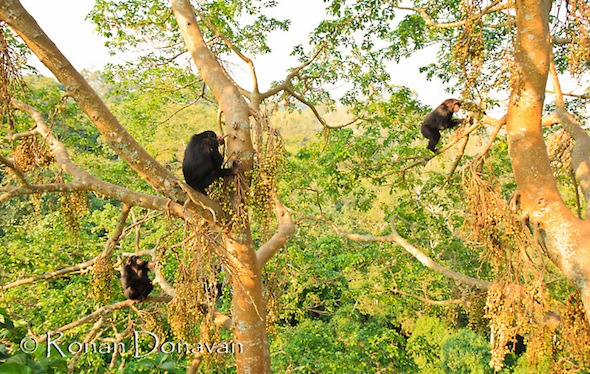
The Kanyawara chimpanzees feeding on figs. Photo courtesy of Ronan Donavan.

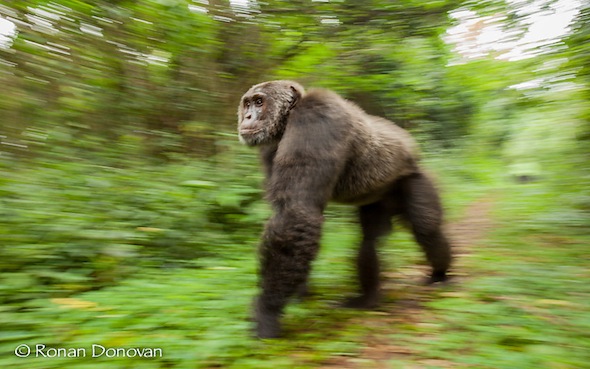
I wish I could tell you about all 53 of our chimps because each one is special in their own way, but I’ve chosen just a few for you to meet: Lanjo, Outamba, Max, Tsunami, and Tembo.

Lanjo was born in 1995. He is quite large for his age and he’s recognizable because his hair is light brown compared to the more typical black hair of the other chimps. He is not only handsome, but he is also loved by all the researchers and field assistants. Our alpha male, Kakama, recently passed away and we have been taking bets on who is going to take over. My money is on Lanjo although some other folks favor Eslom. Interestingly, these two couldn’t be more different—while Eslom is likely to display, chase everyone and generally cause chaos wherever he goes, Lanjo is as cool as a cucumber and just watches it all happen. That’s the kind of alpha that I would want and I have a feeling most of chimps would prefer cool over crazy! It’s going to be an interesting couple of months in our community since we know that changes in the hierarchy really shake up relationships among the males. Individuals jockey for position and need to figure out which of their friends will be most useful to them as they vie for dominance. Fingers and toes crossed for Lanjo, although Kakama will be greatly missed.

lanjo

Lanjo showing off his muscles for the camera. Photo courtesy of Ronan Donavan.

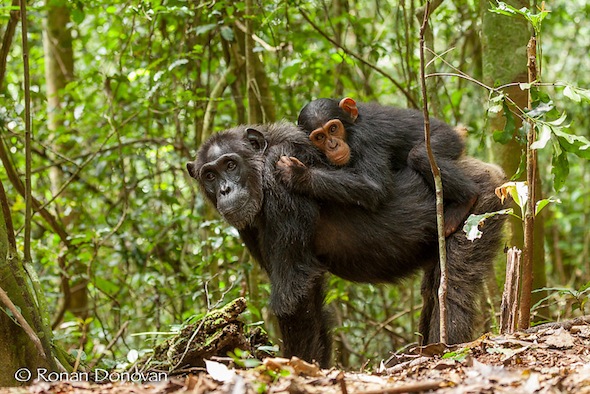
Outamba is a high ranking female and is recognizable because of her narrow mouth and prominent brow. We think she is about 34 although it’s hard to know her exact age because females transfer into new communities during adolescence and we make educated guesses about their age. Outamba is Kanyawara’s baby-making machine! She has had 5 infants in 15 years—that’s one baby every 3 years compared to the average female who generally has one baby every 5-6 years. It’s even more impressive that all of Outamba’s babies have survived, so she’s not just making babies quickly but she’s doing a great job of taking care of them too. We think she is such a successful mother because as a high-ranking female, she has access to the areas of the highest quality food. For mammals, more food means more babies and higher infant survival rates—so Outamba must be eating well.

outamba

Outamba carrying her youngest daughter Gola on her back. Photo courtesy of Ronan Donavan.

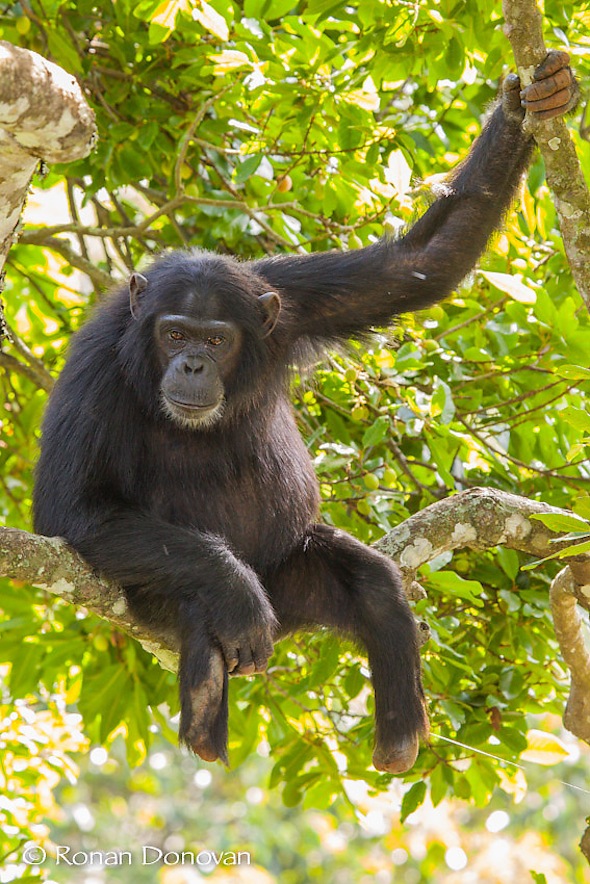
Max is one of our shy individuals and we don’t see him very often because he prefers to stay near his mother in a remote part of the Kanyawara range. This is unusual for an adolescent male because as he grows up he should spend more time with the adult trying to integrate into the male dominance hierarchy. Max’s odd behavior most likely stems from the fact that he lost both of his feet to wire snares set by poachers when he was younger. I’ll write more about these snares and our conservation efforts in another post, but they affect our young chimps more often than adults because these guys barrel through the forest without looking where they are going. Another reminder that baby chimpanzees and baby humans are very similar. Despite these injuries, Max is a trooper! He can still climb trees like a champ and has survived for a number of years without his feet.

max

Max sitting in a tree. He lost both his feet to wire snares. Photo courtesy of Ronan Donavan.

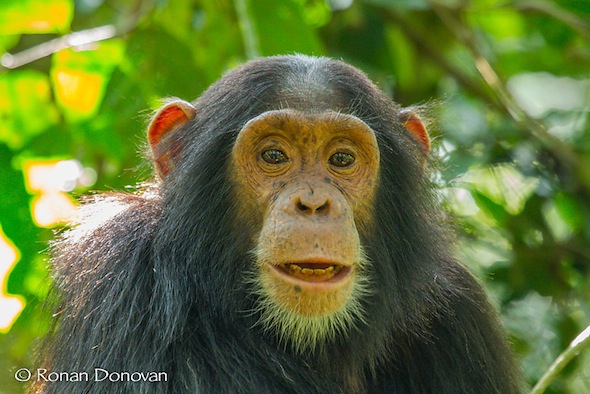
Tsunami was born in January of 2005. Her mother is Tongo and she is Lanjo’s younger sister. Right now, her face is still pink with a few dark freckles but this will change as she gets older and her face darkens. Like our other young chimps, Tsunami likes playing with objects such as rocks and sticks and she will even carry these things around for days. She is often seen playing with and trying to carry her siblings. In 2011, tragedy struck when Tsunami’s baby sister, Teddy, died after accidentally falling out of a tree. Tongo couldn’t carry the body and had to leave it on the ground but Tsunami stayed with Teddy and even tried carrying her—it was heartbreaking. I think Tsunami is going to make a great mom when she grows up—she certainly has a good role model in Tongo and she is one amazing big sister.

tsunami

Tsunami, one of our juvenile females. Photo courtesy of Ronan Donavan.

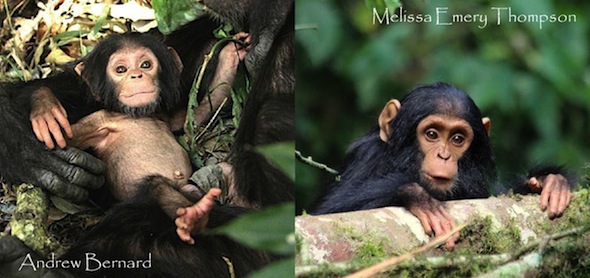
At 1.5 years, Tembo is one of our youngest chimpanzees. We gave him the Swahili word for elephant as a name, because he was born the same day that elephants came to camp and knocked over a tree. Tembo is a special guy because he is not only the son of Tenkere but also the grandson of Outamba. Since female chimpanzees are supposed to transfer to new communities at adolescence, it’s unusual to have maternal grandmothers in a group. We’re not sure why Tenkere decided to stay but it is likely that it’s because she also has access to high quality food like her mom, which she may not have as a new immigrant to another community. Not leaving may end up being a poor choice because Tenkere is genetically related to many of the males in the group. We’ll have to keep an eye on Tembo and get DNA samples from him to do a paternity test. But, so far he seems healthy and playful and he has quite a family looking out for him. I’m hoping he lives up to his name—big and strong and able to knock over trees.

tembo

(Left) Newborn Tembo lying with his mother Tenkere. Even as a newborn he had sideburns just like his mother. (Right) Tembo at 1.5 years of age. Photos courtesy of Andrew Bernard and Melissa Emery Thompson, respectively.

Well that’s all for now. Next time, I’ll describe a little bit more about my research and some of the other projects that we are working on. In the meantime, please check out our website for more news from the field.

Filed Under: Advocacy, Free-living chimps Tagged With: advocacy, animal protection, animal rescue, animal rights, Animal Welfare, chimpanzee, chimpanzee rescue, chimpanzee retirement, chimpanzee sanctuary, Chimpanzee Sanctuary Northwest, free-living chimps, kanyawara, kibale chimpanzee project, kibale national park, wild chimpanzees, wild chimps, zarin machanda

15 minutes of paint

August 11, 2013 by Lisa

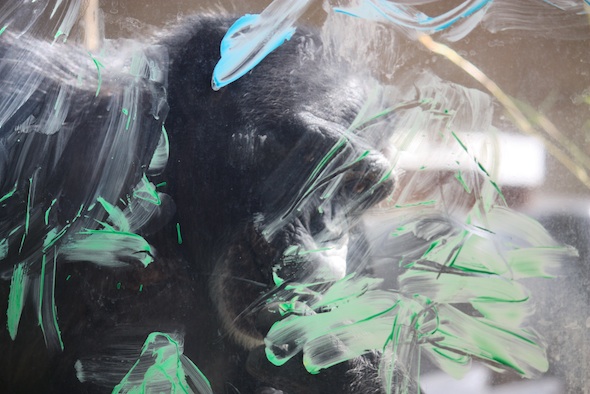
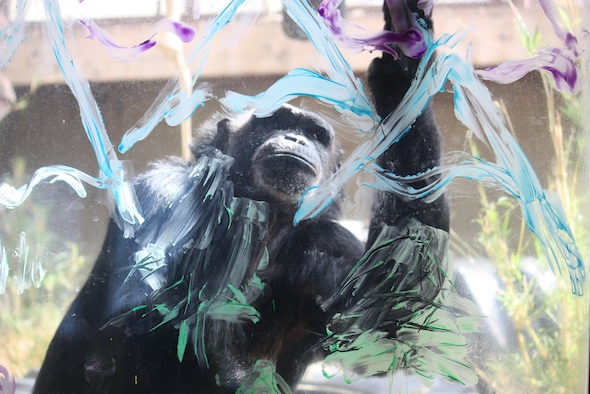
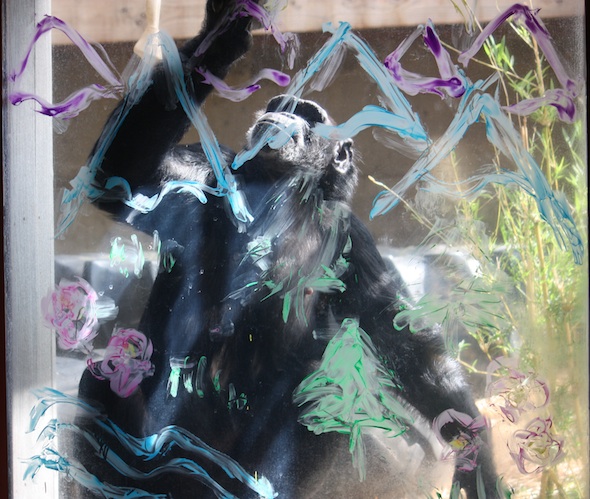
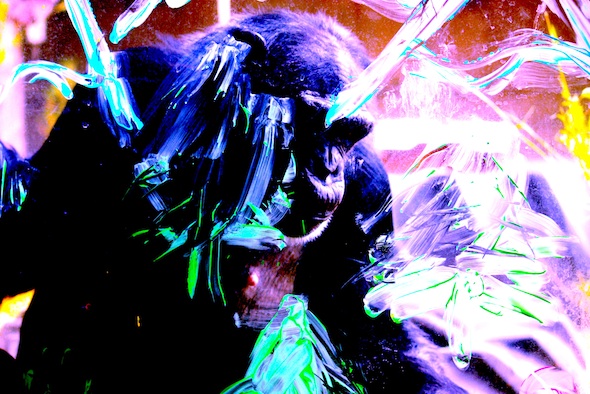
Thank you again to Lindsay Zager’s parents who sponsored today in honor of her birthday. Jamie really got into the spirit of things by spending some time making the artwork we provided today her own.

We painted a mountain-scape on the window between the greenhouse and the playroom and, as soon she was able to, Jamie inspected our work.

web_Jamie_closeup_inspect_paint_on_window_PR_ls_IMG_3633

She also made some personal edits.

web_Jamie_touch_paint_on_window_between_GH&PR_ls_IMG_3647

web_Jamie_fullbody_touch_paint_on_window_between_GH&PR_ls_IMG_3652

And, here is my nod to Lindsay’s day, an Andy Warhol-esqe version of Jamie and the artwork. Happy Birthday, Lindsay!!

web_Jamie_midrange_AndyWarhol_inspect_paint_on_window_between_GH&PR_ls_IMG_3667

Filed Under: Art, Enrichment, Jamie, Sanctuary, Sponsor-a-day, Thanks Tagged With: advocacy, chimpanzee rescue, Chimpanzee Sanctuary Northwest, Cle Elum 7, csnw, Enrichment, Jamie, Sanctuary, Sponsor-a-day

Jacky

July 23, 2013 by Debbie

As part of our guest blogger series, here is a post by Dr. Sheri Speede. Sheri founded In Defense of Animals-Africa (IDA-Africa), after working as Northwest Director of In Defense of Animals. While working for IDA, she helped advocate for companion, farm, and research animals in the US. After a couple of trips to Cameroon, her focus shifted to providing sanctuary for chimpanzees in Africa who had been part of the illegal pet trade or were bushmeat orphans. In addition to founding IDA-Africa, she also opened Sanaga-Yong Chimpanzee Rescue Center in Cameroon. You might recall that J.B. posted a blog a couple of weeks ago about life and death. He mentioned a very moving story of how the Sanaga-Yong chimpanzees grieved after the passing of one of the residents, Dorothy.

CSNW has had a long-time connection with Sheri and IDA-Africa, and we will always be grateful for her advice on the electric fencing during the development of Young’s Hill!

Here, Dr. Speede tells the story of Jacky.

—

All but one of our 73 chimpanzee residents at Sanaga-Yong Chimpanzee Rescue Center in Cameroon’s Mbargue Forest were born to free-living mothers. Each was orphaned as a nursing infant when a poacher killed his/her mother to supply the illegal bushmeat trade. Working with the government of Cameroon, we rescued some of the orphans from hunters and dealers while they were still infants. Others suffered decades of abuse on chains or in small cages before we reached them. Resilience and capacity for emotional recovery seem to vary among individual chimpanzees as much as these life-defining qualities do among humans.

Although I am equally committed to each of our 73 chimpanzees, the gentleness coupled with profound inner strength of some individuals have inspired my deepest respect and admiration. One awe-inspiring chimpanzee who has touched me deeply is Jacky. He lived in a small cage at a hotel, first taken in as a tourist attraction, for over 30 years. When I met him in 1997 Jacky was furious and dangerous. Local people called him the “mad chimpanzee,” meaning he was crazy, and it wasn’t difficult to see how he had earned that reputation. He refused to make eye contact with us, and his various forms of stereotypy, while heart wrenching, did make him appear lost to the sane world. In one of his most disturbing and frequent manifestations, he placed one open hand in his mouth while rapidly and forcefully pounding the top of his head with his other fisted hand. He abused himself like this frequently and for minutes at a time, causing the top of his head to be bald. Anyone who accidentally veered too close to his cage paid a high price for the mistake. With lightning speed and certain intent Jacky could grab hapless hands, pull them into his cage, and with a single bite inflict irreversible damage.

web_Jacky_Atlantic_Beach_Hotel_Sheri

Jacky in his cage at Atlantic Beach Hotel, where he lived for 30 years. Photo © Sheri Speede.

After we finally succeeded in bringing Jacky to Sanaga-Yong Chimpanzee Rescue Center in 1999, he soon stopped his self-abuse. I cautiously kept my distance from him until one day he initiated a change in our relationship. After watching me care for the wound of another chimpanzee, he turned to present me with a laceration on his own back that needed care, and we became friends. While these changes in his temperament were remarkable, his rapidly evolving relationships with other chimpanzees at the sanctuary were most amazing, and his capacity for leadership that survived so many years of deprivation seemed nothing short of miraculous. He formed an alliance with adult female Nama (who had been shackled by a chain at another hotel for 16 years), and together they led a social group of chimpanzees for ten years. Under the gentle and just leadership of this powerful duo, we were able to introduce many young orphans, eventually expanding their social group to twenty-six.

Eventually, a younger, stronger male persistently challenged Jacky, and after a struggle for dominance that lasted many months, he eventually pant-grunted his submission and handed over the reins of leadership about three years ago. Today Jacky is a respected elder, and although he is no longer the alpha male, we still call the group “Jacky’s group.” Without a lot of responsibility, he spends his days playing and avoiding conflict, which seems a form of contented retirement.

web_Jacky_Carol_Yarrow

Jacky at Sanaga-Yong Chimpanzee Rescue Center. Photo: Carol Yarrow.

Sheri has written about Jacky and other chimpanzees in her book Kindred Beings, which will be published by HarperCollins in September 2013.

Filed Under: Advocacy, Free-living chimps, Sanctuary Tagged With: advocacy, animal protection, animal rescue, animal rights, Animal Welfare, chimpanzee, chimpanzee rescue, chimpanzee retirement, chimpanzee sanctuary, Chimpanzee Sanctuary Northwest, ida africa, jacky, primate protection, primate rescue, sanaga-yong, Sanctuary, sheri speede

Help others Take Action – share Eyes on Apes!

July 2, 2013 by Debbie

CSNW is a really unique place. We have seven amazing beings under our care, whom as you know are of utmost importance around here and truly run the show! Well, Jamie does anyway 😉 And we love to share stories about each of their personalities and their day-to-day lives.

For instance, today has been a continuation of the heat wave that has hit Cle Elum, but before the hot afternoon sun came around we did a breakfast forage on the hill which everyone loved. Here’s Foxie enjoying a piece of grapefruit:

web_Foxie_dora_orange_platform_YH_jb_IMG_2561

After we cleaned the playroom, Denice and I filled a kiddie pool with cool water, and harvested some black currents we have growing in the garden. We spread the currents around as a forage and also dropped some into the water. Jody and Jamie especially loved it!

web_jody_eat_black_current_forage_stairs_PR_dm_IMG_0013

web_jamie_eat_black_current_forage_pool_PR_dm_IMG_0017

CSNW is also pretty big on education and advocacy. Eyes on Apes is our advocacy group and we really want to help make a difference for apes everywhere. The Cle Elum Seven truly serve as ambassadors for the life that all chimpanzees in captivity deserve, and for their wild counterparts who need our help to protect their habitat. This is only something we can achieve with your help! If you haven’t joined the Take Action e-mail list, do that today! Share our Facebook page, and re-tweet our plea for more followers on Twitter.

web_jamie_up_close_PR_dm_IMG_0018

Filed Under: Advocacy, Food, Foxie, Jamie, Jody, Sanctuary, Young's Hill Tagged With: advocacy, animal protection, animal rescue, animal rights, Animal Welfare, chimp enrichment, chimp sanctuary, chimpanzee, chimpanzee rescue, chimpanzee retirement, chimpanzee sanctuary, Chimpanzee Sanctuary Northwest, Cle Elum 7, Cle Elum Seven, csnw, eyes on apes, Foxie, Jamie, Jody, primate protection, primate rescue, rescue, Sanctuary

The FARDC ‘Petting Zoo’ at Bili

June 18, 2013 by Debbie

Dr. Cleve Hicks, one of our guest bloggers, was featured last month with a series of posts called “Along the Bushmeat Highway” (Read Part 1, Part 2, and Part 3). The story was from July of last year, and Cleve has given us some more recent follow-up information about the Bili forest area in the DRC. WARNING: some disturbing images included in this entry (the most graphic one is included as a link in its caption).

—

UPDATE – THE FARDC ‘PETTING ZOO’ AT BILI, OCTOBER 2012

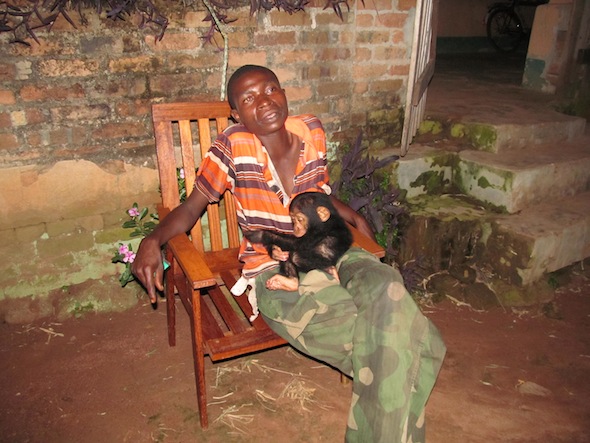
The skinny young man dressed in a mix of rags and military gear loomed out of the night like an apparition. He careened across our yard and nearly collapsed on top of Ephrem. Our evening banter was abruptly cut off as we rose from our chairs to confront the lurching, inebriated intruder. He was the youngest member in the squad of six Congolese soldiers stationed in a barracks up the hill from us in Bili. The soldier was so drunk that he could barely sit upright in the seat which we had offered him. At least on this occasion he had left his weapon back at the barracks. ‘I am a member of the Congolese military!’ he proclaimed in a slurred voice. ‘I am Congolese, and this is my pet!’ I looked in his lap and my heart sunk as I made out the dark shape clinging there: a baby chimpanzee, perhaps two years old, her eyes dull and glassy, pink tongue lolling out of her mouth. She periodically nodded off into a dazed slumber, and it looked as if the rumours that the troops were keeping her intoxicated with booze and dope were true.

1 drunk soldier with baby chimp

A drunken young soldier with a baby chimpanzee at our project house. (Photo © Ephrem Mpaka of the Lukuru Wildlife Research Foundation).

2 cleve with soldier and baby chimp

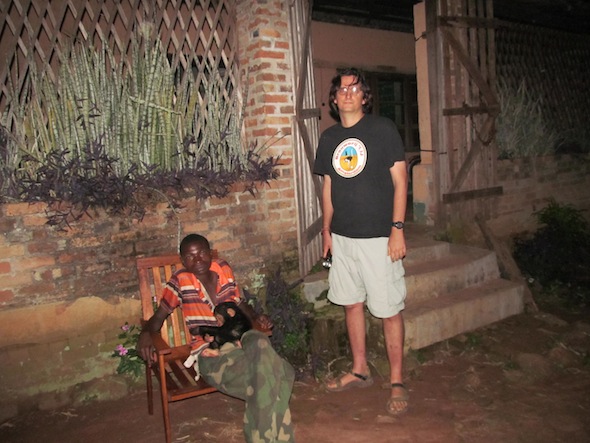
This was the same orphan that our team had photographed the day before, gazing out from the arms of her owner with a look of befuddled hopelessness. I had sent Ephrem with a pair of Ecoguards over to the barracks of the FARDC (Forces Armées de la République Démocratique du Congo) to photograph the ‘petting zoo’ which we had been told the new squad leader was keeping there. In addition to this little female chimpanzee, named Congo, the military and their families were keeping three monkey orphans: a baboon tied to a short leash, an agile mangabey, and a red tailed guenon. The latter two primates scampered around the yard looking for food. After some initial tension between our guards and the military, things calmed down and the soldiers allowed Ephrem to photograph the primates. The soldiers explained that they had acquired the orphan chimpanzee from a shop in the town of Roa about 50 km southwest of Bili, as a ‘mascot’ for the troops. Ephrem explained to the men that it was both dangerous and immoral to keep primates in such a condition, and in the case of the chimpanzee, illegal. Later that evening we considered sending the guards to confiscate Congo, but in the end, decided against it. These military were heavily-armed, often drunk, and had already made threats against our project. Also, we had no place to send the poor orphan.

3 orphan chimp Congo

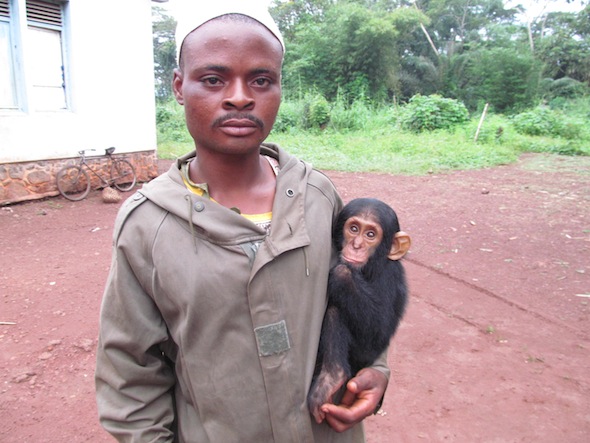
The orphan chimpanzee Congo kept by a soldier at the military barracks in Bili.

We were unsure why this young soldier had come to our house with the baby chimpanzee. Did he want to sell her to us? Intimidate us? Or was he just out-of-his-mind drunk? Maybe all three at once. After failing completely to penetrate his whiskey-soaked stupor with reason, we sent him stumbling on his way back to the barracks.

Two of the three chimpanzee orphans we had encountered on this trip, one in Bili and the other two en route, had been held by FARDC soldiers and officers (the third was held by a traditional chief at Lisala). The one we saw in the regional capital of Buta had been kept by the highest military authority in that town. Although the people of Bili certainly consumed monkeys and other wildlife, we had never seen any chimpanzee meat or orphans in the hands of the locals. The indigenous Azande still seemed to hunt only for local trade and consumption, but it was clearly in the vested interested of a number of outsiders to link up Bili to the huge and rapidly expanding commercial bushmeat network a hundred miles to the south. This was particularly the case for ivory. What a terrible example these military men and federal officials were setting – and not only in regards to conservation.

Later in the month these military men, in cahoots with the corrupt territorial administrator, began to shake down local merchants for money and merchandise, citing a law forbidding non-soldiers from wearing military-style clothing and mercilessly harassing anyone who happened to be wearing khaki shorts or cargo pants. They would then use this money to buy copious amounts of alcohol, which they would drink in public – fuelling more roadside shakedowns. They even did this to one of our motorbike drivers at our project base, forcing me to record the incident on film and threaten to report the culprits to the authorities. Only the threat of exposure caused them to back down. It was and is my hope that the local people, frequently victims of such aggression and thievery from the soldiers and administrators, would realize that we could serve as an ally against such forces of anarchy – and there were indications that this was happening.

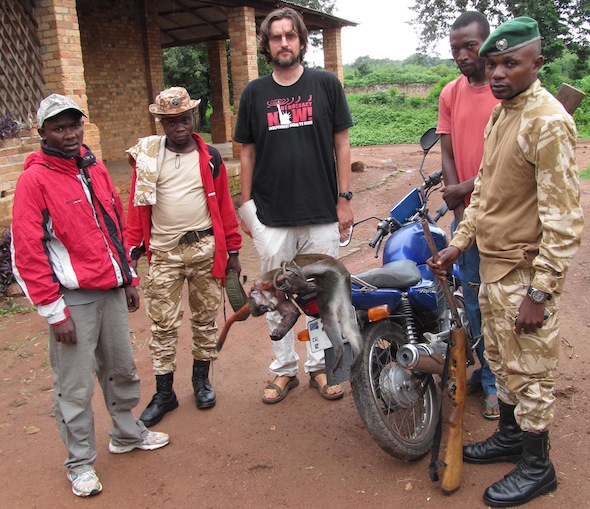
In addition, we found evidence that powerful outsiders were ignoring the closed hunting season, a period of several months in which it is forbidden by national law to hunt. The purpose of this closed season is to allow key prey species to recover. On the road between our forest camp and Bili, in the middle of this closed season, our guards came upon a man shooting a red tailed guenon out of a tree. They confiscated his gun and the monkey carcass and brought them to us. It turned out the gun belonged to a highly-placed government official in Bili. That man paid us a visit on the same night demanding that we return his gun. We refused to comply. Later, in a public hearing, he tried to explain to us why it should be permissible for powerful men like him to hunt any time they wanted to. We encountered similar incomprehension of or disrespect for basic Congolese law from a number of regional officials throughout the course of our stay in Bili.

4 confiscated monkey & shotgun

Our Ecoguards, Feruzi OPJ and Feruzi Yenga, confiscated this monkey and shotgun during the closed hunting season. The owner was a powerful governmental official.

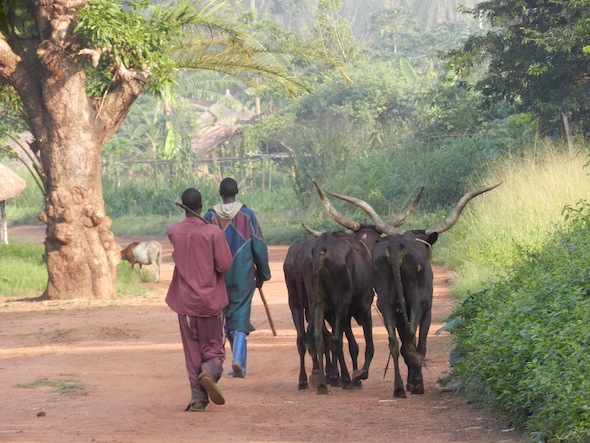
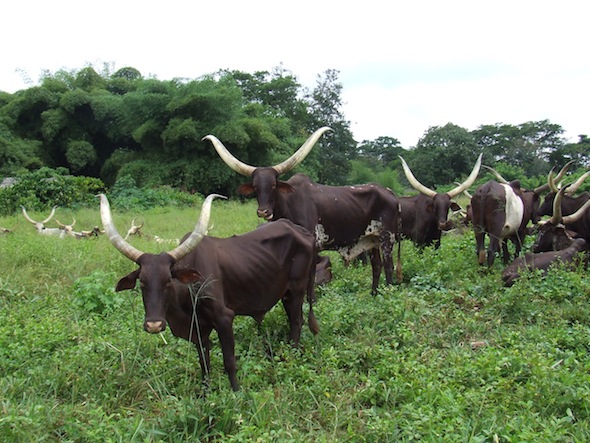
In late October, on our way out of Bili to Buta, we drove past a herd of 45 Mbororo cattle being imported into the lushly forested region. We had seen only a few very skinny cattle at Bili, but here, further south in the heart of the forest, domesticated animals were arriving in increasing numbers – out with the local fauna, in with the cattle, pigs, goats, and chickens. Arriving at Buta, we stopped at the headquarters of the highest-ranking regional military official, a man whom our team had confirmed owned a baby chimpanzee. Despite this, he was widely known to be professional and respectful in his dealings with civilians. He listened courteously to our complaints about his troops in Bili and said he would work to get them transferred, and that he would also send out a message to his soldiers not to buy baby chimpanzees. At least he listened to us and appeared to take our complaints seriously. I am under no illusions that this will change anything much, for the orphan Congo or the people of Bili, but I am convinced from what we have seen that the Congolese military are a crucial link in the illicit trade of protected wildlife species, from chimpanzees to elephants. The commander told us that he and his team had been recently trained at their base by military advisors from the United States, and he proudly showed us a certificate on the wall to prove it. Might this arrangement between foreign governments and the FARDC present us with an opportunity to spread to the Congolese troops the urgent message that they should be protecting, not cruelly exploiting, DR Congo’s priceless and world-famous endangered species?

5 bili cattle

Domesticated livestock are rapidly replacing the local fauna (above, Bili, below, Road to Buta)
6 cattle road to buta

7 male chimp gangu forest

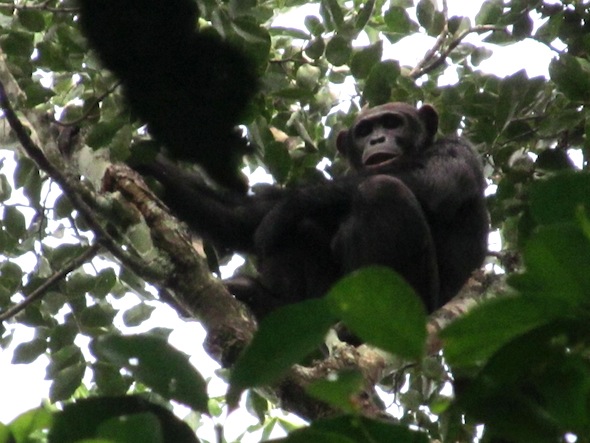
A majestic adult male chimpanzee in the Gangu Forest (photo © Ephrem Mpaka of Lukuru Wildlife Research Foundation). How can we keep him and his kind from ending up in the bushmeat markets? It may soon be too late for Gangu’s elephants (adult and juvenile mandibles found at a hunting camp).

Along the Bushmeat Highway: Part 1
Along the Bushmeat Highway: Part 2
Along the Bushmeat Highway: Part 3

This mission was made possible by the generous support of the Max Planck institute for Evolutionary Anthropology, The Lukuru Wildlife Research Foundation, The US Fish and Wildlife Service, l’ Institut Congolais pour la Conservation de la Nature, The Lucie Burgers Foundation, and The African Wildife Foundation.


Filed Under: Advocacy, Free-living chimps Tagged With: advocacy, animal protection, animal rescue, animal rights, Animal Welfare, bili, bushmeat, chimpanzee, chimpanzee sanctuary, Chimpanzee Sanctuary Northwest, dr. cleve hicks, FARDC, free-living chimps, lukuru wildlife research foundation, primate protection, primate rescue, wild chimps

  • « Go to Previous Page
  • Page 1
  • Interim pages omitted …
  • Page 4
  • Page 5
  • Page 6
  • Page 7
  • Page 8
  • Interim pages omitted …
  • Page 11
  • Go to Next Page »

Primary Sidebar

Subscribe To the Blog and Get Notified of New Posts First!

Archives

Calendar of Blog Posts

June 2026
S M T W T F S
 123456
78910111213
14151617181920
21222324252627
282930  
« May    

Categories

SUBSCRIBE TO OUR NEWSLETTER

Footer

PO Box 952
Cle Elum, WA 98922
[email protected]
509-699-0728
501c3 registered charity
EIN: 68-0552915

Official DDAF Grantee

Menu

  • The Chimpanzees
  • Blog
  • About Us
  • You can help
  • Resources
  • Contact
  • Donate

Proud Member of

Connect With Us

Search

Copyright © 2026 Chimpanzee Sanctuary Northwest. All Rights Reserved. Site by Vegan Web Design