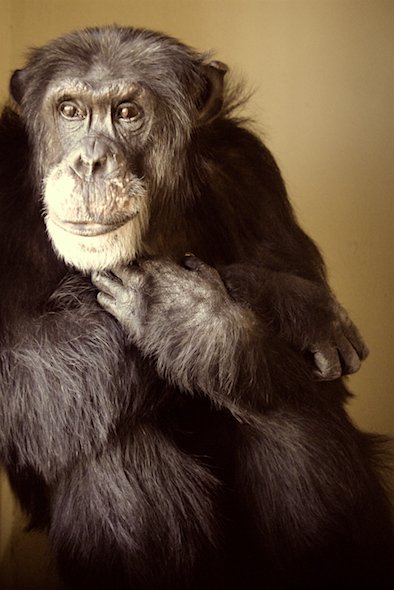
As the saying goes, if you really care for someone you’d give them the shirt off your back. For Jamie, it’s going to have to be the shoes off your feet.
The Bonobo Book
Today is sponsored by Kenneth Epstein in honor of Nicki Walters and in memory of her husband, Bill “Twister” Walters, on his birthday. Kenneth shared this message about today:
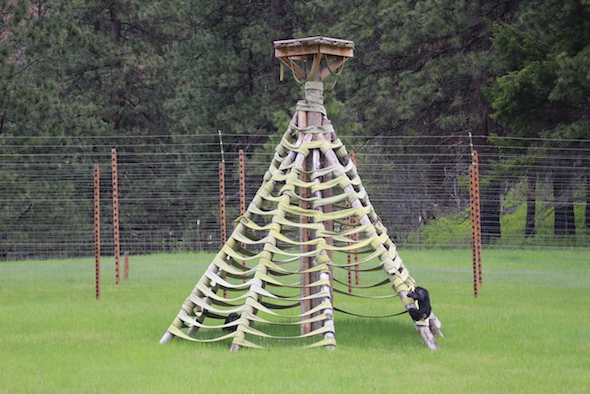
“Nicki Walters honored her husband Bill by sponsoring the chimps on his birthday. That beautiful gesture of love inspired me and many of their friends and family to share their love of the chimps. So much so that the Twister structure was built the following year in Bill’s honor. We lost Bill to cancer a few months later but he got to see the chimps play on the structure named after him. While we miss Bill we know that nothing would make him happier than knowing that the chimps are partying in his honor.”
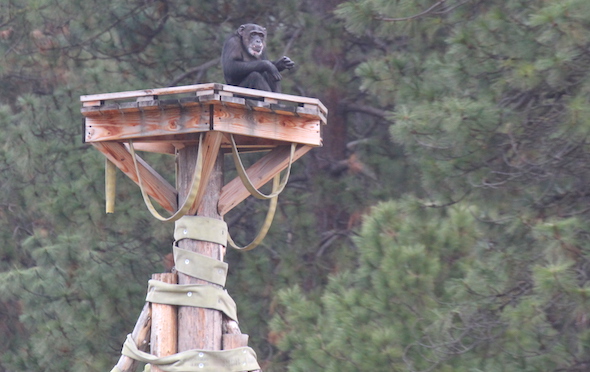
We at CSNW are so thankful for the generosity of Bill, Nicki, and their family and friends. The chimpanzees continue to receive so much joy from their wonderful gift of the “Twister” structure! This morning as the chimps ventured out onto the Hill, Missy raced up the Twister as Jamie and Annie watched from below. When Missy started to climb down from the top she began to do somersaults all the way down, from firehose to firehose! We’ve never seen her do this before! It continues to be a favorite lookout for Jamie to oversee her home, especially during the long summer evenings. The joy the Twister has brought to the chimps is unforgettable, just like Bill.
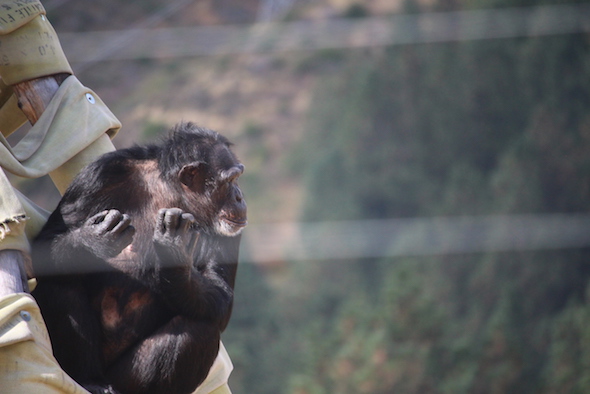
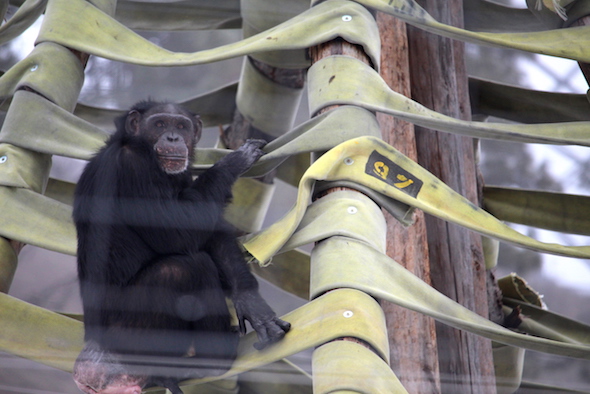
CSNW had a very busy Sunday! Old friends visiting, our wonderful interns taking ID tests (and killing it!), materials being dropped off from the Chimpanzee and Human Communicate Institute, and of course cleaning. Jamie also received a new pair of boots yesterday, which she is very happy about. In the morning after I gave the chimps access to Young’s Hill, Jamie sprinted through the raceway very pilo and very excited for us to put the boots on and walk around the Hill! Young’s Hill was a hot commodity this morning. It felt like a warm spring day and the chimps were all about it! But at last the cold breeze came and it went back and forth between almost a rain storm and being sunny. The chimps enjoyed their sun while they could and Jamie persevered as usual being the amazing person she is. Here are a collection of photos throughout the day:
Missy ripping around the Hill this morning:
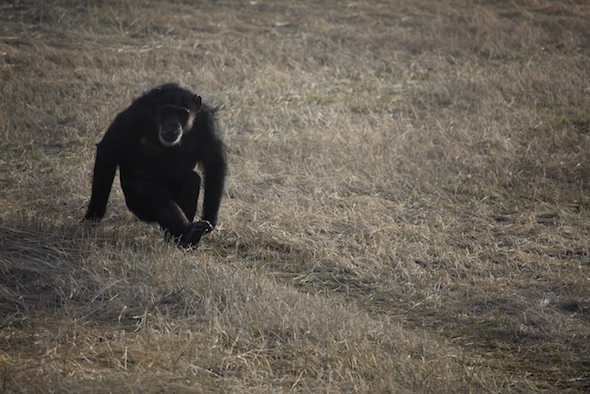
Missy waiting for Annie:

Annie:
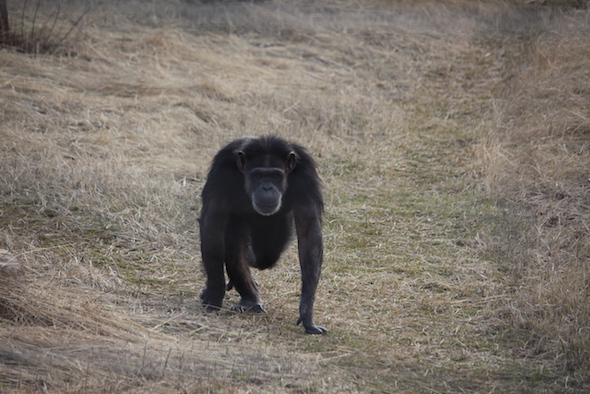
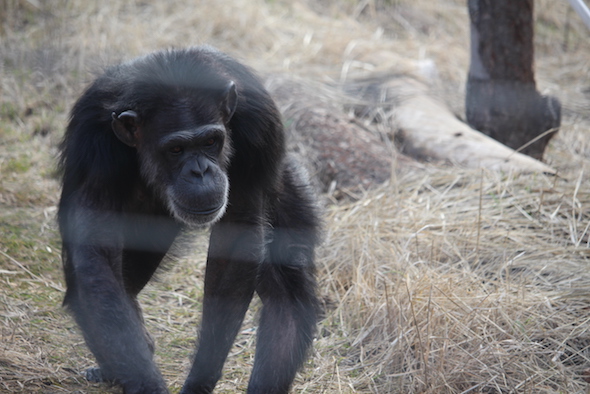
Later Annie & Missy basked in the sun, grooming and playing with each others toes:
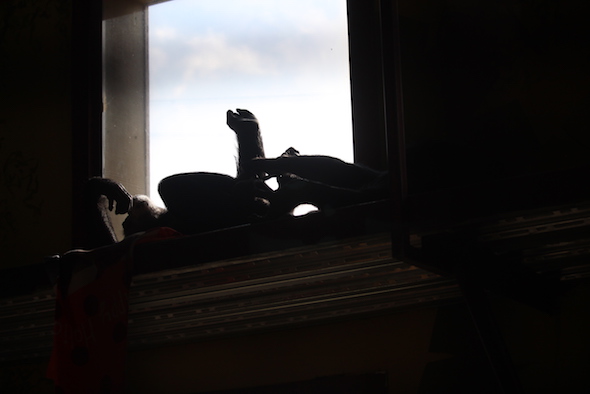
Jamie our fierce leader:
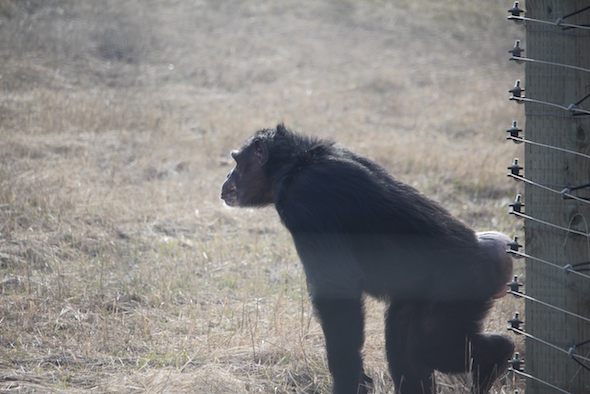
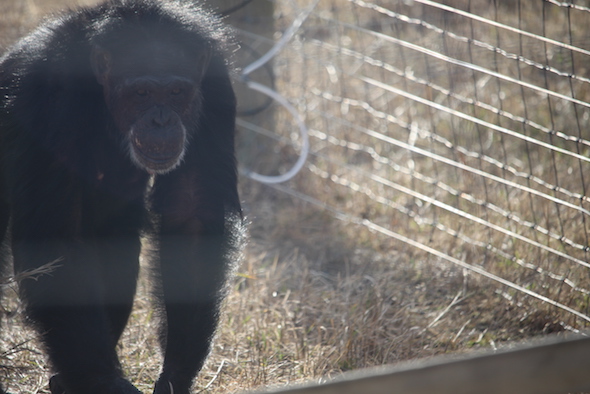
Missy was backing Jamie up on the Hill, helping with surveillance:

Jamie:
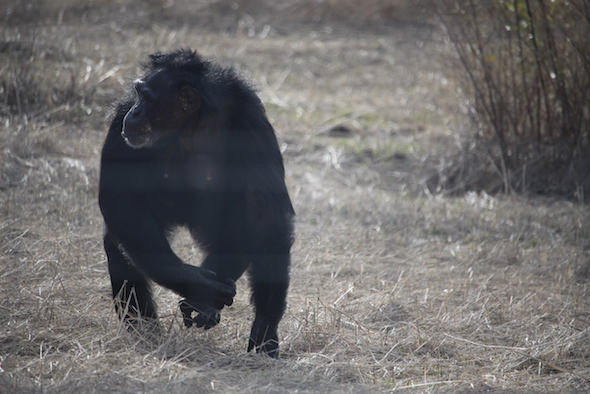
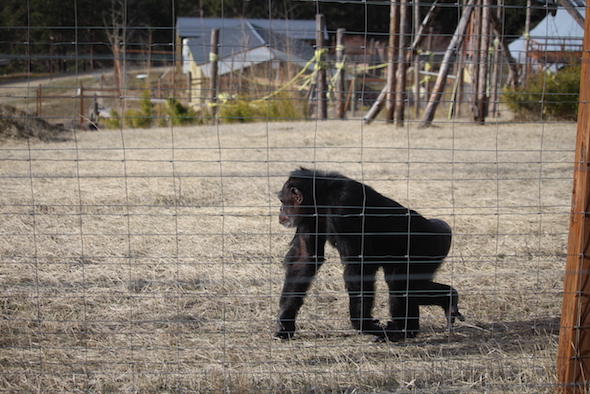
Jody was the gate keeper waiting for everyone to get in safely:
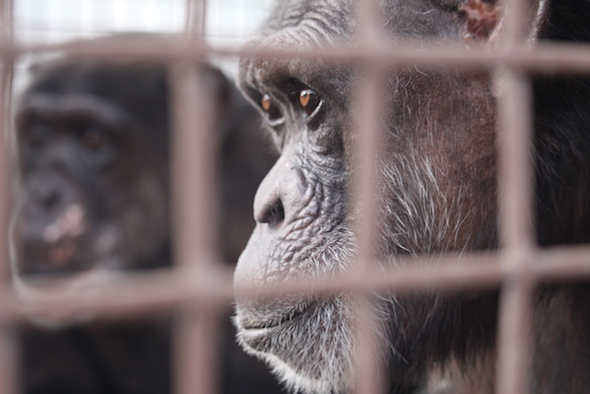
Foxie spending some time with her doll:
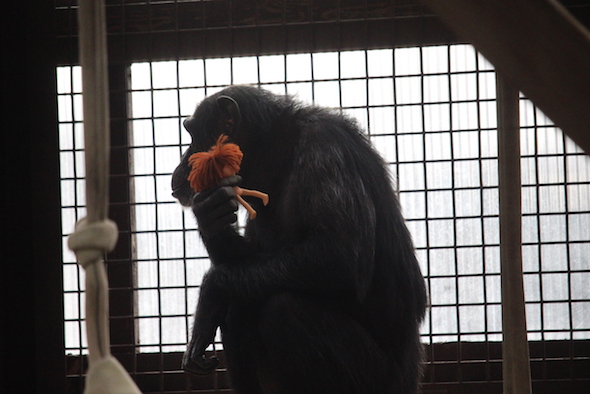
Dizzy with Excitement
At Chimpanzee Sanctuary Northwest, we encourage all of our staff and volunteers to communicate with the chimps in their language as much as possible. This means that we adopt a submissive posture when the chimps are displaying, we cover our top teeth when we smile during play, and we pant hoot with the group when they are excited.
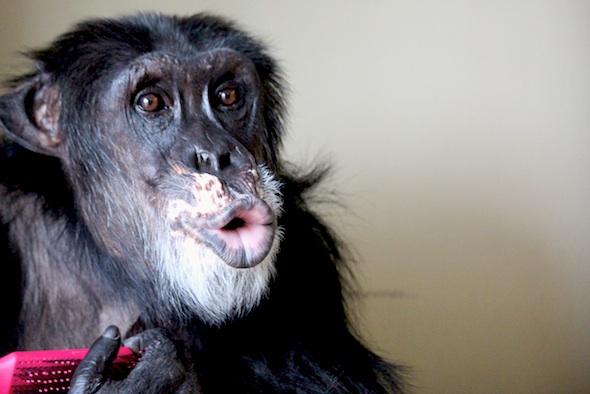
This last one can be difficult, though. Pant hoots, like many other chimp vocalizations such as breathy-pant greetings and laughter, require rapid breathing – as much as 10 to 15 times the normal rate. One minute you’re singing along with the chimps, the next minute you’re passed out on the floor. How do the chimps get away with it?
One interesting theory involves laryngeal air sacs, which are inflatable extensions of the vocal tract in the neck and upper chest of chimps and many other primates. I worked with chimps for a while without even realizing that they had air sacs, and they only came to my attention because they are prone to infection (airsacculitis) and occasionally need to be treated. They’re not noticeable in chimpanzees under normal circumstances like they are in some other species. Interestingly, humans and a few other primates lack them altogether.
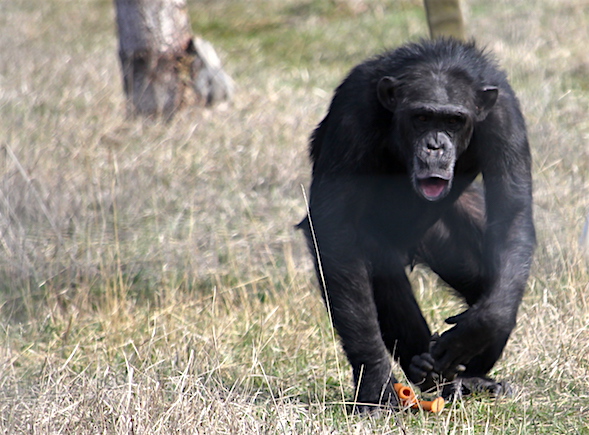
So what function do they serve? No one really knows for sure. The most obvious answer would be that they make vocalizations more efficient, possibly by increasing amplitude, matching impedance with the surrounding air, or lowering their frequency so that they travel farther through forest environments. But this doesn’t seem to be true in all species. Alternatively, they may allow smaller primates to sound larger than they are for the purposes of mating or territoriality – much like the way that male dogs attempt to urinate as high on a tree as possible. Whereas dogs tag trees to say WATCH OUT – VERY BIG DOG WAS HERE, perhaps monkeys are saying BEWARE – YOU ARE ENTERING GIANT MONKEY TERRITORY. But again, the evidence is mixed.
Air sacs are thought to be associated with a few species-specific calls such as the siamang’s “ascending boom” and what is perhaps the best named primate vocalization of all time, the gorilla’s “sex whinny”.
My favorite theory – which does not make it true, by any means – is that these air sacs allow certain primates to produce rapid inhale-exhale calls without hyperventilating. The sacs expand during exhalation, which means that they fill with CO2-rich air, and then they collapse during inhalation. What do humans often do when we are hyperventilating? We breath into paper bags to rebreathe our own air and restore CO2 levels (don’t try this at home on my advice, as it appears some more serious conditions can be mistaken for hyperventilation and made worse by rebreathing). Chimps, it turns out, have the equivalent of paper bags built right in.
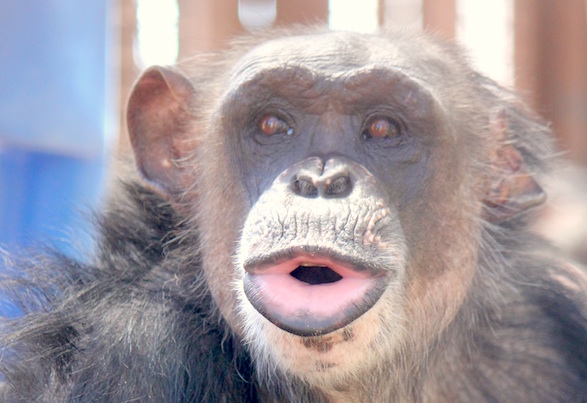
Air sacs may very well serve different functions in different species, or even multiple functions within the same species. The above theories aren’t mutually exclusive. But it’s clear that humans get along just fine without them – well, humans that don’t work with chimps, that is. Our ancestors most likely possessed them, so why would they disappear? It’s possible that when humans evolved ways to modulate our breathing and produce multiple phrases with each exhale we lost the need for them, and because they are prone to infection, they eventually disappeared.
Which means that we humans have to temper our excitement around the chimp house or else we’ll end up passing out before the party has even started.
Safe and sound
We give out over 70 fleece blankets each day so that the chimps can sleep in clean, comfortable nests. Night nests are usually built up off the ground on the catwalks in the playroom or on benches in the smaller front rooms. Sometimes the chimps sleep near each other, other times they seek privacy.
Annie often gathers blankets from the playroom and front rooms to build her nest on a front room bench. Its takes a lot of work to get the nest just right.
A Hug and a High-Five
Jody had some enthusiastic greetings for her friends this morning…
Mind Readers
Most people accept that chimpanzees are intelligent, but can they read minds? Not in a Carnac the Magnificent kind of way, but rather, do they know what other chimpanzees may or may not know? Can they take the perspective of another individual and alter their behavior accordingly? In other words, do they have what’s known as a Theory of Mind?
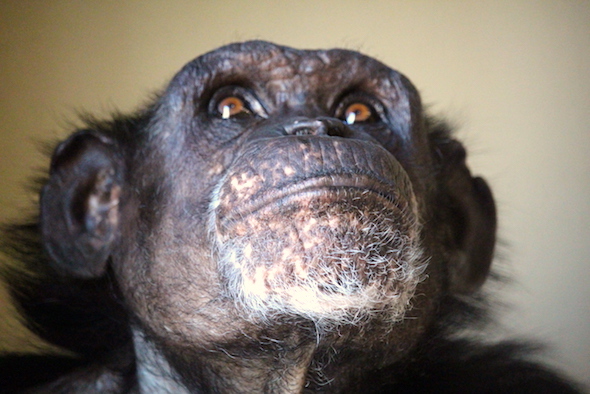
If you spend time around chimps you probably wouldn’t doubt for a second that they do. But one of the roles of science is to challenge our casual assumptions and force us to abandon complex explanations when simpler ones will do. For years, scientists tried to determine whether chimps were truly capable of acting on knowledge of other individuals’ mental states. They ran experiments in behavioral laboratories to try to tease out the answers. For example, would chimpanzees understand that a blindfolded researcher was incapable of telling them where food was hidden because she could not see it being hidden? The results were often inconclusive and it’s not hard to understand why. How often does someone sit blindfolded in a chair in front of you while someone else hides food around the building? What a strange thing to do. And since humans are always in cahoots anyway, who’s to say they didn’t know where the food would be before putting the blindfold on? If the chimpanzees could read minds, they’d probably wonder how we lost ours.
Field experiments offer an alternative to the more contrived situations found in the lab. Recently, a group of researchers studied how wild chimpanzees in Uganda change their alarm calls based on whether they think those around them are aware of the threat or not (read a summary here, or go here for the full article). Not surprisingly, chimps that heard a resting call from a hidden loudspeaker prior to discovering an artificial snake on a trail made a greater effort to alert those around them than when they heard alarm calls from the same speaker. They assumed that other chimps would not make resting calls if they were aware of the snake, and as a result they issued more alarm calls and stayed longer by the snake to point out the threat to those who needed to be informed.
In others words, the chimps’ responses to the sight of a snake were not simply reflexive, the way we might scream when startled. Rather, they were calculated in such a way as to ensure that critical information was given to those who needed it. From one mind to another.
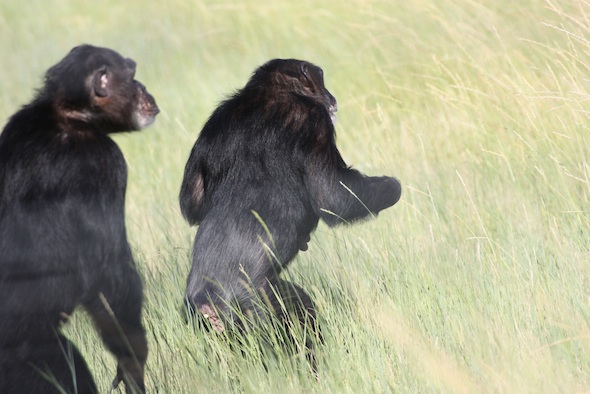
I have to admit that I do wonder about the ethics of exposing wild chimpanzees to fake snakes and recorded calls, and a quick check-in with a trusted friend in the field confirmed that these experiments can have a negative impact if not done correctly. You certainly wouldn’t want to desensitize wild chimpanzees to snakes or fill them with the fear that snakes suddenly lurk around every corner.
I mention all this because a) it’s in the news, b) it’s interesting, even if you already assumed that chimps had this ability, but most importantly, c) it’s a great excuse to update our compilation of chimps reacting to snakes as CSNW:
The one, the only…
The one, the only…Burrito.