In 2011, primatologists Lucy Birkett and Nicholas Newton-Fisher conducted a study that sought to shed light on a simple yet provocative question: How abnormal is the behavior of captive, zoo-living chimpanzees? I encourage you to read the paper but I’ll spare you the suspense:
Very.
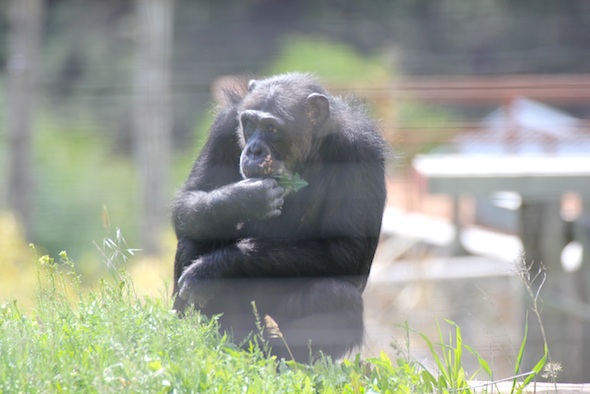
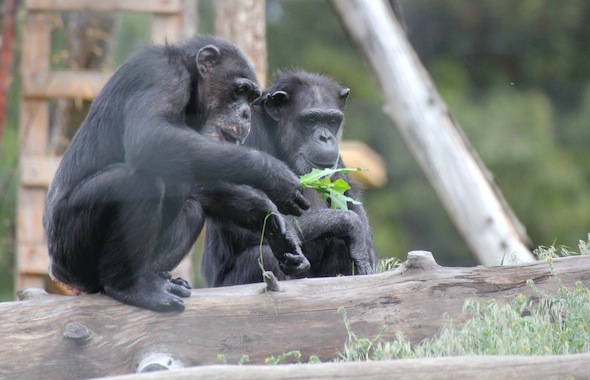
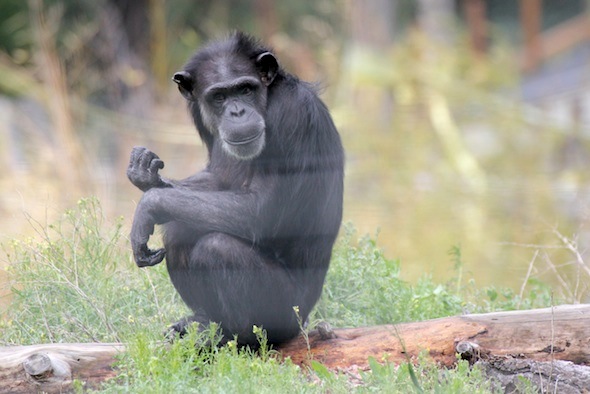
Their treatment of the issue was only slightly more nuanced. Captive chimpanzee behavior is normal, the authors say, in that they display many of the same behaviors as their wild counterparts—behaviors that we refer to as species-typical. As we know, captive chimpanzees tend to run, climb, groom, and use tools, just like wild chimps. The problem is that they also display a wide range of behaviors that are only rarely, if ever, seen in wild chimpanzees, such as hair-plucking, regurgitation and re-ingestion, coprophagy (eating feces), urophagy (drinking urine), pacing, rocking, self-clasping, and self-biting, which are commonly understood to be a reflection of poor welfare at some stage of life, and perhaps even mental illness. After observing the behavior of 40 chimpanzees at six accredited zoos in the U.S. and Europe, the authors came to the conclusion that abnormal behavior was not only present but endemic in these populations, regardless of group size, composition, and housing. Every single chimpanzee subject exhibited at least one abnormal behavior during the study period, with an average repertoire of five abnormal behaviors and an average frequency of once every forty minutes. This, it should be noted, was in contrast to the whopping total of zero instances that they recorded in over 1,023 hours observing wild chimpanzees in Uganda.
Researchers within in the zoo community rejected this characterization. They conducted their own study, which utilized a larger sample size but substituted surveys of zoo staff for direct behavioral observation, and concluded that only 64% of chimpanzees displayed abnormal behavior. And after excluding coprophagy, which some argue can be considered abnormal without necessarily being reflective of poor welfare, the overall prevalence of, shall we say, meaningfully abnormal behavior in their study dropped to a somewhat lower but still shockingly high 48%. As a rebuttal to the use of the term endemic, the paper may have succeeded, but it should provide little consolation.
Why would half or more of all chimpanzees in accredited zoological institutions exhibit abnormal behavior, in such stark contrast to their wild counterparts? Why, in light of decades of rigorous animal welfare science and the best efforts of hundreds upon hundreds of experts, do captive chimpanzees continue to regurgitate and pluck themselves bald?
One thing I discovered shortly after entering this field is that there is little agreement as to what it means for an animal to have a good life. To some, a good life is one in which one’s basic needs are met. As Dr. Dave Hone argues in an article entitled Why Zoos are Good:
…[zoo animals] will not suffer from the threat or stress of predators (and nor will they be killed in a grisly manner or eaten alive) or the irritation and pain of parasites, injuries and illnesses will be treated, they won’t suffer or die of drought or starvation and indeed will get a varied and high-quality diet with all the supplements required. They can be spared bullying or social ostracism or even infanticide by others of their kind, or a lack of a suitable home or environment in which to live. A lot of very nasty things happen to truly ‘wild’ animals that simply don’t happen in good zoos and to cast a life that is ‘free’ as one that is ‘good’ is, I think, an error.
There’s no question that the best zoos attempt to do all of this and more for the chimpanzees in their care. Why, then, does abnormal behavior persist?
The answer is that chimpanzees are more than just bundles of basic needs. They are complex social and emotional beings with highly intelligent and inquisitive minds. Moreover, chimpanzees are adapted to employ these traits in the environments in which their species evolved—a diverse range of environments, it should be said, from rain forest to savanna, which altogether actually have relatively little in common, save for one thing: their complete lack of resemblance to an urban zoo exhibit.
Should we be surprised that animals whose home ranges are measured in square miles in the wild feel frustrated in zoo exhibits? Should we expect animals that evolved dynamic fission-fusion communities of up to 150 individuals to thrive in relatively static groups of a dozen or less? Do we believe that members of a species that exhibits a predictable pattern of migration, in which males remain in their natal communities while females generally emigrate upon reaching adolescence, would not experience prolonged stress when groups are broken up and reorganized in violation of those patterns? This mismatch between the captive environment and the environment in which chimpanzees evolved both denies them the opportunity to express behaviors that are biologically and psychologically fulfilling and introduces stressors for which they have no innate coping mechanisms. And, importantly, it exists to varying degrees in every situation in which chimpanzees live under human care, from laboratory to zoo to sanctuary.
Regarding Dr. Hone’s point, I would never argue that life for wild chimpanzees is perfect. But I don’t think it requires a defense, either. It very well may be nasty, brutish, and short (actually, wild chimpanzees that reach adulthood live nearly as long as captive chimpanzees), but it is theirs, and has been for millions of years. It would be strange, and perhaps too convenient, to think we could improve upon it.
If we accept that all is not well for captive chimpanzees, we must then ask ourselves why we continue to breed them in captivity. I, for one, am not against all forms of captivity, as for the better part of the last 25 years I have worked to keep chimpanzees behind bars and electric fencing. Sanctuaries are necessary for chimpanzees who have been raised in captivity or who cannot be returned to the wild. And in fact many zoos have, to their great credit, provided homes for chimpanzees from laboratories, the pet trade, and various failed and shuttered institutions. But intentionally breeding and keeping animals in a way that denies their autonomy and restricts the full repertoire of their behavior, and which results in the proliferation of myriad abnormal behaviors despite our best efforts to enrich their environments, requires justification or, at the very least, a bit more reflection.
The modern defense of maintaining chimpanzees in zoos rests on two assumptions. The first is that the captive chimpanzee population serves an important role as a reservoir for one day restoring declining wild populations—the ark strategy, if you will. Given what we know about captive chimpanzees’ behavioral abnormalities and the absence of any kind of culturally-transmitted knowledge that would permit them to survive independently, this is unlikely to succeed and is generally accepted as such, even within the zoo community. The second is that zoo chimpanzees help educate the public and inspire support for conservation efforts. For this there is at least a somewhat more robust debate. But even if we were to accept that these benefits could only be achieved by maintaining chimpanzees in exhibits, our rightness in doing so would depend largely on how we measure the costs on the other side of the ledger; namely, those borne by the captive chimpanzees themselves.
The degree to which abnormal behavior correlates to the internal experience of suffering in captive chimpanzees is difficult to define with precision and we must be careful not to lump all abnormal behaviors together as though each is indicative of the same degree of compromised welfare. But the data appear to support what many of us have experienced professionally and what many others know intuitively: The chimps aren’t alright. And the reason for their troubles, it seems, has less to do with the way in which we keep them than with the very fact that we keep them at all. Our society is just now beginning to wrestle with the fact that, at least for some species like elephants and cetaceans, captivity is simply incompatible with good welfare. If we care enough about chimpanzees to conserve their wild populations, it’s time we think critically about the well being of the individuals serving on their behalf.