• Skip to main content
  • Skip to primary sidebar
  • Skip to footer

Chimpanzee Sanctuary Northwest

Hope. Love. Home. Sanctuary

  • Our Family
    • The Chimpanzees
    • The Cattle
  • Blog
  • About Us
    • Visiting the Sanctuary
    • Philosophy
      • FAQs
      • Mission, Vision & Goals
      • Privacy Policy
    • The Humans
      • Staff
      • Board of Directors
      • Founder
    • Annual Reports
    • The Future of CSNW
    • CSNW In The News
  • You can help
    • Donate
      • Become a Chimpanzee Pal
      • Sponsor A Day
      • Transfer Stock
      • Be A Produce Patron
      • Be a Bovine Buddy
      • Give from your IRA
      • Personalized Stones
      • Bring Them Home Campaign
    • Leave A Legacy
    • Employment Opportunities
    • Volunteer
    • See Our Wish List
    • Events
  • Resources
    • About Chimpanzees
    • Enrichment Database
    • Advocacy
      • Advocacy Action Center
      • Apes in Entertainment
        • Trainers
        • Role of the AHA
        • Greeting Cards
      • Chimpanzees as Pets
      • Roadside Zoos
      • Chimpanzees in Biomedical Research
      • Conservation
        • African Apes
        • Orangutans
  • Shop
    • Merchandise Store
  • Contact
  • DONATE NOW

primate rescue

Why are orangutans endangered in the wild?

February 18, 2014 by Debbie

This guest blog is by Rich Zimmerman, Executive Director of Orangutan Outreach. Rich helped facilitate getting CSNW an iPad as part of their Apps for Apes program! He is our first guest blogger to tell us information about our red ape cousins in Asia. Rich’s experience is in helping raise awareness and funds for the projects in the field. He has accompanied a few rescue missions in Borneo but his work is mainly in New York and online—advocating on behalf of orangutans, promoting the cause and communicating the critical need to help them before it’s too late.

—

What inspired you to work with orangutans?

I’ve loved orangutans since I was a child. I went in a different direction professionally and it was only later in life—when I realized just how perilously close the orangutans were to extinction in the wild—that I decided I needed to do something to help them. After traveling to Indonesia and seeing the utter devastation to their forests and the rescue center cages full of hundreds of orphaned and displaced orangutans staring out with such sadness and desperation in their eyes, I decided to dedicate my life to helping them. I created Orangutan Outreach in 2007 as a way to raise awareness of the crisis facing wild orangutans and to raise funds for the rescue projects in Borneo and Sumatra.

Can you tell us a brief story about an individual orangutan that was personally affected by human encroachment?

Every orangutan in every rescue center has been affected by human encroachment. Whenever there is a conflict, the human always wins. Orangutans—and elephants, rhinos, tigers, monkey, you name it—always fall victim to the constant expansion of human settlement and the destruction of their habitat by logging, palm oil, and mining companies. Every baby in a rescue center was torn off his or her dying mother. These innocent babies are traumatized—just as any human baby would be if pulled from its mother. And for each infant confiscated and brought to a rehabilitation center, it’s estimated that anywhere from four to nine did not survive. It’s horrific what is being done to these creatures… for no fault of their own they are being wiped out of existence by humans.

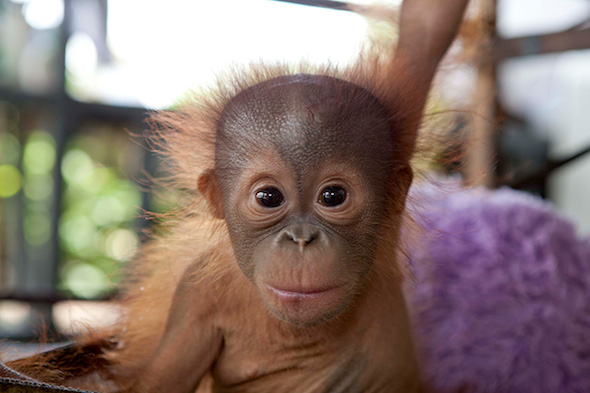
Let me tell you two quick stories. The first is Rickina, who was rescued by our partners International Animal Rescue (IAR) when she was less than a year old. When they confiscated her she has a gaping machete wound in her skull—obviously received when the poachers killer her mother. The wound was fresh. Rickina is now doing really well—thanks to the expert care of the team at IAR Ketapang. She is quite famous online—with more than 350,000 views of her video on YouTube.
OrangutanOutreach-IAR-rickina
Baby Orangutan Rickina is being cared for at IAR Ketapang (and can be adopted!). Photo © International Animal Rescue.

Another amazing story is Gober, a blind, older female orangutan being cared for by our partners Sumatran Orangutan Conservation Programme (SOCP). When she was caught eating fruit in the garden of a local villager she was going to be killed. Instead she was rescued and brought to the SOCP quarantine center. She had cataracts and could barely see. She was housed in a cage next to a younger male orangutan (named Leuser) who had been shot with a pellet gun more than a hundred times by local villagers. He was totally blind and the fact that he’d even survived is testament to the phenomenal will to live of orangutans. Well, orangutans never cease to amaze… nine months later Gober gave birth to beautiful twins, Ganteng and Ginting. Twins are extremely rare among orangutans—which makes sense given the fact that in the wild they spend their lives high up in the treetops. Imagine trying to move around in the canopy carrying two babies! Gober had successful cataract surgery and her sight has been partially restored. Hopefully she and the twins will be released back into the wild later this year!
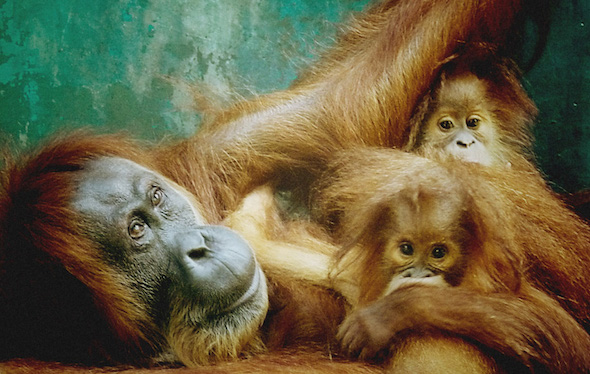
OrangutanOutreach-SOCP-gober
Gober & the Twins are being cared for by SOCP (and can be adopted!) Photo © Sumatran Orangutan Conservation Programme.

Why are orangutans endangered in the wild?

The expansionary activities of the timber, mining and palm oil industries have led to a catastrophic decrease in wild orangutan populations. Palm oil has been the main contributor to the orangutan genocide in the last decade. Around 90% of the global supply of palm oil comes from Indonesia & Malaysia and this has come at a tremendous cost for biodiversity. Indonesian forests are being burned to the ground—releasing so much carbon into the atmosphere that Indonesia now ranks only behind China and US in carbon emissions—and it is barely industrialized. The UNEP estimates that the forests of Indonesia are being cleared at a rate of six football fields per minute, every minute of every day.

The palm oil industry is guilty of truly heinous ecological atrocities. The forests of Borneo and Sumatra are the only place where these gentle, intelligent creatures live, and the cultivation of palm oil has directly led to the brutal deaths of thousands of individuals as the industry has expanded into previously undisturbed areas of rainforest at an alarming rate.

When the forest is cleared, adult orangutans are killed on sight. These peaceful, sentient beings who share approximately 97% of our DNA are shot, macheted, beaten, burned, mutilated, tortured and often eaten. Babies are literally torn off their dying mothers so they can be sold on the black market as illegal pets to wealthy families who see them as status symbols of their own power and prestige. This has been documented time and again.
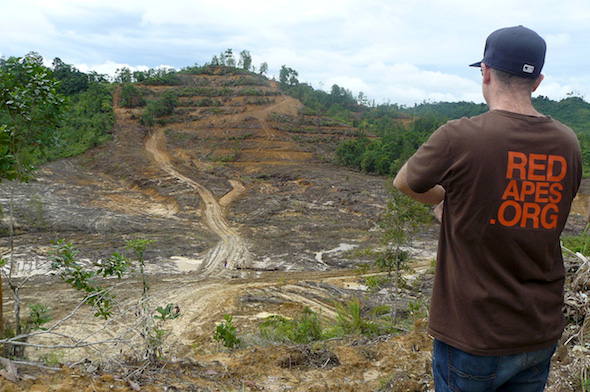
OrangutanOutreach-deforestation-1200w
Surveying deforestation in West Kalimantan (Indonesian Borneo). Photo © Orangutan Outreach

Have you seen any recovery of wild orphaned orangutans (e.g. is reintroduction possible)?

Reintroduction is very possible! Over the last year and a half, our partners at BOS have released more than 100 rehabilitated orangutans into a safe and secure forest deep in the heart of Borneo—far away from bulldozers and oil palm companies. And the population is flourishing! While there has been one death reported there have been multiple births recorded by the post-release monitoring team. The cycle of life continues in the forest for the world’s first re-created orangutan population. It takes roughly 250-300 individuals to create a stable population so there are many releases to go before the forest has reached carrying capacity according to strict IUCN guidelines. What BOS needs now is to find more forests to release more orangutans. There are still around 600 orangutans being cared for at the Nyaru Menteng Facility. They also have orangutans in East Kalimantan who are gradually being released into a separate forest. IAR is doing the same in West Kalimantan. They’ve been able to release orangutans from their excellent new facility in Ketapang. SOCP has a successful release program in Northern Sumatra. All these projects and programs are ongoing—and are only possible due to the generosity of donors.
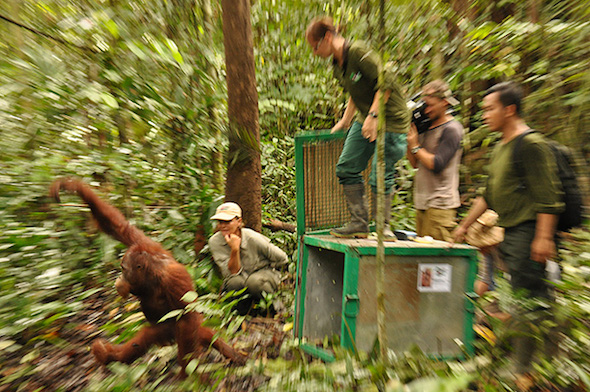
OrangutanOutreach-BOS-Releases
BOS Nyaru Menteng Orangutan Release Photo © Borneo Orangutan Survival Foundation.

Filed Under: Advocacy, Sanctuary Tagged With: advocacy, animal protection, animal rescue, animal rights, apps for apes, chimp sanctuary, Chimpanzee Sanctuary Northwest, csnw, free-living orangutans, orangutan, orangutan outreach, primate protection, primate rescue, rehabilitation, rescue, Sanctuary, wild orangutans

Margot

January 21, 2014 by Debbie

This post is by a new guest blogger, Gwendy Reyes-Illg. She is an emergency veterinarian in Loveland, Colorado and serves on the Leadership Council of the Humane Society Veterinary Medical Association. She has visited and volunteered her services to several primate sanctuaries in the United States and Africa. Currently Dr. Reyes-Illg is pursuing a master’s degree in Animal and Environmental Ethics at Colorado State University. In a few years, she plans to relocate permanently to Africa to help primate sanctuaries and their surrounding communities. We asked her a few questions about her work—the first of which are answered here, and the rest will be in a follow-up post soon. WARNING: one possibly disturbing image is included in this entry as a link in the text.

—

How long have you been working in the field, and how did you get started there? What do you find most rewarding about working with chimpanzees and gorillas?

I’ve been working with apes for the past 13 years. As a college student, I took a semester off to intern at the Center for Great Apes in Wauchula, FL, a sanctuary for chimpanzees and orangutans rescued or retired from the entertainment and pets trades. I have loved animals and advocated for them for as long as I can remember—by age 10, I was an ethical vegetarian—so my heart was already set on spending my life working with and for animals.

A documentary about Jane Goodall, along with the book The Great Ape Project, inspired me to focus on apes. Fascinating creatures in their own right, apes also serve as a natural “bridge” for extending moral consideration beyond our own species. In veterinary school, I always tried to imagine how I could adapt what I was learning to primate sanctuaries, especially those in remote areas with limited resources.

Now, as a veterinarian, what is most rewarding for me is the moments of connection that I have with individual primates. After an anesthetic procedure, I often sit with the patient while he or she wakes up to make sure they are recovering well. This is a quiet time where they are away from their group. Even chimpanzees who are normally pretty shy with humans will come out of their shell a bit, and reach out a hand to be held. Given how strong and intimidating chimpanzees can be when emotionally aroused, I am always amazed at the gentleness with which many of them groom and touch.

Tell us about an individual ape personally affected by human encroachment, and how you were involved in their recovery.

Unlike most apes in North American sanctuaries, almost all the chimpanzees and gorillas in African sanctuaries were born in the wild. They were taken from the forest when the mothers they were clinging to were killed so their bodies could be sold as “bushmeat.” Though ape meat is illegal, it can be sold at a high price because, for some, consuming it is a status symbol. Even some restaurants in Europe and North America have been caught serving ape meat.

Infants’ small size means that they fetch a higher price when sold alive, as “pets” or tourist attractions. After the horrors of being torn from their mothers, many infants die of their wounds, neglect, or illnesses they contract from their captors. The survivors are often tied by the waist or chained by the neck in private homes or hotels. The rare lucky survivors wind up in one of dozens of sanctuaries throughout Africa after being confiscated by authorities or surrendered by people who have purchased them.

Margot, a four-year-old “little girl,” is one chimpanzee I got to know especially well during my last time in Africa. She was confiscated from a poacher in 2011 and arrived at the Sanaga-Yong Chimpanzee Rescue Center with several shotgun wounds to her face—probably from the same gun that killed her mother. As a result, she had a broken jaw, as well as a hole in the roof of her mouth (palate) that connected to her nose. While most of her wounds healed soon after her arrival, the hole in her palate proved very difficult to surgically repair. Both a human surgeon and a veterinarian attempted to close the hole, but two surgeries later, it was still there, and Margot was frequently developing respiratory infections from aspiration.

margot surgery

Before my last volunteer trip, the sanctuary director and I consulted with several maxillofacial surgeons to develop a new surgical plan and get the special supplies I would need for what we hoped would be Margot’s final surgery. Margot was gently anesthetized and carefully monitored and tended to by Nicholas, the Cameroonian veterinary technician, while I performed the surgery. Afterward, she had to eat an all liquid diet and take several different medications to prevent pain and infection. We were worried Margot or one of the other chimpanzees in her group might pull out the stitches before the repair had healed so, instead of going out into the forest everyday with the others, Margot had to stay inside with a caregiver for two weeks. She was not happy about this!

Despite the disruption of her routine and missing her chimpanzee friends, Margot was a very good patient. Every day or two, I visited her, played for a bit and tried to get a peek at how the repair was holding up. Margot was so gentle and tolerant, even with everything she was going through—and all she had survived in her short life. At last check, it looks like the surgery has been a success! The hole was finally closed. Margot will have another check-up soon, to make sure everything is continuing to heal well.

Filed Under: Advocacy, Free-living chimps, Sanctuary Tagged With: advocacy, animal protection, animal rescue, animal rights, Animal Welfare, chimp sanctuary, Chimpanzee Sanctuary Northwest, Gwendy Reyes-Illg, primate protection, primate rescue, rescue, Sanaga-Yong Chimpanzee Rescue Center, Sanctuary

Foxie with tiny trolls

January 4, 2014 by Debbie

It seems Foxie has been the center of our blog posts lately, but that might be because no matter what she is doing she is bright, playful, funny, and can bring a smile to all of our faces. You’ll see what I mean while watching this video:


Filed Under: Enrichment, Foxie, Play, Sanctuary, Trolls Tagged With: animal protection, animal rescue, animal rights, Animal Welfare, chimp, chimp sanctuary, Chimpanzee Sanctuary Northwest, Cle Elum Seven, csnw, Enrichment, Foxie, primate protection, primate rescue, troll

Cheers!

December 31, 2013 by Debbie

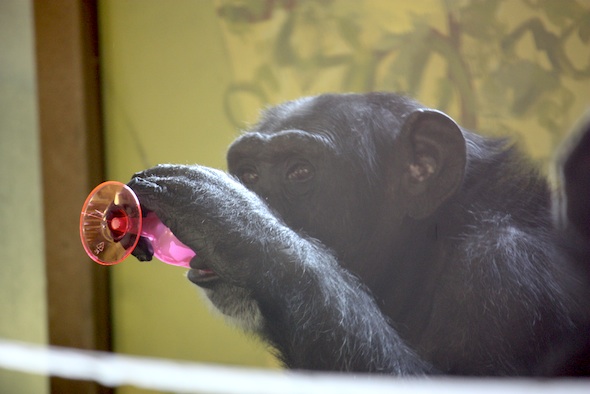
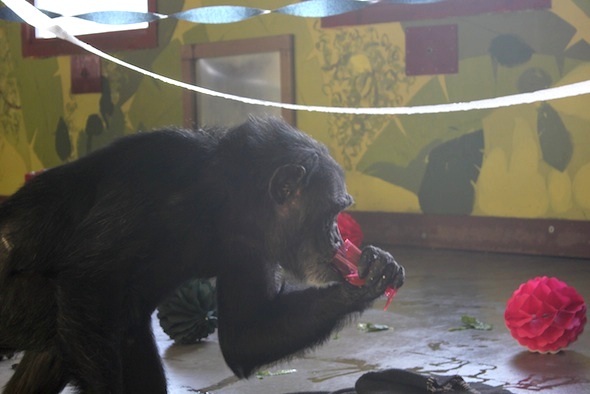
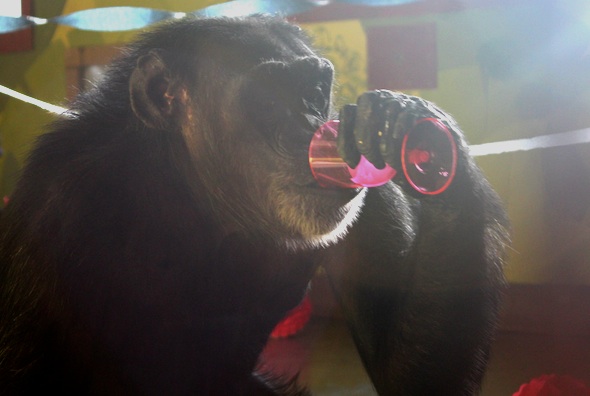
Happy New Year’s Eve! We want to thank Jody Ubert for sponsoring today for the chimpanzees. Jody, you’ll be happy to know that we had a wonderful little New Year’s Eve party for the chimpanzees today, complete with party streamers and plastic champagne flutes with sparkling apple cider. The chimps loved them!

Today is also the last chance to donate before the end of the year. If you’re on our mailing list, you received this message in your inbox this morning, which includes a link to the Foxie Inspires Us video. Foxie and her friends are in a Holiday Pal competition, too, and I think it’d be really great to see all seven chimps with two full candy canes by the end of 2013. Check the progress here, and support your favorite pal before the ball drops at midnight tonight!

Here is Foxie enjoying some of the cider from today:

web_foxie_drink_apple_cider_new_year's_eve_PR_jb_IMG_6653

web_foxie_drink_apple_cider_new_year's_eve_PR_jb_IMG_7422

web_foxie_drink_apple_cider_new_year's_eve_PR_jb_IMG_7423

Thank you to everyone who has made the last five and half years of sanctuary so wonderful for the Cle Elum Seven. Cheers to you and yours, and have a Happy New Year!

Filed Under: Enrichment, Food, Foxie, Party, Sanctuary, Sponsor-a-day, Thanks Tagged With: animal protection, animal rescue, animal rights, Animal Welfare, chimp enrichment, chimp rescue, chimp sanctuary, chimpanzee, chimpanzee rescue, chimpanzee retirement, chimpanzee sanctuary, Chimpanzee Sanctuary Northwest, Cle Elum 7, Cle Elum Seven, csnw, Foxie, Fundraising, primate protection, primate rescue, Sanctuary

Nothing To See Here

December 22, 2013 by Elizabeth

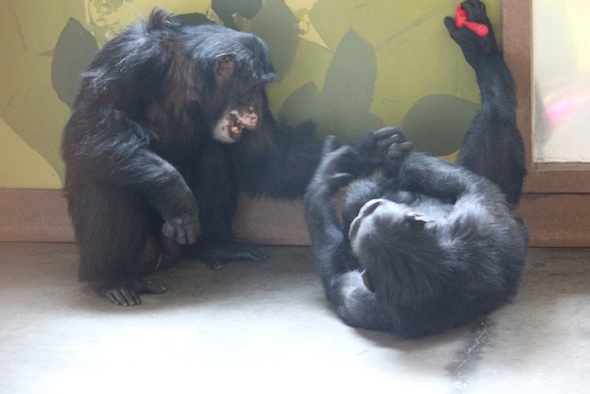
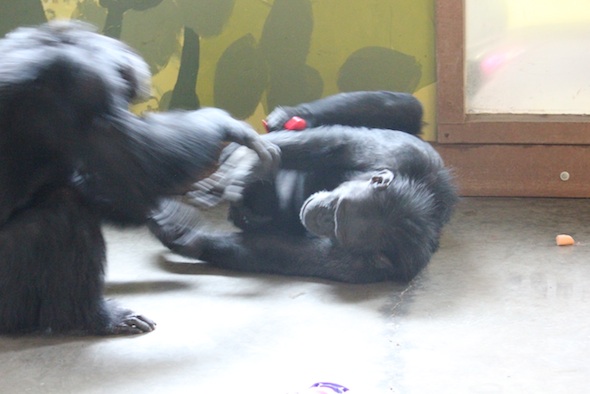
Posting to the blog is one of my favorite job duties. I love sharing stories, photos, or videos of the chimpanzees, because someone is almost always doing something funny, endearing, impressive, or otherwise interesting. But capturing these moments on camera can be a challenge.

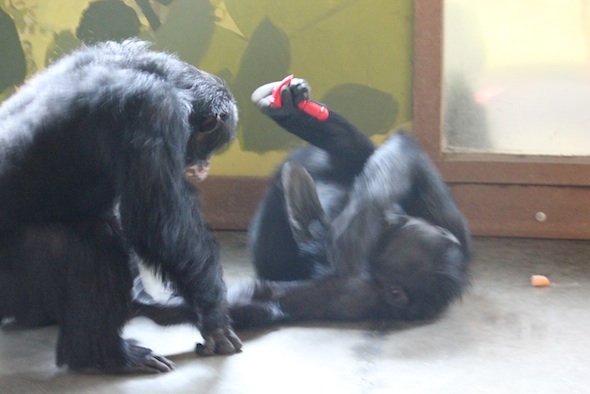
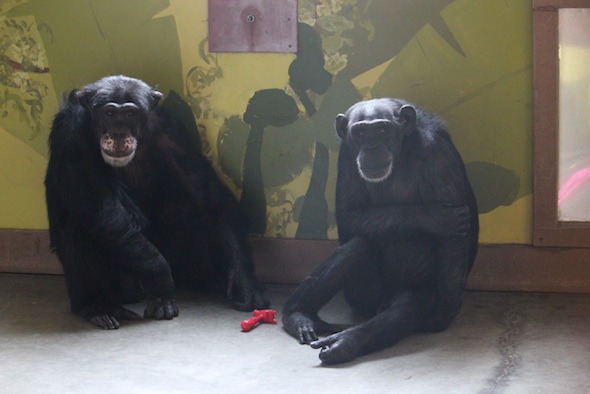
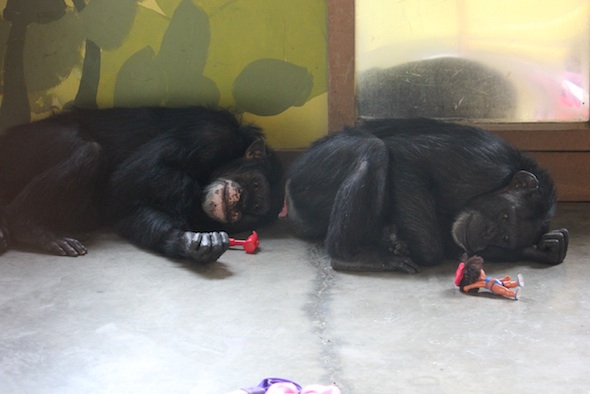
I just came across a series of photos Diana took a couple of weeks ago of Foxie and Burrito playing. The series perfectly illustrates our daily struggles trying to get photos of the chimpanzees for the blog. When we witness moments like this, we run and grab the camera.

web_Burrito_Foxie_play_wrestle_playface_blur_pr_dg_IMG_6766

web_Burrito_Foxie_play_enrichment_toy_wrestle_playface_blur_pr_dg_IMG_6754

web_Burrito_Foxie_play_enrichment_toy_wrestle_playface_blur_pr_dg_IMG_6758

web_Burrito_Foxie_play_enrichment_toy_wrestle_playface_blur_pr_dg_IMG_6755

web_Burrito_Foxie_play_enrichment_toy_wrestle_playface_blur_pr_dg_IMG_6753

But as soon as the chimps catch sight of the photographer, whatever blog-worthy thing they were doing often comes screeching to a halt, as though it never happened.

web_Burrito_Foxie_nothing_to_see_here_play_stop_pr_dg_IMG_6763

web_Burrito_Foxie_lie_floor_after_play_enrichment_pr_dg_IMG_6771

Filed Under: Burrito, Foxie, Play, Sanctuary Tagged With: Burrito, Chimpanzee Sanctuary Northwest, Foxie, primate rescue, Sanctuary

Take Action Tuesday: Chance in Wolf of Wall Street

December 10, 2013 by Debbie

EOA take action tuesday

This action alert went out earlier today. Not on the mailing list? Sign up for Eyes on Apes Take Action list today to get these alerts straight to your inbox!

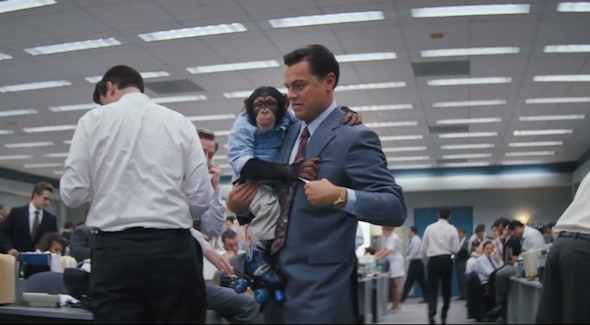
In the upcoming movie Wolf of Wall Street, Leonardo DiCaprio is seen holding an infant chimpanzee, Chance. It is especially disappointing because Mr. DiCaprio is known for his passion for animal conservation—most recently he supported conservation efforts to save tigers in Nepal.

Animal advocacy groups have contacted Mr. DiCaprio and the movie producers, however our efforts to reach out have not resulted in Chance’s scenes getting removed from the movie. Now it is time for the public to speak up!

wolf-of-wall-st-screen-shot

Chance was once a pet, and his previous owners discarded him to a pseudo-sanctuary called the Big Cat Habitat and Gulf Coast Sanctuary. The animal attraction claims to be a reserve for animals, but they regularly exploit their residents for entertainment purposes. In fact, Chance’s owners (the Rosaire-Zoppe family) are the only remaining trainers that continue to use chimpanzees in circuses. No respectable reserve or animal sanctuary would lease out their animals for media productions such as this movie.

Even if the AHA was present for filming, they have no authority over Chance’s treatment off-set, making the “no animals were harmed” disclaimer misleading.

Portraying chimpanzees as cute and cuddly attractions seriously misinforms the public on the true nature of these beings and perpetuates the pet and entertainment industries. Studies have shown that showing chimpanzees alongside humans in film and TV mask their endangered status, and these scenes hurt conservation efforts.

Despite hearing these facts from advocacy groups, the Wolf of Wall Street producers have not removed Chance’s scenes from the movie, which will be released on December 25. We encourage you to please post on the movie’s poster on their Facebook page and Twitter to let them know that because of the issues with Chance’s scenes you will not be going to see the movie, and you will tell all your friends to boycott it with you.

Sample Facebook Post:

I’m boycotting Wolf of Wall Street because of the chimpanzee scenes! Even Hollywood knows that abuse occurs when animals are used in movies (hollywoodreporter.com/feature). Chimpanzees don’t belong in movies unless they are CGI. Chimpanzees are an endangered species and showing them as cute and cuddly props hurts conservation efforts and perpetuates the pet trade.

Sample Tweets:

Pls RT! Join @EyesOnApes and tell @LeoDiCaprio chimps should not be in movies & you won’t see @TheWolfofWallSt!

RT! @LeoDiCaprio I will boycott @TheWolfofWallSt because of Chance’s scenes. Chimps do not belong in movies! EyesOnApes.org

Don’t support animal abuse. Refuse to see @LeoDiCaprio in @TheWolfofWallSt and tell all your friends. EyesOnApes.org Pls RT!

The final thing you can do to help Chance is to spread the word! Please share this alert on social media and encourage your friends to boycott the movie with you.

Filed Under: Advocacy, Apes in Entertainment, Sanctuary Tagged With: advocacy, animal protection, animal rescue, animal rights, Animal Welfare, boycott, chance, chimpanzee, chimpanzee rescue, chimpanzee retirement, Chimpanzee Sanctuary Northwest, chimps in entertainment, conservation, csnw, dicaprio, leo, leo dicaprio, leonardo dicaprio, primate protection, primate rescue, Sanctuary, take action, wolf of wall st, wolf of wall street, WoWS

Green Toys!

November 27, 2013 by Katelyn

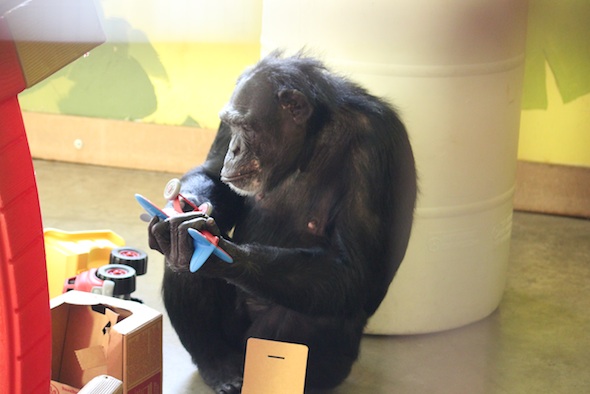
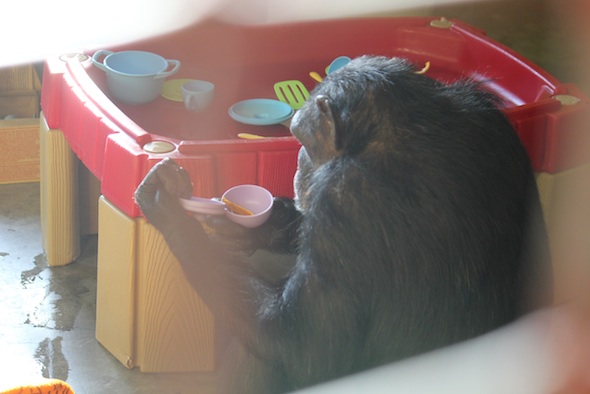
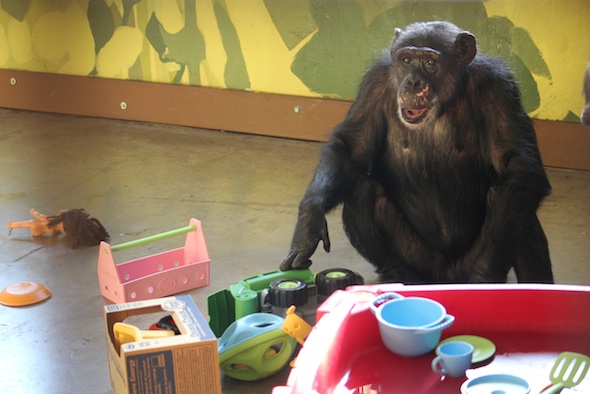
And our thankfulness continues! If you saw the blog yesterday, you’ll know that the chimpanzees received many wonderful new gifts from some of our amazing supporters! Well, today the chimpanzees also received new toys from Green Toys! In addition to the ongoing challenge we (and Enrichment Coordinator, Debbie) have of finding things that are new and interesting for the chimpanzees’ active minds (particularly Jamie’s!), as you can imagine, the life as an item of chimpanzee enrichment is not an easy one. So after receiving a variety of Green Toys from our amazing supporters via our Wishlist, we were pretty excited to learn that they are chimp-tested and caregiver-approved! Green Toys are not only environmentally friendly but can take a licking from the chimps and remain relatively unscathed.

Here is Jamie checking out a new dump truck:

web_jamie_hold_green_toys_dump_truck_enrichment_PR_dm_IMG_6595

Jamie giving the “bite test” to a submarine as Foxie (who is still loving her new French Dora doll from yesterday!) comes to check things out:

web_jamie_green_toys_submarine_foxie_french_dora_enrichment_PR_dm_IMG_6525

And Jamie checking out a new airplane (and I am pretty sure thinking she could fly one):

web_jamie_hold_green_toys_airplane_enrichment_PR_dm_IMG_6654

Missy enjoying some orange “tea” in the tea set:

web_missy_forage_enrichment_green_toys_cup_PR_dm_IMG_6603

Missy:

web_missy_relaxed_face_green_toys_enrichment_PR_dm_IMG_6581

Foxie:

web_Foxie_bite_green_toys_keys_dm_IMG_6659

Thank you so much Green Toys for the chimpanzees’ gifts! And also for making great toys which just happen to be great chimpanzee enrichment!

Filed Under: Enrichment, Foxie, Jamie, Missy, Sanctuary, Thanks Tagged With: animal protection, animal rescue, animal rights, Animal Welfare, chimp enrichment, chimp sanctuary, chimpanzee, chimpanzee rescue, chimpanzee retirement, chimpanzee sanctuary, Chimpanzee Sanctuary Northwest, Cle Elum 7, Cle Elum Seven, csnw, Enrichment, Foxie, Jamie, Missy, primate protection, primate rescue, Sanctuary

  • « Go to Previous Page
  • Page 1
  • Interim pages omitted …
  • Page 15
  • Page 16
  • Page 17
  • Page 18
  • Page 19
  • Interim pages omitted …
  • Page 50
  • Go to Next Page »

Primary Sidebar

Subscribe To the Blog and Get Notified of New Posts First!

Archives

Calendar of Blog Posts

June 2026
S M T W T F S
 123456
78910111213
14151617181920
21222324252627
282930  
« May    

Categories

SUBSCRIBE TO OUR NEWSLETTER

Footer

PO Box 952
Cle Elum, WA 98922
[email protected]
509-699-0728
501c3 registered charity
EIN: 68-0552915

Official DDAF Grantee

Menu

  • The Chimpanzees
  • Blog
  • About Us
  • You can help
  • Resources
  • Contact
  • Donate

Proud Member of

Connect With Us

Search

Copyright © 2026 Chimpanzee Sanctuary Northwest. All Rights Reserved. Site by Vegan Web Design