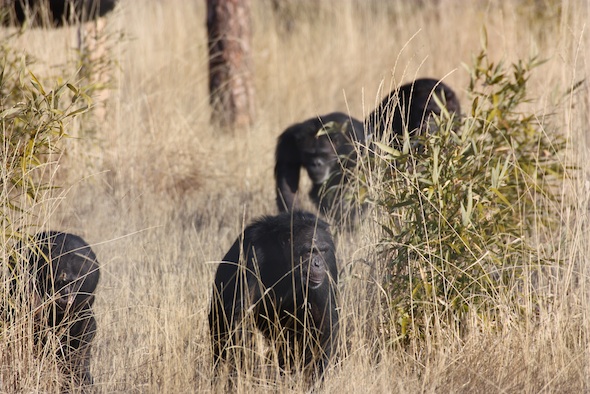
No matter how long you work at a sanctuary or how well you know the chimps, there are still moments that take your breath away. Jody, Foxie, Jamie, and Burrito spent decades living in isolation in barren laboratory cages. Today, they are free to patrol their territory as a family.
northwest
Be Still My Heart
It’s appropriate to get really mushy because it’s Valentine’s Day tomorrow, right?
I am going to share something I love about each of the chimpanzees below, but first I need to get mushy about you – Chimpanzee Sanctuary Northwest supporters.
First, a confession: fundraising has not been my life’s ambition. I’ve met people who I might call “born fundraisers,” and I can definitively say that they posses qualities that I simply do not.
However, the more I do this fundraising thing, the more I appreciate what a unique and special position I am in. I get to make dreams come true – dreams for the chimpanzees, and dreams for donors who support the chimpanzees. We are all very much in this together, with the same goals for the future, and I feel that connection when I talk to those who support the sanctuary.
Not many people have a job that is so fulfilling, and very few people have a job with so much positive feedback. Katelyn and I were talking about this in the office the other day – we regularly have people call or email to not only make a donation, but also to say that they love the work we are doing and appreciate us sharing stories of the chimpanzees, allowing them to feel connected to the chimps as the individuals who they are.
Thank you for being supportive and for sharing your love with the chimpanzees – and with the humans too!
Speaking of which… as I write this, we are just $1,797 away from reaching our $12,000 goal for the Share the Chimp Love fundraiser, which ends at the end of the day tomorrow. UPDATE: big thanks to Julie L. for donating exactly $1,797 after this post was published!
If you are feeling the love, but haven’t yet made a donation, you can share that love now on this page. You can choose to spread the love even further by donating in honor of someone else for Valentine’s Day, or just make a donation for the love of Annie, Burrito, Foxie, Jamie, Jody, Missy, and Negra.
Below are just some of the things that I love about each of the chimpanzees at the sanctuary.
It would be so fun for me if you also shared what you love about Annie, Burrito, Foxie, Jamie, Jody, Missy, and Negra in the comments!
I love ANNIE’s serenity:
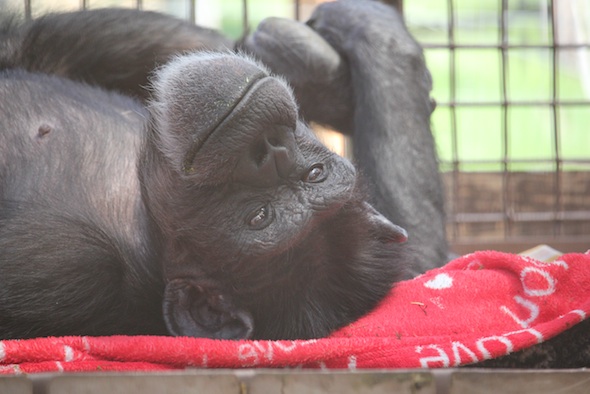
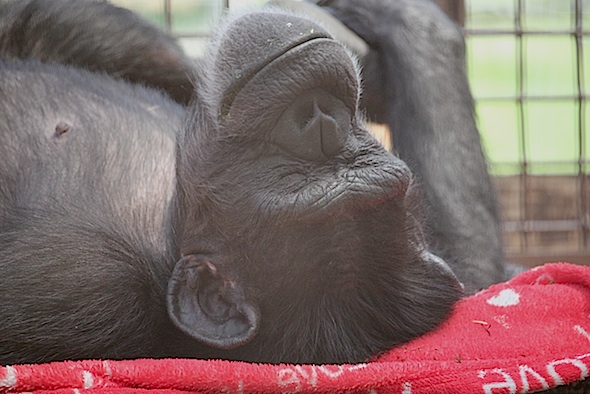
and her bird noises!
I love when BURRITO’s “chimpanzeeness” really comes through (for the full explanation of the video below, see this blog post from 2013 when it was originally published):
I love FOXIE’S “happy toes” (video from 2010):
I love JAMIE’s brave leadership:
I love JODY’ nesting skills:
I love MISSY’s ability to entertain herself:
I love NEGRA’s playful moments (video from 2011):
Thank you again for being a part of Sharing the Chimp Love!

Alfalfa, the miracle weight loss food
If the chimps had their way, they’d eat all day long. Burrito would be unstoppable. Negra would probably forego blankets entirely and just make huge nests out of bread and peanuts so that she would never have to get out of bed again. But overeating is not usually conducive to good health, so for their sake we try to balance these two competing interests as best we can.
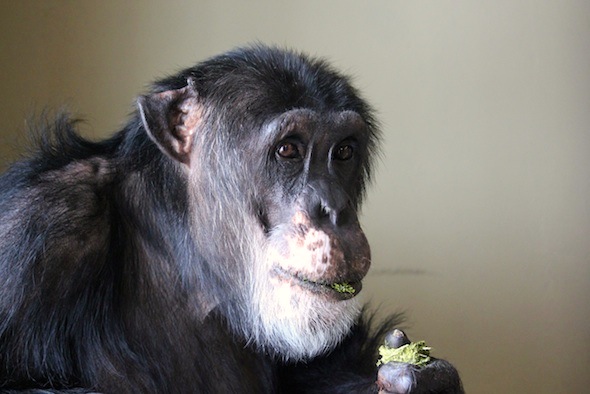
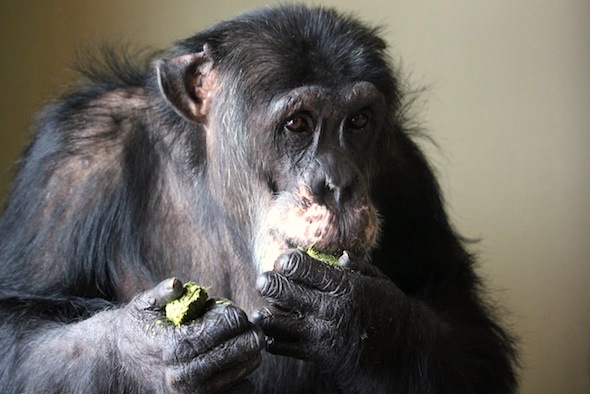
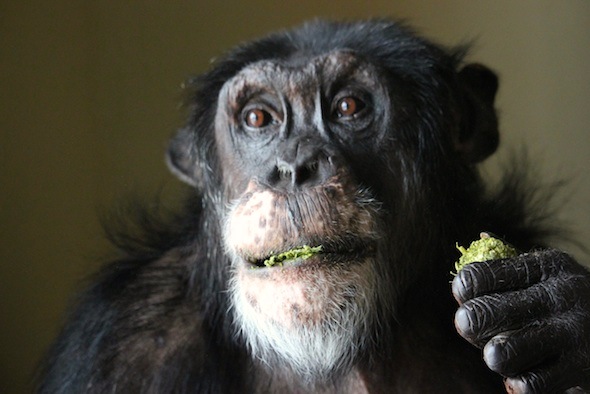
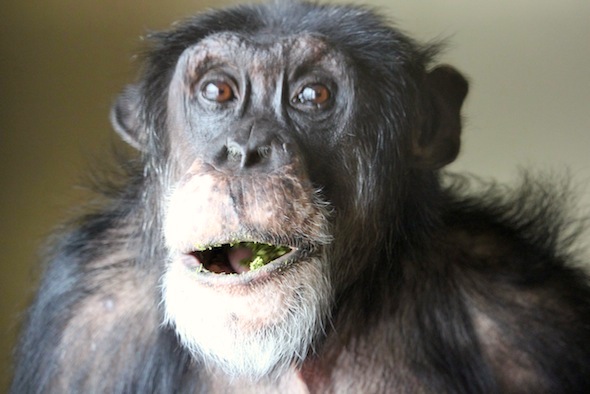
Thankfully, there’s a miracle diet food that helps keep chimps happy and healthy: alfalfa. Not just alfalfa, but also bamboo, grape vines, timothy hay, cattails – things that we collectively refer to as “browse”. Chimps love browse, but most browse plants are too fibrous to be digested properly, so they either pass right through or the chimps spit them out after a thorough chewing. Browse makes it possible for chimps to chew to their hearts’ content without eating a lot of calories.
In the summer and fall, many types of browse grow naturally in the chimps’ two-acre enclosure, which allows them to grab a snack anytime they like. Naturally occurring browse is harder to find during the winter, so we make sure to provide Burrito and his family with store-bought treats like alfalfa cubes on a regular basis:
A shock from the past
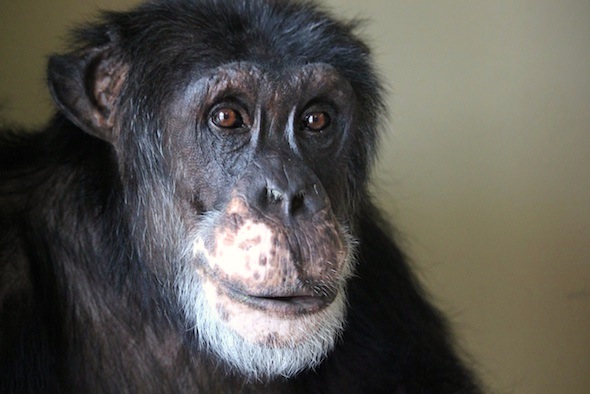
When I was gathering photos the other day for the Share the Chimp Love Video, I came across the photo below of Jamie and gasped out loud.
I think it’s been a few years since I saw this image, but it’s very familiar. It was taken in September of 2008, three months after the chimpanzees arrived to Chimpanzee Sanctuary Northwest. J.B. posted it to the blog back then.
It was one of the best photo portraits we had of Jamie, and we even used it for some early postcards that we made.
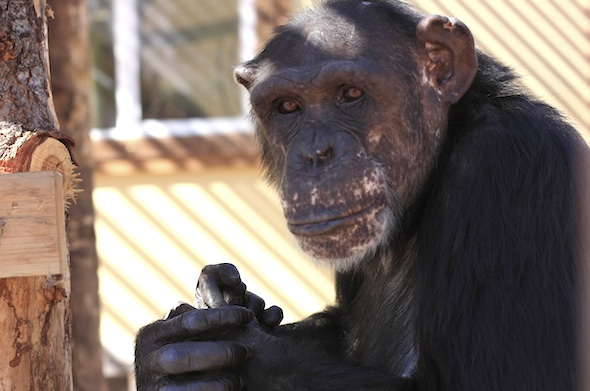
But looking at it now, it’s just not the Jamie of today.
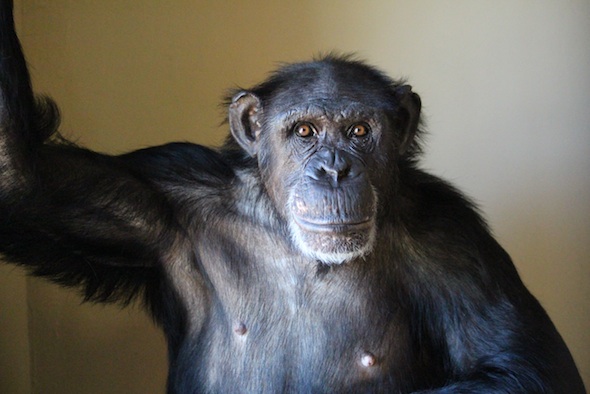
Her cheeks were hollow and her eyes sunken. Her freckles were more pronounced – maybe because they hadn’t darkened from sun exposure yet. And the look in her eyes just wasn’t the determined, curious Jamie that we now know and love.
Compare that before photo with the one I included in the Share the Chimp Love Video, taken last summer:
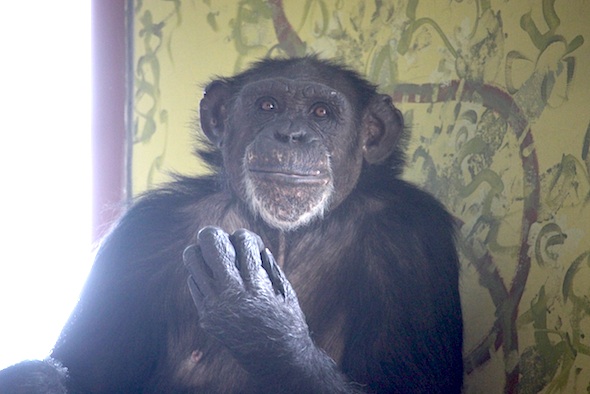
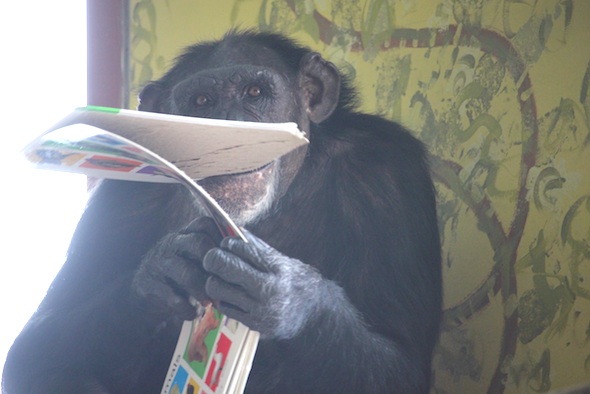
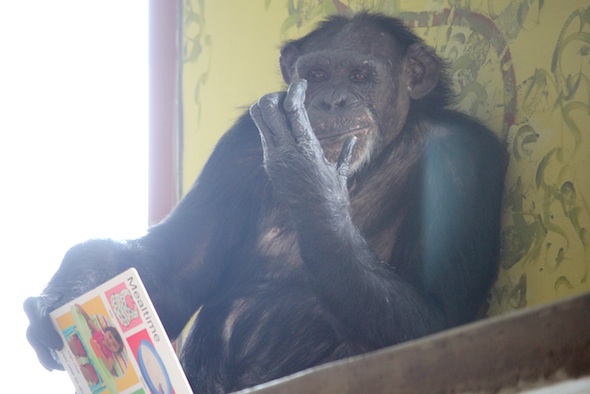
Or these that I took this morning of Jamie getting the most out of a new book:

Lessons from our friends
One Green Planet is featuring an article today by our very own Diana Goodrich, in which she shares a little of what she has learned from our chimpanzee friends.
Along those same lines, here’s a tip from Annie on maintaining that youthful glow:
Nap Time
I love taking photos and video of the chimpanzees running around, being active, and getting into mischief. Active chimpanzees are generally happy chimpanzees, and when I watch them explore and run I think of all of the years they lived in small cages.
There’s also something incredible, though, about watching the chimps truly relax.
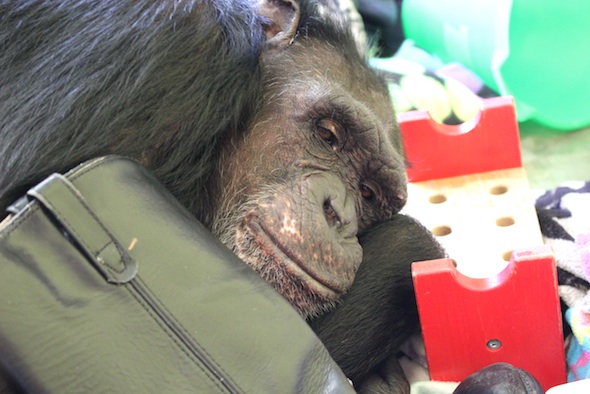
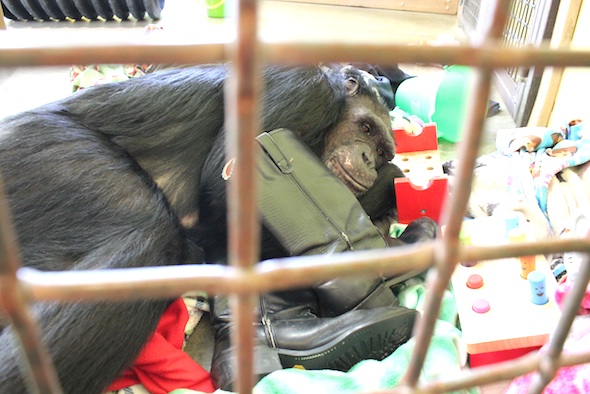
Today the sun is streaming into the playroom and seems to be making Jamie and Negra very sleepy.
Jamie, in typical Jamie fashion, is curled up in her nest with boots and toys:
Of course, being Jamie, this nap is not going to last very long:
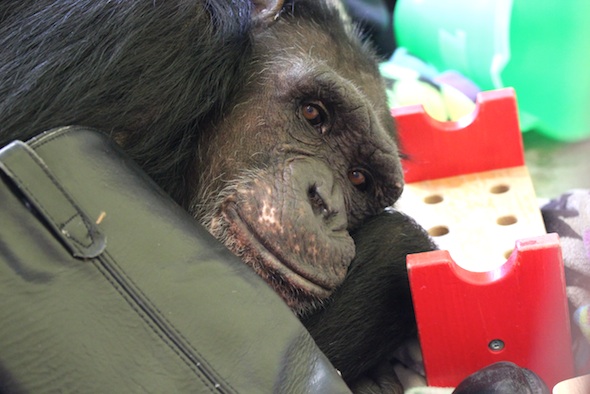
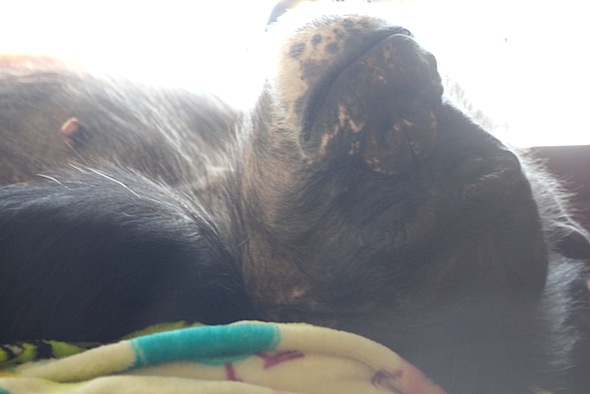
Negra is in her spot on the catwalk of the playroom in front of the window – feet up in the air:
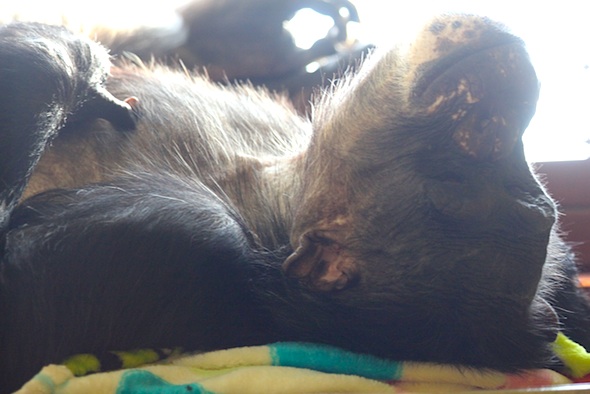
Doesn’t this just make you want to join them in relaxing in the sun?
Introductions
Introductions. In the chimp sanctuary world, no word is as simultaneously exciting and terrifying.
Introductions occur anytime you form a social group from unfamiliar individuals. They are exciting because chimps are social creatures, and they benefit greatly from living in groups, especially groups that are large and diverse. And they are terrifying because chimpanzees can be incredibly aggressive and they don’t always welcome new members with open arms.
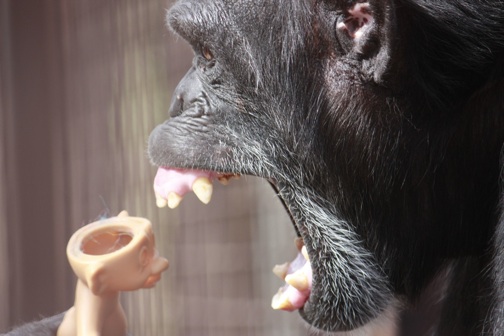
As many of you know, Chimpanzee Sanctuary Northwest is in the process of expanding. Our plan is to add a new wing to the facility to accommodate an additional group, but we also hope to add new members to the Cle Elum Seven family. So what can we expect when we introduce new chimps to this group that has been together for nearly a decade?
Let’s start with the good news. According to the literature, over 85% of documented introductions have been successful. In studies like these, an introduction is considered a success when a chimp is integrated into the group and remains there for at least one to two months.
Now, the bad news. Even when introductions are successful, the process can be ugly. How ugly? Let me explain it this way: the introduction protocol from a progressive and reputable zoo recommends that introductions be stopped immediately only in cases of “severe injuries that impede locomotion, loss of limb function, severe gaping wounds with bone(s) exposed, severe blood loss, [or] compromised state of consciousness.” According to the same document, a discussion about stopping the introduction may be warranted in situations of “extreme fatigue or severe loss of appetite, relentless pursuit of an individual such that the individual can’t eat, sleep, etc…[or] mental shutdown.”
Imagine if we applied these criteria to humans…
How was Billy’s first day of school?
Well, Ricky bit half of his ear off, the other kids chased him up and down the hallway all morning, and he got trapped at the top of the jungle gym for an hour during recess by a raging hoard of 6-year-olds, but by lunchtime they allowed him come down and eat a few tater tots off the floor. So, all in all, things are going pretty well!
The thing is, chimps are not humans, and we need to judge their interactions by a different standard. It’s not as cold and heartless as it may seem because if we separated them at the first sign of aggression, there would be very few chimps living in groups. The Cle Elum Seven are a good example of this. They’re all missing bits and pieces of ears, fingers, and toes from fights during their time in the lab and here at the sanctuary. But by and large, they’ve learned to get along, and they’ll do the same when it comes time to add someone new to the mix.
Despite all the fighting and potential for injury, chimps will usually work things out if we allow them to. And when they do, they get to take back a little piece of the life they should have known in the wild.