• Skip to main content
  • Skip to primary sidebar
  • Skip to footer

Chimpanzee Sanctuary Northwest

Hope. Love. Home. Sanctuary

  • Our Family
    • The Chimpanzees
    • The Cattle
  • Blog
  • About Us
    • Visiting the Sanctuary
    • Philosophy
      • FAQs
      • Mission, Vision & Goals
      • Privacy Policy
    • The Humans
      • Staff
      • Board of Directors
      • Founder
    • Annual Reports
    • The Future of CSNW
    • CSNW In The News
  • You can help
    • Donate
      • Become a Chimpanzee Pal
      • Sponsor A Day
      • Transfer Stock
      • Be A Produce Patron
      • Be a Bovine Buddy
      • Give from your IRA
      • Personalized Stones
      • Bring Them Home Campaign
    • Leave A Legacy
    • Employment Opportunities
    • Volunteer
    • See Our Wish List
    • Events
  • Resources
    • About Chimpanzees
    • Enrichment Database
    • Advocacy
      • Advocacy Action Center
      • Apes in Entertainment
        • Trainers
        • Role of the AHA
        • Greeting Cards
      • Chimpanzees as Pets
      • Roadside Zoos
      • Chimpanzees in Biomedical Research
      • Conservation
        • African Apes
        • Orangutans
  • Shop
    • Merchandise Store
  • Contact
  • DONATE NOW

meals

What Makes Us Tick

July 10, 2023 by J.B.

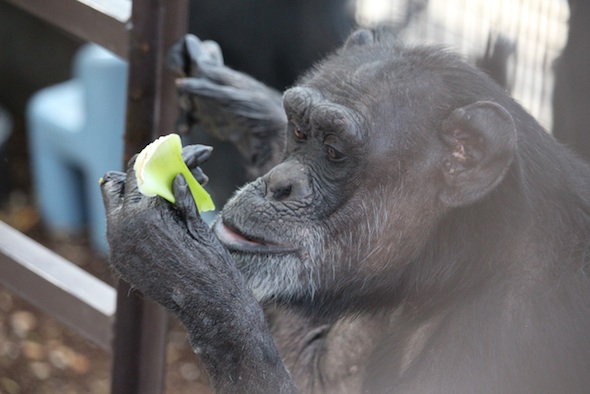
We’ve written a lot about that ways that Positive Reinforcement Training (PRT) can improve the lives of captive animals, including—or should I say especially?— chimpanzees. Chimps are so powerful and so strong-willed that often the only way to get them to reliably engage in certain behaviors, whether it’s allowing the stick of a needle to administer medication or leaving an enclosure so it can be cleaned, is to ensure that it is by their own choice.

One area where PRT is particularly useful is during meals. Some dominant chimps take a What’s mine is mine and what’s yours is also mine approach to food, leaving other chimps in their group hungry, anxious, or both. A technique known as cooperative feeding can encourage dominant chimps to allow their group mates to eat their meals in peace by rewarding tolerance for others eating nearby. The trick is not to forcefully assert our own sense of fairness but to show certain chimps that it can be worth their while to chill out a bit. Sure, you could steal someone else’s food, but if you allow everyone else to eat you’ll get something even better for a whole lot less effort.
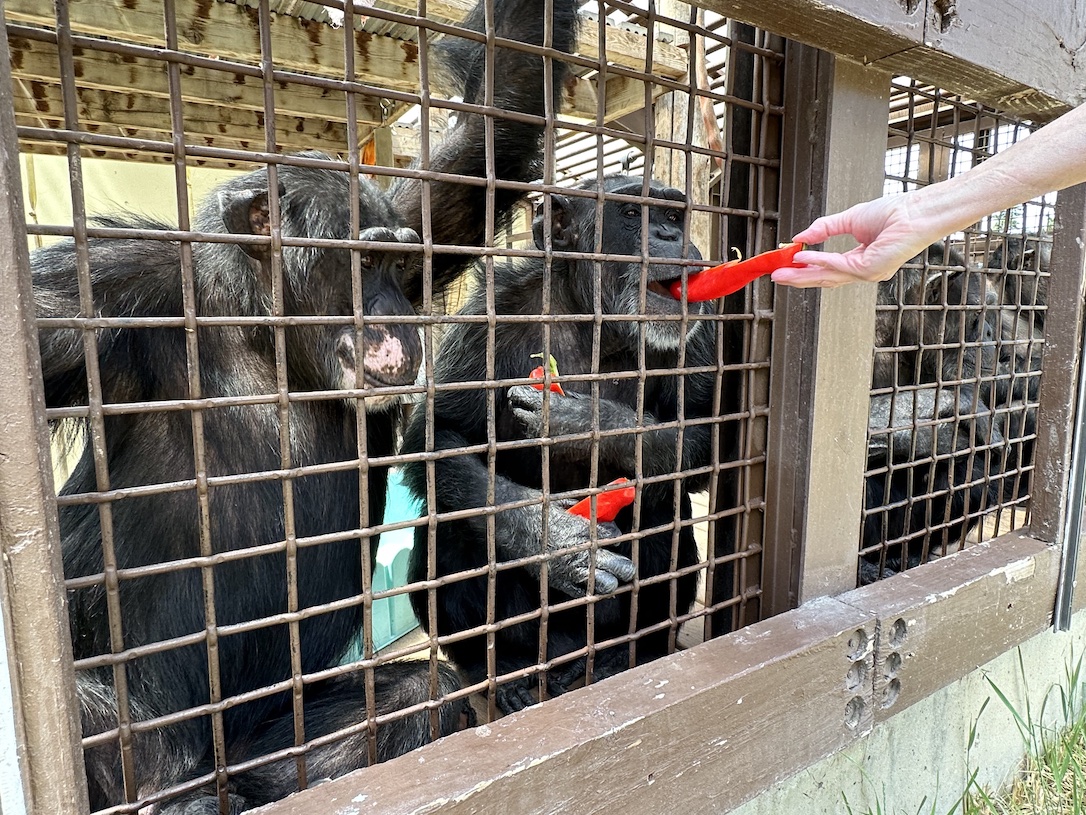
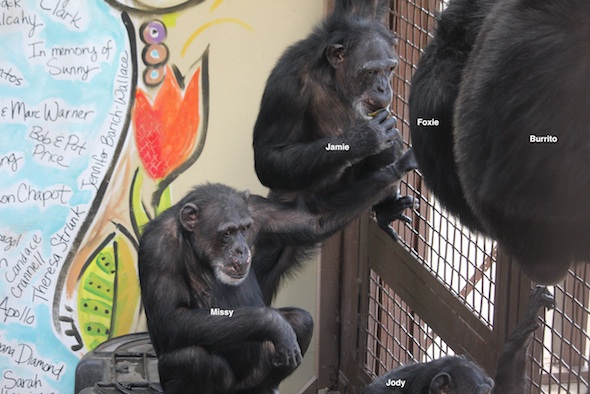
We’ve been using this technique with Jamie lately, as she has been giving both Foxie and Annie a hard time during meals. It’s certainly not unheard of for Jamie to steal food to assert her dominance, but the recent uptick has had her group mates on edge and unwilling to even take certain foods. Why all of a sudden? It’s hard to say for sure, but it’s possible that Jody’s passing left some ambiguity within the hierarchy and Jamie may have been feeling the need to remind everyone that there will be no changes at the top. Subtle, she is not.
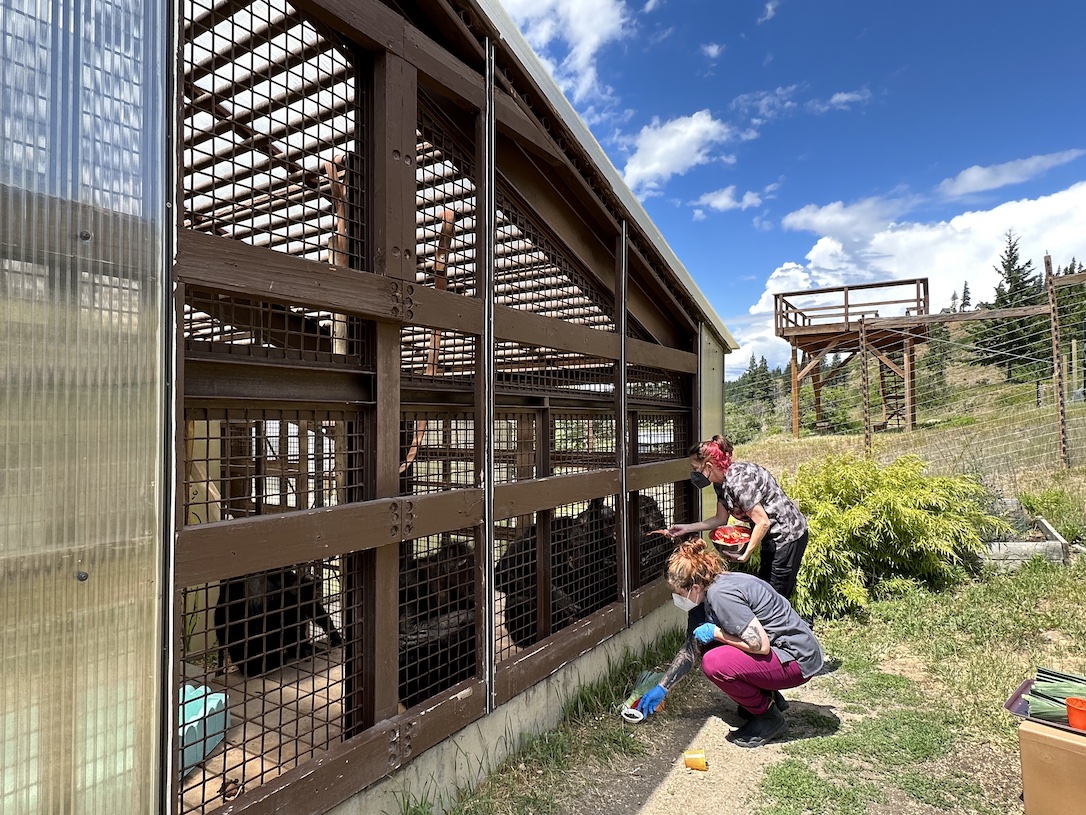
One of the keys to effective training is finding the right unconditioned reinforcer, which is the natural reward that often follows the click or whistle, telling the animal that behavior is worth doing again. In almost all of the training we do—that is, the training the occurs during formal sessions—that reinforcer is food. Sips of juice, pieces of chopped up fruit, and bits of primate chow are all effective, though each individual will be motivated according to their own preferences. For Jamie, that means a click! and a piece of preferred food or drink every time she watches Foxie or Annie receive something she might want to steal. And if she stays at her station throughout the entire meal, she may even get a special treat, such as a whole clementine, at the end.
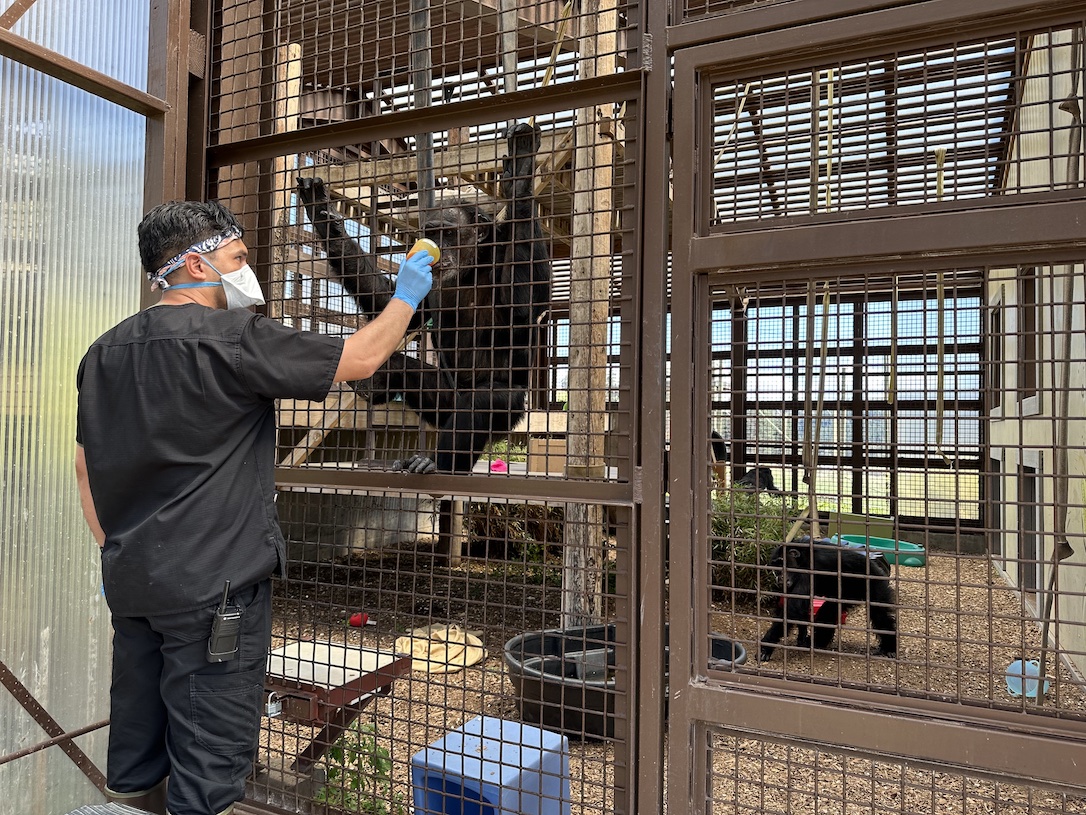
But food is such an efficient reinforcer that we sometimes forget that it’s not the only one. For Jamie, flattering her ego may be an equal or even greater reward. That’s not to say that Jamie doesn’t appreciate the special treats, but the extra attention from her caregivers and special status at mealtimes may being doing some if not most of the work. Perhaps when you are recognized as the boss by the humans in front of all your group mates, there’s less need to constantly remind everyone.
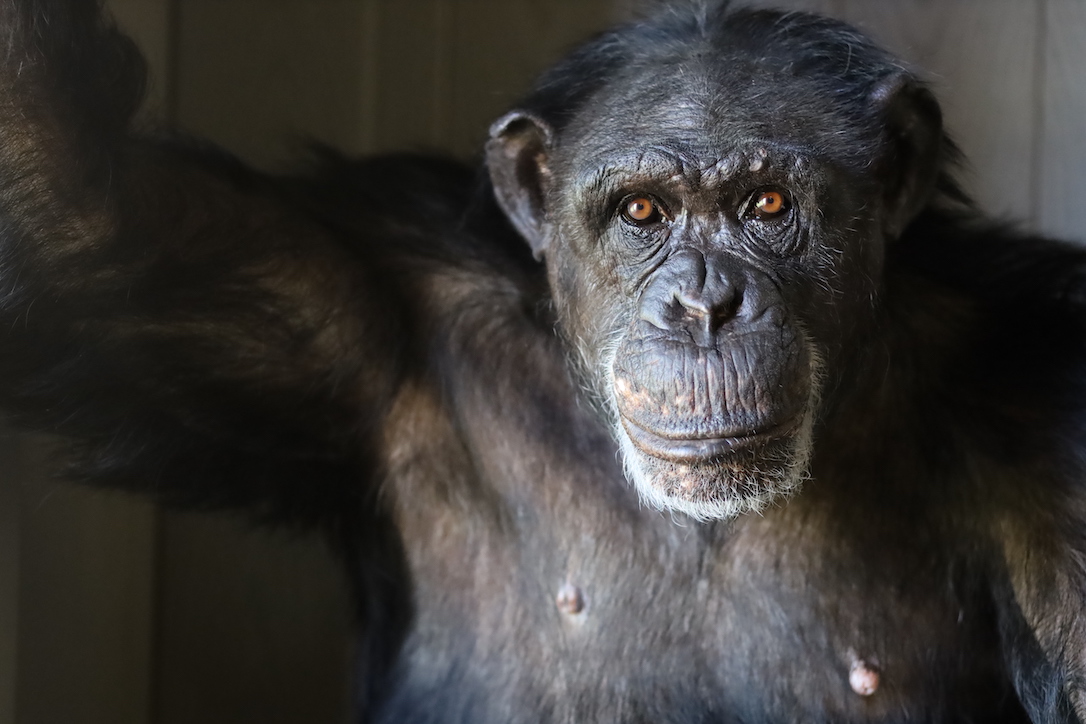
We’re all motivated by a handful of basic desires – to be noticed, to be appreciated, to be respected. Figuring out what makes someone tick can go a long way toward influencing their behavior. Because in the end, Jamie isn’t as complicated as she would appear: all she needs is the unquestioning loyalty, unreserved admiration, and complete and thorough submission of all those around her, human and chimpanzee, at all times. That and a few extra pear slices and she’ll be happy to mind her own business at lunch.
Filed Under: Jamie Tagged With: aggression, chimpanzee, cooperative feeding, Food, Jamie, meals, northwest, prt, rescue, Sanctuary, training

Human Problems

January 22, 2021 by J.B.

Earlier, Diana and I were discussing how serving meals to the Seven has changed over the years. It used to be that you would grab the first course – tomatoes, for example – and serve each chimp his or her portion until that course was done. Then you’d move on to the next course. It’s not that they never became impatient but there was at least a logical and orderly process. But the chimps have turned everything upside down. Missy now has to eat her tomatoes first. Negra, on the other hand, has to have her chow first. Meanwhile, Jamie is going to have her leeks first and that’s not a request that’s an order. It’s not just a simple matter of preference – if they don’t get their desired food first, it’s a full-on hunger strike. So now we’re just grabbing food from this bowl and that bowl amidst a frenzy of Bronx cheers and spit. Sometimes I feel like it’s my first day as a waiter in a busy restaurant. OK, Table 2 wants water with no ice, Table 6 wants a large salad but in two small bowls, Table 9 is still waiting for their entree, and wait…was it no ice or extra ice for Table 2??

I used to be able to write down exactly who ate what and how much, but now it’s all a blur. Today’s log:

Lunch:

Chimps ate food.

Perhaps it has less to do with the chimps and more to do with the natural affects of aging on the brain. But I swear, somehow the Californians are even pickier! The problem over there is that Willy B can be a bully at mealtimes and Honey B is the Slowest Eater On The Planet. The number one rule for lower-ranking chimps is to consume your food as fast as possible. But Honey B doesn’t play by anyone’s rules. And who are you calling low-ranking, anyway? By the time Willy B is done and starting to get antsy, she’s still sitting on a pile of food just licking a piece of fruit and staring into your eyes.

Of course, these fall into the category known by the chimps as “Human Problems”, which as you might guess, are of no concern to them. As it should be.

Filed Under: Food, Latest Videos Tagged With: chimpanzee, Food, meals, northwest, rescue, Sanctuary

Serving

March 14, 2016 by Keri

I’ve been wanting to write a blog post about serving food for a while now in response to a question I am frequently asked. How do we give food to the chimpanzees if we never enter the enclosures with them or stick our fingers into the enclosures? There are a few different options, including serving the food through the openings in the caging to each of the chimps and setting up forages for the chimps to gather the food themselves.

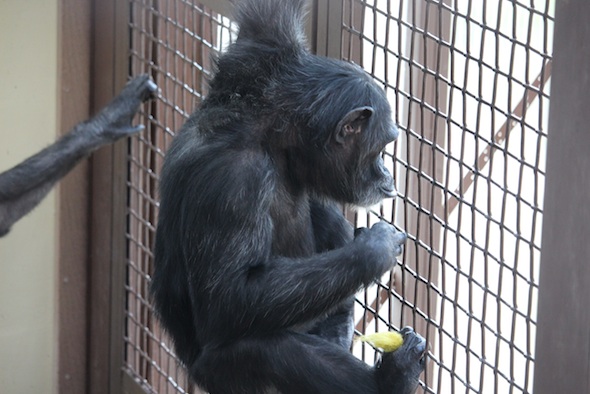
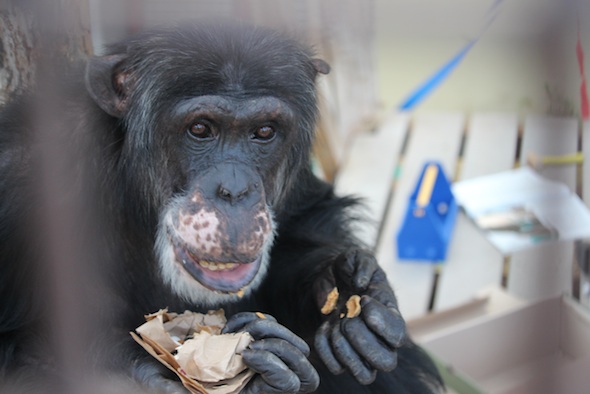
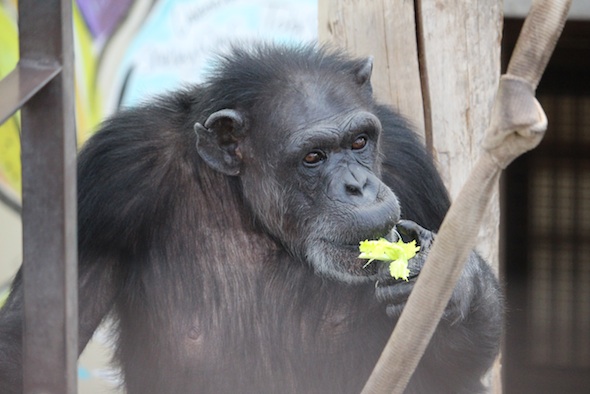
Serving entails serving food to the chimps’ hand or mouth (or sometimes foot). We make sure to cut foods to a size that will easily fit through the squares in the caging or we can drop food into food chutes (located in the Front Rooms). Things like celery, carrots and cucumbers are easy to hand to the chimps through the openings. Roasted vegetables are softer and we use small paper plates or serving trays that can be rolled up and passed through the openings. Liquids, such as fruit smoothies, (which are served at breakfast) are poured into cups and caregivers hold the cups up to the chimps’ outstretched lips. Serving allows us to know exactly how much each chimp is getting of each food. Check out this link to see examples of meals we serve throughout the day.

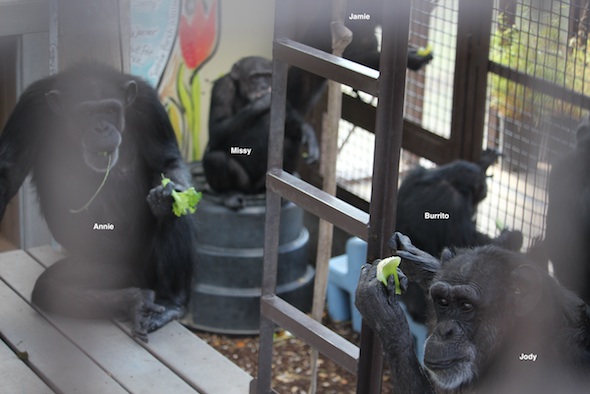
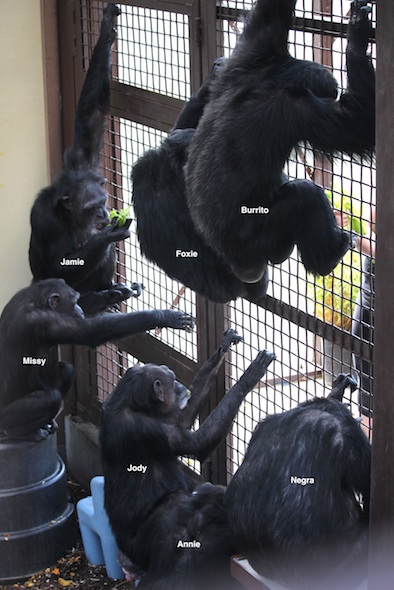
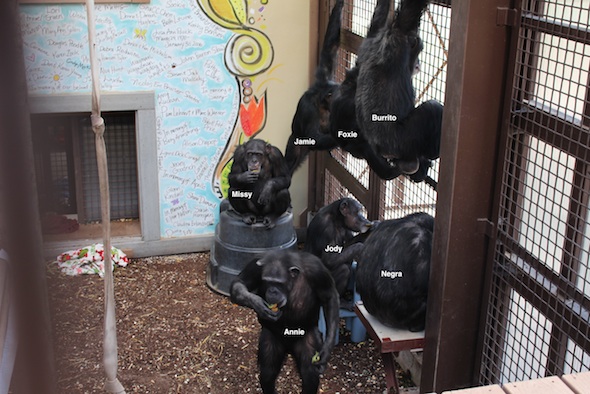
The following photos were all taken during the chimps’ dinner from the top of the Greenhouse when the panels were off this past summer. As you can see in the photos, some of the chimps prefer to hang, while others prefer to sit on the ground or utilize the plastic chairs or barrels.

web_All_chimps_being_served_dinner_through_caging_GH_kh_IMG_3093

web_All_chimps_hang_caging_sit_ground_dinner_GH_kh_IMG_3089

web_Missy_Jamie_Burrito_Jody_Foxie_served_dinner_GH_kh_IMG_3090

Foxie usually brings a friend with her to meals (hint, look at what is in her foot).
web_Foxie_hold_caging_troll_in_foot_GH_kh_IMG_3109

Burrito eating his night bag.
web_Burrito_eat_hold_nightbag_GH_kh_IMG_3115

Annie
web_Annie_eat_celery_dinner_GH_kh_IMG_3100

Some of the chimps prefer to stay and eat all of their food where it is served, while others tend to gather their portions and go to a different area to eat them.

web_Annie_Jody_sit_platform_eat_celery_Burrito_Jamie_Negra_in_background_GH_kh_IMG_3103

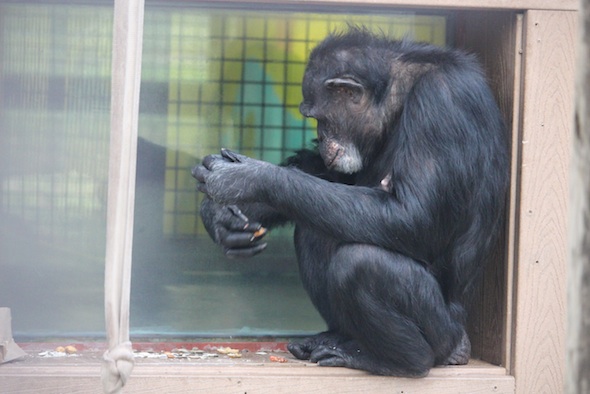
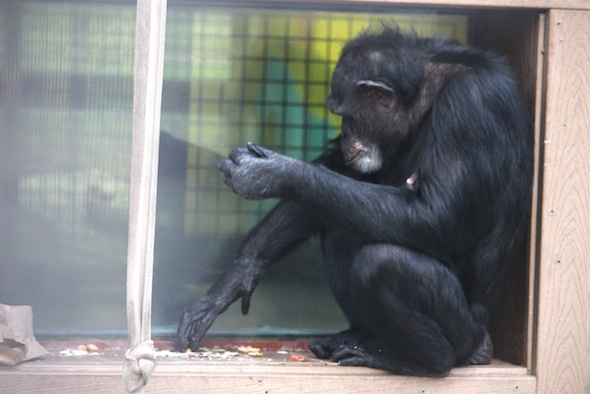
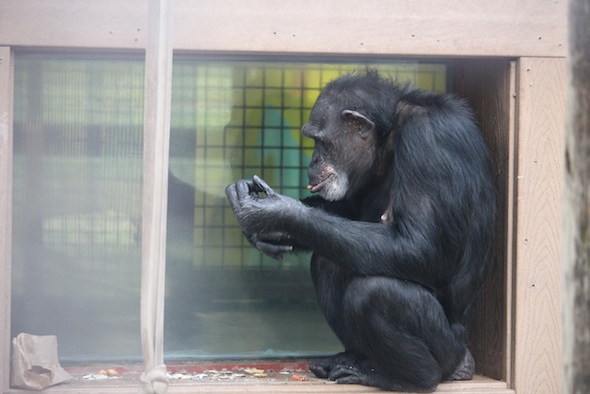
Jamie prefers to open her night bag, pour out its contents and pick through the nuts, seeds, popcorn and dried fruit.
web_Jamie_sit_windowsill_go_through_eat_nightbag_GH_kh_IMG_3119

web_Jamie_sit_windowsill_go_through_eat_nightbag_GH_kh_IMG_3120

web_Jamie_sit_windowsill_go_through_eat_nightbag_GH_kh_IMG_3122

Here’s a closeup of Jody eating her celery.
web_Jody_eat_look_at_celery_in_hand_dinner_GH_kh_IMG_3104

Foraging allows the chimps to move around and gather the food themselves, which is what they would be doing in the wild. For forages, we cut the food into smaller pieces and scatter them throughout the various enclosures after we have cleaned (the chimps are locked out of the enclosure humans are in). Once we have locked up and done our safety checks, we give the chimps access to the enclosure and they gather the food themselves. Foraging gets the chimps moving (important for chimps in captivity) and gives the chimps choices over which foods they prefer to collect and eat first. Click on the link at the beginning of the paragraph for a great video of the chimps foraging on Young’s Hill.

Filed Under: Annie, Burrito, Caregivers, Chimpanzee Behavior, Food, Foxie, Jamie, Jody, Missy, Negra, Sanctuary Tagged With: Annie, Burrito, Chimpanzee Sanctuary Northwest, eat, Food, forage, Foxie, Jamie, Jody, meals, Missy, Negra

Primary Sidebar

Subscribe To the Blog and Get Notified of New Posts First!

Archives

Calendar of Blog Posts

June 2026
S M T W T F S
 123456
78910111213
14151617181920
21222324252627
282930  
« May    

Categories

SUBSCRIBE TO OUR NEWSLETTER

Footer

PO Box 952
Cle Elum, WA 98922
[email protected]
509-699-0728
501c3 registered charity
EIN: 68-0552915

Official DDAF Grantee

Menu

  • The Chimpanzees
  • Blog
  • About Us
  • You can help
  • Resources
  • Contact
  • Donate

Proud Member of

Connect With Us

Search

Copyright © 2026 Chimpanzee Sanctuary Northwest. All Rights Reserved. Site by Vegan Web Design