• Skip to main content
  • Skip to primary sidebar
  • Skip to footer

Chimpanzee Sanctuary Northwest

Hope. Love. Home. Sanctuary

  • Our Family
    • The Chimpanzees
    • The Cattle
  • Blog
  • About Us
    • Visiting the Sanctuary
    • Philosophy
      • FAQs
      • Mission, Vision & Goals
      • Privacy Policy
    • The Humans
      • Staff
      • Board of Directors
      • Founder
    • Annual Reports
    • The Future of CSNW
    • CSNW In The News
  • You can help
    • Donate
      • Become a Chimpanzee Pal
      • Sponsor A Day
      • Transfer Stock
      • Be A Produce Patron
      • Be a Bovine Buddy
      • Give from your IRA
      • Personalized Stones
      • Bring Them Home Campaign
    • Leave A Legacy
    • Employment Opportunities
    • Volunteer
    • See Our Wish List
    • Events
  • Resources
    • About Chimpanzees
    • Enrichment Database
    • Advocacy
      • Advocacy Action Center
      • Apes in Entertainment
        • Trainers
        • Role of the AHA
        • Greeting Cards
      • Chimpanzees as Pets
      • Roadside Zoos
      • Chimpanzees in Biomedical Research
      • Conservation
        • African Apes
        • Orangutans
  • Shop
    • Merchandise Store
  • Contact
  • DONATE NOW

Cle Elum 7

Annie’s story

June 7, 2013 by Debbie

Leading up to the five year anniversary next week, we wanted to share the stories of each chimpanzee before they came to CSNW. Annie, Burrito, Foxie, Jamie, Jody, Missy, and Negra all were housed in a windowless basement at the Buckshire Corporation in Pennsylvania before they were rescued in June 2008. Buckshire leased their chimps primarily to two laboratories: White Sands Research Center (which later became the infamous Coulston Foundation) in New Mexico, and the Laboratory for Experimental Medicine and Surgery in Primates (otherwise known as LEMSIP) in New York.

Through their decades in research, the chimpanzees were routinely anesthetized, or “knocked down,” for physical exams and to be injected with vaccines or provide blood samples for research. After giving birth to infants, they were anesthetized and their babies were removed from them and taken to a nursery where they would become the next generation of research chimpanzees.

Today, the chimpanzees no longer have to live in fear of being injected with vaccines or undergo invasive exams, they no longer have to sleep in 5 x 5 x 7 foot cages with slatted bars for a floor, and they no longer have to be alone. Now they have the feeling of sun on their backs when on Young’s Hill, they have the choice of what to play with or who to interact with, they get really healthy and delicious fresh fruit and veggies, and they can relax. CSNW has given them what they deserve, a peaceful and comfortable retirement.

Today, we’ll share Annie’s story:

We don’t know a lot about Annie’s infancy. She was reportedly captured from the wild to be used in research and it’s estimated that she was born in 1974. Buckshire purchase Annie from a private breeder and leased her out to White Sands Research Center where she was used in hepatitis vaccine research and also used as a breeder. Records indicate that she arrived at White Sands in late 1981. Ten days after her arrival to White Sands, she was knocked down to have her blood drawn and get a new tattoo—“WSRC #33.” A couple months later she was transferred to her first breeding cage.

Annie would have been a youngster, a merely seven years old when she was forced to breed. She was transferred back and forth for nearly two years and bred with at least seven different males—David, Max, Panchito, Rufus, Mack, Chuck, and Cheetah. In June 1983, she gave birth to her first infant, Tobias, who was immediately removed and taken to the nursery.

6/22/83 – Delivered infant male #78 Tobias, appears healthy – removed to nursery.

In the wild, chimpanzee mothers will nurse their babies for the first four or five years. Just like humans, their bond is incredibly strong. But in the lab, babies were immediately taken away from their mothers and never allowed to make that bond. Annie was never able to truly be a mother, and was instead transferred countless times between even more male breeding partners.

Over the next decade, Annie gave birth to five more babies—Abby, Brooke, Virgil, Mariah, and Damian. In the technicians’ reports she was said to be a good mother, observed nursing and cleaning her infants. In most cases, Annie’s infants were stolen from her within days of giving birth. In each case, she was knocked down and the babies were removed and taken to the nursery.

7/24/84 – Delivered healthy infant female #101 Abby. Removed and taken to nursery – infant appears in good health – mother cleaned very well.

9/12/87 – Delivered healthy infant female… mother taking good care of infant, clean and nursing. Infant #CA0168 (Brooke).

Annie got to care for Brooke for almost a whole week: 9/18/87 – Infant female removed and taken to nursery. Stayed on mother since 9/12 – excellent mother… both infant and mother appear in excellent health.

6/23/89 – Infant taken from mother at this time… to the nursery. Infant named Virgil #201.

9/24/91 – Took infant to nursery. Infant was a girl #224 (Mariah).

5/6/94 – Gave birth at approx. 2:20pm. Mother taking good care of baby. Infant is looking good at this time. (Damian #244)

5/7/94 – Animal anesthetized to remove baby… Baby was not holding onto mother or nursing.

After spending over a decade at WSRC (which became the Coulston Foundation), she finally was shipped back to Buckshire in late 1996. For the next 12 years, she stayed at Buckshire, never getting to be a mother to her babies, never getting to make true friends and never getting to really be a chimpanzee. Read what Diana said when she first met Annie (and Missy).

Annie, on her second day in sanctuary:
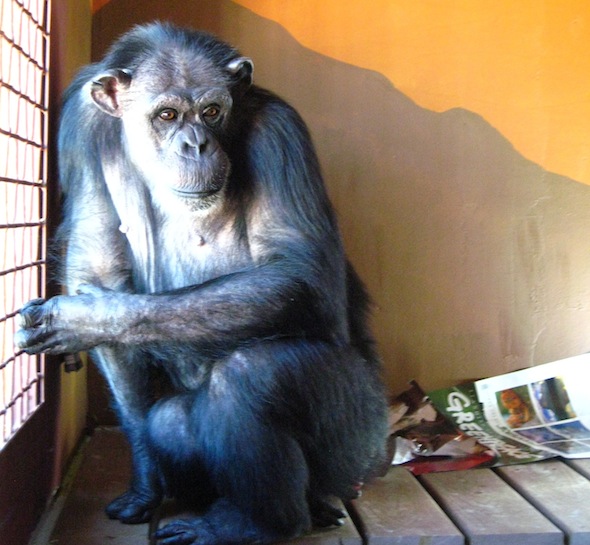
web Annie sit on FR4 bench second day before

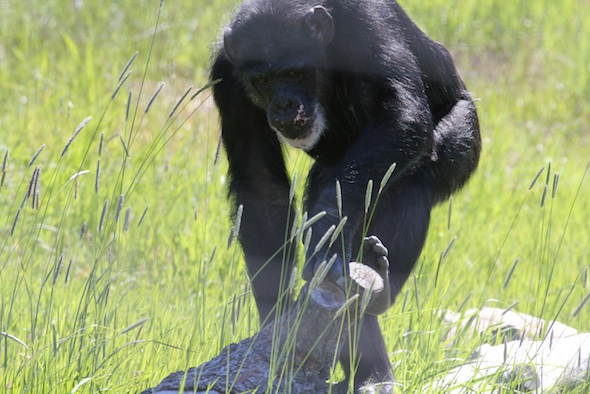
In June 2008, she was rescued by Chimpanzee Sanctuary Northwest and retired to live with the Cle Elum Seven, where she has had access to sun over her head and grass under her feet for probably the first time since she was captured from Africa.

Annie now, on Young’s Hill:
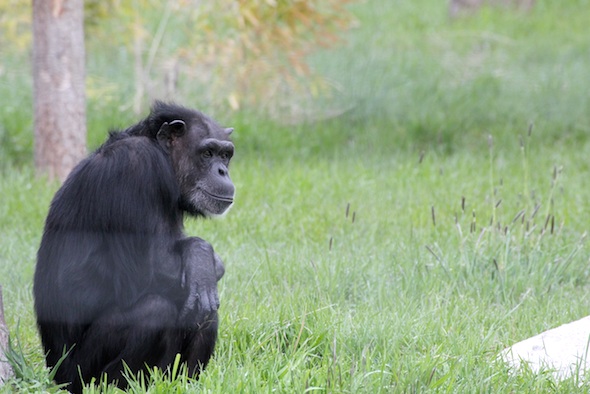
web Annie sit arms crossed next to treat rock YH IMG_6264

web Annie sit next to treat rock arms crossed YH IMG_6267

To honor Annie’s five years in sanctuary, Give Five today to help give her one meal of delicious fresh fruits and veggies. Share with your friends, too!
Filed Under: Annie, Chimp histories, Chimpanzees in Biomedical Research, Sanctuary Tagged With: advocacy, Animal Welfare, Annie, biomedical research, Buckshire, chimpanzee rescue, Cle Elum 7, coulston foundation, csnw, primate protection, Sanctuary, white sands research center

Negra’s Journey

June 6, 2013 by Elizabeth

One week from today, we will celebrate Negra’s 40th birthday and CSNW’s 5 year anniversary. Due to incomplete lab records, we don’t know Negra’s actual date of birth. To honor her status as the Queen of the Cle Elum Seven, we celebrate her birthday on June 13, the anniversary of the chimpanzees’ arrival to the sanctuary.

Negra is the oldest of the seven chimps here, and it’s easy to tell by looking at her. She is rounder than the other chimps and moves a lot slower. While they’re playing energetic games of chase, she can often be found wrapped in a blanket gazing out the window. Negra has the wisdom and dignity that often come with age. It’s for this reason that we call her our Queen.

One of the things I love most about Negra is that she doesn’t settle. She demands what she thinks she deserves and doesn’t give up until she gets it. Usually, what she thinks she deserves is her night bag, a nightly post-dinner treat of nuts and seeds in a small paper bag. She loves night bags so much that often, mid-dinner service, she claps her hands together imperiously as if to say, “I’ll take that night bag NOW, please.”

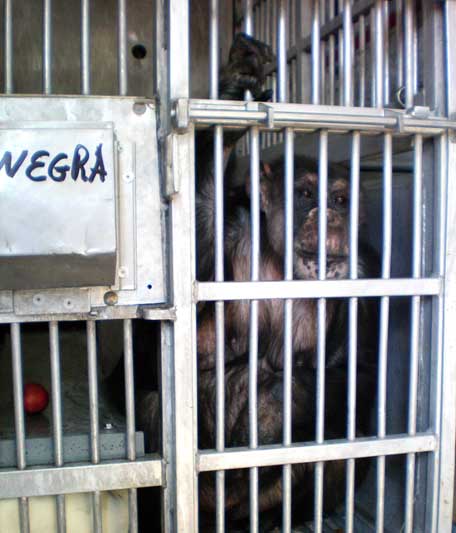
This photo was taken when Negra and the rest of the Cle Elum Seven were en route to CSNW from the laboratory five years ago. I often wonder what Negra was thinking sitting in her cage on the transport truck, leaving over three decades of research labs behind. Of course, she couldn’t have known during that cross-country drive that those days were in the past.

Negra in transport cage

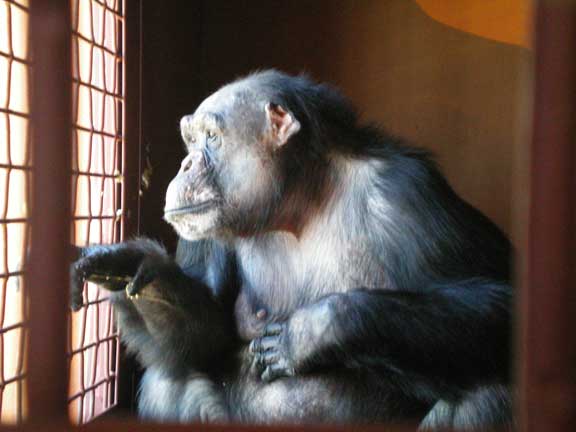
I’d like to think that she started to understand that her life was changing shortly after arriving at the sanctuary. This photo was taken on June 13, 2008, just hours after the transport truck carrying the chimpanzees pulled into our driveway. Negra and the others took turns in front of this window. In the lab they had lived in a windowless basement, so it’s likely that she was seeing outside for the first time in many years, maybe decades.

Negra looking serene

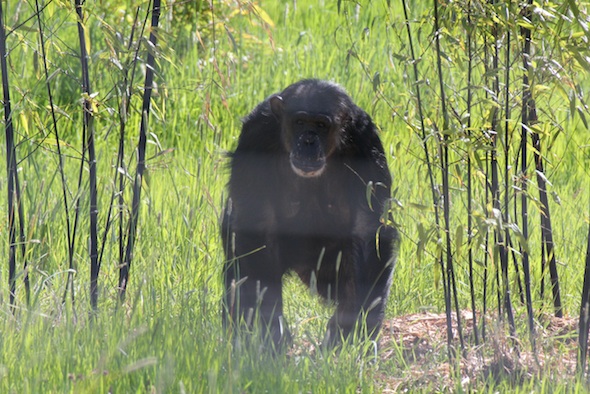
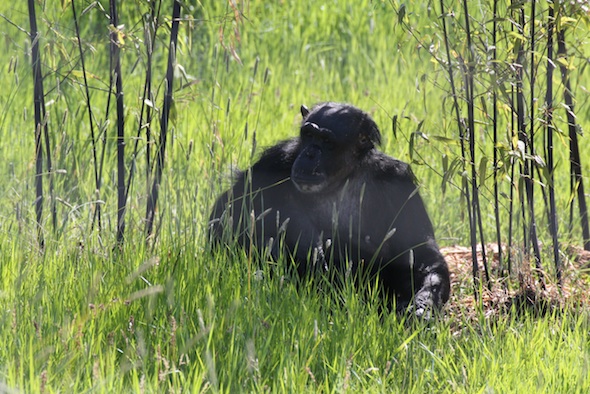
The next two photos were taken this morning, almost exactly five years later. Negra spent the morning foraging for fruit and sitting in the grass on Young’s Hill, the chimps’ two-acre outdoor habitat. I don’t know if Negra will ever get used to the feel of the cool grass under her feet or the sight of the blue sky overhead, but I think that she finally knows that her past is history.

web Negra stand shade green grass bamboo look at camera YH (ek) IMG_9120

web Negra sit shade green grass bamboo YH (ek) IMG_9129

Next Thursday, June 13, please join us for Give Five Day. By donating just $5, you’ll pay for one meal for one of the chimpanzees, show your love for Negra and the others, and enable us to keep serving seven incredible survivors.

Filed Under: Fundraising, Negra, Sanctuary, Young's Hill Tagged With: chimpanzee rescue, chimpanzee retirement, Chimpanzee Sanctuary Northwest, Cle Elum 7, Cle Elum Seven, Sanctuary, young's hill

A Gentleman’s Tea Party

June 5, 2013 by Katelyn

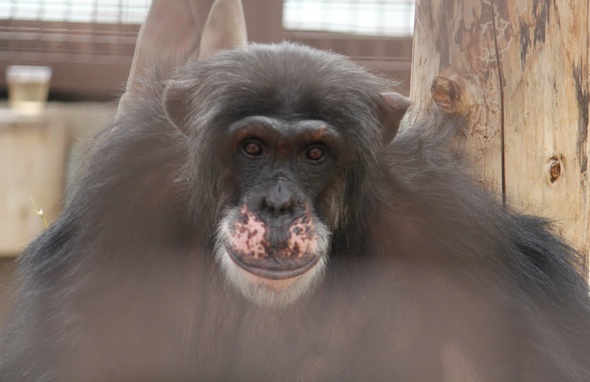
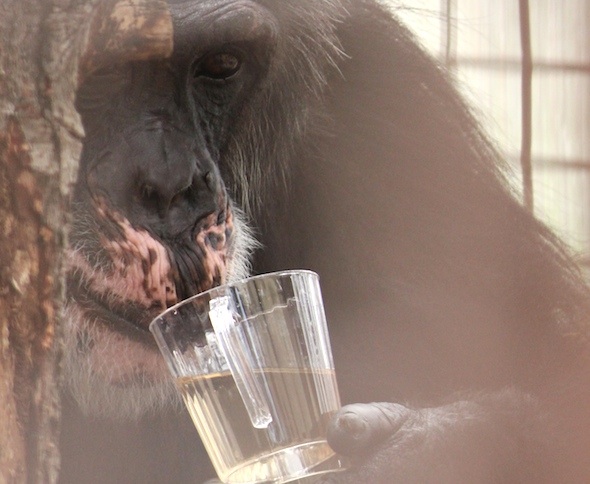
Today I brought in some new “garden tool” themed enrichment for the chimpanzees so we decided to throw an impromptu garden tea party in the greenhouse this morning.  JB and Diana contributed beautiful roses from their garden which the chimps love to smell and eat, and we brewed some berry tea to put out in teacups.  And in perfect serendipity, Zibby Wilder, a former board member for the sanctuary (featured in this video of when the chimps first arrived almost five years ago!), came for a visit and just happened to bring fresh grapevines which the chimps were very excited about!  Being the only fella at the garden tea party, Burrito had no problem problem joining in to enjoy the treats and he was the perfect gentleman.

web burrito cute look at camera GH (dm) IMG_9019

web burrito hand grab tea cup rose GH (dm) IMG_9015

web burrito sip tea hide cute GH (dm) IMG_9018

Filed Under: Burrito, Caregivers, Chimpanzees in Biomedical Research, Enrichment, Food, Fundraising, Party, Sanctuary Tagged With: Burrito, chimp sanctuary, chimpanzee rescue, chimpanzee retirement, chimpanzee sanctuary, Chimpanzee Sanctuary Northwest, Cle Elum 7, csnw, Enrichment, Party, Sanctuary

Sunny sanctuary days

June 2, 2013 by Lisa

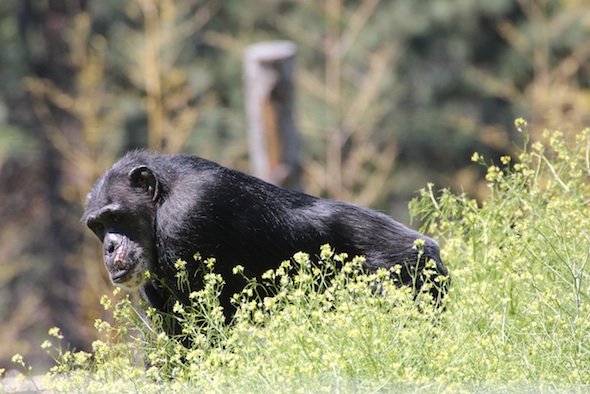
Last week Katelyn posted about Jamie’s reaction to a relief from the rainy days of May. I have to admit, I’m right there with her! I, too, have anxiously been awaiting the warmth of the central Washington summer. Working here brings an added satisfaction to each sunny day as I have the pleasure of anticipating and watching the joy of the chimpanzees as they forage and spend time on Young’s Hill. Never having been deprived of the sky, the wind, the grass, and the sun I simply can not imagine what an amazing contrast this is to the chimpanzees today but I appreciate every opportunity, every day that gives them one more gift of freedom. Here is Missy, enjoying Young’s Hill in the sun.

web Missy walk climb log triangle look toward camera YH IMG_8899

web Missy in wild mustard YH IMG_8837

web Missy in tall grass YH IMG_8817

Filed Under: Missy, Sanctuary, Young's Hill Tagged With: chimp rescue, chimpanzee, chimpanzee rescue, chimpanzee retirement, chimpanzee sanctuary, Chimpanzee Sanctuary Northwest, Cle Elum 7, csnw, Missy, young's hill

Annie tries new things

May 29, 2013 by Lisa

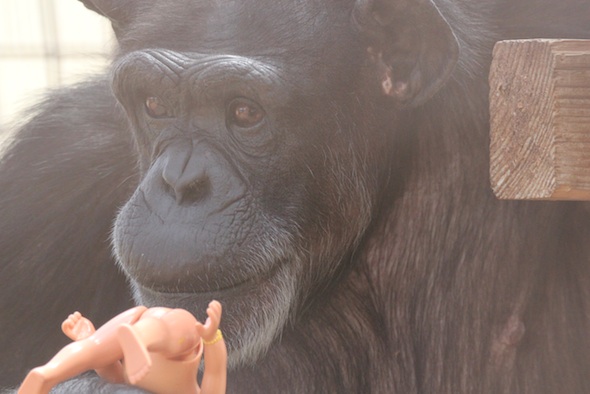
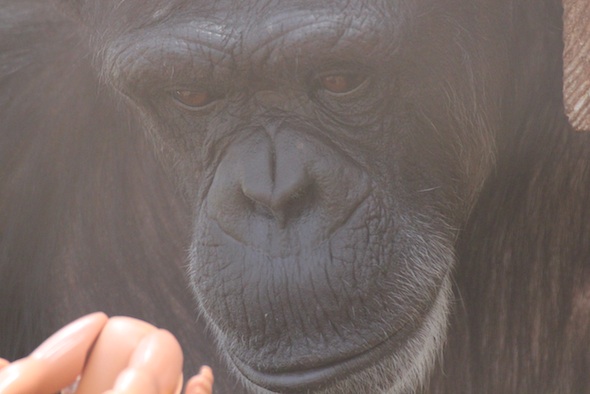
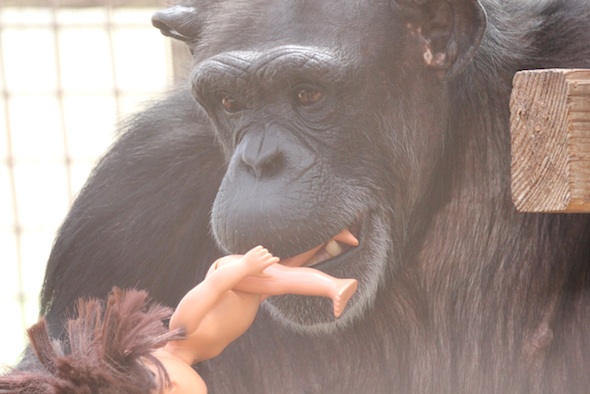
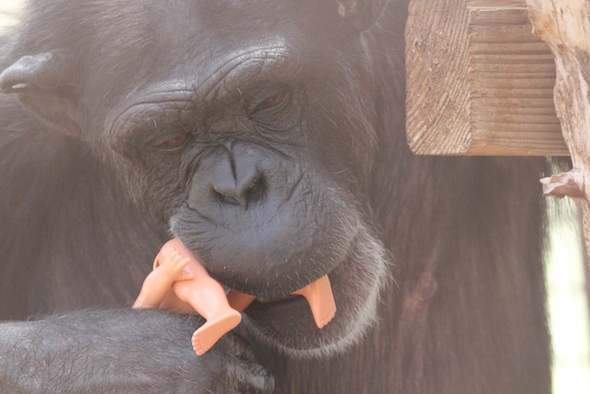
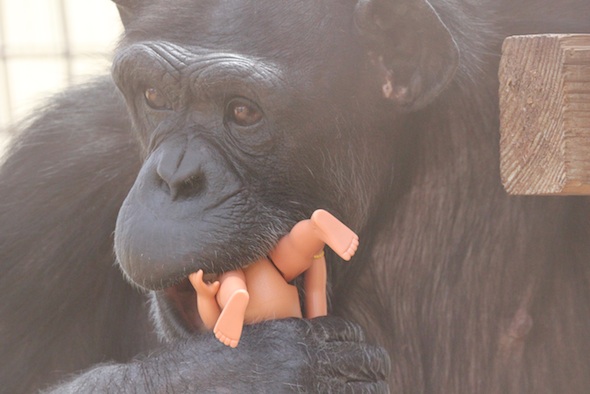
As the newest staff member I am enjoying many new responsibilities. The one that is, perhaps, the most fun is coming to know the chimpanzees better and developing my relationships with them. During my very first volunteer shift I remember being drawn to Annie. Elizabeth described her to me as shy and reserved, especially with the human caregivers. She reminded me of another chimpanzee friend in that regard. Over the years as a volunteer I have had the privilege to watch as she slowly comes out of her shell and I can’t tell you how lucky I always feel when Annie takes the time to greet me or play with me, however briefly. I enjoy coming to know her for herself as she figures out who that is in sanctuary. She’s always surprising us with her changing tastes; today, we caught her on film playing with one of Foxie’s Dora dolls.

web Annie hold dora greenhouse GH (ek) IMG_8742

web Annie close up inspect dora greenhouse GH (ek) IMG_8739

web Annie hold bite dora greenhouse GH (ek) IMG_8752

web Annie hold bite dora greenhouse GH (ek) IMG_8744

web Annie hold bite Dora greenhouse GH (ek) IMG_8741

web Annie close up look at camera greenhouse GH (ek) IMG_8737

Filed Under: Annie, Enrichment, Sanctuary Tagged With: Annie, chimp enrichment, Chimpanzee Sanctuary Northwest, Cle Elum 7, Cle Elum Seven, csnw

What a difference a day makes

May 28, 2013 by Katelyn

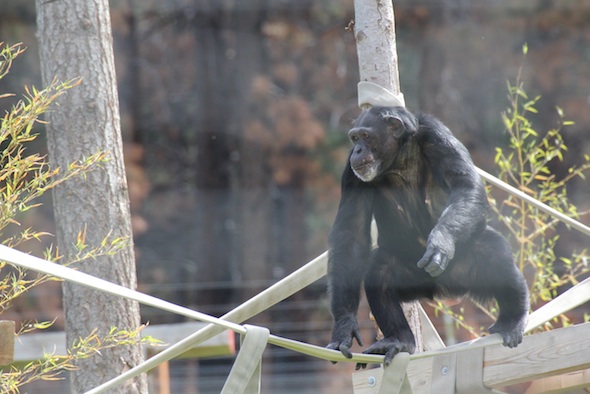
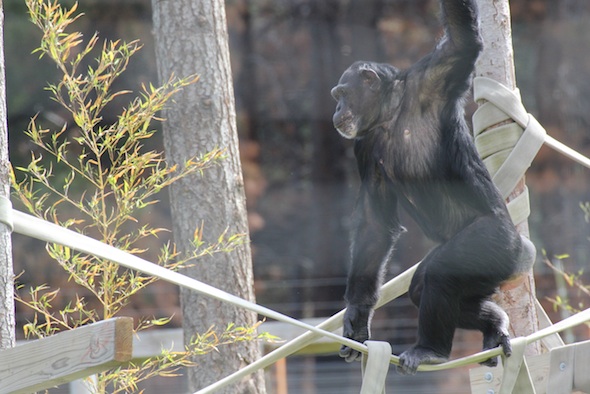
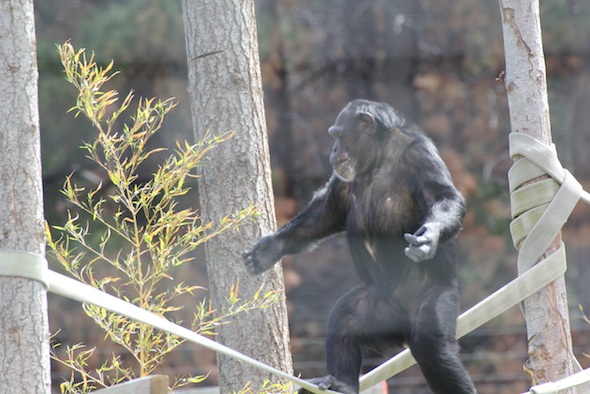
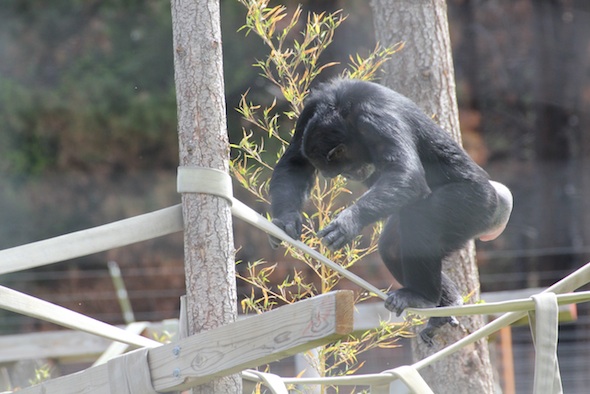
We have been having many days of much needed, but seemingly never ending, rain here at the sanctuary.  And let me tell you, Jamie has had a bee in her bonnet for days.  And when Jamie’s not happy she makes it well known.  I can’t really blame her as it’s hard to be stuck inside after we have had so many beautiful days recently.  As caregivers, it is always first in our minds as to how we can make the days better for the chimps, particularly when they aren’t able to go outside.  Yesterday, despite our best efforts, Jamie was a grouchy lady and let it be known in no uncertain terms that she wanted nothing to do with any of our suggestions.  But today the humans and chimpanzees finally awoke to sunny skies.  Everyone was in a good mood and JB even got a laugh from Annie, who typically reserves those for her raucous games of chase with her best friend, Missy.  We put a breakfast forage on Young’s Hill to make the most of the day and the chimps were all lined up waiting for the door to open.  They immediately all filed through the raceway together with Negra (!) in the lead. Everyone spread out, foraging through the now significantly taller grass, food squeaking with joy (we are hoping to have some great footage of this from the GoPro camera on the hill soon).  And then much to our surprise, we spotted Jamie trying her hand at tightrope walking across the fire hose bridge!  While this is usually a classic Missy move, I’d say Jamie is giving her a run for her money.  And the best thing yet? That bee that’s been in Jamie’s bonnet seems to have flown off.

web Jamie tightrope firehose yh I IMG_8613

web Jamie tightrope firehose yh II IMG_8614

web Jamie tightrope firehose yh III IMG_8615

web Jamie tightrope firehose yh IV IMG_8616

I love Jamie’s face in this last picture.  It almost looks as though she’s giving herself a little congratulatory cheer.  I would look like that as well if I had just been able to do a tightrope walk across the fire hose bridge!

web Jamie tightrope firehose yh V IMG_8623

Filed Under: Annie, Caregivers, Chimpanzee Behavior, Enrichment, Food, Jamie, Negra, Sanctuary, Young's Hill Tagged With: Annie, chimp enrichment, chimp sanctuary, chimpanzee rescue, chimpanzee retirement, chimpanzee sanctuary, Chimpanzee Sanctuary Northwest, Cle Elum 7, csnw, Enrichment, Jamie, Negra, Sanctuary, young's hill

Resilience

May 21, 2013 by Debbie

This is the first of a series of guest blogger posts from researchers that work with free-living apes. Maureen McCarthy graduated from the Chimpanzee and Human Communication Institute and is currently a PhD candidate at the University of Southern California. She is doing research with chimpanzees in Uganda and has a regular featured blog on Scientific American’s blog. Here’s her most recent entry that mentions Foxie:

—

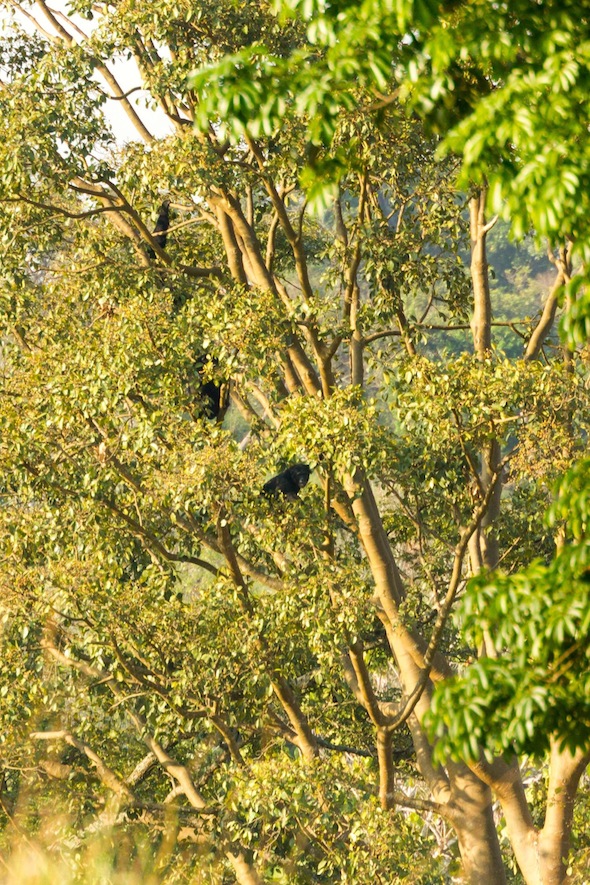
Their chorus of pant hoots gave them away in dramatic fashion. The chimpanzees we’d been looking for were nearby, and we knew exactly where to find them. Though farmland and trees blocked our view, we could hear that the chimpanzees had arrived at a particular fig tree laden with ripe fruits. As ripe fruit specialists, chimpanzees seek out fruiting figs like this Ficus exasperata. On a good day, we can use our knowledge of when these figs are ripening to help us find the chimpanzees.

We took a circuitous route through the gardens to a grassy hilltop with a clear, albeit distant, view of the Ficus.  I dropped my backpack and pulled out my binoculars. I began to scan the tree in an attempt to identify the large dark figures foraging. I could make out the silhouettes of at least seven or eight chimpanzees, all foraging on figs or seated in the huge tree.

Photo 1

Chimpanzees feed in a Ficus exasperata tree. Photo © Jack Lester.

After observing their foraging for a few peaceful moments, I heard a jarring but familiar sound. A man working in a garden nearby shouted at the chimpanzees. Though the tree was in an isolated area of grassland several dozen meters from where he worked, he was clearly uncomfortable with their presence. A few threatening shouts were enough to convince the chimpanzees it was best to cut short their breakfast. They descended quickly from the fig. I now counted twelve chimpanzees as they walked in a single file line back across the grassland and to a small patch of forest nearby. As we watched them go, field assistant Nick commented that he felt sorry for the chimps.

At times like these, I am reminded of one of the most recurrent lessons from my research thus far: chimpanzees are surprisingly resilient. They may have waited until later to forage, or perhaps they found another source of nutrition (which, unfortunately, may have involved risky crop-raiding). However, as long as no one hunted them or set a mantrap to ensnare them, as is sometimes the case, they probably found something to eat and survived another day. Despite the rapid rate of forest degradation in their habitat, they have persisted. They continue to forage, reproduce, and tend to the complex political matters of chimpanzee life, even if these behaviors must be modified somewhat to fit a drastically altered environment.

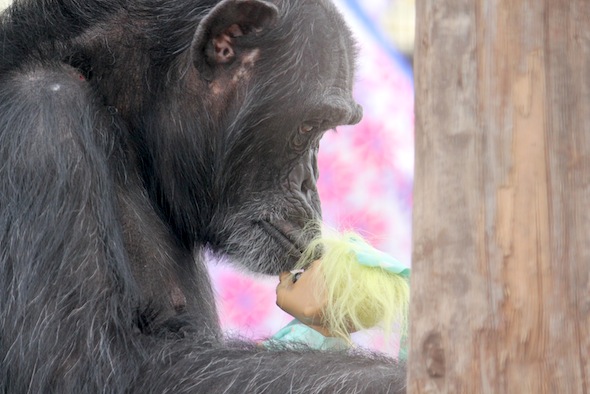
I was again reminded of chimpanzee resilience when, on a recent visit to my mother’s home, I opened an old box to find my childhood collection of troll dolls. After a moment’s consideration, I decided to send them to a chimpanzee named Foxie. Foxie is a resident of Chimpanzee Sanctuary Northwest (CSNW), a sanctuary in Cle Elum, Washington that serves as home to seven chimpanzees. The “Cle Elum Seven,” as they are known, have lived in biomedical laboratories for most of their lives. They were involved in invasive hepatitis vaccine research and used for laboratory breeding. Foxie gave birth to five infants, but was forced to give them all up, just like so many other breeding female chimpanzees in laboratories. Perhaps as a fulfillment of the maternal behaviors she was never able to express, Foxie can now usually be found carrying a troll or other doll with her.

Photo 2

Foxie cares for a troll doll.

The caregivers who know Foxie and the other members of the Cle Elum Seven can attest to this adaptability. All seven have displayed drastic changes in both behavior and physical appearance since arriving at CSNW several years ago. The shift from a windowless laboratory basement to a spacious sanctuary with dedicated caregivers and outdoor access has—not surprisingly—had an unambiguously positive effect on them.

Why might chimpanzees be so adaptable to change?  It may have aided the survival of their ancestors–and ours. For example, many primates regularly face drastic seasonal changes in rainfall, temperature, and food availability. Some primates have specialized adaptations that help them survive under harshly changing seasonal conditions. For chimpanzees, a learned knowledge of the fruit tree locations, even during periods of low fruit availability, is critical. Chimpanzees acquire this knowledge over a prolonged period of development, with high reliance on their mothers until full weaning at age 5, followed by juvenile and sub-adulthood learning periods lasting until age 15. A high degree of neural plasticity facilitates this learning ability. In humans, an especially high degree of plasticity may aid our strong reliance on learning. Plasticity may also play a key role in what we call resilience, enabling both humans and our chimpanzee kin to roll with the punches during trying times. For chimpanzees today, this may mean finding a new fruit tree when one due to ripen has been felled, or basking in the sun for the first time after decades inside a laboratory.

This post was originally published at Scientific American.

Filed Under: Advocacy, Free-living chimps Tagged With: advocacy, animal protection, animal rescue, animal rights, Animal Welfare, chimpanzee, chimpanzee rescue, chimpanzee retirement, Chimpanzee Sanctuary Northwest, Cle Elum 7, Cle Elum Seven, csnw, eyes on apes, Foxie, free-living chimps, maureen mccarthy, primate rescue, rescue, resilience, Sanctuary, uganda

  • « Go to Previous Page
  • Page 1
  • Interim pages omitted …
  • Page 123
  • Page 124
  • Page 125
  • Page 126
  • Page 127
  • Interim pages omitted …
  • Page 197
  • Go to Next Page »

Primary Sidebar

Subscribe To the Blog and Get Notified of New Posts First!

Archives

Calendar of Blog Posts

June 2026
S M T W T F S
 123456
78910111213
14151617181920
21222324252627
282930  
« May    

Categories

SUBSCRIBE TO OUR NEWSLETTER

Footer

PO Box 952
Cle Elum, WA 98922
[email protected]
509-699-0728
501c3 registered charity
EIN: 68-0552915

Official DDAF Grantee

Menu

  • The Chimpanzees
  • Blog
  • About Us
  • You can help
  • Resources
  • Contact
  • Donate

Proud Member of

Connect With Us

Search

Copyright © 2026 Chimpanzee Sanctuary Northwest. All Rights Reserved. Site by Vegan Web Design