• Skip to main content
  • Skip to primary sidebar
  • Skip to footer

Chimpanzee Sanctuary Northwest

Hope. Love. Home. Sanctuary

  • Our Family
    • The Chimpanzees
    • The Cattle
  • Blog
  • About Us
    • Visiting the Sanctuary
    • Philosophy
      • FAQs
      • Mission, Vision & Goals
      • Privacy Policy
    • The Humans
      • Staff
      • Board of Directors
      • Founder
    • Annual Reports
    • The Future of CSNW
    • CSNW In The News
  • You can help
    • Donate
      • Become a Chimpanzee Pal
      • Sponsor A Day
      • Transfer Stock
      • Be A Produce Patron
      • Be a Bovine Buddy
      • Give from your IRA
      • Personalized Stones
      • Bring Them Home Campaign
    • Leave A Legacy
    • Employment Opportunities
    • Volunteer
    • See Our Wish List
    • Events
  • Resources
    • About Chimpanzees
    • Enrichment Database
    • Advocacy
      • Advocacy Action Center
      • Apes in Entertainment
        • Trainers
        • Role of the AHA
        • Greeting Cards
      • Chimpanzees as Pets
      • Roadside Zoos
      • Chimpanzees in Biomedical Research
      • Conservation
        • African Apes
        • Orangutans
  • Shop
    • Merchandise Store
  • Contact
  • DONATE NOW

chimpanzee retirement

What a difference a day makes

May 28, 2013 by Katelyn

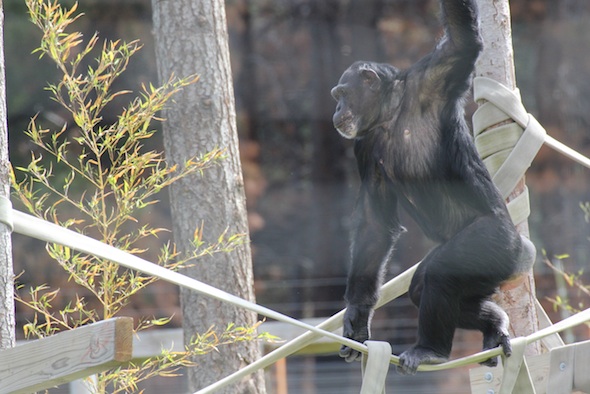
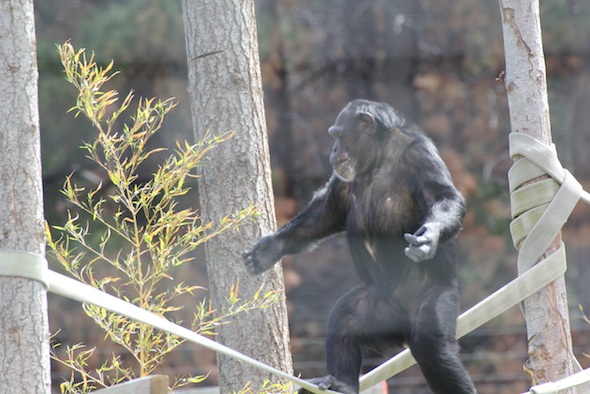
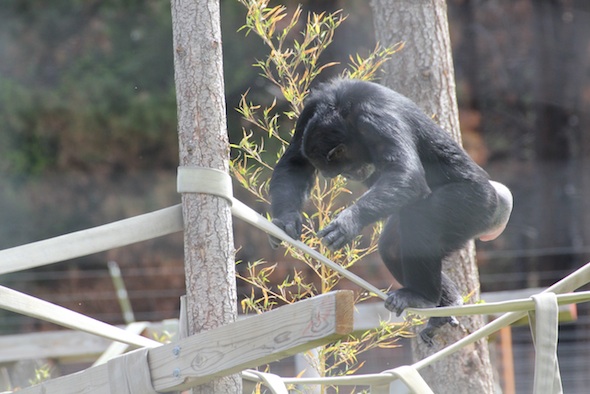
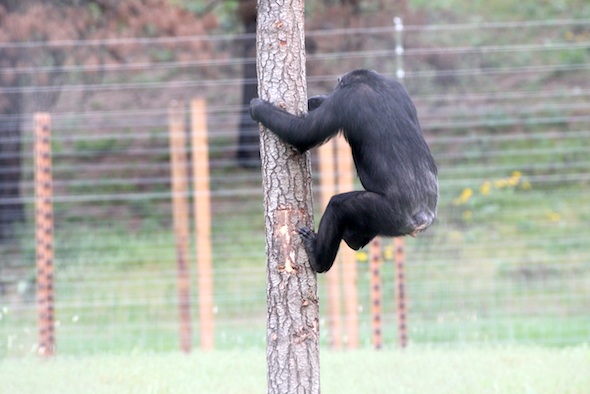
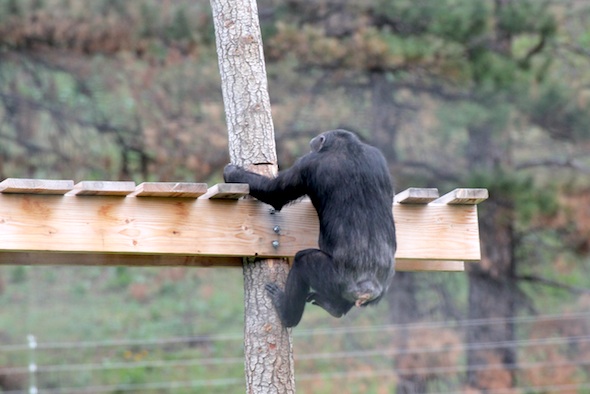
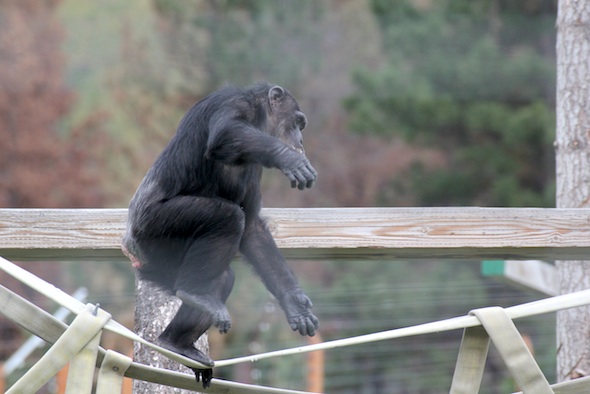
We have been having many days of much needed, but seemingly never ending, rain here at the sanctuary.  And let me tell you, Jamie has had a bee in her bonnet for days.  And when Jamie’s not happy she makes it well known.  I can’t really blame her as it’s hard to be stuck inside after we have had so many beautiful days recently.  As caregivers, it is always first in our minds as to how we can make the days better for the chimps, particularly when they aren’t able to go outside.  Yesterday, despite our best efforts, Jamie was a grouchy lady and let it be known in no uncertain terms that she wanted nothing to do with any of our suggestions.  But today the humans and chimpanzees finally awoke to sunny skies.  Everyone was in a good mood and JB even got a laugh from Annie, who typically reserves those for her raucous games of chase with her best friend, Missy.  We put a breakfast forage on Young’s Hill to make the most of the day and the chimps were all lined up waiting for the door to open.  They immediately all filed through the raceway together with Negra (!) in the lead. Everyone spread out, foraging through the now significantly taller grass, food squeaking with joy (we are hoping to have some great footage of this from the GoPro camera on the hill soon).  And then much to our surprise, we spotted Jamie trying her hand at tightrope walking across the fire hose bridge!  While this is usually a classic Missy move, I’d say Jamie is giving her a run for her money.  And the best thing yet? That bee that’s been in Jamie’s bonnet seems to have flown off.
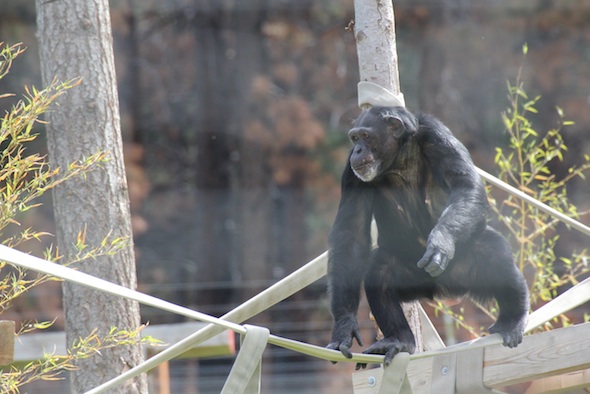
web Jamie tightrope firehose yh I IMG_8613

web Jamie tightrope firehose yh II IMG_8614

web Jamie tightrope firehose yh III IMG_8615

web Jamie tightrope firehose yh IV IMG_8616

I love Jamie’s face in this last picture.  It almost looks as though she’s giving herself a little congratulatory cheer.  I would look like that as well if I had just been able to do a tightrope walk across the fire hose bridge!
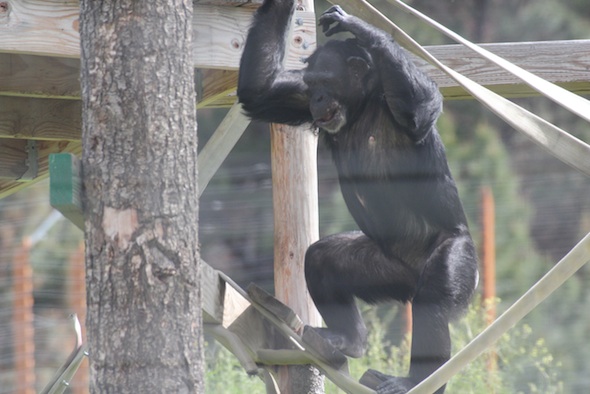
web Jamie tightrope firehose yh V IMG_8623

Filed Under: Annie, Caregivers, Chimpanzee Behavior, Enrichment, Food, Jamie, Negra, Sanctuary, Young's Hill Tagged With: Annie, chimp enrichment, chimp sanctuary, chimpanzee rescue, chimpanzee retirement, chimpanzee sanctuary, Chimpanzee Sanctuary Northwest, Cle Elum 7, csnw, Enrichment, Jamie, Negra, Sanctuary, young's hill

Introducing Lisa

May 22, 2013 by Elizabeth

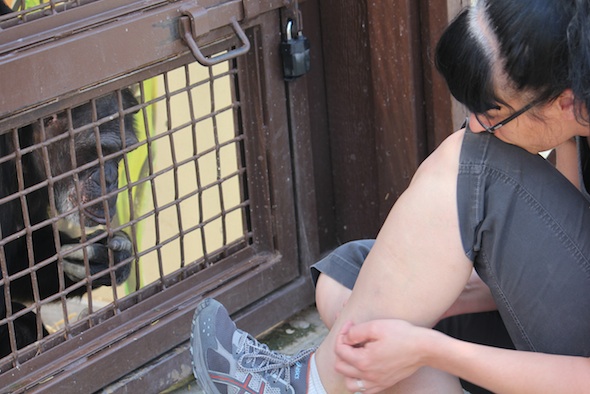
The CSNW human family continues to grow! Lisa Schuster is our newest part-time staff caregiver. Lisa has been in the chimpanzees’ lives for a few years now as a volunteer caregiver, and she is universally adored. Jody is overjoyed about Lisa’s new job (Lisa might by Jody’s favorite human ever), and Jamie always appreciates Lisa’s choice of footwear.

You can get in touch with Lisa at [email protected] for questions, comments, or words of welcome.

resized IMG_7557

resized IMG_7563

resized IMG_7562

Filed Under: Caregivers, Jamie, News, Sanctuary, Volunteers Tagged With: chimpanzee, chimpanzee retirement, Cle Elum Seven, Sanctuary

Resilience

May 21, 2013 by Debbie

This is the first of a series of guest blogger posts from researchers that work with free-living apes. Maureen McCarthy graduated from the Chimpanzee and Human Communication Institute and is currently a PhD candidate at the University of Southern California. She is doing research with chimpanzees in Uganda and has a regular featured blog on Scientific American’s blog. Here’s her most recent entry that mentions Foxie:

—

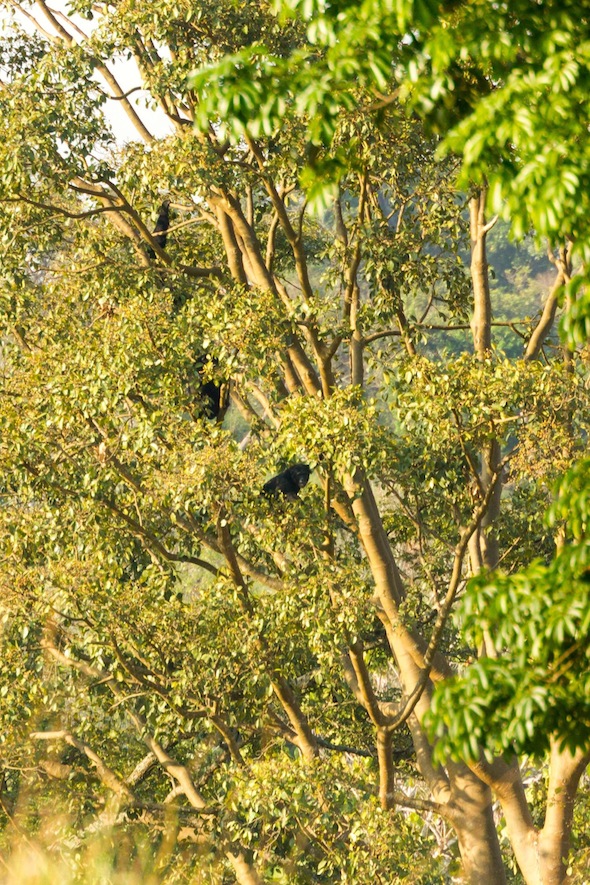
Their chorus of pant hoots gave them away in dramatic fashion. The chimpanzees we’d been looking for were nearby, and we knew exactly where to find them. Though farmland and trees blocked our view, we could hear that the chimpanzees had arrived at a particular fig tree laden with ripe fruits. As ripe fruit specialists, chimpanzees seek out fruiting figs like this Ficus exasperata. On a good day, we can use our knowledge of when these figs are ripening to help us find the chimpanzees.

We took a circuitous route through the gardens to a grassy hilltop with a clear, albeit distant, view of the Ficus.  I dropped my backpack and pulled out my binoculars. I began to scan the tree in an attempt to identify the large dark figures foraging. I could make out the silhouettes of at least seven or eight chimpanzees, all foraging on figs or seated in the huge tree.

Photo 1

Chimpanzees feed in a Ficus exasperata tree. Photo © Jack Lester.

After observing their foraging for a few peaceful moments, I heard a jarring but familiar sound. A man working in a garden nearby shouted at the chimpanzees. Though the tree was in an isolated area of grassland several dozen meters from where he worked, he was clearly uncomfortable with their presence. A few threatening shouts were enough to convince the chimpanzees it was best to cut short their breakfast. They descended quickly from the fig. I now counted twelve chimpanzees as they walked in a single file line back across the grassland and to a small patch of forest nearby. As we watched them go, field assistant Nick commented that he felt sorry for the chimps.

At times like these, I am reminded of one of the most recurrent lessons from my research thus far: chimpanzees are surprisingly resilient. They may have waited until later to forage, or perhaps they found another source of nutrition (which, unfortunately, may have involved risky crop-raiding). However, as long as no one hunted them or set a mantrap to ensnare them, as is sometimes the case, they probably found something to eat and survived another day. Despite the rapid rate of forest degradation in their habitat, they have persisted. They continue to forage, reproduce, and tend to the complex political matters of chimpanzee life, even if these behaviors must be modified somewhat to fit a drastically altered environment.

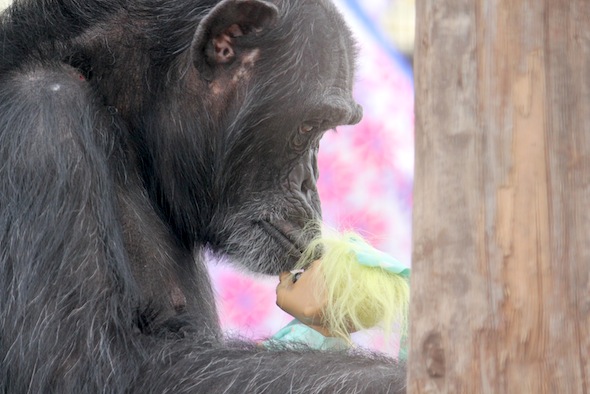
I was again reminded of chimpanzee resilience when, on a recent visit to my mother’s home, I opened an old box to find my childhood collection of troll dolls. After a moment’s consideration, I decided to send them to a chimpanzee named Foxie. Foxie is a resident of Chimpanzee Sanctuary Northwest (CSNW), a sanctuary in Cle Elum, Washington that serves as home to seven chimpanzees. The “Cle Elum Seven,” as they are known, have lived in biomedical laboratories for most of their lives. They were involved in invasive hepatitis vaccine research and used for laboratory breeding. Foxie gave birth to five infants, but was forced to give them all up, just like so many other breeding female chimpanzees in laboratories. Perhaps as a fulfillment of the maternal behaviors she was never able to express, Foxie can now usually be found carrying a troll or other doll with her.

Photo 2

Foxie cares for a troll doll.

The caregivers who know Foxie and the other members of the Cle Elum Seven can attest to this adaptability. All seven have displayed drastic changes in both behavior and physical appearance since arriving at CSNW several years ago. The shift from a windowless laboratory basement to a spacious sanctuary with dedicated caregivers and outdoor access has—not surprisingly—had an unambiguously positive effect on them.

Why might chimpanzees be so adaptable to change?  It may have aided the survival of their ancestors–and ours. For example, many primates regularly face drastic seasonal changes in rainfall, temperature, and food availability. Some primates have specialized adaptations that help them survive under harshly changing seasonal conditions. For chimpanzees, a learned knowledge of the fruit tree locations, even during periods of low fruit availability, is critical. Chimpanzees acquire this knowledge over a prolonged period of development, with high reliance on their mothers until full weaning at age 5, followed by juvenile and sub-adulthood learning periods lasting until age 15. A high degree of neural plasticity facilitates this learning ability. In humans, an especially high degree of plasticity may aid our strong reliance on learning. Plasticity may also play a key role in what we call resilience, enabling both humans and our chimpanzee kin to roll with the punches during trying times. For chimpanzees today, this may mean finding a new fruit tree when one due to ripen has been felled, or basking in the sun for the first time after decades inside a laboratory.

This post was originally published at Scientific American.

Filed Under: Advocacy, Free-living chimps Tagged With: advocacy, animal protection, animal rescue, animal rights, Animal Welfare, chimpanzee, chimpanzee rescue, chimpanzee retirement, Chimpanzee Sanctuary Northwest, Cle Elum 7, Cle Elum Seven, csnw, eyes on apes, Foxie, free-living chimps, maureen mccarthy, primate rescue, rescue, resilience, Sanctuary, uganda

Upcoming guest bloggers

May 18, 2013 by Debbie

I’m pretty excited to announce that we’re going to be featuring some guest bloggers who work with apes in the wild! Our mission at the sanctuary is to provide quality lifetime care for the Cle Elum Seven, but also to advocate for apes everywhere. If you’re signed up for our Take Action list, you’ve probably received some action alerts from Eyes on Apes before. These are usually for issues that our nonhuman ape cousins face close to home, like the entertainment, pet, and biomedical industries.

Free-living apes are facing a whole different set of issues. In Africa their habitat is slowly being torn down, and the logging roads create access for hunters to easily hunt chimpanzees, gorillas, bonobos, and a whole slew of other exotic animals and sell their meat on the black market (it’s called the bushmeat trade). In Southeast Asia, orangutans are losing much of their habitat to palm oil plantations and other agricultural development.

From afar, there’s only so much detail we can provide—but those who are right there witnessing these issues can paint a very different picture. Our goal is to have them tell their stories, and help us to help our closest living relatives who are literally facing extinction.

We already have folks lined up for this exciting project: Dr. Cleve Hicks (former graduate student at the Chimpanzee and Human Communication Institute just down the road) who is now working with apes in the Bili Forest in central Africa; Dr. Debra Durham who is currently in east Africa and has expertise in both captive and free-living issues (you might remember this article about PTSD in ex-biomedical lab chimps, including Negra); and Dr. Zarin Machanda who met JB and Diana at the Fauna Foundation years ago, and has worked with chimpanzees in east Africa. Stay tuned for these stories with great information coming very soon!

Here’s a photo of Negra, who now gets to have sunshine, friends, and choices after being stolen from Africa and used in biomedical research for decades. Let’s raise awareness about others like Negra still in labs, and for her relatives in Africa that need our help. Share this video and subscribe to the blog if you haven’t already, so you’ll be sure to get notified of the upcoming guest blogger posts!

web Negra green grass Young's Hill YH IMG_8027

—

Guest blog posts:

Resilience and The Landmine Snare by Maureen McCarthy

Along the Bushmeat Highway: Part One, Two, and Three and The FARDC ‘Petting Zoo’ at Bili by Dr. Cleve Hicks

Video interview Part One and Part Two with Dr. Debra Durham (presented as a Take Action Tuesday posts)

Jacky and Nama by Dr. Sheri Speede

Meet the Chimpanzees of Kanyawara and Research at Kanyawara by Dr. Zarin Machanda

Margot and Is successful reintroduction possible? by Dr. Gwendy Reyes-Illg

Why are orangutans endangered in the wild? by Rich Zimmerman

Filed Under: Advocacy, Free-living chimps, Negra, Sanctuary Tagged With: advocacy, africa, african rainforest logging, animal protection, animal rescue, animal rights, Animal Welfare, bushmeat trade, chimpanzee, chimpanzee rescue, chimpanzee retirement, chimpanzee sanctuary, Chimpanzee Sanctuary Northwest, Cle Elum 7, Cle Elum Seven, cleve hicks, csnw, debra durham, eyes on apes, free-living chimps, free-living orangutans, indonesia, malaysia, Negra, orangutan, palm oil, primate protection, primate rescue, Sanctuary, wild chimpanzees, wild orangutans, zarin machanda

Missy the distractor

May 16, 2013 by Debbie

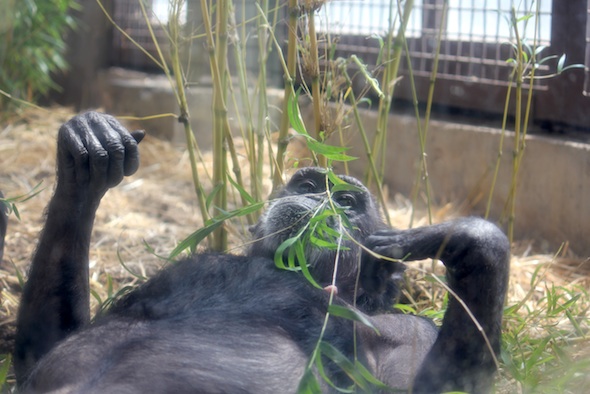
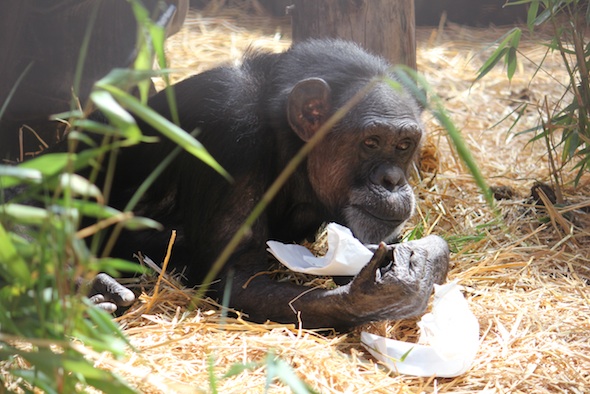
Thanks to Jackie Heinricher of Provitro Biosciences, the chimps have had the pleasure of having bamboo in the greenhouse. Jody has especially appreciated nesting in it. This morning, J.B. planted a couple more really tall plants, and Jody did not hesitate to take advantage of such valuable nesting material. She seemed pretty happy! Katelyn and I were commenting that it was interesting she chose the bamboo over her usual blankets, but Jody is an expert nest-builder and will use all sort of things like paper and straw in addition to blankets.

web jody nest in bamboo GH (dm) IMG_8128

web jody nest bamboo GH (dm) IMG_8209

While Jody was happily building her wonderful nest, Missy decided to interrupt her and try to engage her in play. Missy is able to bring the playful side out in just about anybody, even the generally less playful Jody. She entertained Missy’s need for playing for a little while, and then returned to building the perfect nest. Wait for the end of the video—you’ll see just how content and comfy she looks.

Thanks again Provitro Biosciences!

web missy jody wrestle laugh play bite foot on face GH (dm) IMG_8160

Filed Under: Annie, Enrichment, Food, Jody, Missy, Nesting, Play, Sanctuary, Thanks Tagged With: animal protection, animal rescue, animal rights, Animal Welfare, Annie, chimp enrichment, chimpanzee, chimpanzee rescue, chimpanzee retirement, chimpanzee sanctuary, Chimpanzee Sanctuary Northwest, Jody, Missy, Nesting, Play, primate rescue, Sanctuary

Always on the go

May 14, 2013 by Debbie

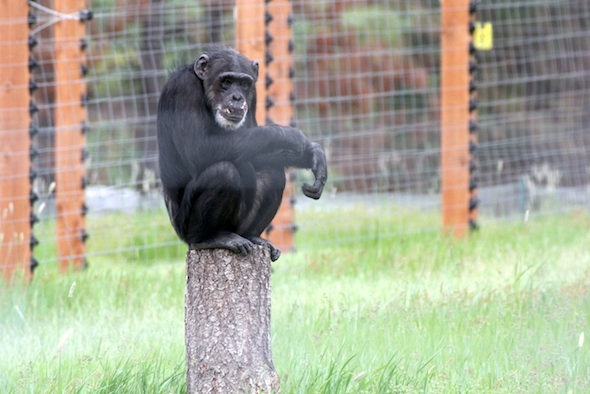
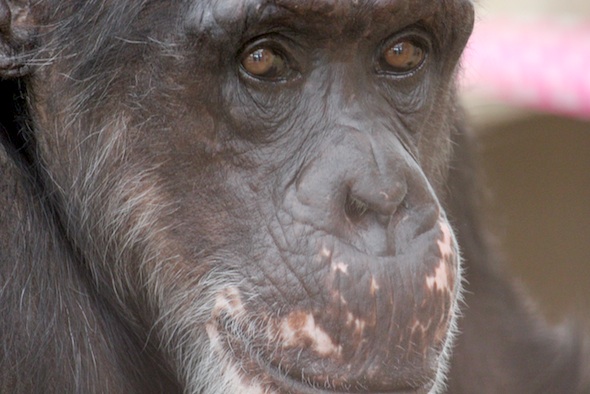
We all know that Missy is a bundle of energy. She’s got one speed when she’s on Young’s Hill: FAST. She brings a smile to our faces every time she darts back and forth and up and down the hill, because she’s able to exert her energy in a space larger than she ever would have even imagined of in the lab. It’s so hard to try and think of how she was able to contain that energy in the confined space she had for decades. Now, she’s able to run as fast as she can, climb every structure and post, do her acrobatics on the fire hoses, and if she wants, to sit still. Missy is a very great example of how the chimps now have choices.

web Missy climb post Young's Hill YH IMG_8082

web Missy climb post structure Young's Hill YH IMG_8070

web Missy tightrope fire hose shaky bridge Young's Hill YH IMG_7968

web Missy sit on stump Young's Hill YH IMG_8093

web Missy close up greenhouse GH IMG_7897

Filed Under: Missy, Sanctuary, Young's Hill Tagged With: animal protection, animal rescue, animal rights, Animal Welfare, chimp enrichment, chimp sanctuary, chimpanzee, chimpanzee rescue, chimpanzee retirement, chimpanzee sanctuary, Chimpanzee Sanctuary Northwest, Cle Elum 7, Cle Elum Seven, csnw, Missy, Play, primate protection, primate rescue, rescue, Sanctuary, young's hill

Nesting in the Bamboo

May 8, 2013 by Elizabeth

We planted some bamboo in the greenhouse this morning. Since chimpanzees are naturally curious and destructive, the plants might not last long, but for now everyone’s leaving them alone for the most part. Jody, however, thinks they make prime nesting material.

web Jody lie down nest new bamboo greenhouse GH IMG_7399

Thanks so much to ProVitro Biosciences for the bamboo!

Filed Under: Enrichment, Jody, Nesting, Sanctuary, Thanks Tagged With: Animal Welfare, chimp enrichment, chimpanzee retirement, Chimpanzee Sanctuary Northwest, Cle Elum 7, Cle Elum Seven, Jody, Sanctuary

  • « Go to Previous Page
  • Page 1
  • Interim pages omitted …
  • Page 118
  • Page 119
  • Page 120
  • Page 121
  • Page 122
  • Interim pages omitted …
  • Page 190
  • Go to Next Page »

Primary Sidebar

Subscribe To the Blog and Get Notified of New Posts First!

Archives

Calendar of Blog Posts

June 2026
S M T W T F S
 123456
78910111213
14151617181920
21222324252627
282930  
« May    

Categories

SUBSCRIBE TO OUR NEWSLETTER

Footer

PO Box 952
Cle Elum, WA 98922
[email protected]
509-699-0728
501c3 registered charity
EIN: 68-0552915

Official DDAF Grantee

Menu

  • The Chimpanzees
  • Blog
  • About Us
  • You can help
  • Resources
  • Contact
  • Donate

Proud Member of

Connect With Us

Search

Copyright © 2026 Chimpanzee Sanctuary Northwest. All Rights Reserved. Site by Vegan Web Design