• Skip to main content
  • Skip to primary sidebar
  • Skip to footer

Chimpanzee Sanctuary Northwest

Hope. Love. Home. Sanctuary

  • Our Family
    • The Chimpanzees
    • The Cattle
  • Blog
  • About Us
    • Visiting the Sanctuary
    • Philosophy
      • FAQs
      • Mission, Vision & Goals
      • Privacy Policy
    • The Humans
      • Staff
      • Board of Directors
      • Founder
    • Annual Reports
    • The Future of CSNW
    • CSNW In The News
  • You can help
    • Donate
      • Become a Chimpanzee Pal
      • Sponsor A Day
      • Transfer Stock
      • Be A Produce Patron
      • Be a Bovine Buddy
      • Give from your IRA
      • Personalized Stones
      • Bring Them Home Campaign
    • Leave A Legacy
    • Employment Opportunities
    • Volunteer
    • See Our Wish List
    • Events
  • Resources
    • About Chimpanzees
    • Enrichment Database
    • Advocacy
      • Advocacy Action Center
      • Apes in Entertainment
        • Trainers
        • Role of the AHA
        • Greeting Cards
      • Chimpanzees as Pets
      • Roadside Zoos
      • Chimpanzees in Biomedical Research
      • Conservation
        • African Apes
        • Orangutans
  • Shop
    • Merchandise Store
  • Contact
  • DONATE NOW

biomedical research

A Necessary Evil?

December 14, 2011 by J.B.

A recent study on chimpanzee behavior has caught the attention of the media. It’s formally titled The Neural and Cognitive Correlates of Aimed Throwing in Chimpanzees: A Magnetic Resonance Image and Behavioral Study on a Unique Form of Social Tool Use, but if you’re wondering why the media would care so much about this subject, it may help to know that some people refer to it as “The Poop-Throwing Study.” Some journalists just love an excuse to put the word “poop” in their stories.

In fact, it’s not really about poop-throwing, but about aimed throwing in general (some chimps just happen to throw feces because that’s what’s available to them, and because they know that it will provoke a strong reaction from the recipient). Specifically, the authors propose that the development of brain areas responsible for aimed throwing, a complex behavior requiring both planning for the future and knowledge of velocity and trajectory, laid the foundation for the development of human language.

The origin of human language is an interesting subject and chimpanzee caregivers, much like journalists, love to discuss poop. So I was interested in reading this paper. But reading about the methods reminded me that there is a whole world of invasive research on chimpanzees that goes largely unnoticed.

For this study, the authors used 78 chimpanzees from the Yerkes Regional Primate Research Center in Georgia. The chimps were separated from their social groups and anesthetized. They were then transported to an MRI machine where their brains were scanned. Following the scan, they remained in isolation for 6-12 hours until the anesthesia wore off.

Anesthetizing a chimpanzee is something that should never be taken lightly. From a chimpanzee’s perspective, the options range from bad to worse. For this study, the laboratory immobilized the chimpanzees using ketamine, an anesthetic commonly used at zoos, sanctuaries, and laboratories due to its high safety margin. It’s very difficult to lethally overdose a chimpanzee on ketamine, but that doesn’t mean that the drug’s effects are pleasant. Ketamine is a dissociative drug; it creates perceptual distortions and a feeling of separation from one’s own body. It is related to PCP and is similarly abused as a street drug. Some chimps tolerate ketamine better than others. One chimpanzee that Diana and I worked with at the Fauna Foundation, named Billy Jo, had a terrible reaction to ketamine. In the laboratory, he chewed his own thumb off while under anesthesia – on two separate occasions. Watching him recover from anesthesia, even in the caring environment of the sanctuary, was heartbreaking.

Many captive chimps will present a part of their body to the technician for injection. Either they have learned the hard way that it’s easier than being darted, or they have been trained through operant conditioning. I know that Yerkes uses operant conditioning for this purpose, so I’m sure that many of the chimps used in this study cooperated with their own anesthesia. But training is time-consuming, and some chimps are less receptive to training than others (and who can blame them if they refuse to cooperate!), so I would also guess that many had to be darted. Chimps are usually darted using an air- or CO2-powered pistol to shoot pressurized or explosive darts which eject the anesthetic drug upon impact.

Anesthesia is a sad fact of life for captive chimps. There are times when medical intervention is necessary and in the best interest of the chimpanzee, and most procedures require a chimpanzee to be immobilized for their safety and ours. But if we are going to separate a chimpanzee from her family, shoot her with a dart, and inject her with drugs that can induce fear, confusion, and anxiety, I think we need a better justification than curiosity about the origins of language.

Biomedical research involving chimpanzees is commonly portrayed as a necessary evil, but there is nothing even remotely necessary about research like this. MRI’s and PET scans may technically be noninvasive, but not when used on chimpanzees against their will. At a primatology conference I attended last year, many researchers whose careers revolve around brain imaging were upset because the Great Ape Protection and Cost Savings Act would ban experiments like these. Here’s hoping we can get it passed soon.


Filed Under: Chimpanzees in Biomedical Research, Sanctuary Tagged With: anesthesia, biomedical research, chimpanzee, dart, feces, ketamine, northwest, poop throwing, research, Sanctuary

Winter Break

November 26, 2011 by Diana

It was gorgeous this afternoon! No wind (a rarity around these parts), clear skies and that welcoming yellow orb in the sky. Everyone except Burrito and Negra spent quite a bit of time on Young’s Hill enjoying this little break from winter. Burrito was very happy to grab snow from the raceway and Negra peaked out but went back to the warmth of her nest.

These two don’t spend much time with each other, but today Annie and Jody went on a little hike together:

Jody and Annie in the bamboo

Jody hid herself above the bamboo:

jody behind bamboo

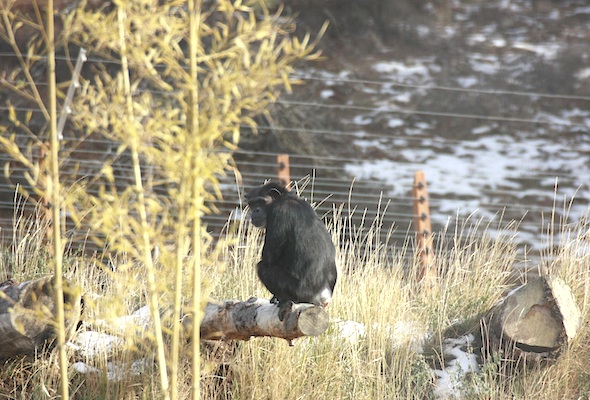
Annie found a perch:

Annie perched on log


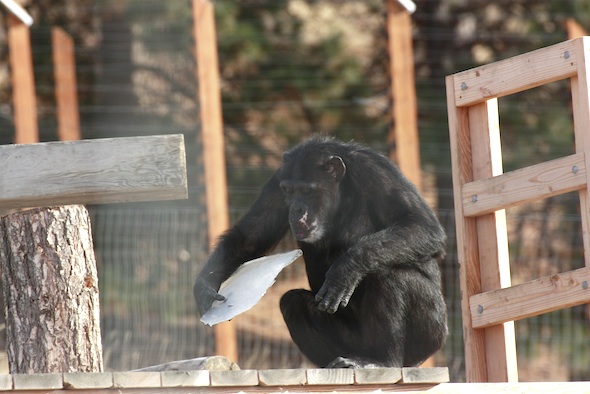
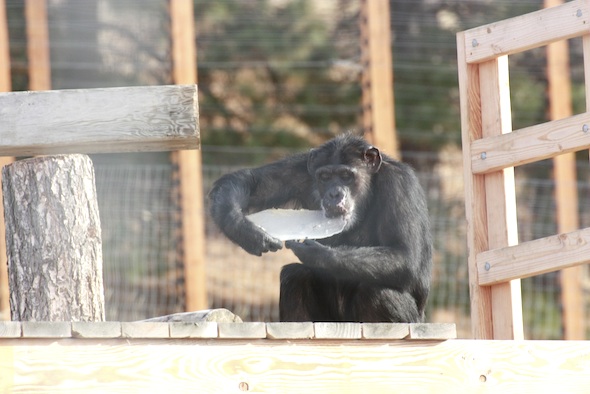
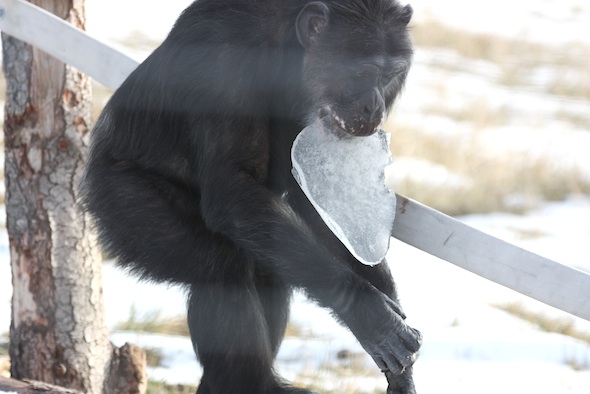
Meanwhile, Missy was busy with a large piece of ice she found in a tire:

Missy hold ice

Missy eat ice

Missy carry ice in mouth


Jamie was busy trying to stuff a tie (with a troll doll tied to it) into one of the holes in the treat rock:

Jamie stuffing tie into treat rock


and Foxie wandered all around with her dolls:

Foxie walking with troll dolls

Foxie walking with troll dolls 2

Filed Under: Annie, Foxie, Jamie, Jody, Missy, Young's Hill Tagged With: biomedical research, chimp, chimpanzee, csnw, northwest, rescue, Sanctuary, young's hill

Update: how you can help chimpanzees

November 4, 2011 by Diana

For Seattleites and other Washingtonians who missed the talk on Wednesday, Physicians Committee for Responsible Medicine has posted information about how you can help chimpanzees by contacting Senator Patty Murray. Time is of the essence, so do this today. Find all the info you need here (including a link for those who live outside of Washington): http://www.pcrm.org/email/murray_letter.html

For those who did come to the talk – thank you! It was great to see both familiar and new faces. As we said on Wednesday, we are hopeful that biomedical experimentation on chimpanzees in the U.S. can end soon. Jody’s son Levi and all of the chimpanzees still used as experimental subjects need your voices to make this happen.

PCRM’s Research Policy Specialist Noelle Callahan and Director of Public and Government Affairs Elizabeth Kucinich visited the sanctuary yesterday. Normally shy, Burrito spent the entire visit staring at Elizabeth Kucinich. I do believe he’s in love.

In the photo below, left to right, is Sarah, Noelle Callahan, me and Elizabeth Kucinich.

Filed Under: Jody Tagged With: biomedical research, chimp, chimpanzee, csnw, northwest, patty murray, Sanctuary

Chimps in Labs report

April 24, 2011 by Diana

We are lucky that we are able to see and share “the other side of the story” of the Cle Elum Seven chimpanzees. But we never forget where they came from and we never forget about the over 1,000 chimpanzees still in biomedical research facilities.

Today, an excellent set of articles came out about the use of chimpanzees in biomedical research and the issue of the Alamogordo Primate Facility chimpanzees whose fate is still uncertain after receiving a temporary reprieve from their transfer to what is now called the Texas Biomedical Research Institute. Please read the series of articles in McClatchy by Chris Adams here: www.mcclatchydc.com/chimps

If you’ve been following this story on our blog and e-newsletters (just search for “Alamogordo” in the search box to the right), you know that Jody’s son Levi was already transferred to the biomedical facility. Among the 186 chimpanzees whose fate is depending on the decision of the NIH officials examining the issue is Negra’s daughter Heidi (pictured below), Foxie’s son David, and Jody’s daughter April.

Heidi

This is a crucial time for not just the Alamogordo chimpanzees, but all laboratory chimpanzees. The bill to outlaw the use of chimpanzees in invasive biomedical research in the United States was recently reintroduced as the Great Ape Protection and Cost Savings Act.

Learn more about this bill and how to help: Project R&R

For more on the Alamogordo Primate Facility chimpanzees: Retire the Chimps

Filed Under: News, Sanctuary Tagged With: biomedical research, chimp, chimpanze, chris adams, csnw, david, Foxie, Great Ape Protection Act, heidi, Jody, levi, mcclatchy, Negra, texas biomedical research institute

Jamie and choices

January 15, 2011 by Diana

While going though blog posts the last couple of weeks, I was struck by what I wrote about Jamie after meeting her for the first time. This was written three years ago, almost six months before she came to Chimpanzee Sanctuary Northwest. This is what I wrote (link to the original post here):

Jamie is someone who could be referred to as a “character.” She clearly likes attention and demanded a lot of it from me and the other Direct Care Committee members (J.B. and Sarah) who accompanied me on my first visit to Buckshire to meet the chimpanzees. Jamie was the most gregarious of the group and was full of energy. She was clearly pleased to have the rapt attention of new people and really enjoyed having her feet tickled (with newspaper) and playing chase.

The first physical feature that I noticed about Jamie was that her belly had almost no hair. This was obviously due to “over-grooming” – Jamie picks out the hair on her belly and the skin underneath the hair. Over-grooming is considered a form of self-mutilation and can be the result of a stressful, unpredictable life or a sign of utter boredom. Often, this type of behavior gradually disappears when a chimpanzee is moved to a sanctuary which provides a stimulating environment.

A big element that is missing from the day-to-day life of the chimpanzees at Buckshire is the lack of choice. Born into captivity, Jamie’s entire life has been determined by the humans who claimed ownership over her. Her early years were spent as a “performer” in a circus, and then she was passed on to the biomedical research industry (note: we now know she lived with an animal trainer for nine years, but we don’t know how or where she was used during that time). There are very few opportunities to make choices in her daily existence at Buckshire. For Jamie, I believe this will be the biggest benefit to her new life at CSNW. I imagine that once she figures out there are so many things that she can do and ask for, she will probably be quite demanding of the time and energy of the staff at the sanctuary. And they will, no doubt, be elated to indulge her desires.

Jamie did, in fact, completely stop plucking the hair from her belly when she arrived at the sanctuary. She began to do it again this summer after an illness, though it was much, much less severe than before and not very noticeable (nothing like this photo of her bare belly when she arrived). Sometimes this happens with stereotypical behavior – it returns even though the environment has vastly improved. Hair plucking / over-grooming is a really common behavior in captive chimpanzees. We’re keeping an eye on Jamie and making sure she has things to do, which is partly why we started the “enhanced enrichment” in the evenings.

What really struck me about the post, though, was the last two sentences. Did I call that one, or what?? Jamie is by far the most demanding chimpanzee at the sanctuary. A lot of what we do to enrich the lives of the chimps is with Jamie in mind. And I do love to indulge her curiosity and need for stimulation. Just tonight she saw me bringing in some boots to put away and motioned for me. I stopped and lined up all of the boots in front of the caging. She nodded with appreciation in her Jamie way, then indicated that she wanted one, so I gave it to her. Then she wanted another, so I gave her a second boot. In the end, she was satisfied with four boots, but probably more satisfied with the interaction and the process of asking and receiving.

Filed Under: Jamie, Sanctuary Tagged With: biomedical research, chimp, chimpanzee, Enrichment, Jamie, northwest, Sanctuary

Reprieve for Alamogordo Chimpanzees

December 31, 2010 by Diana

My family lives in New Mexico and my very sharp and active 89-year-old grandmother, who is a supporter of the Cle Elum Seven, sent me word of this great news this morning.

(for background information about the Alamogordo chimpanzees, visit: http://retirethechimps.org/)

Here’s the beginning of a story that the Albuquerque Journal published today:

Chimps To Stay in N.M. for a While

By Rene Romo
Copyright © 2010 Albuquerque Journal
Journal Southern Bureau

LAS CRUCES — The nearly 200 chimps housed at a federal facility in Alamogordo have won a temporary reprieve from being transferred to another site, where they were to become test subjects, according to the Governor’s Office.
In a phone call received late Thursday afternoon, an official with the National Institutes of Health informed Gov. Bill Richardson that the chimps will not be transferred until the National Academy of Sciences completes a review of policies related to the use of chimpanzees in biomedical research, according to a governor’s spokeswoman.
The review is expected to postpone the chimp transfer for about two years, said Richardson spokesman Alarie Ray-Garcia.
“Until the study is completed, there will be no transfer of the chimps,” Ray-Garcia said.

Read more: http://www.abqjournal.com/news/state/312320216413newsstate12-31-10.htm

This means that Negra’s daughter Heidi, Foxie’s son David and Jody’s daughter April will not be put back into research, at least for the time being. And it means that we still have time to let our voices be heard so that they and all of the chimpanzees can be retired permanently.

Filed Under: Sanctuary Tagged With: alamogordo, alamogordo primate facility, biomedical research, chimp, chimpanzee, governor bill richardson, Sanctuary

Levi and Brandon Wood’s video

November 23, 2010 by Diana

Today, Jody’s son Levi turns 27. He has been a research subject his entire life. The note in Jody’s file for this day twenty-seven years ago simply says, “Delivered healthy infant male #88 – removed & taken to nursery.” If she got a glimpse of Levi that day, it was probably the last time Jody saw her son.

Six weeks later, an adult male chimpanzee was transferred into Jody’s cage in the hopes of “breeding” her again.

Levi was among the unlucky group of chimpanzees who have already been moved from the Alamogordo Primate Facility to the Southwest National Primate Research Center in San Antonio, Texas.

Learn more about the transfer of the Alamogordo chimps on Animal Protection of New Mexico’s FAQ page and learn how to help here: RetireTheChimps.org.

Also, for Jody and Levi, please support the Great Ape Protection Act, which would permanently retire all chimpanzees currently supported by the federal government and would ban the use of great apes in invasive biomedical research. Visit the HSUS TAKE ACTION link to contact your reps.

For inspiration, watch 10-year-old Brandon Wood’s video below. Brandon is one of the most active chimpanzee advocates out there. The dedication of someone so young is remarkable. You can follow Brandon through his blog, his Facebook page or on Twitter. Visit his sites and thank him for working so hard for chimpanzees.

Filed Under: Thanks Tagged With: alamogordo primate facility, animal protection of new mexico, biomedical research, brandon wood, hsus, human society of the united states, Jody, levi, make a chimp smile, southwest National Primate Research Center

  • « Go to Previous Page
  • Page 1
  • Interim pages omitted …
  • Page 5
  • Page 6
  • Page 7
  • Page 8
  • Go to Next Page »

Primary Sidebar

Subscribe To the Blog and Get Notified of New Posts First!

Archives

Calendar of Blog Posts

June 2026
S M T W T F S
 123456
78910111213
14151617181920
21222324252627
282930  
« May    

Categories

SUBSCRIBE TO OUR NEWSLETTER

Footer

PO Box 952
Cle Elum, WA 98922
[email protected]
509-699-0728
501c3 registered charity
EIN: 68-0552915

Official DDAF Grantee

Menu

  • The Chimpanzees
  • Blog
  • About Us
  • You can help
  • Resources
  • Contact
  • Donate

Proud Member of

Connect With Us

Search

Copyright © 2026 Chimpanzee Sanctuary Northwest. All Rights Reserved. Site by Vegan Web Design