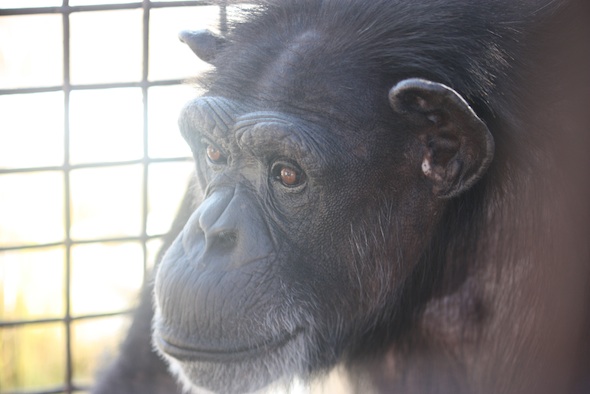
Burrito, the youngest of the Cle Elum Seven chimpanzees, turned 29 today. As you can tell from all the food squeaking in the following video, he really enjoyed the party. Many thanks to all the supporters that helped make today a special day for him.
Nest Envy
Negra continued her playful streak this morning, but I think her real intention was to steal Jody’s bed.
Celebrating another day on the hill
There’s so much to celebrate this week, from Save the Chimps final migration to the NIH’s dramatic announcement about the role of chimpanzees in biomedical research.
Here at the sanctuary, the chimps celebrated another sunny winter day by running around their 2-acre enclosure.
A Necessary Evil?
A recent study on chimpanzee behavior has caught the attention of the media. It’s formally titled The Neural and Cognitive Correlates of Aimed Throwing in Chimpanzees: A Magnetic Resonance Image and Behavioral Study on a Unique Form of Social Tool Use, but if you’re wondering why the media would care so much about this subject, it may help to know that some people refer to it as “The Poop-Throwing Study.” Some journalists just love an excuse to put the word “poop” in their stories.
In fact, it’s not really about poop-throwing, but about aimed throwing in general (some chimps just happen to throw feces because that’s what’s available to them, and because they know that it will provoke a strong reaction from the recipient). Specifically, the authors propose that the development of brain areas responsible for aimed throwing, a complex behavior requiring both planning for the future and knowledge of velocity and trajectory, laid the foundation for the development of human language.
The origin of human language is an interesting subject and chimpanzee caregivers, much like journalists, love to discuss poop. So I was interested in reading this paper. But reading about the methods reminded me that there is a whole world of invasive research on chimpanzees that goes largely unnoticed.
For this study, the authors used 78 chimpanzees from the Yerkes Regional Primate Research Center in Georgia. The chimps were separated from their social groups and anesthetized. They were then transported to an MRI machine where their brains were scanned. Following the scan, they remained in isolation for 6-12 hours until the anesthesia wore off.
Anesthetizing a chimpanzee is something that should never be taken lightly. From a chimpanzee’s perspective, the options range from bad to worse. For this study, the laboratory immobilized the chimpanzees using ketamine, an anesthetic commonly used at zoos, sanctuaries, and laboratories due to its high safety margin. It’s very difficult to lethally overdose a chimpanzee on ketamine, but that doesn’t mean that the drug’s effects are pleasant. Ketamine is a dissociative drug; it creates perceptual distortions and a feeling of separation from one’s own body. It is related to PCP and is similarly abused as a street drug. Some chimps tolerate ketamine better than others. One chimpanzee that Diana and I worked with at the Fauna Foundation, named Billy Jo, had a terrible reaction to ketamine. In the laboratory, he chewed his own thumb off while under anesthesia – on two separate occasions. Watching him recover from anesthesia, even in the caring environment of the sanctuary, was heartbreaking.
Many captive chimps will present a part of their body to the technician for injection. Either they have learned the hard way that it’s easier than being darted, or they have been trained through operant conditioning. I know that Yerkes uses operant conditioning for this purpose, so I’m sure that many of the chimps used in this study cooperated with their own anesthesia. But training is time-consuming, and some chimps are less receptive to training than others (and who can blame them if they refuse to cooperate!), so I would also guess that many had to be darted. Chimps are usually darted using an air- or CO2-powered pistol to shoot pressurized or explosive darts which eject the anesthetic drug upon impact.
Anesthesia is a sad fact of life for captive chimps. There are times when medical intervention is necessary and in the best interest of the chimpanzee, and most procedures require a chimpanzee to be immobilized for their safety and ours. But if we are going to separate a chimpanzee from her family, shoot her with a dart, and inject her with drugs that can induce fear, confusion, and anxiety, I think we need a better justification than curiosity about the origins of language.
Biomedical research involving chimpanzees is commonly portrayed as a necessary evil, but there is nothing even remotely necessary about research like this. MRI’s and PET scans may technically be noninvasive, but not when used on chimpanzees against their will. At a primatology conference I attended last year, many researchers whose careers revolve around brain imaging were upset because the Great Ape Protection and Cost Savings Act would ban experiments like these. Here’s hoping we can get it passed soon.
Trouble on the hill
It is getting very cold here in Cle Elum, but the sun is out and there’s no snow on the ground so the chimps continue to go out on the hill every day. Today, Jamie led Missy, Annie, and Jody on a walk through the bamboo.
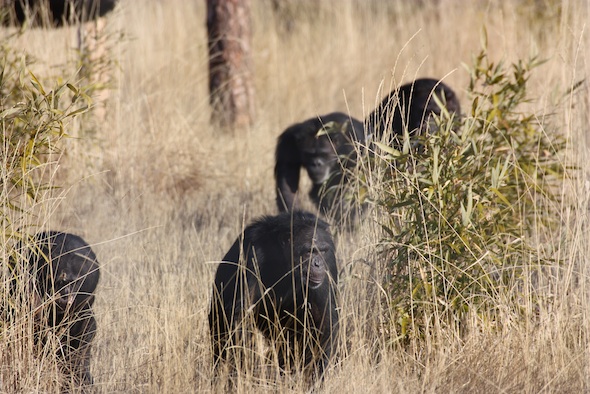
Later, Jody was alarmed by something in the upper corner of the enclosure. Here you can see a great example of a fear grimace – what many people mistake for a smile.
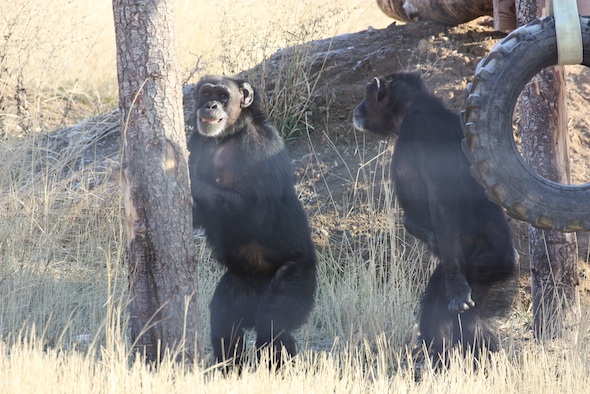
Annie stayed back, but Jody was determined to go in for a closer look. She kept looking back for some support, but she was on her own.

The chimps love being able to roam across two acres, but at times like this I think it can feel a long way from the safety of their original sanctuary home.
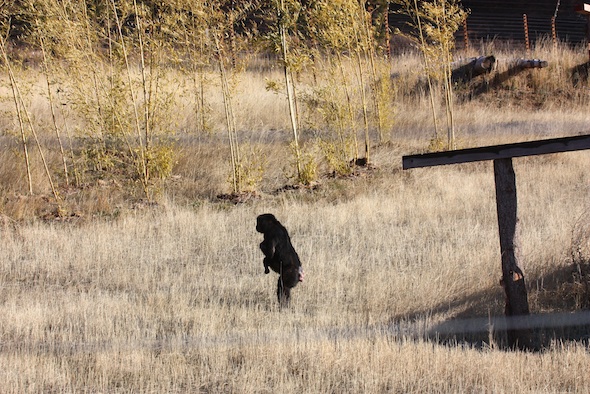
She got as far as the bamboo grove but didn’t seem to have to courage to go any further; at least not without backup.
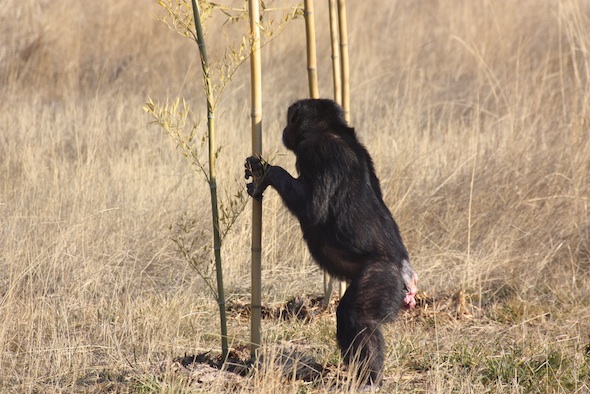
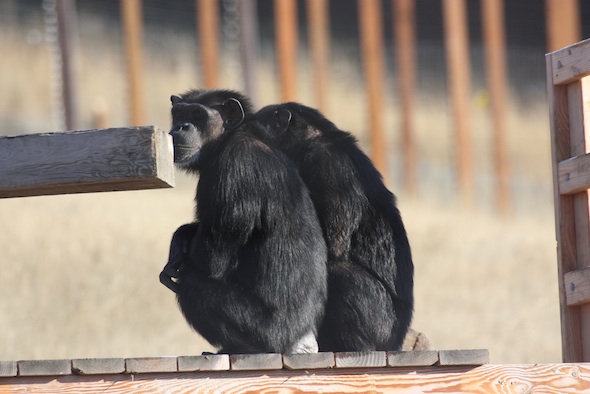
So she went back to the platform to be with Annie.
Peering in Silhouette
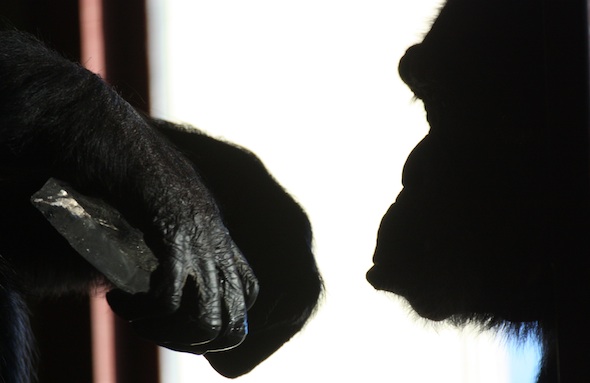
Peering is one of my favorite chimpanzee behaviors. It is related to peering as we commonly understand it (looking intently at something), but it has a more narrow usage with chimpanzees. Chimpanzees often peer when they would like another chimpanzee to share some of their food. Rather than asking for some, they stare at the food as if it is some mysterious substance from outer space, sometimes getting as close as a few inches from the other chimp’s mouth. As a result, the peering chimp annoys the other chimp into either turning away or reluctantly giving up some of their food.
Today, Negra was enjoying a piece of ice from Young’s Hill while Jody peered at her. Peering can go on for an awfully long time, long enough to make me uncomfortable just watching it. I’m not sure whether Negra ever gave Jody a piece of the ice.
Jody and Foxie on the hill
Jody sampled the snow from many different areas of Young’s Hill today. Her favorite seemed to be the snow from the crater in our miniature Mt. St. Helens replica.
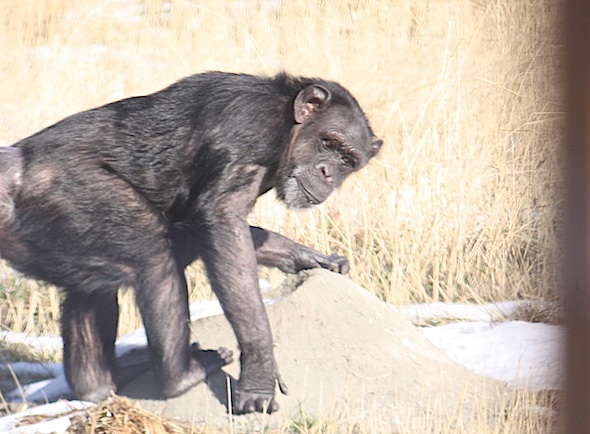
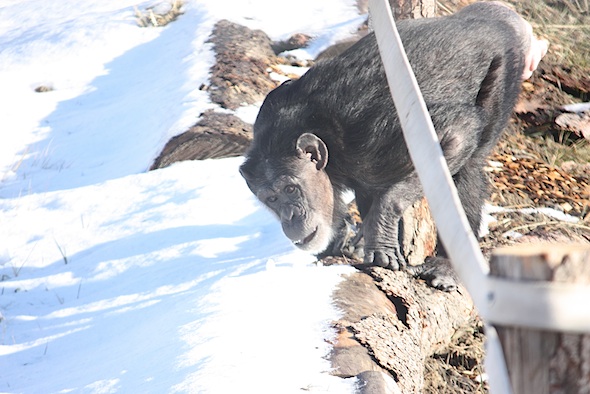
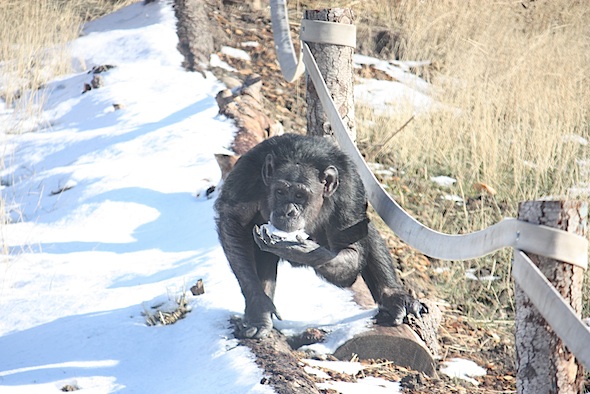
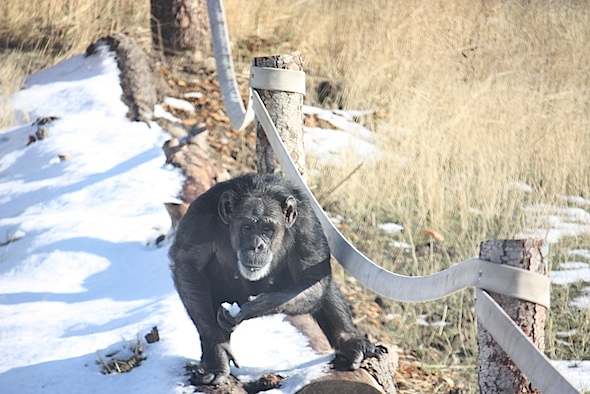
Foxie also went all the way outside today, but she tried to keep her feet off of the snow as much as possible.

Everyone else seemed content to grab some snow from the end of the raceway and watch Jody and Foxie brave the cold from the warmth of the greenhouse.