• Skip to main content
  • Skip to primary sidebar
  • Skip to footer

Chimpanzee Sanctuary Northwest

Hope. Love. Home. Sanctuary

  • Our Family
    • The Chimpanzees
    • The Cattle
  • Blog
  • About Us
    • Visiting the Sanctuary
    • Philosophy
      • FAQs
      • Mission, Vision & Goals
      • Privacy Policy
    • The Humans
      • Staff
      • Board of Directors
      • Founder
    • Annual Reports
    • The Future of CSNW
    • CSNW In The News
  • You can help
    • Donate
      • Become a Chimpanzee Pal
      • Sponsor A Day
      • Transfer Stock
      • Be A Produce Patron
      • Be a Bovine Buddy
      • Give from your IRA
      • Personalized Stones
      • Bring Them Home Campaign
    • Leave A Legacy
    • Employment Opportunities
    • Volunteer
    • See Our Wish List
    • Events
  • Resources
    • About Chimpanzees
    • Enrichment Database
    • Advocacy
      • Advocacy Action Center
      • Apes in Entertainment
        • Trainers
        • Role of the AHA
        • Greeting Cards
      • Chimpanzees as Pets
      • Roadside Zoos
      • Chimpanzees in Biomedical Research
      • Conservation
        • African Apes
        • Orangutans
  • Shop
    • Merchandise Store
  • Contact
  • DONATE NOW

animal rights

Foxie and the garter snake

July 6, 2013 by Debbie

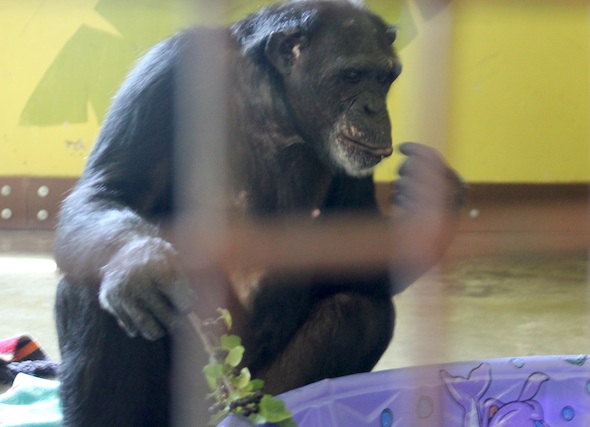
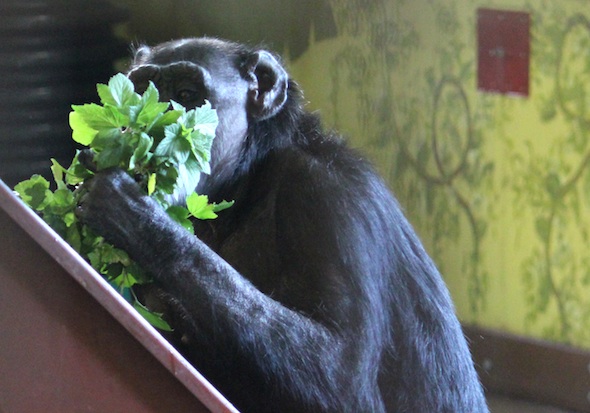
Chimps are very investigative, defensive, and at times aggressive. Combine all these characteristics and add a small garter snake into the equation and you get a whole group of chimps ready to attack an intruder! This morning a garter snake made its way into the greenhouse and the chimps were on high alert. Everyone took a second to peer at it, but most kept their distance. Foxie, however, showed a lot of bravery and was doing her best to protect her home by trying to attack the snake (but without touching it).

The chimps encounter snakes every now and then. They’re very careful not too get too close to something that raises so much alarm, which is a smart instinct. Thankfully, garter snakes are completely harmless so there’s nothing to really worry about if they do touch it. In fact after filming this attack, I closed off the greenhouse and picked up the snake (who was still alive) and took him to a nice garden area that I thought he’d pretty happy about. I apparently don’t have a huge fear of snakes because I was holding him for awhile, talking to volunteers Patti and Connie about how we were going to set up today’s lunch forage, when they said “will you just put that snake down already?!” Like I said, harmless 🙂

The snakes seem to be good at “playing dead” so as not to actually get killed. At the end of the video you’ll see that Jamie was fairly convinced Foxie had taken care of the problem, and then left it alone. I was glad to be able to rescue it and find that he was not at all harmed.

Filed Under: Chimpanzee Behavior, Enrichment, Foxie, Jamie, Jody, Sanctuary Tagged With: animal protection, animal rescue, animal rights, Animal Welfare, chimp, chimp behavior, chimp enrichment, chimp sanctuary, chimpanzee, chimpanzee rescue, chimpanzee retirement, chimpanzee sanctuary, Chimpanzee Sanctuary Northwest, Cle Elum 7, Cle Elum Seven, csnw, Enrichment, Foxie, garter, instinct, Jamie, Jody, natural, primate protection, primate rescue, rescue, Sanctuary, snake, territorial

Help others Take Action – share Eyes on Apes!

July 2, 2013 by Debbie

CSNW is a really unique place. We have seven amazing beings under our care, whom as you know are of utmost importance around here and truly run the show! Well, Jamie does anyway 😉 And we love to share stories about each of their personalities and their day-to-day lives.

For instance, today has been a continuation of the heat wave that has hit Cle Elum, but before the hot afternoon sun came around we did a breakfast forage on the hill which everyone loved. Here’s Foxie enjoying a piece of grapefruit:

web_Foxie_dora_orange_platform_YH_jb_IMG_2561

After we cleaned the playroom, Denice and I filled a kiddie pool with cool water, and harvested some black currents we have growing in the garden. We spread the currents around as a forage and also dropped some into the water. Jody and Jamie especially loved it!

web_jody_eat_black_current_forage_stairs_PR_dm_IMG_0013

web_jamie_eat_black_current_forage_pool_PR_dm_IMG_0017

CSNW is also pretty big on education and advocacy. Eyes on Apes is our advocacy group and we really want to help make a difference for apes everywhere. The Cle Elum Seven truly serve as ambassadors for the life that all chimpanzees in captivity deserve, and for their wild counterparts who need our help to protect their habitat. This is only something we can achieve with your help! If you haven’t joined the Take Action e-mail list, do that today! Share our Facebook page, and re-tweet our plea for more followers on Twitter.

web_jamie_up_close_PR_dm_IMG_0018

Filed Under: Advocacy, Food, Foxie, Jamie, Jody, Sanctuary, Young's Hill Tagged With: advocacy, animal protection, animal rescue, animal rights, Animal Welfare, chimp enrichment, chimp sanctuary, chimpanzee, chimpanzee rescue, chimpanzee retirement, chimpanzee sanctuary, Chimpanzee Sanctuary Northwest, Cle Elum 7, Cle Elum Seven, csnw, eyes on apes, Foxie, Jamie, Jody, primate protection, primate rescue, rescue, Sanctuary

Foxie and her dolls

June 25, 2013 by Debbie

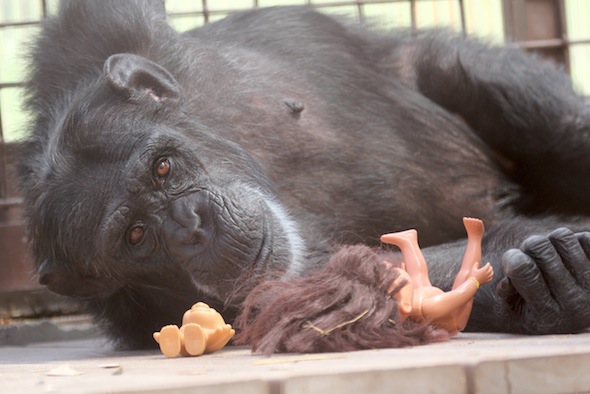
Foxie is usually never without a troll doll or Dora the Explorer doll. But there’s been some occasions where she differs from the usual and pick dolls or enrichment that are entirely different, and sometimes—shockingly—she’s been seen walking around Young’s Hill without any doll along for the ride. As endearing as Foxie’s doll love is, I think it’s really good to see her varying a bit in her choices for enrichment.

Sometimes she picks a troll AND a Dora:

web_Foxie_lie_on_deck_troll_dora_look_at_camera_greenhouse_GH_ek_IMG_8733

Sometimes it’s something totally different (in this case, a “My Little Pony” pink horse head)

web_Foxie_pink_my_little_pony_head_playroom_PR_IMG_7518

Sometimes we can’t be for sure if she’s carrying one or not… but she sure looks good with that beautiful forest background!

web_Foxie_top_of_climbing_structure_grapefruit_peel_in_mouth_look_toward_camera_Young's_Hill_YH_ek_IMG_8610

And sometimes she’s interested in enjoying the sunshine with her chimpanzee friends and leaves the dolls to wait for her inside:

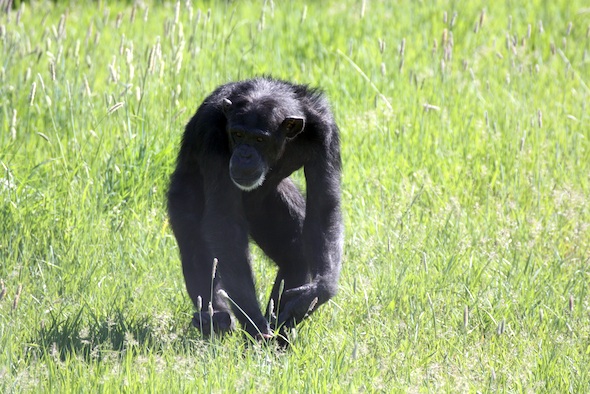
web_Foxie_walk_green_grass_Young's_Hill_YH_IMG_1839

Filed Under: Enrichment, Foxie, Sanctuary, Trolls, Young's Hill Tagged With: animal protection, animal rescue, animal rights, Animal Welfare, chimp enrichment, chimpanzee, chimpanzee rescue, chimpanzee retirement, chimpanzee sanctuary, Chimpanzee Sanctuary Northwest, Cle Elum 7, Cle Elum Seven, csnw, Enrichment, Foxie, primate protection, primate rescue, Sanctuary, young's hill

Beautiful Jody

June 20, 2013 by Debbie

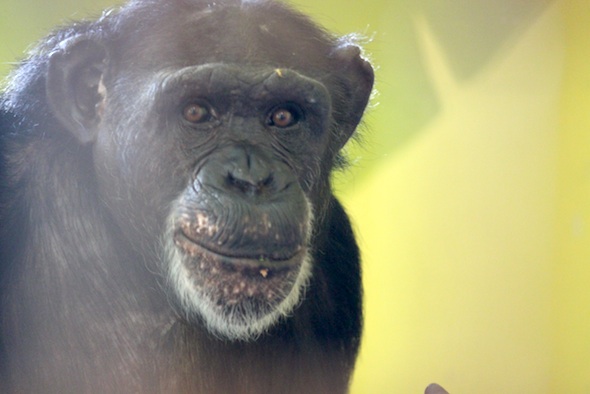
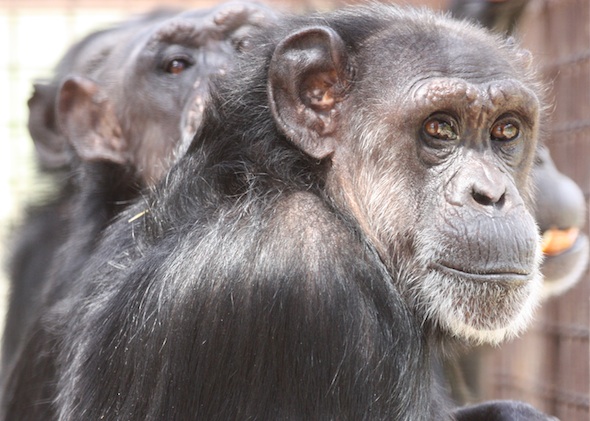
I love Jody’s eyes. And in this picture, Negra’s eyes peeking over to Elizabeth as she’s taking the photo really bring a smile to my face!

web_Jody_look_at_camera_lunch_anniversary_birthday_party_greenhouse_GH_ek_IMG_2402

Filed Under: Jody, Negra, Sanctuary Tagged With: animal protection, animal rescue, animal rights, Animal Welfare, chimpanzee, chimpanzee rescue, chimpanzee retirement, chimpanzee sanctuary, Chimpanzee Sanctuary Northwest, Cle Elum 7, Cle Elum Seven, csnw, Enrichment, Jody, Negra, primate protection, primate rescue, rescue, Sanctuary

The FARDC ‘Petting Zoo’ at Bili

June 18, 2013 by Debbie

Dr. Cleve Hicks, one of our guest bloggers, was featured last month with a series of posts called “Along the Bushmeat Highway” (Read Part 1, Part 2, and Part 3). The story was from July of last year, and Cleve has given us some more recent follow-up information about the Bili forest area in the DRC. WARNING: some disturbing images included in this entry (the most graphic one is included as a link in its caption).

—

UPDATE – THE FARDC ‘PETTING ZOO’ AT BILI, OCTOBER 2012

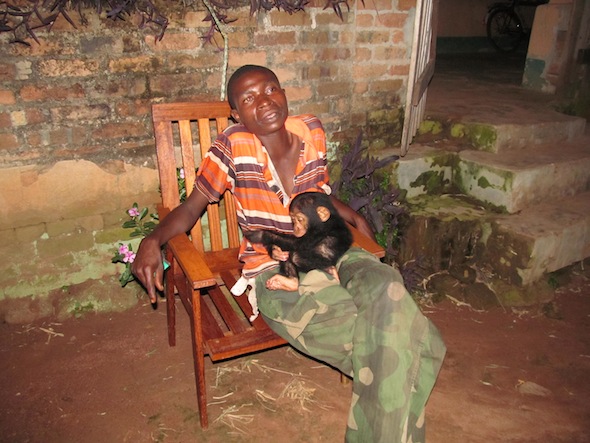
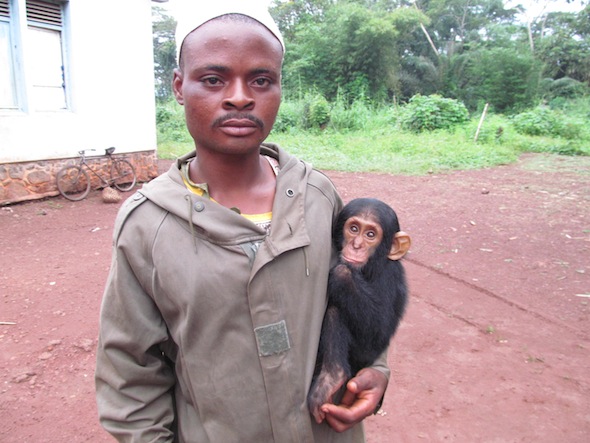
The skinny young man dressed in a mix of rags and military gear loomed out of the night like an apparition. He careened across our yard and nearly collapsed on top of Ephrem. Our evening banter was abruptly cut off as we rose from our chairs to confront the lurching, inebriated intruder. He was the youngest member in the squad of six Congolese soldiers stationed in a barracks up the hill from us in Bili. The soldier was so drunk that he could barely sit upright in the seat which we had offered him. At least on this occasion he had left his weapon back at the barracks. ‘I am a member of the Congolese military!’ he proclaimed in a slurred voice. ‘I am Congolese, and this is my pet!’ I looked in his lap and my heart sunk as I made out the dark shape clinging there: a baby chimpanzee, perhaps two years old, her eyes dull and glassy, pink tongue lolling out of her mouth. She periodically nodded off into a dazed slumber, and it looked as if the rumours that the troops were keeping her intoxicated with booze and dope were true.

1 drunk soldier with baby chimp

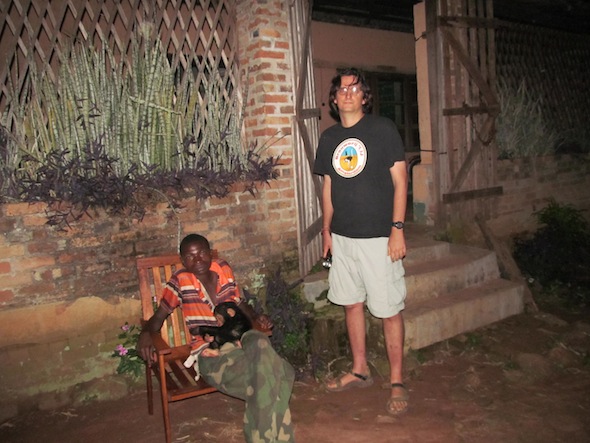
A drunken young soldier with a baby chimpanzee at our project house. (Photo © Ephrem Mpaka of the Lukuru Wildlife Research Foundation).

2 cleve with soldier and baby chimp

This was the same orphan that our team had photographed the day before, gazing out from the arms of her owner with a look of befuddled hopelessness. I had sent Ephrem with a pair of Ecoguards over to the barracks of the FARDC (Forces Armées de la République Démocratique du Congo) to photograph the ‘petting zoo’ which we had been told the new squad leader was keeping there. In addition to this little female chimpanzee, named Congo, the military and their families were keeping three monkey orphans: a baboon tied to a short leash, an agile mangabey, and a red tailed guenon. The latter two primates scampered around the yard looking for food. After some initial tension between our guards and the military, things calmed down and the soldiers allowed Ephrem to photograph the primates. The soldiers explained that they had acquired the orphan chimpanzee from a shop in the town of Roa about 50 km southwest of Bili, as a ‘mascot’ for the troops. Ephrem explained to the men that it was both dangerous and immoral to keep primates in such a condition, and in the case of the chimpanzee, illegal. Later that evening we considered sending the guards to confiscate Congo, but in the end, decided against it. These military were heavily-armed, often drunk, and had already made threats against our project. Also, we had no place to send the poor orphan.

3 orphan chimp Congo

The orphan chimpanzee Congo kept by a soldier at the military barracks in Bili.

We were unsure why this young soldier had come to our house with the baby chimpanzee. Did he want to sell her to us? Intimidate us? Or was he just out-of-his-mind drunk? Maybe all three at once. After failing completely to penetrate his whiskey-soaked stupor with reason, we sent him stumbling on his way back to the barracks.

Two of the three chimpanzee orphans we had encountered on this trip, one in Bili and the other two en route, had been held by FARDC soldiers and officers (the third was held by a traditional chief at Lisala). The one we saw in the regional capital of Buta had been kept by the highest military authority in that town. Although the people of Bili certainly consumed monkeys and other wildlife, we had never seen any chimpanzee meat or orphans in the hands of the locals. The indigenous Azande still seemed to hunt only for local trade and consumption, but it was clearly in the vested interested of a number of outsiders to link up Bili to the huge and rapidly expanding commercial bushmeat network a hundred miles to the south. This was particularly the case for ivory. What a terrible example these military men and federal officials were setting – and not only in regards to conservation.

Later in the month these military men, in cahoots with the corrupt territorial administrator, began to shake down local merchants for money and merchandise, citing a law forbidding non-soldiers from wearing military-style clothing and mercilessly harassing anyone who happened to be wearing khaki shorts or cargo pants. They would then use this money to buy copious amounts of alcohol, which they would drink in public – fuelling more roadside shakedowns. They even did this to one of our motorbike drivers at our project base, forcing me to record the incident on film and threaten to report the culprits to the authorities. Only the threat of exposure caused them to back down. It was and is my hope that the local people, frequently victims of such aggression and thievery from the soldiers and administrators, would realize that we could serve as an ally against such forces of anarchy – and there were indications that this was happening.

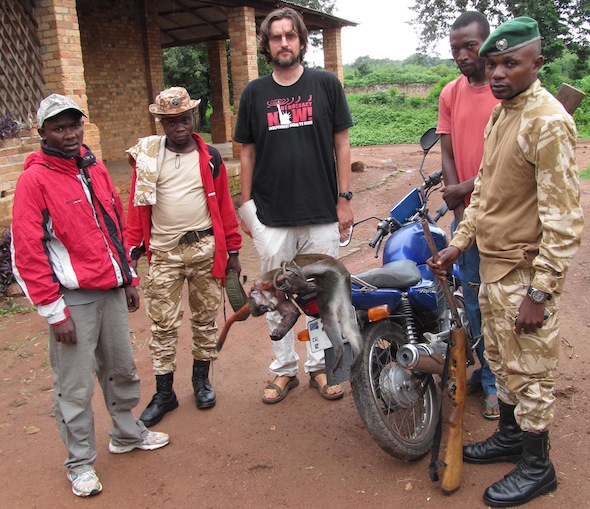
In addition, we found evidence that powerful outsiders were ignoring the closed hunting season, a period of several months in which it is forbidden by national law to hunt. The purpose of this closed season is to allow key prey species to recover. On the road between our forest camp and Bili, in the middle of this closed season, our guards came upon a man shooting a red tailed guenon out of a tree. They confiscated his gun and the monkey carcass and brought them to us. It turned out the gun belonged to a highly-placed government official in Bili. That man paid us a visit on the same night demanding that we return his gun. We refused to comply. Later, in a public hearing, he tried to explain to us why it should be permissible for powerful men like him to hunt any time they wanted to. We encountered similar incomprehension of or disrespect for basic Congolese law from a number of regional officials throughout the course of our stay in Bili.

4 confiscated monkey & shotgun

Our Ecoguards, Feruzi OPJ and Feruzi Yenga, confiscated this monkey and shotgun during the closed hunting season. The owner was a powerful governmental official.

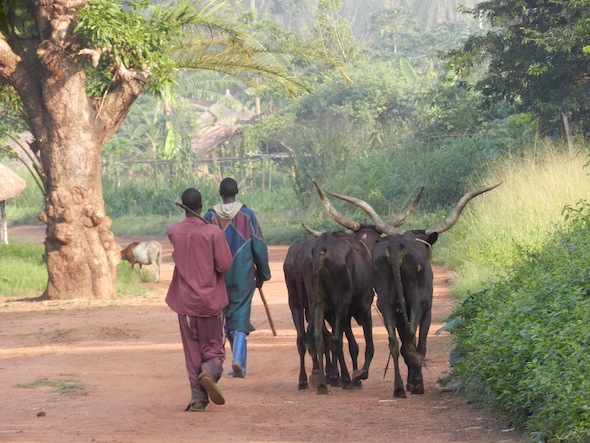
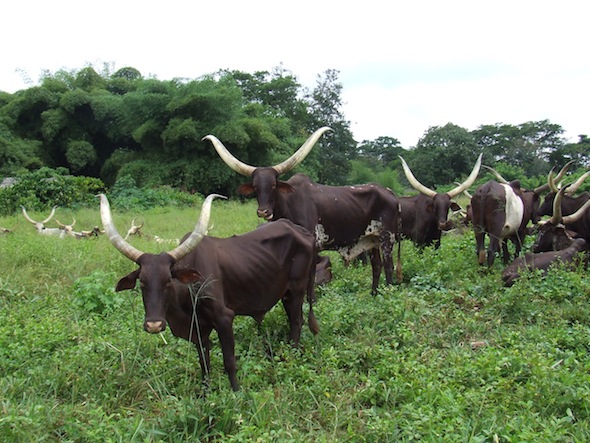
In late October, on our way out of Bili to Buta, we drove past a herd of 45 Mbororo cattle being imported into the lushly forested region. We had seen only a few very skinny cattle at Bili, but here, further south in the heart of the forest, domesticated animals were arriving in increasing numbers – out with the local fauna, in with the cattle, pigs, goats, and chickens. Arriving at Buta, we stopped at the headquarters of the highest-ranking regional military official, a man whom our team had confirmed owned a baby chimpanzee. Despite this, he was widely known to be professional and respectful in his dealings with civilians. He listened courteously to our complaints about his troops in Bili and said he would work to get them transferred, and that he would also send out a message to his soldiers not to buy baby chimpanzees. At least he listened to us and appeared to take our complaints seriously. I am under no illusions that this will change anything much, for the orphan Congo or the people of Bili, but I am convinced from what we have seen that the Congolese military are a crucial link in the illicit trade of protected wildlife species, from chimpanzees to elephants. The commander told us that he and his team had been recently trained at their base by military advisors from the United States, and he proudly showed us a certificate on the wall to prove it. Might this arrangement between foreign governments and the FARDC present us with an opportunity to spread to the Congolese troops the urgent message that they should be protecting, not cruelly exploiting, DR Congo’s priceless and world-famous endangered species?

5 bili cattle

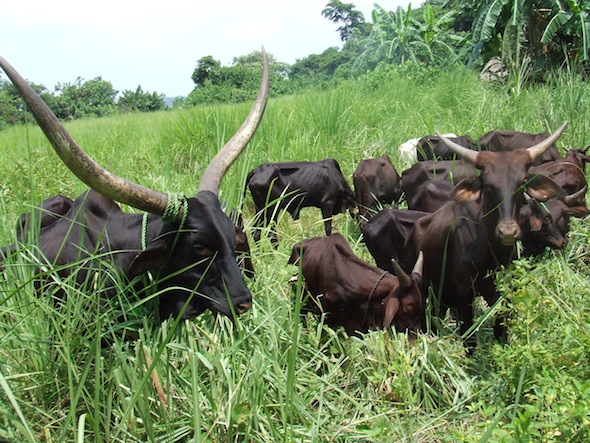
Domesticated livestock are rapidly replacing the local fauna (above, Bili, below, Road to Buta)
6 cattle road to buta

7 male chimp gangu forest

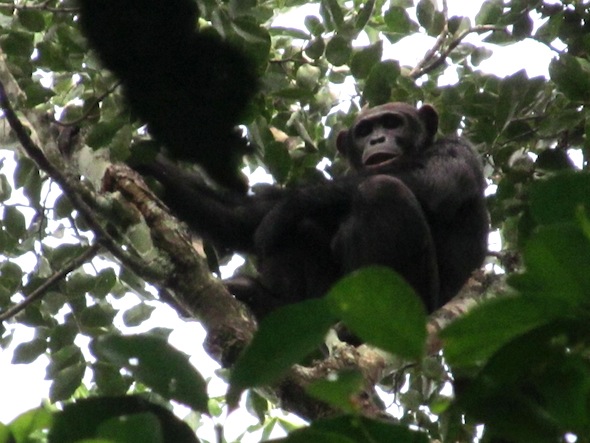
A majestic adult male chimpanzee in the Gangu Forest (photo © Ephrem Mpaka of Lukuru Wildlife Research Foundation). How can we keep him and his kind from ending up in the bushmeat markets? It may soon be too late for Gangu’s elephants (adult and juvenile mandibles found at a hunting camp).

Along the Bushmeat Highway: Part 1
Along the Bushmeat Highway: Part 2
Along the Bushmeat Highway: Part 3

This mission was made possible by the generous support of the Max Planck institute for Evolutionary Anthropology, The Lukuru Wildlife Research Foundation, The US Fish and Wildlife Service, l’ Institut Congolais pour la Conservation de la Nature, The Lucie Burgers Foundation, and The African Wildife Foundation.


Filed Under: Advocacy, Free-living chimps Tagged With: advocacy, animal protection, animal rescue, animal rights, Animal Welfare, bili, bushmeat, chimpanzee, chimpanzee sanctuary, Chimpanzee Sanctuary Northwest, dr. cleve hicks, FARDC, free-living chimps, lukuru wildlife research foundation, primate protection, primate rescue, wild chimps

Take Action Tuesday: Split-listing may be removed!

June 11, 2013 by Debbie

EOA take action tuesday

This morning the US Fish and Wildlife Service (FWS)  announced that they are proposing to remove the split listing between captive and free-living chimpanzees, making ALL chimpanzees endangered. This potentially will have a major influence on how chimpanzees are treated in this country. It will certainly have an impact on invasive research and most likely entertainment as well.

Read our press release on the proposal and see this news article featuring a photo of CSNW’s resident, Jody (read her story here).

At this moment, the FWS  has only made a proposal and this does not guarantee that it will be passed.  The FWS is currently accepting public comment, so we need your help! Please leave a comment here to express your thoughts on this issue. Let them know that chimpanzees should be regarded as an endangered species and that the hundreds of chimps still in labs and entertainment truly deserve to be in sanctuaries. Spread the word!


Filed Under: Advocacy, Apes in Entertainment, Chimpanzees in Biomedical Research, Free-living chimps, Sanctuary Tagged With: advocacy, animal protection, animal rescue, animal rights, Animal Welfare, chimpanzee, chimpanzee rescue, chimpanzee retirement, chimpanzee sanctuary, Cle Elum Seven, csnw, endangered, eyes on apes, FWS, Jody, primate protection, primate rescue, Sanctuary, split-listing, US fish and wildlife

Along the Bushmeat Highway: Part 3

May 26, 2013 by Debbie

This is the third installment of a series of posts from Dr. Cleve Hicks. Cleve did his PhD research in the DRC studying chimps in the Bili Forest. Read Part 1 of this story and Part 2 first! (To add some context to the story, look at the map of the “Bushmeat Highway” here).

—

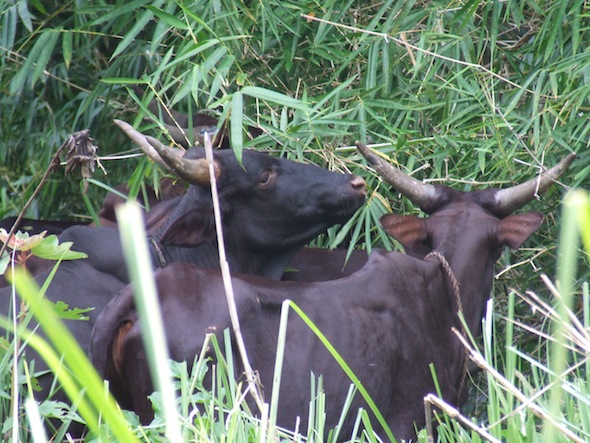
Our stay in Titule was prolonged an extra day due to an illness suffered by one of our Ecoguards. Fortunately we were able to sleep at the house of my old friend Chief Mangay of Lebo. Upon departing from Titule, we veered north towards Bili, crossing the mighty Uele River on pirogues. Villagers on the south bank of the Uele proudly showed us a large eagle they had captured from its nest. On the north bank of the river, we left behind the continuous cover of forest to the south and entered into savannah / forest mosaic territory. This road was, as it had been in 2006, much less heavily trafficked than the roads to the south of the Uele. Not only did we see no monkey or duiker carcasses or monkey orphans, but just to the north of the Uele we got of first glimpse of free-living monkeys in the trees above the road: a black and white colobus and a bit further along a tree-full of chittering red-tailed guenons. Lukuru researchers Ephrem Mpaka and Gilbert Paluku had noticed the same pattern (no monkey or duiker meat) on their trip from Buta to Bili two days earlier. This was encouraging, but there were also signs that times and circumstances were changing. In the north bank riverside town of Lisala, as we stopped to snack on binyes (simple concoctions of flour, sugar, and palm oil), we were confronted with a bustling herd of long-horned cattle, about 15 in number, munching on bamboo and riverside herbs. They were being herded by local Congolese, whom we were told had recently bought them from Mbororo herders to the north. We watched the bovines munch their way through the roadside forest and the lush vegetation lining the Uele River. Are these cattle destined to replace the abundant hippopotamuses that forage under the cover of night along the river’s edge?

MbororCattleUele

A large herd of cattle purchased by local Congolese from Mbororo herders, on the north bank of the Uele River, Lisala.

CattleEatBambo

Cattle feasting on bamboo at the forest edge.

Further to the north, in the shadow of a collapsed bridge across the Api River, we were told by a local man that Mbororo herders were massed just 30 km away from us, with tens of thousands of cattle ready to sweep across the savannahs. In their wake, he claimed, sometimes travelled child soldiers of the dreaded Lord’s Resistance Army (although according to him, the two groups were not friends). Later, as we travelled north, we would hear from a number of Azande that the Mbororo would frequently raid their fields for crops, leading to pitched battles. Such observations reinforced my impression of an inherent contradiction in the policy of the authorities of Northern DRC. Government officials were both sending military to confront Mbororo herders but at the same time buying cattle from them. Where this will lead is impossible to say.

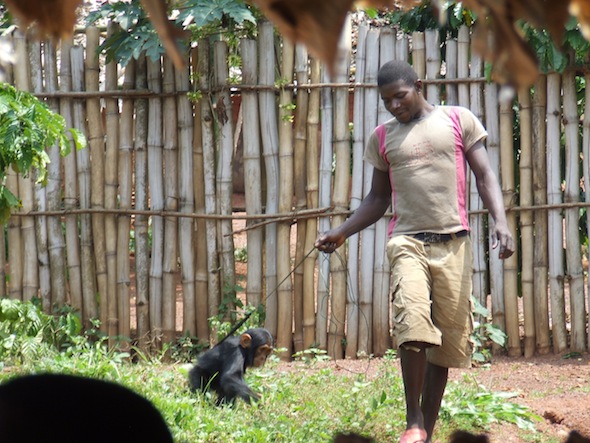
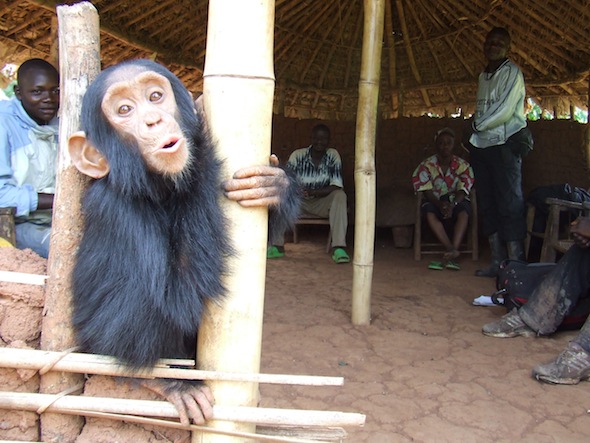
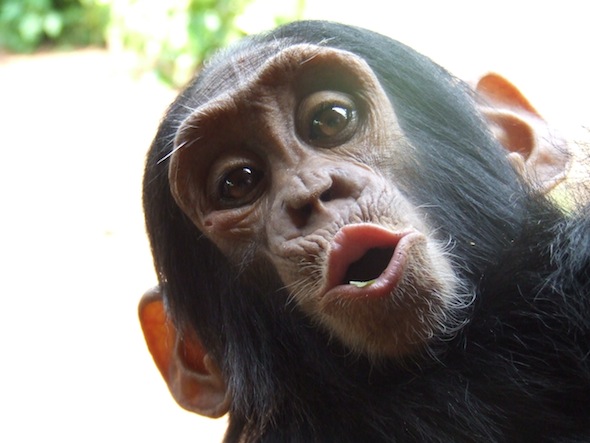
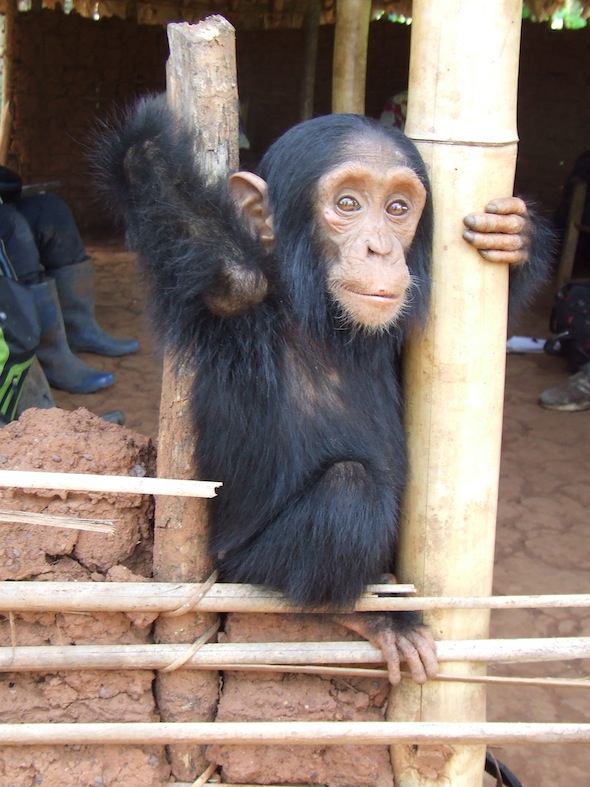
Sadly, although commerce in monkeys and duikers seemed to be much less common in this region, as was the case at Bili 5 years ago, we did hear the distressing news that the traditional chief of Lisala was keeping an orphan chimpanzee at his house about 1 km north of the Uele River. In the past, we had received a number of reports of orphan chimpanzees having been captured from this narrow belt along the north bank of the Uele River. Henri and I paid the chief a visit. Henri carefully explained the ICCN mission and asked the chief if we could see the orphan. He sent someone up to his house, and in a few minutes we heard a shrill, near-human scream. Shortly after, we watched as a tiny infant chimpanzee was dragged down to the paillote on a leash. I readied my camera and began taking photos as the orphan was placed onto a bamboo pole beneath the chief’s paillote.

On my previous mission south of the Uele River I had looked into the desperate eyes of over 35 orphan chimpanzees, but one never really gets used to the shock of it—the unimaginable sense of loss and helplessness registered in those haunted, searching brown eyes. Although in the past we had been able to save a number of the orphans we had encountered on our travels, today there was nothing I could do for Lisala, only photograph him as he raised his eyes skyward and emitted a plaintive pant-hoot to which he will never hear a response.

Henri got the story of Lisala’s capture from the chief: about two months ago, in the forest about a two hours’ walk east from the town, a group of local bow-hunters came across a party of chimpanzees. According to the chief, the apes fled in terror, abandoning the baby for the hunters to capture. This is often the story given, but I find it extremely unlikely that a mother chimpanzee would desert her baby. Far more likely, she was shot for bushmeat, which the chief would not want to admit to the ICCN. Indeed, Lisala had a vivid red bruise on his right brow ridge, possibly acquired when he tumbled out of the trees clutching onto his dying mother.

LisalaOrphan1

LisalaOrphan2

LisalaOrphan3

Lisala the orphan chimpanzee, kept by a traditional chief just north of the Uele River.

The hunters presented the baby as a gift to the chief. Now the chief wanted cigarettes and / or money from us for the privilege of seeing his baby chimpanzee. We politely deferred, of course, and went into our standard speech about the danger of keeping chimpanzees as a pets, and the damage that such a practice inflicts on populations of free-living apes. As we left his parcel, the chief called out after us in Lingala as a parting shot: ‘Ezali mabe te – ey ko batela mboka ya mokondji!’ (It isn’t a bad thing – he will guard the chief’s village!’).

As we sped northwards on our motorbikes, I was left with a heavy heart. There are only a limited number of times that this tragic situation can repeat itself before the African forests will be emptied of our closest evolutionary cousins. We have little time left to come up with a solution.

LisalaOrphan4

What can we do to keep this tragedy from repeating itself over and over again?

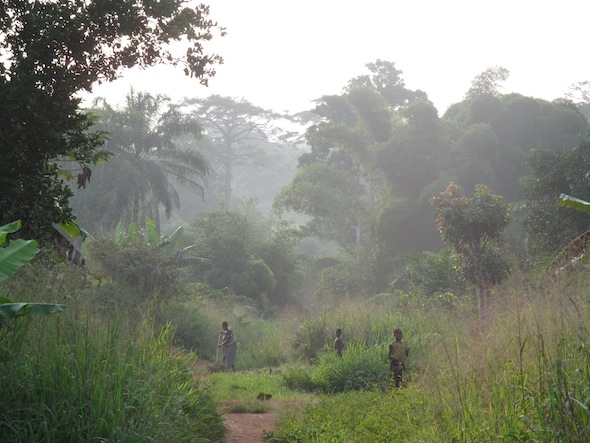
A few hours and a couple of motorbike breakdowns later, near sunset, we crossed into the hinterlands of Bili, 12 km south of the town center. We stopped to stretch our sore backs and munch on some soft pink peanuts offered us by a friendly villager. A tiny and rather brazen kitten approached us and made fast friends with Karsten. We wondered what awaited us in the frontier town just over the horizon. The last time I set foot in Bili was over five years ago. Although at that time bushmeat was certainly consumed locally, there was little evidence that, with the exception of ivory, it had become linked to the commercial trade networks proliferating rapidly to the south. But will the situation remain the same in 2012? We shall see…

BiliWoman

The outskirts of Bili at sunset.

Along the Bushmeat Highway: Part 1
Along the Bushmeat Highway: Part 2

Also by Dr. Cleve Hicks, The FARDC ‘Petting Zoo’ at Bili

This mission was made possible by the generous support of the Max Planck institute for Evolutionary Anthropology, The Lukuru Wildlife Research Foundation, The US Fish and Wildlife Service, l’ Institut Congolais pour la Conservation de la Nature, The Lucie Burgers Foundation, and The African Wildife Foundation.

Filed Under: Advocacy, Free-living chimps Tagged With: advocacy, animal protection, animal rescue, animal rights, Animal Welfare, bushmeat, bushmeat orphans, chimpanzee, Chimpanzee Sanctuary Northwest, dr. cleve hicks, eyes on apes, free-living chimps, primate protection

  • « Go to Previous Page
  • Page 1
  • Interim pages omitted …
  • Page 49
  • Page 50
  • Page 51
  • Page 52
  • Page 53
  • Interim pages omitted …
  • Page 81
  • Go to Next Page »

Primary Sidebar

Subscribe To the Blog and Get Notified of New Posts First!

Archives

Calendar of Blog Posts

June 2026
S M T W T F S
 123456
78910111213
14151617181920
21222324252627
282930  
« May    

Categories

SUBSCRIBE TO OUR NEWSLETTER

Footer

PO Box 952
Cle Elum, WA 98922
[email protected]
509-699-0728
501c3 registered charity
EIN: 68-0552915

Official DDAF Grantee

Menu

  • The Chimpanzees
  • Blog
  • About Us
  • You can help
  • Resources
  • Contact
  • Donate

Proud Member of

Connect With Us

Search

Copyright © 2026 Chimpanzee Sanctuary Northwest. All Rights Reserved. Site by Vegan Web Design