Missy is Annie’s best friend, but she is more dominant on the chimp hierarchy. Today she took Annie’s place in a huge paper nest Annie built (called “displacement”), but Annie didn’t get upset—instead, she started to play.
animal rights
Stability
We often mention on the blog the changes that we observe in the chimpanzees and how we’ve seen them grow over the past five and a half years. There’s no doubt that they are still coming into their own, after living the majority of their lives in lab cages and having no control over their choices and no ability to predict what could happen next.
One of the tragic things about captivity is that the chimps are entirely dependent on us caregivers—we provide food, blankets, enrichment, and we shift the doors between their enclosures. For this reason, it is very important to have a routine so that the chimpanzees can have expectations, and can make decisions based on what they know will happen next. This is what is truly the epitome of being in a sanctuary.
Through these choices, we really see the chimpanzees develop their idiosyncratic likes and dislikes, and we see them grow and change over time. Foxie used to only want to play with trolls, and then some time ago she expanded to nurturing Dora dolls (though she still loves trolls). Jamie has a extreme love for boots, but recently it’s been more fashion boots that she prefers over cowgirl boots (her old favorite). Missy loves socks and slinkys, Burrito loves to have wooden toys to bite on, Annie loves to rub water on her face, Jody likes edible flowers and soapy bubbles, and Negra likes peanuts and nesting.
Having choices has allowed the chimps to relax, enjoy the sunshine, friends, good food, and space to run—and that has made them so much healthier and stronger than they ever were in the lab. See for yourself, check out the before and after photos of each of the chimps on their story pages here.
Although we see so many wonderful changes in the chimpanzees due to all the choice they have now, there are some things that never change. I was looking back through some old blog posts from this time in 2008, before the chimpanzees arrived. Diana’s first impressions of the chimps were spot-on and still six years later, they enjoy the same things she predicted they would when they came to CSNW. She talked about Jamie and choices, Negra and nesting, and Missy and Annie’s close friendship and their desire to play, play, play. These are things that the chimpanzees love to do everyday, but unlike in the lab, they are able to fully appreciate and express their preferences.
Today, the enrichment theme was “grooming day.” Jamie had lots of enrichment to choose from. Boots, scarves, emery boards, scrub brushes, trolls, pillows, blankets, paper, and even a toothbrush. Out of all of that, she chose to make a big nest out of a tube of exam table paper. (Thanks, Carol!)
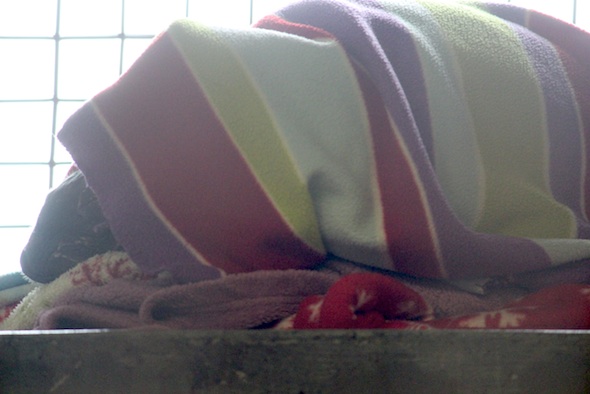
Negra cuddled in a giant nest:
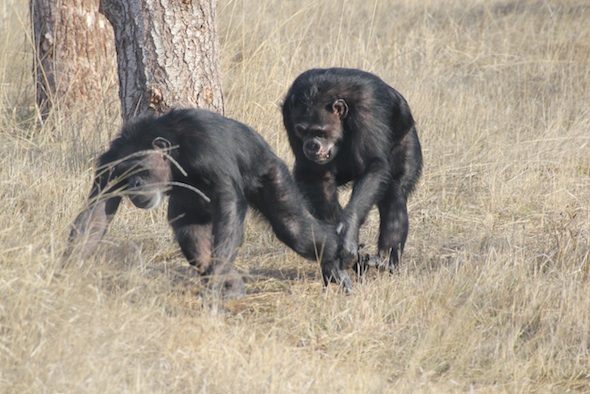
Missy and Annie:
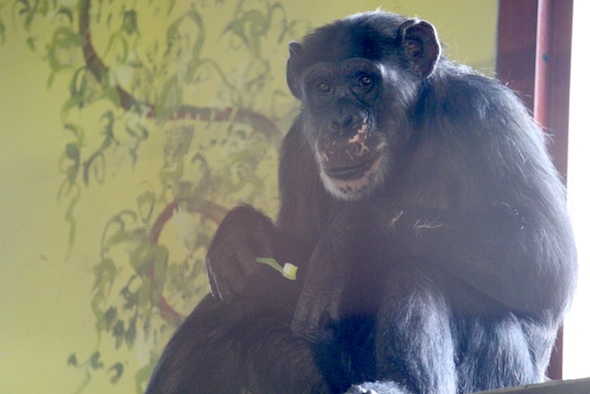
And just for fun, Missy’s enrichment item of choice on grooming day:
I so look forward to the changes that are to come and see how the Cle Elum Seven will continue to flourish in sanctuary , but I know I can still count on some stability in the foundation of what they each love, and will continue to enjoy more and more for the rest of their lives.
No such thing as an easy project in Jamie’s eyes
Jamie likes projects. If you’ve been following us for awhile, you’ve probably heard us say something along the lines of “she’s always keeping busy.” It’s so true! Her mind is always working out some puzzle, I think even when she’s napping she’s still getting a plan together about what to do when she gets up!
The other day she and I were going through her boots and she pointed toward this high-heeled zippered boot. I took it to the chute where I could give it to her, but she didn’t move. I came back over to where she was and she gestured like she just wanted to groom it. I wore it for her while she picked at it, and then I took it off and let her hold it against the caging and groom at her leisure.
Very quickly she started to unzip it. At any time I could have tried to give it to her through the chute, but I think she preferred to work on it the hard way—through the caging.
Margot
This post is by a new guest blogger, Gwendy Reyes-Illg. She is an emergency veterinarian in Loveland, Colorado and serves on the Leadership Council of the Humane Society Veterinary Medical Association. She has visited and volunteered her services to several primate sanctuaries in the United States and Africa. Currently Dr. Reyes-Illg is pursuing a master’s degree in Animal and Environmental Ethics at Colorado State University. In a few years, she plans to relocate permanently to Africa to help primate sanctuaries and their surrounding communities. We asked her a few questions about her work—the first of which are answered here, and the rest will be in a follow-up post soon. WARNING: one possibly disturbing image is included in this entry as a link in the text.
—
How long have you been working in the field, and how did you get started there? What do you find most rewarding about working with chimpanzees and gorillas?
I’ve been working with apes for the past 13 years. As a college student, I took a semester off to intern at the Center for Great Apes in Wauchula, FL, a sanctuary for chimpanzees and orangutans rescued or retired from the entertainment and pets trades. I have loved animals and advocated for them for as long as I can remember—by age 10, I was an ethical vegetarian—so my heart was already set on spending my life working with and for animals.
A documentary about Jane Goodall, along with the book The Great Ape Project, inspired me to focus on apes. Fascinating creatures in their own right, apes also serve as a natural “bridge” for extending moral consideration beyond our own species. In veterinary school, I always tried to imagine how I could adapt what I was learning to primate sanctuaries, especially those in remote areas with limited resources.
Now, as a veterinarian, what is most rewarding for me is the moments of connection that I have with individual primates. After an anesthetic procedure, I often sit with the patient while he or she wakes up to make sure they are recovering well. This is a quiet time where they are away from their group. Even chimpanzees who are normally pretty shy with humans will come out of their shell a bit, and reach out a hand to be held. Given how strong and intimidating chimpanzees can be when emotionally aroused, I am always amazed at the gentleness with which many of them groom and touch.
Tell us about an individual ape personally affected by human encroachment, and how you were involved in their recovery.
Unlike most apes in North American sanctuaries, almost all the chimpanzees and gorillas in African sanctuaries were born in the wild. They were taken from the forest when the mothers they were clinging to were killed so their bodies could be sold as “bushmeat.” Though ape meat is illegal, it can be sold at a high price because, for some, consuming it is a status symbol. Even some restaurants in Europe and North America have been caught serving ape meat.
Infants’ small size means that they fetch a higher price when sold alive, as “pets” or tourist attractions. After the horrors of being torn from their mothers, many infants die of their wounds, neglect, or illnesses they contract from their captors. The survivors are often tied by the waist or chained by the neck in private homes or hotels. The rare lucky survivors wind up in one of dozens of sanctuaries throughout Africa after being confiscated by authorities or surrendered by people who have purchased them.
Margot, a four-year-old “little girl,” is one chimpanzee I got to know especially well during my last time in Africa. She was confiscated from a poacher in 2011 and arrived at the Sanaga-Yong Chimpanzee Rescue Center with several shotgun wounds to her face—probably from the same gun that killed her mother. As a result, she had a broken jaw, as well as a hole in the roof of her mouth (palate) that connected to her nose. While most of her wounds healed soon after her arrival, the hole in her palate proved very difficult to surgically repair. Both a human surgeon and a veterinarian attempted to close the hole, but two surgeries later, it was still there, and Margot was frequently developing respiratory infections from aspiration.

Before my last volunteer trip, the sanctuary director and I consulted with several maxillofacial surgeons to develop a new surgical plan and get the special supplies I would need for what we hoped would be Margot’s final surgery. Margot was gently anesthetized and carefully monitored and tended to by Nicholas, the Cameroonian veterinary technician, while I performed the surgery. Afterward, she had to eat an all liquid diet and take several different medications to prevent pain and infection. We were worried Margot or one of the other chimpanzees in her group might pull out the stitches before the repair had healed so, instead of going out into the forest everyday with the others, Margot had to stay inside with a caregiver for two weeks. She was not happy about this!
Despite the disruption of her routine and missing her chimpanzee friends, Margot was a very good patient. Every day or two, I visited her, played for a bit and tried to get a peek at how the repair was holding up. Margot was so gentle and tolerant, even with everything she was going through—and all she had survived in her short life. At last check, it looks like the surgery has been a success! The hole was finally closed. Margot will have another check-up soon, to make sure everything is continuing to heal well.

Zen Sand Garden
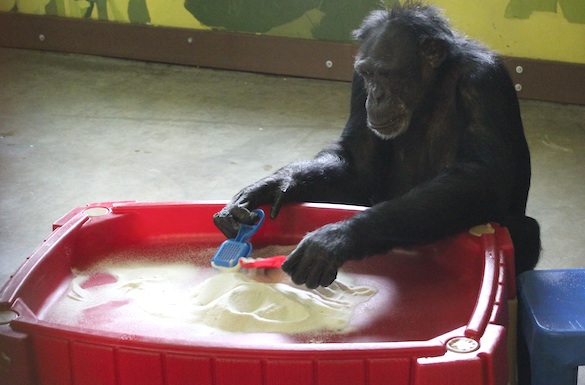
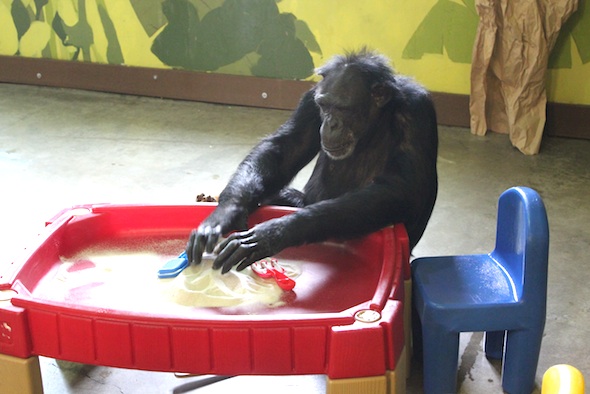
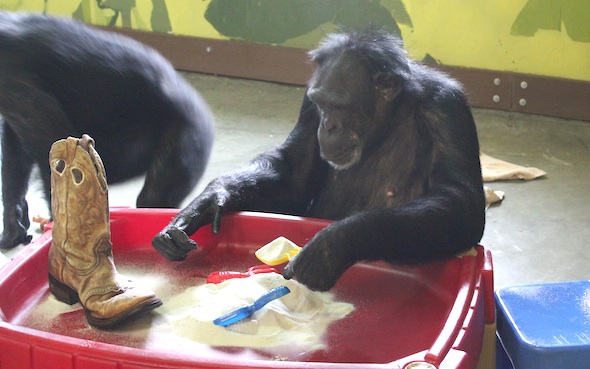
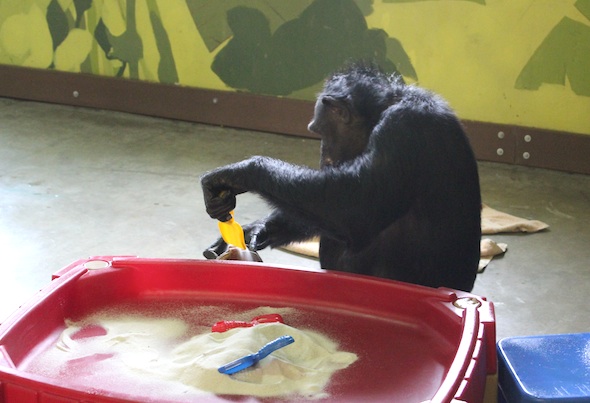
Supporter Michelle C. recently sent the chimpanzees a very unique gift – a piece of the Florida beach along with some little shovels. Today we set up the gift from afar in the sandbox table.
Looking at the set up reminded me of those zen sand gardens that are sold to business executives. This one, of course, catered to Jamie (note the boot).
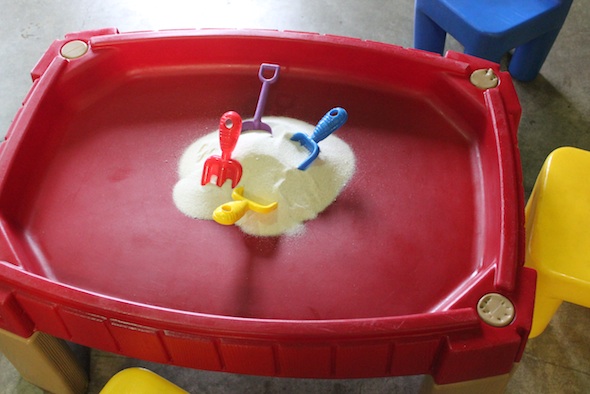
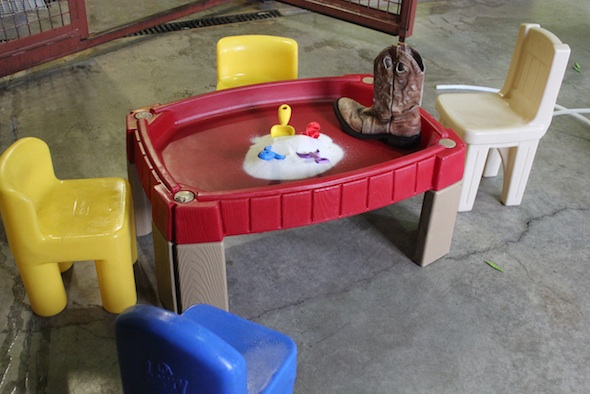
There’s a video in the middle of this post of Jamie truly looking pretty zen as she played in the sand. The other chimps weren’t sure what to make of the stuff. They’ve had sand before (one of my favorite memories is Jody laying in the sandbox in the greenhouse on “Spa Day” ). But the chimps had probably never encountered the soft white sand of the Florida beaches.
Jody and Foxie getting a closer look:
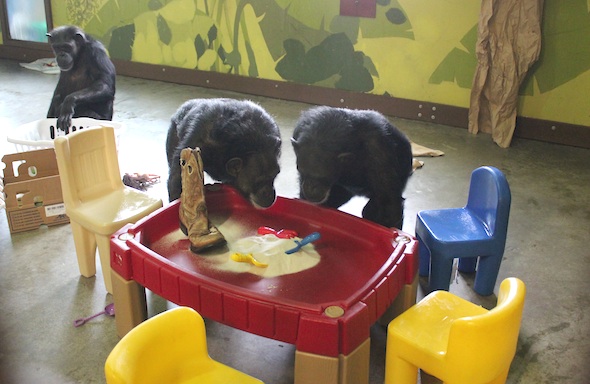
Annie joining the inspection:
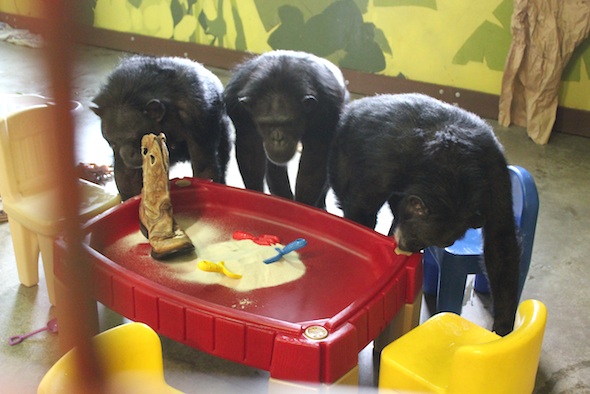
Jody digging in:
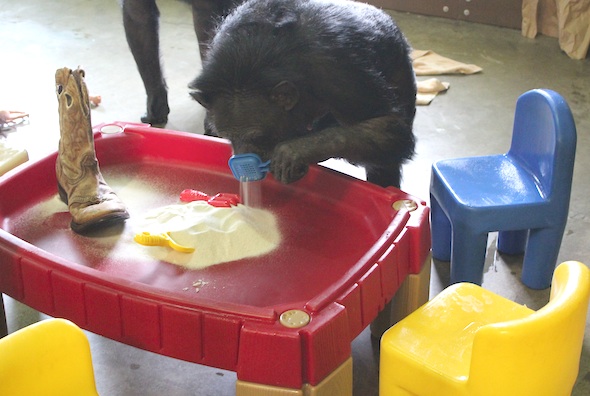
And Jamie getting zen:
Missy and Annie play wrestle
Are you sick of seeing Missy and Annie play? I didn’t think so! These two are always wrestling and having a good time. Here’s a video that is bound to brighten your Tuesday afternoon:
Foxie with tiny trolls
It seems Foxie has been the center of our blog posts lately, but that might be because no matter what she is doing she is bright, playful, funny, and can bring a smile to all of our faces. You’ll see what I mean while watching this video: