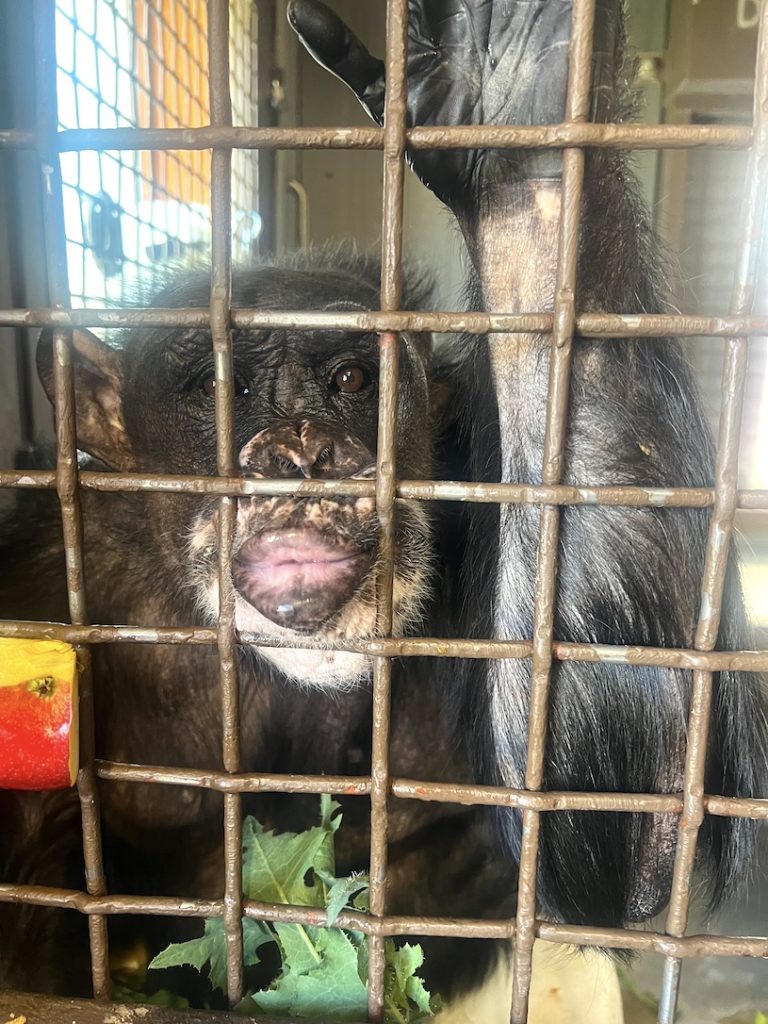
We’ve all been thinking a lot about Negra lately. You too, I know. Her ups and downs with her health and mobility have mostly been gentle waves. Some days, some moments, better than others. Dr. Erin created a new daily welfare assessment form that can capture more subtle and nuanced changes with plenty of room for writing down observations. On this assessment, the staff that day make note of her mobility, which remains her primary concern, as well as continence, gastrointestinal monitoring including periodic sampling for any signs of internal bleeding (so much of care comes down to poop, doesn’t it?), appetite and eating, what we offer for hydrating foods, social interactions with both humans and other chimpanzees, respiratory rate, and any other observations of the day. She’s still socializing with at least one, and more often two or three friends a day, climbing to the top of her beloved greenhouse structure, and occasionally weighing in on the drama from the other group in her classic “you kids quiet down over there” manner. She’s still our Queen Negra.
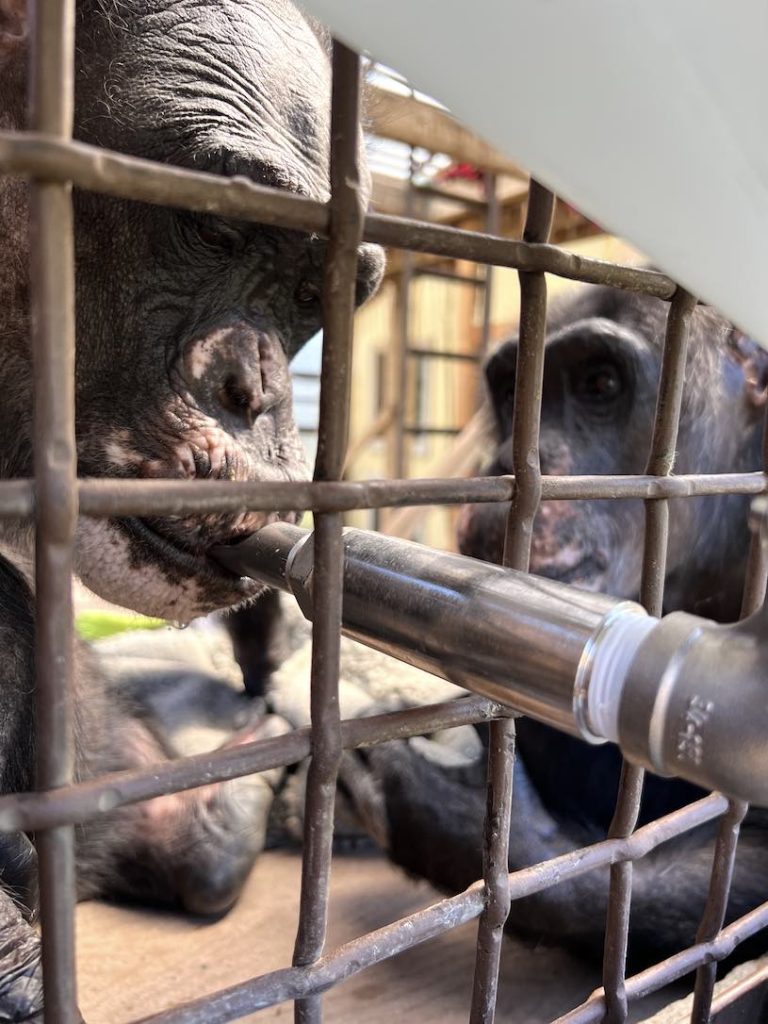
We’ve rigged up a portable watering spigot so she can access water while lounging on the deck of the greenhouse, and it’s become a popular device for all of the chimps.
Something I’ve been contemplating lately is what Negra remembers of her past. Not of the trauma she experienced in the lab–having her children taken away, being isolated, and living in a basement holding facility–but of her very early years. What were her very first memories?
We don’t know how old she was when she was captured in Africa. It’s not even possible for me to fathom that actually happened, to be honest. Perhaps it’s because I’ve always lived so far from that world of wildlife trafficking, knowing some of the results of the exploitative process, sheltered from the process itself. When Negra was captured, whether that was in 1973 as our records indicate, or as early as 1969 as other records seem to show, it was not an uncommon occurrence. There was a demand for chimpanzees for the space program in the United States and a supply of wild chimpanzees living across the world to fill that demand.
However old she was, Negra was born a wild chimpanzee. Did she know her mother? Her siblings? Did she spend enough time in her native land to learn about the best plants to harvest and where to find the ripest figs? Did she learn to nest high in the trees by watching her family make their beds? Did she learn how to fish for ants or termites?
That last question is what I was wondering while I watched her expertly use a chopstick to extract peanut butter from a PVC tube. It’s not the same, yet the elements are all there.
Was she thinking of Africa?
Thanks goes to Katelyn and Erin for the photos in this post. The feature image, taken by Katelyn, is Negra enjoying some chives and roses while lounging in the greenhouse.