When I tell people that I work at a chimpanzee sanctuary, they usually respond with one of the following frequently-asked questions: Do you get to touch the chimps? Do they go outside? Can people visit the sanctuary?
Today’s blog post responds to another common question with a complex answer: Are the chimps trained?
If this question refers to the awful practice of coercing captive primates to perform tasks for our entertainment, then the answer is a plain and emphatic “no.” (“We don’t do that here.”)
When defined more broadly though, behavioral training can be an important practice for improving and maintaining excellent animal welfare. For example, chimpanzees can be taught to voluntarily cooperate in their own veterinary care, greatly reducing the stress and risk associated with medical procedures. Training can also be a powerful tool for improving human-chimpanzee relationships, desensitizing chimps to unfamiliar environmental changes, and providing the chimps with additional cognitive, social and sensory enrichment.
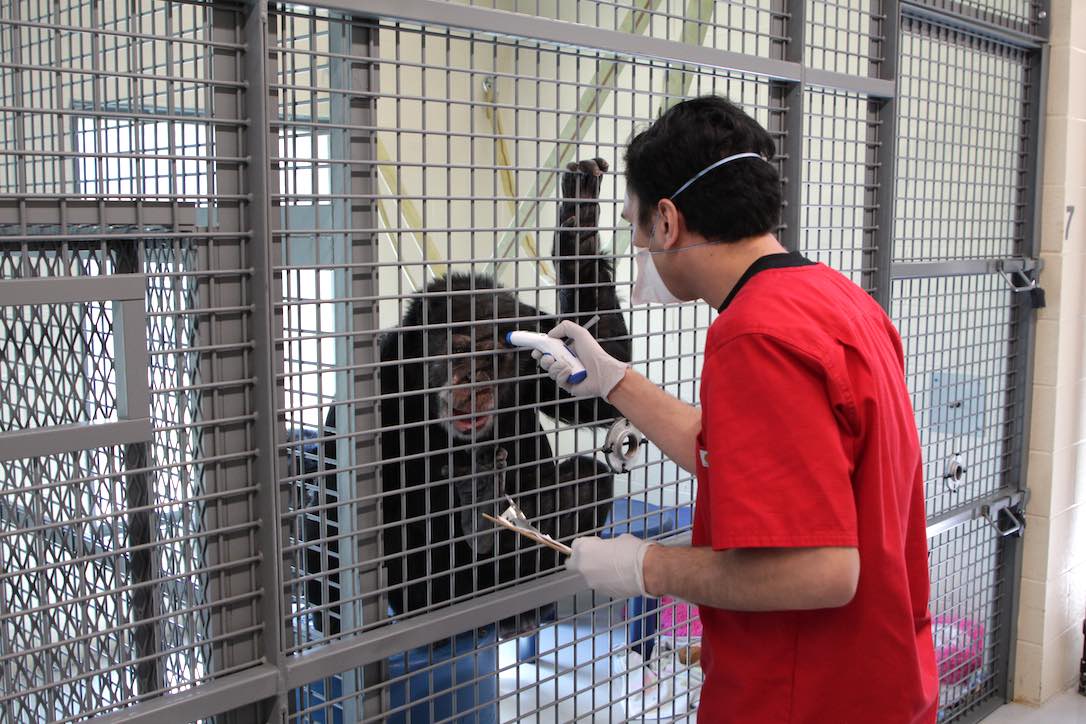
CSNW, like many institutions that care for chimpanzees, has adapted a behavioral training program to improve the lives of the residents. Our past training initiatives have helped us administer medical care and monitor chimpanzee wellness over the years. We are now revamping this framework to utilize a larger staff, accommodate an additional group of chimps, and target loftier goals. Last year, we invited Margaret Whittaker of Creative Animal Behavior Solutions to review training methodology and help us optimize our plans for the future. One key takeaway has been that progress requires a shared understanding of the underlying theory and familiarity with common techniques. We caregivers should understand what training is, value training as an important component of care, and know how to train efficiently and responsibly.
Essentially, training is the process of behavior modification through learning. We often call training between humans “teaching” and training with non-humans “conditioning,” but they’re basically synonymous. Our preferred type of training, operant conditioning, allows the chimps to voluntarily participate and choose which behaviors to present. The chimpanzees are free to come and go at their own leisure, and we never punish them for choosing not to participate. Indeed, certain individuals often decline our invitation because they have better things to do, and that’s okay. In operant conditioning, they’re the operators.
Although the semantics are complicated, the activity of operant conditioning is actually quite simple. First, the trainer uses both a verbal and gestural cue to communicate that a desired behavior will be rewarded in the subsequent window. (You can see an example of J.B. asking Burrito to present his right foot below.) Then, the trainer uses an audible “bridge” to mark the correct behavior and indicate that a treat is on the way. This edible reward is a form of motivation via positive reinforcement. In training jargon, “positive” refers to the addition of a stimulus and “reinforcement” refers to the increase in a desired behavior.
In short, we give rewards when the chimps choose to do desirable behaviors.
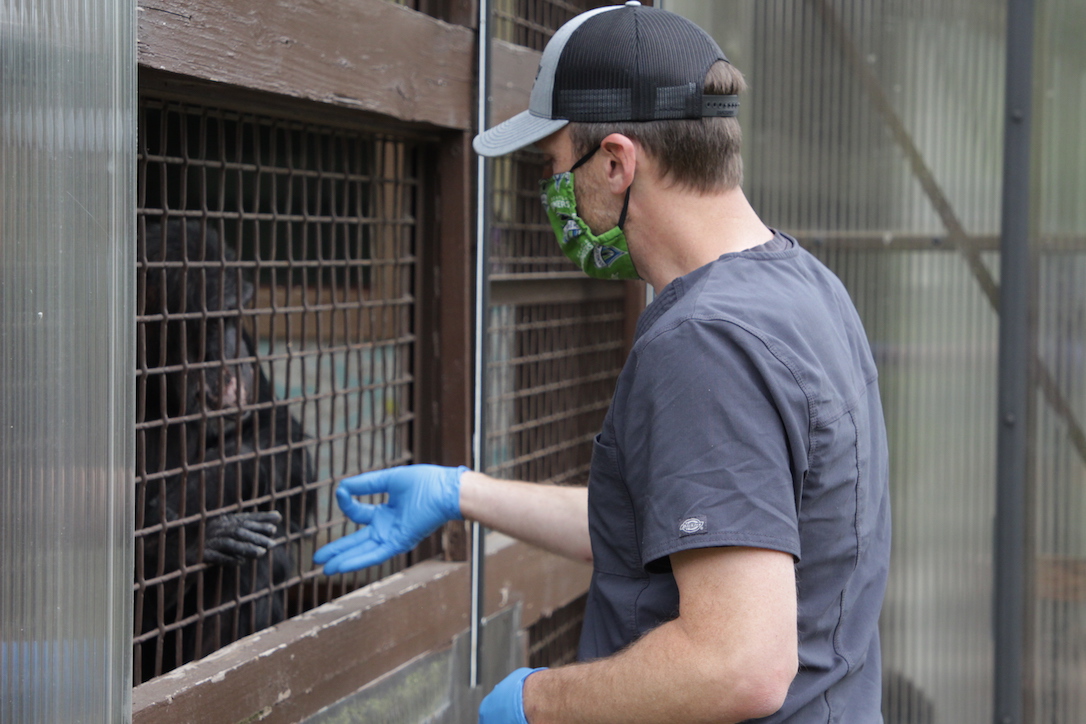
You may be wondering why we choose to modify chimpanzee behavior through training. After all, the chimps are wild creatures and we should respect their freedom to choose their own behavior. Even so, captivity is an unfortunate and complicated circumstance, unfairly chosen for them long ago, and purposeful training has the potential to make this environment more comfortable for them. Of course, we caregivers carry the responsibility to only focus our efforts on behaviors that benefit the chimps and use the least intrusive, minimally aversive methods for each.
Some examples of behaviors we train and rehearse are:
Eating cooperatively and/or at stations (allowing subordinate group members to receive food)
Presenting various body parts for injury treatment and monitoring
Receiving injections for vaccinations and sedation/immobilization
Shifting between enclosures to enable cleaning and to facilitate social integrations
Sitting on a bench scale to monitor weight and body condition
In the future, we will also prioritize desensitizing the chimps to uncomfortable but necessary medical procedures, including heart and lung auscultation, radiographs, EKGs and ultrasounds. These approaches usually require that we isolate, immobilize and anesthetize chimpanzees; winning their voluntarily participation is a safer and less stressful alternative for all involved!
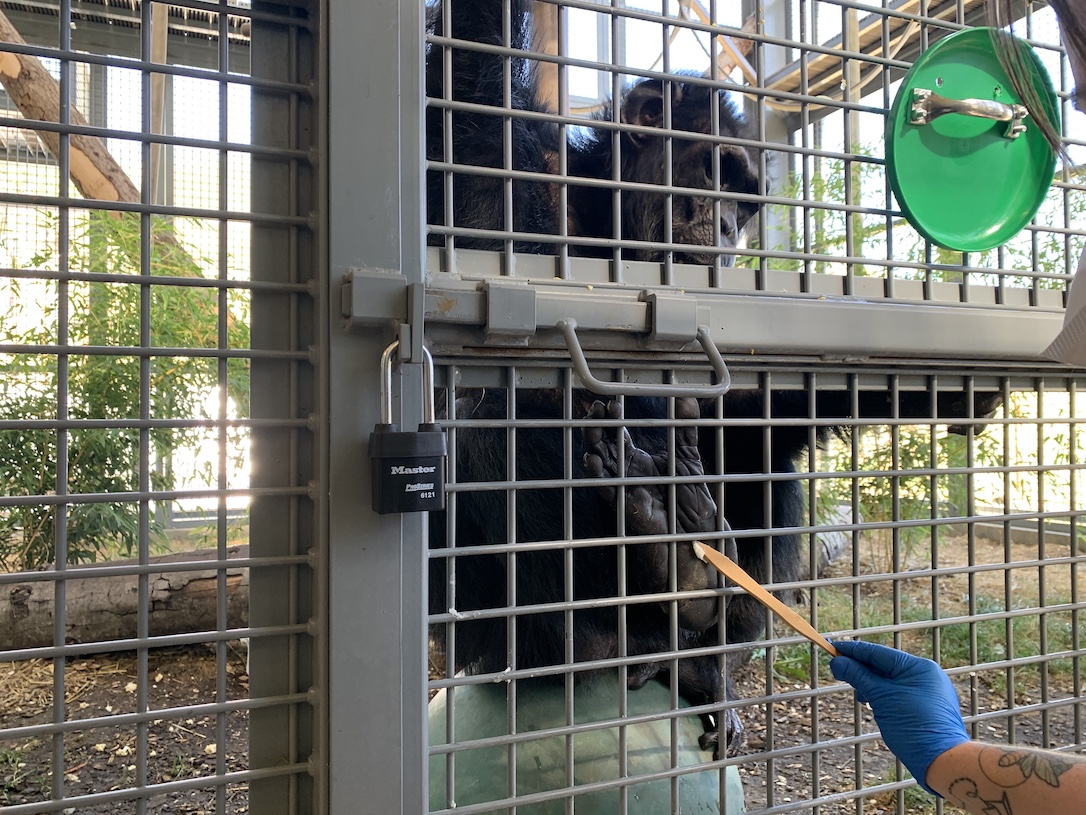
I hope to share more content related to behavioral training (including visual demonstrations of our progress) in the near future!