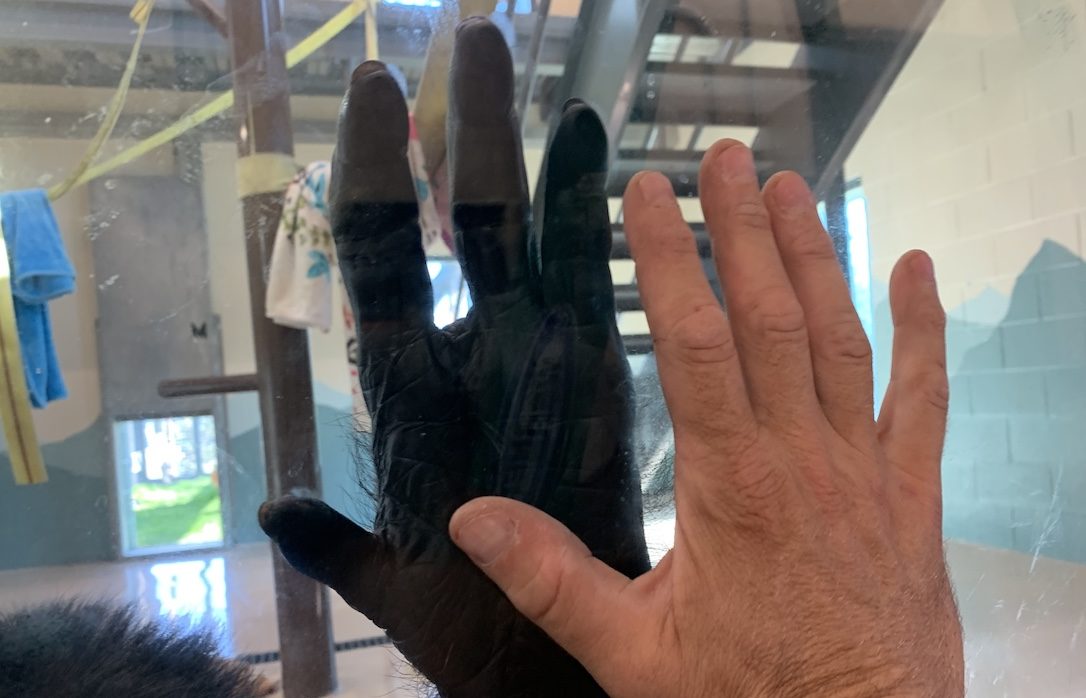
Recently, we invited you to submit your questions. Joshua wanted to know: Why does Cy have only three fingers and a thumb on his left hand?
The short answer?
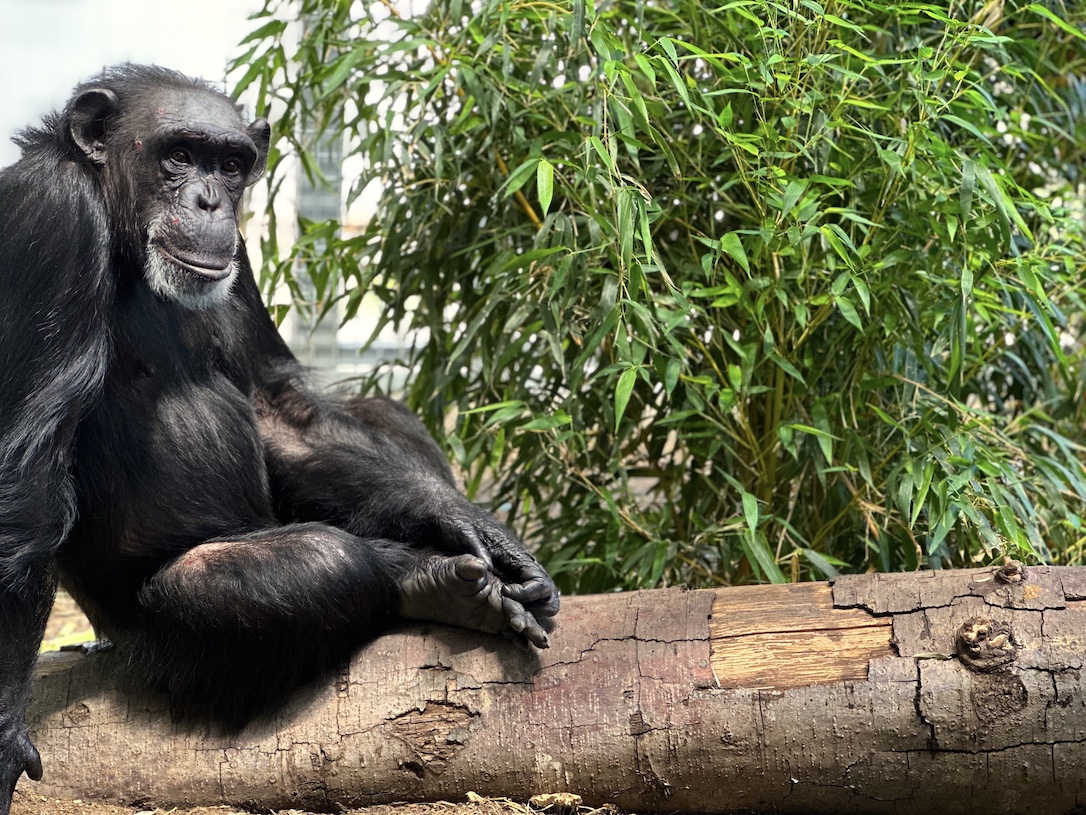
As far as we’ve been told, Rayne bit off or severely injured the third digit of Cy’s left hand at some point during their time at their previous home in California. As to why she did it (if the accusations are indeed true), we need to step back a bit.
Chimpanzees can be incredibly aggressive. And I don’t mean traumatized research chimpanzees can be aggressive or chimpanzees kept in captivity can be aggressive. I mean that natural selection has endowed all chimpanzees, to varying degrees, with a capacity for aggression and a tendency to utilize it to achieve certain ends. In other words, it’s a normal part of being a social chimpanzee—a tiny fraction of their overall behavior, to be sure, but an important one.
When discussing aggression in chimps, we typically differentiate between intergroup and intragroup aggression. Intergroup aggression, or the violence directed at chimpanzees in other communities, has the distinction of being far more lethal. These attacks, often the result of stealthy raids into neighboring communities, are understood to be part of an evolutionary strategy to guard or gain access to territory (and thus resources such as food or potential mates). Intragroup aggression, on the other hand, tends to be a way that chimpanzees—particularly late adolescent and adult males—determine rank or status within the community. Lethal aggression does occur within communities (often in the form of infanticide or the overthrow of the alpha male) but at about half the rate of that between groups.
It’s almost impossible to describe to someone who doesn’t work with chimps just how violent chimpanzee fights can be. Their strength, speed, and agility are literally superhuman. Their screams and cries are deafening. And they can be seemingly ruthless, quite often ganging up on more vulnerable chimps. While their muscular arms and legs are used to grapple and pin, their ultimate weapons of choice are their large teeth and powerful jaws, which open wide enough to accommodate most any body part of an intended victim—though they usually select ears, fingers, toes, and, in cases of more extreme violence, genitalia.
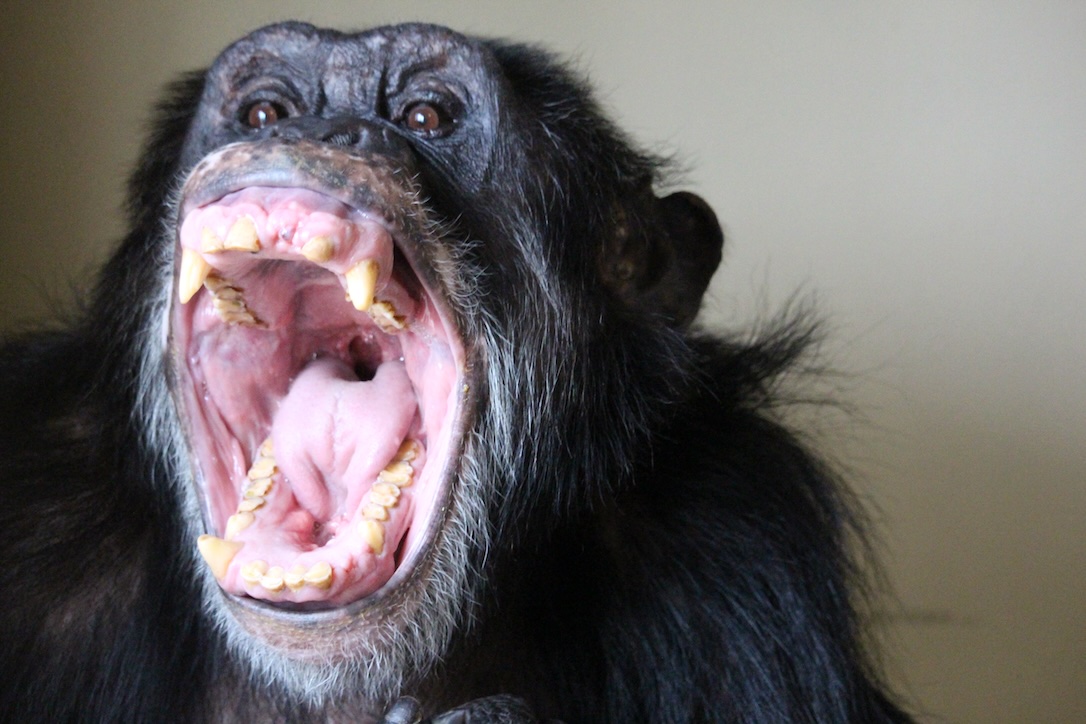
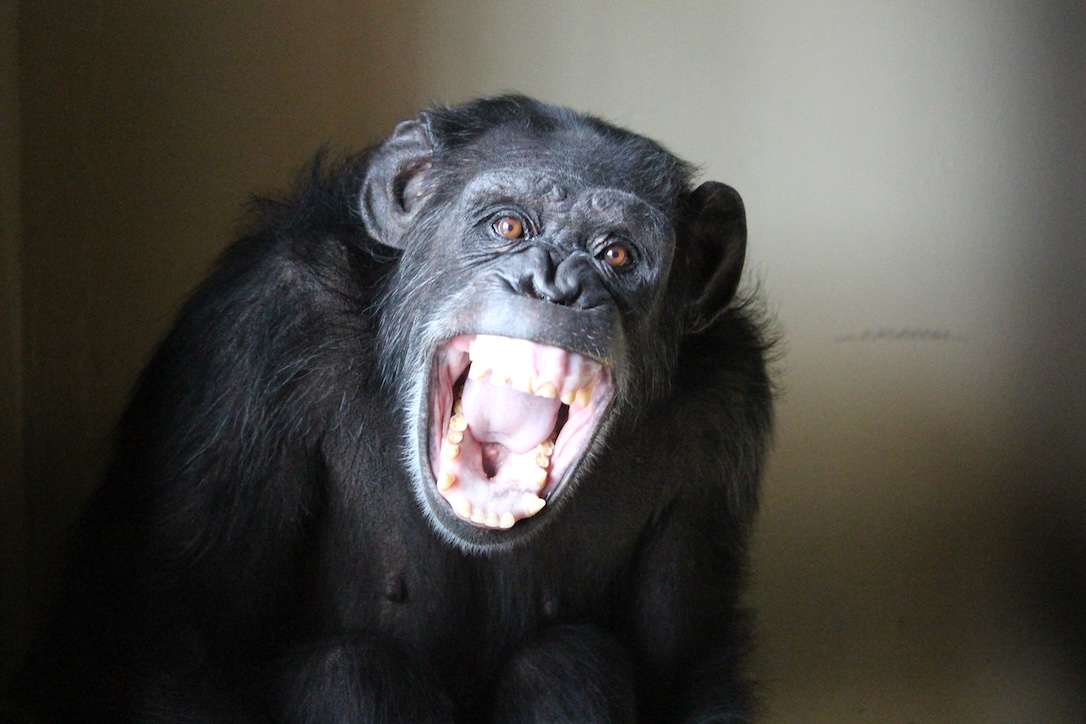
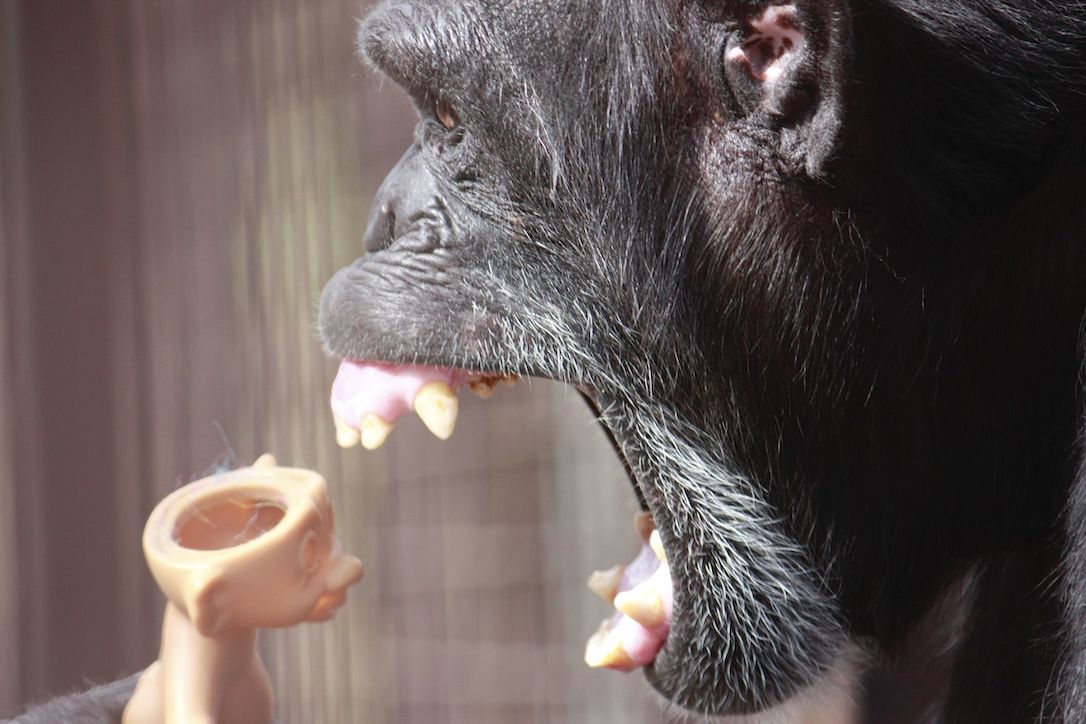
Life for captive chimpanzees is very different from that of their wild counterparts. They don’t have the same kind of territories to defend, nor do they have the potential to acquire new resources by raiding and killing. But natural selection doesn’t typically endow us with knowledge of why we behave the way we do; instead we’re simply primed to behave in ways that tended to benefit our ancestors (humans are no exception to this). And captive chimpanzees are often presented with situations that stoke those very same intergroup prejudices—most notably, during social introductions. When we are integrating groups—or even riskier, adding a single chimpanzee to an established group—we have to overcome that same hostility toward outsiders that drives wild chimpanzees to attack and kill their neighbors. And this is where we may see the most severe forms of aggression. At CSNW, it once lead to a conflict in which one participant, Honey B, had to have her toe amputated, and another, Burrito, had to be castrated due to the severity of the wound to his scrotum. Neither injury was lethal, though in Burrito’s case it was largely because of timely veterinary intervention. In a way you could say that we’re fortunate, because chimpanzees have died in similar circumstances at many accredited zoos and sanctuaries. These are the stories that don’t always make it to social media, but instead are shared by keepers and caregivers over drinks at a conference hotel bar, finding comfort in others that understand what it is like to work in this crazy field.
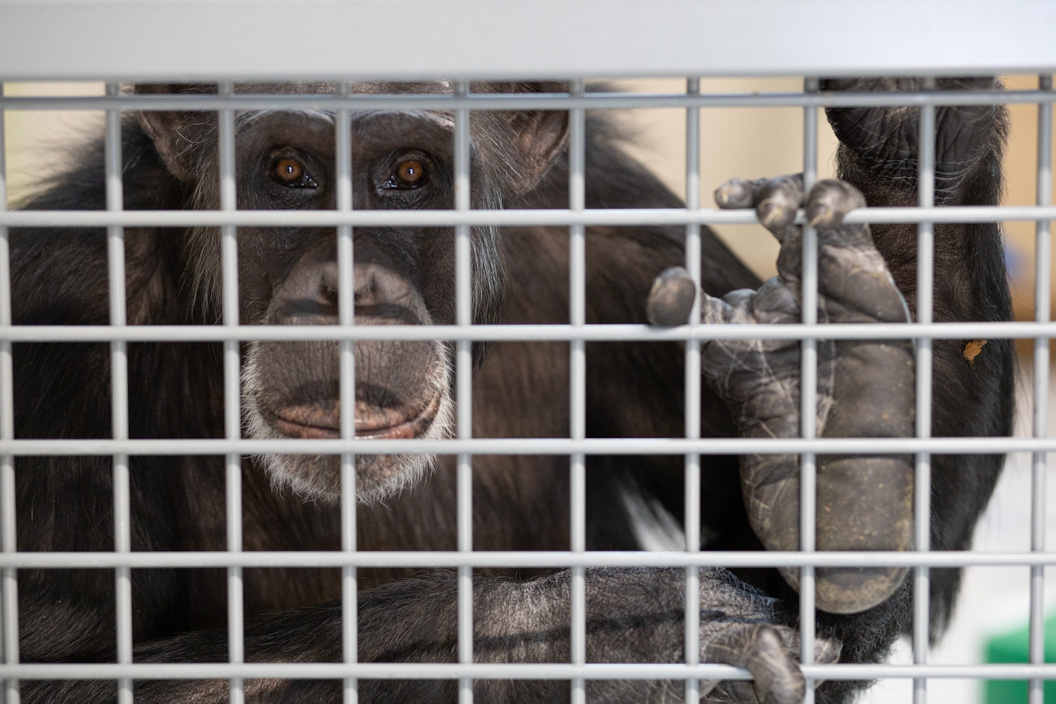
More often, we are witnessing the almost commonplace kind of aggression that serves to establish rank, form coalitions, and settle scores. Chimps, like humans, are status-seekers. Status may come with tangible benefits, but status itself is an intrinsic benefit, one that is apparently worth fighting for. Because this form of aggression serves to clarify relative dominance, we tend to see somewhat less of it in stable groups and more in groups that are newly formed, lacking a strong leader, or undergoing a leadership transition. It also appears to be more common in groups with unusual compositions (in terms of age, sex, etc.) or ones with chimps that lack social experience. Regardless, wherever there are two or more chimpanzees, there will be at least the occasional fight. One study at an accredited zoo found that their chimpanzees were wounded in fights ten times per year on average. Thankfully, along with their superhuman fighting abilities, chimps possess a superhuman ability to heal and an equally superhuman tolerance for pain.
Jamie’s group has been together for over 18 years now. You’d think that they would have achieved some level of stability after all this time. But they epitomize the problem with a lack of leadership and atypical rearing. When they arrived from the lab, we did a quick inventory of missing ears and digits: Negra was missing half an ear, Annie’s ear was torn almost in two, Burrito was missing a fingertip, Missy was missing most of a pinky, and Jody was missing toes (though at least one was said to have been severed by a guillotine cage door). Those are just the ones I can think of off the top of my head. We do the same inventory of every group that we rescue, and relatively few adult chimpanzees arrive at sanctuary with all ears and digits fully intact—unless they, like George, lived largely alone.
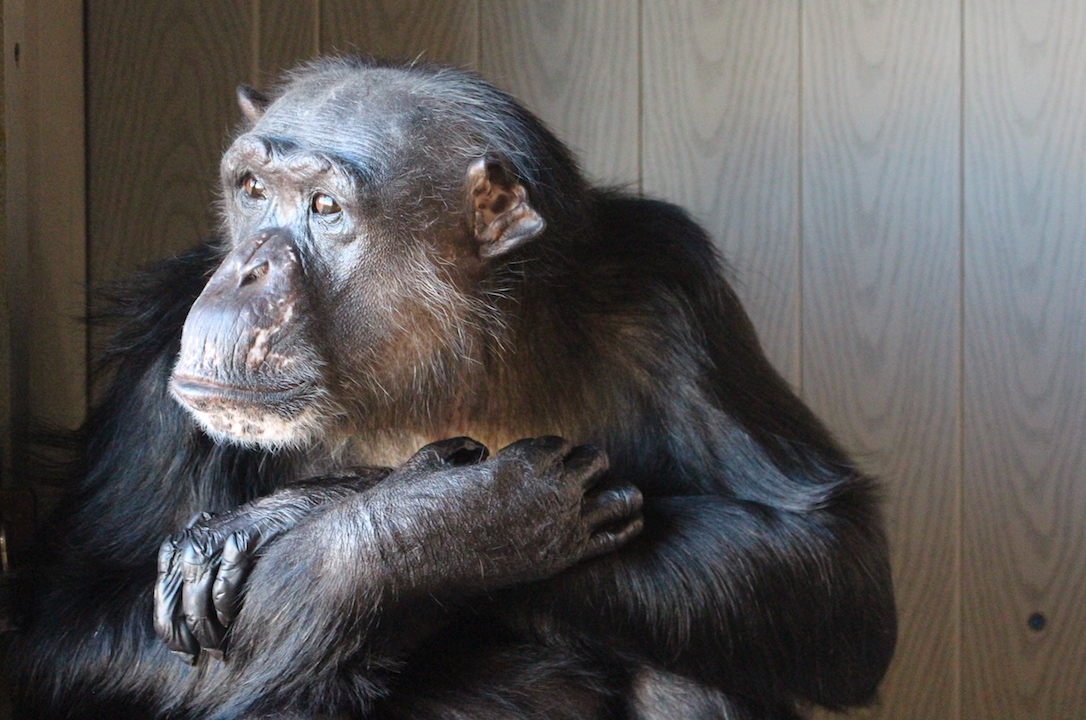
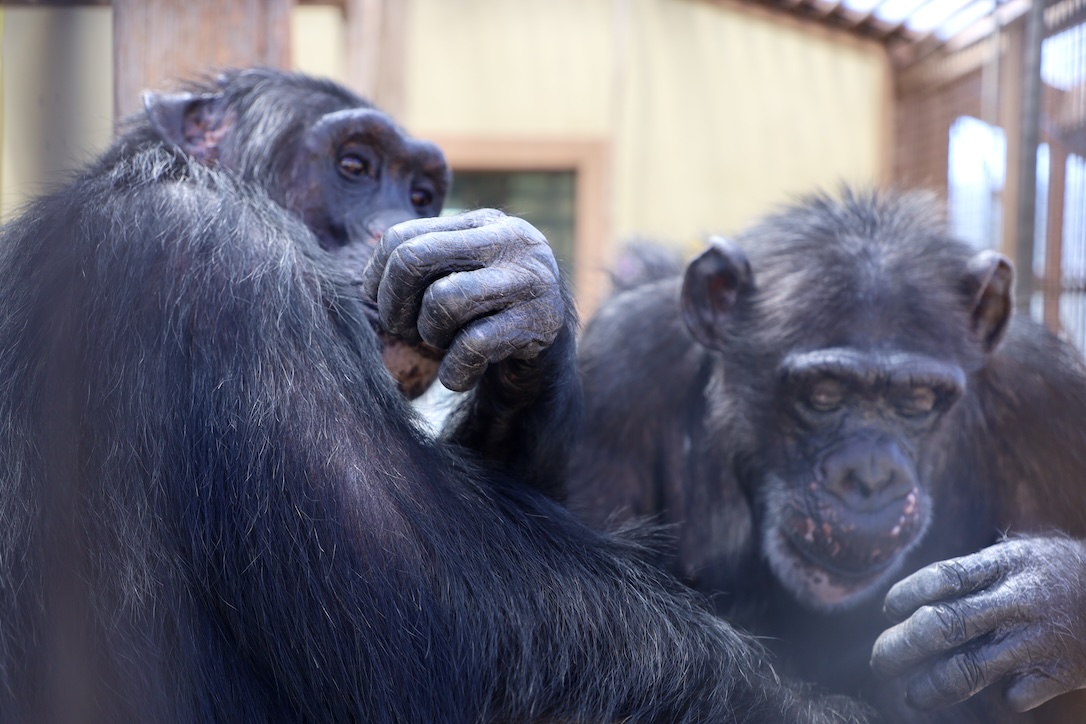
We’ve done our fair share of repairs and amputations here at the sanctuary, beyond those of Burrito and Honey B. One morning, the chimp house was perfectly still until a shriek erupted from Front Room 4. We looked over to see Burrito fleeing and Foxie sitting there in shock, a chunk of her ear laying on the bench beside her.
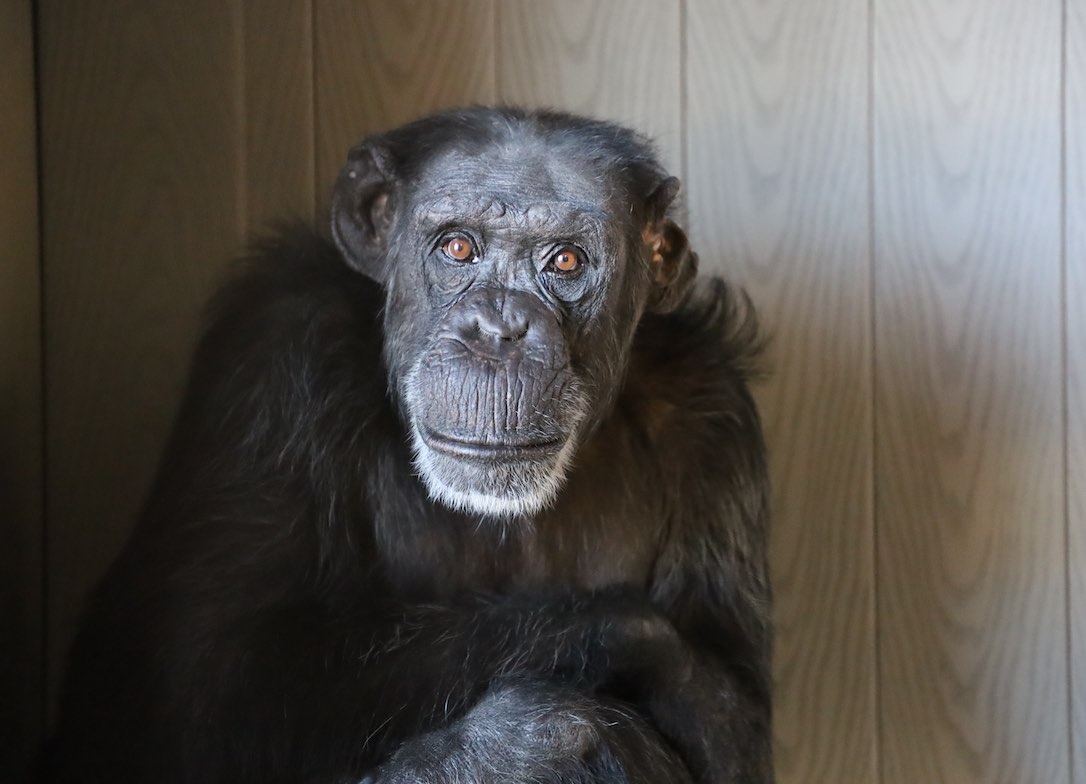
There’s a trap that I try to steer people clear of (and one that I have to try to avoid myself), which is to assume that every action that a chimpanzee takes is part of a grand Machiavellian drama; that each squabble is a deft maneuver towards some strategic aim. Did Burrito bite Foxie’s ear off because he wanted to outrank her? Was he trying to form an alliance with Jamie, who has positioned herself as Foxie’s chief antagonist? Possibly. That kind of thing certainly happens. But again, we have to bear in mind that the algorithm of natural selection has in many cases done most of the calculations for us in advance, and has left us with some rather dumb emotions to carry out all the work. Status might ultimately bring more food and more mating opportunities, but we start fights because we’re pissed. We overcompensate because we’re insecure. We anger others because we are socially inept. We gang up on the weak because we crave power. We ostracize those who are different because we want to belong. In other words, we can describe chimpanzee behavior in terms of ultimate causes, but as socially savvy as chimps are—and they are very savvy—the proximate cause for any given fight or injury is likely that they are bundles of emotions, both noble and ignoble, with the strength of several humans and teeth like railroad spikes.
As for Cy’s finger, I certainly don’t know what happened, but knowing him now, I’d be willing to place a bet: Rayne was going after someone she was mad at and Cy was injured trying to stop the fight. That’s the other thing about chimp fights, at least in captivity—they rarely end as they began and the chimp with the most injuries was probably not involved at the start.





Thank you, J.B., for that informative exposition. Whether it was your intention or not, your posting serves as a supplemental reading to the feature on Jane Goodall in yesterday’s N.Y. Times Sunday Magazine.
Thank you, JB.
Somewhat tangential….where did Honey B rank in the 9? Just looking at the pic, and thinking of how she’s often content to be off on her own, I’m wondering what her rank was….and if it even mattered to her:smile:
Thanks for this insight JB. It goes some way to answering a question I raised some time go when I asked how hierarchy is established in captive chimps. we know how it happens in the wild, but what about in the chimps that have always been in captivity? How did Jamie become the boss lady…..although knowing her as we do, nobody would be foolish enough to challenge her? Cy seems a natural and very successful leader, but if these groups weren’t together previously, how and when was the pecking order worked out? It’s all fascinating stuff, and missing some bits doesn’t seem to bother them.
J.B. this information was very interesting. I watched the series Chimp Empire and they certainly did maim/kill their neighbors, it was quite shocking.
However, it’s been suggested that my BFF, sweet Honey B took part in the partial removal of one of Burrito’s body parts. No, it can’t be true…can it?
Thank you for such an interesting and informative blog post.The caption under Rayne’s photo reminds me of something Frans de Waal said at a primate conference many years ago. He asked the audience what was the difference between chimpanzees and politicians disagreeing. His answer was the Chimps act of reconciliation. Indeed, they can and do have some frightening interactions and then, minus the loss of some flesh, it all is over and in the past. What amazing resilience and reconciliation they possess. We can learn so much from them.
I’ve always agreed with this, more today than ever, although I think the ability of some to work “across the aisle” is what (used to?) define a good politician. I’m clinging to the hope that it could be that way again.
wow! what a blogpost!
I would have never guessed that Cy’s missing digit was courtesy of Rayne! Although chimps can be violent at times, I really admire their ability to reconcile even after pretty intense conflicts. Foxie and Burrito are still good friends and don’t seem to have any hard feelings. I don’t know a lot of humans who would be so magnanimous towards someone who was responsible for the removal of half of their ear.
Ah. Now I understand even better your process with George in particular. Especially when it comes to social skills. Now it’s not George who will be joining Cy’s group. It will be all the others joining Cy’s group, of which George is already a member. Interesting.
Thank you J.B. for taking the time to write this wonderful explanation on aggression. It was so informative.
JB. you’re amazing at writing/conveying.
You could post detailed information like this every week as far as I’m concerned, J.B.! Perhaps your explanation regarding Cy’s missing finger could follow the introduction to Fans de Waal’s book “Chimpanzee Politics”. You have a gift of interpreting what you know so we can all understand. Best part, you sprinkle in your sense of humor. “No regrets” — Rayne. Under that specific photo, too perfect! 🙂 Thanks for your time taken to write this post today.
Fascinating and frightening (chimpanzees scare the heck out of me!) Your knowledge leaves me in awe.
Wow! very interesting and so informative! Thank you, J.B.!
JB–Thanks for sharing so much re: chimp aggresion! You have given us understanding why you take so much time with your introductions!! And as one mentioned we could learn alot from the chimps about even when they are hurt they don’t seem to hold a grudge. Thanks to all those who care for these beautiful chimps!!
I hope JB and Diana wont mind if I post this link here.
It’s a Save the Chimps story. A wonderful story. perfect for the New Year
https://youtu.be/tcKmYmC_fgM?si=utWv9EXsypk6h3Bw
I love that! They won’t mind you posting it. I previously emailed it directly to them myself lol. And everybody I know, of course!
:sweat_smile::sweat_smile:
Wishing you much love in 2026, Paulette!
this somehow ended up in my spam folder! I’m just now seeing this. Thank you, Linda! Much love right back at you! and EVERYONE!