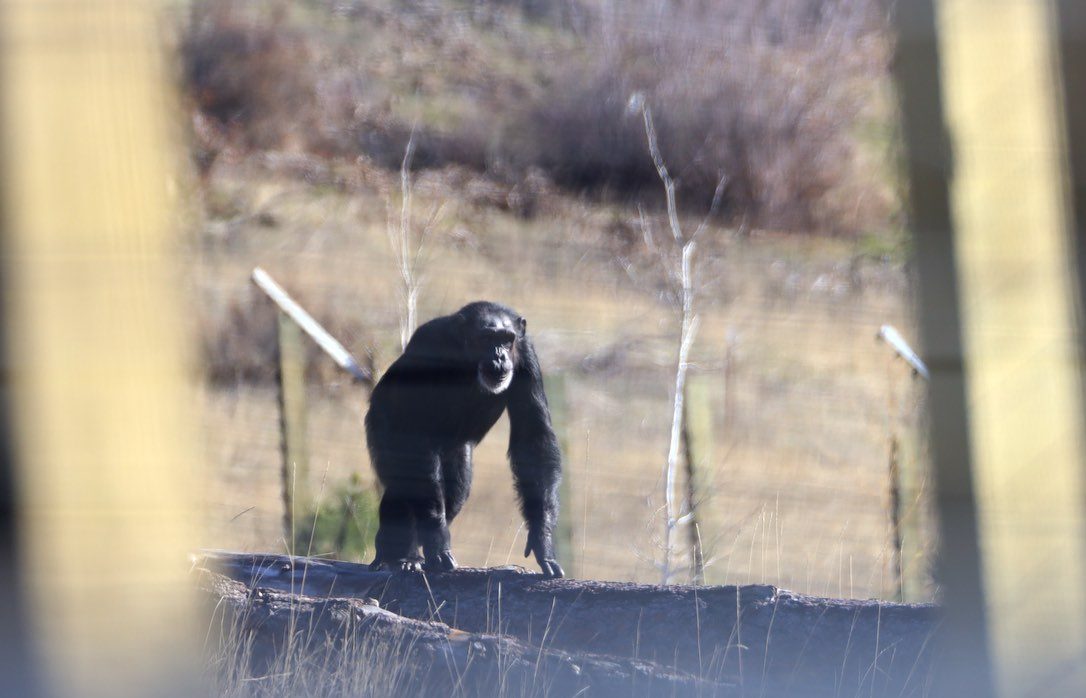
We are ch-ch-chuggin’ along with integrating George into a larger social group. Today marks another milestone in that goal. Rayne has now moved in with George and Cy permanently. This part of the introduction has gone pretty good so far, though it did have some of the challenges mentioned before in other meeting George had with Rayne. There had been some brief conflicts between them, with Cy acting as mediator. The only real time we have seen Cy “take a side” was when George lashed out at Cy for a minute, which really wasn’t taking a side as much as it was defending himself. Chimp politics, amirite?
But since then, the three have made up and we have caught them playing with each other at various points in the day.
What was the miscommunication? I’m not sure, personally, but they know. Which brings up on of the questions we received from last week’s invitation for questions.
One of our long time followers, Kathleen, had asked about my perspective on the role gestural communication plays in this integration process with George. In my view, it plays a pretty significant role.
As you may remember, for most of his life, George has lived with one other female or completely alone. There are several different theories on how gestural communication is acquired, but really they learn it primarily from their mothers and the community they grow up in. And chimpanzees are remarkably resilient in adaptation. When females leave their group when they become of age to bear children, they will adjust the gestures they have learned growing up to match that of the new group that allows them in.
Why females? Chimpanzees in the wild live in a patriarchal society, meaning the males stay in the groups they are born into and the females leave to ensure the gene pool remains diverse enough to successfully reproduce.
One of the things an advisor on my thesis committee told me when I questioned why it’s easier to study the older male population compared to younger chimpanzees or females is because the older males are just that. Stubborn, “not going to change my ways,” old men. So their gestures are going to be the best representative of that group’s gesture repertoire.
That being said though, George is still a vibrant young man and is learning how to communicate with his new friends. This is my own personal opinion and not supported fully by any research, but I believe there is a basic blueprint to some gestures, but how it’s produce and the meaning it takes on is based on the environmental factor. My apologies but I couldn’t find the reference quick enough for this blog, but there is some kind of understanding chimpanzees in accredited zoos tend to understand each other better when they move between the facilities. Unlike those in other captive settings, zoo chimpanzees get to be raised by their mother for the most part. All the behaviors they have learned have been passed down from generation to generation originating initially from a relatively small group of wild caught chimpanzees. Chimpanzees used in the biomedical field had a different type of upbringing.
To me, the biomedical chimpanzees’ situation is very reminiscent of the case if the Nicaraguan deaf children who spontaneously created their own sign language. It’s a fascinating case study I encourage you all to read. If you ever find it, there is also a really fun game called “Sign” that is based on it where you have to create your own gesture communication system with those you’re playing with. But again, it is my own personal theory backed by no formal research that those in a sanctuary setting are kind of piecemealing it together as they go. It is why I believe why there can be those misunderstandings in the beginning of introductions even though to our eyes it doesn’t seem like there isn’t any difference in the gestures they use with each other.
In this little example, you can see Rayne doing her group’s infamous “bunny hop” trying to get George to engage in play. It also seems like George is misreading it as a display so he is displaying back by trying to look bigger and hunching his shoulders over.
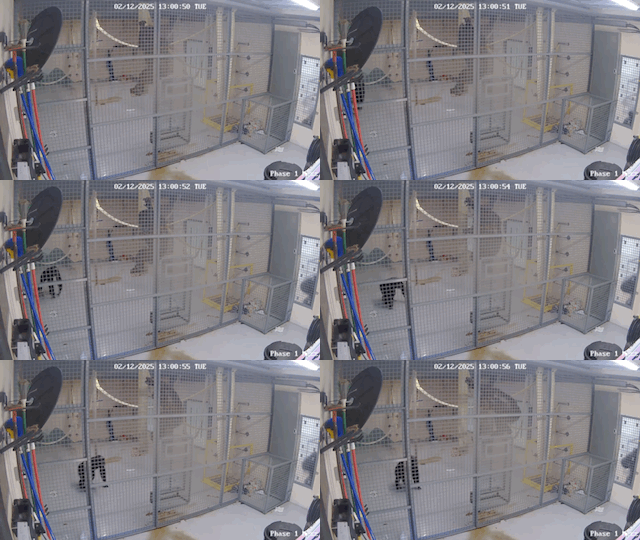
Luckily enough, in this instance, George picked up that Rayne’s intention was non-threatening so he engaged in a game of chase.
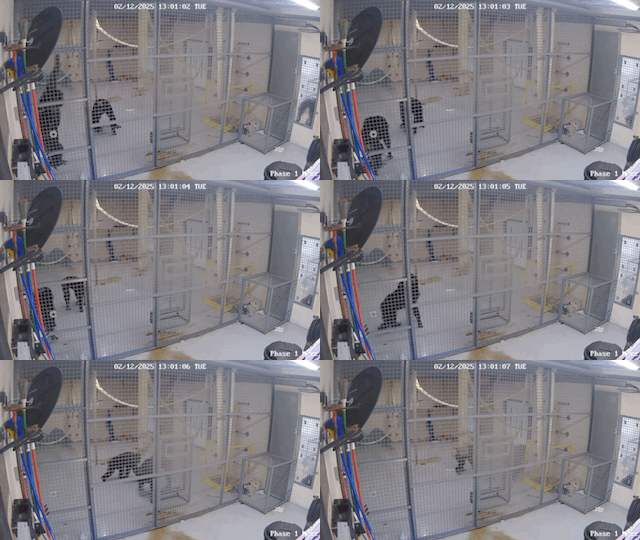
This next little clip is when I interpreted as evidence of George learning and adapting. The little “knocks” you see him doing to get Lucky to play don’t seem like much. If you were to ask any of the caregivers where they have seen this move before, however, there is a high chance they would respond, “Gordo.” That’s an almost exclusive Gordo move. We have not seen George do this until recently and after a recent intro with Gordo.
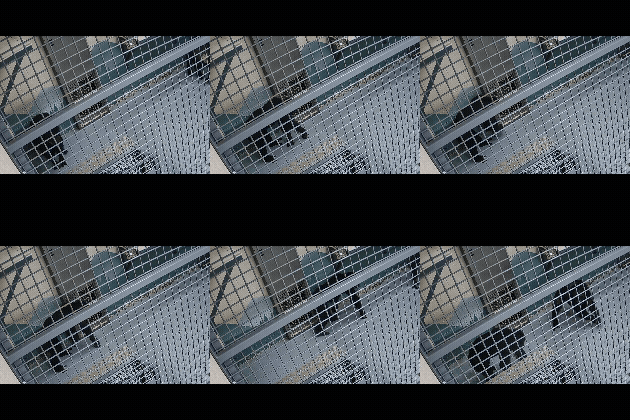
I cannot definitively confirm this because I am not George and can’t tell what he was thinking, but if I had to guess he picked it up to help himself be better understood by Lucky, who lives with Gordo. Again, that is my own guess.
Today is also Giving Tuesday! There is still time to help us reach our goal to help build a new support building for staff to work in! Any little bit gets us closer to helping us fully bring the expansion of our facility to reality!
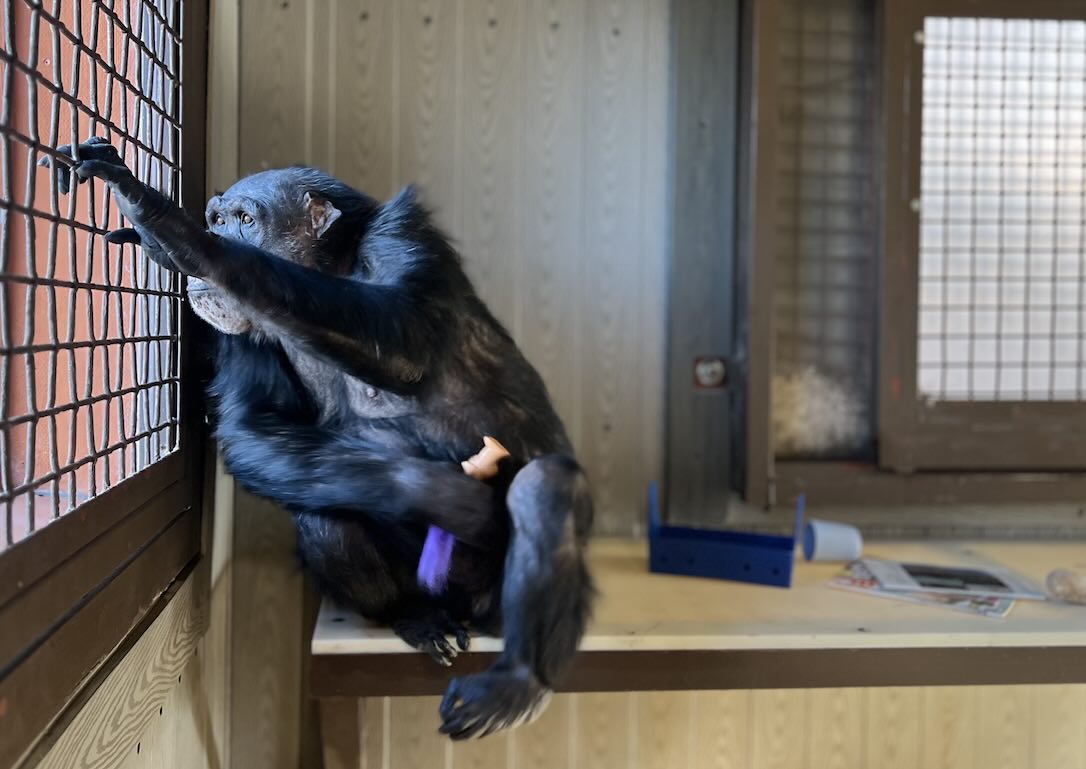
Bonus Photo of Negra coming in for lunch with a purple-haired Troll!





I remember thinking something along these kines, Chad, when you had the first video on the bray with Cy, Rayne, and George. He wanted reassurance/a hug from Rayne, but he had his palm facing up and waggled his fingers, much as humans might do when beckoning someone. Whereas most of the chimps here hold their hand straight and perpendicular to the ground, as if they were going to shake your hand.
George doesn’t know Burrito, but those knocks are currency on the other side, as well.
Good thing George is a fast study!
Btw, it looks like the link to the first pic is broken.
Thank you, Linda! I think I fixed the first pic or I hope I did.
i’ve observed a trpop of zoo chimps who were intrpduced to another troop of zoo chimps. There is a certain amount of posturing and hand gestures as well as vocalizations. I compared it to groups of people each speaking a different language but learning through gestures to express themselves to one another, until each group picks up some of the language of the other. The intelligence of chimpanzees Is amazing and something we can observe and study, but never fully understand since we aren’t chimps.
Thank you, Chad, for sharing what you have observed and learned.
Communication is such a complex thing and it’s something I think about a lot living in a country where the dominant language is not my mother tongue. While there are some universal gestures, there are nuances that are different depending on the society and it can lead to misunderstandings quite easily! I know how confusing and frustrating it might feel for George at times, but I also know he’s proven himself to be an amazingly smart and adaptable guy!
Hi Chad! Thanks for your insight and time spent to enlighten us on gestural communication, especially when it applies to savvy little George. The bounce, the knock! It appears he is a quick study and he’s showing his desire to understand and fit in with his new companions. George seems to take all this newness in stride, even if some of the learning process is hard to grasp. The learning curve of the communication process must be tricky for him. Sometimes emotions are hard to decipher, even for the most social savvy types. I trust Rayne to be a good role model for the female contingency. 🙂
For years I worked with an artist who created products that combined her imagery and words and sentiment. As the company grew, and the products were sold internationally, we needed to have every product translated accordingly. We discovered this was a very difficult task. There is more to language, or should I say communication, than grammar and syntax. There’s colloquialism for one, but what we found to be most challenging was interpreting/expressing the emotions and feelings the artist was trying to convey. And for the artist, the most important message within each product was the sentiment, the emotional value. After failed attempts we caught on and, eventually, found ways to create translations that were not word for word but instead represented the country, or townships, way of communicating. In other words, just like George, we translated by using a “bounce” and a “knock” to ensure our true meaning was understood and in doing so, we finally fit in to different cultures.
I really appreciate and enjoy your insights Chad. As far as I’m concerned your frontline observations and the conclusions/theories you develop are so valuable, to you, the chimpanzees and the other caregivers. But also to those of us who are completely fascinated by these near humans and the situations you as caregiviers (and saints I might add) encounter in doing the absolute BEST things possible to give them sanctuary, safety, home and freedom of choice as well as loads of entertainment/enrichment and yummy food. Thanks to all of you at CSNW!