• Skip to main content
  • Skip to primary sidebar
  • Skip to footer

Chimpanzee Sanctuary Northwest

Hope. Love. Home. Sanctuary

  • Our Family
    • The Chimpanzees
    • The Cattle
  • Blog
  • About Us
    • Visiting the Sanctuary
    • Philosophy
      • FAQs
      • Mission, Vision & Goals
      • Privacy Policy
    • The Humans
      • Staff
      • Board of Directors
      • Founder
    • Annual Reports
    • The Future of CSNW
    • CSNW In The News
  • You can help
    • Donate
      • Become a Chimpanzee Pal
      • Sponsor A Day
      • Transfer Stock
      • Be A Produce Patron
      • Be a Bovine Buddy
      • Give from your IRA
      • Personalized Stones
      • Bring Them Home Campaign
    • Leave A Legacy
    • Employment Opportunities
    • Volunteer
    • See Our Wish List
    • Events
  • Resources
    • About Chimpanzees
    • Enrichment Database
    • Advocacy
      • Advocacy Action Center
      • Apes in Entertainment
        • Trainers
        • Role of the AHA
        • Greeting Cards
      • Chimpanzees as Pets
      • Roadside Zoos
      • Chimpanzees in Biomedical Research
      • Conservation
        • African Apes
        • Orangutans
  • Shop
    • Merchandise Store
  • Contact
  • DONATE NOW

J.B.

The Chimps Aren’t Alright

October 9, 2023 by J.B.

In 2011, primatologists Lucy Birkett and Nicholas Newton-Fisher conducted a study that sought to shed light on a simple yet provocative question: How abnormal is the behavior of captive, zoo-living chimpanzees? I encourage you to read the paper but I’ll spare you the suspense:

Very.

Their treatment of the issue was only slightly more nuanced. Captive chimpanzee behavior is normal, the authors say, in that they display many of the same behaviors as their wild counterparts—behaviors that we refer to as species-typical. As we know, captive chimpanzees tend to run, climb, groom, and use tools, just like wild chimps. The problem is that they also display a wide range of behaviors that are only rarely, if ever, seen in wild chimpanzees, such as hair-plucking, regurgitation and re-ingestion, coprophagy (eating feces), urophagy (drinking urine), pacing, rocking, self-clasping, and self-biting, which are commonly understood to be a reflection of poor welfare at some stage of life, and perhaps even mental illness. After observing the behavior of 40 chimpanzees at six accredited zoos in the U.S. and Europe, the authors came to the conclusion that abnormal behavior was not only present but endemic in these populations, regardless of group size, composition, and housing. Every single chimpanzee subject exhibited at least one abnormal behavior during the study period, with an average repertoire of five abnormal behaviors and an average frequency of once every forty minutes. This, it should be noted, was in contrast to the whopping total of zero instances that they recorded in over 1,023 hours observing wild chimpanzees in Uganda.

Researchers within in the zoo community rejected this characterization. They conducted their own study, which utilized a larger sample size but substituted surveys of zoo staff for direct behavioral observation, and concluded that only 64% of chimpanzees displayed abnormal behavior. And after excluding coprophagy, which some argue can be considered abnormal without necessarily being reflective of poor welfare, the overall prevalence of, shall we say, meaningfully abnormal behavior in their study dropped to a somewhat lower but still shockingly high 48%. As a rebuttal to the use of the term endemic, the paper may have succeeded, but it should provide little consolation.

Why would half or more of all chimpanzees in accredited zoological institutions exhibit abnormal behavior, in such stark contrast to their wild counterparts? Why, in light of decades of rigorous animal welfare science and the best efforts of hundreds upon hundreds of experts, do captive chimpanzees continue to regurgitate and pluck themselves bald?

One thing I discovered shortly after entering this field is that there is little agreement as to what it means for an animal to have a good life. To some, a good life is one in which one’s basic needs are met. As Dr. Dave Hone argues in an article entitled Why Zoos are Good:

…[zoo animals] will not suffer from the threat or stress of predators (and nor will they be killed in a grisly manner or eaten alive) or the irritation and pain of parasites, injuries and illnesses will be treated, they won’t suffer or die of drought or starvation and indeed will get a varied and high-quality diet with all the supplements required. They can be spared bullying or social ostracism or even infanticide by others of their kind, or a lack of a suitable home or environment in which to live. A lot of very nasty things happen to truly ‘wild’ animals that simply don’t happen in good zoos and to cast a life that is ‘free’ as one that is ‘good’ is, I think, an error.

There’s no question that the best zoos attempt to do all of this and more for the chimpanzees in their care. Why, then, does abnormal behavior persist?

The answer is that chimpanzees are more than just bundles of basic needs. They are complex social and emotional beings with highly intelligent and inquisitive minds. Moreover, chimpanzees are adapted to employ these traits in the environments in which their species evolved—a diverse range of environments, it should be said, from rain forest to savanna, which altogether actually have relatively little in common, save for one thing: their complete lack of resemblance to an urban zoo exhibit.

Should we be surprised that animals whose home ranges are measured in square miles in the wild feel frustrated in zoo exhibits? Should we expect animals that evolved dynamic fission-fusion communities of up to 150 individuals to thrive in relatively static groups of a dozen or less? Do we believe that members of a species that exhibits a predictable pattern of migration, in which males remain in their natal communities while females generally emigrate upon reaching adolescence, would not experience prolonged stress when groups are broken up and reorganized in violation of those patterns? This mismatch between the captive environment and the environment in which chimpanzees evolved both denies them the opportunity to express behaviors that are biologically and psychologically fulfilling and introduces stressors for which they have no innate coping mechanisms. And, importantly, it exists to varying degrees in every situation in which chimpanzees live under human care, from laboratory to zoo to sanctuary.

Regarding Dr. Hone’s point, I would never argue that life for wild chimpanzees is perfect. But I don’t think it requires a defense, either. It very well may be nasty, brutish, and short (actually, wild chimpanzees that reach adulthood live nearly as long as captive chimpanzees), but it is theirs, and has been for millions of years. It would be strange, and perhaps too convenient, to think we could improve upon it.

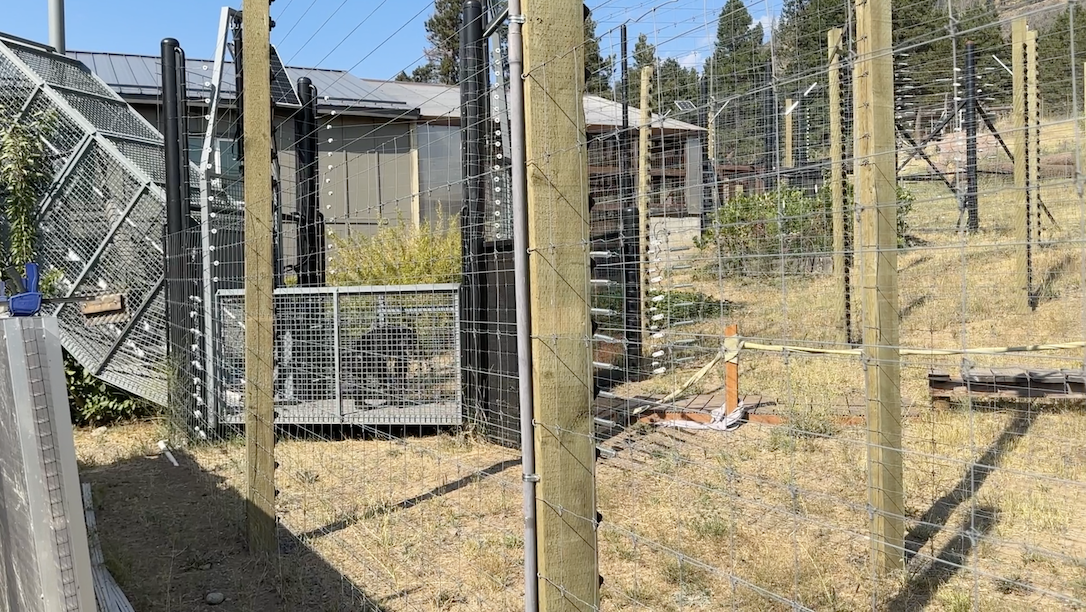
If we accept that all is not well for captive chimpanzees, we must then ask ourselves why we continue to breed them in captivity. I, for one, am not against all forms of captivity, as for the better part of the last 25 years I have worked to keep chimpanzees behind bars and electric fencing. Sanctuaries are necessary for chimpanzees who have been raised in captivity or who cannot be returned to the wild. And in fact many zoos have, to their great credit, provided homes for chimpanzees from laboratories, the pet trade, and various failed and shuttered institutions. But intentionally breeding and keeping animals in a way that denies their autonomy and restricts the full repertoire of their behavior, and which results in the proliferation of myriad abnormal behaviors despite our best efforts to enrich their environments, requires justification or, at the very least, a bit more reflection.

The modern defense of maintaining chimpanzees in zoos rests on two assumptions. The first is that the captive chimpanzee population serves an important role as a reservoir for one day restoring declining wild populations—the ark strategy, if you will. Given what we know about captive chimpanzees’ behavioral abnormalities and the absence of any kind of culturally-transmitted knowledge that would permit them to survive independently, this is unlikely to succeed and is generally accepted as such, even within the zoo community. The second is that zoo chimpanzees help educate the public and inspire support for conservation efforts. For this there is at least a somewhat more robust debate. But even if we were to accept that these benefits could only be achieved by maintaining chimpanzees in exhibits, our rightness in doing so would depend largely on how we measure the costs on the other side of the ledger; namely, those borne by the captive chimpanzees themselves.

The degree to which abnormal behavior correlates to the internal experience of suffering in captive chimpanzees is difficult to define with precision and we must be careful not to lump all abnormal behaviors together as though each is indicative of the same degree of compromised welfare. But the data appear to support what many of us have experienced professionally and what many others know intuitively: The chimps aren’t alright. And the reason for their troubles, it seems, has less to do with the way in which we keep them than with the very fact that we keep them at all. Our society is just now beginning to wrestle with the fact that, at least for some species like elephants and cetaceans, captivity is simply incompatible with good welfare. If we care enough about chimpanzees to conserve their wild populations, it’s time we think critically about the well being of the individuals serving on their behalf.
Filed Under: Advocacy, Chimpanzee Behavior, Sanctuary Tagged With: abnormal, behavior, birkett, captivity, chimpanzee, coprophagy, Enrichment, ethics, newton-fisher, northwest, rescue, ross, Sanctuary, sterotypie, urophagy, zoo, zoos

Claiming the Bray

October 2, 2023 by J.B.

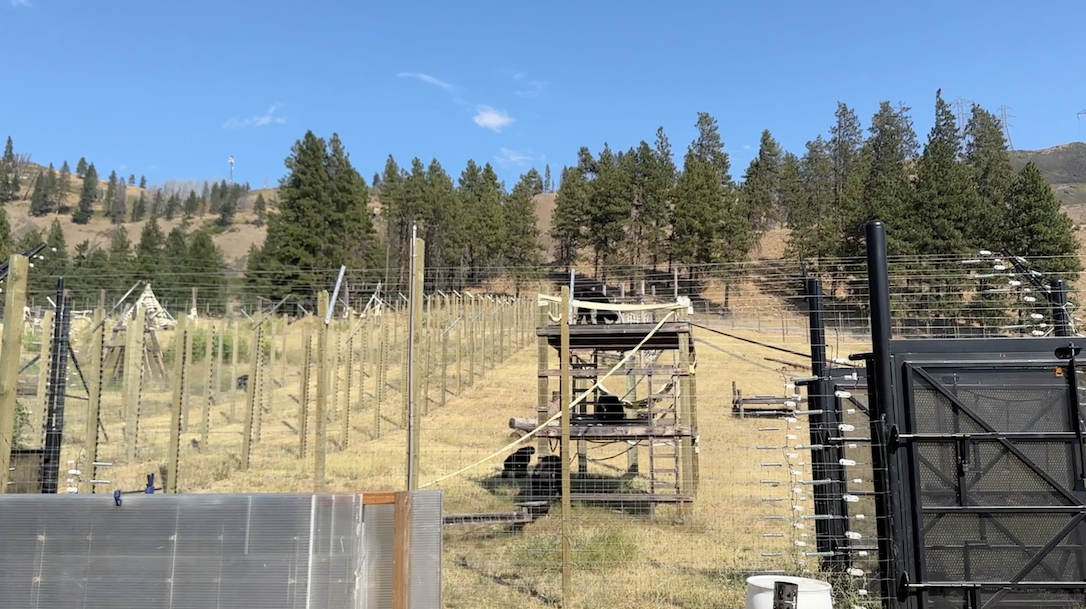
When Jamie’s group first got access to Young’s Hill back in 2011, it was the first time any of them had stepped outdoors in decades. Young’s Hill quickly became a place to tentatively explore, to run, and even, at times, to play. But it would be a while before it truly became their own.

Young’s Hill became their own months later when they began to patrol the fence line early in the morning and at the end of the day. It became their own when they would rush outdoors together any time unfamiliar people or animals entered the property. It became their own when their idea of home finally stretched beyond the walls of the playroom and greenhouse to include the two acres of hillside above the chimp house.

I believe that Cy’s family is just now beginning to claim the Bray as their own.


P.S. Don’t forget about Great Apes Giving Day tomorrow!

P.P.S. Terry is part gorilla! We knew it all along!

Filed Under: Display, Latest Videos, The Bray

Mave’s 34th Birthday Party

September 25, 2023 by J.B.

Mave and her family celebrated her 34th birthday today with a forage that included young coconuts. Initially, Mave did not get her own coconut but after some time foraging her best friend Dora placed an extra one by Mave’s side. Did she mean to offer it to Mave or did she simply not object when Mave picked it up? Either way, Dora is a good friend and it was the perfect gift.

Filed Under: Enrichment, Latest Videos, Mave, Party Tagged With: birthday, chimpanzee, Mave, northwest, Party, rescue, Sanctuary

Play All Day

September 18, 2023 by J.B.

If you hear laughter coming from the chimp house, chances are Burrito is involved.

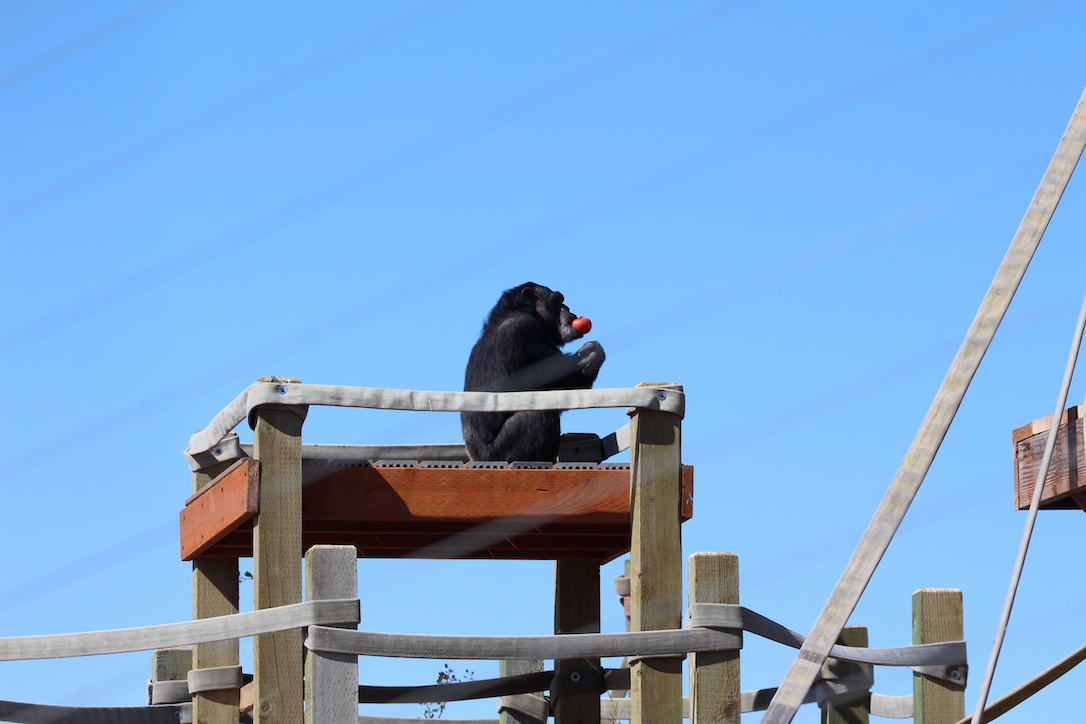
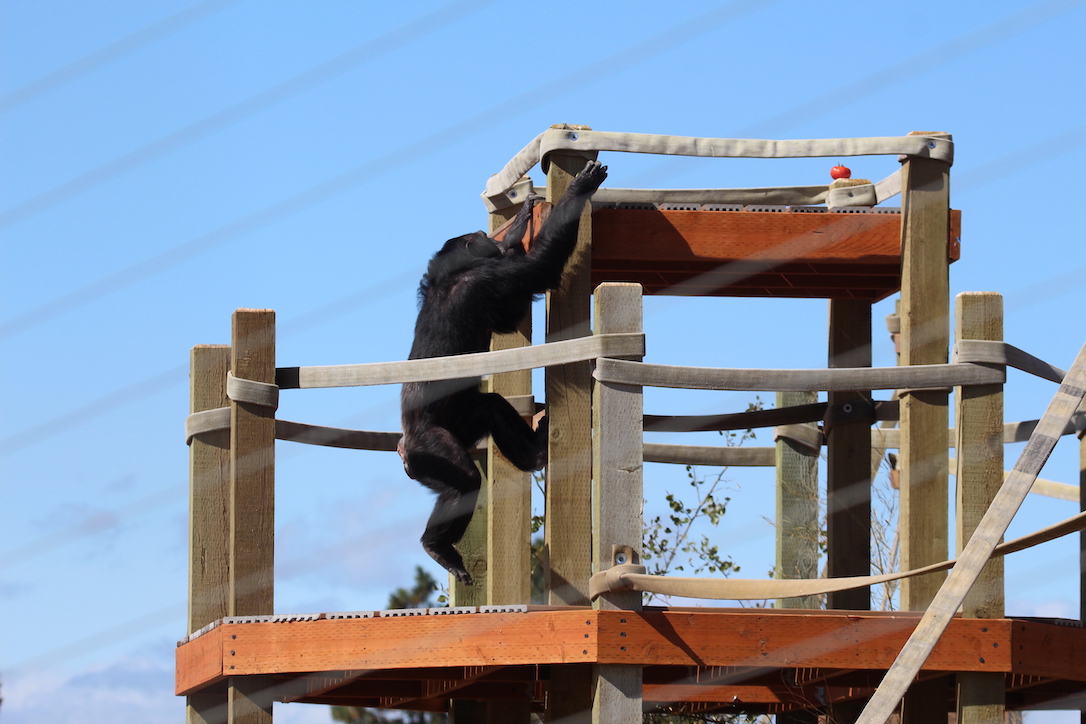
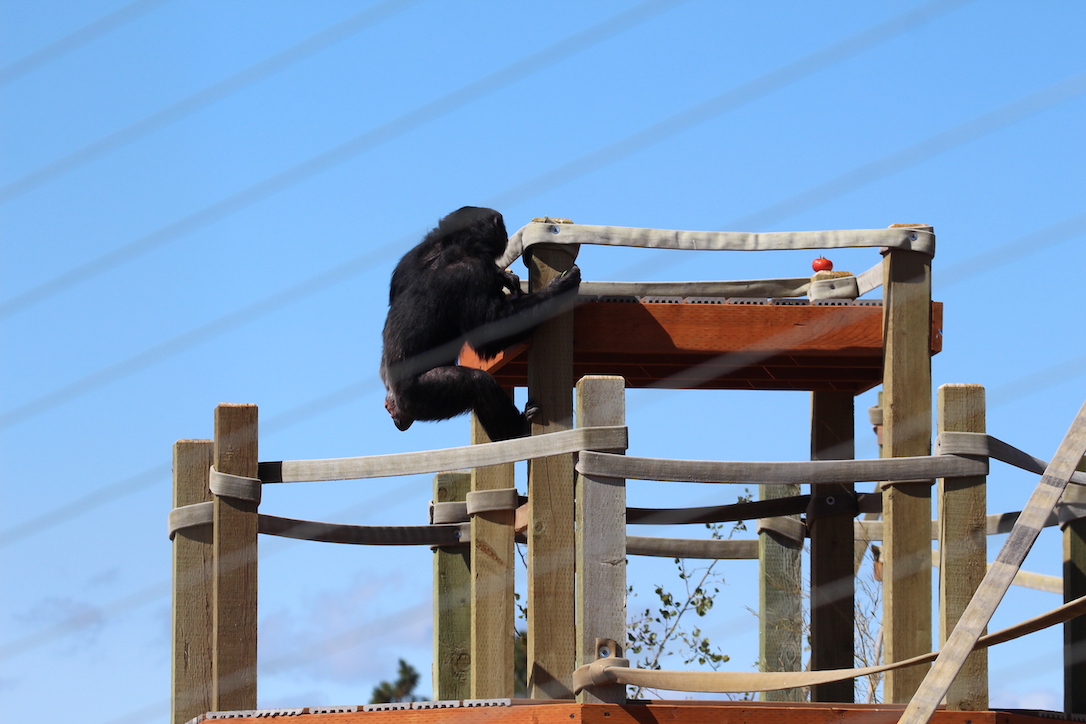
Also – we put out a lunch forage for Cy’s group this afternoon and Chad placed a whole tomato where only the bravest chimpanzee could find it. Look at Lucky go!

Filed Under: Burrito, Forage, Jamie, Lucky, Play, The Bray, Young's Hill Tagged With: chimpanzee, forage, northwest, Play, rescue, Sanctuary

Grooming with Terry

September 11, 2023 by J.B.

Chimpanzee grooming vocalizations fall into a few broad categories. Generally speaking, you’ve got your teeth clackers, your lip smackers, and your raspberry blowers. But within those categories, every chimp’s vocalization is unique. Some are quiet, with the lips just barely touching as if they are whispering. Others are quite loud – I can often hear Willy B’s teeth clacking during the morning grooming sessions through the security camera system audio.

Each chimpanzee has a different style of grooming, as well. Terry likes to do two things: 1) gently brush your skin with his fingers, and 2) try to pull individual hairs out of your arm. Our safety rules prohibit us from allowing the chimps to use two hands while grooming us, so Terry is forced to try to pluck our hairs by grasping them between his index and middle fingers. Luckily for us, it’s not very effective.

For chimps like Terry, grooming seems to be more about spending quality time with chimp and human friends. For Honey B, on the other hand, it’s all about picking scabs and drawing blood. She gets frenzied when she sees something to pick at, and she will continually direct you to turn your arm or present a different body part until she finds something good. I actually feel bad disappointing her when I haven’t injured myself recently. Honey B is the reason why we sometimes turn around and wonder how someone got in a fight without us hearing a sound. Where did all those wounds suddenly come from? Turns out Dr. Honey B was on duty and she opened every nearly-healed scrape and scab on one of her friends!

I wish chimpanzees were always as gentle as Terry is in this video as he tries to shoo away the third wheel at his grooming party.

Filed Under: Chimpanzee Behavior, Grooming, Honey B, Terry Tagged With: chimpanzee, Grooming, noises, northwest, rescue, Sanctuary, vocalizations

Perimeter Patrol Parkour

September 4, 2023 by J.B.

While the caregivers were preparing breakfast, Burrito and his family set out on their first patrol of the day.

Sometimes patrolling is serious business, like when there are strangers on the property or unusual animal noises coming from the hillside above. But most are a more laid back affair, with the object being to enjoy some fresh air, climb as many structures as possible along the way, and, occasionally, grab the feet of the person ahead of you.

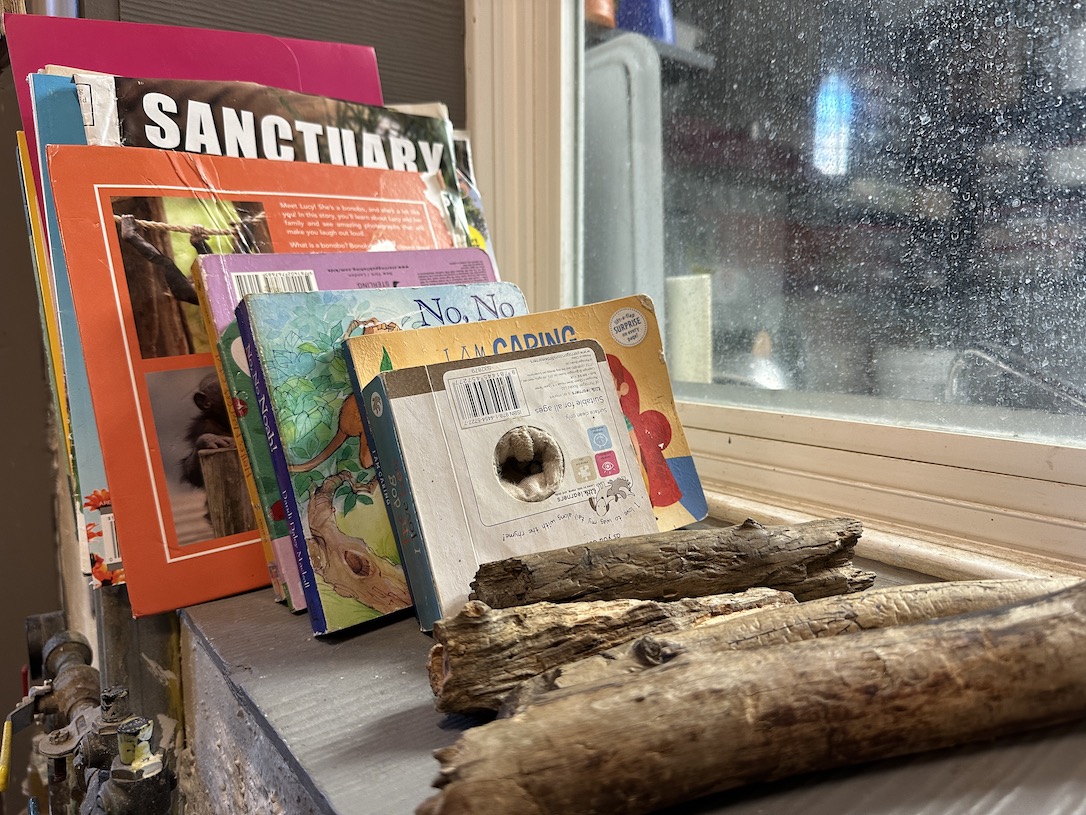
In this video you can see Burrito selecting his stick of the day, which he then carries back with him to the chimp house. I remember working for days to clean up all of the slash debris from the trees we cut down to create the extended fence line. Thank goodness I gave up trying to get it all. Clearly these are some great sticks! Ultimately, these end up along with Jamie’s library of well-worn-but-still-clean-enough-to-keep books on the windowsill between the playroom and the kitchen.

Filed Under: Burrito, Young's Hill Tagged With: Burrito, chimpanzee, northwest, patrol, rescue, Sanctuary, stick

A Natural History of Jerks

August 28, 2023 by J.B.

Male chimps can be jerks. True, females can also be jerks (see: Chimpanzee, Jamie), and not all males are jerks (at least not all of the time). There is an exception to every rule. Nonetheless, it is undeniable that chimpanzee jerkishness has a certain maleness to it, just as chimpanzee maleness contains a certain jerkishness.

But just as not all male chimps are alike, so too is it true that not all jerks are alike. While this is by no means an an exhaustive examination of the topic, here we will distinguish between two types of jerk: Those jerks who wreak havoc blindly, as if possessed, and those who inflict their jerkiness with forethought and intention.

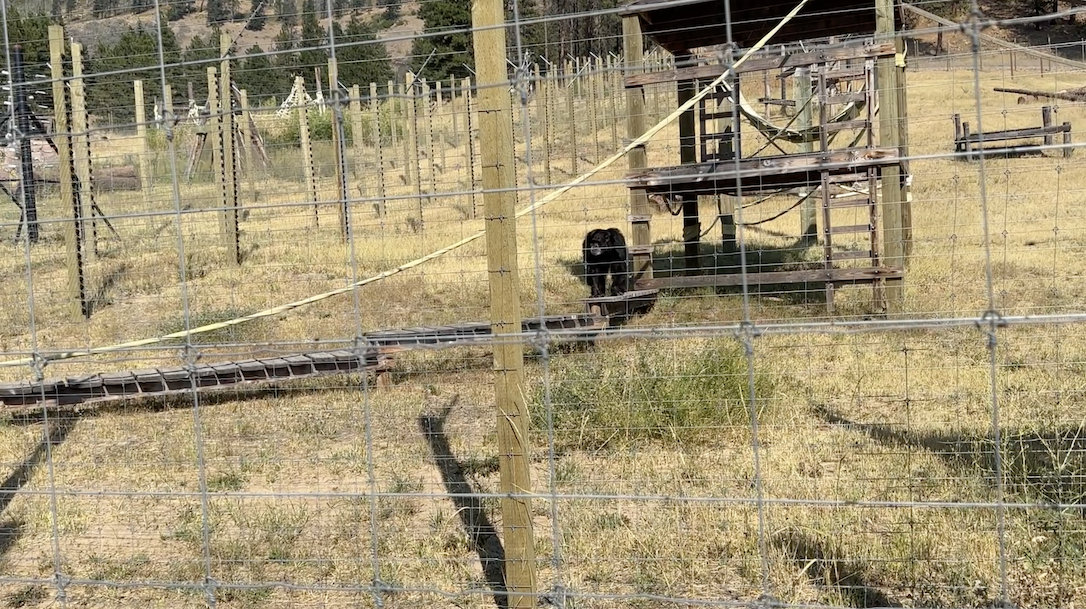
To illustrate the former, let’s turn to our dear friend Willy B. Today I watched him sit peacefully in the shade beneath a climbing structure on the Bray, his 2-acre habitat, surveying the yard for remnants of a the day’s forage. When the forage was finished, he quietly returned to the indoor enclosures. It being mid-afternoon, however, this peaceful Dr. Jekyll was suddenly and inexplicably transmogrified into a raging Mr. Hyde. Apropos of nothing and with no other chimps in sight, he began to bang on the food chute with the back of his wrist. The noise and vibration shattered the calm of the afternoon and soon the others were up from their naps. With hair on end, they circled each other in the confines of the front room area. Some began to pant hoot, which in turn raised the tension in the room even further. Minutes went by. The banging was incessant. Others began to stand bipedally and swagger. Bang, bang, bang. The noise swelled and soon came to fully occupy the space where thoughts would normally occur, making it impossible to do anything but join in the chaos. Bang, bang, bang…

BANG! A fight breaks out. The swirling mass of chimpanzees, now screaming, races from the front rooms through the chute and out to the Bray. Willy B climbs to the top of the tower and, with a fear grimace, watches as the other chimps threaten and hit one another. But he is not angry. Instead, he is scared and confused. Because he is once again Dr. Jekyll, wondering what on earth could have caused such tumult below.

Interestingly, this fight contained within it, and was indeed amplified by, the actions of our second type of jerk. Are you familiar with the admonition, common in both comedy and politics, to never punch down? For male chimpanzees, punching down is not only accepted in certain circumstances but is in fact a right of passage. As Craig Stanford states in The New Chimpanzee,

[Adolescent male chimpanzees] don’t submissively pant grunt to one another, and dominance among them is hard to discern. But once a young male reaches adulthood, he begins to climb to higher rank by taking on and intimidating each adult female. When he has risen in status above the most dominant female, the young male finds himself at the bottom of the male dominance network. Only time and repeated jousts with higher-ranking males will determine his ultimate highest status. (p.42-43)

According to some researchers, adolescent male chimpanzees routinely harass adult females as a low-cost way method of honing their competitive skills before testing them in the much riskier world of male competitive dominance. Gordo is well beyond adolescence, but his actions are often reminiscent of a chimpanzee stuck permanently in the liminal space between the female and male hierarchies. While size does not dictate rank, his more diminutive stature makes it unlikely that would challenge Cy, Terry, or Willy B directly. His social skills are of little help, either. He is able, however, to dominate Honey B. Usually.

As the dust on the Bray began to settle, the chimpanzees worked their way through the chute and back to the greenhouse. The screams had subsided and all that remained was Honey B’s diminishing whimper. This, thought Gordo, was the perfect time to assert himself. As she approached him, he hit her across the back and ran straight back to the Bray, knowing that she was afraid of the outdoors and wouldn’t have the courage to follow him.

He reached the platform and turned to watch Honey B screaming at him helplessly from the end of the chute.

Is it any less indecent for Willy B to cause daily disruptions to the harmony of the group simply because they are born out of blind rage and not malice? I make no claims as to the relative moral status of these two varieties of jerkishness. Nor, again, do I intend to cast all males as irredeemably jerkish. But in my experience, they do seem on average to contain each type of jerkishness in greater proportion than their female counterparts.

And as to whether these same tendencies prevail in my own species, I claim ignorance.

Filed Under: Chimpanzee Behavior, Gordo, Willy B Tagged With: aggression, behavior, chimpanzee, jerk, northwest, rescue, Sanctuary

  • « Go to Previous Page
  • Page 1
  • Interim pages omitted …
  • Page 17
  • Page 18
  • Page 19
  • Page 20
  • Page 21
  • Interim pages omitted …
  • Page 134
  • Go to Next Page »

Primary Sidebar

Subscribe To the Blog and Get Notified of New Posts First!

Archives

Calendar of Blog Posts

June 2026
S M T W T F S
 123456
78910111213
14151617181920
21222324252627
282930  
« May    

Categories

SUBSCRIBE TO OUR NEWSLETTER

Footer

PO Box 952
Cle Elum, WA 98922
[email protected]
509-699-0728
501c3 registered charity
EIN: 68-0552915

Official DDAF Grantee

Menu

  • The Chimpanzees
  • Blog
  • About Us
  • You can help
  • Resources
  • Contact
  • Donate

Proud Member of

Connect With Us

Search

Copyright © 2026 Chimpanzee Sanctuary Northwest. All Rights Reserved. Site by Vegan Web Design